
Culture-driven team building is the practice of choosing team-building activities based on the behaviors and values you want your culture to show, instead of picking an event first and hoping culture improves. The culture sets the brief. An escape room, a volunteer day, or a weekly retrospective only counts when it rehearses something specific, such as trust, candor, or asking for help, and when the team connects it back to daily work.
This article explains why that approach outperforms one-off fun events and walks through a step-by-step method you can start this week. It also maps common culture values to specific activities and shows how to tell whether the effort is working. The method suits in-office, hybrid, and remote teams, and most of it costs nothing.
Robyn Benincasa is a keynote speaker, a former world champion adventure racer, and a former San Diego firefighter. She has spent two decades working with Fortune 1000 organizations on how teams win together. The guidance below comes from that team-first view of culture.
Why culture-driven team building matters
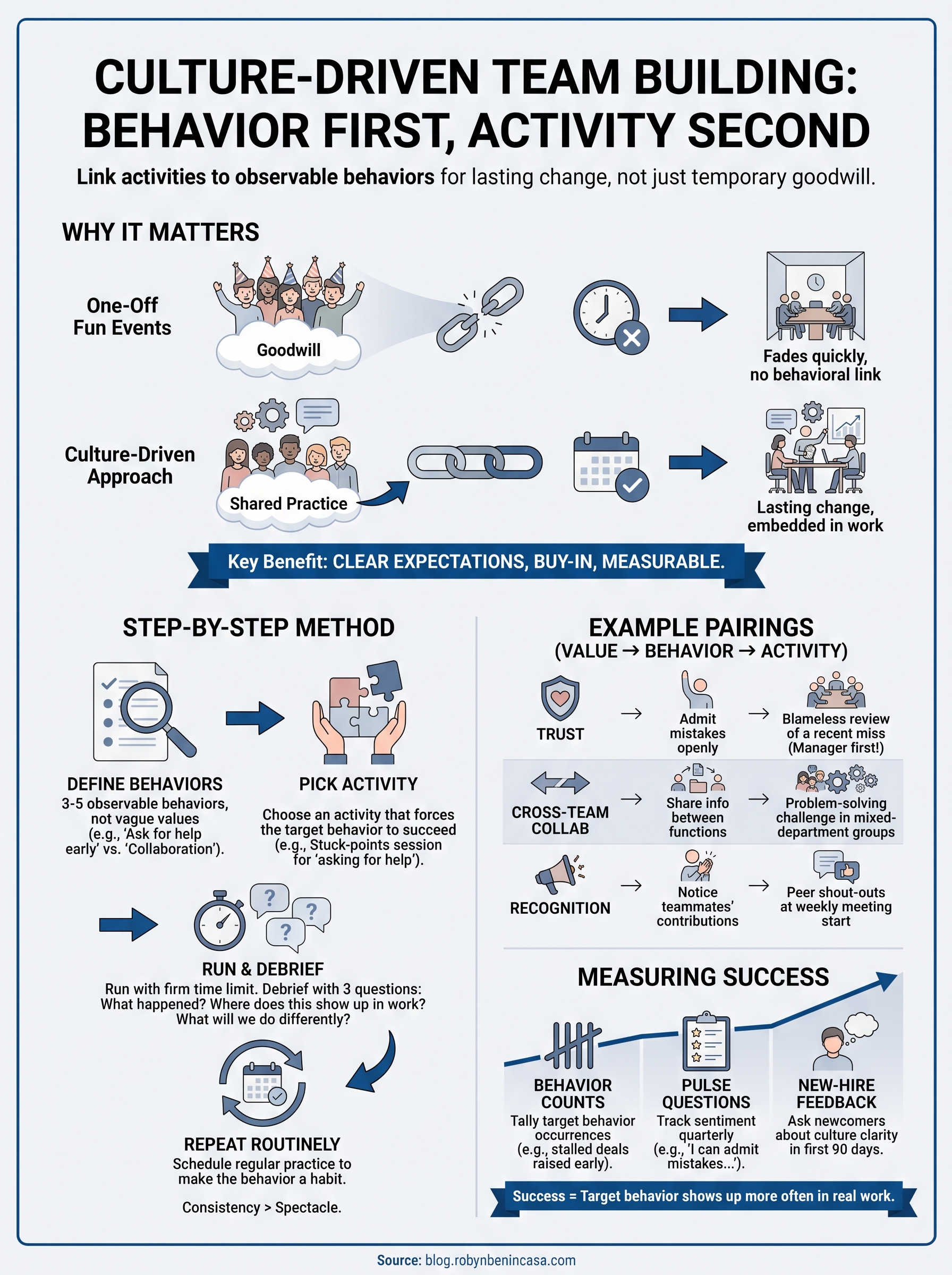
It matters because it turns a short-lived good mood into a lasting change in how people work together. Events chosen for fun create goodwill that fades within days if nothing at work reinforces it. Events chosen for culture give the team a shared practice to repeat.
Why one-off events fade
A paintball afternoon or a catered offsite feels good, but it rarely changes what happens in Monday’s meeting. People return to the same habits, the same silos, and the same unspoken rules. The event had no link to behavior, so there was nothing to carry forward.
Culture-driven team building closes that gap. You decide first what people should do differently, such as raise problems early or share credit, and you design the activity to practice exactly that. The debrief is where the learning transfers, because the team names where the behavior applies to real work.
An activity changes culture only when the team can say what it practiced and where it will use it on Monday.
What you gain when culture leads
Starting from behaviors gives you several practical advantages over activity-first planning:
- Buy-in from skeptics. People who dislike forced fun will join something that has a clear purpose.
- Clearer expectations for new hires. Named behaviors tell newcomers how the team works.
- Easier measurement. You can watch whether the target behavior shows up more often.
- Fewer wasted events. If an activity does not serve a named behavior, you skip it.
How to do culture-driven team building step by step
Start by defining the culture in behaviors people can see, then pick an activity that forces one of them, run it, and debrief it. Repeat on a schedule so the behavior becomes routine.
Start with behaviors you can observe
Values like "transparency" or "ownership" are too abstract to practice. Translate each one into something a colleague could watch happen. Pick three to five behaviors, not ten, so the team can remember them.
- Vague: "We value collaboration."
- Observable: "When we are stuck for more than a day, we ask a teammate."
- Vague: "We value accountability."
- Observable: "We flag a missed deadline before it is due, not after."
Run the activity, then debrief
Use the same five steps for any activity, from a 10-minute check-in to a half-day challenge:
- Pick one target behavior.
- Choose an activity that makes that behavior necessary to succeed.
- Tell the team in one sentence why you are doing it.
- Run it with a firm time limit.
- Debrief with three questions: What happened? Where does this show up in our real work? What will we do differently this week?
Never skip the debrief. It takes 10 to 15 minutes and carries most of the value.
Worked example: a 12-person sales team
Say deals on this team stall because people hide problems until the monthly review. The target behavior is "ask for help early." The team runs a weekly 30-minute stuck-points session. Each person names one deal or task where they are stuck, and a teammate offers one next step. That costs 6 person-hours a week (12 people at 30 minutes) and no money.

Once a quarter, the team adds a 90-minute challenge where each person holds only part of the information and the group must share it to finish. The debrief asks when they last withheld information on a live deal. After eight weeks, count how many stalled deals surfaced before the monthly review. That number tells you whether the culture is moving.
An outside voice can help the team agree on a shared language first. Robyn Benincasa’s Extreme T.E.A.M.W.O.R.K. keynote runs 45 to 60 minutes and teaches the 8 elements of a winning culture. It is based on her New York Times bestseller Make Winning Inevitable. A keynote starts the conversation, and the weekly practice sustains it.
Culture-driven team building activities by value
Match each culture value to an activity that forces the matching behavior. The table below gives six pairings, with suggested durations you can adjust to your team.
Matching activities to values
| Culture value | Behavior to build | Activity | Suggested time |
|---|---|---|---|
| Trust | Admit mistakes openly | Blameless review of a recent miss, led by the manager first | 45 min |
| Cross-team collaboration | Share information between functions | Problem-solving challenge in mixed-department groups | 90 min |
| Recognition | Notice teammates’ contributions | Peer shout-outs at the start of the weekly meeting | 5 min |
| Resilience | Stay constructive under pressure | Hard but achievable group challenge, then a debrief on how people reacted | 60 min |
| Transparency | Share bad news early | "What is at risk this week?" round in the standup | 10 min |
| Belonging | Know colleagues beyond their roles | Paired storytelling: "a moment that shaped how I work" | 20 min |

Notice that the manager goes first in the trust activity. Leaders set the risk level for everyone else. If the manager admits a mistake, others follow. If the manager stays silent, the exercise turns into theater.
Pick the behavior first and the activity second, and the table does the rest.
Adapting for remote teams and tight budgets
Every activity in the table costs nothing. For remote teams, run them on video with a shared document for notes, and move recognition into a dedicated chat channel so it works across time zones. Keep video sessions short, because attention drops faster on a screen than in a room.
Budget is rarely the constraint. Consistency matters more than spectacle. A 10-minute ritual repeated every week shapes culture more than a yearly offsite.
How to tell if it is working
Culture-driven team building is working when the target behavior shows up more often in real work, not when people say the event was fun. Measure the behavior directly and review it on a schedule.
Track behavior, not smiles
Use three signals, and review them every quarter:
- Behavior counts. Tally how often the target behavior appears, such as stalled deals raised early or missed deadlines flagged in advance.
- Pulse questions. Ask the same two or three questions each quarter, such as "I can admit a mistake on this team without penalty," on a 1 to 5 scale.
- New-hire feedback. Ask people in their first 90 days how clearly they understand how the team works.
A rising trend across all three beats any single survey. Look at direction over time, since one quarter’s number says little by itself.
Common mistakes to avoid
Most failures come from the same few errors. Mandatory fun breeds resentment, so keep activities purposeful and short. Skipping the debrief turns an exercise into entertainment. Exempting leaders signals that the culture applies to everyone but them. Naming too many values leaves nobody able to remember them. And stopping after one event returns the team to its old habits within weeks.
Culture shifts through repetition, so schedule the practice before you schedule the party.
Make the culture the brief
Culture-driven team building starts with one question: what should people do differently? Name three to five observable behaviors, choose activities that force them, debrief every time, and track whether the behavior grows. That discipline separates a team that had a nice afternoon from a team that actually works differently.
You can begin with a 10-minute ritual this week. If you want an outside voice to help your team agree on what a winning culture looks like, explore Robyn Benincasa’s team culture keynotes and resources.