The best culture team building activities change how people treat each other on an ordinary Tuesday, not just how they feel at an offsite. Pick an activity that targets one specific culture gap, repeat it on a schedule, and have leaders take part. A keynote suits leaders who need a shared language fast. A values workshop suits teams with unclear norms. Check-ins and recognition rituals suit remote teams. A cross-team swap suits siloed departments.
Most lists of team-building ideas hand you games and leave the culture question unanswered. You get a fun hour, then the same silos, the same quiet meetings, and the same unspoken rules the following Monday. Culture shifts when behavior shifts, and behavior shifts through repeated experiences with a clear purpose.
This article gives you eight activities that work for remote, hybrid, and in-office teams. Each one comes with steps, a fit guide, and what to expect. The lessons draw on the work of Robyn Benincasa, a world champion adventure racer and longtime San Diego firefighter who speaks to organizations about building winning team cultures. A final section shows you how to choose and how to make the effort last.
1. Culture keynote with team follow-up
A keynote is the fastest way to give a whole group the same vocabulary for culture, especially after a merger, a reorganization, or a rough year. Robyn Benincasa’s Extreme T.E.A.M.W.O.R.K. keynote does this in 45 to 60 minutes.
How to run it
The talk teaches the 8 elements of a winning culture, drawn from her New York Times bestseller Make Winning Inevitable. It uses storytelling and video of ordinary people achieving extraordinary things together. The keynote is the spark, and your follow-up decides whether anything changes.
- Book the keynote for an all-hands meeting, kickoff, or leadership offsite, in person or virtual.
- Right afterward, split into groups of four to six. Ask which of the 8 elements is strongest on your team and which is weakest.
- Have each group commit to one visible behavior change for 30 days.
- Put the commitments on the agenda of your next monthly meeting and report back.
A keynote starts the conversation about culture, and the follow-up groups are where it turns into behavior.
Best for
Use this when your group is too large for small-circle exercises, or when the culture needs a visible reset from leadership. Match the talk to your situation. Adapt, Overcome, and Win as One fits AI transformation, industry disruption, and culture resets. Inspiring Greatness through G.R.I.T. fits teams facing adversity or stretch goals. Why Winners Win (30 to 60 minutes) fits sales meetings and revenue kickoffs.
Remote teams can run it virtually. Keep cameras on for the small-group discussion that follows, because the talk alone will not shift habits. To ask about availability, email bookrobyn@worldclassteams.com.
2. Team values and ground rules workshop
A values workshop turns vague culture talk into written agreements your team can hold each other to. Plan 60 to 90 minutes, and end with four or five values, each tied to a behavior you can observe.
How to run it
Start with three questions: What do we really care about in doing our job? What does success mean for this team? What actions would show we live those values? Silent writing first keeps the loudest voices from steering the room.
- Everyone writes answers alone for five minutes.
- Cluster the answers on a shared whiteboard or document.
- Vote the clusters down to four or five values.
- Write one observable behavior under each, such as "we raise disagreement in the meeting, not afterward."
- Review the list every quarter and cut any value nobody can name.
A value without a behavior beside it is a poster, and a behavior is something your team can actually hold each other to.
Best for
New teams, merged teams, and new managers get the most from this. It also helps when two groups carry different habits into one department. Watch for false agreement. If everyone nods too quickly, ask individuals what worries them about the proposed rules.
Remote teams can run it in a shared document with breakout rooms of three or four. Rotate who reports back from each room so the quieter people speak.
3. Weekly roses and thorns check-in
A five-minute check-in builds trust faster than most events because it repeats. Each person shares a rose (something good) and a thorn (something hard), once a week, in the same slot.

How to run it
Keep the format fixed so it stays easy. Add a "bud," something people look forward to, if you want a lighter tone.
- Open the weekly team meeting with the check-in, before any status updates.
- The leader goes first and shares a real thorn, not a disguised brag.
- Nobody fixes or debates. The only response is "thanks for sharing," unless the person asks for help.
- Rotate the facilitator every week so it belongs to the team.
Trust grows when the leader shares a real difficulty first and nobody rushes to fix it.
Best for
Remote and hybrid teams benefit most, because they lack the hallway chats where this information normally surfaces. It works equally well in an office as a stand-up opener.
For teams across time zones, run it asynchronously in a dedicated chat channel and let people reply during the day. The ritual dies the first time a leader reacts defensively to a thorn, so decide ahead of time how you will respond.
4. Cross-team shadow swap
A shadow swap breaks silos by putting people inside another function’s day. Pair colleagues from different teams for two to three hours, and each learns what the other’s work actually involves.
How to run it
Pairing sales with operations, or engineering with customer support, tends to produce the sharpest insights. Prepare people so the time is not wasted.
- Pair people from teams that hand work to each other.
- Each person prepares three questions about the other’s work.
- The observer watches, asks questions, and holds back on advice.
- Hold a 20-minute debrief with two prompts: "One thing I did not know" and "One change I will make in how I hand work to you."
Most silos persist because people never see how their handoffs land on the other side.
Best for
Use it for departments that blame each other, for onboarding new hires, and after reorganizations. Remote pairs can share a screen while one person does real work and narrates it.
Expect awkwardness in the first ten minutes and useful honesty after that. Collect the "changes I will make" in one document, and ask leaders to review it a month later.
5. Specific peer recognition ritual
A recognition ritual makes the behaviors you want visible and repeatable. The rule is simple: name the person, say what they did, and say who it helped. Five minutes a week is enough.
How to run it
Vague praise like "great job" teaches nothing. Specific praise tells everyone what good looks like on this team.
- Pick a fixed slot, such as the last five minutes of the weekly meeting or a standing chat thread.
- Require the three parts: who, what, and impact.
- Have the leader model it for the first three weeks.
- Review monthly who has been recognized, and make sure it spreads across roles and levels, not just top performers.
Specific thanks teach the team what good looks like, which a vague "great job" never does.
Best for
This suits teams where good work goes unnoticed, and remote teams where effort is invisible. Peer-to-peer recognition tends to work better than a monthly prize chosen by management, because a single winner can breed competition instead of teamwork.
In offices, a physical card or whiteboard works. Remote teams do well with a dedicated channel. Keep it voluntary and never turn it into a quota that people satisfy with filler.
6. Team problem-solving challenge
A problem-solving challenge gives mixed teams a real friction point to fix together. Run it for 90 minutes to half a day, then commit to acting on at least one idea.
How to run it
Choose a genuine problem, such as slow handoffs, a confusing onboarding process, or a recurring customer complaint. Adventure racing teams cross the finish line together, so the pace of the whole group matters more than any one star. Build the same rule into the exercise: every team member presents or contributes.
- Form mixed teams of four or five from different functions.
- Give each team the same problem statement and a time limit.
- Each team presents its fix in three minutes.
- Leaders pick at least one idea and name an owner and a date within 30 days.
A challenge only builds culture when leaders act on the winning idea, because ignored ideas create cynicism.
Best for
Mid-size and cross-functional groups gain the most, particularly when teams have stopped believing their input matters. Remote teams can use breakout rooms and a shared document for each group.
The commitment to act is non-negotiable. If nothing changes afterward, people read the event as theater and join the next one with their guard up.
7. Group volunteer day
A volunteer day builds culture through shared purpose and shared effort outside normal roles. Give people a half day and a cause they chose, and mix groups across levels.

How to run it
Let employees nominate the cause, which builds ownership before the day starts. Mixing levels matters, because a manager sorting donations next to a new hire resets how they talk afterward.
- Collect nominations and vote on one or two causes.
- Form groups of four to eight, mixed across departments and levels.
- Volunteer for the half day.
- Spend 15 minutes afterward on one question: "What did we notice about how we worked together?"
- Share stories in your next all-hands.
Working side by side on something that is not your job shows people how colleagues behave outside their usual roles.
Best for
Larger teams and in-office groups benefit most, especially where levels rarely mix. Choose activities with physical accessibility in mind so no one sits out.
Remote teams can volunteer skills instead, such as helping a nonprofit with a website review or mentoring. The reflection question matters more than the task, so do not skip it.
8. After-action review
An after-action review is a 30-minute debrief after a project, launch, or incident that turns experience into learning. Fire crews and military units use the format because it separates what happened from who is at fault.
How to run it
The power is in the four fixed questions and the no-blame rule. Hold the review within a week of the event, while memories are fresh.
- What did we set out to do?
- What actually happened?
- Why was there a gap between the two?
- What will we do differently next time, and who owns each change?
The leader speaks last, so they do not anchor the discussion. Record the answers in a shared document that the whole team can read.
Teams that review without blame learn faster because people stop hiding mistakes.
Best for
Use it for high-pressure teams, after launches, and wherever the same mistakes keep repeating. It works well in sales, operations, and project teams.
Remote groups run it on video with a shared document for live notes. If people stay silent, ask each person to write one answer privately before anyone speaks.
How to choose and sustain your culture activities
Choose by the culture problem you are trying to solve, not by what looks fun. Start with one activity per problem, then add a recurring ritual so the effort outlasts the event.
Match the activity to your culture problem
Use this table to find your starting point. Every option can run remotely with the adjustments above.
| Culture problem | Start with | Time needed |
|---|---|---|
| No shared language after a change | 1. Culture keynote | 45–60 min |
| Unclear norms or merged teams | 2. Values workshop | 60–90 min |
| Low trust, quiet meetings | 3. Roses and thorns | 5 min weekly |
| Silos between departments | 4. Shadow swap | 2–3 hours |
| Good work goes unnoticed | 5. Recognition ritual | 5 min weekly |
| Cynicism about process | 6. Problem-solving challenge | 90 min to half day |
| Levels and functions never mix | 7. Volunteer day | Half day |
| Repeated mistakes or blame | 8. After-action review | 30 min per project |
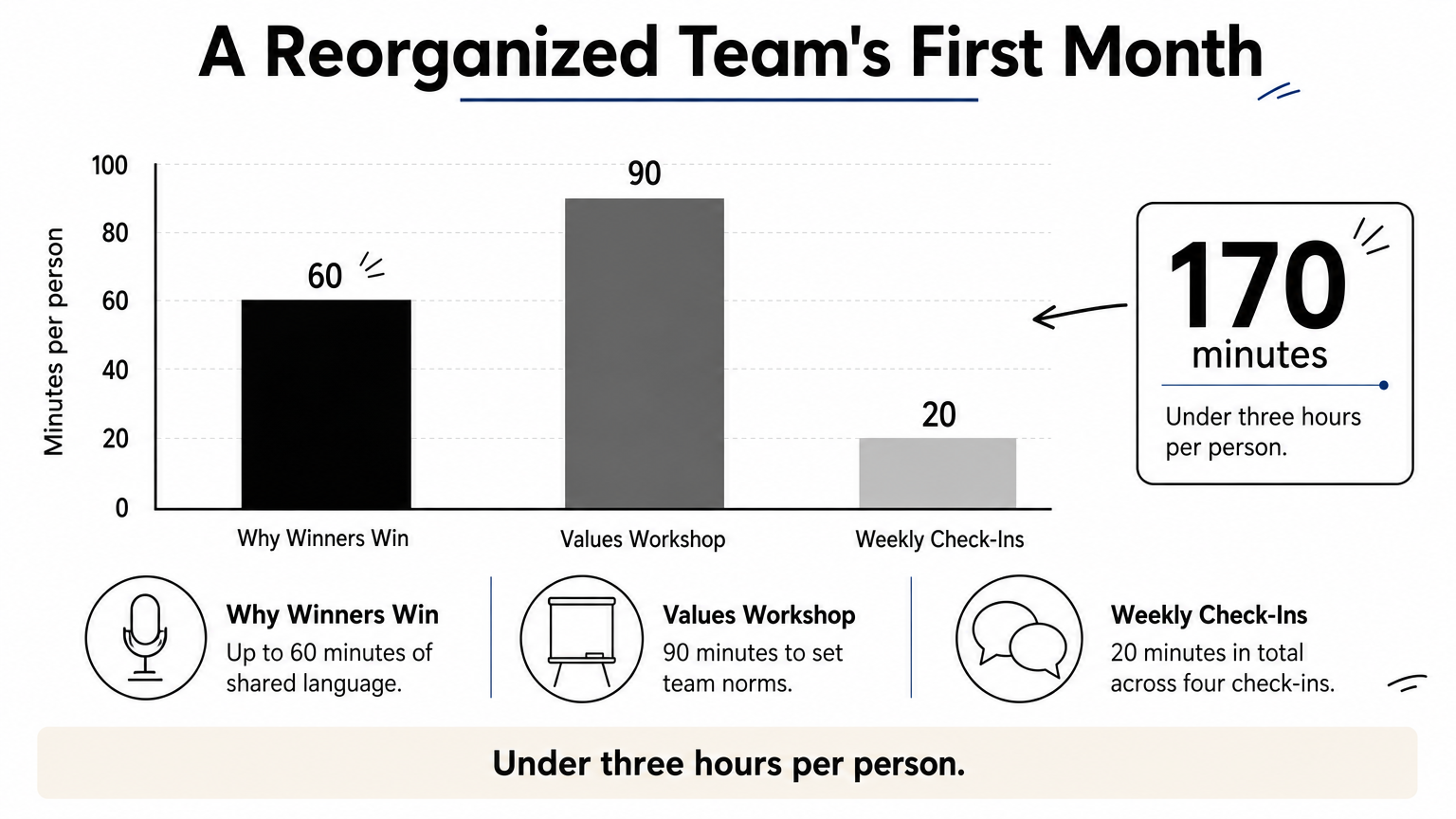
Here is a worked example. A 40-person hybrid sales team has just been reorganized. In the first month, it holds a Why Winners Win keynote (up to 60 minutes), a values workshop (90 minutes), and four weekly check-ins (20 minutes in total). That adds up to 170 minutes, under three hours per person, and it covers shared language, norms, and trust.
Make culture change stick
Run small rituals weekly, a larger activity once or twice a quarter, and a big reset such as a keynote about once a year. Frequency matters more than size, because culture is built by what happens repeatedly. Leaders must participate, not observe. A team will copy what the leader does, not what the leader says.
Track a few signals rather than a long survey: how many people speak in meetings, how smoothly work moves between teams, and voluntary turnover. Add one pulse question each quarter, such as "Do you feel comfortable disagreeing with a decision?" Choose formats that everyone can join, including quieter people, who often prefer writing first, and people who need accessible venues. Pair each activity with one area you want to strengthen, such as purpose, trust, communication, recognition, or learning, and review progress every quarter.
Pick one activity and start this month
Culture team building works when each activity targets a real gap, repeats on a schedule, and involves the leaders. Values workshops and check-ins give you norms and trust. Swaps, challenges, and volunteer days connect people across silos. Recognition rituals and after-action reviews keep good behavior visible and mistakes useful. A keynote can set the shared language that all of it builds on.
Choose the one problem that hurts most, run the matching activity, and set a date to review what changed. If you want a keynote to open the conversation with your whole team, explore Robyn Benincasa’s team culture resources and see which talk fits your situation.