To learn how to introduce speakers at an event, follow one pattern. Collect a current bio and the correct pronunciation of the name. Build a 60 to 90 second introduction around why this speaker, why this topic, and why this audience. Then rehearse it aloud and say the speaker’s name last. Skip the full résumé. Give the audience a reason to listen and give the speaker a warm start.
Most introductions go wrong in one of two ways. The host reads a long list of degrees and job titles while the room checks their phones, or the host wings it, rambles, and stumbles over the name. Either way, the speaker walks on stage with less goodwill than they deserve, and you are the person who set that up.
This guide covers what an introduction is for, then three steps: gather the facts, write the script, and deliver it. You will also find sample scripts for a keynote, a general template, and a school or church event. Robyn Benincasa speaks at corporate events, and the handoff from host to speaker is a detail planners fully control, so the keynote examples here come from that world.
What a good speaker introduction does
A good introduction is a short bridge between the audience and the person on stage. It gives people a reason to care, shows the speaker is credible, and makes the speaker feel welcome.
The job of an introduction
An introduction has three jobs. It tells people why this talk matters to them, it shows why this speaker is credible on the topic, and it creates a warm transition to the stage. Anything that does not serve one of those jobs can go.
Credentials are only one of the three. The most common mistake is treating the introduction as a résumé reading. Audiences do not remember where a speaker went to school. They remember whether the host made them curious. Compare "Please welcome Dana Lee, who holds three degrees and has held six titles" with "Every team in this room has a number to hit this quarter, and Dana Lee has helped teams hit theirs."
An introduction is about what the audience will gain, not what the speaker has done.
How long it should run
Aim for 60 to 90 seconds, which is roughly 150 to 200 words at a natural speaking pace. Some guides allow up to five minutes, but that is too long for almost every event. The speaker is the main content, and you are the opening act.
If you are unsure what to cut, cut a credential, not the hook. A shorter introduction leaves the audience wanting more, and that is the feeling you want them to have when the speaker walks out.
Step 1. Gather what you need
Start by collecting facts from the speaker, not from a search engine. Three things matter: a current bio, the correct pronunciation, and a short list of credentials that fit the talk.
Request the bio and an intro preference
Ask for a short bio and any preferred introduction at the moment you confirm the date. If you are still at the invitation stage, put the request in the same email that offers the slot. Many professional speakers keep a ready-made introduction, and it is your best raw material.
Use it as a base, then trim it to your event. Never read it flat from a sheet of paper. Add a personal touch if you have one, such as a book you read or a session you attended, but keep it to a sentence.
Lock down the name and the pronunciation
Confirm how the speaker’s name and organization are pronounced by asking the speaker or their team. Write it phonetically on your card, for example "Siobhan" as "shi-VAWN". A phonetic spelling also lets a backup host step in if you cannot make the event.

Say the name aloud several times during prep, and check it once more on the day. Mispronouncing a name tells the speaker and the audience that nobody paid attention.
Choose three facts that fit the talk
Pick three credentials that prove this person can deliver this specific talk, and drop the rest. For a leadership keynote by Robyn Benincasa, the relevant facts are her years as a world champion adventure racer, her 20-plus years as a San Diego firefighter, and her New York Times best-selling book. Her background in pharmaceutical sales would earn a place only for a sales audience.
Family details, pets, and hobbies stay out unless they connect directly to the topic. A good test is simple. If the audience would not miss a fact when it is gone, cut it.
Choose credentials that prove the promise of the talk, not credentials that fill the time.
Step 2. Write the introduction in four parts
Write the script in a fixed order: hook, topic, proof, then the handoff with the name. This order keeps you under 90 seconds and keeps the focus on the audience.
Follow the hook, topic, proof, name order
Each part has one job and a small length budget, so the whole script stays tight.
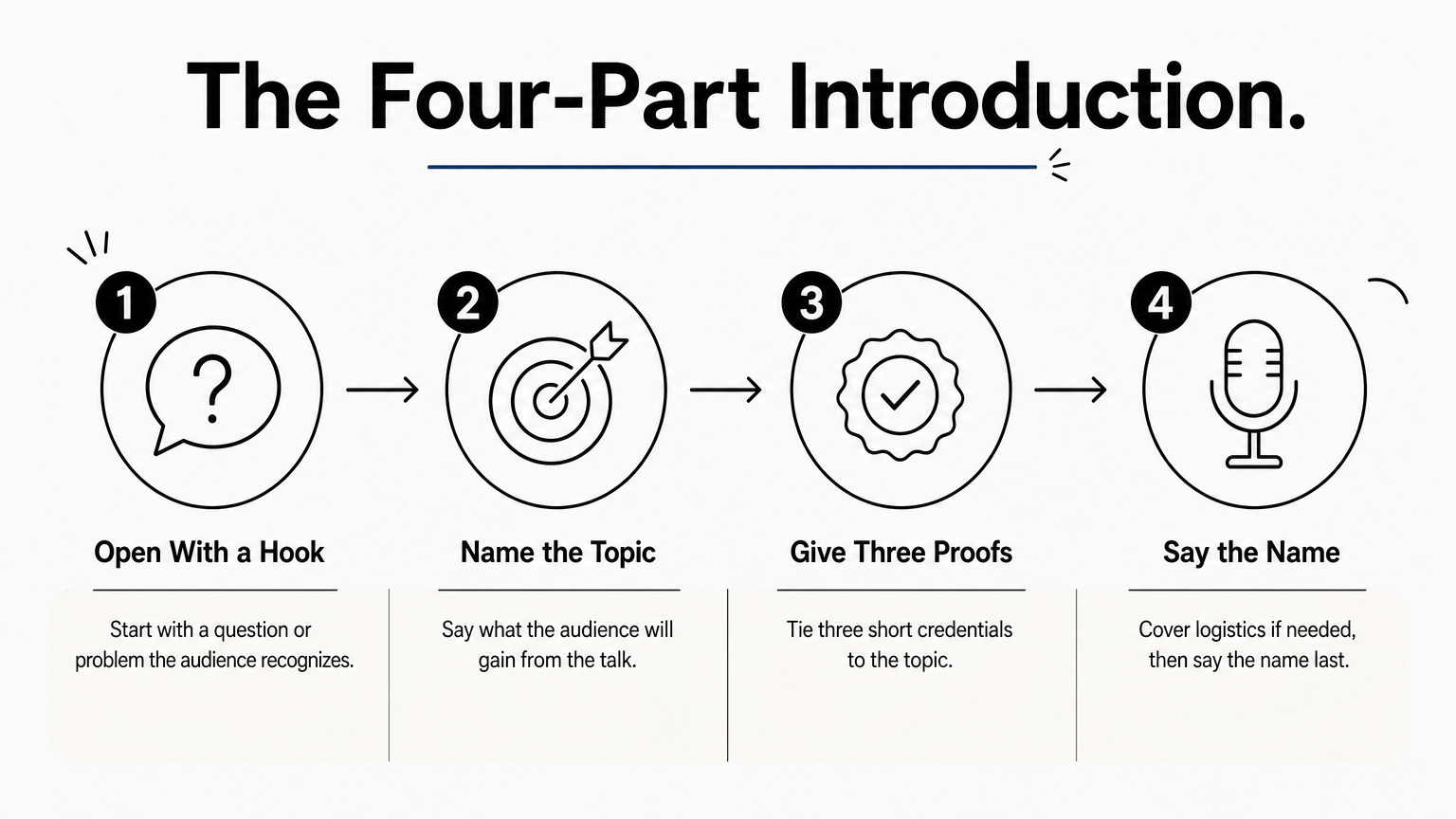
| Part | Job | Length |
|---|---|---|
| Hook | A question or problem the audience recognizes | 1 to 2 sentences |
| Topic | What they will gain from the talk | 1 sentence |
| Proof | Three credentials tied to the topic | 3 short sentences |
| Handoff | Logistics if needed, then the name | 1 to 2 sentences |
Answer why this speaker, topic, audience, and now
Your hook gets stronger when it quietly answers four questions: why this speaker, why this topic, why this audience, and why now. Hosts usually cover the first two and skip the third. A line such as "Every sales team in this room has a number to hit this quarter" connects the room to the speaker before the speaker says a word.
The "why now" should tie to something real, like a merger, a new fiscal year, or the theme of the conference. If nothing real applies, leave it out rather than inventing urgency.
What to include and what to cut
Keep the introduction focused on the audience’s benefit, and leave out anything that competes with the speaker.
| Include | Leave out |
|---|---|
| A hook tied to the audience’s problem | The full résumé or every job title |
| Three credentials that match the topic | Family details and unrelated hobbies |
| The talk title and one clear takeaway | The speaker’s key points, which spoil the talk |
| A sincere, warm tone | Jokes you are not sure the speaker and room will enjoy |
| The name, said last | Praise of the speaker’s "amazing speaking skills," which sets a bar they must clear |
Give the audience the promise and the proof, and save the content for the speaker.
Step 3. Rehearse and hand off cleanly
A strong script still fails if you read it badly or fumble the exit. Rehearse out loud, cover logistics before the speaker starts, and make the handoff crisp.
Practice out loud with a timer
Read the script aloud at least twice with a timer, and cut until you are under 90 seconds. Know it well enough to look up from the page, but do not memorize it word for word. A card with the hook, the three credentials, the phonetic name, and the logistics is enough.

Practice your energy as well as your words. The last line should be your most enthusiastic, because that is where the audience decides to applaud.
Cover logistics before the speaker begins
Tell the audience what they need to know so the speaker does not spend stage time on it. That includes whether questions come during or after the talk and whether the speaker will sign books. For a virtual event, say where to type questions in the chat.
Do this before the introduction proper, or right before the name. Either way, do not let logistics bury the hook.
Make the handoff
Say the name last, with energy, and start the applause yourself. Then stay on stage until the speaker reaches you, shake their hand, and leave. Walking off early leaves the speaker alone in an awkward silence. Never save the name for a long buildup, because the audience should hear it clearly and early enough to remember it.
Say the name last, start the applause, and stay on stage until the speaker reaches you.
Sample scripts you can adapt
These scripts follow the four-part order. Swap in your own facts, and keep each one under 90 seconds when you read it aloud.
Keynote at a corporate event
This example uses a leadership keynote and the facts from step 1. Replace the bracketed length with the real talk time. Robyn’s Why Winners Win keynote, for example, runs 30 to 60 minutes.
Every team in this room has a number it wants to move. Think about the last time your group hit a goal nobody thought was possible. What was different about how you worked together?

Our next speaker has built a career around that question. Robyn Benincasa led adventure racing teams to dominate world championship competition for more than a decade. She served as a San Diego firefighter for more than 20 years. And she is a New York Times best-selling author on what makes teams win.

Over the next [30] minutes, she will show us what a winning team culture looks like and what we can start doing on Monday. Please welcome Robyn Benincasa.
Fill-in template for any event
Use this when you introduce a colleague, a vendor, or an outside expert at a conference or internal meeting.
[Hook: a question or problem the audience faces.]

Today's topic is [talk title], and our speaker is [Name, phonetic pronunciation].

[Name] [credential 1 tied to the topic]. [Credential 2]. [Credential 3].

In the next [number] minutes, you will learn [one concrete takeaway]. [Logistics: when questions happen, book signing.]

Please join me in welcoming [Name].
School or church guest speaker
Keep the tone warm and plain. Mention the speaker’s connection to the community if it is real and relevant.
Good morning, everyone. Many of us have wondered how to [problem the group shares].

Our guest today, [Name, phonetic], has [one relevant experience] and has spent [number] years helping [people like this group].

[He/She/They] will speak for about [20] minutes, and there will be time for questions at the end.

Please give a warm welcome to [Name].
Every strong introduction is the same four parts: hook, topic, proof, and the name last.
Keep it short and send them to the stage
Knowing how to introduce speakers at an event comes down to three habits. Gather real facts and confirm the name. Write a 60 to 90 second script that opens with the audience’s problem, proves the speaker’s fit with three credentials, and ends with the name. Then rehearse aloud, cover logistics, and stay on stage until the speaker arrives.
You do not need a clever script or a big personality. You need a clear promise, a short list of proof, and a confident handoff. Use the templates above for your next event and adjust them after you hear them in the room.
If you plan keynotes or team events and want more practical guidance on working with speakers, you can find more guides for event planners and leaders on our blog.