You’ve got a keynote coming up, and the blank page is staring back at you. Writing a keynote speaker speech that actually lands isn’t about stringing together inspiring quotes. It’s about structure, a strong opening, and a message your audience still remembers three months later. Most speeches fail before they’re ever delivered because the writer skipped the hard part: figuring out what the room actually needs to hear.
If you’re wondering how professionals build a talk that holds a room for 45 minutes, the answer comes down to a few repeatable moves. You need a clear narrative arc, an opening that earns attention in the first 30 seconds, and a close that ties back to your core idea instead of trailing off. Skip any of these and even great content falls flat.
I’ve spent 20 years on stages talking to sales teams, executives, and conference crowds about how to build a high performing team, and the speech itself matters as much as the message. In this guide, you’ll get a practical structure you can copy, real opening techniques that work, and examples pulled from talks that actually changed how audiences think about leadership and teamwork.
What sets a keynote speech apart
A keynote speaker speech isn’t just a longer version of the quarterly update or the sales training deck. It sets the tone for the entire event, whether that’s a sales kickoff, a leadership offsite, or a three-day conference. Everything else on the agenda, breakout sessions, panels, workshops, gets filtered through the lens the keynote created. That’s why a keynote address carries more weight than its runtime suggests, and why the role a keynote speaker actually plays shapes the whole event: it’s the emotional anchor the rest of the day builds on.
A keynote speech vs. a business presentation
Business presentations inform. Keynote speeches transform how people think about a problem, then hand them a reason to act differently once they leave the room. The differences show up clearly when you line them up side by side, much like how keynote speakers differ from other speakers on the same agenda.
| Element | Business presentation | Keynote speech |
|---|---|---|
| Primary goal | Share information or data | Shift perspective, inspire action |
| Structure | Agenda-driven, sequential | Narrative arc with a single throughline |
| Audience role | Passive receivers of updates | Active participants in a shared experience |
| Memorable takeaway | A list of action items | One core idea tied to a story |
| Delivery style | Reads from slides | Speaks from experience, slides support |
Why the audience remembers the story, not the slides
Executives forget bullet points within a day. They remember the moment a speaker told a story that mirrored their own struggle. That’s the whole game with a conference keynote: you’re not competing with other speakers on information density, you’re competing on whether your story sticks. I’ve watched sales teams quote a single line from a talk two years later, not because it was clever, but because it connected to something they were already wrestling with at work.
A keynote lives or dies on whether the audience can repeat its one idea a week later.
Great keynotes also demand something a standard talk doesn’t: first-hand credibility. Audiences can tell within minutes whether a speaker has actually lived what they’re describing or is reciting borrowed frameworks. When I talk about creating a strong team culture, it comes from leading adventure racing teams through 24-hour expeditions and running into burning buildings with a crew whose lives depended on trust, not from a textbook. That lived experience is what separates a forgettable keynote address from one people bring up in meetings a year later. If you’re evaluating speakers or building your own talk, start by asking whether the content reflects something the speaker has actually done, not just studied.
Step 1. Know your audience and event goal
Before you open a blank document, find out who’s actually sitting in the room. A corporate keynote written for a sales kickoff needs a different energy and vocabulary than one for a leadership offsite grappling with a merger. Skip this research and you’ll write a generic talk that could be delivered to anyone, which means it lands with no one.
Research before you write a word
Start by getting specifics from the event planner or HR contact, not just a vague theme. Ask directly:
- What’s the state of the team right now? Growing, restructuring, recovering from layoffs?
- What keeps leadership up at night this quarter?
- What talks have landed well at past events, and which ones fell flat?
- Is this a celebration, a course correction, or a kickoff?
These answers shape everything from tone to which stories you pull from your own experience.
Match your message to the event goal
Every keynote address serves a business purpose, even when it’s framed as inspiration. A sales meeting keynote needs to connect to numbers and competitive drive. A leadership summit needs language around culture and trust, which is the territory a corporate culture keynote speaker lives in. When I worked with a national insurance company whose team had slipped to 17th in sales rankings, the goal wasn’t motivation for its own sake, it was giving that team a concrete framework for rebuilding trust that translated into results.
A keynote built for the wrong room is just a good speech delivered to the wrong people.
Getting this step right before you write a single line saves you from rewriting the entire speech later. It also gives you the raw material, real details about real people, that makes Step 2 far easier to nail.
Step 2. Define your one core message
Once you know the room, narrow your entire keynote speech down to a single sentence. Not a theme, not a topic area, one specific idea the audience should be able to repeat to a coworker the next morning. If you can’t say it in one breath, it’s not ready yet. Most first drafts fail here because the speaker tries to cover five good ideas instead of committing to one.
Write your core message before you write anything else
Before you draft a single story or slide, write your core message at the top of the page. Test it against these questions:
- Can I say this in under 15 words?
- Does it connect directly to the event goal I identified in Step 1?
- Would this idea change how someone approaches their job on Monday?
- Can I back it up with a specific story from my own experience?
If the answer to any of those is no, keep revising before you move forward.
Let every story serve the message
Stories, data, and examples earn a spot in your motivational speech only if they reinforce that one sentence. When I build a talk around "winning teams choose trust over ego," every adventure racing story, every firefighting example, gets filtered through that lens. Anything that doesn’t serve it gets cut, no matter how good the anecdote is on its own.
If a story doesn’t reinforce your one core message, it doesn’t belong in the speech, no matter how good it is.
This discipline matters more in a corporate keynote than in casual speaking because executives and sales teams are pattern-recognition machines. They’ll spot a wandering message within minutes, and once they check out, you won’t get them back. A tightly defined message is also what makes Step 3’s structure possible, since every section of your speech now has a clear job to do.
Step 3. Structure your speech from hook to close
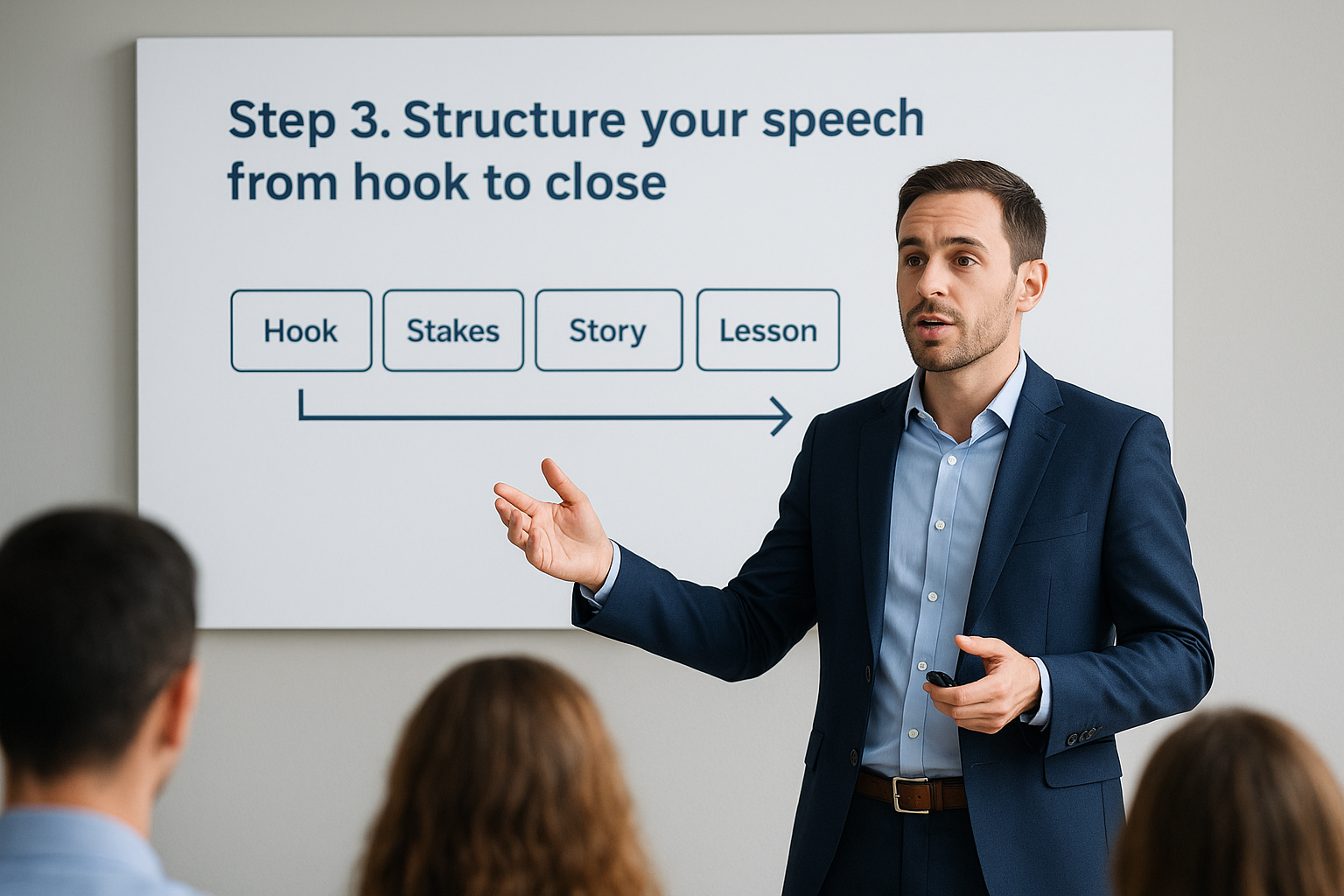
Once your core message is locked, build the skeleton that carries it. A keynote speech structure doesn’t need to be complicated, it needs to be reliable. Think of it as five moves: hook, stakes, story, lesson, close. Each one has a job, and skipping a move is why so many talks feel like they wander instead of build toward something.
The five-part arc that holds a room
Here’s the breakdown I use for nearly every keynote presentation, whether it’s 20 minutes or a full hour:
| Section | Time allotment | Purpose |
|---|---|---|
| Hook | First 2 minutes | Earn attention, plant your core message |
| Stakes | Next 3-5 minutes | Show why this problem matters to this room |
| Story | Bulk of the talk | Prove the message through lived experience |
| Lesson | 5-10 minutes | Translate the story into a usable framework |
| Close | Final 3-5 minutes | Return to the hook, issue a clear call to action |
Open with a hook, not a warm-up
Skip the "thank you for having me" opener entirely. Start mid-scene, drop the audience straight into a moment of real tension, a burning building, a race gone wrong, a deal that almost collapsed. That’s what earns the first 30 seconds.
A speech that opens with small talk has already lost the room before the real content starts.
Close by returning to where you started
Your ending should echo your opening image, now recontextualized by everything the audience just learned. If you opened with a race against the clock, close by revisiting that same moment and naming what changed. That callback is what makes a conference keynote feel complete instead of just finished. It’s also what makes your one core message stick long after the applause fades, because you gave the audience a full circle instead of a fade-out.
Step 4. Rehearse and deliver with presence
Writing the speech gets you halfway there. Delivery is where a keynote speaker speech either earns its reputation or falls apart under the lights. I’ve watched speakers with a strong script lose a room because they read from notes, rushed their pacing, or never rehearsed out loud until the day of the event. Presence isn’t a personality trait, it’s a skill you build through repetition.
Rehearse out loud, not just in your head
Silently reviewing your talk in your mind tricks you into thinking it’s ready. Say every word out loud, standing up, at the pace and volume you’ll use on stage. Do this enough times that your transitions become automatic, freeing you to focus on the room instead of your next line.
- Record yourself on video and watch it back for filler words and rushed pacing
- Time each section against the structure from Step 3 so no part runs long
- Practice in front of one honest colleague who’ll tell you where it drags
- Rehearse your opening line until it feels conversational, not memorized
A speech rehearsed only in your head is a speech you haven’t actually practiced.
Bring physical presence into the room
Your body communicates before you say a word. Stand still during key lines instead of pacing nervously, use pauses to let a point land, and make eye contact across sections of the audience rather than scanning the front row. These public speaking tips apply whether you’re on a physical stage or delivering a virtual keynote through a camera, where presence has to come through even more deliberately since you lose the room’s energy feedback.

When it’s time to deliver, trust the rehearsal. Confidence on stage comes from knowing your material cold, not from winging it and hoping the energy carries you.
Turning preparation into a memorable keynote
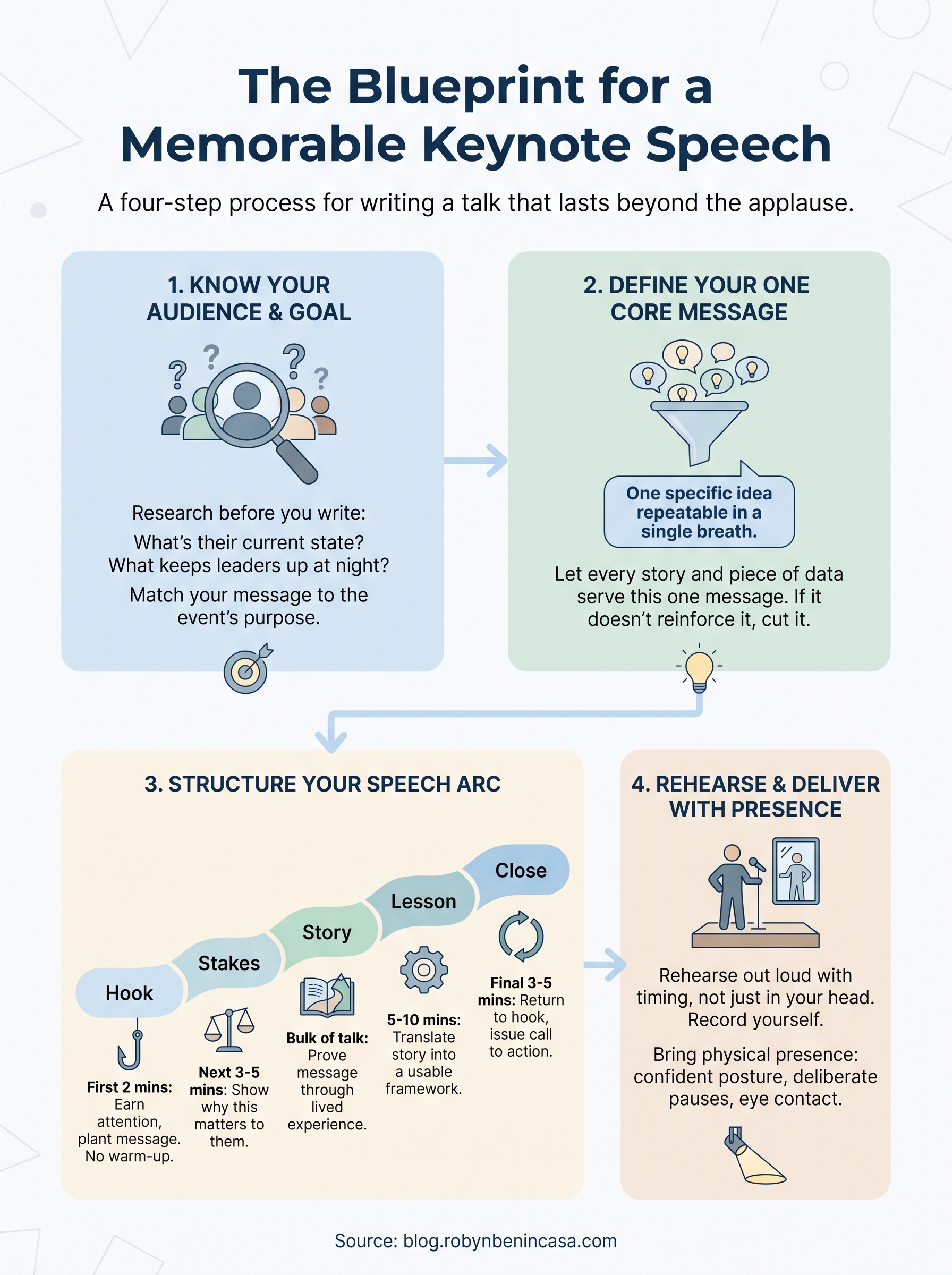
Great keynotes aren’t luck. They come from knowing your audience, committing to one message, building a structure that carries that message from hook to close, and rehearsing until delivery feels effortless. Skip any one of those steps and even a talented speaker ends up with a talk that entertains for an hour and disappears by Monday. Follow all four and you get something rarer: a room full of people who repeat your idea to coworkers who weren’t even there.
If you’re planning an event and want a keynote speaker speech built on twenty years of leading teams through burning buildings and championship adventure races, not borrowed frameworks, that’s exactly what I bring to the stage. See how to choose the best keynote speaker for a corporate event, then start the conversation about what your next sales kickoff, leadership offsite, or conference really needs to hear.