You want to learn how to support a struggling coworker, teammate, or employee, and you keep seeing the term resilience first aid training. Before you pay for a course, you need to know what it actually teaches, how long it takes, and whether to take it online or in person.
Here is the short answer. Resilience First Aid (RFA) is a strength-based course that teaches you to support someone’s mental health in everyday moments, using listening, perspective, and practical coping steps rather than clinical diagnosis. Most programs run from a few hours to a full day, and they come in online, blended, and in-person formats. The right choice depends on your schedule, your team size, and how much practice you want with other people.
Below, you will find what RFA covers, how each format compares, how long certification usually takes, and what to look for in a provider. I have spent years leading high-stakes teams as an adventure racer and firefighter, and I have seen that resilient teams are built by people who know how to show up for each other under pressure.
Why resilience first aid training matters
The gap between noticing and helping
Most people can tell when a teammate is off. They go quiet in meetings, miss a deadline they never miss, or snap over something small. Noticing is the easy part. What stalls people is not knowing what to say next, so they say nothing, or they offer a quick "let me know if you need anything" and move on.
Firefighters learn this early. You train for the medical call long before you run one, because nobody improvises well at 3 a.m. Mental health support works the same way. Resilience first aid training gives you a practiced approach and a few reliable steps, so you act instead of freezing.
The business case for supporting people early
The World Health Organization estimates that 12 billion working days are lost every year to depression and anxiety, costing the global economy close to US$1 trillion in lost productivity. A single course will not fix that. But people who spot strain early and respond well change what happens next on a team.
Here is how the day-to-day looks different once managers and peers have practiced these skills.
| Without training | With training |
|---|---|
| Strain gets ignored or avoided | Someone checks in early and directly |
| Well-meant advice and quick fixes | Listening first, then options |
| Help is offered only at the crisis point | Early referral to an EAP or professional |
| Every conversation lands on HR | Support is spread across the team |
For HR leaders, a formal resilience first aid certification also gives you something concrete to point to. You can show who has completed the course, what they practiced, and where employees should turn when a conversation goes beyond what a peer can handle.
Why the strength-based approach works
Strength-based means you start with what a person is already doing right, not with what is wrong. That sounds soft until you see it work. In a multi-day adventure race, a teammate who is falling apart does not need a lecture on mental toughness. They need someone to name what they have already gotten through and then shrink the problem to the next hour.

The same principle carries into an office, a hospital unit, or a sales floor. People open up when they feel respected, and they stay engaged when they leave a conversation with a small, doable next step. Resilience first aid builds that habit on purpose, which is why it fits so naturally into leadership and team culture work.
Resilience first aid does not make you a therapist. It makes you the person who notices, listens, and connects someone to the right help.
That boundary matters. Good programs are clear that you are not diagnosing or treating anyone. You are the first responder in a conversation, and the course teaches you when to stay with someone and when to bring in a professional.
How to choose the right resilience first aid format
The content of a course matters more than the delivery, but delivery decides whether people finish it and use it. Pick the format that fits how your people learn and how much live practice you want, because the skill you are building is a conversation. Reading about a conversation is not the same as having one.
Online, blended, and in-person at a glance
Every resilience first aid certification path should teach the same core skills. What changes is how much time you spend talking with other people and who sets the pace.
| Format | Best for | Trade-off |
|---|---|---|
| Online, self-paced | Individuals, remote staff, shift workers | Little live practice, easy to put off |
| Blended (online plus live session) | Most teams and departments | The live portion needs scheduling |
| In-person | Managers, leadership cohorts, crews | Travel, higher cost, fixed dates |
A live virtual session sits between blended and in-person. It works well for distributed teams, as long as the group is small enough for everyone to practice out loud.
Match the format to your situation
Start with who is taking the course and what they will do afterward. A few rules of thumb from my own work with teams:
- One person on a tight schedule: self-paced online resilience training is fine, as long as you find a colleague to practice with.
- A department of 20 to 100: blended keeps costs and calendar pain down while still giving everyone live practice.
- Managers and team leads: in-person or live virtual, because these are the people who will have the hard conversations.
- Remote or hybrid teams: live virtual sessions with breakout groups beat a stack of recorded videos.
The best format is the one that gives you the most practice talking with a real person.
Firefighters do not learn patient care from a slideshow, and you should not expect to learn supportive conversations that way either. Whatever you choose, confirm that live role-play or guided practice is part of the course before you enroll. If a provider offers an online course with no practice component, treat it as an introduction, not full training.
Finally, check how the hours are delivered. Some programs spread the same material over several short sessions, and others compress it into one long day. Shorter sessions over a few weeks usually stick better, and the next section shows what those hours should contain.
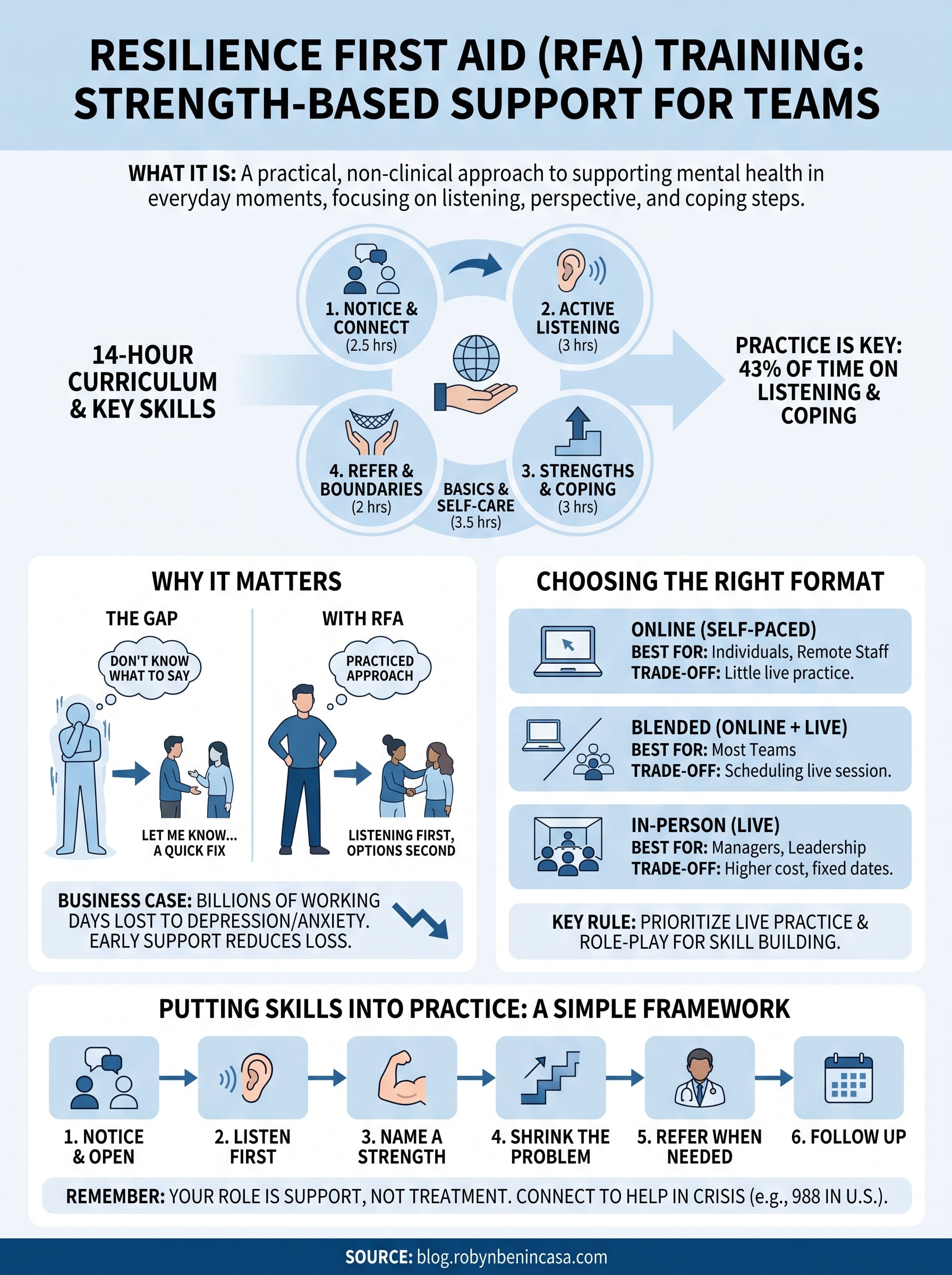
What the 14-hour curriculum covers
Fourteen hours sounds like a lot until you see what has to fit. The course has to teach you to notice, listen, respond, and refer, and you need time to practice each step out loud. Provider outlines differ in wording, so treat the breakdown below as the typical shape of a 14-hour resilience first aid training program, not a universal syllabus.
What the hours usually cover
| Module | What you learn | Approx. hours |
|---|---|---|
| Stress and resilience basics | How stress shows up, and the strength-based mindset | 2 |
| Noticing and connecting | Spotting behavior changes, opening a conversation | 2.5 |
| Active listening | Listening without fixing, reflecting back what you hear | 3 |
| Strengths and coping | Naming past wins, shrinking a problem to the next step | 3 |
| Referral and boundaries | Scope of your role, EAP, crisis resources | 2 |
| Self-care and review | Your own recovery, final scenarios | 1.5 |

Look at where the weight sits. Listening and strengths-based coping take about 43 percent of the time, and that is correct. Those are the skills that break down first when a real person is upset in front of you.
Practice is the real curriculum
Most of the learning happens in scenarios, not slides. You rehearse a hard opening line, you listen to a partner for three minutes without offering advice, and you get feedback. Role-play feels awkward for about ten minutes, and then it becomes the part people say they use most.
Fourteen hours should leave you able to hold a hard conversation, not just define one.
Before you enroll, ask to see the outline and confirm it includes these three things:
- Live or guided practice in every major module, not only at the end
- A clear section on when to refer and how to hand someone off
- Self-care for the helper, since supporting others drains you too
If any of those is missing, you are buying information rather than a skill. Sorting that out now saves you from a certificate that looks good and changes nothing on your team.
How long certification takes and how long it lasts
Time from first session to certificate
The 14 hours of resilience first aid training is contact time, not calendar time. How fast you finish depends on how the provider schedules the hours. These are the common patterns, so you can match one to your calendar.
| Schedule | Typical pattern | Calendar time |
|---|---|---|
| Intensive in-person | Two 7-hour days | 2 days |
| Spaced live sessions | Four sessions of about 3.5 hours | 2 to 4 weeks |
| Blended | Self-paced modules plus one live practice session | 2 to 6 weeks |
| Self-paced online | Modules on your own time | A few weeks, depending on you |
Some courses also require a short assessment or a completed practice scenario before they issue the certificate. Ask whether that assessment is counted inside the 14 hours or added on top, so you can plan around the full time commitment.
How long the certificate lasts
Validity is where providers differ most. Many issue a certificate with a stated expiration, commonly one to three years, while others hand out a certificate of completion that never expires. I can’t give you one number that applies everywhere, so get the policy in writing before you pay.
A certificate proves you finished the course. Only practice proves you can still do it.
That gap matters because skills fade. If you rehearsed a hard conversation twice in a classroom and never used it again, you will be rusty within a year. An expiration date is a useful nudge, not a flaw in the program.
Questions to settle before you enroll
A few quick questions will tell you what your resilience first aid certification is really worth:
- Does the certificate expire, and if so, when?
- Is there a refresher course, and what does renewal cost?
- Are assessments included in the 14 hours?
- Will you receive a verifiable record that HR can file?
For teams, I suggest scheduling a yearly refresher or peer practice session rather than waiting for certificates to lapse. Treat it like recertifying for CPR. A short, regular tune-up keeps the skills sharp for the day someone actually needs you.
Who benefits most from the training
Anyone who works alongside other people can use this training, but some roles get a bigger return than others. The common thread is regular contact with people under strain, whether that happens on a sales floor, in a hospital unit, or at a fire station.
Roles that gain the most
Look at who people actually turn to when things get hard. It is rarely a counselor first. It is the supervisor, the veteran coworker, or the HR partner down the hall, and those are the people to train first. A resilience first aid course gives them a practiced way to respond instead of improvising.
| Role | Why it helps |
|---|---|
| Managers and supervisors | They notice changes first and hold the hard conversations |
| HR and people leaders | They can build referral paths and a shared language |
| Healthcare, public safety, and military teams | High stress and repeated exposure to trauma |
| Sales and customer-facing staff | Constant pressure and rejection |
| Educators and nonprofit staff | They carry other people’s stress every day |
Teams facing change and pressure
Mergers, layoffs, and missed targets raise stress for everyone at once. Teams in those periods benefit because the skills spread across many people rather than landing on one overloaded manager. When 15 colleagues can listen well and refer wisely, support no longer depends on a single person’s calendar.
The people closest to the strain are the ones best placed to help.
Individuals gain too. If you are a parent, a volunteer, or a friend whom others lean on, the same steps work outside the office. You do not need a title to benefit. You need a willingness to practice listening and the honesty to admit when someone needs more help than you can give.
How to compare providers and what to ask before enrolling
Two providers can both sell resilience first aid training and deliver very different courses. A polished landing page tells you little. Ask for specifics in writing, then compare the answers side by side, the way you would compare bids from two contractors.
Check who built and teaches the course
Start with the instructors. Look for facilitators with real field experience, such as clinicians, crisis responders, or leaders who have supported teams through hard events. Slides can be copied. The judgment to handle a messy practice scenario cannot. Then ask who developed the curriculum, and whether the resilience first aid certification carries weight with your employer, industry body, or insurer.
Questions to ask before you pay
Use this table as a checklist when you talk to each provider.
| Question | Good answer | Warning sign |
|---|---|---|
| How many of the 14 hours are live practice? | A clear number, with practice in every module | "It depends" |
| What is the class size? | Small groups with breakout practice | 100 people on one call |
| What do you get afterward? | Workbook, refresher option, verifiable record | A PDF and nothing else |
| Can you see a sample outline or talk to a past client? | Yes, within a day or two | Vague or no answer |
| What is the total cost? | One itemized price | Fees for assessment or renewal appear at checkout |
Class size matters more than most buyers expect. In my experience, groups above 25 leave little room for feedback, and feedback is where the skill gets built. If a provider can’t say how practice is supervised, assume it isn’t.
If a provider can’t tell you what happens in the room, don’t expect the course to change what happens on your team.
Weigh cost against value
Price alone misleads. Divide the fee by the hours of live, instructor-led practice, not by total hours, and you will see which course actually gives you more. For a team, also ask about group rates and on-site delivery, since bringing an instructor to you often costs less than sending 30 people elsewhere. Finally, ask for a short call before you commit. A good provider welcomes it.
How to put resilience first aid skills into practice
Skills fade unless you use them, so plan your first real conversations before the course ends. Keep it small. You do not need a crisis to start, just a teammate who seems off and ten quiet minutes to check in.
A simple conversation framework
Most resilience first aid training programs teach some version of the same sequence. This is the one I carry into every hard conversation:

- Notice and open. "You’ve seemed stretched lately. How are you holding up?"
- Listen first. Let them finish. Do not fix anything for the first few minutes.
- Name a strength. "You got through the audit last quarter with half the staff."
- Shrink the problem. Ask what one thing would help in the next day or week.
- Refer when needed. Point to your EAP, a clinician, or a crisis line.
- Follow up. Check in again within a week.
Step six is the one people skip. A follow-up message takes thirty seconds and tells the person you meant what you said. It also shows you whether the next step you agreed on actually helped.
The conversation that matters most is the second one, the follow-up.
Build the habit in 30 days
Within the first week, hold one low-stakes check-in with a colleague, even if nothing seems wrong. That makes your opening line familiar, so it does not feel strange when the stakes are higher.
By week four, trade practice scenarios with a classmate or coworker for 15 minutes, the way crews run drills. Take turns listening for three minutes without advice, then swap feedback. Short, repeated reps beat one long refresher.
Know where your role ends
Your job is to support, not treat. If someone mentions harming themselves, stay with them and connect them to help right away. In the U.S., you can call or text 988 to reach the Suicide & Crisis Lifeline. Afterward, look after yourself too, because helpers need recovery time as much as anyone.
Choosing your next step
Resilience first aid training comes down to one skill: having a supportive conversation before a struggle becomes a crisis. Pick the format that gives you real live practice, confirm the hours and the certificate policy in writing, and ask each provider about class size. Those checks separate a course that changes behavior from one that only adds a line to a résumé.
Then use what you learn. Practice within the first week, follow up with the people you check in on, and refresh your skills every year. A certificate shows you finished. Your next hard conversation shows whether it worked.
If you want a team where people look out for each other, this course is a strong start. For more on leadership, team culture, and how winning teams support one another under pressure, explore Robyn Benincasa’s leadership and team building skills resources and take the next step with your team.