
You can’t order a strong culture off a menu, and you can’t fake it with a pizza party or a new set of office values on the wall. Team culture building is slow, deliberate work, and most leaders only notice it’s missing after morale drops, turnover spikes, or a merger scrambles the org chart. If you’re searching for answers, you already know the posters aren’t working.
This guide gives you the real steps for how to build a strong team culture, not the vague version. You’ll get practical, field-tested moves for creating a positive team culture that survives pressure, not just the good months.
I’ve spent 15 years leading world championship adventure racing teams and 20+ years as a San Diego firefighter, and both jobs taught me the same lesson: shared commitment beats individual talent every time. Below, I’ll walk through what actually separates a good team culture from a mediocre one, and give you concrete team culture ideas you can put to work this week, whether you’re rebuilding trust after a rough quarter or starting fresh with a new team.
What is team culture, and why does it matter?
Team culture is the set of unwritten rules that actually run your workplace, not the ones printed in the employee handbook. It’s how people treat each other when a deadline slips, whether a rookie can challenge a veteran’s idea in a meeting, and what happens the moment a leader leaves the room. What is team culture in the workplace, really? It’s the sum of a thousand small decisions your team makes every day about how hard to try, how honest to be, and how much they’ll cover for each other when things go sideways. You don’t write that on a poster. You build it through repeated behavior until it becomes the default.
During my adventure racing years, I watched this play out on multi-day expedition races where teams paddled, biked, and climbed nonstop for four to ten days straight, often with almost no sleep. The teams with the strongest athletes didn’t win most of the time. The teams that won consistently were the ones where a struggling teammate never got left behind, where someone always said "we’re stopping until everyone’s fed," and where nobody blamed a teammate for a wrong turn at 3 a.m. That’s strong team culture in its rawest form: shared ownership of the outcome, no matter who’s carrying the heaviest pack that hour.
A strong team culture is the difference between people who show up and people who show up for each other.
Here’s why this matters for your organization specifically. Gallup’s research on workplace engagement has repeatedly tied strong team dynamics to lower turnover and higher productivity, and you’ve probably seen this firsthand: teams with a positive team culture ride out layoff rumors, budget cuts, and leadership changes without falling apart. Teams without one lose their best people the moment a recruiter calls. Neglecting culture doesn’t just cost you morale points. It costs you retention, referrals, and the kind of institutional knowledge that walks out the door with a two-weeks notice.
So before you touch a single value statement or team-building exercise, get honest about where you stand today. Ask yourself: if your best performer quit tomorrow, would the team’s culture survive intact, or would it collapse with them? That answer tells you exactly how much foundational work lies ahead.
Step 1. Define your team’s core values and mission
Start by naming what you actually stand for, not what sounds good in a press release. Building a team culture without clear values is like racing without a map; you’ll move fast, but you won’t know where you’re headed. When I raced with Team Eco-Internet, we didn’t just say "teamwork matters." We defined exactly what that meant in practice: no one finishes a leg alone, every decision gets made out loud, and complaints come with a proposed fix attached. Those weren’t slogans. They were rules we enforced on ourselves at hour 80 of a race, when quitting felt easier than continuing.
Grab your team and answer three questions together, not from a corner office alone:
- What behavior do we want to see when things go wrong?
- What will we never tolerate, regardless of results?
- What’s the one outcome we’re all willing to sacrifice comfort for?
Write the answers down in plain language, five words or fewer per value. "Own your mistakes" beats "foster a culture of accountability" every time.
If your team can’t repeat your values from memory, you don’t have values, you have wall art.
Then test them immediately. Bring a real recent conflict to the group and ask whether your new values would have changed the outcome. If the answer is no, creating a team culture around those words is pointless. Rewrite until the values actually predict behavior, not just describe intentions.
Step 2. Lead by example to set the cultural tone
Your team watches what you do, not what you say in the all-hands meeting. Leading by example is the fastest way to build team culture, because every shortcut you take gets copied within a week. During a 24-hour mountain bike leg in the Costa Rica jungle, I once watched a team captain fake an injury just to avoid admitting he was exhausted. His team learned that lying beats honesty when things get hard, and it cost them the race two days later when nobody trusted his next call. Setting the cultural tone starts with you owning your own bad days out loud.

People don’t follow your words, they follow your worst moment under pressure.
Show the behavior before you demand it
If you want a good team culture built on accountability, admit your own mistakes first, in front of the team, without spinning them. If you want collaboration, ask a junior teammate for their opinion in a meeting and actually use it. Concrete moves that work:
- Apologize specifically when you’re wrong, naming the error out loud.
- Ask for help publicly instead of quietly fixing things yourself.
- Show up early to the hard tasks, not just the visible ones.
Consistency matters more than intensity here. One heroic gesture won’t overwrite months of cutting corners, but small, repeated acts of integrity will. Team members calibrate their own effort and honesty against yours, whether you’re a firefighter captain or a sales director, so give them something worth matching.
Step 3. Build trust through open, honest communication
Trust collapses the moment people start hiding bad news from each other, and you feel it instantly on a team, whether you’re mid-race or mid-quarter. Open, honest communication is the backbone of any strong team culture, because silence always gets filled with assumptions, and assumptions are usually worse than the truth. On expedition races, we ran short debriefs after every leg, no matter how exhausted we were, because unspoken frustration festers faster than any physical injury. If a teammate was falling behind, we said so directly, right then, instead of letting resentment build for six more hours.
Trust isn’t built in the good conversations, it’s built in the hard ones you don’t avoid.
Make honesty the easy choice, not the risky one
People only tell you the truth if the truth doesn’t cost them something. Punish someone for raising a problem once, and you’ll never hear about the next one until it’s a crisis. Try these moves to keep communication flowing both directions:
- Ask direct questions in meetings: "What’s not working right now?"
- Thank people publicly for surfacing bad news early.
- Share your own uncertainty instead of projecting false confidence.
- Follow up privately on tough feedback, don’t just drop it and move on.
Regularly practicing these habits is what separates teams with good team culture from ones running on politeness alone. Skip a week of this, and old habits of silence creep right back in.
Step 4. Recognize wins and reinforce the behaviors you want
Whatever you celebrate in public, your team will repeat. That’s not a soft leadership platitude, it’s a mechanical fact of human behavior. Recognizing wins the right way means you’re not just handing out praise for hitting numbers, you’re pointing at the specific behavior that got you there. When a paddler on my team pushed through a shoulder injury without complaining and quietly picked up a teammate’s slack, we called it out by name at the next checkpoint, in front of everyone. That single moment of recognition did more to shape positive team culture than any pep talk could have.

Praise the behavior, not just the result, or you’ll get more results and less of the behavior that mattered.
Reward the process, not just the scoreboard
Most teams only celebrate outcomes: the closed deal, the finished race, the hit quota. That trains people to chase results by any means necessary. Instead, build recognition around the actions you actually want repeated:
- Call out specific behaviors in meetings, not vague praise like "great job."
- Recognize the teammate who asked for help, not just the one who solved it alone.
- Highlight recoveries from mistakes as loudly as you highlight wins.
- Make recognition public when possible, it teaches the whole team what matters.
This is one of the simplest team culture ideas to implement, and one of the most skipped. Managers get busy and let good moments pass unnoticed. Don’t. Every unrecognized act of teamwork is a missed chance to reinforce the exact culture you’re trying to build on a team.
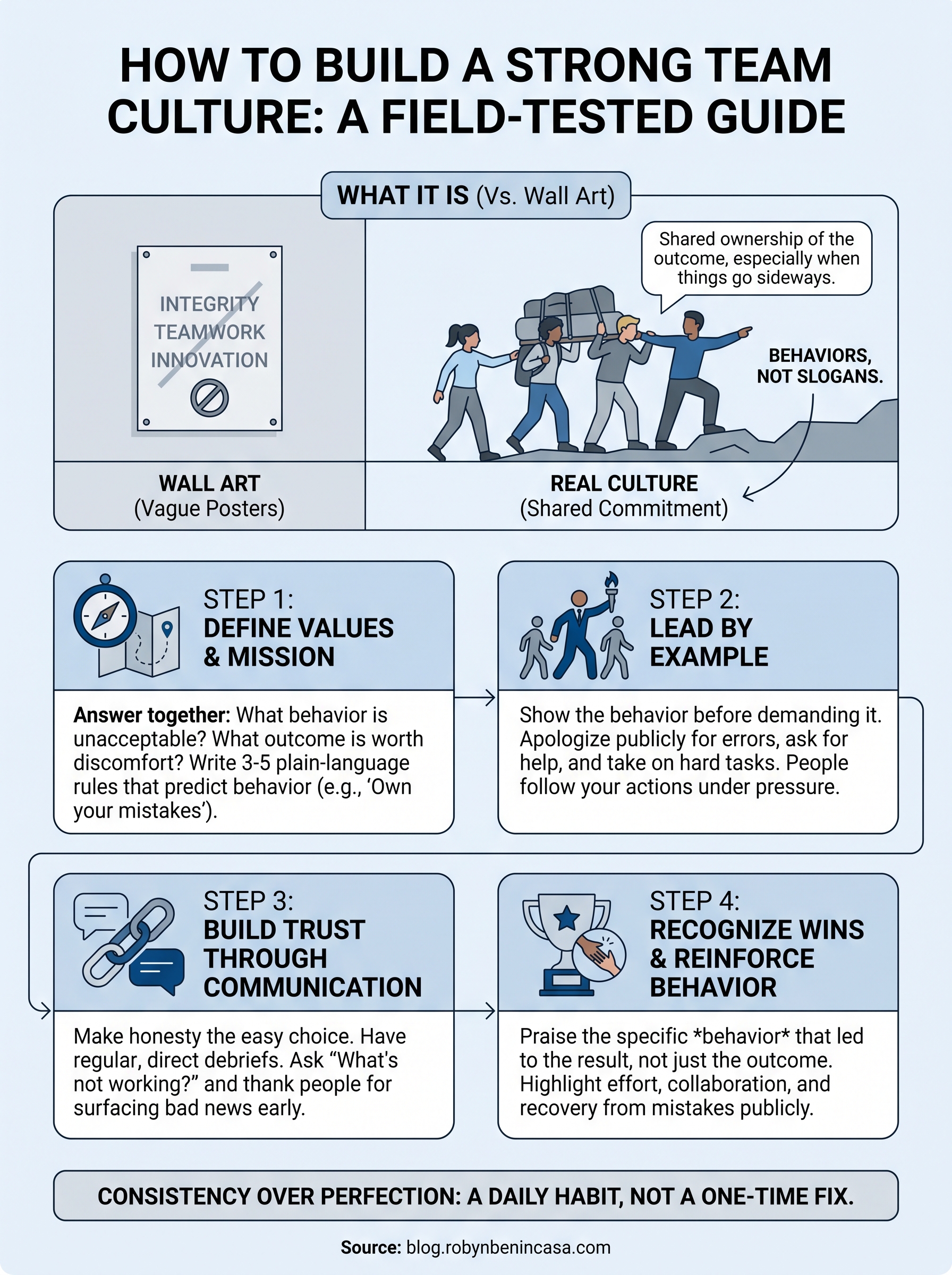
Building culture takes consistency, not perfection
None of these four steps work as a one-time fix. Building team culture is a daily habit, not a quarterly initiative you roll out and forget. You’ll miss days. You’ll slip back into old patterns when deadlines pile up. That’s fine, as long as you get back to the values, the example-setting, the honest conversations, and the specific recognition the next day. The teams I raced with didn’t win because they were perfect at hour one. They won because they kept choosing each other at hour eighty, when quitting was the easier option.
Your team is watching how you handle the hard weeks, not just the good ones. That’s where strong team culture actually gets built.
If you want your leadership team to see these principles in action, with real stories from the racecourse and the firehouse, book Robyn to speak at your next event.