
You’ve seen the term on every conference agenda: keynote speaker. But if you’re planning an event and trying to figure out who to book, or why that slot matters more than the others, you need a straight answer, not marketing fluff. What is a keynote speaker, exactly, and why does that person often set the tone for the entire event?
Here’s the short version: a keynote speaker delivers the central message of an event, the one idea everyone else’s sessions build around or respond to. They open or close the program, set the theme, and give the audience something to carry with them long after the coffee breaks and breakout sessions are forgotten. That’s different from a general session speaker or a panelist filling a smaller slot on the schedule.
I’ve spent two decades speaking to corporate audiences about leadership and team culture, so I know what separates a forgettable keynote from one that changes how a room thinks about work. In this article, I’ll walk you through the role of a keynote speaker, how it differs from a guest speaker, and what actually makes one worth the investment for your next event.
Why keynote speakers matter for your event’s success
A strong keynote does more than fill a slot on the agenda. It sets the emotional and intellectual tone for everything that follows, which is exactly why the role of a keynote speaker carries so much weight in event planning. When you open a conference with a speaker who nails the theme, attendees walk into every breakout session primed to connect the dots. When you close with one, you send people home with a story they’ll repeat at the office Monday morning instead of a vague memory of slides and coffee.

They create a shared reference point for the whole room
Think about the last conference you attended where hundreds of people sat in dozens of different sessions. Without a unifying idea, those attendees leave with fragmented takeaways that don’t add up to much. A keynote speaker gives everyone in that room the same starting point. I’ve watched sales teams walk out of a keynote using a single phrase, like "win as one," and then hear that same phrase echoed in breakout sessions, hallway conversations, and follow-up emails for months. That’s not an accident. It’s the definition of keynote speaker in action: someone whose message becomes the connective tissue for an entire event.
A great keynote gives hundreds of people the same starting point, so every other session at the event has something to build on.
They drive measurable outcomes, not just applause
Event planners increasingly get asked to justify the speaker budget, and rightly so. A keynote that lands doesn’t just entertain, it changes behavior back at the office. I’ve had sales organizations tell me they moved from 17th to 1st in national rankings after building their culture around ideas introduced in a keynote. That’s the kind of return an executive team can point to when someone asks why the company spent five figures on a speaker slot. If your keynote speaker can’t connect their message to a business outcome your audience actually cares about, whether that’s retention, morale, safety, or performance, you’re paying for entertainment, not impact.
They set the energy level for the rest of the day
Anyone who has run a conference knows the first twenty minutes decide the mood for the next eight hours. A flat opening keynote means you’re fighting an uphill battle all day to keep people engaged. A sharp one means your breakout facilitators get an audience that’s already leaning forward. This matters just as much for closing keynotes, which need to send people out the door energized rather than checking their phones for flight times.
A quick comparison of what’s at stake
| Without a strong keynote | With a strong keynote |
|---|---|
| Sessions feel disconnected | Sessions build on a shared theme |
| Attendees forget the event by Friday | Attendees repeat the message for months |
| Energy dips after lunch | Momentum carries through breakouts |
| Hard to justify the speaker budget | Easy to tie back to business results |
| Feels like a checkbox on the agenda | Becomes the thing people talk about afterward |
Why this matters even more for virtual and hybrid events
Distributed teams have fewer chances to feel like one organization, so the stakes go up, not down, when everyone is watching from a laptop instead of a ballroom. A keynote speaker who can hold attention on a screen and still deliver a message that unifies a scattered workforce is doing real work for your culture, not just checking a box on the run sheet. If you’re planning a virtual leadership offsite or an all-hands meeting spread across time zones, the keynote slot is often the only moment the entire company experiences together, which makes picking the right person for it even more important than it would be at an in-person event.
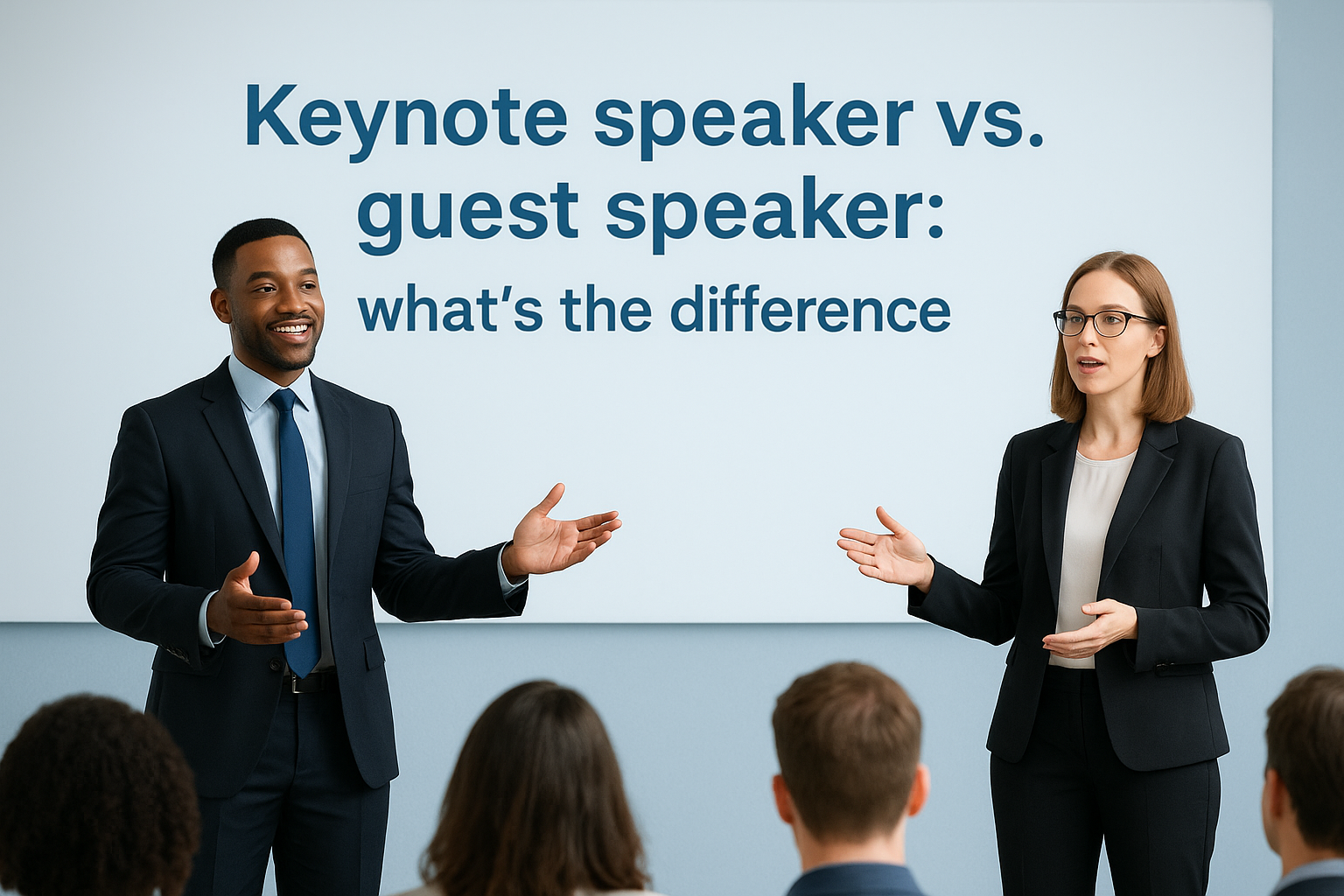
Keynote speaker vs. guest speaker: what’s the difference
Planners mix these two terms up constantly, and it costs them when they’re negotiating fees or building an agenda. The definition of keynote speaker centers on ownership of the event’s central theme. A guest speaker, by contrast, gets invited to add value to a single session without carrying the responsibility for tying the whole event together. Neither role is lesser, but they’re built for different jobs, and confusing them leads to mismatched expectations on both sides.
Scope of responsibility
Most guest speakers walk into a room, deliver their material, and walk out, with little pressure to connect their content to anything happening in the rest of the program. A keynote speaker, on the other hand, is expected to research the organization, understand why the event is happening, and shape a message that speaks directly to that context. This is the meaning of keynote speaker that most event planners eventually learn the hard way: you’re not booking a performance, you’re booking someone to anchor your entire agenda.
A guest speaker fills a slot. A keynote speaker gives the whole event a reason to make sense.
Placement, pay, and preparation
The practical differences show up in scheduling and budget too. Here’s how they typically compare:
| Factor | Keynote speaker | Guest speaker |
|---|---|---|
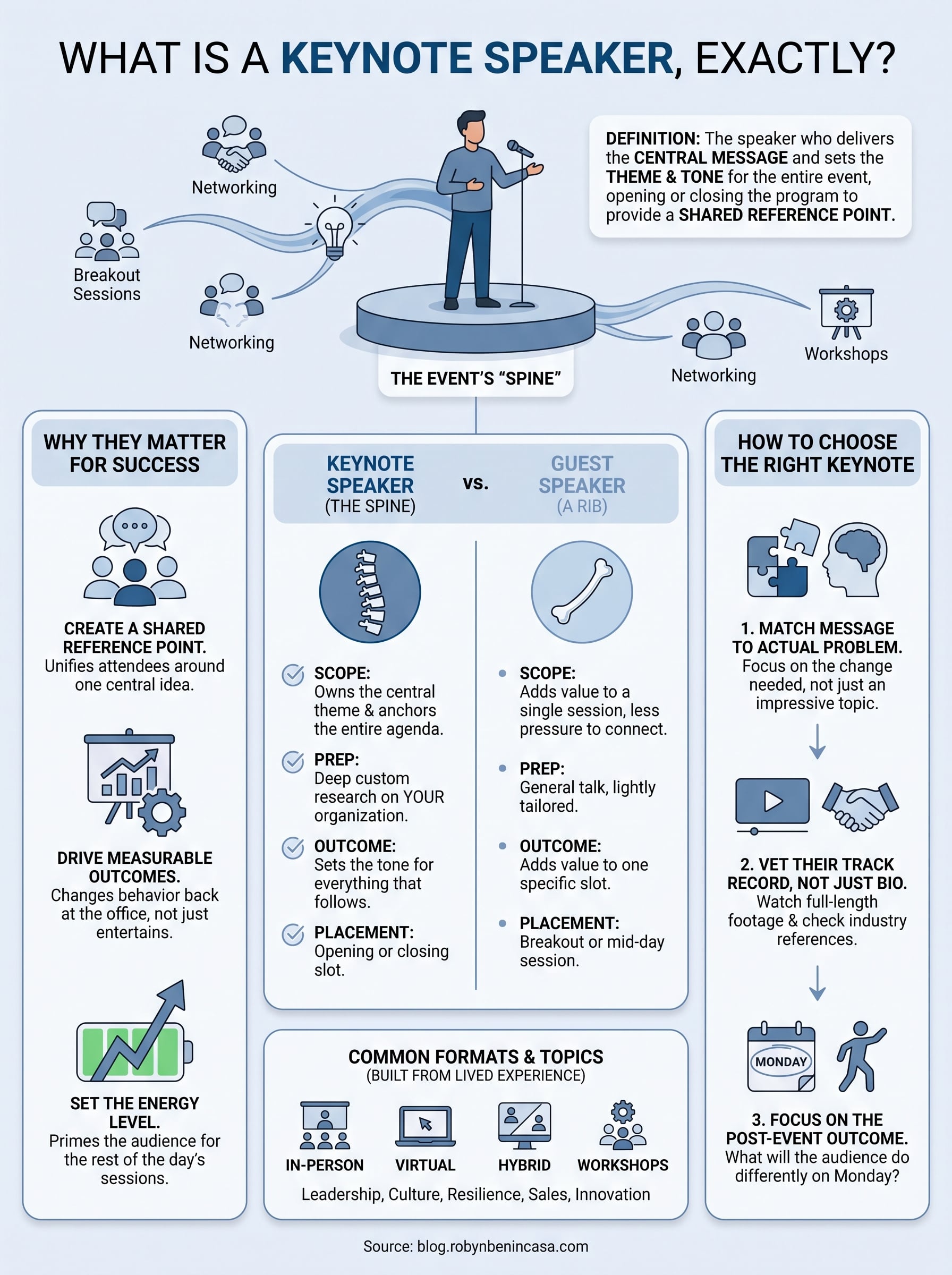
| Placement on agenda | Opening or closing slot | Breakout or mid-day session |
| Audience size | Entire event | Subset of attendees |
| Prep involved | Custom research on your organization | General talk, lightly tailored |
| Fee range | Higher, reflects top billing | Lower, reflects narrower reach |
| Expected outcome | Sets tone, drives shared takeaway | Adds value to one session |
Think of it this way: a keynote is the spine of the event, and every guest speaker’s session is a rib attached to it. Where a guest speaker might repeat a talk almost word for word at ten different conferences a year, a keynote speaker usually customizes the opening, the examples, and the call to action for your specific audience, your industry, and the outcome you’ve told them you’re chasing. That level of customization is exactly why the fee, and the impact, tend to run higher.
How to choose the right keynote speaker for your event
Picking a keynote speaker is less about star power and more about fit. You’re not casting a celebrity, you’re hiring someone to deliver the one message your entire audience needs to hear and remember. Get the fit wrong and you’ve spent five figures on an entertaining hour that evaporates by Monday. Get it right and you’ve bought a cultural reference point that outlasts the event itself.
Match the message to your actual business problem
Start with the outcome you need, not the topic that sounds impressive on a save-the-date. If your sales team is sliding in the rankings, you need someone who can speak directly to performance and accountability, not generic motivation. If you’re recovering from a merger and half the room doesn’t trust the other half yet, you need a speaker whose whole framework is built around trust and team culture. I always ask planners the same question before we talk topics: what do you want your audience doing differently the Monday after I leave? If they can’t answer that, we’re not ready to pick a theme yet.
Choose a keynote speaker based on the problem you need solved, not the topic that sounds best on the program.
Vet their track record, not just their bio
A polished speaker page tells you almost nothing about how a person performs in front of your specific audience. Ask for video of a full talk, not a two-minute highlight reel. Ask for references from event planners in your industry. Ask how they customize content for different audiences, because a speaker who gives the identical talk everywhere isn’t thinking about your people at all.
A practical checklist for the decision
- Confirm relevant experience: has this speaker addressed audiences in your industry or facing a similar challenge?
- Watch full-length footage: a highlight reel hides pacing problems and weak audience engagement.
- Ask about customization: will they reference your company, your goals, and your terminology, or recycle a stock talk?
- Check virtual delivery skills separately: holding a room is different from holding a screen.
- Talk to at least one past client: ask what changed at their organization after the talk, not just how the talk felt.
Run through that list before you sign a contract, and you’ll avoid the most common mistake planners make: booking a name instead of a fit.
What to expect: keynote speaker topics, formats, and fees
Once you understand the keynote speaker meaning, the next question is practical: what does booking one actually involve? Topics, formats, and fees vary widely, but knowing the general ranges helps you plan a realistic budget and timeline instead of guessing.
Common topic categories
Keynote topics tend to fall into a handful of buckets, even though every speaker builds a unique version of each one. Leadership and team culture, resilience and change management, sales performance, safety, and innovation are the most requested categories across corporate events. My own keynotes, like T.E.A.M.W.O.R.K. and WIN AS ONE, live in that leadership and culture bucket because that’s where I’ve spent 20 years building expertise, first as a firefighter, then as a world champion adventure racer leading teams through conditions where sloppy communication gets people hurt.
The best keynote topic is the one built from lived experience, not a slide deck assembled the week before the event.
Formats have expanded well beyond the ballroom stage
A decade ago, "keynote" almost always meant one person on a stage with a clicker. That’s changed. Planners now book:
- In-person keynotes: the traditional format, still the standard for large conferences and annual meetings
- Virtual keynotes: delivered live over video for distributed teams or all-hands meetings
- Hybrid formats: an in-person speaker addressing both a live room and a remote audience simultaneously
- Workshop add-ons: a shorter follow-up session that turns the keynote’s ideas into a working exercise for smaller teams
Each format asks something different of the speaker. Virtual delivery, especially, separates speakers who can only work a room from those who can hold attention through a screen.
Fees depend on more than name recognition
Rates for professional keynote speakers typically range from a few thousand dollars for regional or niche speakers to well into five figures for speakers with a strong track record, published books, and national media recognition. Factors that move the number include travel requirements, exclusivity requests, the amount of custom research involved, and whether you’re booking a single talk or a talk plus workshop package. Speakers who invest in your organization’s specific goals before they ever set foot on stage, or in front of a camera, tend to price accordingly, and event planners who’ve seen the difference in audience impact usually agree it’s worth it.
The takeaway on keynote speakers
At its core, a keynote speaker is the person who gives your event a spine, someone who owns the central message and hands your audience a shared takeaway instead of a pile of disconnected sessions. That’s the real definition of keynote speaker, and it’s why the booking decision deserves more thought than picking the biggest name on a speakers bureau list. Match the message to the problem you’re actually trying to solve, vet the track record instead of the highlight reel, and treat the fee as an investment in what your team does differently the Monday after the event ends.
If you’re planning a leadership offsite, sales kickoff, or company-wide meeting and want a keynote built around real team culture rather than generic motivation, explore Robyn’s keynote topics and see which one fits the outcome you’re chasing.