
Someone asks you to describe your team culture, maybe in a survey, an interview, or a board meeting, and you freeze. "Good" and "fine" don’t cut it, and you know it. Finding the right words to describe team culture matters more than most leaders realize, because vague language leads to vague culture, and vague culture is where silos and disengagement quietly take root.
This list gives you exactly what you need: a real bank of team culture words covering the good, the bad, and the in-between. Whether you’re writing a job posting, prepping for an employee survey, or trying to describe team culture honestly in a performance review, you’ll find precise language here instead of corporate filler.
I’ve spent 15 years building world championship adventure racing teams and two decades as a firefighter, and the language you use to name your culture shapes how people actually behave inside it. Below you’ll find 40 words organized by tone, positive terms that signal a thriving team, negative ones that flag dysfunction early, and neutral descriptors useful for objective assessment. Use them to diagnose where your team stands right now, and where it needs to go.
1. Positive words that describe a great team culture
What the words say about your team

When you reach for positive team culture words, you’re doing more than making your team sound good on paper. You’re naming behaviors you want to see repeated. On my adventure racing teams, we didn’t win because we had the fastest individual athletes. We won because we had language for what we expected from each other, words like "collaborative" and "accountable" that turned into actual habits during 24-hour races through the jungle. The right word, said often enough by leadership, becomes a standard people hold each other to.
Words to use
Here’s a working list of team culture words that describe strong, functional teams, and if you want the bigger picture first, here’s what team culture is and why it matters. Use these when writing job postings, culture statements, or performance reviews where you want to reinforce specific behavior.
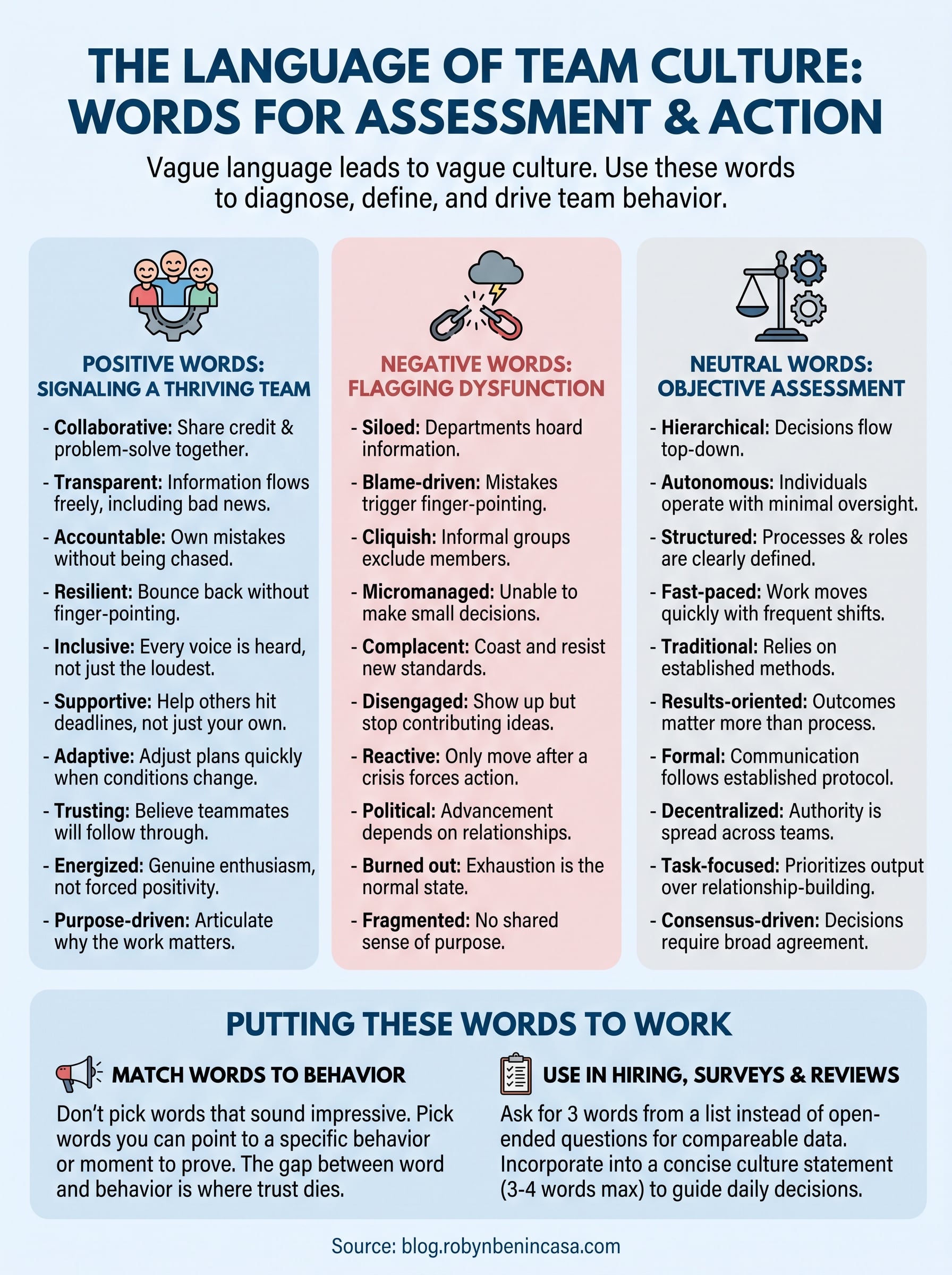
- Collaborative: people share credit and problem-solve together instead of competing
- Transparent: information flows freely, including bad news
- Accountable: team members own mistakes without needing to be chased
- Resilient: the team bounces back from setbacks without pointing fingers
- Inclusive: every voice gets heard, not just the loudest one
- Supportive: people help each other hit deadlines, not just their own
- Adaptive: the team adjusts plans quickly when conditions change
- Trusting: people believe their teammates will follow through
- Energized: the team brings genuine enthusiasm, not forced positivity
- Purpose-driven: everyone can articulate why the work matters
A team culture word only matters if you can point to a specific behavior that proves it’s true.
Where these words fit best
These words carry the most weight in employee surveys, recruiting materials, and leadership offsites where you’re setting expectations rather than just describing what already exists. I use several of these in my keynote on the 8 Essential Elements of a World-Class Team Culture, because naming the behavior is the first step toward building it. Drop these words into onboarding documents too, so new hires understand the standard from day one instead of guessing at it over their first six months.
2. Negative words that describe a toxic team culture
What the words say about your team
Naming dysfunction is uncomfortable, but a team culture synonym for "toxic" gives you something specific to fix instead of a vague feeling that something’s off. I’ve seen teams limp along for years because nobody would say the word "siloed" out loud in a meeting, let alone start the work of breaking down silos at work. On a race team, if you can’t name that a navigator is hoarding information, you can’t fix the trust problem before it costs you the race. The same goes for a sales floor or a hospital unit. Negative words aren’t an attack, they’re a diagnosis.
You can’t repair what you refuse to name.
Words to use
These words describe patterns that erode trust and performance over time:
- Siloed: departments hoard information instead of sharing it
- Blame-driven: mistakes trigger finger-pointing instead of problem-solving
- Cliquish: informal groups exclude newer or quieter members
- Micromanaged: people can’t make small decisions without approval
- Complacent: the team coasts and resists new standards
- Disengaged: people show up but stop contributing ideas
- Reactive: the team only moves after a crisis forces action
- Political: advancement depends on relationships, not results
- Burned out: exhaustion has become the normal state
- Fragmented: no shared sense of what the team is even trying to do
Where these words fit best
Use these words in exit interviews, anonymous surveys, and honest internal audits, places where candor matters more than optics. They’re also useful shorthand when you’re briefing leadership on where a team culture assessment revealed real cracks, so the fix can start immediately.
3. Neutral words that describe a team’s culture
What the words say about your team

Not every culture question needs a verdict. Sometimes you just need accurate, neutral team culture words that describe how a team operates without labeling it good or bad. A team can be "structured" without being rigid in a bad way, or "fast-paced" without being chaotic. These descriptors work well when you’re documenting culture for a merger, an acquisition, or a new leader stepping into a team they haven’t judged yet. On race teams, we’d describe a new partner squad as "hierarchical" or "autonomous" before we ever decided if that structure helped or hurt them.
Neutral language lets you observe a team before you start fixing it.
Words to use
Reach for these when you want to describe team culture factually, before deciding what to change:
- Hierarchical: decisions flow top-down through clear levels
- Autonomous: individuals operate with minimal daily oversight
- Structured: processes and roles are clearly defined
- Fast-paced: work moves quickly, with frequent shifts in priority
- Traditional: the team relies on established, long-standing methods
- Results-oriented: outcomes matter more than process
- Formal: communication follows established protocol
- Decentralized: authority is spread across teams, not concentrated
- Task-focused: the team prioritizes output over relationship-building
- Consensus-driven: decisions require broad agreement before moving forward
Where these words fit best
Use these terms in culture audits, org charts, and onboarding guides where you’re mapping how a team functions, not scoring it. They’re also the safest choice during a team culture assessment or an organizational culture assessment tool rollout conducted by outside consultants who need language everyone can agree on before opinions enter the room.
4. How to choose the right words for your team culture
Match the word to real behavior
Don’t pick a word because it sounds impressive on a slide. Pick it because you can point to a specific moment that proves it’s true. If you call your team "collaborative," you should be able to name the last time two departments solved a problem together without a manager forcing it. When leaders describe team culture with words nobody can back up, employees notice the gap immediately, trust erodes faster than if you’d said nothing at all, and building trust in a team at work gets that much harder.
The gap between the word you use and the behavior people see is where trust dies.
Use them in interviews and surveys
During hiring and employee surveys, ask people to pick three words from a list like this one instead of answering an open-ended "describe our culture" question. Open questions get you vague answers. A forced choice gets you data you can actually compare quarter over quarter.
- Give candidates the same word list and ask which three match their last team, then ask why
- Run an anonymous survey, alongside your usual organizational culture survey questions, asking employees to choose words describing the team today versus the team they want in a year
- Track which negative words repeat across departments; that’s your priority fix
Use them to shape a culture statement
Once you’ve gathered honest words from your team, build them into a culture statement that guides hiring, reviews, and daily decisions, one of the proven steps to build culture in a team. Zero in on three or four words maximum. A statement with fifteen adjectives is a wish list, not a standard anyone can be held to.
Putting these words to work
Words alone won’t fix a broken team, but the right ones give you a starting point that vague feedback never will. Naming your culture accurately, whether that’s "collaborative" or "siloed" or simply "fast-paced," turns a fuzzy impression into something you can actually act on. Pick your three or four words, test them against real behavior, and use them consistently in interviews, reviews, and onboarding until they stop being aspirational and start being true.
That shift from words on a page to habits on a team is exactly what I’ve spent 15 years studying, first on championship adventure racing courses and then as a firefighter leading crews under real pressure. If you’re ready to build a culture your people can actually name and live up to, bring in a corporate culture keynote speaker and I’ll show your team how the language turns into results.