You’ve got a team offsite coming up, a budget for one activity, and a group of people who’ve done the trust falls and the ropes courses already. So you’re searching for team building activities escape room style because you want something that actually forces people to communicate under pressure, not just stand around holding hands. Fair instinct. A good puzzle room compresses hours of team dynamics into 60 minutes and shows you, in real time, who steps up, who shuts down, and who solves problems out loud versus alone.
This list covers nine escape room team building activities you can actually book or build, from commercial venues with corporate packages to DIY versions you can run in a conference room for teams scattered across offices. You’ll find options for small groups, distributed teams, and budgets that range from free to a few thousand dollars.
I’ve spent 20 years leading teams through actual life-or-death scenarios as a firefighter and adventure racer, and the same principles that win world championship races show up in a well-designed escape room: clear roles, fast decisions, shared ownership of the outcome. These picks reflect that lens, not just novelty.
1. Commercial escape room venues
Commercial escape rooms are the original version of this activity, and they’re still the easiest way to get a polished experience without doing any setup yourself. You book a room at a local venue, show up with your group, and a trained game master runs the whole thing while you focus on the puzzles. These businesses exist specifically to sell immersive puzzle experiences, so the production value tends to be high: themed sets, sound effects, hidden mechanisms, sometimes actors who play a role in the story.
How it works
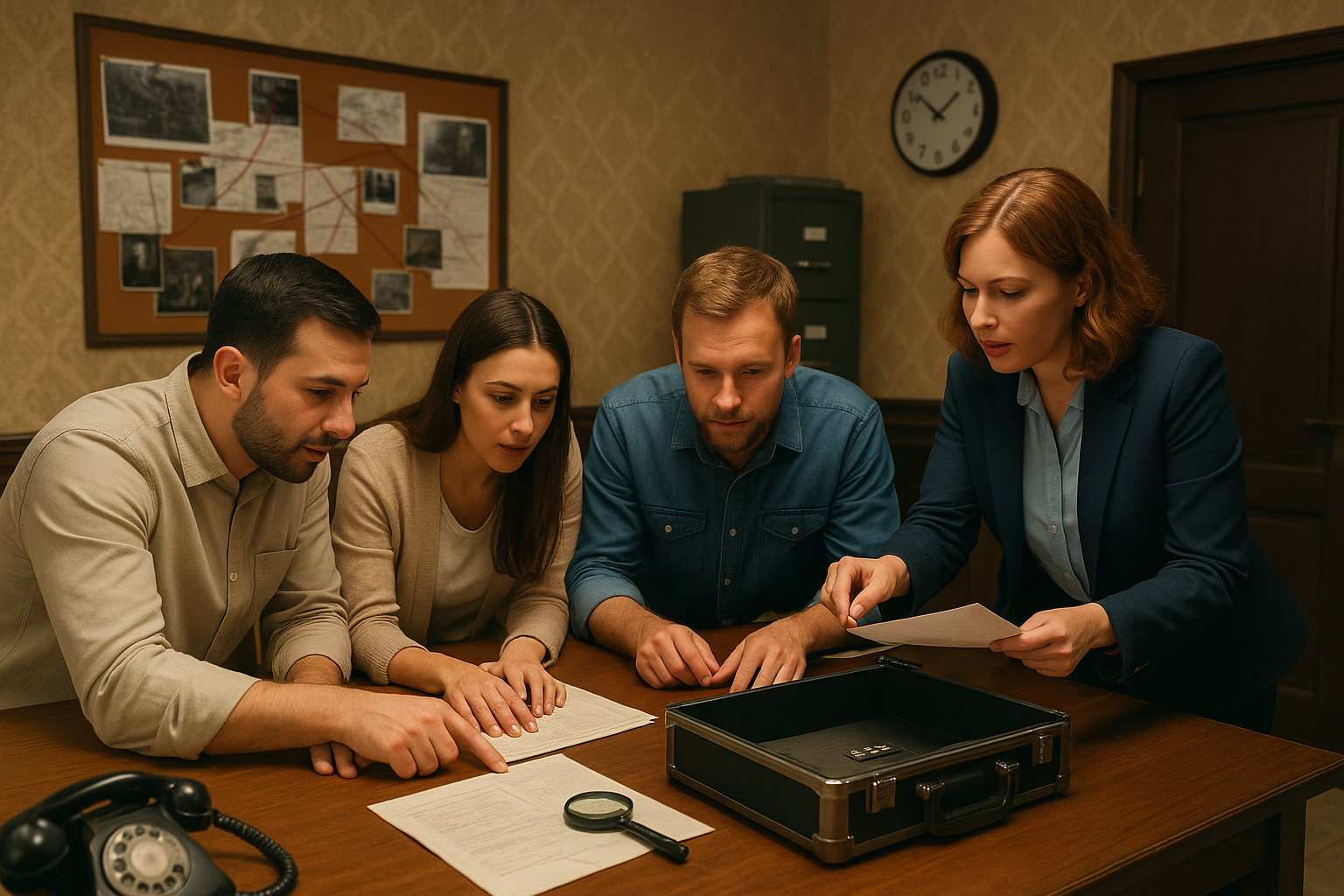
Your group gets locked in a themed room (a bank vault, a spaceship, a detective’s office) and has 60 minutes to find clues, crack codes, and solve a chain of puzzles to "escape." A game master watches through cameras and can offer hints if you’re stuck, which keeps frustration from tanking morale. Most venues now run a debrief afterward where staff highlight what worked and what didn’t in your group’s problem-solving, which is the part that actually makes this a team building activities escape room exercise instead of just a fun outing.
Best for
This format suits teams that want a done-for-you experience with zero setup on your end. It works well for client-facing events too, since the polish reflects on your company, and it slots neatly alongside other corporate event team building activities you may already be planning. Sales teams, leadership cohorts, and cross-departmental groups who don’t normally work together all do well here because the shared novelty flattens hierarchy fast.
A locked room with a ticking clock tells you more about how your team communicates than a year of status meetings.
Group size and time needed
Most commercial rooms hold 6 to 10 people comfortably, though some venues offer larger rooms or let you book multiple rooms and compare times. Budget 90 minutes total: a 10-minute briefing, the 60-minute game, and a debrief.
Cost and what to book
| Group size | Typical cost per person | What’s included |
|---|---|---|
| 6-10 | $30-$45 | One room, game master, standard debrief |
| 11-20 (multiple rooms) | $30-$50 | Head-to-head rooms, comparison debrief |
| Corporate packages | $500-$2,000 flat | Private booking, custom debrief, sometimes catering |
Ask specifically for their corporate team building package, not the general public booking. Most venues have one, and it usually includes a facilitator who ties the puzzles back to workplace behavior instead of just handing you a completion time.
2. DIY escape room built in your office
Building your own escape room in a conference room costs almost nothing and gives you total control over the puzzles, which makes it one of the more flexible indoor team building activities for work and lets you tie them directly to your company’s real work. Instead of a generic spy theme, you write clues around your product, your org chart, or an inside joke from last year’s sales conference. This is one of the more overlooked escape room team building activities because people assume it takes professional design skills. It doesn’t. It takes an afternoon and a willingness to hide sticky notes in weird places.
How it works
One person on your team (usually whoever loves puzzles) designs a chain of 4 to 6 clues locked behind a final combination lock or sealed envelope. Clues get taped under chairs, inside binders, or behind a whiteboard. Teams race to solve the chain and "escape" the room before time runs out.
Best for
Small companies or single departments with a designer willing to spend a few hours building the puzzle. It’s a strong fit for budget-conscious teams and for groups who already know each other well enough to enjoy inside-joke clues, and it pairs well with other low-cost team building activities for employees.
Group size and time needed
Works best with 4 to 8 people split into two small teams, running 30 to 45 minutes. Larger offices can build two identical rooms and race departments against each other.
Cost and materials needed
The best DIY escape rooms use what’s already in your building, not what’s in a party supply catalog.
- Combination locks or lockboxes ($10-$20 each on Amazon)
- Sticky notes, envelopes, string, and tape
- A printed answer key for the facilitator
- Total cost: usually under $75 for a reusable kit
3. Escape room board games and kits
Escape room board games package the whole experience into a box you can order online and run at your next team meeting with zero design work. Brands like Exit: The Game and Unlock! sell dozens of themed escape room kits, each built around a self-contained story with cards, locks, and puzzle sheets instead of a physical room. They’re a fast way to run team building activities escape room style without booking a venue or building anything from scratch.
How it works
Your group opens the box, reads a short story setup, and starts working through numbered cards and physical props (paper wheels, code cards, sometimes small locks). Each solved puzzle reveals the next card or unlocks a code that advances the story until the group reaches the final solution.
Best for
Kits suit smaller teams or breakout groups within a bigger offsite, since most are designed for 3 to 5 players per box, which puts them squarely among the better team building ideas for small groups. They’re also a good fit for repeat activities, since you can buy a new theme every quarter without repeating a venue.
A twenty-dollar box can produce the same huddle-and-argue dynamic as a two-thousand-dollar venue booking.
Group size and time needed
Most kits run 60 to 90 minutes and support 1 to 5 players each. Buy multiple copies of the same kit to run several small groups in parallel, then compare finish times.
Cost and what you’ll need
- One kit per small group: $15-$25
- A timer (phone app works fine)
- A table per group and a quiet corner
- Total cost for a 20-person offsite: roughly $75-$125 for four kits
4. Printable escape room games
Printable escape room games strip the concept down to its cheapest form: a PDF you download, print, and hand out with zero shipping time or physical props to buy. Sites and marketplaces sell printable puzzle packs built around office themes, holiday parties, or generic mystery plots, and you can run one the same afternoon you find it. For teams planning a last-minute team building activities escape room session with no budget for kits or venues, this is the fastest path to yes.
How it works
You print a set of puzzle sheets, cipher wheels, and a final answer card, then scatter or stack them for teams to work through in order. Groups solve each sheet to get a code or word that unlocks the next page, ending in a final phrase or number that "opens" the last envelope.
A stack of paper and a printer can deliver the same suspense as a locked steel door.
Best for
This format suits remote-adjacent offices running the activity across multiple small conference rooms at once, since you just print more copies. It also works for teams on a hard deadline who need something ready in an hour, not a week, much like other quick team building activities for meetings.
Group size and time needed
Best run in teams of 3 to 6, with each round taking 30 to 45 minutes. Print several sets to run parallel groups and compare completion times at the end.
Cost and what you’ll need
- A printable pack: $5-$15 per download
- Access to a printer and paper
- Scissors and envelopes for sealing clues
- Total cost for a full office: usually under $20
5. Virtual escape rooms for remote teams
Virtual escape rooms solve a real problem: your team is spread across four time zones and a physical venue just isn’t an option. These experiences run entirely over video call, with a live host walking your group through a themed story while sharing puzzle images, videos, and interactive digital clues on screen. They’ve become one of the go-to virtual team building activities for corporate teams for companies that went remote or hybrid and never fully came back together.

How it works
Everyone joins a single video call, and a host shares their screen to present the mystery, drop hints, and reveal new puzzle pieces as the group solves each stage. Some platforms split large groups into breakout rooms first, then reunite everyone for the final puzzle so the whole team shares the win.
Distance stops being an excuse for disconnection once your whole team is staring at the same puzzle at the same time.
Best for
This format suits fully remote or distributed teams who rarely see each other on camera, let alone in person, and it sits comfortably next to other team building activities for remote teams. It also works for global companies running the same session twice to cover different time zones without asking anyone to stay up until midnight.
Group size and time needed
Most virtual hosts comfortably manage 8 to 25 people on one call, with larger groups split into breakout teams of 4 to 6. Sessions typically run 60 to 75 minutes, including intro and debrief.
Cost and what you’ll need
- Booking with a live host: $25-$40 per person
- A stable video call platform (Zoom, Google Meet)
- One device per small group if using breakout rooms
- Total cost for 20 people: roughly $500-$800
6. Hybrid escape rooms for mixed teams
Hybrid escape rooms exist for the reality most companies actually have: half the team in the office and half working from home. These setups connect an in-person group to remote participants through a shared video feed, so everyone solves the same puzzle chain even though they’re not in the same building. It’s a practical answer for anyone planning team building activities escape room style for a workforce that’s never fully in one place.
How it works
A facilitator runs the physical room while streaming key clues to remote participants on a call, who then feed solutions back to the in-room team through chat or voice. Some vendors split puzzles deliberately, giving remote players information the in-person group can’t see and vice versa, which forces both sides to actually talk instead of one group carrying the whole game.
The moment your in-office team needs the person on the video call to solve it, the hierarchy of "who’s really here" disappears.
Best for
This format suits hybrid workplaces where remote employees often feel like an afterthought in office events. It also works well for companies with one satellite office joining a headquarters offsite.
Group size and time needed
Plan for 8 to 16 people total, split roughly evenly between the room and the call, running 60 to 75 minutes including a joint debrief.
Cost and what you’ll need
- Hybrid-specific booking with vendor: $35-$55 per person
- A room with a large screen and good camera angle
- Stable internet on both ends
- Total cost for 12 people: roughly $500-$650
7. Escape room design workshop
An escape room design workshop flips the whole premise: instead of solving a puzzle someone else built, your team builds one from scratch for another group to solve. A facilitator gives each small team a theme, a prop kit, and a deadline, then the teams swap creations and try to break each other’s rooms. This format works because building a puzzle forces the same collaboration skills as solving one, plus a layer of creative problem solving activities for teams that most escape room team building activities skip entirely.
How it works
Groups get 45 to 60 minutes to design a mini escape room using a supplied kit of locks, cards, and a theme card, then hand their creation to another team. Each team then has 20 to 30 minutes to solve the room the other group built, followed by a group debrief on design choices and problem-solving approaches, much like structured communication exercises for teams.
Building the puzzle teaches your team more about each other’s thinking than solving one ever could.
Best for
This format suits creative teams and marketing, product, or design departments who enjoy building things as much as solving them. It also works well as a second-day activity at a multi-day offsite, since it changes the energy after a day of passive sessions.
Group size and time needed
Works best with 12 to 24 people split into teams of 4 to 6, running 90 to 120 minutes total including the design phase, the swap, and debrief.
Cost and what you’ll need
- Facilitator-led kits: $40-$60 per person
- Prop supplies: locks, index cards, envelopes, string
- A separate table or room per team
- Total cost for 16 people: roughly $700-$900
8. Outdoor scavenger hunt escape challenge
An outdoor scavenger hunt team building escape challenge takes the locked-room concept and spreads it across a campus, park, or downtown block. Instead of one sealed space, your team moves between physical checkpoints, solving clues that unlock the next location instead of the next envelope. This variation on escape room team building activities trades claustrophobia for fresh air, which matters if your group includes anyone who dreads a small locked room.
How it works
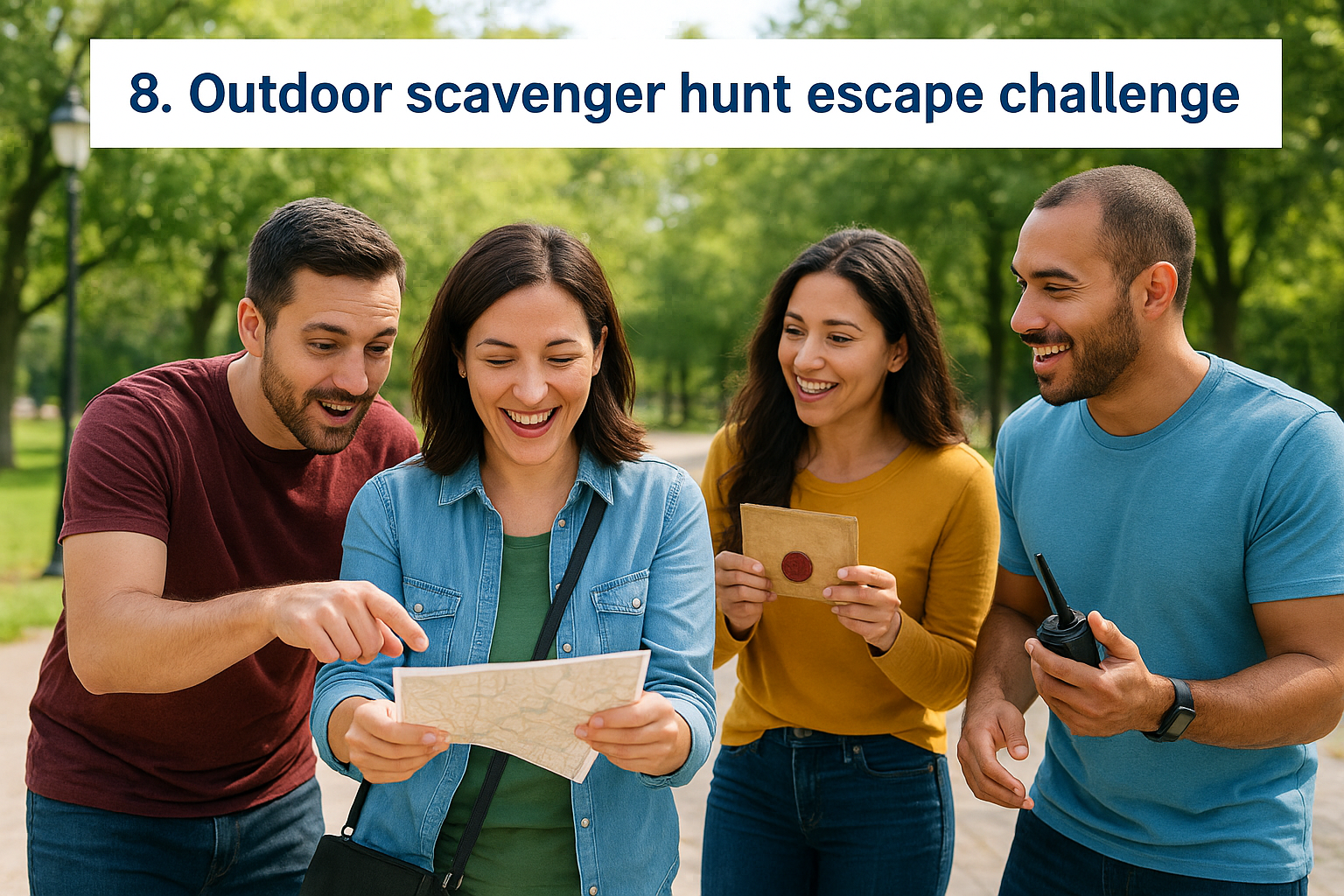
Teams get a starting clue that points to a physical location, where they find the next puzzle hidden in a planter, taped under a bench, or coded into a landmark’s plaque. Solving each clue reveals a code or coordinate for the next stop, and the first team to reach the final checkpoint and crack the closing puzzle wins.
Fresh air and a countdown clock pull the same focus out of a group that four walls usually get credit for.
Best for
This format suits active teams and companies based near a walkable downtown, campus, or large park. It also works well for company picnics or half-day offsites where you want an activity that doubles as exercise, alongside other outdoor team building activities for work.
Group size and time needed
Plan for 10 to 30 people split into teams of 4 to 6, with the full hunt running 60 to 90 minutes depending on how spread out your checkpoints are.
Cost and what you’ll need
- A GPS-based scavenger hunt app or a printed clue map: $0-$15 per person
- Weatherproof envelopes or lockboxes for outdoor clues
- Walkie-talkies or a group text thread for check-ins
- Total cost for 20 people: roughly $150-$300, including a small prize budget
9. Murder mystery escape experience
A murder mystery escape experience blends a whodunit dinner party with a locked-room puzzle chain, giving each person a character, a secret, and a stake in the outcome. Unlike a standard puzzle room where everyone shares the same goal, this format hands out hidden motives and private clues, so solving the case means getting people to reveal information they’d rather keep to themselves. It’s one of the more social escape room team building activities on this list, built for groups who like a story as much as a puzzle.
How it works
Each participant receives a character sheet with a backstory, an alibi, and one or two secrets tied to the murder. Teams question each other, trade physical clues, and solve a handful of locked puzzles that reveal evidence, all while a facilitator keeps the story moving toward a final accusation.
Getting a coworker to admit their character’s secret takes the same trust you need to admit a real mistake at work.
Best for
This format suits social teams who enjoy roleplay and don’t mind a little theater with their team building. It works especially well at holiday parties or year-end offsites where the mood calls for something lighter, like the funny team building activities that keep the room laughing instead of grinding through puzzles.
Group size and time needed
Plan for 8 to 20 people, with everyone assigned a character. Sessions typically run 90 to 120 minutes, including character introductions, investigation time, and a final reveal.
Cost and what you’ll need
- Hosted murder mystery kit or facilitator: $30-$50 per person
- Printed character sheets and props
- A large room where people can mingle freely
- Total cost for 15 people: roughly $500-$750
Picking the right fit for your team
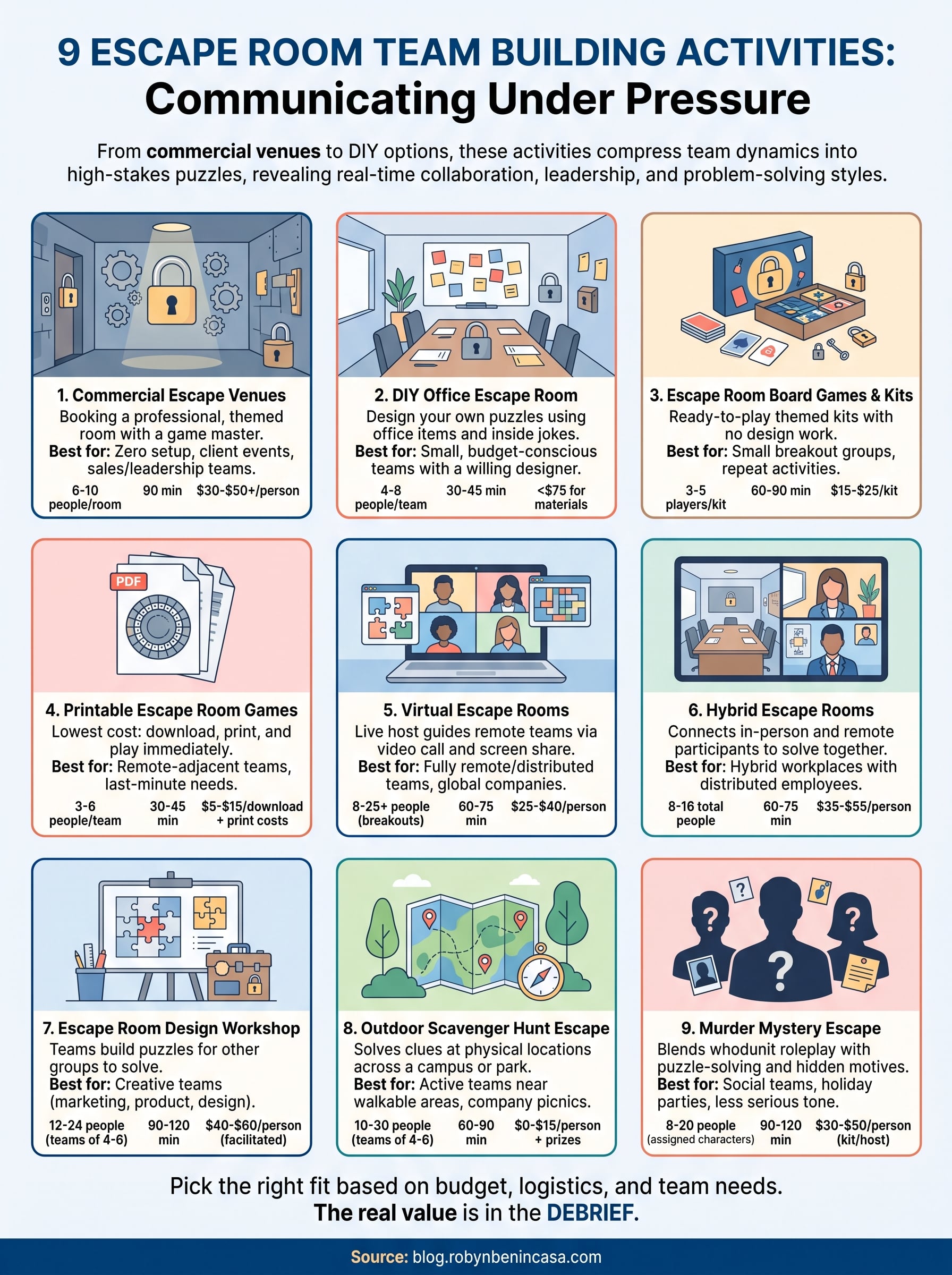
Nine options is a lot of choice, so narrow it down by budget and logistics first, then by what your team actually needs to work on. A distributed team gets more out of a virtual or hybrid room than a downtown scavenger hunt. A group that’s already tight-knit will enjoy the inside jokes of a DIY office build more than strangers at a commercial venue. Whatever escape room team building activities you pick, the puzzle itself is just the container. The real value shows up in the debrief, when you talk through who led, who went quiet, and who solved the thing everyone else missed.
That’s the same lens I use when I work with organizations on building team culture that outlasts a single offsite. If you want help turning a day like this into a lasting shift in how your team performs, here’s how to hire a keynote speaker for your next event and what comes after the locked door opens.