
You can feel the best team culture within five minutes of walking into a room. People back each other up, say what they think, and finish what they start. You can also feel the opposite just as fast. Most leaders know which one they have. Far fewer know how to move from one to the other.
Here is the short answer. The best team cultures are built on shared commitment, not individual talent. In 15 years of world championship adventure racing, my teams won because every member agreed to move at the pace of the team, not the fastest person. The same pattern shows up in firehouses and sales organizations. One sales team I worked with went from 17th to 1st nationally once its culture changed.
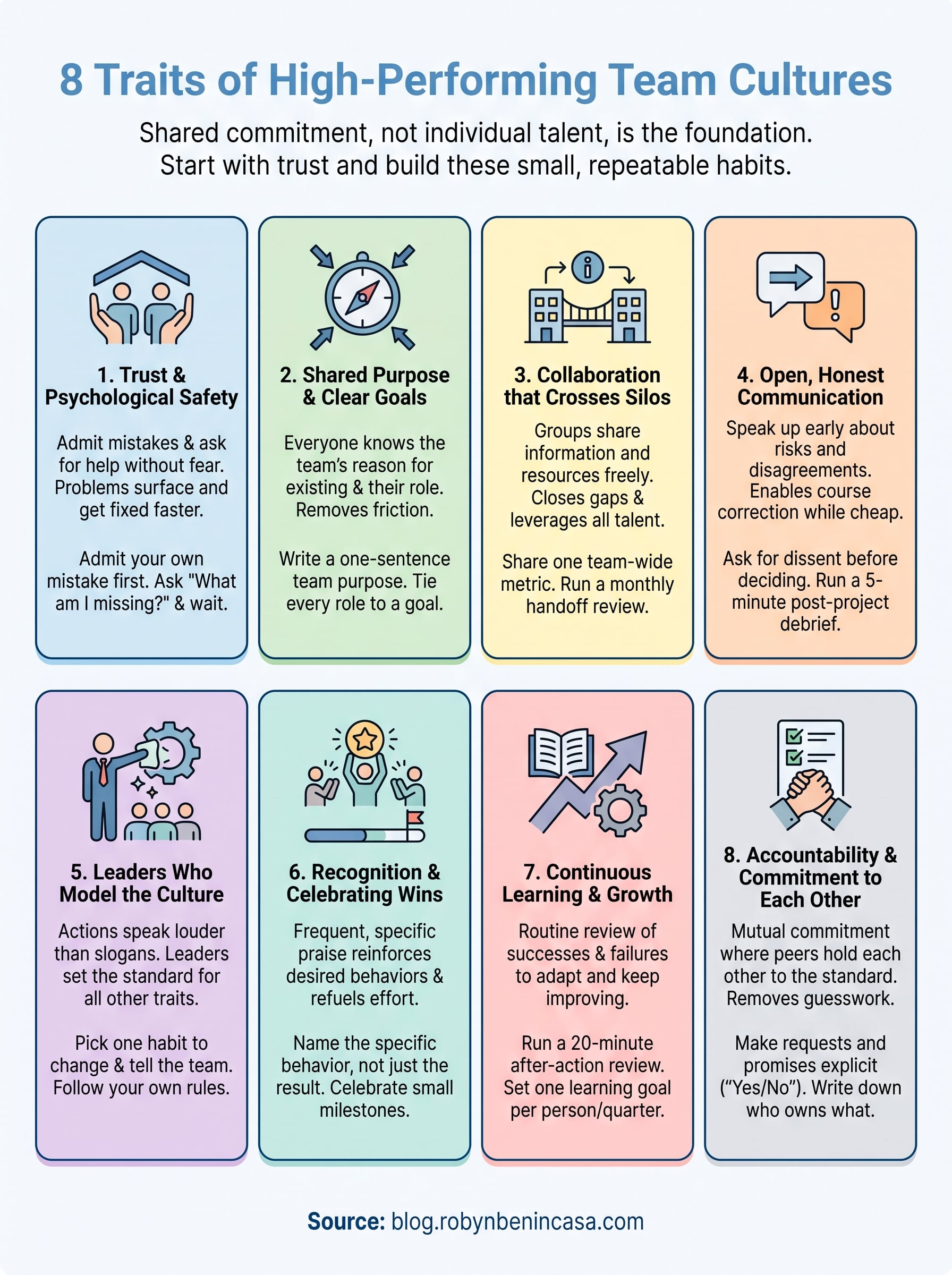
Below, you will find 8 examples and traits of high-performing team cultures, drawn from adventure racing, firefighting, and the companies I have worked with. Each one comes with a practical step you can take this week, whether you lead five people or five hundred.
1. Trust and psychological safety
What it looks like in practice
On a world championship adventure race, four teammates share one map, one tent, and almost no sleep for days. In the best team culture, nobody hides a blister or a bad patch until it becomes a crisis. Struggling teammates ask for help early, and the team responds by redistributing gear or clipping on a tow line, not by judging.

Firehouses work the same way. A rookie can say "I’m not sure about this call" and get a real answer instead of an eye roll. Psychological safety means people can admit mistakes and ask questions without fear of embarrassment or punishment. Everything else on this list rests on it.
Why it drives performance
Google’s Project Aristotle studied 180 internal teams and found that psychological safety was the most important of five dynamics separating effective teams from the rest. You can read the findings in Google’s re:Work guide on team effectiveness. When you set out to build a high-performing team, talent and experience matter far less than whether people feel safe speaking up.
The reason is simple. Problems surface sooner when people feel safe. A hidden mistake costs little at hour one and a lot at hour forty. Teams that report bad news fast also fix it fast, while teams that punish the messenger find out about the problem when it is too late.
Trust is not a perk of a strong team. It is the mechanism that lets a team find and fix its problems.
How to build it on your team
To build trust on your team at work, begin with small, repeatable behaviors, not a company-wide initiative. Your team watches what you do the first time someone makes a mistake, and that moment sets the rules. Try these four moves over the next month:
- Admit your own mistake first. Do it in your next team meeting, out loud, with no excuses.
- Ask "What am I missing?" Then stay quiet for ten full seconds and let someone answer.
- Thank the person who brings bad news. Do it in front of the group, every time.
- Review failures by asking what happened, not who did it. Fix the process before you question the person.
Expect the first few weeks to feel awkward. Silence is normal early on. Keep going, because trust is built by repeated proof, not by a single speech.
2. A shared purpose and clear goals
What it looks like in practice
In adventure racing, the rule is blunt: a team only finishes when all four members cross the line together. Every call, from route choice to pace, traces back to that single goal. Nobody argues about whether to wait for a struggling teammate, because the purpose already answered the question.
You can test any team in one minute. Ask three people what the team exists to do and what they personally own. In the best team culture, you hear the same answer three times, in different words.
Why it drives performance
Clarity removes friction. When goals are specific, people make decisions without waiting for permission, and meetings get shorter because the debate is about how, not why.
Google’s Project Aristotle listed structure and clarity, along with meaning and impact, among the five dynamics of effective teams. Vague goals force people to guess, and guessing splits a team into camps pulling in different directions.
A team that cannot state its goal in one sentence is not yet a team.
How to build it on your team
Write the goal down, then test it against real decisions. Start with these three steps:
- Write a one-sentence team purpose with your people, not for them.
- Set no more than three goals per quarter, each with a number and a date.
- Tie every role to the goal. Ask each person, "How does your work move this forward?"
Revisit the list at the start of every weekly meeting. A goal nobody mentions for a month is a poster, not a goal.
3. Collaboration that crosses silos
What it looks like in practice

Silos form at work when every group chases its own scoreboard. On a fire scene, the engine crew, the truck crew, and the paramedics all have different jobs, yet they run one plan. In the best team culture, nobody says "that’s not my department". People pass along information before anyone asks for it.
You can spot this in an office, too. When a sales rep learns about a delivery problem, does the operations lead hear about it the same day? If the answer is yes, your teams are working as one.
Why it drives performance
Most business problems sit between departments, not inside them. When sales promises what operations cannot deliver, the customer pays for the gap. Shared information closes those gaps before they reach the people you serve.
Silos also waste talent. Good ideas stay trapped in one group while another group solves the same problem from scratch.
Your customer never sees your org chart, only whether your teams act as one.
How to build it on your team
Create a culture of collaboration on purpose, because those connections will not form on their own. Pick one real project this quarter and staff it across two or three departments, which is the simplest form of cross-functional collaboration training. People learn to trust colleagues they have worked beside, not ones they only email.
- Share one team-wide metric. Give every group a number they win or lose on together.
- Run a monthly handoff review. Spend 15 minutes asking where information got stuck between groups.
- Rotate people into each other’s meetings. One visit a quarter is enough to change how teams see each other.
Reward the behavior you want. When someone helps another department hit its goal, say so publicly and make it count in their review.
4. Open, honest communication
What it looks like in practice
In a race that runs around the clock, small things get said out loud. "I’m bonking." "I don’t think this is the right ridgeline." Nobody waits for a polite moment, because a navigation doubt kept quiet for an hour can cost a team half a day.
On a fire engine, crews run a short briefing before every call and talk through what went well afterward. In the best team culture, honesty is routine, not dramatic. People disagree in the room, then commit once the decision is made.
Why it drives performance
Teams act on the information they have. Bad information produces bad decisions, and silence is the most common source of it. When people share what they actually see, leaders can correct course while it is still cheap.
Honest communication also ends the meeting after the meeting. Without it, the real conversation moves to private chats and hallways, and the work stalls while everyone guesses who agreed to what.
A team can only act on what its members are willing to say out loud.
How to build it on your team
Make honesty easy, then make it expected. You do not need a new program, just a few repeatable habits and a handful of communication activities for teams that give people a regular place to speak up:
- Open meetings with a risk check. Ask each person to name one thing that might go wrong.
- Ask for dissent before you decide. Say, "Who sees this differently?" and wait.
- Run a five-minute debrief after each project. Cover what worked, what didn’t, and what changes next time.
- Give feedback within 48 hours. Keep it specific, private, and about behavior, not character.
5. Leaders who model the culture
What it looks like in practice
Culture and leadership are inseparable, because culture is whatever the leader does when nobody is checking. In adventure racing, the captain who asks teammates to share the load is the first to pick up the extra pack. On a fire crew, the officer cleans the rig alongside the rookies after a long shift. Nobody announces the values because everyone sees them.
The reverse is just as visible. A leader who preaches candor but gets defensive when challenged teaches the team one thing: stay quiet. People copy behavior, not slogans.
Why it drives performance
Employees believe what they see. When your words and actions disagree, the team follows your actions every time, and your stated values become noise. Consistency builds credibility, and credibility is what makes people follow you through a hard stretch.
Leaders also set the ceiling for every other trait on this list. Trust, honesty, and accountability rarely grow past what the person at the top demonstrates daily. The best team culture is usually a mirror of its leader’s habits.
Your team will never rise above the standard you are willing to live by.
How to build it on your team
Start with an audit of yourself. Ask two trusted people which of your behaviors the team copies, good or bad. Then pick one habit to change and tell the team you are working on it.
- Write down three values and attach one visible behavior to each.
- Take the least glamorous task on a project, in public, once a month.
- Follow your own rules. If meetings start on time, you arrive early.
- Invite correction. Ask, "Where did I miss our standard this week?"
6. Recognition and celebrating wins
What it looks like in practice

After a brutal stage in a race, our team would stop and name what each person had done. "You carried my pack for six hours." "Your navigation kept us out of the wrong valley." It took two minutes, and it fed everyone for the next leg.
Firehouses do it with less polish. After a tough call, the officer points out the specific thing a rookie did right. In the best team culture, recognition is frequent, specific, and peer to peer, not a plaque handed out once a year.
Why it drives performance
People repeat what gets noticed. Specific recognition tells the team which behaviors to repeat, which makes it one of the cheapest ways to shape culture. Generic praise like "great job, everyone" teaches nothing about what mattered.
Recognition is also where culture and employee engagement meet, refueling effort during long stretches when results come slowly. Teams that celebrate small wins keep their energy for the big ones. Teams that save every cheer for the finish line often burn out in the middle.
What gets recognized gets repeated, so recognize the behavior you want more of.
How to build it on your team
Make appreciation a weekly habit, not a special event. These four moves take almost no budget:
- Name the behavior, not just the result. "You flagged the risk early" beats "nice work."
- Open meetings with shout-outs. Give it two minutes, and let anyone give one.
- Mark milestones, not only finish lines. Celebrate the halfway point of a long project.
- Ask how people like to be thanked. Some love public praise, and some dread it.
Watch for the quiet contributors. Leaders tend to thank the visible people and miss the ones who keep the work moving behind the scenes.
7. Continuous learning and growth
What it looks like in practice
After every race, my teams asked the same three questions: what worked, what cost us time, and what do we change next time. Nobody was exempt, including the captain. In the best team culture, learning is a routine habit, not a reaction to failure.
Firefighters work the same way. Crews drill skills they already have, then review real calls afterward. A veteran still picks up something from a rookie’s fresh eye, and nobody treats that as an insult.
Why it drives performance
Markets, customers, and tools change faster than any job description. A team that stops learning starts falling behind, even while its current numbers look fine. The skills that won last year’s race rarely win this year’s.
Growth also keeps your strongest people. Talented employees leave when they stop developing, and they stay when they can see a path forward. Reviewing mistakes openly also means the same error rarely happens twice.
A team that learns faster than its rivals does not need to be the most talented one.
How to build it on your team
Block time for learning on the calendar, because urgent work will otherwise eat every hour. Then make it a shared practice, not a solo chore:
- Run a 20-minute after-action review at the end of every project. Ask what was supposed to happen, what did happen, and what you will change.
- Set one learning goal per person each quarter, and check progress in your one-on-ones.
- Rotate a 10-minute teach-back into team meetings, so everyone shares something they learned.
- Protect two hours a month for training, and don’t cancel it when a deadline looms.
Start with the review. It costs nothing, and it shows the team that mistakes are material for learning, not for blame.
8. Accountability and commitment to each other
What it looks like in practice
In adventure racing, commitment to each other is the whole strategy. When a teammate’s pace dropped, nobody complained or pulled ahead. We split their pack weight and slowed down together. Everyone knew the others would do the same for them.
Accountability in the best team culture is mutual, not top-down. Peers hold each other to the standard, so the leader is not the only one who speaks up. On a fire crew, a firefighter who skips a gear check hears about it from a colleague long before the captain does.
Why it drives performance
Clear commitments remove the guesswork about who is doing what. When people trust that teammates will deliver, they stop double-checking and start building. Without accountability, your top performers end up carrying the weakest links, and resentment follows.
Peer accountability also works faster than management. A direct word from a colleague today beats a formal review three months from now. Teams that hold each other to the standard stop that standard from drifting.
Real accountability is a promise teammates make to each other, not a rule a boss enforces.
How to build it on your team
To create a culture of accountability, make commitments visible, then follow up on them every week. These four steps keep it simple:
- Write down who owns what. Put one name and one date on every task.
- Make requests and promises explicit. "Can you deliver this by Friday?" deserves a clear yes or no.
- Hold a five-minute weekly check-in. Ask what each person committed to and what got done.
- Address misses quickly and privately. Ask what got in the way, then agree on the next step.
Let the team help write the standards. People keep commitments they helped create, and they police them more gently and more firmly than any manager could. Also praise the person who says "I can’t make this date" early, because early honesty beats silent failure every time.
Where to start with your own team
You do not need to fix all eight traits at once. Pick the one your team needs most, and start with trust, because every other trait depends on it. Then take one step from that section this week, such as admitting your own mistake in your next meeting.
The best team culture is not a poster or an offsite. It is a set of small habits you repeat until the team stops noticing them. Stay consistent for a quarter, and people will speak up sooner and own their commitments more fully.
If you want help turning these traits into results with your own people, consider bringing in a corporate culture keynote speaker. You will find stories from the race course and the firehouse, plus practical ideas for building a culture that lasts.