
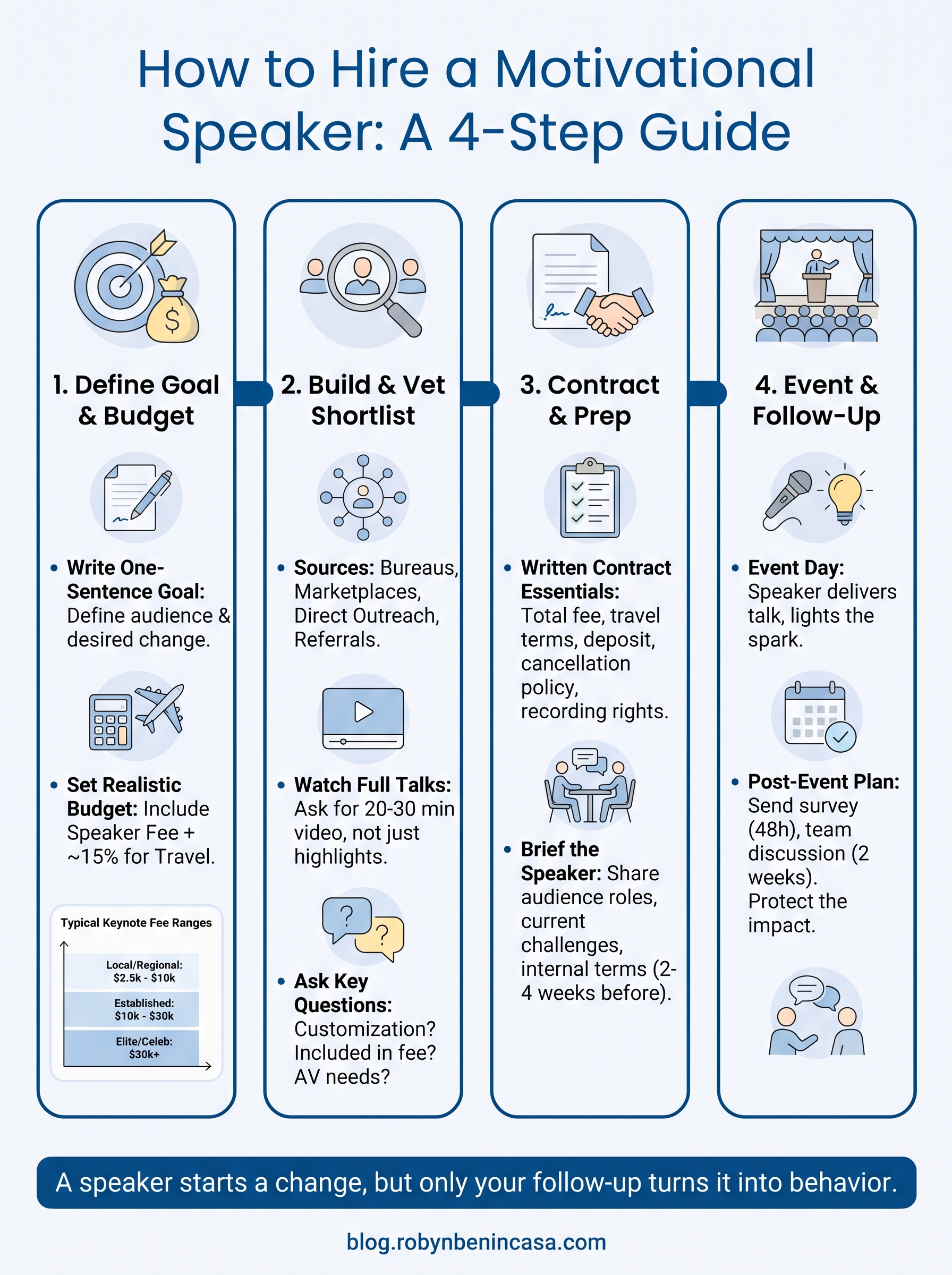
To hire a motivational speaker, define the one change you want your audience to make, set a budget that covers the fee plus travel, and build a shortlist of three to five speakers. Then watch their full-length talks, check references, and put every detail in a written contract. Start three to six months before your event for popular speakers.
The hard part is that the market gives you little to work with. Fees are rarely posted, and a polished promo reel says little about how a speaker handles your audience. A wrong pick is on stage in front of everyone for an hour. Planners often choose on name recognition, then find out the talk has nothing to do with the event’s goal.
This guide covers why hiring a speaker makes sense, then walks through four steps: setting the goal and budget, building a shortlist, vetting candidates, and handling the contract and prep. The examples reflect how keynotes on leadership and teamwork, like Robyn Benincasa’s, are typically booked for corporate events.
Why hire a motivational speaker
Hire a motivational speaker when you need to shift how a room thinks or feels at one specific moment, such as a sales kickoff, a post-merger meeting, or a conference opening. The talk starts a change. It does not finish one.
What a speaker does well
A good speaker gives a group a shared story and a shared language in under an hour. People who sit in separate departments hear the same example, laugh at the same moment, and leave with the same vocabulary. That is hard to get from an email or a slide deck.

A speaker also brings outside credibility. Leadership can say "we need to collaborate" for a year and get nods. A guest who has led a team through real adversity says it once and people repeat it for weeks.
When the investment pays off
The spend is easiest to justify at these moments:
- A sales kickoff or revenue meeting that needs energy and a common goal
- A merger, reorganization, or leadership change
- A tough year when morale has dropped
- A conference or offsite that needs a strong opening or closing keynote
- A new initiative that needs buy-in across silos
A speaker lights the spark, but only your follow-up turns it into behavior.
Step 1. Define the goal and set the budget
Write one sentence that names who is in the room and what you want them to do differently afterward. Then set a budget that includes the speaker’s fee and travel.
Write a one-sentence goal
A usable goal reads like this: "Our 300 sales reps should leave the kickoff ready to share leads across regions." That sentence filters candidates fast. A vague goal such as "inspire the team" lets every speaker look like a fit, and that is how you end up comparing fees instead of fit.
What motivational speakers cost
Fees depend on the speaker’s profile, demand, and date, and most are quoted per event, not posted. These are typical ranges for a live keynote, so treat them as a planning guide:

| Speaker tier | Typical keynote fee |
|---|---|
| Local or regional professional speakers | $2,500 to $10,000 |
| Established speakers and authors | $10,000 to $30,000 |
| Bestselling authors, former executives, elite athletes | $30,000 to $75,000 |
| Celebrities and household names | $75,000 and up |
Virtual keynotes often cost less because there is no travel, but many speakers keep the fee close to their in-person rate. Ask for both numbers.
Work out the real total
Say you plan a 300-person kickoff and choose a speaker at $15,000. Add about 15% for travel (airfare, hotel, ground transport), which is $2,250. Round it up to $2,500 to be safe. Your total is $17,500. Many speakers ask for 50% as a deposit, so $7,500 is due at signing.
Budget for the fee plus roughly 15% for travel, and ask what the quote includes.
Step 2. Build a shortlist of three to five speakers
Pull candidates from at least two channels, then cut the list to three to five speakers whose topics match your goal. More than five makes the comparison slow and muddy.
Where to look
Each source has a different strength:
- Speaker bureaus and agencies handle matching and negotiation. The bureau’s commission usually comes out of the speaker’s fee, so you often pay the same quoted rate.
- Online speaker marketplaces let you filter by topic, budget, and location and request several quotes at once.
- Direct outreach works when you already know a name. Check the speaker’s website for a booking page.
- Peer referrals from planners at similar companies are the most reliable source of honest feedback.
Local or national pool
A local speaker cuts travel cost and gives you scheduling flexibility if your date moves. A national pool gives you more topic choices and more specialized experience. If your budget is under $10,000, start local. If the talk must match a precise theme, search wider.
Match the talk to the goal
Check that the speaker’s catalog maps to your situation. Robyn Benincasa’s keynotes show how a clear catalog works:
| Your situation | Keynote | Length |
|---|---|---|
| Sales kickoff or competitive team | Why Winners Win | 30 to 60 min |
| Disruption, AI change, culture reset | Adapt, Overcome, and Win as One | 45 to 60 min |
| Tough year or stretch goal | Inspiring Greatness through G.R.I.T. | 45 to 60 min |
| Building a connected team culture | Extreme T.E.A.M.W.O.R.K. | 45 to 60 min |
If a speaker cannot say which of their talks fits your goal, keep looking.
Step 3. Vet and compare your shortlist
Judge each candidate on full-length footage, direct answers to a few specific questions, and a conversation with a past client. Skip anyone who only offers a highlight reel.
Watch full-length talks
A three-minute reel shows the best moments. Ask for a full 20 to 30 minute video of a live keynote. Watch for stories that connect to a point, how the audience reacts, and whether the speaker gives people something to do on Monday. Note whether the room looks like your room in size and industry.
Ask these five questions
- How will you customize the talk for our audience?
- Which similar events or industries have you spoken to?
- What is included in your fee, and what is billed separately?
- What audio-visual setup do you need?
- Can I talk to a planner who booked you for a similar event?
A confident speaker answers the first question with specifics, such as pre-event interviews with your leaders. A generic answer means a generic talk.
Check references
Call the planner, not the executive who enjoyed the talk. Ask whether the speaker was easy to work with, arrived on time, stuck to the agreed length, and responded to the brief. Two calls are enough to catch most problems.
Full-length footage and a planner reference tell you more than any promo reel.
Step 4. Contract, brief, and follow up
Sign a written agreement that covers fee, travel, schedule, and cancellation. Then brief the speaker on your audience and plan the follow-up before the date arrives.
What goes in the contract
Make sure the agreement states:
- The total fee and exactly what it includes
- Who pays for travel, and the limits on class of travel and lodging
- Deposit amount and payment schedule
- Cancellation and postponement terms for both sides
- Talk length, Q&A time, and any breakout sessions
- Recording and rights to share the video
- Audio-visual and stage requirements
Brief the speaker, then follow up
Book a 30-minute call with the speaker two to four weeks before the event. Share attendee roles, the challenges your team faces right now, internal terms to use or avoid, and what happens earlier in the agenda. This is how a speaker tailors the talk.
After the event, send a short survey within 48 hours. Within two weeks, have managers run a 15-minute team discussion on one idea from the talk. Without a follow-up, even a great keynote fades within a month.
A signed contract protects the date, and a post-event plan protects the impact.
Start with a clear goal
Hiring well comes down to a clear goal, a realistic budget, a short list, full-length footage, and a thorough contract. Most bad bookings skip the first step. If you can state who is in the room and what you want them to do differently, the rest of the process gets much easier.
If your event centers on leadership, teamwork, or culture, you can explore Robyn Benincasa’s keynotes and booking options to see how a speaker’s talks map to goals like these.