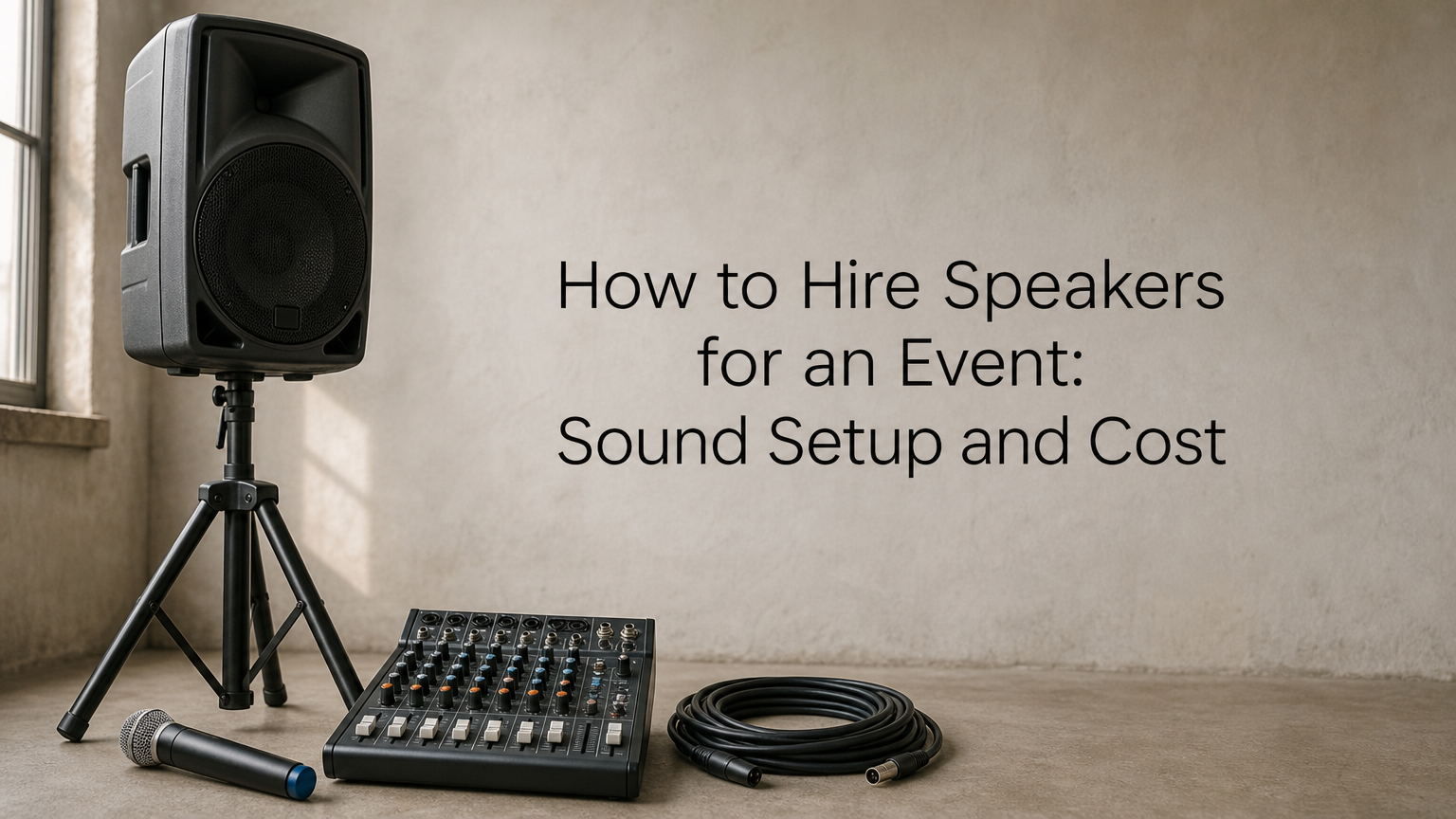
To hire speakers for an event, count your guests, decide whether the sound will carry speech, music or video, and ask two or three local rental companies to quote the same setup. A pair of powered speakers, a small mixer and a wireless microphone cover most meetings and luncheons. Budget for delivery, setup and a technician, not just the gear.
Most planners go wrong in one of two ways. They rent a rig built for a concert when a luncheon needs clear speech, or they rent one small speaker for a 200-person ballroom and hear complaints from the back rows. Quotes also arrive in different formats, so comparing them is hard, and the real costs show up later as line items.
This guide walks you through four steps: matching the setup to the event, pricing the rental, vetting local providers, and testing before doors open. It also covers the other meaning of the phrase, booking a person to speak, because the two jobs meet on stage day. We write from the keynote side of the stage, where bad audio costs you the room.
Before you start: what you are actually hiring
Hiring speakers for an event means one of two things: renting loudspeakers and sound gear, or booking a person to speak. Most events need both, and they are separate contracts with separate costs.
Loudspeakers or a keynote speaker?
An audio rental company delivers equipment, sets it up and often runs it. A keynote speaker is booked through the speaker’s own team or a bureau, with a fee quoted per engagement plus travel. If you are looking to hire event speakers in the human sense, ask for the talk length early, because it drives your audio plan.
Robyn Benincasa’s keynotes, for example, run 30 to 60 minutes depending on the topic. That means power and batteries must last a full hour with margin.
Rent the sound and book the speaker as two contracts, then make sure they agree on technical needs.
Five facts to gather before you call
Providers can only quote what you can describe. Collect these first:
- Headcount: the number of seated or standing guests.
- Room: its size and ceiling height, and whether it is indoors or outdoors.
- Content: speech only, speech with video, live music, or a DJ.
- Schedule: date, doors-open time, and how long the program runs.
- Logistics: power outlets, load-in access and how early you can enter the venue.
Step 1. Match the setup to your event
Choose the setup by content first and headcount second. Speech needs clarity, music needs low-end power, and video needs a clean audio feed from the presenter’s laptop.
Pick by content type
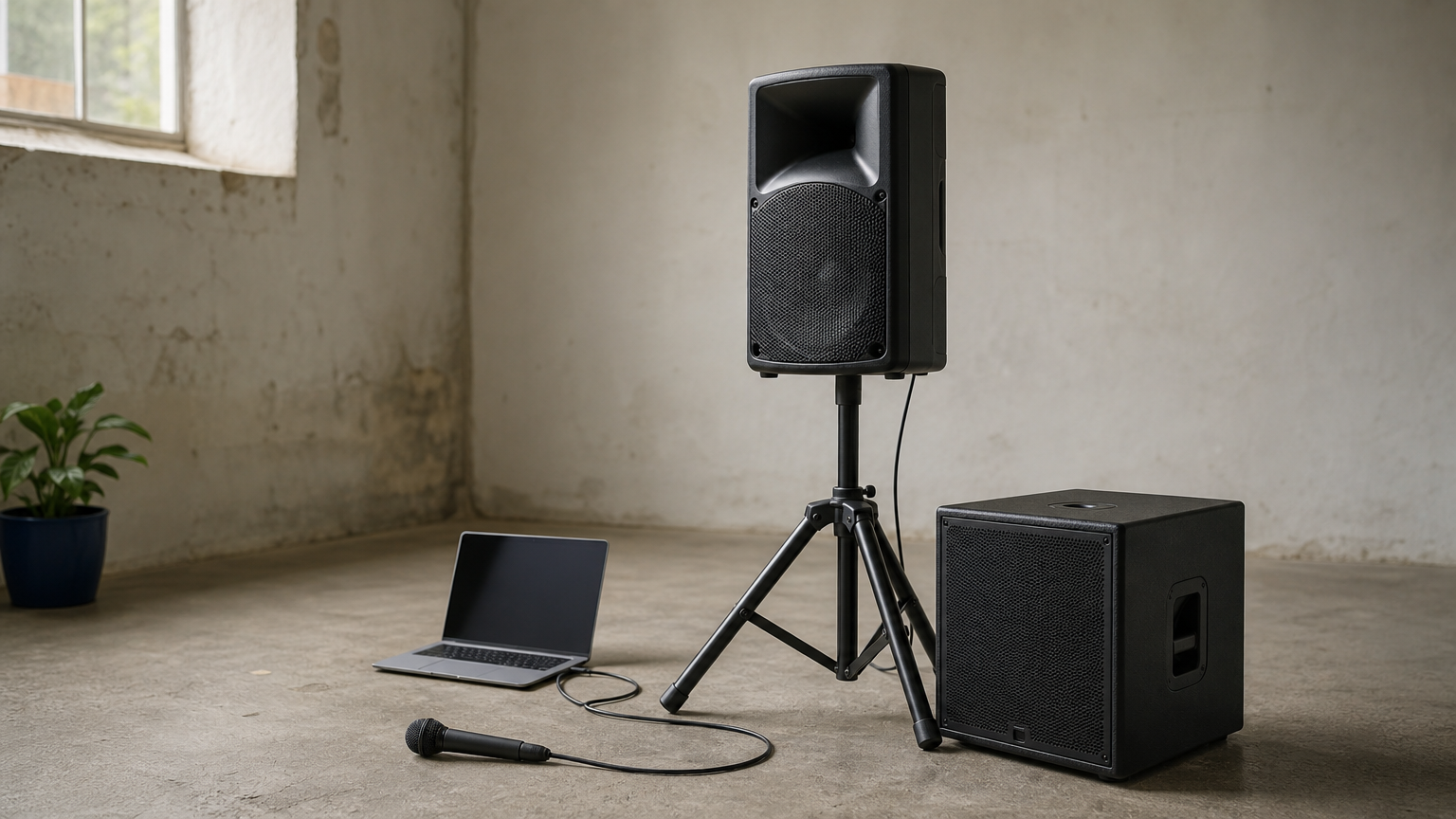
For speech-only events such as keynotes, toasts and award ceremonies, you want full-range powered speakers and wireless microphones, with no subwoofer. For music or dancing, add subwoofers, because small speakers cannot move enough low-frequency air to fill a room. For presentations with video clips, you need a mixer input for the laptop, so say so when you request a quote.
Pick by crowd size
Use this table as a starting point. These are rough planning figures, and hard walls, low ceilings and open air change the answer, so let the provider confirm sizing.
| Event | Guests | Typical setup |
|---|---|---|
| Small meeting | Up to 40 | One powered speaker, one wireless mic |
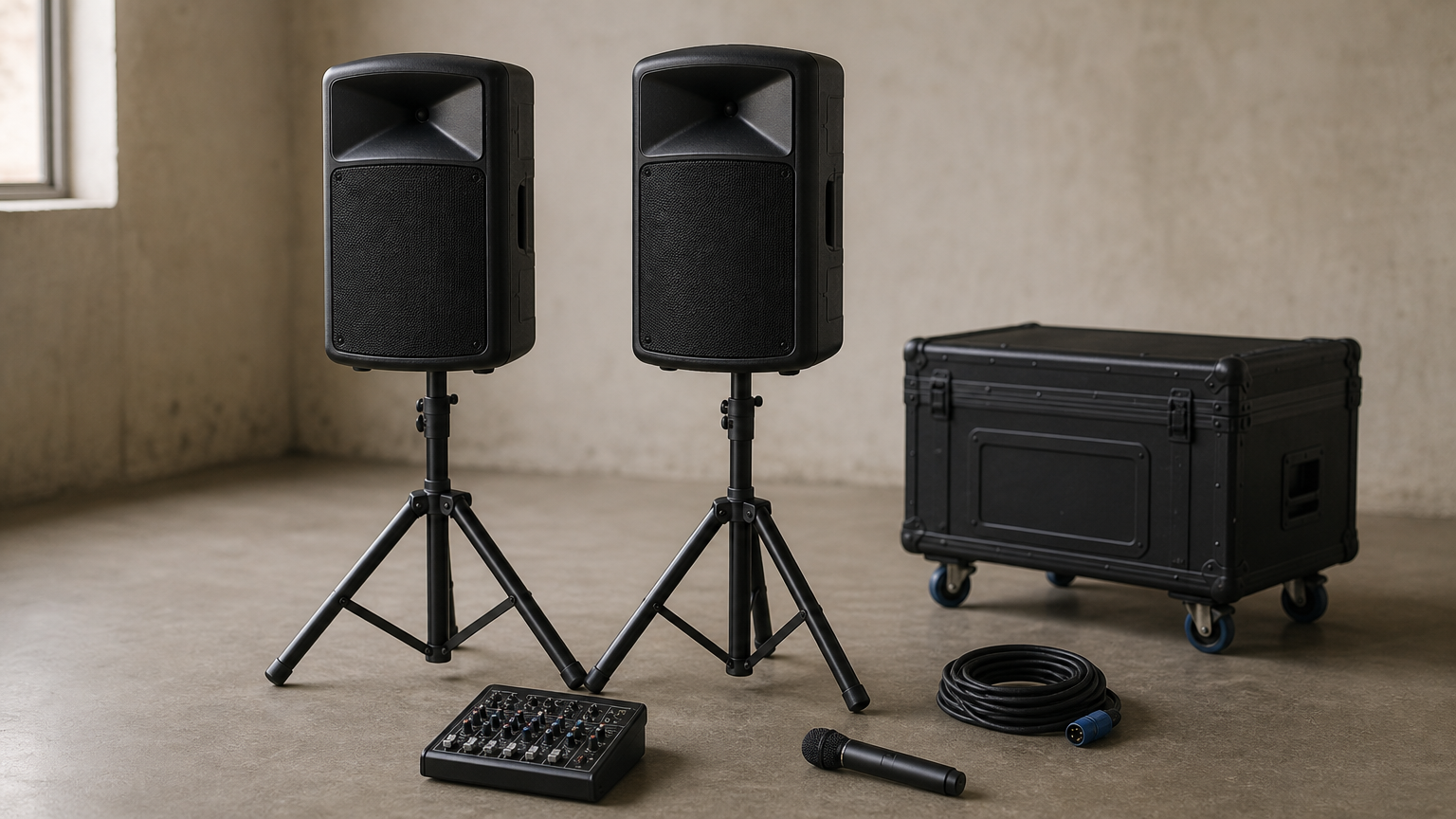
| Luncheon or breakout | 50 to 150 | Pair of powered 12 or 15 inch speakers on stands, small mixer, two wireless mics |
| Ballroom general session | 150 to 400 | Larger speaker pair or small line array, delay speakers for long rooms, an operator |
| Party with music | 50 and up | Speaker pair plus one or two subwoofers, DJ mixer |
| Outdoor event | Any | Extra speakers, since open air has no walls to reflect sound |
Size the rig to the room and the content, not to the biggest event you can imagine.
Step 2. Get itemized quotes and budget the total
Budget for the whole package: gear, delivery, setup, a technician and a deposit. The daily rate on a speaker listing is only one line of that total.
What drives the price
Rental prices vary by market and provider. These are the factors that move a quote:
- Quantity and size of speakers, plus subwoofers and microphones.
- Rental length. Many providers discount multi-day or weekly rentals.
- Delivery distance and the load-in difficulty, such as stairs or a long carry.
- On-site technician time, usually billed by the hour.
- Deposit, insurance and damage terms.
Speaker fees for a person are separate. A keynote fee is quoted per engagement, so request it from the speaker’s team.
A worked example: 120-person luncheon
Here is an illustrative budget for a keynote luncheon in a hotel ballroom. The numbers are planning figures, so use them to sanity-check real quotes, not as a price list.
| Item | Cost |
|---|---|
| Two powered 12 inch speakers with stands (2 × $100) | $200 |
| Wireless handheld mic | $40 |
| Small mixer | $40 |
| Cables and power | $20 |
| Delivery and pickup | $100 |
| Setup and operator, 3 hours | $150 |
| Total | $550 |
If your quote is far above this, ask which line is driving it. If it is far below, check what is missing, usually the technician or the delivery.
A cheap day rate with no setup is not a cheap quote.
Step 3. Vet local providers and compare quotes
Pick the provider who quotes your exact setup in writing, can load in on your schedule and has backup gear. Price should break ties, not lead the decision.
Where to find local providers
Search "speaker rental near me" with your city name, then open the listings and compare inventory and delivery area. Ask your venue first, since many have in-house audio or a preferred vendor list, and some charge a fee for outside gear. If you have booked a keynote speaker, ask their team who they have worked with in your area.
Send each provider the same request so the quotes line up:
Event: [type], [date], doors at [time], program [start to end]
Venue: [name and address], [indoor/outdoor], load-in at [time]
Guests: [number]
Audio needs: [speech / music / video playback from laptop]
Please quote: speakers, subwoofers (if needed), mixer, [number] wireless
mics, delivery, setup, operator, pickup, deposit and damage terms.
Please include a backup plan if a mic or speaker fails.
Questions to ask before you pay a deposit
- Which speaker models will you send, and what room size are they rated for?
- Is a technician included, and for how many hours?
- What happens if a microphone or speaker fails mid-event?
- What are the power and cabling requirements at my venue?
- What is the cancellation and damage policy?
Ask every provider the same questions, and trust the one who answers with specifics.
Step 4. Test the sound before guests arrive
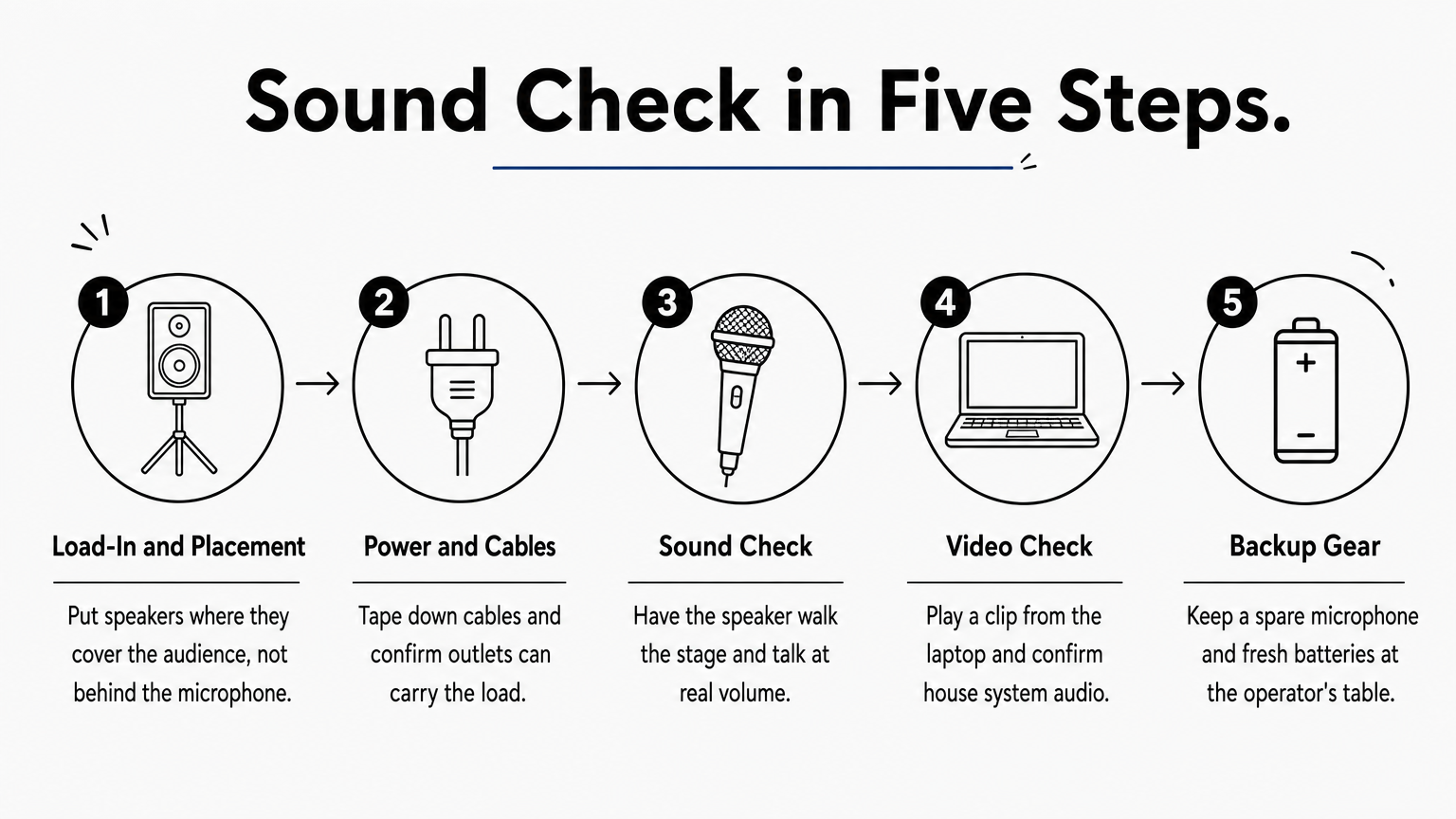
Schedule delivery at least two hours before doors open and run a full sound check with the person who will speak. A check with an empty room catches most problems.
A day-of timeline
- Load-in and placement: put speakers where they cover the audience, not behind the microphone.
- Power and cables: tape down cables and confirm outlets can carry the load.
- Sound check: have the speaker walk the stage and talk at real volume, then listen from the back row.
- Video check: play a clip from the presenter’s laptop and confirm the audio comes through the house system.
- Backup: keep a spare microphone and fresh batteries at the operator’s table.
If you booked a keynote speaker too
Send the speaker’s team your audio plan well before the event. Keynotes with video depend on clean laptop-to-speaker playback. Robyn’s Extreme T.E.A.M.W.O.R.K. keynote, for instance, uses videos of ordinary people achieving extraordinary things together, so a silent or muddy clip costs real impact. Ask which microphone style the speaker prefers, usually a headset or lavalier for hands-free movement, and confirm it with your provider.
A great talk through bad sound is a bad talk, so sound check with the speaker, not before them.
Book the sound, then the stage
Hiring speakers for an event comes down to four moves: match the setup to your content and headcount, price the whole package, vet providers with identical questions, and sound check with the actual speaker. Do those and you avoid the two classic failures, an overbuilt rig and a room that cannot hear.
If you are also choosing a person for the stage, you can find more guides on working with event speakers at Robyn Benincasa’s blog on keynotes, team building and event planning.