
The best leadership training for non-managers teaches you to influence people, communicate clearly, and lead change without a title, and it lets you practice on real work. Five formats do this well: a live team keynote, instructor-led courses, free online courses, stretch assignments with a mentor, and peer groups with coaching. Teams that want a shared starting point should pick the keynote. Individuals with a budget should pick a course. Anyone starting from zero should begin with a free course or a stretch assignment.
The problem is that most leadership programs are built for people who already manage. If you have no direct reports, you scroll past course pages that assume you do. Yet you still have to get work done through others, persuade peers, and steer projects when nobody reports to you. The wrong format wastes weeks, and a format that never touches your daily work fades fast.
This article compares the five formats, shows what each covers, who it suits, and what it costs in time and money, then helps you choose. Robyn Benincasa is a former San Diego firefighter and world champion adventure racer who speaks to organizations on teamwork. Her keynote is the first option, with honest limits on what a keynote can and cannot do.
1. Live team keynote for the whole department
A live keynote works best as the starting point for a whole team, individual contributors included, not as a full skills course. It gives everyone one shared language for leading from any seat, and you build the skills afterward through practice.

What it covers
Robyn Benincasa’s Extreme T.E.A.M.W.O.R.K. keynote teaches the 8 elements of a winning team culture through storytelling and videos of ordinary people achieving extraordinary things together. It is based on her New York Times bestseller Make Winning Inevitable. The lessons come from her years leading adventure racing teams and working as a San Diego firefighter. Pick the keynote that matches your situation:
- Extreme T.E.A.M.W.O.R.K. (45–60 min): organizations that need a connected team culture.
- Why Winners Win (30–60 min): sales meetings, revenue kickoffs, and competitive teams.
- Adapt, Overcome, and Win as One (45–60 min): AI transformation, industry disruption, and culture resets.
- Inspiring Greatness through G.R.I.T. (45–60 min): teams facing adversity, tough years, or stretch goals.
Who it suits and what it costs
This format suits HR leaders and event planners who want managers and non-managers hearing the same message at an offsite, kickoff, or conference. Virtual delivery is available if your team is distributed. To book, contact bookrobyn@worldclassteams.com.
A keynote runs under an hour, so it cannot replace practice. Treat it as the spark, then pair it with one of the options below.
A keynote starts the conversation about leading without a title, but only practice turns it into skill.
2. Instructor-led courses for non-supervisors
Instructor-led courses give you structured skill-building with feedback from a trainer and a room of peers. Professional-training firms, associations, and graduate schools run them in classrooms and live virtual sessions.
What they cover
Courses aimed at individual contributors and non-supervisors usually focus on influence without authority, communication, and leading change. Typical modules include:
- Making clear asks and getting reliable agreement
- Giving and receiving feedback
- Understanding leadership styles and behaviors
- Leading through change in an organization
- Keeping work visible and moving across teams
Catalogs label these courses "non-supervisors," "non-managers," or "individual contributors." Use those words when you search, because a generic "leadership course" is usually written for people with direct reports.
Who it suits and what it costs
These courses suit people whose employer sponsors training and who learn best with a live group. Seat prices vary widely by provider, so compare the total cost, including travel and time away from work.
Before you enroll, check four things: whether there are practice exercises, whether the instructor gives personal feedback, how large the class is, and whether you leave with an action plan for your own job. Look for a course that makes you work through a real problem from your job instead of only listening.
A good course makes you practice on a real problem from your own job, not just listen to concepts.
3. Free and low-cost online courses
Free leadership training for non-managers exists, and it is the lowest-risk way to find out whether you enjoy leadership topics. University-backed platforms, nonprofit training sites, and LinkedIn Learning-style libraries all offer self-paced courses.

What they cover
Free courses lean toward fundamentals: goal setting with SMART goals, people-management basics, the difference between leading and managing, and workplace communication. Some are written for managers, but they still help you. They show you how managers think, which makes you better at working with them and ready when a promotion arrives.
Some platforms let you watch for free and charge only for a certificate. Decide upfront whether you need the credential or just the learning.
Who it suits and what it costs
This option suits self-starters, remote workers, and anyone on a tight budget. The weakness is that nobody gives you feedback, and it is easy to drop a course in week three. A simple schedule fixes most of that. Spend 3 hours a week for 8 weeks, which is 24 hours in total, and apply one lesson at work each week. For instance, week two covers feedback, so you ask a colleague for feedback on one presentation.
Free courses cost nothing but only work if you schedule them and apply one lesson every week.
4. Stretch assignments with a mentor
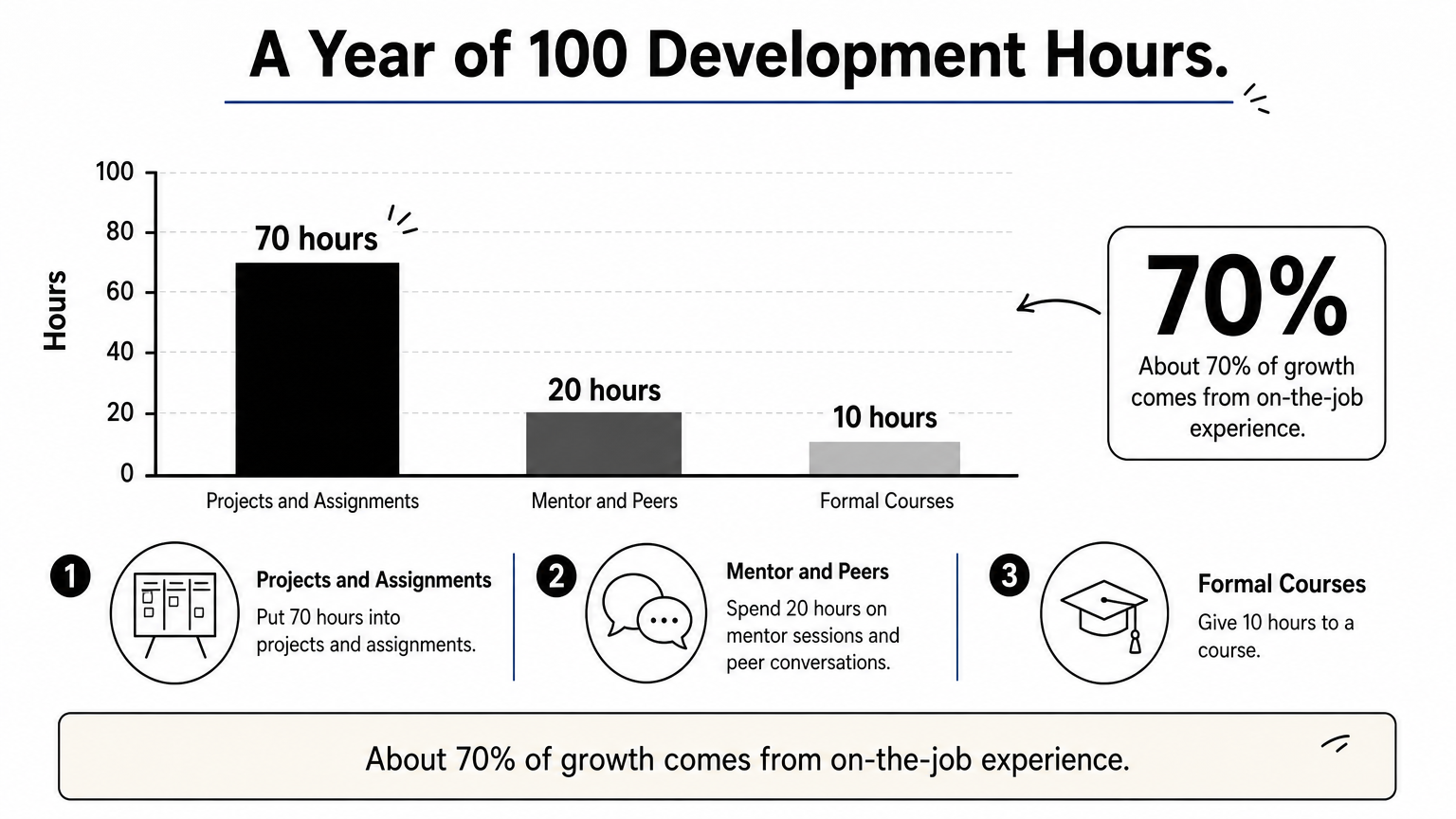
Stretch assignments with a mentor are the most effective option because they build leadership on real work. A widely used development model, the 70-20-10 rule, says about 70% of growth comes from on-the-job experience, 20% from other people, and 10% from formal courses.
What it looks like
Ask to lead something small but visible, and find a senior person who will give you honest feedback afterward. Good assignments include:
- Leading a cross-team project or launch
- Onboarding and coaching a new hire
- Running a meeting series or retrospective
- Presenting results to executives
- Mediating a disagreement between two groups
After each one, spend 20 minutes with your mentor on what worked and what you would change.
Who it suits and what it costs
This suits anyone with a live project and a supportive manager. There is no direct cost, but you pay in time and need your manager’s backing. Pitch it as a benefit to the team, not as a personal favor.
Here is the 70-20-10 split applied to a year with 100 hours of development time. Put 70 hours into projects and assignments, 20 hours into mentor sessions and peer conversations, and 10 hours into a course. If you want leadership practice, put your hours here first.
Most of your leadership growth will come from the projects you lead, not the courses you take.
5. Peer learning groups and coaching
Peer groups and coaching add what self-study lacks, which is other people telling you how you came across. A group of four to eight colleagues who meet every other week is enough, and one-on-one coaching works for specific problems.
What it looks like
A simple peer circle runs on a repeating format:
- Everyone reads the same short chapter or article beforehand.
- One member brings a real situation, such as a stalled project or a difficult peer.
- The group asks questions before offering advice.
- The member commits to one action and reports back next meeting.
A professional coach works differently. You agree on a goal and a fixed number of sessions, and the coach pushes you to follow through between them.
Who it suits and what it costs
Peer circles suit people who have taken a course but stall when applying it. They cost nothing except time, and rotating the facilitator keeps them going. Coaching is paid per session or per package, and prices vary by coach, so ask for the total before you commit.
A group that holds you to one action per meeting beats any course you finish and forget.
How to choose the right option for you
Choose by who is paying and how much feedback you need. The decision is simple once you separate team-wide needs from personal ones.
Compare the five formats side by side
| Option | Best for | Time | Cost |
|---|---|---|---|
| Live team keynote | Whole teams needing a shared culture | 30–60 minutes per session | – |
| Instructor-led course | Sponsored individuals who want feedback | Varies by provider | Per-seat fee |
| Free or low-cost online course | Self-starters on a tight budget | Self-paced | Free to low |
| Stretch assignment with mentor | Anyone with a live project | Months, alongside regular work | No direct cost |
| Peer group or coaching | People who stall on applying lessons | Recurring sessions | Free (peers) to per-session (coach) |
Build a combination that fits
Combining formats beats picking one. For almost no money, take a free course, volunteer for one stretch assignment, and start a peer circle. If you wonder how to lead when you are not a manager, that combination covers it: you own outcomes, communicate early, and help others succeed. If you are the one buying for a team, start with a keynote and make the practice formats part of the plan afterward.
The cheapest strong plan is a free course, one stretch assignment, and a peer group that meets regularly.
Pick one format and start this month
Leadership training for non-managers works when it builds influence, communication, and change skills on real work. A keynote starts the conversation for a team, a course adds structure, a free course tests your interest, a stretch assignment builds the skills, and a peer group keeps you accountable. You do not need a title to start any of them. You need one format and a date on your calendar.
If you lead a team and want a shared starting point, explore Robyn Benincasa’s keynotes and team-building resources and see which of her four talks fits your next kickoff or offsite.