Mindfulness resilience training is a structured program that teaches you to notice your thoughts, emotions, and body sensations without judging them, so you recover faster when stress or adversity hits. Mindfulness is the skill. Resilience is the result: the capacity to bounce back and keep functioning. Programs range from a handful of short online sessions to eight-week courses, and first responders, healthcare workers, and office teams all use them.
This article explains why the training matters, how programs are built, what research shows about stress and burnout, and how to choose a course that fits you. It also marks where the evidence is thin, because any program that promises to cure burnout deserves skepticism.
Robyn Benincasa spent more than 20 years as a San Diego firefighter and led world championship adventure racing teams through punishing conditions. She now speaks to organizations about team culture. Pressure is the common thread in all of that work, which is why this topic belongs on this blog, and why the article treats resilience as something you build both alone and together.
Why mindfulness resilience training matters
Mindfulness resilience training matters because it targets the habits that turn ordinary stress into burnout: rumination, avoidance, and reacting before you think. It also fits into a busy week, since many programs ask for minutes a day rather than hours.
How stress turns into burnout
Burnout builds when demands stay high and recovery stays low. Over months, people start to cope by avoiding. They skip hard conversations, numb out, or replay problems at night. A West Virginia project for police officers, firefighters, and emergency medical personnel tested a mindfulness program because avoidant coping strategies are common in that work and leave work-related trauma unaddressed.
Mindfulness trains the opposite move. You notice the stress response as it starts, stay with it long enough to see it clearly, and then choose what to do next.
Who gets the most from it
The training is aimed at jobs and life stages where pressure is constant. Common audiences include:
- First responders: Mindfulness-Based Resilience Training (MBRT) is a preventive intervention tailored to them to reduce outcomes such as burnout.
- Frontline health workers: Compressed formats fit around shift schedules.
- Office and remote employees: Self-paced online programs fit around meetings.
- Anyone in a tough stretch: Mergers, layoffs, and caregiving all qualify.
The word "preventive" matters here. These programs work best when you start before you are depleted, not after.
Mindfulness resilience training treats resilience as a skill you practice, not a trait you either have or lack.
How mindfulness resilience training works in practice
Most programs combine guided meditation, short skills practice, and daily home practice over four to eight weeks, while workplace versions shrink to a few short online sessions.
What a program teaches
The exact mix varies, but these building blocks appear again and again:
- Mindfulness meditation: You anchor attention on the breath or body and return to it each time your mind wanders.
- Breath-work: You slow your breathing to settle the body when it is activated.
- Compassion meditation: You direct kindness toward yourself and others, which compassion-based courses add to standard mindfulness.
- Imagery: You use mental pictures to practice calm or recovery.
- Emotion regulation skills: You learn to name a feeling and respond to it instead of being driven by it.
Sessions teach the techniques. Daily repetition is what makes them hold under pressure.
Program formats compared
| Format | Typical length | What it includes |
|---|---|---|
| Compassion-based resilience course | 8 weeks | Mindfulness and compassion meditation, imagery, breath-work |
| Introductory resilience course | 4 weeks | Basic mindfulness and emotion regulation skills |
| Online workplace program (Resilience@Work) | 6 self-paced sessions of about 20 to 25 minutes | Internet-based mindfulness training for employees |
| First responder program (MBRT) | Compressed residential format | Mindfulness skills tailored to police, fire, and EMS work |
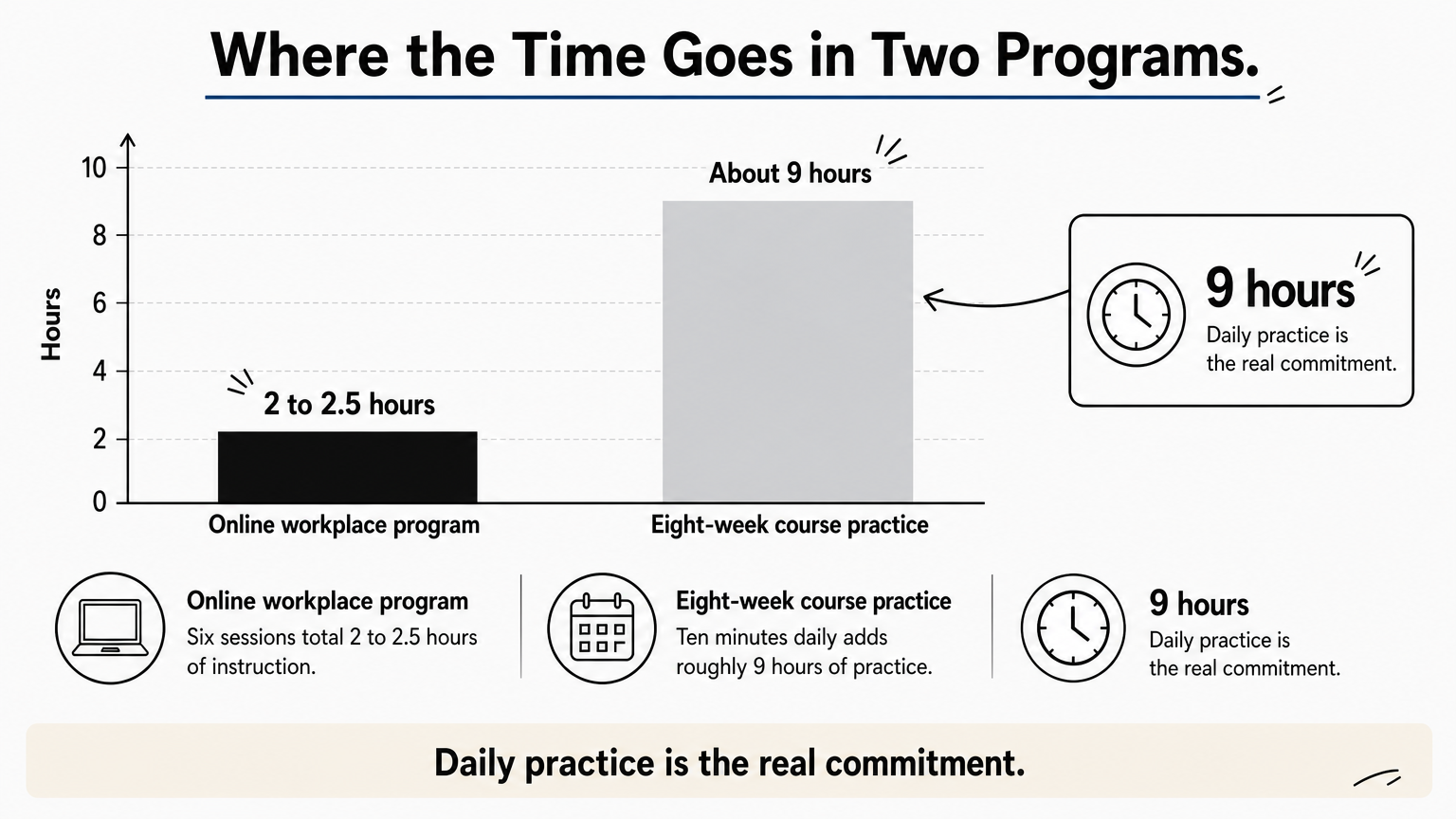
Look at the real time cost. Six online sessions at 20 to 25 minutes each add up to 2 to 2.5 hours of instruction. An eight-week course with 10 minutes of daily practice adds roughly 9 hours of practice (56 days times 10 minutes) on top of the class time.
The real commitment of any program is the daily practice between sessions, not the sessions themselves.
Frameworks and acronyms you will see
You may run into "the 7 C’s of resilience." That is pediatrician Kenneth Ginsburg’s model for young people: competence, confidence, connection, character, contribution, coping, and control. Lists like "5 C’s of mindfulness" or "5 R’s of mindfulness" are different. Teachers create these as memory aids, and no single standard version exists, so judge a course by what it teaches and how, not by its acronym.
What the research shows about stress and burnout
Research suggests mindfulness-based programs modestly reduce stress and improve emotional regulation, but results vary and many studies are small or early-stage.
Results from workplace and first responder programs
In the West Virginia MBRT project, participants reported significant improvements in emotional intelligence, emotional regulation, occupational stress, and fatigue. Perceived stress, anger, and mindfulness moved in the right direction, but those changes only approached statistical significance.
The six-session Resilience@Work program was tested as a pilot study in the Journal of Occupational Health Psychology. It was designed to enhance psychological resilience among workers through self-paced internet training. A pilot shows a design is workable and promising. It does not settle how big the benefit is.
What happens in the brain
Neuroimaging studies of regular meditators report differences in prefrontal regions and in the default mode network, which is linked to mind-wandering and rumination. That fits the idea that mindfulness reduces ruminative thinking. Still, brain scan findings are being replicated and refined, and a scan difference does not prove that a given course will help you.

Limits to keep in mind
Read any claim about these programs against a few caveats:
- Many outcomes are self-reported, so expectations can color the results.
- Samples are often small, and some studies have no comparison group.
- Follow-up is usually short, so long-term effects are less clear.
- Mindfulness training is not a treatment for clinical depression or PTSD on its own. If you live with either, talk to a licensed clinician first.
- Some people, especially those with a trauma history, find silent meditation distressing. Good programs let you adapt or opt out.
A pilot result tells you a program is promising, not proven.
How to choose and start a program
Choose by matching the program to your audience, your available time, and the teacher’s training, then commit to short daily practice.
Five questions to ask before you enroll
- Is it built for people like you? A program designed for first responders differs from one for remote office staff.
- How much time does it need each week? Count the home practice, not just class time.
- Who teaches it? Ask about their mindfulness training and their experience with your population.
- Does it report outcomes honestly? Look for named measures and sample sizes, not only testimonials.
- Does it handle difficult experiences? Check for options to modify or pause practices.
If a provider cannot answer these plainly, keep looking. A good program is happy to explain its design.
Where team culture fits
Resilience under pressure is also social. A person who has learned to steady their own attention still struggles on a team with no trust. Robyn Benincasa’s keynote Inspiring Greatness through G.R.I.T. is built for teams facing adversity, tough years, or stretch goals, and it runs 45 to 60 minutes. Its premise is that real grit comes from connection.
A keynote does not replace a multi-week mindfulness course. Treat it as the shared starting point and the course as the skill-building that follows.
Individual practice builds the skill, and a connected team gives that skill somewhere to hold.
Putting resilience training to work
Mindfulness resilience training teaches you to notice stress early and respond on purpose. It works through short, repeated practice over four to eight weeks, and the best evidence so far shows modest gains in stress, emotional regulation, and fatigue. Choose a program built for your situation, check how honestly it reports results, and seek clinical care when your struggles go beyond everyday stress.
Resilience also lives in how people work together. If your organization wants a team that holds up through disruption and hard years, explore Robyn Benincasa’s keynotes on team resilience and see which one fits your next event.