The best leadership training and development companies share three traits: research behind the curriculum, a format that fits how your leaders learn, and a way to measure behavior change afterward. Center for Creative Leadership and DDI suit organizations building a leadership pipeline. FranklinCovey and Dale Carnegie suit teams that want a repeatable skills curriculum. Vistage suits CEOs who want a standing peer group. Robyn Benincasa suits leaders who need one high-energy keynote to launch or reinforce a culture change.
The problem is that every provider’s website says it is the best. Prices run from a few thousand dollars per person to multi-year enterprise contracts. Without a clear view of format and fit, you can spend a full budget on a program your managers finish and forget.
This article compares six providers on the same terms: what they teach, who they suit, and what to expect on cost. Each entry also names its limits. Use it to shortlist the right providers for your managers and executives, and to ask sharper questions on your first call.
1. Robyn Benincasa
Robyn Benincasa is the right pick when you need a high-energy keynote to start a leadership program, align a team around a shared culture, or restart momentum after a hard year. Full disclosure: this is her blog, so she is listed first. She is a speaker, not a multi-week training firm.

How it works
Robyn built her teaching on two careers. She was a San Diego firefighter for more than 20 years and led adventure racing teams to world championship level. Her T.E.A.M.W.O.R.K. keynote teaches the 8 elements of a winning team culture, drawn from her New York Times bestselling book Make Winning Inevitable.
Audiences hear stories and see video of ordinary people achieving extraordinary things together. The takeaway is practical: how a team builds trust, shares the load, and wins as one. Organizations such as Boston Scientific have booked her for this work.
A keynote starts the change, and a curriculum from the providers below sustains it.
Who it suits and what it costs
Choose Robyn when the goal is energy and a shared language for a large group, such as a leadership offsite, sales kickoff, or conference. Pair her talk with a longer program from this list for skill-building.
- Topics: Extreme T.E.A.M.W.O.R.K. for next-level challenges, Adapt, Overcome, and Win as One for disruption such as AI transformation, Inspiring Greatness through G.R.I.T. for teams in adversity, and Why Winners Win for sales teams.
- Format: Each keynote runs 45 to 60 minutes, and Why Winners Win runs 30 to 60 minutes.
- Cost: Fees are not published. Request a quote at bookrobyn@worldclassteams.com.
2. Center for Creative Leadership
Center for Creative Leadership (CCL) is the strongest choice when you want research-backed programs for executives, managers, or frontline leaders. It is a global nonprofit that has focused on leadership development and research since 1970.
How it works
CCL sells open-enrollment programs where your leaders learn beside peers from other organizations. It also offers custom programs and coaching for companies that want a tailored design. Its curriculum rests on decades of behavioral research and validated assessments, so participants get data on their own behavior, not only classroom theory. Campuses include Greensboro, Colorado Springs, San Diego, Brussels, and Singapore.
That research base is why CCL appears so often on lists of top rated leadership training programs. The trade-off is that open enrollment mixes companies, so the content is less specific to your culture.
CCL is the evidence-first option, best when you can send leaders to it rather than bring it to you.
Who it suits and what it costs
CCL fits organizations that send a handful of high-potential leaders. It also fits those building a tiered pipeline from first-time manager to executive.
- Format: Open-enrollment programs, custom organizational engagements, and coaching.
- Cost: Published estimates put individual programs at roughly $5,000 to $20,000 or more. Custom work is quoted separately.
- Limit: Cohorts disband after the program, so there is no standing peer group.
3. FranklinCovey
FranklinCovey is the best fit when you want a proven framework that your whole organization can learn and reuse. Its content grows out of Stephen R. Covey’s 7 Habits of Highly Effective People and includes frameworks such as the 4 Disciplines of Execution.
How it works
FranklinCovey offers open-enrollment workshops and custom client programs focused on execution, trust, and leadership. Certified facilitators deliver the material, and it is available in many languages. That consistency helps when managers sit in different offices or countries.
The programs are principle-based and built for real-world application. The model also includes an All Access Pass, which gives an organization broad access to its content instead of paying workshop by workshop.
FranklinCovey gives you a common leadership vocabulary, which matters most when many managers must learn the same thing.
Who it suits and what it costs
It suits companies that want dozens or hundreds of managers working from one shared playbook. It suits smaller groups less well, because the value comes from scale.
- Format: Workshops, custom programs, and the All Access Pass.
- Cost: Published estimates put individual workshops at roughly $2,000 to $5,000. The All Access Pass is quoted per organization.
- Limit: Participants attend together but do not form an ongoing peer group.
4. DDI
DDI (Development Dimensions International) suits large organizations that need assessment and succession planning alongside training. Founded in 1970, it combines behavioral science research with leadership development for corporate clients.
How it works
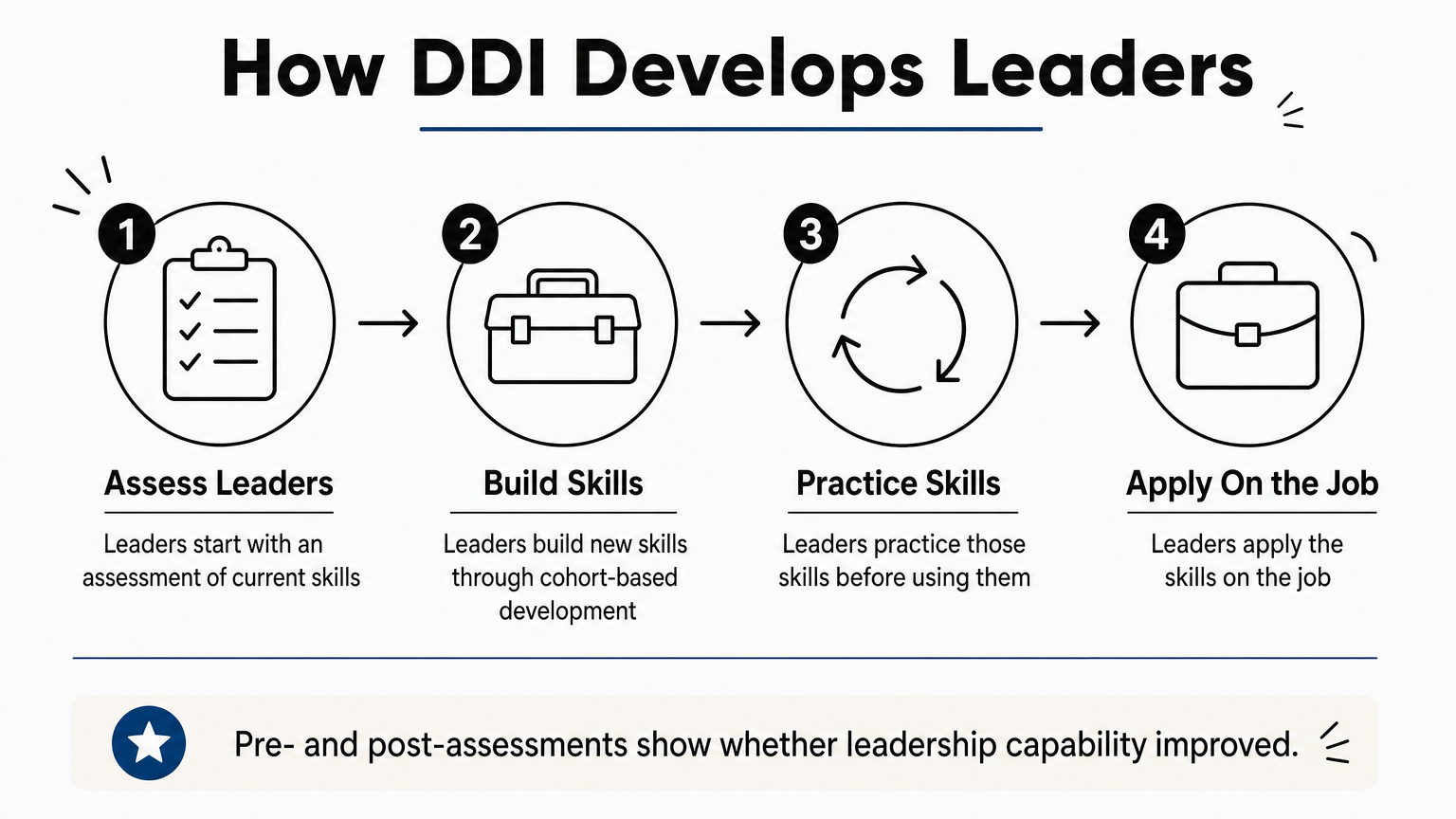
DDI uses a competency-based model grounded in industrial-organizational psychology. Leaders are assessed, build skills, practice them, and then apply them on the job. Pre- and post-assessments show whether leadership capability actually improved.
Programs run as cohorts inside your company, so leaders build internal networks instead of external ones. DDI serves multinationals with standardized frameworks across regions, which keeps a global pipeline consistent.
DDI is a system for selecting and growing leaders at scale, not a single course.
Who it suits and what it costs
DDI fits enterprises developing hundreds of leaders that want data on who is ready for the next role. A team of ten managers will find it more than they need.
- Format: Assessments, cohort-based development, and succession planning.
- Cost: Engagements often span multiple years and are quoted per organization, so per-person pricing is hard to pin down.
- Limit: The setup effort is heavy for small teams.
5. Dale Carnegie Training
Dale Carnegie Training is the pick when your leaders’ gap is communication and presence, and you want skills practiced over weeks, not crammed into one day. It has taught leadership and communication since 1912.
How it works
Courses cover effective communication, leadership, sales, and customer service, in person and virtual. Courses typically run about 8 to 12 weeks, with repeated practice in a supportive group. Participants try a skill, get feedback, and try it again, which is how habits change.
Delivery runs through a franchised network, so quality can vary by location. Ask to sit in on a session or meet the instructor before you commit.
Spread practice over weeks beats a one-day event, and Dale Carnegie builds its courses around that idea.
Who it suits and what it costs
It suits frontline managers and individual contributors moving into leadership, not only senior executives. It is also a good complement to a framework-heavy program that skips live practice.
- Format: Multi-week courses, in person or virtual.
- Cost: Published estimates put courses at roughly $2,000 to $3,500 per participant.
- Limit: Cohorts are temporary, and results depend on the local instructor.
6. Vistage
Vistage is the pick for CEOs and business owners who want a standing peer group instead of a classroom. It was founded in 1957 and, by its own figures, serves over 45,000 members across 40 countries.

How it works
Members join monthly groups of 12 to 16 non-competing CEOs led by an experienced mentor called a Chair. A typical meeting pairs a speaker workshop with peer issue-processing, and members also get one-on-one coaching between meetings. The value comes from confidential, repeated conversation with people who face the same decisions.
Vistage develops the person at the top through peers, not through a curriculum.
Who it suits and what it costs
It suits owners and chief executives of small and midsize companies. It does not train a cohort of managers, so it solves a different problem than most providers here.
- Format: Monthly peer group meetings plus one-on-one coaching.
- Cost: Vistage has published a $2,500 initiation fee plus $1,380 per month. Over the first year, that is $2,500 plus 12 × $1,380 ($16,560), or $19,060.
- Limit: Confirm current fees, because they can change.
How to pick from this list
Match the provider to the problem. Choose CCL or DDI to build a leadership pipeline, FranklinCovey for a shared framework, Dale Carnegie for communication skills, Vistage for a CEO peer group, and a keynote to launch or reinforce a culture change.
Most organizations get the best result by pairing a keynote with a sustained program. The keynote creates energy and a shared language, and the program turns that energy into practiced skills. To bring that kickoff to your next leadership event, explore Robyn Benincasa’s keynotes.