The fastest way to approach building sales team culture is to do three things in order. Write down the behaviors you expect from every rep. Rebuild pay and goals so those behaviors get rewarded. Then reinforce them in weekly habits like coaching, deal huddles, and recognition. Culture is what your reps do when you are not in the room, so you shape it by what you repeat, reward, and tolerate.
Most sales leaders already feel the problem. You run a strong kickoff, put the values on a slide, and by week three the team is back to lone-wolf selling, hoarded leads, and quiet sandbagging. The cause is rarely the people. It is usually slogans with no system behind them.
This guide covers what sales team culture is, the three steps that build it, and concrete examples you can copy. It draws on the team lessons of Robyn Benincasa, a former pharmaceutical and hospital supply sales rep who went on to lead world championship adventure racing teams and serve as a San Diego firefighter.
What sales team culture is and why it pays
Sales team culture is the unwritten set of rules for how your reps compete, share, and treat customers. It pays because it decides whether talent turns into results. Treat it as an operating system, not a mood.
What culture looks like on a sales floor
You can see culture in small choices. Does a rep share a winning email sequence or keep it private? Does anyone flag a bad-fit deal, or does everyone push it to close? What happens to the rep who missed quota but helped three teammates win? Those answers are your culture, whatever your slide deck says.
The payoff is measurable. Korn Ferry’s 2024 Sales Maturity Survey found that sales organizations with a high-performance culture reported 19% higher quota attainment and 22% higher win rates than their peers. Gallup research adds that employees who feel connected to their organization’s culture are 4.3 times as likely to be engaged at work.
Culture is not what you announce at kickoff. It is what your reps do on a Tuesday when nobody is watching.
Run a quick culture audit first
Before you change anything, find out where you stand. Answer the questions below honestly, then ask two or three reps the same ones privately. The gaps between your answers and theirs become your starting list.
- When a rep closes a big deal, who hears about it, and how fast?
- Can a new hire name the three things that get a rep promoted?
- What did you do the last time a top biller treated a teammate badly?
- How many reps ask a peer for help in a typical week?
- Do the goals for sales, sales ops, and support pull in the same direction?
Step 1. Write the standards your team lives by
Turn culture into three to five observable behaviors, each short enough that a rep can repeat it from memory. A value like "teamwork" is too vague to coach. A behavior like "we share every win story within 24 hours" is something you can see and reward.
Pick behaviors, not values
Start with the outcomes you want, then work backward to what a rep would visibly do. Use one sentence per standard, and make it testable. This template keeps the wording consistent:

We [specific behavior] so that [customer or team outcome].
Proof you will see: [observable evidence].
Here is how it reads filled in: "We bring stuck deals to the Friday huddle so that no rep loses a deal alone. Proof you will see: every open deal over 30 days has a teammate’s input logged." Keep the list short. Five standards people remember beat twelve they don’t.
Say it yourself, then hire and promote against it
Culture flows from the leader, so deliver the standards in person to every rep, not through a memo. Explain the reason behind each one and tell a real story of a rep who lived it. Then repeat it at the start of every quarter, because repetition convinces people the standards are permanent.
Next, enforce the standards where it costs you something. If your top biller hoards leads and belittles teammates, and you say nothing, the team learns your real rules within a week. Promote the people who model the behaviors, and coach or move those who won’t. Robyn’s T.E.A.M.W.O.R.K. framework, the eight elements of a winning team culture, uses the same logic. A standard only counts when leaders hold themselves to it first.
If a standard has no behavior you can observe, it is a poster, not a culture.
Step 2. Align pay and goals with the culture
Your comp plan is the loudest culture statement you make, so pay for the behaviors you wrote down. If you preach collaboration but pay only on individual quota, reps will believe the plan every time.
Add a team component to individual pay
You do not have to abandon individual accountability. Keep it dominant, and tie a smaller slice to the team result. Take a team of 8 reps, each with a $300,000 quarterly quota, so the team quota is $2.4M. Each rep has $15,000 of variable pay per quarter, split 80% individual ($12,000) and 20% team ($3,000). Assume the team lands at 95% of its quota ($2.28M).

| Rep | Individual attainment | Individual pay (80%) | Team pay (20% at 95%) | Total |
|---|---|---|---|---|
| A | 110% | $13,200 | $2,850 | $16,050 |
| B | 100% | $12,000 | $2,850 | $14,850 |
| C | 80% | $9,600 | $2,850 | $12,450 |
The table uses simple linear payouts to show the mechanics. Rep A still earns the most, so top performers are not punished. But every rep now has a reason to help Rep C, because the team slice rises when the whole group closes more. Adjust the split to your own plan and your own sales cycle.
Remove goals that fight each other
Check that the targets for sales, sales ops, and customer success can all be hit at the same time. If sales is told to grow 15% while support is told to cut headcount, you have built conflict into the plan, and no values slide will fix it. Set the goals together and write down how each team’s resources grow when revenue grows.
Handle leaderboards with care. Keep them visible, but rank on growth and activity metrics as well as closed revenue, so a new rep sees progress and not just last place. Healthy competition pushes people. Constant public ranking drives your best collaborators out.
Reps follow the pay plan, not the poster. Pay for the behavior you want repeated.
Step 3. Reinforce it with weekly habits
Culture sticks through rhythm, not events. Put three habits on the calendar and protect them: coaching, a structured onboarding plan, and a small set of indicators you review every month.
Coach every week, not every quarter
Coaching only at quarterly reviews or kickoffs makes feedback feel like a verdict. A weekly rhythm makes it normal. A simple cadence looks like this:
- Weekly 1:1 (30 minutes): one deal, one skill, one commitment for next week.
- Friday deal huddle (30 minutes): each rep brings one stuck deal, and teammates offer next moves.
- Call review (20 minutes): one recorded call per rep per week, scored against the same short checklist.
Notice that two of the three habits are shared. That is deliberate. Shared habits build the trust that individual coaching cannot.
Onboard against the standards with a 30-60-90 plan
New hires absorb culture fastest, so build your standards into their first three months.
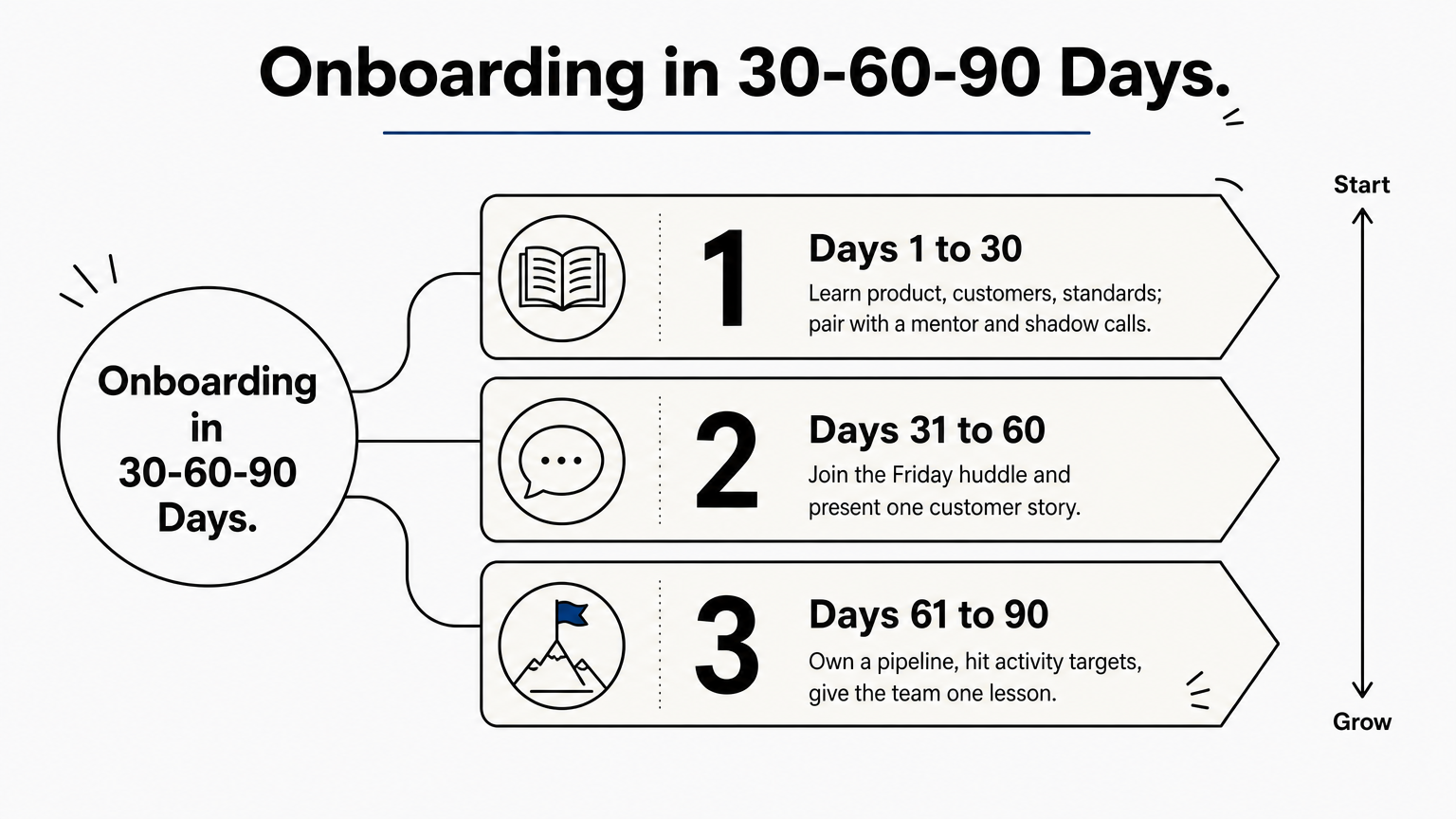
- Days 1 to 30: learn the product, the customers, and the standards. Pair each hire with a mentor and have them shadow calls.
- Days 31 to 60: run calls with a mentor listening, join the Friday huddle, and present one customer story.
- Days 61 to 90: own a pipeline, hit agreed activity targets, and give one lesson to the team.
During hiring, ask candidates how they collaborate and what they want from a team. Early answers reveal a mismatch before it costs you a quarter.
Track a few indicators monthly
Look at inputs as well as outputs, since revenue alone reflects past conditions. Review these each month:
- Days for a new hire to reach a first closed deal
- Share of scheduled 1:1s actually held
- Percent of reps at 80% or more of quota, not just the team average
- Voluntary rep turnover over the last 12 months
- Deals where a teammate’s help was logged
What you review every month is what your team believes you care about.
Sales team culture examples to borrow
Strong sales cultures show up as small, repeatable rituals tied to a clear standard. Borrow the ones that match the behaviors you chose in Step 1 rather than copying all of them.
Five rituals and what they signal
| Culture trait | Ritual | What it tells reps |
|---|---|---|
| Collaboration | Friday huddle where each rep brings one stuck deal | Nobody fights a deal alone |
| Customer-first | Reps can disqualify a poor-fit deal with a one-line reason, no penalty | Revenue that churns does not count |
| Learning | A rotating rep walks through a lost deal in 10 minutes, no blame | Mistakes are team material |
| Recognition | Weekly shout-out for the best assist, not just the biggest close | Helping is a promotable skill |
| Accountability | The same leading indicators posted for everyone, including top billers | Standards apply to all |
Pick two rituals to start. Run them for a full quarter before adding more, because a ritual that lasts six weeks teaches reps that rituals fade.
What a racecourse teaches a sales floor
In adventure racing, teammates must finish together, so the team moves at the pace of its most struggling member. Robyn Benincasa’s racing teams dominated the sport not through individual athletic talent but through a deliberate culture of collaboration and shared commitment. Sales teams can borrow the same habit: when a rep is behind, the response is help, not a spotlight on the problem. Sales teams she has worked with have moved from 17th to 1st nationally.
If you want an outside voice to launch the effort at a sales meeting or revenue kickoff, her Why Winners Win keynote runs 30 to 60 minutes and shows how individual champions become a winning team. Use it as a starting point, then let your own weekly habits carry the culture forward.
Make culture a weekly habit
Building a sales team culture comes down to three moves. Define behaviors your reps can see, align pay and goals so those behaviors get rewarded, and reinforce them every week through coaching, onboarding, and a few honest indicators. Start with the audit, write three to five standards, and add one ritual this month.
You do not need a perfect plan. You need consistency, because reps believe what they see repeated. If you want more ideas on leadership and team building, read more on building winning team cultures and pick the next habit to put on your calendar.