Resilience training for first responders is structured education that teaches police officers, firefighters, EMS crews, and dispatchers to manage cumulative stress, recover from hard calls, and protect their sleep, relationships, and judgment. It is not therapy. Therapy treats problems that already exist, while resilience training builds skills before the strain compounds. Programs range from a one-hour online course to a multi-day, instructor-led class, and the right one depends on your role, your schedule, and whether you are choosing for yourself or for a department.
This article explains why the job wears people down, how to choose between program formats, what a solid curriculum teaches, and how to roll training out so it sticks. You will get a format comparison, a five-question vetting list, and a worked scheduling example.
Robyn Benincasa spent more than 20 years as a San Diego firefighter and now speaks to organizations about team culture and performance under pressure. That station-house experience shapes the practical, peer-first view in this guide.
Why first responders need resilience training
Resilience training matters because the stress of the job accumulates, and reactive care usually arrives after the damage is done. The goal is to give responders skills they can use on the job, not only help once something breaks.
Stress builds shift by shift
Single critical incidents get the attention, but most of the load comes from repetition. Fatal accidents, violence, calls involving children, rotating shifts that wreck sleep, and public scrutiny all stack up. Over a career, cumulative stress shows up as irritability, emotional numbness, intrusive replays of calls, and hypervigilance that does not switch off at home.

People sometimes call this "first responder syndrome." That is an informal label, not a clinical diagnosis, but the symptoms behind it are real. These reactions are common and do not automatically mean PTSD, though persistent ones deserve a conversation with a clinician.
Responders rarely break on one call. They wear down across hundreds of them.
Proactive skills fill the gap left by reactive care
Therapists, employee assistance programs, and critical incident stress debriefings all respond after an event. Many calls never qualify as "critical" yet still add weight. Resilience training works earlier. It teaches skills you use before, during, and after calls, and it makes talking about stress normal instead of a sign of weakness.
For leaders, the case is practical. Departments invest in these programs to support retention, participation, and career longevity, since experienced people are expensive to lose and slow to replace.
How to choose a resilience training program
Choose by matching the format to your goal, then vetting the instructors, the curriculum, and the follow-up. A short course raises awareness. Skill-building takes more hours and more practice.
Compare the common formats
Most options fall into four formats. The lengths below come from publicly described programs, so confirm details with any provider.
| Format | Typical length | Best for |
|---|---|---|
| Short online course | About 1 hour (SAMHSA’s Shield of Resilience for law enforcement) | Individuals who want a first step |
| Single-session workshop | About 4 hours | A department in-service day |
| Instructor-led virtual course | 2 days, 4 to 5 hours each, up to 25 participants (the IAFF format) | Peer skill-building without travel |
| Multi-module in-person program | Varies by provider | Agencies pursuing culture change |
SAMHSA describes its Shield of Resilience course as a free, one-hour online option aimed at behavioral health stressors in law enforcement. Short courses build awareness, but they rarely change habits on their own.
Vet any program with five questions
Ask these before you commit time or budget:
- Who teaches it? Peers with field experience earn trust fastest. Credentialed clinicians add depth. The best programs use both.
- What skills does it teach? You should get a clear list, such as breathing, sleep, and thinking skills, plus the science behind each one.
- Do you practice or only listen? Lecture builds awareness. Rehearsal builds ability.
- Is it confidential and stigma-free? Responders will not engage if they fear a report to command.
- What happens after class? Look for manuals, refreshers, and links to peer support.
Worked example for a 60-person department
Say your class cap is 25, as in the IAFF virtual format. Sixty people divided by 25 is 2.4, so you need three cohorts. Three cohorts of 20 keeps every class under the cap and lets each shift stay staffed. At two days per cohort, that is six training days to schedule.
The right program is the one your people will attend, practice, and return to.
What a good resilience curriculum covers
A solid curriculum teaches a handful of trainable skills across the mind, the body, and relationships. If a program covers only one of those, it is incomplete.
Core skills and what they look like on shift
| Skill | What it looks like in practice |
|---|---|
| Tactical breathing | Slowing your heart rate before and after a high-intensity call |
| Cognitive flexibility | Separating what happened from the story you tell yourself afterward |
| Sleep and recovery | Protecting rest around rotating shifts |
| Social connection | Having someone who knows the job to talk to, on and off shift |
| Meaning and purpose | Reconnecting with why you do the work |
| Nutrition and exercise | Fueling and moving the body to handle sustained load |

Breathing and sleep give the fastest returns, because both are physical and easy to practice. Thinking skills take longer but protect you from the spiral that follows a bad call.
How the 7 C’s of resilience fit
You may see the 7 C’s of resilience: competence, confidence, connection, character, contribution, coping, and control. The model comes from youth development, not public safety. Still, it works as a checklist for breadth. Connection, coping, and control map most directly onto a responder’s needs.
Good training also avoids two traps. It never asks you to suppress emotion or tough out strain indefinitely. And it never presents itself as a replacement for clinical care. Resilience skills sit alongside therapy, peer support, and employee assistance resources.
How to roll out resilience training in your department
Roll it out by starting with leadership, scheduling around shifts, and following up after the class ends. A one-time event fades within weeks.
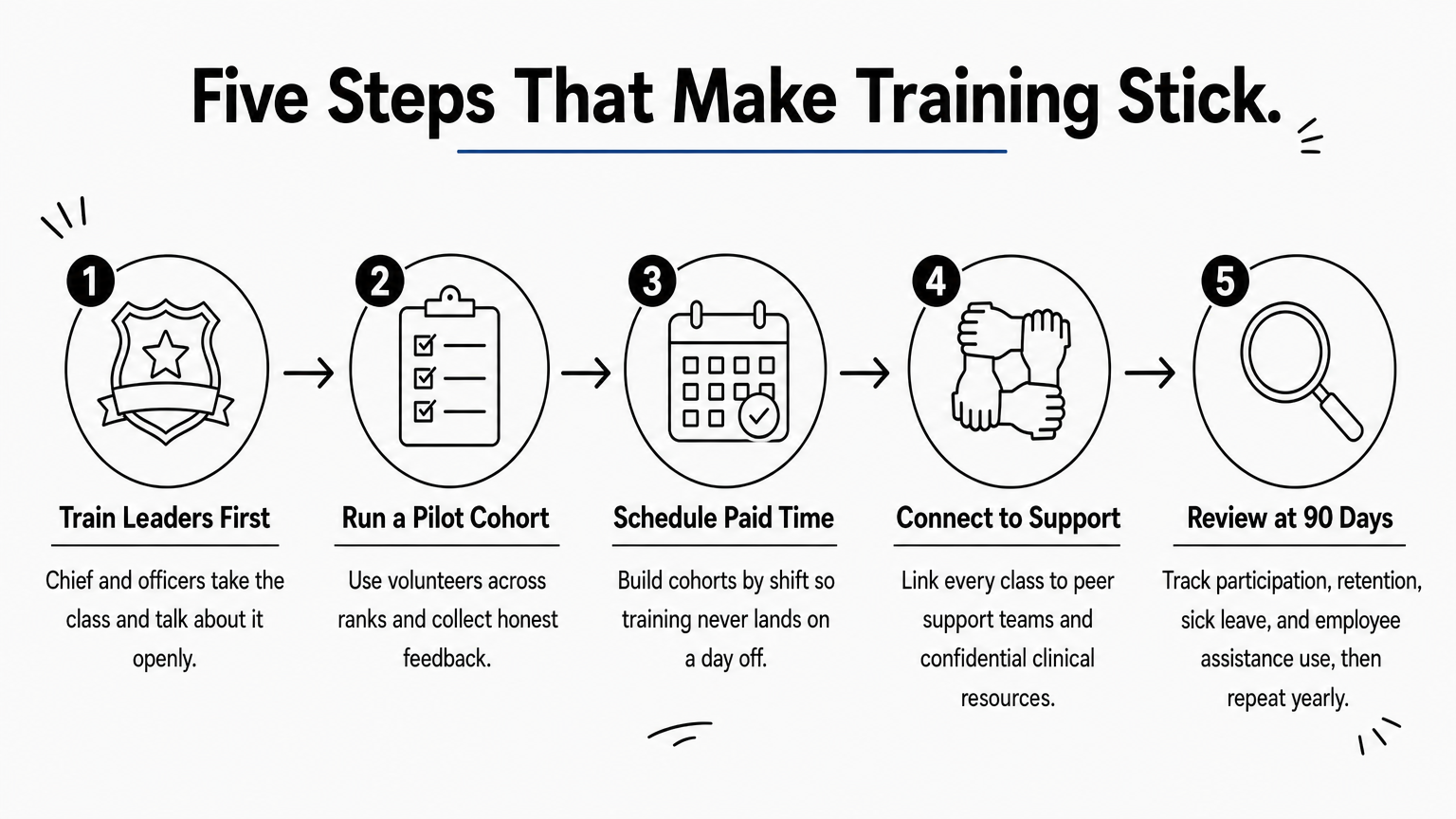
Five steps that make it stick
- Train leaders first. When the chief and officers take the class and talk about it openly, everyone else follows.
- Run a pilot cohort. Use volunteers across ranks and collect honest feedback.
- Schedule it as paid time. Build cohorts by shift so training does not become one more thing to do on a day off.
- Connect it to support. Link every class to peer support teams and confidential clinical resources.
- Review at 90 days and yearly. Track participation and measures you already have, such as retention, sick leave, and employee assistance use.
Culture changes when leaders model the skills, not when they approve the budget.
Where keynotes fit and when training is not enough
A keynote is not skills training, but it can set the tone before it begins. Robyn Benincasa’s Inspiring Greatness through G.R.I.T. keynote runs 45 to 60 minutes and is built for teams facing adversity or tough years. It shows that real grit comes from connection, which is a useful message to deliver to a whole department before breathing and recovery classes begin.
Training also has limits. If you or a colleague is in crisis or thinking about suicide, call or text 988, the Suicide and Crisis Lifeline, in the United States. Do not wait for the next class.
Start with one honest step
Resilience training works because it builds skills before stress compounds. The best programs are taught by people who know the job, teach practiced skills across mind and body, protect confidentiality, and follow up after class. Pick a format that fits your schedule, vet it with the five questions above, and bring leaders in first.
If you lead a department or a team and want a keynote that opens the conversation about connection, perseverance, and winning together, explore Robyn Benincasa’s leadership and team resources.