Author: admin

  • 15 Icebreakers Team Building Activities Your Team Will Love

    15 Icebreakers Team Building Activities Your Team Will Love

    You’ve watched it happen: a meeting starts, everyone stares at their laptop, and the first ten minutes disappear into awkward silence before anyone actually engages. Icebreakers team building activities fix that problem fast, but only if you pick ones that fit your group instead of recycling the same tired "two truths and a lie" every quarter. The right activity opens people up in minutes and sets the tone for real collaboration.

    This list gives you 15 tested icebreakers you can run in five minutes or fifty, in person or on a video call, with a sales team, a leadership offsite, or a cross-department group that barely knows each other’s names. Each one is built to do more than fill time. They’re designed to spark genuine connection that carries into the actual work.

    I’ve spent 15 years building world championship adventure racing teams and two decades as a San Diego firefighter, and both jobs taught me the same lesson: teams that trust each other perform better under pressure. These icebreakers reflect that same principle on a smaller scale. Below, you’ll find activities organized by group size and setting, so you can match the right one to your next meeting, kickoff, or offsite without guessing.

    1. Two truths and a lie

    This is the classic for a reason. It costs nothing to run, needs zero props, and works whether you have 5 people in a conference room or 50 people on a video call. The trick isn’t the game itself, it’s how you facilitate it, and most teams never get past the surface-level version.

    How it works

    Each person shares three statements about themselves: two true, one false. The group votes on which statement they think is the lie, then the person reveals the answer. Simple setup, but the payoff comes from the follow-up conversation, not the guessing.

    • Give people 60 seconds to think of their three statements before starting
    • Go around in a fixed order so nobody stalls the group
    • After each reveal, let the group ask one follow-up question about the true statements
    • Keep a tally of correct guesses if you want a light competitive element

    Best for

    This works best for new teams or groups where people have worked together for months but never actually learned much about each other. It’s also a smart choice for mixed-seniority groups, since a director and a new hire are on completely equal footing when it comes to guessing a colleague’s secret triathlon habit.

    Time needed

    Budget 2 to 3 minutes per person, including the reveal and a quick follow-up question. For a group of 10, plan on 25 to 30 minutes total. If you’re tight on time, cap it at five volunteers instead of forcing the whole room through it.

    Facilitator tips

    The biggest mistake I see leaders make with this icebreaker is treating it as filler before the real meeting starts. Don’t. Model the exercise yourself first, and make your "lie" genuinely hard to spot. If you go first with something forgettable, the rest of the group follows your lead and phones it in too.

    The moment people learn something surprising about a coworker, the room’s energy shifts from polite to genuinely curious.

    Push people toward specific, unexpected details instead of generic ones like "I have a dog" or "I like hiking." A statement like "I once got lost for three days on a solo backpacking trip" generates way more conversation than a vague hobby mention. If your group has done this activity before, raise the stakes by requiring statements tied to a theme, like a work achievement, a travel story, or a childhood memory. That small constraint keeps veterans of the game from phoning in the same three facts they’ve used for years.

    2. Human bingo

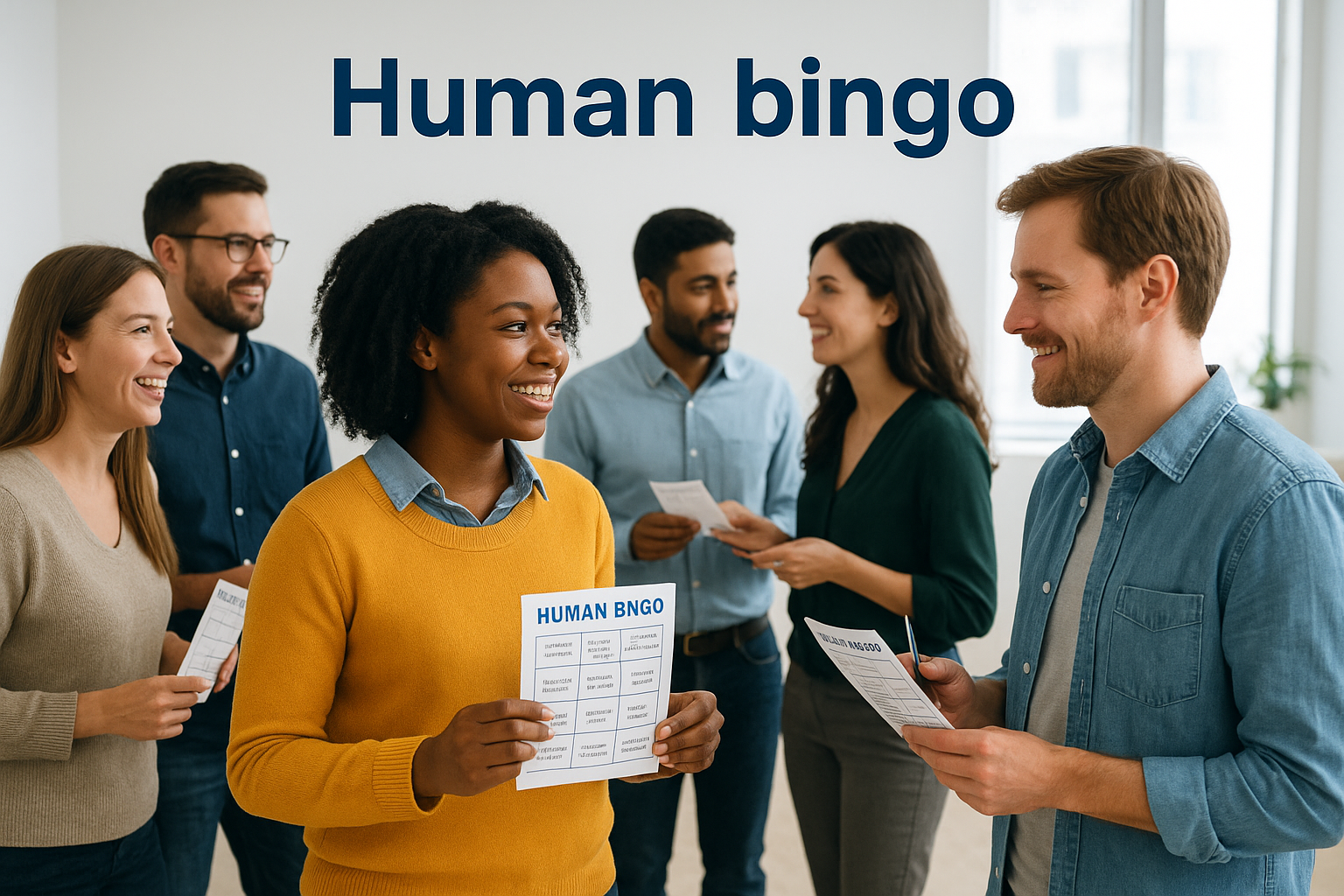
    Human bingo turns introductions into a scavenger hunt. Instead of standing up and talking about themselves, people move around the room hunting for coworkers who match specific traits, and that movement alone breaks the stiffness that comes with a static icebreaker.
    2. Human bingo

    How it works

    Before the session, build a bingo grid with squares like "has run a marathon," "speaks three languages," or "worked at a startup before this job." Hand out one card per person, then give the group 10 to 15 minutes to mingle and collect signatures for squares that apply to each coworker they meet. Whoever fills a row, column, or full card first wins.

    • Customize the grid to your team so the squares actually fit the group
    • Require a full conversation, not just a signature, before moving to the next square
    • Mix in a few work-related traits alongside personal ones

    Best for

    This fits large groups best, think all-hands meetings, conference sessions, or new-hire orientations where dozens of people need to meet quickly. It’s especially useful when attendees come from different departments and rarely interact otherwise.

    Time needed

    Plan for 15 to 20 minutes total, including setup instructions and a short debrief where the winner shares a surprising match they found.

    Facilitator tips

    Skip generic squares like "has a sibling." Build your grid around traits specific to your organization or industry.

    A well-built bingo card turns a room of strangers into a web of small, real conversations in under 15 minutes.

    Circulate yourself during the activity instead of standing at the front. Your presence signals that mingling is genuinely encouraged, not optional.

    3. Desert island scenario

    This icebreaker forces small groups to negotiate, prioritize, and reveal how they think under constraints, all through a simple hypothetical. It works well when you want to see natural leaders and collaborators emerge without staging a formal exercise.

    How it works

    Split the room into groups of four or five and give them a scenario: they’re stranded on a desert island and can only keep five items from a list of ten. Each group has to debate and agree on their final five, then explain their reasoning to the larger room. The group negotiation matters more than the actual answer, since it exposes how people argue, compromise, and build consensus under pressure.

    Best for

    This suits teams preparing for cross-functional projects or any group that needs practice making decisions together fast. It also works well for leadership groups where you want to observe who naturally steps into a facilitation role during the debate.

    Time needed

    Budget 15 to 20 minutes: five minutes to explain and split into groups, eight to ten minutes for debate, and five minutes for each group to share their final list and reasoning.

    Facilitator tips

    Keep the item list deliberately odd. Include practical picks alongside a wildcard like a guitar or a deck of cards, since those forced trade-offs generate better debate than an obvious survival list.

    How a group argues over a hypothetical island reveals more about their real decision-making style than any survey ever will.

    Listen for who dominates the conversation and who goes quiet. That pattern often mirrors how the same group behaves in actual project meetings.

    le, timeline traces the history of your team or organization on a shared visual line, running from a founding date to the present day, with peopleployees adding events they remember along the way. It works especially well when you want people to see how much shared history already exists, even in teams that feel newly formed…a wall, whiteboard, or shared slide, and give people sticky notes to add milestones: launches, big wins, tough stretches, or personal moments (like joining the team). Give each person 2-3 minutes to place their notes and explain what they mean, then step back and look at the full picture together.

    Best for

    This fits teams with mixed tenure best, groups where some people have been there five years and others five weeks. It also works surprisingly well after a merger or reorg, when…actually let me just write clean prose without trying to force list where not needed. Let’s write final.Wait I need to actually write the final text properly, not stream-of-consciousness. Let me compose properly now.systematically.original..done thinking, now write actual content.Now writing final answer.The team timeline activity has each person add a memorable moment to a shared visual timeline of the team or company’s history, creating a shared narrative in the process.Let me write clean version below within word budget 264 (max 294).Keep bullet list optional but not required for every section; earlier sections had lists in some, not others. I’ll include a short list for

    5. Coat of arms

    This icebreaker asks people to sketch a personal shield divided into sections representing different parts of their life, then share the drawing with the group. It sounds simple, but a hand-drawn shield pulls out stories that a verbal introduction never would, especially from people who freeze up when asked to "just tell us about yourself."

    How it works

    Hand out paper divided into four or five sections, or draw the template on a shared slide for virtual groups. Each section gets a prompt: a proud achievement, a core value, a hobby outside work, and something people would be surprised to learn. Give everyone 8 to 10 minutes to draw, then go around and let each person explain their shield in under a minute.

    • Keep the drawing low-pressure. Stick figures are fine.
    • Use consistent prompts so shields are easy to compare across the group.
    • Post finished shields on a shared wall or slide deck afterward.

    Best for

    Quiet groups benefit the most here, since drawing gives introverts a script to follow instead of putting them on the spot to talk unprompted. It also works well for creative teams and workshops where visual thinking is already part of the culture.

    Time needed

    Plan for 20 to 25 minutes with a group of eight to ten: 10 minutes to draw, then roughly 90 seconds per person to share.

    Facilitator tips

    Share your own shield first, and pick a genuinely personal detail for the surprise section.

    A crude drawing of a campfire tells you more about a coworker than a polished elevator pitch ever will.

    Resist the urge to rush the sharing round. The value lives in the stories, not the artwork.

    6. Human knot

    Few icebreakers team building activities get people laughing and grumbling in the same breath like the human knot. It’s a physical puzzle disguised as a game, and it forces a group to communicate clearly or stay tangled for a lot longer than they’d like.

    6. Human knot

    How it works

    Gather 8 to 12 people in a tight circle, shoulder to shoulder. Everyone reaches across and grabs two different hands that don’t belong to the person directly next to them. Once every hand is linked, the group has to untangle itself into a full circle without letting go.

    1. Form the circle and grab hands as described
    2. Assign one person to call out suggested moves if the group stalls
    3. Untangle by stepping over, under, or through linked arms
    4. Stop and reset if the knot becomes truly impossible

    Best for

    Active, younger, or physically comfortable teams get the most out of this one. Skip it for groups with mobility limitations or anyone uneasy with close physical contact, since forced closeness can backfire fast with the wrong crowd.

    Time needed

    Budget 10 to 15 minutes, including the setup instructions and a couple of failed attempts before the group finds its rhythm.

    Facilitator tips

    Resist jumping in to solve it for them. The value comes from watching the group problem-solve out loud, not from a fast finish.

    A tangled circle of coworkers talking their way free teaches more about communication than any slide deck on the subject.

    Set a loose time cap so a stubborn knot doesn’t eat the whole meeting, and debrief afterward by asking who took charge and who followed.

    7. Back-to-back drawing

    Pairs sit or stand back-to-back, and one person describes a simple image while the other tries to draw it based purely on the verbal description. Nobody sees the other’s paper until the reveal, which makes this one of the more entertaining icebreakers team building activities on this list, since the mismatch between instructions and results almost always gets a laugh.

    How it works

    Give one partner a printed image (a house, a robot, a simple shape pattern) and the other a blank sheet and pencil. The describer explains the image using words only, no gestures, while the artist sketches based on what they hear. After a few minutes, compare the original to the drawing.

    • Ban words like "square" or "circle" for an added challenge
    • Set a strict five-minute timer per round
    • Swap roles and repeat with a new image

    Best for

    This fits pairs or small groups working on cross-team communication, especially teams that rely heavily on written instructions or handoffs, like engineering and support, or sales and operations. It’s also a fun midday reset for any group that’s been sitting through back-to-back presentations.

    Time needed

    Budget 10 to 15 minutes for two rounds per pair, including a two-minute debrief on what made instructions clear or confusing.

    Facilitator tips

    Pick images with a few tricky details, like an object at an odd angle, so the exercise actually tests precision instead of resolving itself.

    A bad drawing built from clear instructions teaches a team more about communication gaps than any feedback survey.

    Debrief by asking what specific phrasing helped versus confused the artist. That detail carries directly back into how the team writes real instructions at work.

    8. Office scavenger hunt

    A scavenger hunt turns a plain office or virtual workspace into a puzzle, sending small teams off to find specific items, complete odd tasks, or snap photos as proof. Groups race the clock, and the mix of competition and movement makes this one of the more energizing icebreakers team building activities for teams that spend most of their day sitting still.

    8. Office scavenger hunt

    How it works

    Build a list of 10 to 15 items or tasks, mixing the practical with the absurd, like "find a coworker’s desk with a plant" or "get a photo of someone doing their best superhero pose." Split the group into teams of three or four, hand out the list, and set a strict time limit. Teams check in with photos or physical items when time runs out.

    • Mix office-specific finds with silly, low-stakes tasks
    • Require a team photo for each completed item
    • Set a clear finish line so teams don’t wander past the deadline

    Best for

    This works well for larger teams split across departments or floors, and it’s a strong choice for new-hire onboarding since it forces people to explore spaces and meet coworkers they’d otherwise never encounter.

    Time needed

    Plan for 20 to 30 minutes, including five minutes to explain rules, 15 to 20 minutes for the hunt, and a short debrief where teams share their favorite find.

    Facilitator tips

    Scout your list ahead of time so every item is actually findable within the space you’re using.

    A scavenger hunt works because it hides connection inside competition, and nobody notices they’re bonding until it’s over.

    Keep remote teams included by adding virtual-friendly tasks, like screenshotting a specific app or finding an object in their home office.

    9. Would you rather

    This one thrives on quick, low-stakes decisions that reveal how people think without demanding much vulnerability. It’s one of the easiest icebreakers team building activities to run cold, since nobody needs prep time or props, just a good list of questions.

    How it works

    Pose a two-option question, like "Would you rather have unlimited vacation days or unlimited budget for one project?" and have people vote by raising hands, typing in chat, or moving to opposite sides of the room. After the vote, ask a few people from each side to explain their pick. Run through five to eight questions, moving quickly so momentum doesn’t stall.

    • Mix work-related questions with purely fun ones
    • Alternate between physical voting and verbal explanations
    • Let people change sides if a good argument sways them

    Best for

    This fits large groups and mixed audiences especially well, since voting requires zero preparation and works the same whether you’ve got 10 people or 200. It’s also a solid warm-up before a brainstorming session, because it gets people talking out loud early.

    Time needed

    Budget 10 to 15 minutes for a full round of questions, including brief explanations after each vote.

    Facilitator tips

    Write your questions ahead of time instead of improvising, since weak questions kill momentum fast.

    A good "would you rather" question does more work in ten seconds than a slow icebreaker does in ten minutes.

    Save your most divisive question for last. Ending on a split vote keeps the energy high right as you transition into the actual meeting.

    10. One-word check-in

    Sometimes the fastest way to read a room is the simplest one. A one-word check-in asks each person to sum up how they’re feeling, or how their week is going, in a single word before the meeting moves into its real agenda. It takes under a minute per person, but it’s one of the most useful icebreakers team building activities for surfacing a team’s actual mood instead of assuming everyone’s fine.

    How it works

    Go around the room, or the video call, and ask everyone to share one word describing their current state, whether that’s their energy level, their week, or how they feel about an upcoming project. No explanations required unless someone wants to add one. The facilitator goes last, which keeps the exercise from feeling like a top-down prompt.

    Best for

    This fits daily standups and recurring meetings best, since it’s fast enough to run every single time without eating into the agenda. It’s especially valuable for teams under stress, like after a tough deadline or during a reorg, where a quick pulse check surfaces problems before they show up in the actual work.

    Time needed

    Budget 30 seconds per person. A team of 10 finishes in under five minutes, including a beat of silence for people to think of their word.

    Facilitator tips

    Don’t skip the exercise just because it feels too small to matter.

    A single honest word from every voice in the room tells a leader more than a long status update ever will.

    If someone’s word signals real trouble, like "exhausted" or "overwhelmed," follow up privately after the meeting instead of putting them on the spot in front of the group.

    11. Speed networking

    Speed networking borrows the format of speed dating and applies it to coworkers who rarely interact. Pairs get a set amount of time to talk, then rotate to a new partner when a timer goes off, which forces rapid-fire connection across a whole room in a fraction of the time a mingling session would take.

    How it works

    Set up two rows of chairs facing each other, or pair people randomly in breakout rooms for virtual groups. Give each pair two to three minutes to answer a prompt or just chat freely, then signal the rotation. Repeat for six to eight rounds so everyone meets a meaningful chunk of the room.

    • Use a loud bell or chat message to signal rotations
    • Provide one prompt per round so conversations don’t stall
    • Track who’s met whom with a simple grid if the group is large

    Best for

    This suits large teams or newly merged departments where most people have never spoken directly. It also works well at conferences and multi-day offsites, where attendees need to build a wider network fast instead of sticking with the same three familiar faces all week.

    Time needed

    Budget 20 to 25 minutes for eight rounds at two and a half minutes each, plus a few minutes for rotation logistics.

    Facilitator tips

    Rotate prompts throughout the session instead of repeating the same question every round, since variety keeps energy from flattening out by round five.

    Speed networking compresses months of casual hallway chats into twenty minutes of focused conversation.

    For virtual sessions, test your breakout room settings ahead of time so rotations happen automatically instead of eating into conversation time.

    12. LEGO team challenge

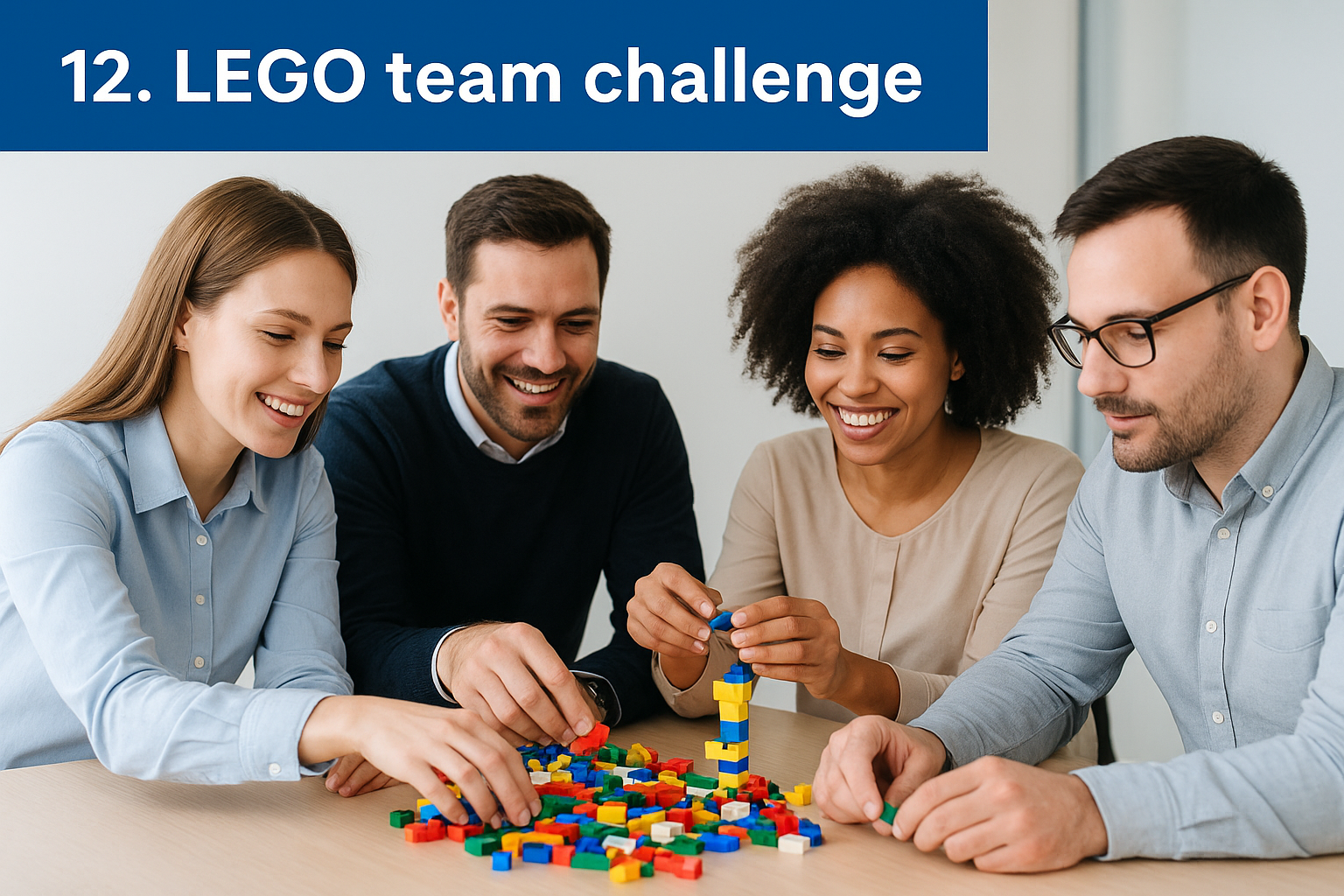
    Hand a group a pile of LEGO bricks and a vague instruction, and you’ll see personalities surface fast. This hands-on icebreaker turns building blocks into a lens for problem-solving styles, and it works because everyone, from the CFO to the newest hire, ends up equally uncertain about which piece goes where.
    12. LEGO team challenge

    How it works

    Split people into teams of three or four and give each team an identical bag of mixed bricks. Assign a build challenge, like "construct something that represents your team’s biggest strength" or a blind copy task where one person describes a hidden model and the rest build it from description alone. Give teams 10 minutes to build, then have each group present their creation and explain the choices behind it.

    Best for

    This fits cross-functional teams working through a merger, restructure, or new project kickoff, since the build process naturally surfaces who leads, who organizes pieces, and who steps back and watches. It also works well for leadership retreats where you want a lighter, tactile break between heavier strategy sessions.

    Time needed

    Budget 25 to 30 minutes total: five minutes for setup and instructions, 10 minutes to build, and 10 to 15 minutes for presentations and debrief.

    Facilitator tips

    Buy a basic bulk set instead of a themed kit, since generic bricks force more creative interpretation than pieces that already look like something specific.

    Watching a team argue over LEGO bricks reveals more about their real collaboration habits than a personality assessment ever will.

    Ask each team to name one decision they made together during the build. That question ties the playful exercise back to how they actually work.

    13. Virtual emoji check-in

    Remote meetings lose the visual cues you’d catch in person, like a slumped posture or a tired sigh before someone speaks up. An emoji check-in replaces those cues with a quick, visual signal everyone can read at a glance, making it one of the simplest icebreakers team building activities built specifically for video calls.

    How it works

    Ask everyone to drop a single emoji into the chat that represents their current mood, energy level, or how their week is going. Give people 15 seconds to think before posting, then scroll through the reactions together as a group. Invite one or two people to explain an unusual choice, like a fire emoji after a rough Monday or a turtle after a slow start to the week.

    Best for

    This fits fully remote teams and hybrid meetings where video fatigue makes long verbal check-ins feel draining. It also works well for large virtual all-hands, since a chat window can capture 50 reactions faster than any spoken round ever could.

    Time needed

    Budget two to three minutes total, including a short scroll through the chat and a couple of follow-up questions.

    Facilitator tips

    Keep the prompt fresh by rotating the theme weekly, asking for a weather emoji one week and a food emoji the next.

    A single well-chosen emoji can say more about someone’s week than a paragraph of polite small talk.

    Watch for repeated negative signals from the same person across multiple meetings, and follow up privately rather than calling it out live on the call.

    14. Trading card introductions

    Everyone remembers swapping trading cards as a kid, and this icebreaker borrows that format to make introductions feel like a keepsake instead of a chore. Each person designs a personal trading card with their photo, a few stats, and a fun fact, then the group trades and collects cards like a mini deck of the whole team. It’s a favorite among icebreakers team building activities for onboarding cohorts, since new hires walk away with an actual reference for who’s who.

    How it works

    Give everyone a template, either printed or digital, with sections for a photo, job title, a fun stat (like years at the company or favorite vacation spot), and one unexpected fact. Give people 10 minutes to fill out their card, then set up a trading round where people swap cards and briefly introduce themselves to whoever they trade with.

    Best for

    This fits new-hire cohorts and onboarding groups best, since it doubles as a lightweight directory people can reference later. It also works well for conferences where attendees want a memorable way to recall new contacts after the event ends.

    Time needed

    Budget 20 to 25 minutes: 10 minutes to design cards, 10 minutes to trade and chat, and a few minutes to wrap up.

    Facilitator tips

    Provide a simple digital template so remote employees can join the same activity without needing a printer.

    A trading card turns a forgettable introduction into something people actually keep on their desk.

    Collect scanned copies afterward and compile them into a shared team directory nobody has to build from scratch later.

    15. Common ground challenge

    Small groups race to find things they all share beyond the obvious, like the same job title or the same office. This closing exercise works well as the last icebreaker in a longer session because it builds on the openness people have already shown, and it ends the list of icebreakers team building activities on a note of genuine connection rather than pure novelty.

    How it works

    Split people into groups of four or five and give them five minutes to write down as many things as they can find in common, with a twist: obvious answers like "we all work here" or "we’re all in this room" don’t count. Groups have to dig past job title and department to find real overlap, like a shared hometown, the same favorite show, or an identical hidden talent. Whichever group finds the longest list of genuine matches shares their findings with the room.

    Best for

    This suits newly formed teams and groups coming off a reorg or merger, where people assume they have nothing in common simply because they haven’t worked together before. It also closes out a longer workshop well, since it sends people back to their desks having just proven how much overlap already exists in the room.

    Time needed

    Budget 12 to 15 minutes: a minute to explain the rules, five minutes for groups to dig for matches, and the remainder for each group to share their best finds.

    Facilitator tips

    Push groups to keep digging once they hit the easy answers, since the real value shows up after the third or fourth obvious match gets ruled out.

    The things a team has in common matter less than the effort they put into finding them.

    Close the activity by asking one group to share their most surprising match with the full room.
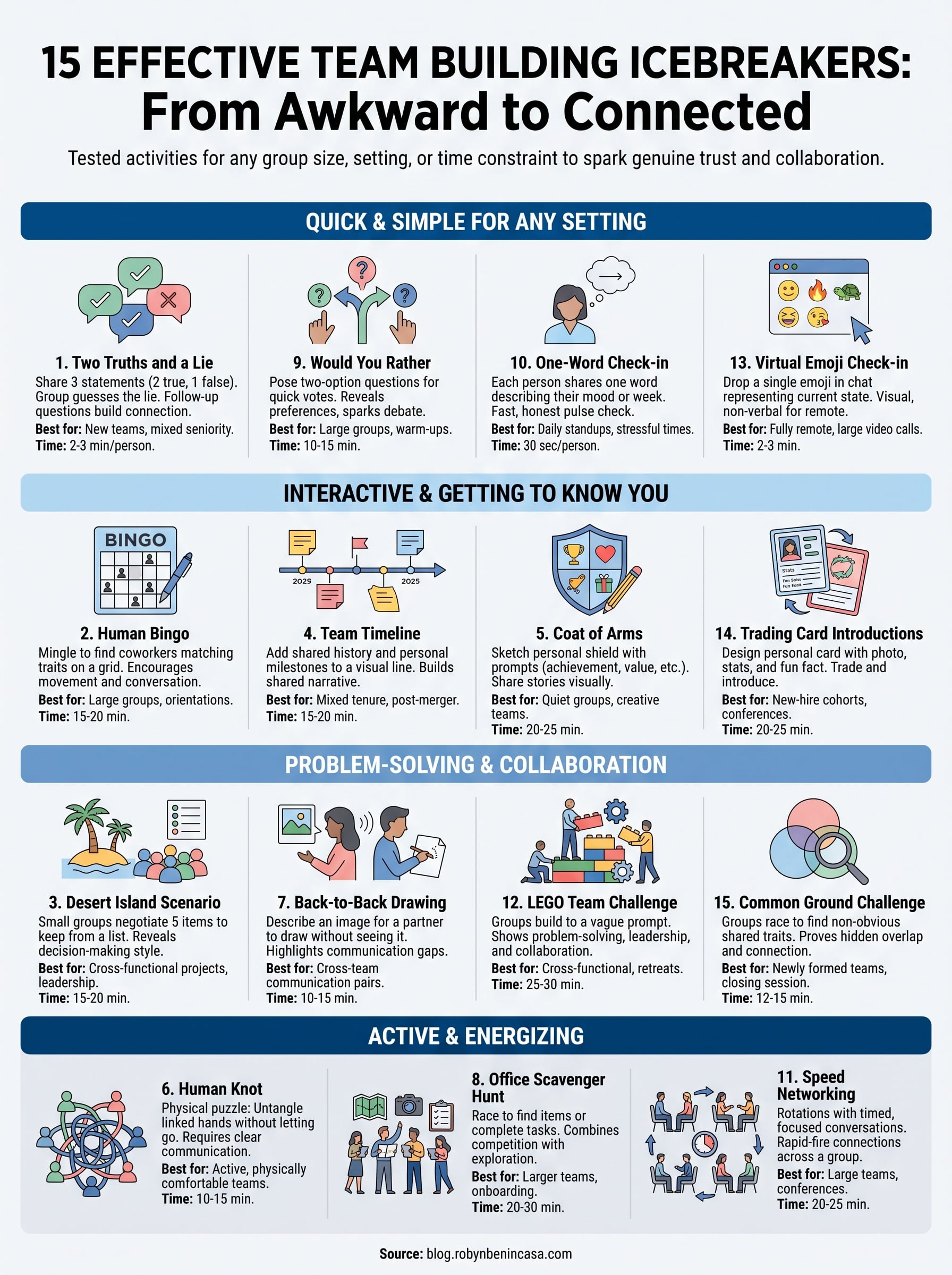
    icebreakers team building activities infographic

    Making connection part of your team culture

    None of these 15 activities will fix a broken culture on their own. What they do is create small, repeated moments where people see each other as humans first and coworkers second, and that habit compounds over time. Pick two or three from this list, run them consistently, and pay attention to which ones actually loosen up your specific group instead of assuming one size fits every meeting.

    Over two decades of building championship adventure racing teams and working alongside firefighters under real pressure, I’ve watched small connection habits turn into the trust that carries teams through the hard stretches. Icebreakers are the entry point, not the whole strategy.

    If you want to go deeper on building that kind of culture across your whole organization, explore Robyn Benincasa’s keynote topics and see how a live session can turn these small moments into lasting team performance.

  • 16 Team Building Activities for Work That Boost Morale

    16 Team Building Activities for Work That Boost Morale

    Most team building activities for work end up feeling forced. Everyone shows up, does the trust fall or the awkward icebreaker, and goes right back to the same silos and the same disengagement the next morning. If you’ve planned events like this before, you already know a fun afternoon doesn’t automatically translate into a stronger team.

    What actually works is different. You need activities that mirror real teamwork, where people have to communicate under pressure, rely on each other, and solve something that matters, even in a low-stakes setting. Below you’ll find 16 team building activities that do exactly that, ranging from quick 20-minute exercises for a Monday meeting to full offsite challenges built for remote and in-person teams alike.

    I’ve spent 15 years racing on world championship adventure racing teams and another two decades as a San Diego firefighter, and both taught me the same lesson: culture beats talent every time. Every activity in this list is chosen because it builds the habits that carry over into daily work, not just a good memory from one afternoon.

    1. Book a keynote-led team experience with Robyn Benincasa

    Before you jump into games and icebreakers, consider starting with something that actually reframes how your team thinks about teamwork itself. A keynote-led team experience gives your group a shared language and a real framework for collaboration, drawn from environments where failure isn’t an option, like adventure racing teams crossing 500 miles of wilderness together or firefighters running into buildings other people are running out of. I built my talks around those lessons because they translate directly into boardrooms, sales floors, and cross-functional teams under deadline pressure.

    How it works

    You bring me in for a keynote, either live or virtual, built around your organization’s specific challenges: a merger, a sales slump, a culture reset, or simply a team that’s grown too fast to stay connected. I don’t do generic motivational speeches. Every talk uses real stories from world championship racing and two decades of firefighting to teach the specific behaviors that separate high-performing teams from the rest. Many organizations pair the keynote with a hands-on workshop segment afterward, so the lessons get practiced immediately instead of forgotten by Monday.

    A great keynote doesn’t just entertain your team, it gives them a shared framework they’ll reference for years.

    Skills it builds

    This format is built to install habits, not just deliver inspiration. Depending on which signature topic you choose, your team walks away with tools for:

    • Building trust fast, even across departments that rarely interact
    • Communicating clearly under pressure and deadline stress
    • Recognizing and using each teammate’s strengths
    • Committing to shared goals instead of individual wins
    • Leading through change without losing morale

    Best for

    Organizations kicking off a leadership offsite, sales kickoff, or annual conference get the most value here, especially when a bigger cultural shift is on the table. It also works well for teams recovering from a rough stretch, layoffs, reorgs, missed targets, where morale needs a genuine reset rather than a surface-level activity. Companies like Allstate, Northrop Grumman, and Boston Scientific have used this format specifically because it addresses measurable business outcomes, not just a feel-good afternoon.

    Time and group size

    A standard keynote runs 45 to 60 minutes and scales from a department of 20 to a full conference of several thousand, live or virtual. If you want the deeper impact, extend it into a half-day or full-day workshop with breakout exercises. You can book Robyn for your next event directly and get a program built around your team’s actual goals, not a one-size-fits-all script.

    2. Human knot

    The human knot is the classic team building activities for work exercise for a reason: it forces physical cooperation and problem-solving in a way that words alone never do. Everyone stands in a circle, reaches across, and grabs two different hands until the group is a tangled mess. The only goal is to untangle without letting go, which sounds simple until arms start crossing in impossible directions.

    2. Human knot

    How it works

    Gather 8 to 12 people in a tight circle and have each person grab the hands of two different people across from them, never someone standing directly next to them. Once the knot forms, the group has to talk through moves, ducking under arms, stepping over others, rotating in place, until the circle untangles itself. No hands can break contact during the process.

    Skills it builds

    This exercise builds verbal communication under pressure and patience with slow, incremental progress. Teams also practice:

    • Giving clear, specific directions instead of vague ones
    • Listening before acting
    • Tolerating physical closeness and mild discomfort
    • Staying calm when a solution isn’t obvious

    The human knot works because untangling it requires the exact same patience and communication a real project bottleneck does.

    Best for

    Newer teams that haven’t built much rapport yet get the most out of this one. It’s also a solid warm-up before a longer workshop, since it breaks physical distance early.

    Time and group size

    Budget 10 to 15 minutes for groups of 8 to 12. Larger teams should split into multiple knots running simultaneously.

    3. Marshmallow challenge

    The marshmallow challenge is a fast, visual test of how teams handle ambiguity, and it’s become one of the most requested team building activities for work because the results are so instantly clear. Give a small group 20 sticks of spaghetti, a yard of tape, a yard of string, and one marshmallow, then tell them to build the tallest freestanding structure that holds the marshmallow on top.

    How it works

    Teams get 18 minutes to design, build, and test their structure before time runs out. Most groups spend the first 15 minutes planning and the last 3 minutes realizing their plan doesn’t work, which is exactly the point. The structural failure usually happens because the marshmallow is heavier than it looks, and teams that skip early prototyping almost always lose to teams that build ugly test versions first.

    Teams that prototype early beat teams that plan perfectly, every single time.

    Skills it builds

    This challenge exposes how a team handles early failure and iteration under a countdown. Specific skills include:

    • Testing ideas quickly instead of overplanning
    • Adapting when a design doesn’t hold
    • Balancing speed against precision
    • Learning from a failed attempt without blame

    Best for

    Innovation and product teams get outsized value here, since the exercise mirrors real prototyping cycles. It also works well for leadership groups who tend to over-plan and under-test in daily operations.

    Time and group size

    Plan for 30 minutes total, including debrief, with teams of 4 broken out from a larger group of any size.

    4. Escape room challenge

    An escape room puts your team inside a locked scenario with a timer, a pile of clues, and one goal: get out before time runs out. Unlike other team building activities for work on this list, this one usually happens at a commercial venue, though plenty of vendors now bring portable kits directly to your office.

    4. Escape room challenge

    How it works

    Groups of 6 to 8 enter a themed room and work through a chain of puzzles, hidden codes, locks, and riddles that only unlock the next clue once solved correctly. Nobody can finish alone. Someone spots the pattern, someone else remembers a detail from ten minutes earlier, and someone has to keep track of the clock. That division of labor happens naturally, without anyone assigning roles.

    The best escape rooms don’t test intelligence, they test whether your team shares information fast enough to use it.

    Skills it builds

    This format rewards information-sharing speed more than individual smarts. Teams also sharpen:

    • Delegating tasks based on who’s already good at what
    • Managing time pressure without panic
    • Speaking up when you notice something others missed
    • Recovering quickly from wrong guesses

    Best for

    Cross-functional teams that rarely work together day to day benefit most, since the puzzles force collaboration between people who don’t normally interact. It’s also a strong pick for teams heading into a high-pressure quarter, since the format mimics deadline stress in a low-stakes setting.

    Time and group size

    Most rooms run 60 minutes and cap groups at 8 to 10 people. Larger departments can book multiple rooms and compare completion times afterward.

    5. Two truths and a lie

    Two truths and a lie is the simplest icebreaker on this list, and that simplicity is exactly why it still works after decades of use in team building activities for work. Each person shares three statements about themselves, two true and one false, and the group votes on which one is the lie. It costs nothing, needs no equipment, and works just as well over video as it does around a conference table.

    How it works

    Go around the room or the video call and have each person share three personal statements out loud. The rest of the group discusses briefly, then votes on which statement they think is false before the person reveals the answer. Keep each round under two minutes so the energy stays high and nobody overthinks their turn.

    The real value isn’t guessing the lie, it’s the follow-up questions people ask once the truth comes out.

    Skills it builds

    This exercise builds active listening and comfort with sharing personal details in a professional setting. It also strengthens:

    • Asking genuine follow-up questions
    • Remembering small details about coworkers
    • Reading tone and body language for hints
    • Building rapport across seniority levels

    Best for

    New hires and newly formed teams get the most value, since it surfaces surprising facts fast. Remote teams meeting for the first time on camera benefit especially, since it replaces the small talk that happens naturally in a hallway.

    Time and group size

    Budget 15 to 20 minutes for groups up to 15. Larger teams should split into breakout rooms of 6 to 8.

    6. Back-to-back drawing challenge

    The back-to-back drawing challenge strips away every visual cue teams normally lean on and forces pure verbal description. Two people sit facing away from each other, one holding a simple image and the other holding a blank paper and pen. This is one of the fastest team building activities for work to set up, since it needs nothing more than paper, pens, and a stack of simple shapes.

    How it works

    Partner up the group and give one person in each pair a basic image, like a house with a chimney or a stack of geometric shapes. That person describes the image out loud without naming it directly or looking at their partner’s paper, while the partner draws based only on the verbal description. After five minutes, pairs compare the drawing to the original and swap roles with a new image.

    Miscommunication shows up on paper immediately, which is exactly why this drawing exercise beats most verbal-only debriefs.

    Skills it builds

    This challenge forces precise verbal instructions since there’s no pointing or gesturing to fall back on. Teams also strengthen:

    • Breaking a task into small, sequential steps
    • Asking clarifying questions instead of guessing
    • Checking understanding before moving forward
    • Staying patient when instructions aren’t landing

    Best for

    Teams that rely heavily on written communication, like remote workers coordinating over Slack or email, benefit most from practicing this level of clarity out loud. It also works well for managers who tend to give vague directions and need direct feedback on how their instructions actually land.

    Time and group size

    Budget 15 minutes for pairs, and it scales to any group size since everyone works simultaneously in twos.

    7. Trust battery exercise

    The trust battery exercise borrows a concept from product teams and applies it to any group that needs an honest read on how much goodwill exists between coworkers. Picture a battery icon next to each relationship on the team. Every interaction either charges it or drains it, and this exercise makes that invisible dynamic visible. It’s one of the more reflective team building activities for work on this list, built for conversation rather than competition.

    How it works

    Give each person a simple grid listing every teammate’s name with a battery symbol beside it. Ask everyone to privately rate how charged that relationship feels, then share observations in pairs or small groups about what charges trust and what drains it on this specific team. Close with a group discussion on one concrete behavior each person will change to keep batteries charged going forward.

    Trust doesn’t build in one meeting, but naming what drains it is the fastest way to stop the bleeding.

    Skills it builds

    This exercise sharpens self-awareness about impact on coworkers, something most people never get direct feedback on. Teams also practice:

    • Giving specific, behavior-based feedback
    • Hearing critique without getting defensive
    • Naming small daily actions that build goodwill
    • Owning a personal commitment to change

    Best for

    Teams recovering from conflict or a rocky reorg benefit most, since it gives permission to name tension directly. Leadership teams also use this well, since trust gaps at the top ripple through the entire organization.

    Time and group size

    Budget 45 minutes for groups of 6 to 10. Larger teams should break into smaller pods to keep the conversation honest.

    8. Office scavenger hunt

    An office scavenger hunt turns a slow afternoon into a race for clues, and it’s one of the easiest team building activities for work to run with almost zero budget. Small teams chase down a list of items, photos, or riddles hidden around the building, and whoever finishes the full list first wins bragging rights. It works just as well in a warehouse, an open-plan office, or a hybrid setup with a few remote clues mixed in.

    How it works

    Break the group into teams of 4 to 6 and hand each one a list of clues that lead to specific locations, objects, or people in the office. Some clues require a photo as proof, like posing with a coworker from another department, which forces cross-team interaction along the way. Set a hard time limit, usually 30 to 45 minutes, and reconvene for a quick reveal of winning teams and favorite photos.

    A scavenger hunt works because it gets people talking to coworkers they’d otherwise never approach.

    Skills it builds

    This format builds quick decision-making under a ticking clock and light competitive collaboration. Teams also practice:

    • Dividing tasks based on who knows the building or people best
    • Making fast calls instead of debating every choice
    • Reaching out to unfamiliar coworkers for a photo or clue
    • Staying organized under a real time constraint

    Best for

    Newer offices or teams that just moved buildings get real value here, since the hunt doubles as a tour. It’s also a strong pick for onboarding new hires alongside established staff.

    Time and group size

    Budget 45 minutes total for groups of any size split into teams of 4 to 6.

    9. Egg drop challenge

    The egg drop challenge takes the marshmallow concept and raises the stakes with a raw egg and a drop from height. Teams build a protective contraption using limited materials, then watch their design get tested from a balcony, ladder, or rooftop while the whole office watches. Few team building activities for work generate as much genuine cheering as this one.

    9. Egg drop challenge

    How it works

    Give each team of 4 to 5 people a raw egg plus a fixed kit of materials, straws, tape, cotton balls, newspaper, and a plastic bag. Teams have 20 minutes to build a casing that keeps the egg intact when dropped from a set height, usually a second-story window or a stepladder outdoors. After the build window closes, drop each team’s egg one at a time and see whose design survives.

    The team that argues over every straw placement usually loses to the team that just tests something and adjusts.

    Skills it builds

    This challenge tests risk assessment under a hard material constraint. Teams also sharpen:

    • Weighing tradeoffs between weight and cushioning
    • Making group decisions fast with limited supplies
    • Accepting a failed design without finger-pointing
    • Celebrating a win that took real collaboration

    Best for

    Engineering, product, and technical teams enjoy this one most, since the physics puzzle plays to their instincts. It also works well as an afternoon energizer at a company picnic or offsite where you already have outdoor space.

    Time and group size

    Budget 40 minutes total for teams of 4 to 5, with the drop portion running quickly once every group finishes building.

    10. Helium stick

    The helium stick looks impossible to mess up until you actually try it. A lightweight rod, usually a tent pole or thin dowel, rests on the extended index fingers of everyone in a small group. The only instruction is to lower the stick to the ground together. Almost every group watches it rise instead, which makes this one of the more counterintuitive team building activities for work on this list.

    How it works

    Line up 6 to 10 people in two facing rows with fingers extended at waist height, then balance the pole across everyone’s fingers. Nobody can grip the stick, only keep a finger touching it, and the group has to lower it to the floor without anyone losing contact. The natural upward pressure from each person’s finger causes the stick to rise instead, and groups usually need several failed attempts before someone suggests slowing down or removing a person from the line.

    The harder everyone pushes to fix the problem individually, the worse it gets, which is the whole lesson.

    Skills it builds

    This exercise exposes how a team handles shared responsibility for a problem nobody can solve alone. It also builds:

    • Slowing down instead of forcing a fix
    • Noticing when individual effort works against the group
    • Testing small adjustments together
    • Staying patient through repeated failure

    Best for

    Teams stuck in a pattern of overworking individual problems instead of collaborating benefit most here. It’s also a strong energizer before a longer planning session.

    Time and group size

    Budget 10 minutes for groups of 6 to 10, with multiple sticks running for larger teams.

    11. Office trivia challenge

    Office trivia turns everyday work knowledge into a low-pressure competition, and it’s one of the easiest team building activities for work to run over lunch or during a quiet Friday afternoon. Teams answer a mix of questions about company history, industry facts, and pop culture, scoring points for speed and accuracy. Nobody needs special equipment beyond a screen and a scorekeeper, which makes it a favorite for teams short on planning time.

    How it works

    Split the group into teams of 3 to 5 and run through five or six rounds covering categories like company milestones, product facts, and general knowledge. Each team submits answers on paper or through a shared form, and a live scoreboard keeps the energy up between rounds. Mix in a bonus round about coworkers themselves, favorite vacation spots or hidden talents, to blend the competitive format with genuine team facts.

    Trivia works because it rewards teams that listen to every voice, not just the person who talks loudest.

    Skills it builds

    This format sharpens collaborative recall under a mild time pressure. Teams also practice:

    • Weighing conflicting guesses before locking in an answer
    • Trusting quieter teammates who know the right fact
    • Staying gracious through a losing round
    • Building shared knowledge about the company itself

    Best for

    Larger departments hosting an all-hands or a lunch-and-learn get strong engagement here, since trivia scales easily across many small teams at once. Onboarding cohorts also benefit, since company-specific rounds teach real facts.

    Time and group size

    Budget 30 to 45 minutes for groups of any size split into teams of 3 to 5.

    12. Strength-spotting circle

    The strength-spotting circle is a quieter addition to this list of team building activities for work, built around genuine appreciation instead of competition or puzzles. Each person sits in a circle while the rest of the group calls out specific strengths they’ve noticed that person bring to the team, real examples from real projects, not generic compliments. It works because most people never hear this kind of direct, specific feedback about what they’re actually good at.

    How it works

    Go around the circle one person at a time, giving each teammate two to three minutes in the spotlight. Everyone else contributes one observed strength, tied to a specific moment or project, rather than a vague trait like "good communicator." The person receiving feedback stays quiet and just listens, then briefly reflects on which comment surprised them most before the circle moves to the next teammate.

    People remember specific praise about their strengths far longer than any generic compliment.

    Skills it builds

    This exercise builds self-awareness around each person’s real contributions, often revealing strengths a teammate didn’t know others noticed. Groups also practice:

    • Giving specific, evidence-based praise instead of empty flattery
    • Receiving recognition without deflecting or downplaying it
    • Noticing quieter contributions that usually go unmentioned
    • Building a shared vocabulary for what good work looks like

    Best for

    Established teams that have worked together for at least a few months get the most value, since the feedback needs real shared history to feel specific. It’s also a strong fit for teams recovering from a stretch of criticism-heavy feedback, where morale needs a genuine boost.

    Time and group size

    Budget 30 to 40 minutes for groups of 6 to 10, allowing roughly three minutes per person.

    13. Team purpose and values workshop

    A team purpose and values workshop takes a step back from games and puzzles to answer a bigger question: why does this team exist, and what do we actually stand for when nobody’s watching? Unlike the quicker team building activities for work on this list, this one produces a document the team keeps referencing, not just a memory of a fun afternoon. It works especially well for teams that have grown fast or merged with another group and never agreed on shared standards.

    How it works

    Gather the team for a facilitated session where everyone first writes down, individually, what they believe the team’s purpose is and which values actually show up in daily work. Compare answers openly, since the gaps between individual answers usually reveal more than the overlaps. The group then drafts a short, specific purpose statement and three to five values with real behavioral examples attached, so "integrity" becomes something like "we tell clients the truth even when it costs us the sale."

    A values statement only matters if it describes behavior specific enough to call out when someone breaks it.

    Skills it builds

    This workshop builds shared accountability for standards the team actually chose together. It also strengthens:

    • Reconciling different views of the team’s mission
    • Turning abstract values into observable behaviors
    • Committing publicly to standards everyone can reference
    • Holding each other accountable without a manager present

    Best for

    Growing teams, newly merged departments, and leadership groups setting direction after a reorg get the most out of this session.

    Time and group size

    Budget 90 minutes for groups of 8 to 15, ideally facilitated by someone outside daily reporting lines.

    14. Minefield communication challenge

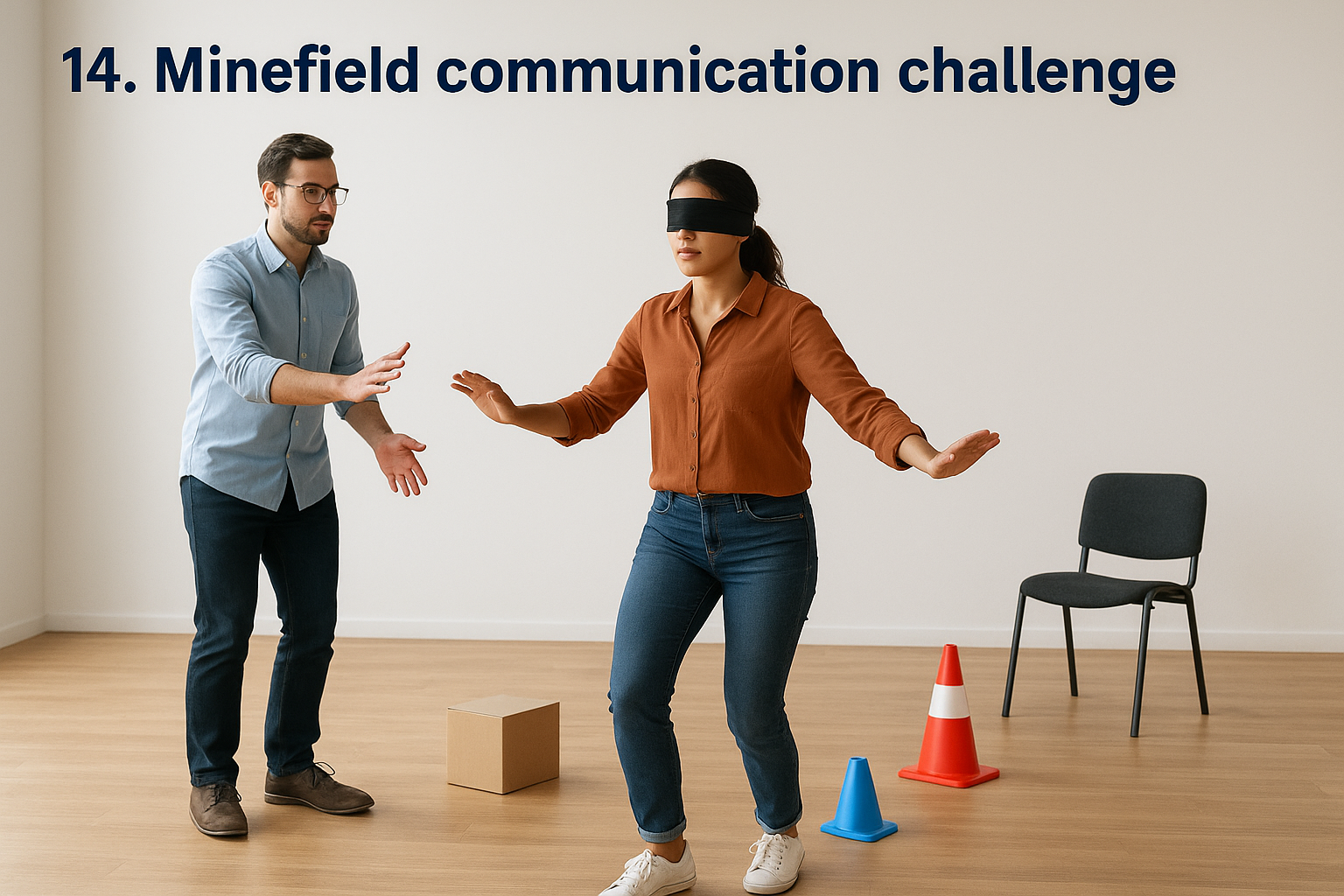
    The minefield communication challenge blindfolds one partner and asks the other to guide them safely through a floor scattered with obstacles, cones, boxes, chairs, using nothing but spoken directions. Of all the team building activities for work on this list, this one puts trust and precise language under the most direct physical test, since one bad instruction sends someone straight into a chair leg.

    14. Minefield communication challenge

    How it works

    Set up an open space with 10 to 15 obstacles spread randomly across the floor, then pair people up with one blindfolded and one sighted. The sighted partner stands at the edge and calls out step-by-step directions while the blindfolded partner navigates from one side to the other without touching anything. Run a second round after swapping roles, then raise the difficulty by adding multiple pairs crossing at once so voices compete for attention.

    Trust gets built the moment someone closes their eyes and follows a voice they can’t see.

    Skills it builds

    This challenge forces precise, real-time direction-giving since vague language causes immediate, visible mistakes. Teams also strengthen:

    • Trusting a teammate’s guidance completely
    • Adjusting instructions on the fly when something changes
    • Staying calm while relying on someone else’s judgment
    • Filtering out noise from competing voices

    Best for

    Teams with a trust deficit or a history of micromanagement benefit most, since the exercise forces genuine reliance on someone else’s word. New managers also gain from playing the sighted role, since it exposes how clearly they actually communicate.

    Time and group size

    Budget 20 minutes for pairs, scaling to any group size running simultaneously.

    15. Community give-back project

    A community give-back project takes your team out of the office entirely and puts them to work on something bigger than a quarterly goal, building homes with Habitat for Humanity, packing meals for a food bank, or cleaning up a local park. Compared to the other team building activities for work on this list, this one leaves a mark outside the company, which tends to stick with people longer than any indoor exercise.

    How it works

    Partner with a local nonprofit a few weeks ahead and confirm a project scope that matches your headcount, since a team of 40 needs a bigger task than a team of 8. Split into smaller crews for specific jobs, painting, sorting, building, and rotate roles partway through so everyone experiences more than one task. Close the day with a short group reflection on what surprised people most.

    Teams that sweat together for a stranger often bond faster than teams that play games for themselves.

    Skills it builds

    This project builds shared purpose outside normal job titles and hierarchy. Teams also strengthen:

    • Working alongside people they rarely collaborate with day to day
    • Taking direction from a nonprofit coordinator instead of a manager
    • Finding satisfaction in physical, tangible results
    • Talking honestly about impact during the debrief

    Best for

    Established teams looking for meaning beyond another indoor exercise get the most value here, especially companies building a stronger community reputation alongside internal culture.

    Time and group size

    Budget a half day, roughly four hours, for groups of any size split into task-based crews of 6 to 10.

    16. Remote team icebreaker session

    A remote team icebreaker session solves a problem the other 15 activities on this list don’t always address: distributed teams that rarely see each other’s faces outside a status update. This structured video call replaces hallway small talk with quick, guided prompts designed for screens instead of conference rooms. It rounds out this list of team building activities for work because remote and hybrid teams need intentional connection, not another meeting disguised as one.

    How it works

    Schedule a dedicated 20 to 30 minute video call separate from any status meeting, and open with a low-stakes prompt like sharing your home office setup or a recent small win. Rotate through three or four quick prompts, keeping each person’s turn under two minutes, and use breakout rooms if the group is larger than 10 so everyone actually gets to talk. Close with a lightning round where people share one thing nobody on the call knows about them.

    Remote teams don’t lack talent, they lack the small moments that build familiarity in person.

    Skills it builds

    This session builds camera comfort and a habit of casual conversation that remote work naturally strips away. Teams also strengthen:

    • Recognizing coworkers as people beyond their job function
    • Speaking up on video without waiting to be called on
    • Building familiarity that makes async messages read warmer
    • Reducing hesitation before reaching out with questions

    Best for

    Fully remote and hybrid teams benefit most, especially new hires who’ve never met coworkers in person. It also works well as a recurring monthly ritual rather than a one-time event.

    Time and group size

    Budget 20 to 30 minutes for groups up to 15, splitting into breakout rooms of 5 to 6 for anything larger.

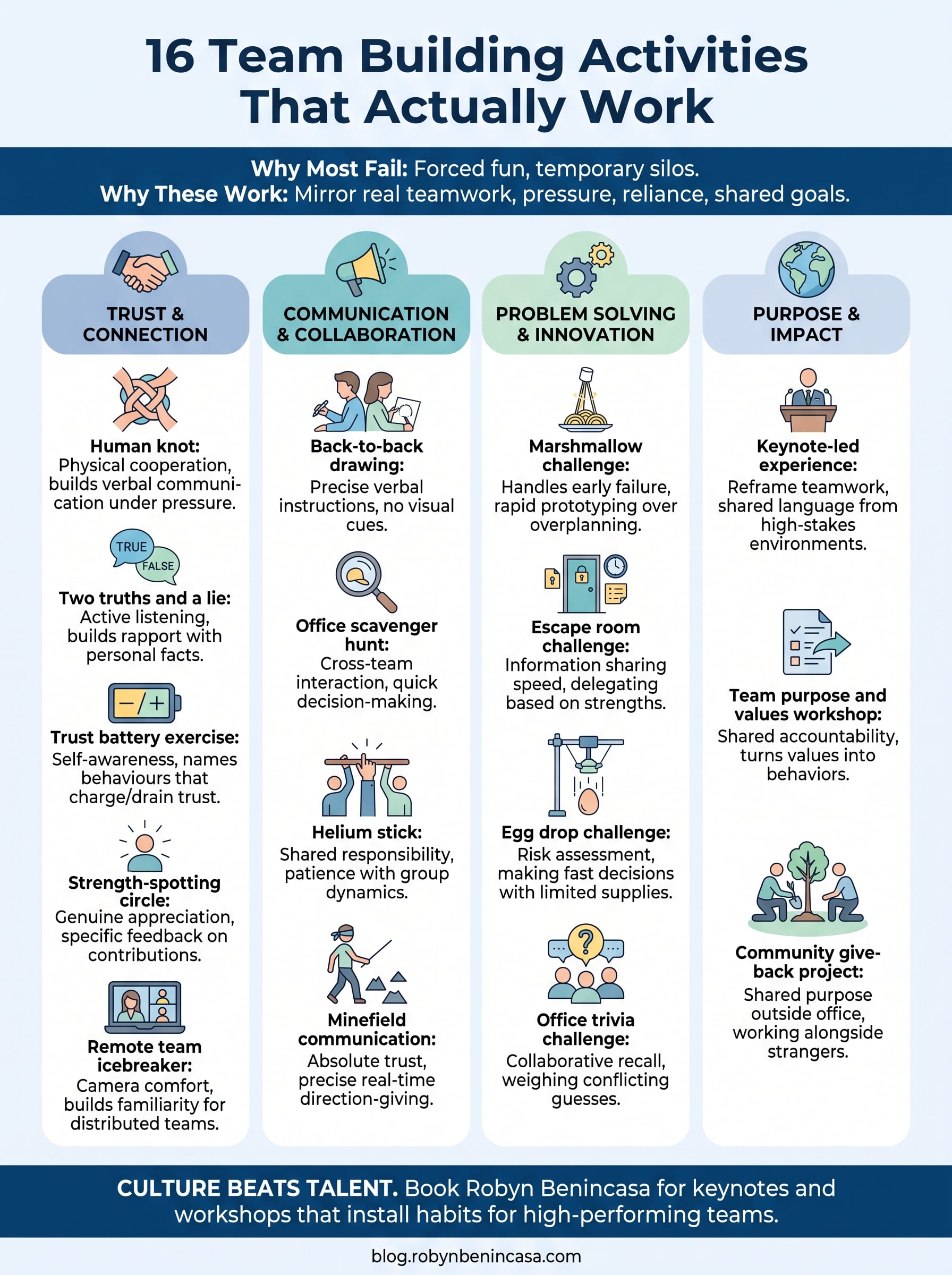
    team building activities for work infographic

    Choosing the right activity for your team

    Match the activity to the actual problem, not the calendar slot you need to fill. A team recovering from a reorg needs the trust battery exercise or a give-back project more than another round of trivia. A team that’s never met in person needs icebreakers before it needs an escape room. Skip the temptation to pick whatever looks most fun in a vendor catalog and start instead with what your team is actually struggling with: communication, trust, or shared purpose.

    The activities on this list work because they mirror real teamwork under real pressure, not because they’re clever games. That’s the same principle behind every keynote I build: give people a framework drawn from environments where the stakes are real, then let them practice it together before the pressure hits at work. If you want that shift to start with a shared experience your whole team remembers, book Robyn for your next event and build a program around what your team actually needs.