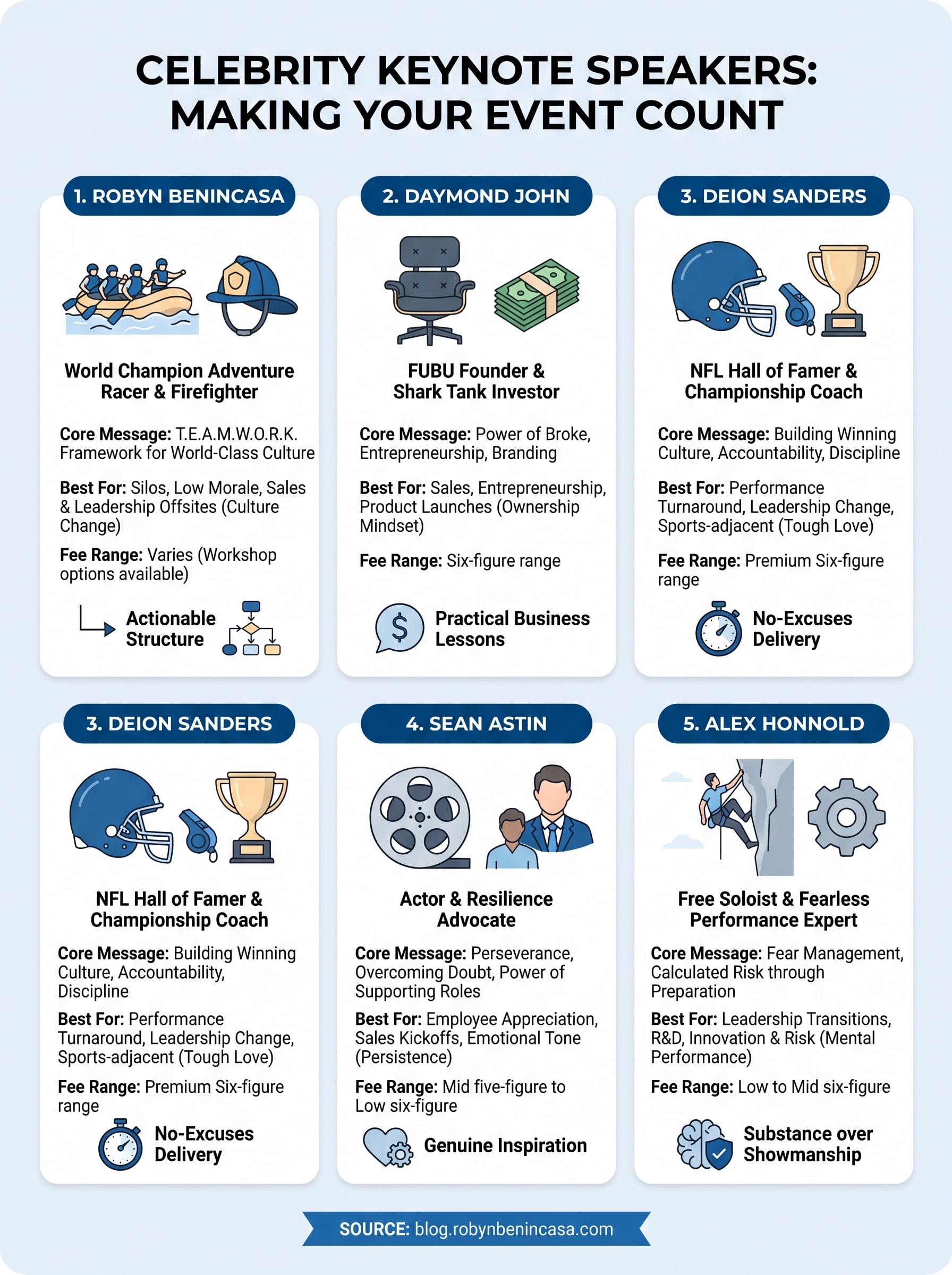
You’ve got a conference date on the calendar, a budget line for talent, and a mandate to make this year’s event actually matter to the people sitting in the room. That’s the moment most planners realize they don’t quite know how to hire a keynote speaker who’ll deliver more than a nice photo for the recap email. Fees range from a few thousand dollars to six figures, agencies pitch you a dozen names, and everyone claims to be a fit for "leadership and teamwork."
This guide walks you through the actual process: how to define what your audience needs before you start browsing bios, what questions separate a professional keynote speaker from someone who just reads slides (and what a keynote speaker’s role actually is), and how booking a keynote speaker actually works from first inquiry to signed contract. You’ll also get a realistic look at typical fees and the red flags that signal a mismatch before you’ve wired a deposit.
Whether you’re planning a sales kickoff, a leadership offsite, or an annual conference, the steps here apply the same way. I’ll draw on what actually gets asked and negotiated when organizations like Allstate or Northrop Grumman book a keynote speaker for conference programs, so you can run your own search with the same confidence.
What to know before you hire a keynote speaker
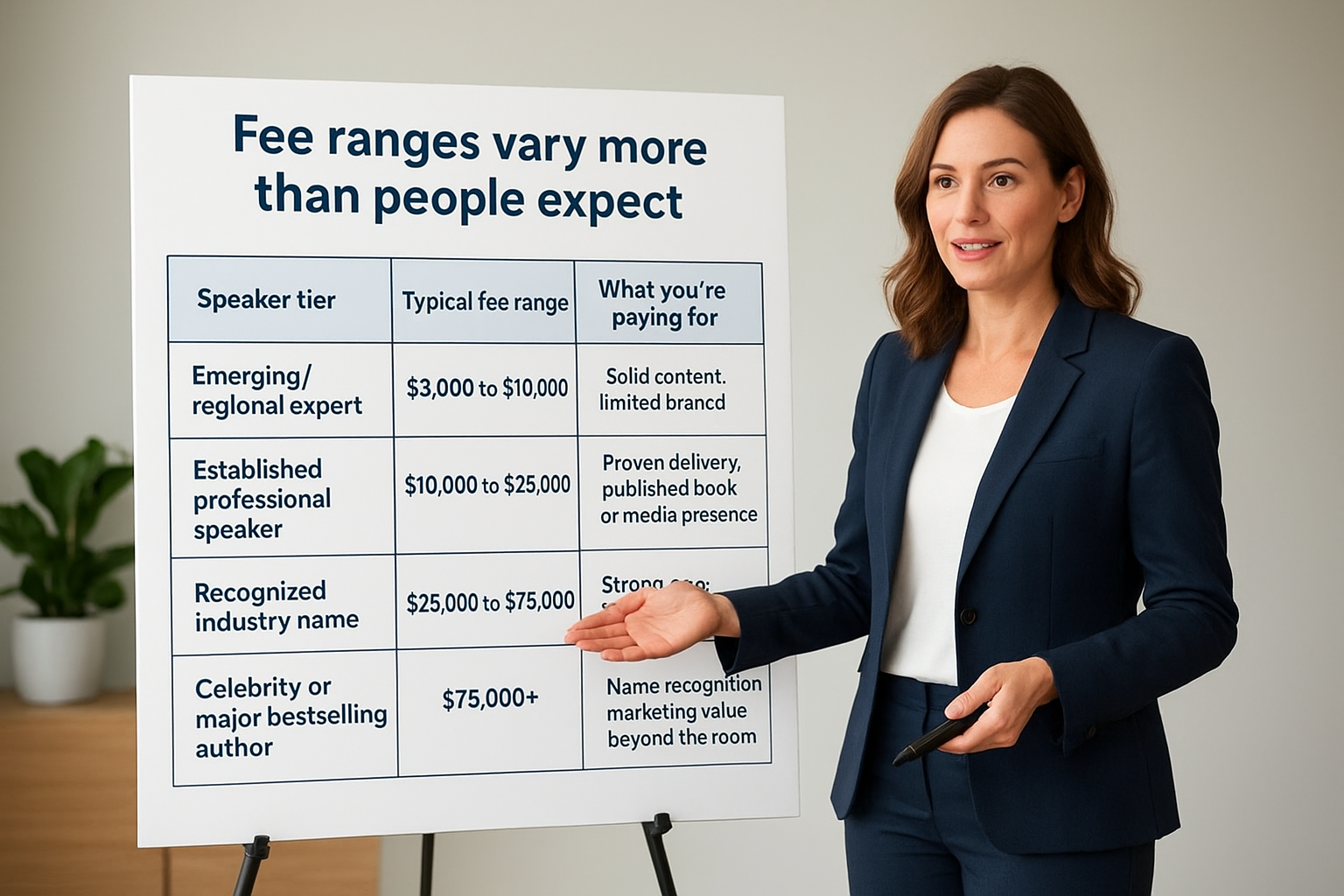
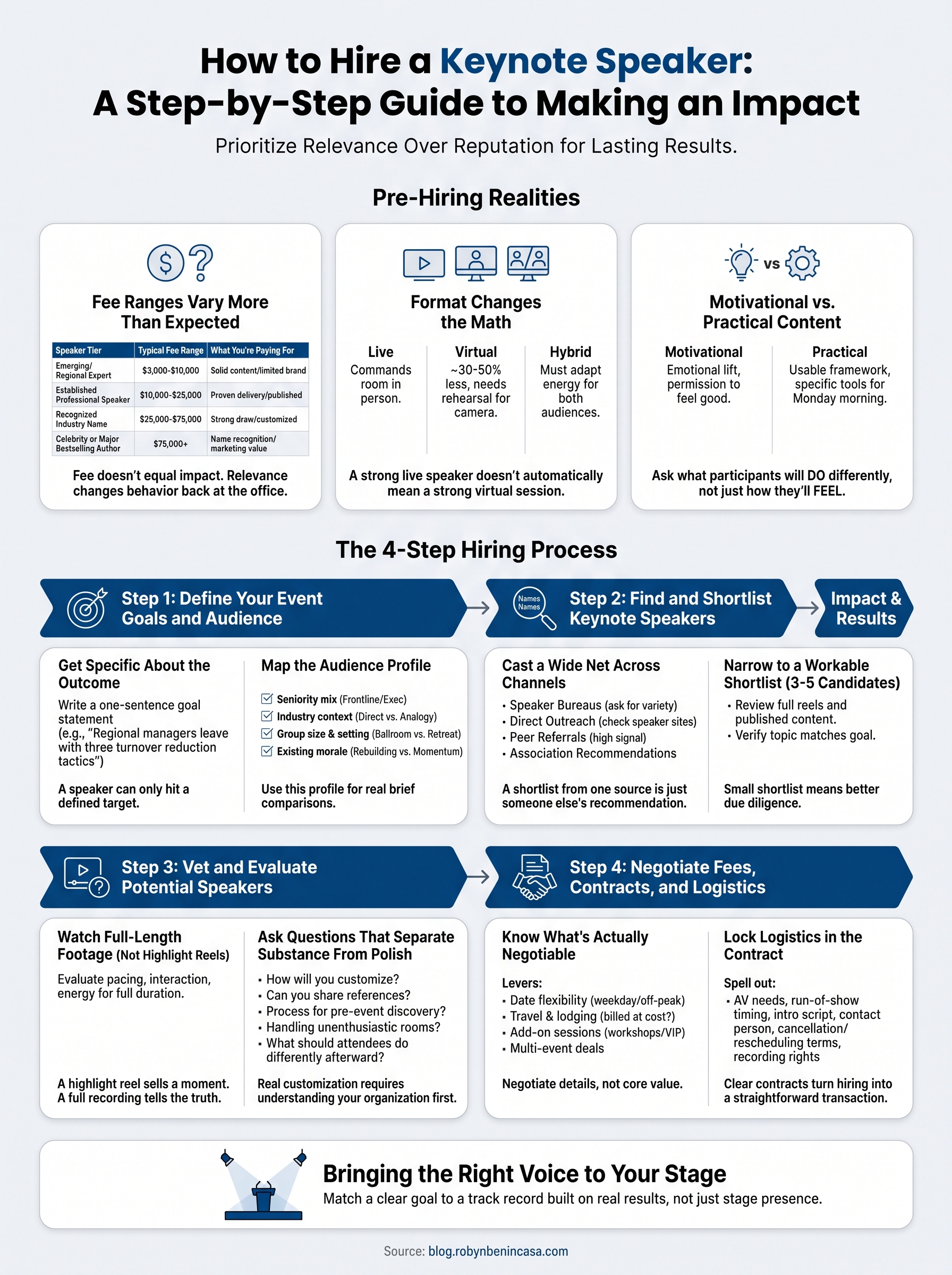
Before you open a browser tab and start Googling names, get clear on a few realities of this market. Hiring a keynote speaker isn’t like booking a caterer where price maps neatly to quality. A $7,500 speaker can outperform a $50,000 name if the content is built for your industry and your audience actually remembers it a month later. Most planners overspend on reputation and underspend on relevance, then wonder why the post-event survey scores are lukewarm.
The right fee tier isn’t about status, it’s about whether the message actually changes behavior back at the office.
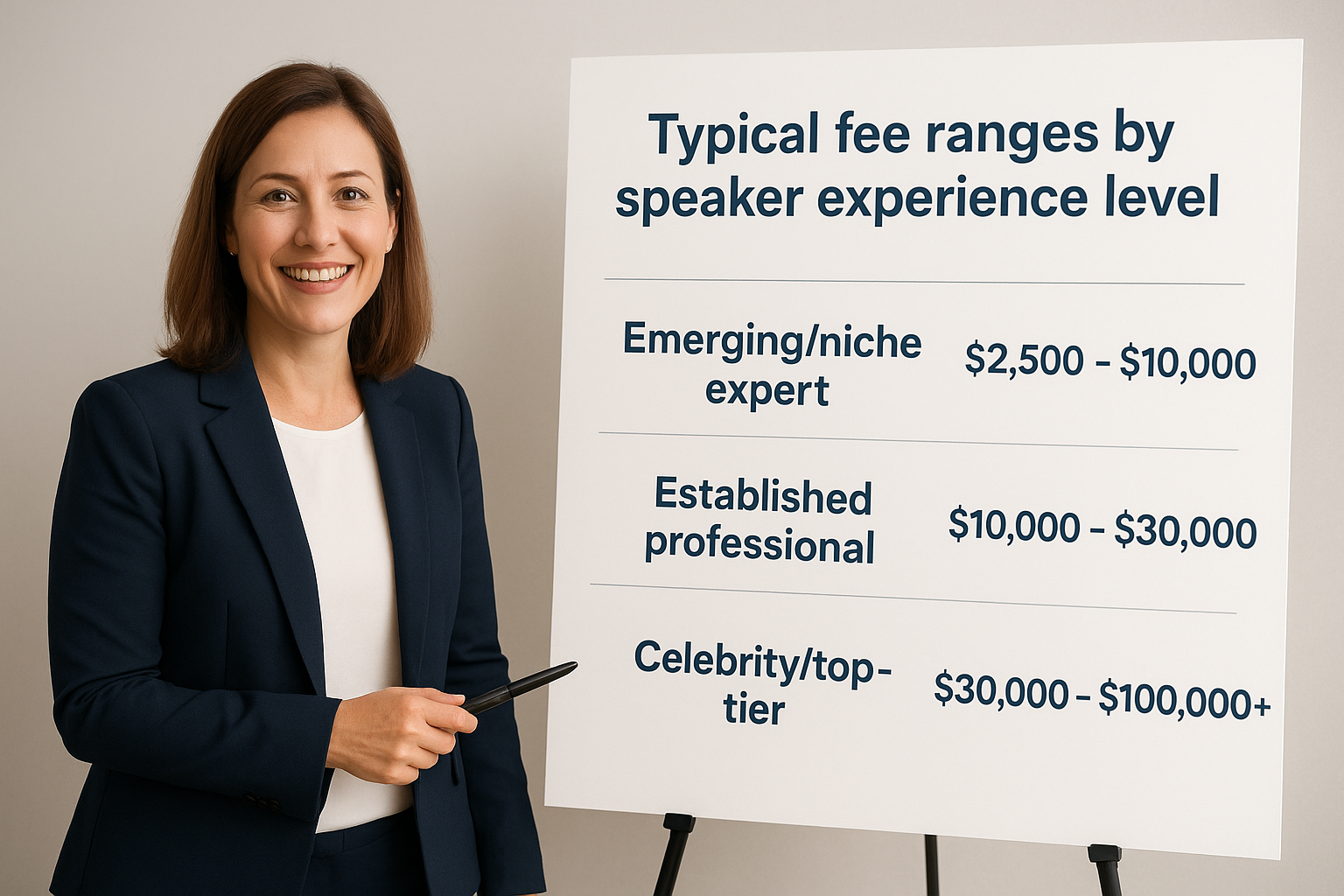
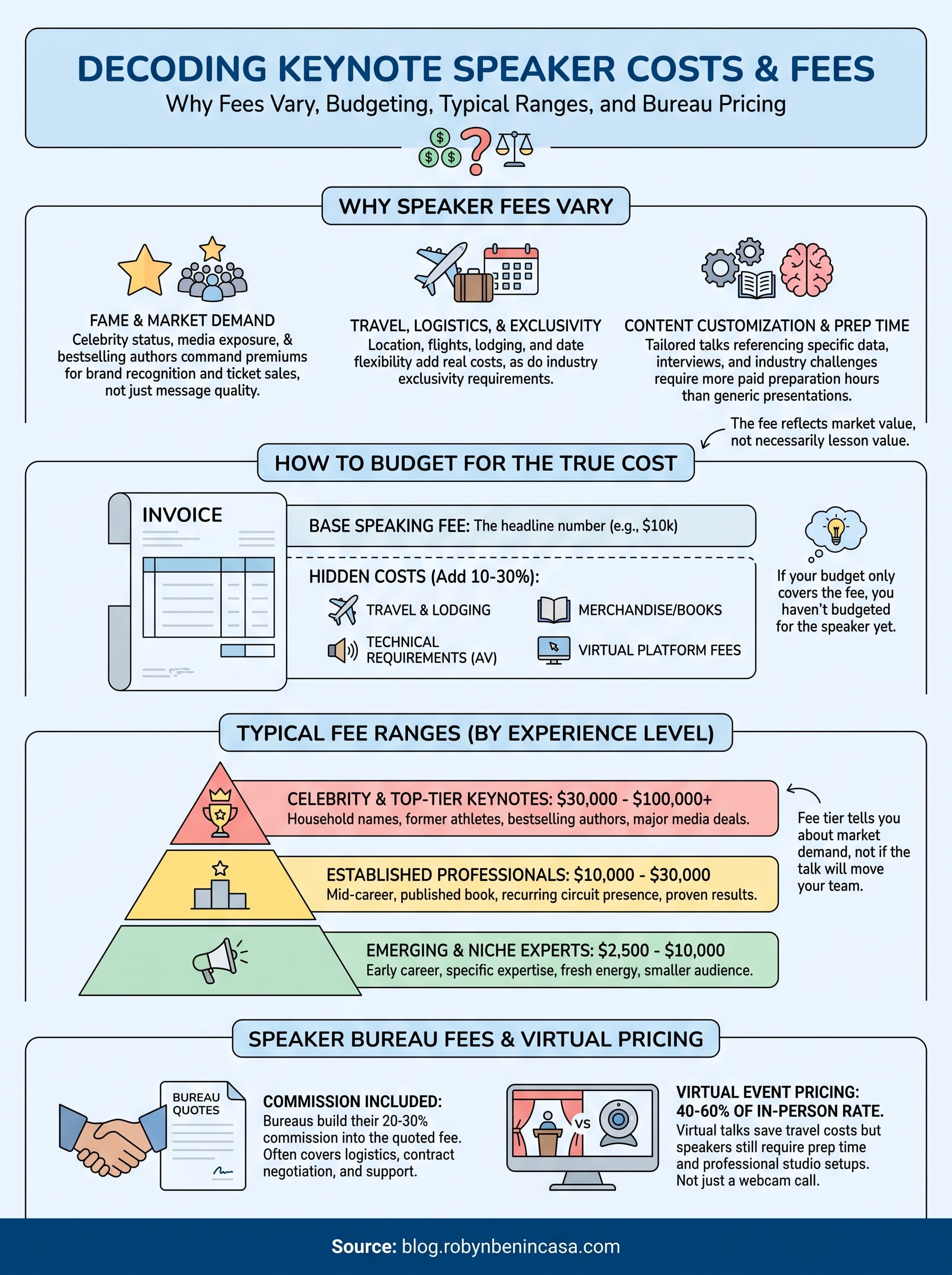
These numbers shift with format, location, and how much customization you request, so treat the table as a starting point for budget conversations, not a locked quote.
Live, virtual, and hybrid change the math
Once you know roughly what you can spend, decide on format, because it affects both cost and speaker selection. A keynote speaker for hire who commands the room in person doesn’t automatically translate to a strong virtual session, and vice versa. Virtual keynotes typically run 30 to 50 percent less than the in-person fee since travel and setup drop out of the equation, but they demand a speaker who’s genuinely rehearsed the format, not someone reading a deck to a webcam. If your event is hybrid, ask directly how the speaker adapts energy and interaction for the remote half of the audience. This is worth clarifying early, since it narrows your shortlist fast and keeps you from booking someone great in a ballroom who falls flat on Zoom.
Motivational versus practical content
Finally, separate motivational keynote speakers who deliver an emotional lift from speakers who leave your team with a usable framework. Both have a place, but they solve different problems. A sales kickoff chasing a specific number needs tools your reps can apply Monday morning. An all-hands meeting after a rough quarter might just need permission to feel good about the mission again. Neither approach is wrong, but conflating the two is how organizations end up with a standing ovation and zero measurable change three months later. If you’re evaluating a professional keynote speaker, and you understand how a keynote differs from other kinds of speakers, ask what participants are supposed to do differently after the talk, not just how they’re supposed to feel. That single question, asked before you shortlist anyone, will save you from the most common hiring mistake in this business: booking charisma and hoping it converts to results on its own.
Step 1. Define your event goals and audience
Before you contact a single agency, write down what success looks like for this specific event. Vague goals like "inspire the team" produce vague results, and they make it nearly impossible to brief a speaker or measure whether the keynote speaker booking was worth the fee. Get specific: are you trying to unify two departments after a merger, reset a sales team’s confidence after a missed quarter, or give a leadership offsite a shared framework for decision-making? Each of those needs a different speaker, different content, and a different tone in the room.
Get specific about the outcome you need
Start by writing a one-sentence goal statement, the kind you could hand to a speaker’s team as a brief. "We want our regional managers to leave with three tactics for reducing turnover" is usable. "We want people fired up" is not. This step matters more than most planners realize.
A speaker can only hit a target you’ve actually defined.
Once you have that sentence, test it against your budget and format decisions from the section above, since a highly specific, industry-tailored outcome usually points you toward the established-professional tier rather than a big name with generic content.
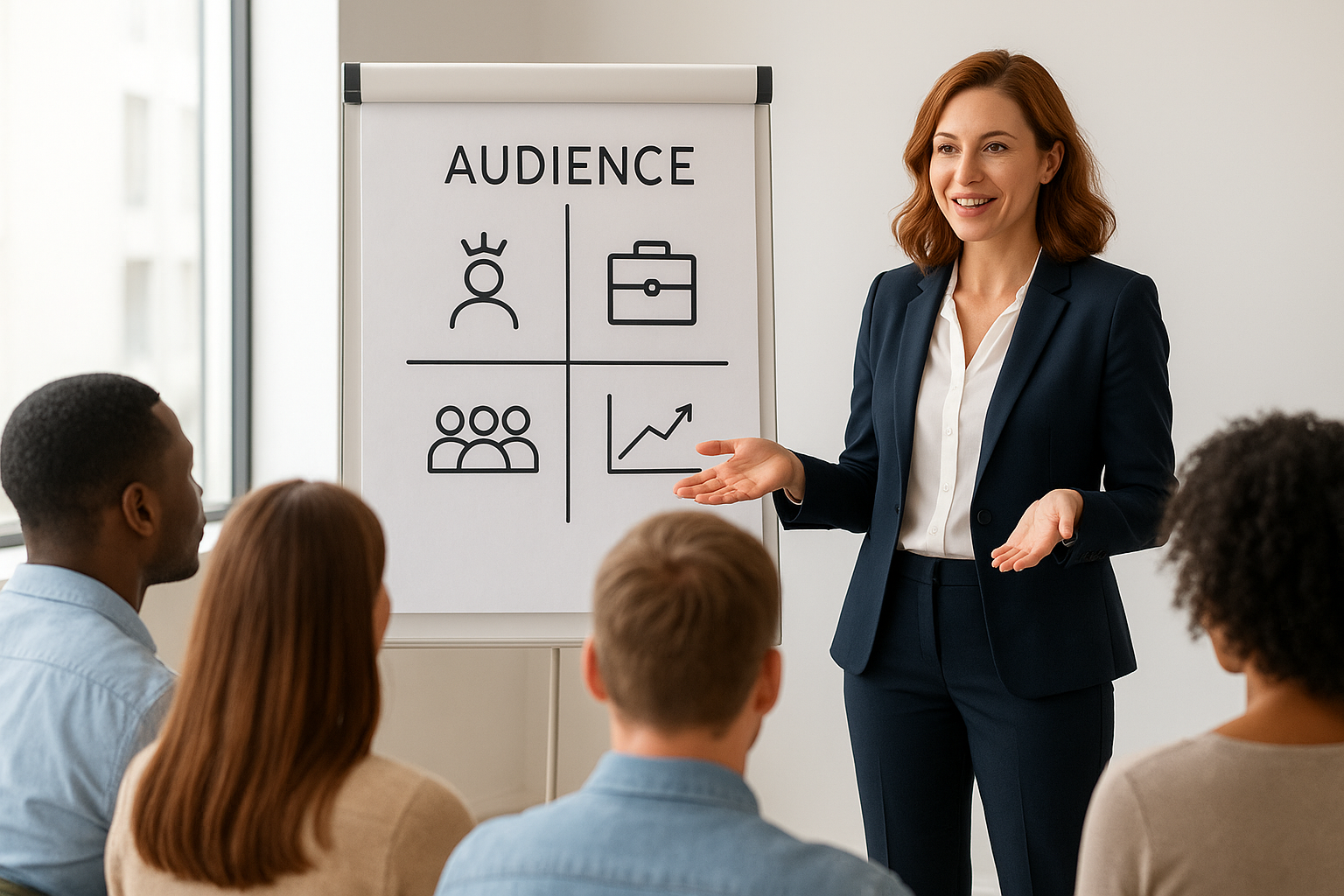
Map the audience before you search names
Next, build a quick audience profile. Knowing who’s in the seats changes which event keynote speaker actually fits, regardless of how impressive their client list looks.
Seniority mix: Are you speaking to frontline employees, middle management, or a room of executives?
Industry context: Does the speaker need direct experience in your sector, or does an outside analogy (adventure racing, sports, military) land better?
Group size and setting: A 200-person ballroom keynote plays differently than a 40-person leadership retreat.
Existing morale: Are you rebuilding trust after a rough year, or building momentum on an already strong team culture?
Writing these details down before you start browsing bios keeps you from getting swayed by a flashy reel that doesn’t actually match your room. It also gives you language to use in Step 2, when you’re comparing candidates against a real brief instead of a gut feeling.
Step 2. Find and shortlist keynote speakers
Now that you’ve got a written goal and an audience profile, start pulling names from more than one channel. Relying only on a single speaker bureau’s suggested list means you’re seeing candidates who pay that bureau a commission, not necessarily the best fit for your room. Cast a wider net and you’ll find better matches faster, plus you’ll have leverage when it’s time to negotiate fees later.
Cast a wide net across the right channels
Good sources rarely overlap, so work through several at once rather than settling for whichever list lands in your inbox first.
Speaker bureaus: Useful for volume and vetted contracts, but ask who else they represent in your topic area so you’re not shown a narrow slice.
Direct outreach: Many speakers, including Robyn Benincasa, list availability and a way to request a booking directly on their own site, which often moves faster than going through a third party.
Peer referrals: Ask other HR leaders or event planners in your industry who they’ve booked and would book again. This is usually the highest-signal source you have.
Association and conference recommendations: Industry groups often keep informal lists of speakers who’ve performed well at similar events.
A shortlist built from one source is really just someone else’s recommendation, not your own research.
Narrow to a workable shortlist
Once you’ve gathered names, cut the list down to three to five real candidates before you go further, using the same criteria you’d apply to choosing the best keynote speaker for a corporate event. Reviewing full speaker reels, reading their published content, and checking whether their topic actually matches your one-sentence goal will eliminate most of the list quickly. Skip anyone whose reel is all crowd shots and applause with no actual content visible, since that’s usually a sign the substance doesn’t hold up under scrutiny. Keeping the shortlist small also makes Step 3 faster, since you’re doing real due diligence on a handful of people instead of skimming twenty bios and hoping one sticks.
Step 3. Vet and evaluate potential speakers
With three to five names on your shortlist, it’s time to test them against reality instead of a highlight reel. This is where most planners get lazy, and it’s exactly where a bad keynote speaker hire gets caught before you sign anything. A polished demo video tells you almost nothing about how someone handles a live Q&A, adapts to a room that’s not laughing at the right moments, or customizes content for your industry instead of recycling the same talk they gave last month in a different city.
Watch full-length footage, not just the highlight reel
Ask every candidate or their team for a complete, unedited recording of a past keynote, not the two-minute sizzle reel built for marketing. A full talk shows you pacing, audience interaction, and whether the energy holds for 45 minutes instead of just the applause line. If a speaker or their agency can’t produce full-length footage, treat that as a real red flag rather than an oversight.
A highlight reel sells you a moment. A full recording tells you the truth.
Ask the questions that separate substance from polish
Get on a call with each finalist, or their representative, and ask direct questions before you move to contracts:
How will you customize this talk for our specific goal and audience?
Can you share two or three references from planners who booked you for a similar event?
What’s your process for a pre-event discovery call with our team?
How do you handle a room that’s not responding the way you expect?
What do you want attendees to actually do differently afterward?
A strong candidate for hiring a keynote speaker answers these without hesitation and usually asks you questions back, since real customization requires understanding your organization first. Vague answers, or a pitch that sounds identical to what you’d hear for any other client, tell you the content isn’t built for your room. This step takes an extra week, but it’s the difference between a speaker who performs and one who actually moves the needle once everyone’s back at their desks.
Step 4. Negotiate fees, contracts, and logistics
Once you’ve picked a finalist, the fee you saw on their website is rarely the final number. Most professional keynote speaker rates have some flexibility, especially if you can offer a slower travel day, a shoulder-season date, or a multi-session add-on like a workshop the next morning. Ask directly whether the quoted fee includes travel, or whether that’s billed separately, since this is the most common source of budget surprises after a contract is signed.
Know what’s actually negotiable
Before you push back on price, understand which levers actually move. Speakers protect their headline fee because it affects every future negotiation, but they’re often flexible on the details around it.
Date flexibility: Weekday or off-peak dates sometimes come with a lower fee than a Friday conference slot.
Travel and lodging: Ask if these are included or billed at cost, and get the answer in writing before you compare quotes across candidates.
Add-on sessions: A breakout workshop or VIP meet-and-greet booked alongside the keynote often costs less per session than booking it separately later.
Multi-year or multi-event deals: If you’re likely to rebook, say so. Speakers will often price a return engagement lower than a one-off.
Negotiate the details around the fee, not the speaker’s core value, and you’ll get further with less friction.
Lock the logistics in the contract
Getting a contract in place protects both sides, and it should spell out more than just the date and dollar amount. Require confirmation of AV needs, run-of-show timing, introduction script, and a named point of contact for the event day. Specify cancellation and rescheduling terms up front, since weather and travel disruptions happen more often than planners expect. Include a clause on recording rights if you plan to use footage internally or for marketing, since this gets contentious after the fact if it isn’t addressed early. A clear contract turns hiring a keynote speaker from a leap of faith into a straightforward business transaction, with no ambiguity about who owns what once the applause fades.
Bringing the right voice to your stage
Getting this right comes down to sequence, not luck. Define the outcome you actually need, build a shortlist from more than one source, vet full-length footage instead of sizzle reels, and lock the logistics in writing before you sign. Skip any of those steps and you’re gambling a five-figure budget on a polished bio instead of a proven fit.
Organizations like Allstate and Northrop Grumman didn’t land on the right speaker by accident. They matched a clear goal to a track record built on real results, not just stage presence. That’s the standard worth holding your own search to, whether you’re planning a sales kickoff or a full leadership conference.
If you’re ready to compare finalists, start with the top corporate event speakers worth booking and see how a speaker who’s led actual world championship teams turns that experience into frameworks your people can use Monday morning.
You’re planning a sales kickoff, leadership offsite, or annual conference, and someone on your team just said the magic words: "we need a speaker who actually moves the needle." That’s harder than it sounds. The motivational speakers business is crowded with people who can work a room but leave your team with nothing to act on Monday morning.
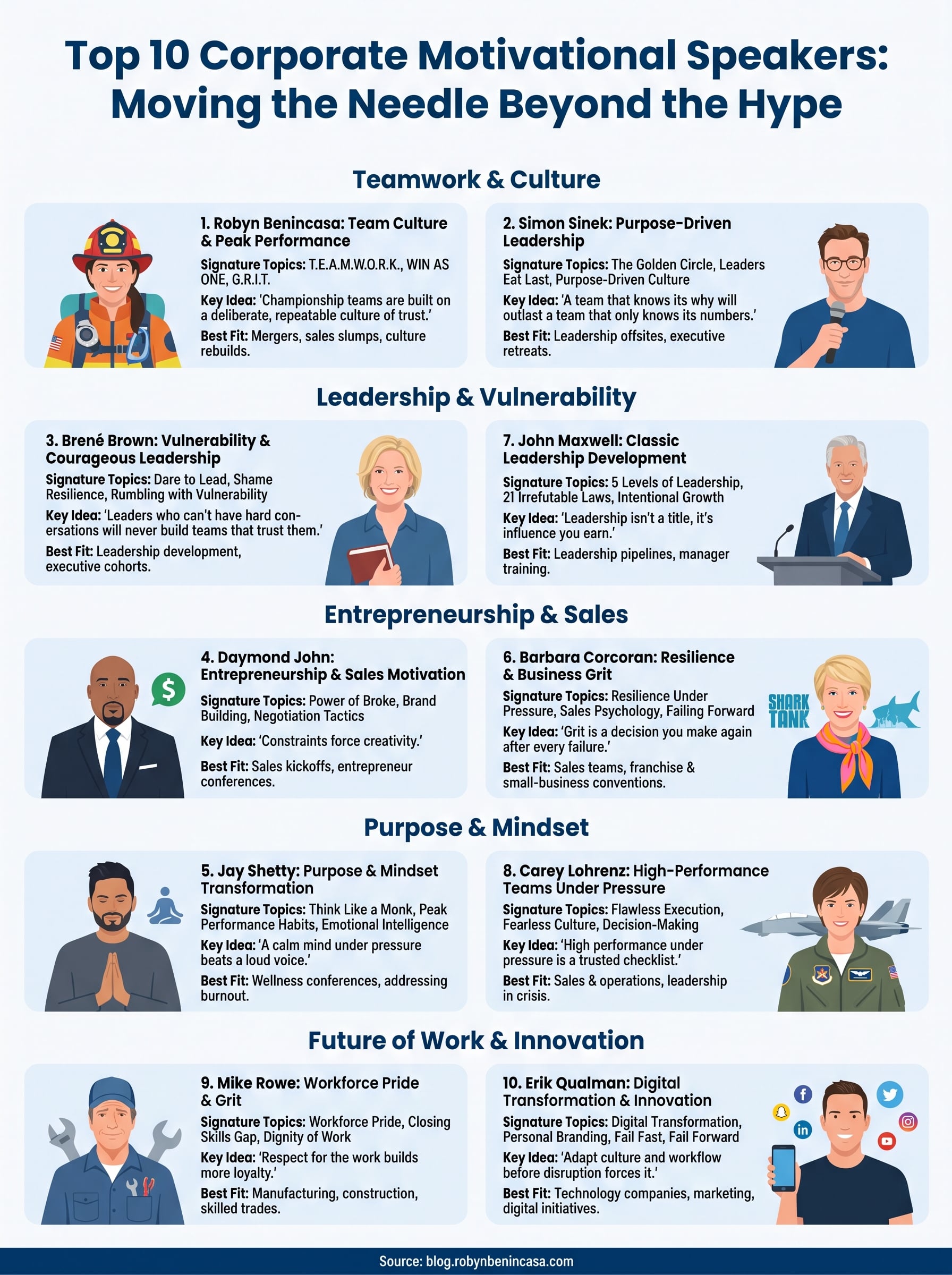
This list skips the hype and focuses on speakers with real track records: measurable results, repeat corporate bookings, and content that connects to actual leadership and performance challenges. Whether you’re vetting business motivational speakers for a 500-person conference or a smaller leadership retreat, you’ll find names here among the best corporate event speakers who’ve proven they can shift culture, not just deliver applause lines.
Below, you’ll get ten motivational speakers worth hearing, including what makes each one distinct, the kind of audience they fit best, and what past clients have said about the results. If you’re comparing motivational speakers for business events tied to sales performance, team cohesion, or organizational change, this rundown gives you a practical starting point instead of another generic top-ten list built on name recognition alone.
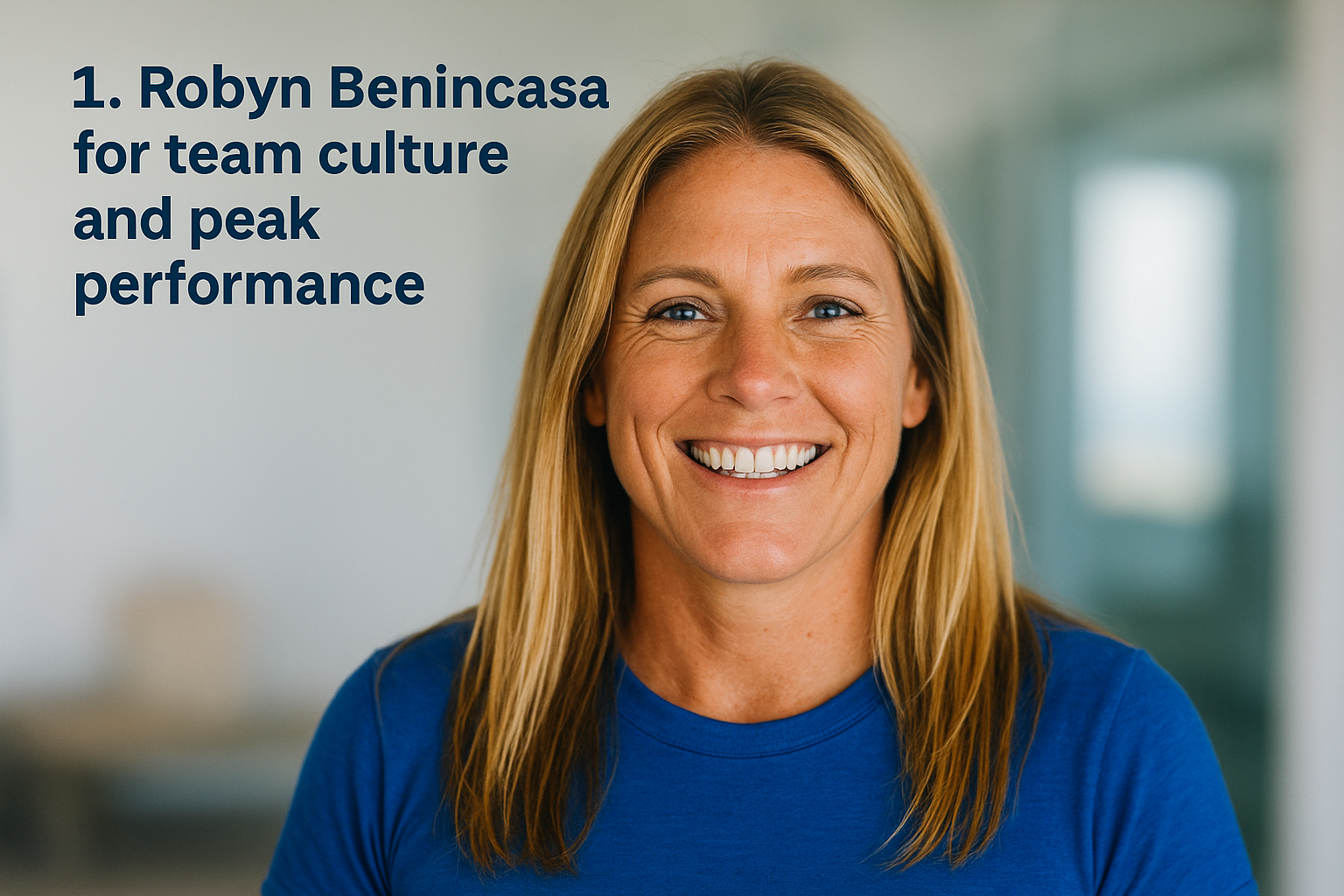
1. Robyn Benincasa for team culture and peak performance
Robyn Benincasa spent 20 years as a San Diego firefighter while also captaining world championship adventure racing teams, the kind of races that run 300 miles nonstop through jungle, mountains, and open ocean with almost no sleep. That combination gives her a rare vantage point on team culture most keynote speakers simply don’t have. She’s not theorizing about pressure and teamwork from a stage; she’s lived it in situations where a bad handoff or a broken trust could end the race, or worse. For any organization searching the motivational speakers business for a corporate culture keynote speaker who can translate extreme performance into everyday leadership lessons, she’s a strong first stop.
Signature topics
Robyn’s core keynote, T.E.A.M.W.O.R.K.: 8 Essential Elements of a World-Class Team Culture, breaks down exactly what separates championship teams from teams that just show up. She also delivers WIN AS ONE, focused on cross-functional collaboration, and INSPIRING GREATNESS THROUGH G.R.I.T., built around resilience during change or hardship. Her book, the New York Times bestseller "How Winning Works," backs every talk with concrete leadership frameworks rather than motivational platitudes. You can browse her full lineup of keynote topics directly.
Championship teams aren’t built on talent alone; they’re built on a deliberate, repeatable culture of trust.
Best fit for your event
Companies navigating mergers, sales slumps, or post-pandemic culture rebuilds tend to get the most out of Robyn’s content, since her frameworks for building a strong team culture are made for exactly that kind of disruption. She’s delivered results for insurance, pharmaceutical, defense, and retail clients including Allstate, InterWest Insurance, Indivior, Boston Scientific, and Northrop Grumman. Both live and virtual formats are available, which matters if you’re planning a hybrid sales kickoff or a distributed leadership summit. Event planners can review her booking page to check availability and formats.
Notable achievements
Her teams didn’t just compete, they dominated the sport of adventure racing for 15 straight years. Clients report concrete business outcomes tied to her keynotes, including one sales division that moved from 17th to 1st nationally after applying her team culture principles. She’s also the founder of the Project Athena Foundation, a nonprofit for injury and illness survivors, work that earned her recognition as a CNN Hero.
2. Simon Sinek for purpose-driven leadership
Simon Sinek built his entire speaking career on one deceptively simple question: why do some organizations inspire loyalty while others just pay salaries? His 2009 TED Talk, "Start With Why," became one of the most-watched talks in the platform’s history, and it launched him into the top tier of the motivational speakers business. Unlike speakers who lean on personal drama for impact, Sinek works from research and pattern recognition across dozens of companies, which gives his talks a more analytical, almost consultative feel.
Signature topics
His best-known frameworks include the Golden Circle model, which argues that great leaders communicate purpose before product, and "Leaders Eat Last," Simon Sinek’s take on teamwork, trust, and sacrifice inside high-performing teams. Corporate audiences often request his content on building a purpose-driven culture that survives leadership turnover and market pressure.
A team that knows its why will outlast a team that only knows its numbers.
Best fit for your event
Organizations wrestling with employee engagement or a muddled mission statement get the most value here. His style suits leadership offsites and executive retreats better than high-energy sales kickoffs, since the delivery is measured rather than rousing.
Notable achievements
Sinek has written five bestselling books, advised military and Fortune 500 leadership teams, and built a media company, The Optimism Company, around his ideas. His TED Talk has drawn well over 60 million views.
3. Brené Brown for vulnerability and courageous leadership
Brené Brown spent two decades researching shame, vulnerability, and courage before her 2010 TEDx Talk, "The Power of Vulnerability," turned her into one of the most requested names in the motivational speakers business. She’s a research professor, not a former executive, and that academic grounding shows in how she builds her talks: data first, story second, action items third. Corporate audiences that expect a typical hype speech often find her approach disarming, since she asks leaders to admit what isn’t working before she tells them how to fix it.
Signature topics
Her signature framework, Dare to Lead, teaches leaders how courageous leadership requires tolerating discomfort and having hard conversations instead of avoiding them. She also speaks on shame resilience, trust-building, and what she calls "rumbling with vulnerability," a phrase that’s found its way into countless corporate leadership programs.
Leaders who can’t have hard conversations will never build teams that trust them.
Best fit for your event
Organizations focused on how to build trust in a team at work after layoffs, restructuring, or a toxic leadership exit benefit most from her content. She fits leadership development programs and executive cohorts better than large sales rallies, since her material rewards reflection over adrenaline.
Notable achievements
Brown has written five number-one New York Times bestsellers, including "Daring Greatly" and "Dare to Lead," and her TEDx Talk ranks among the most-viewed of all time. Her Dare to Lead certification program now trains facilitators inside Fortune 500 companies worldwide.
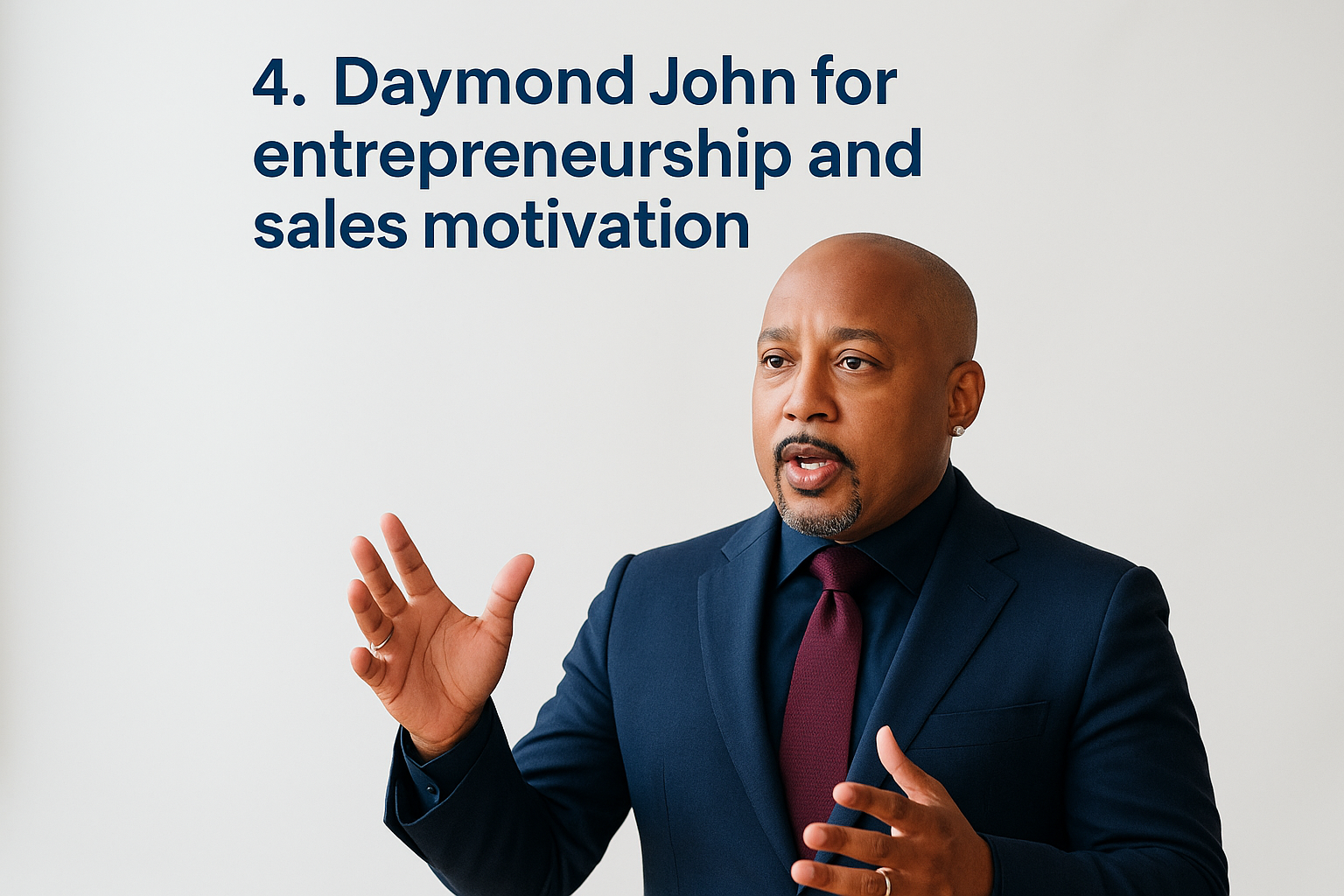
4. Daymond John for entrepreneurship and sales motivation
Daymond John built FUBU from a $40 investment into a $6 billion clothing brand before most audiences ever saw him on "Shark Tank." That path from Queens hustle to boardroom investor makes him one of the most credible business motivational speakers on the entrepreneurship circuit, since he’s failed publicly, rebuilt, and scaled more than once. Sales teams respond to him because he talks in specifics: cash flow mistakes, brand positioning, and the exact pitch tweaks that separate a rejected deal from a signed one.
Signature topics
John’s keynotes center on his "Power of Broke" philosophy, the idea that limited resources force better creativity than a padded budget ever will. He also covers brand building, negotiation tactics drawn straight from his Shark Tank deals, and what he calls the "Displaced Fear" method for pushing past risk-aversion in sales and leadership roles.
Constraints don’t kill good ideas; they force out the ones that actually work.
Best fit for your event
Sales kickoffs and entrepreneurship-focused conferences get the most mileage from John’s material, since his stories map directly onto quota pressure and deal-closing psychology. He also plays well at franchise and small-business conventions where attendees are actively building something, not just managing an existing team.
Notable achievements
One of the most recognizable celebrity speakers to book on the circuit, John has appeared on "Shark Tank" for over a decade, invested in hundreds of companies, and written multiple bestselling books including "The Power of Broke." He’s also served as a presidential ambassador for global entrepreneurship, adding policy credibility to his business track record.
5. Jay Shetty for purpose and mindset transformation
Jay Shetty spent three years as a monk in India before building one of the largest personal development platforms in the world, and that unlikely path gives him a distinct voice among business motivational speakers. His podcast, On Purpose, regularly tops global charts, and his social following runs into the tens of millions, a reach few names in the motivational speakers business can match. Corporate audiences respond to him because he blends monastic discipline with modern productivity science, translating meditation and mindfulness practices into concrete peak performance habits rather than abstract advice.
Signature topics
Shetty’s keynotes draw heavily from his bestselling book "Think Like a Monk", teaching leaders how to manage stress, sharpen focus, and build a peak performance mindset under constant digital distraction. He also speaks on purpose-driven career paths and emotional intelligence, framing both as trainable skills rather than fixed personality traits.
A calm mind under pressure beats a loud voice in the room every time.
Best fit for your event
Organizations dealing with burnout, remote-work fatigue, or a younger workforce craving purpose beyond a paycheck get the strongest results from Shetty’s content. He fits wellness-focused conferences and leadership retreats better than high-adrenaline sales rallies, since his delivery is calm and reflective rather than rousing.
Notable achievements
Shetty’s "Think Like a Monk" hit number one on the New York Times bestseller list, and his On Purpose podcast has logged hundreds of millions of downloads worldwide. He’s built a media and coaching company, On Purpose Productions, extending his influence well beyond the keynote stage.
6. Barbara Corcoran for resilience and business grit
Barbara Corcoran turned a $1,000 loan into The Corcoran Group, one of New York City’s largest real estate firms, before selling it for $66 million and becoming a fixture on "Shark Tank." That rags-to-riches arc, built on repeated failure and stubborn persistence, makes her one of the more relatable business motivational speakers working the corporate circuit today. She doesn’t sugarcoat the grind, and audiences notice the difference between her stories and the polished success narratives most speakers offer.
Signature topics
Corcoran’s keynotes lean on her own business history to teach resilience under pressure, covering how she survived being fired, dyslexia, and 22 different jobs before finding real success. She also speaks on sales psychology, reading people in negotiations, and what she calls "failing forward," turning setbacks into faster iteration rather than paralysis.
Grit isn’t a personality trait, it’s a decision you make again after every failure.
Best fit for your event
Sales teams facing tough quotas and entrepreneurs navigating early-stage struggle get the most value from her direct, no-excuses delivery. She also fits real estate, franchise, and small-business conferences well, since her background speaks directly to their daily pressures.
Notable achievements
Corcoran built a real estate empire from nothing, has invested in dozens of companies through "Shark Tank," and remains one of television’s most recognized business personalities, giving her talks instant credibility with mainstream corporate audiences.
7. John Maxwell for classic leadership development
John Maxwell has spent over four decades writing about leadership, and his books have sold more than 30 million copies in over 50 languages, making him one of the longest-running names in the motivational speakers business. Where newer speakers chase trends, Maxwell built a body of work so foundational that entire corporate training programs are structured around his frameworks. Companies that want proven, time-tested leadership development content over trendy stage presence often land on him first.
Signature topics
Maxwell’s best-known framework, The 5 Levels of Leadership, walks audiences through the stages leaders move through, from positional authority to true influence earned over time. He also teaches The 21 Irrefutable Laws of Leadership, a practical rulebook covering everything from the Law of the Lid to the Law of Buy-In, and his content on intentional growth pushes leaders to treat development as a daily discipline rather than an annual event.
Leadership isn’t a title you’re given, it’s influence you earn one decision at a time.
Best fit for your event
Organizations building internal leadership pipelines or promoting first-time managers get the most value from Maxwell’s structured, teachable frameworks. He fits multi-day leadership academies and manager training conferences better than one-off motivational rallies, since his material rewards repeated study over time.
Notable achievements
Maxwell founded the John Maxwell Company and John Maxwell Team, which has certified thousands of leadership coaches worldwide. He’s advised Fortune 500 executives, nonprofit leaders, and government officials, and several of his titles remain fixtures on leadership bestseller lists decades after publication.
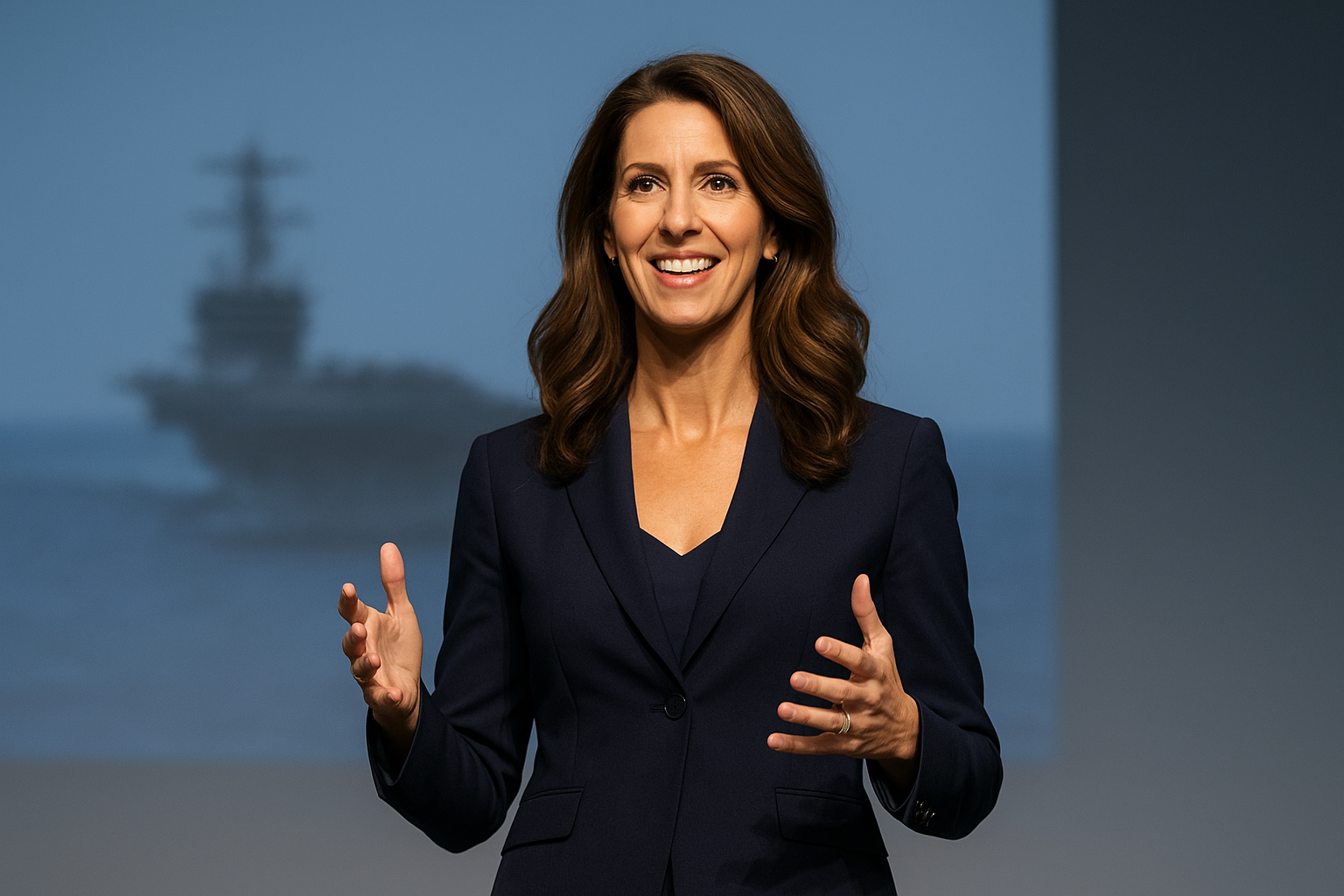
8. Carey Lohrenz for high-performance teams under pressure
Carey Lohrenz became the Navy’s first female F-14 Tomcat pilot, landing multi-million dollar aircraft on aircraft carriers at night, often with fuel running low and zero room for error. That background puts her in a small category among business motivational speakers: people who’ve actually operated inside life-or-death performance pressure rather than just studied it. She translates cockpit discipline into boardroom language, focusing on how teams make fast, high-stakes decisions without falling apart under stress.
Signature topics
Lohrenz’s core keynote centers on what she calls flawless execution, the habits that let elite teams perform consistently when conditions turn chaotic. She also covers building a fearless culture, decision-making under uncertainty, and leading through change, all pulled directly from carrier deck operations and combat flight training rather than borrowed business case studies.
High performance under pressure isn’t talent, it’s a checklist you trust enough to run on autopilot.
Best fit for your event
Sales organizations facing volatile markets and operations teams managing constant deadline pressure get the most from her content, especially those already investing in high performance culture training. She also plays well at leadership conferences focused on decision-making and crisis readiness, since her frameworks translate cleanly into any environment where mistakes carry real cost.
Notable achievements
Lohrenz logged over 300 carrier landings and flew combat missions during her Navy career, then built a second career as a bestselling author with "Fearless Leadership." She’s addressed Fortune 500 companies and government agencies on performance under pressure, and her military credentials give her instant authority with audiences skeptical of typical corporate speakers.
9. Mike Rowe for workforce pride and grit
Mike Rowe spent eight years hosting "Dirty Jobs," crawling through sewers and slaughterhouses alongside the people who keep the country running, and that show turned him into an unlikely fixture in the motivational speakers business. He built his message around a blunt observation: America celebrates college degrees while ignoring the skilled trades that actually keep infrastructure standing. Corporate audiences respond to him because he respects labor at every level, and he calls out the disconnect between what companies say they value and who they actually promote.
Signature topics
Rowe’s keynotes center on workforce pride, challenging the assumption that only white-collar career paths deserve celebration. He speaks on closing the skills gap, rethinking how companies recruit and retain frontline workers, and what he calls the dignity of hard, unglamorous work. His delivery mixes blue-collar storytelling with genuine humor, avoiding the polished consultant tone that dominates much of the motivational speakers for business circuit.
Respect for the work in front of you builds more loyalty than any perk package ever will.
Best fit for your event
Manufacturing, construction, logistics, and skilled-trade companies get the strongest results from Rowe’s material, since his stories speak directly to frontline workforce culture. He also fits conferences focused on recruitment and retention in labor-strapped industries.
Notable achievements
Rowe founded the mikeroweWORKS Foundation, which has awarded millions in scholarships for trade education, and hosted "Dirty Jobs" for over 300 episodes across the U.S.
10. Erik Qualman for digital transformation and innovation
Erik Qualman built his reputation writing "Socialnomics," one of the first books to explain how social media would rewrite the rules of business, sales, and reputation management. His timing wasn’t luck; he’d spent years watching digital behavior shift faster than most executives could track it. That makes him one of the more forward-looking names in the motivational speakers business, since his content focuses less on nostalgia and more on what’s coming next for teams navigating constant technological change.
Signature topics
Qualman’s keynotes cover digital transformation, teaching leaders how to adapt culture and workflow before disruption forces the change on them. He also speaks on personal branding in a digital-first economy and what he calls the "Fail Fast, Fail Forward" approach to innovation, encouraging teams to treat failed experiments as data rather than embarrassment.
The companies that survive disruption are the ones that practiced adapting before they had to.
Best fit for your event
Technology companies, marketing teams, and organizations mid-way through a digital transformation initiative get the most value from Qualman’s material. He also fits conferences focused on innovation strategy and sits comfortably alongside the best change management speakers, where audiences need practical frameworks rather than abstract encouragement to "embrace disruption."
Notable achievements
Qualman’s "Socialnomics" became a bestseller and required reading in business schools worldwide, and his TEDx talks have drawn millions of views. He’s advised companies including Google and Sony on digital strategy, giving his innovation content real-world grounding rather than theoretical polish.
Finding your perfect keynote match
Ten strong options still means one decision: which speaker actually solves your problem. A sales kickoff needs someone like Daymond John or Barbara Corcoran, while a leadership offsite rebuilding trust calls for Brené Brown or Simon Sinek. If your event centers on team culture, cross-functional trust, and turning individual talent into a unified performance under pressure, that’s the exact territory Robyn Benincasa has spent two decades proving out, both as a firefighter and as captain of championship adventure racing teams.
Before you book anyone, match their signature topic to your actual business challenge, not just their name recognition. The right fit shows up in the results your team carries home, not just applause in the room. If team culture, resilience, and measurable performance gains are what you’re after, see how to choose the best keynote speaker for a corporate event and whether Robyn’s approach fits your next one.
You need an activity that actually gets people talking, not another trust fall nobody wants to do. Scavenger hunts solve that problem because they force collaboration without feeling forced, which is why they sit alongside the team-building activities that actually strengthen teams rather than the ones people dread. That’s why team building scavenger hunt activities keep showing up on every planner’s shortlist for offsites, sales kickoffs, and department meetings that need an energy reset.
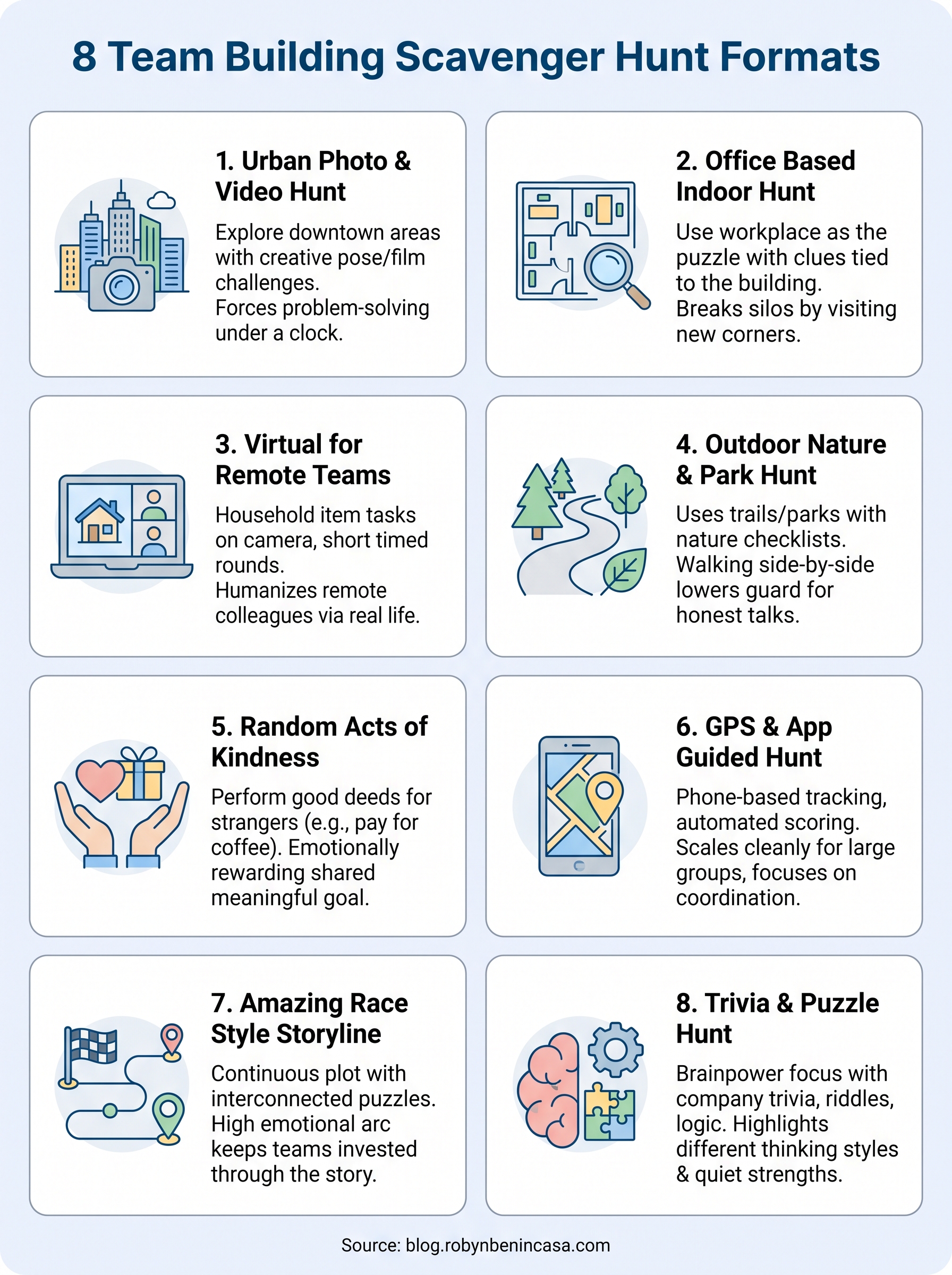
Below you’ll find eight team building activities scavenger hunt formats that work whether your group is sitting in the same conference room or scattered across three time zones on a video call. Each one is built around a real objective: breaking down silos, mixing up seniority levels, or just getting people to laugh together before a hard quarter. None require a big budget or a facilitator with a whistle.
I’ve spent 15 years building championship adventure racing teams and another two decades as a firefighter, and the lesson is always the same: shared small missions build trust faster than lectures ever will. This list covers indoor and outdoor options, virtual-friendly versions, and tips for scaling each hunt from a team of six to a division of six hundred.
1. Urban photo and video scavenger hunt
An urban photo and video scavenger hunt sends small groups out into a downtown area, business park, or convention district with a list of shots to capture and a deadline to beat. It’s one of the most requested team building scavenger hunt activities for companies hosting offsites in a new city, because it turns unfamiliar streets into a shared adventure instead of a logistics headache.
How it works
Split your group into teams of four to six people and hand each team a checklist of 15 to 25 challenges: pose with a street performer, film a 10-second commercial for the host hotel, find the oldest building on the block, or get a stranger to teach them a local phrase. Teams submit proof through a shared photo app, a group text thread, or a simple hashtag on a private social channel. Set a hard return time, usually 90 minutes to two hours, and award points for creativity as much as speed.
Sample checklist categories:
- 1 group photo with a local landmark
- 1 video interview with a stranger
- 1 item collected that starts with each team member's initial
- 1 recreation of a famous movie scene
- 1 act of kindness caught on camera
Why it builds stronger teams
Unlike a scripted icebreaker, this format forces real problem-solving under a clock. Someone has to navigate, someone has to negotiate with strangers, and someone has to keep morale up when the group gets lost. That mix of roles is exactly what I saw in adventure racing: teams win when everyone’s strengths get used, not when one person carries the load.
A city block full of strangers teaches a team faster trust than any conference room ever will.
Groups also come back with inside jokes and a shared story, which does more for long-term culture than a single afternoon should reasonably accomplish.
Best for
This hunt suits groups of 20 to 200 attending an in-person conference, sales kickoff, or leadership offsite in a walkable city, and it pairs well with other corporate event team building activities on the agenda. It works less well for teams with mobility limitations or events in sprawling suburban office parks, where the office-based version below is a smarter fit.
2. Office based indoor scavenger hunt
An office based indoor scavenger hunt turns your own workplace into the puzzle, which makes it the easiest of all team building scavenger hunt activities to run on short notice, and one of the most reliable indoor team building activities for work. No permits, no travel budget, no weather risk. You just need a list, some clues, and a willingness to send people rummaging through the supply closet and the break room.
How it works
Build a clue list tied to your actual building: find the oldest piece of equipment in the IT closet, locate the framed photo from the company’s first office, or track down three coworkers from departments the team never talks to. Teams of three to five rotate through clues in 45 to 60 minutes, checking in with a supervisor or app after each stop.
Mix physical clues (find an object) with people clues (interview a coworker)
Include at least one station outside the team’s usual floor
Cap the hunt at one hour to keep energy high
Why it builds stronger teams
This format works because it pushes people into corners of the building they’d never visit on a normal Tuesday. Quiet departments suddenly get noticed, and new hires learn the building’s layout faster than any orientation packet manages.
The fastest way to break down silos is to send people looking for each other.
Best for
Office hunts suit teams of any size stuck in one building, especially companies short on time or budget. New hire onboarding groups and cross-department mixers get the most value here, especially if you’re already running activities designed to break down silos.
3. Virtual scavenger hunt for remote teams
A virtual scavenger hunt solves the hardest problem in remote work, and the reason it tops most lists of team building activities for remote teams: getting people to actually see each other’s lives instead of just their video tiles. Companies with distributed staff lean on this format because it’s one of the few team building scavenger hunt activities that works identically whether someone joins from a home office in Denver or a kitchen table in Manila.
How it works
Build a list of household items and quick tasks that anyone can complete without leaving their desk: grab something red, find a photo from before age ten, locate the weirdest item in your junk drawer, or show your pet on camera. Run it live on a video call with a 60-second timer per round, or let teams submit through a shared chat channel over a full workday.
Keep rounds short, 60 to 90 seconds each
Score on speed and on the funniest or most personal item
Rotate who calls out the next item
Why it builds stronger teams
Remote colleagues often know job titles but nothing personal about each other. This hunt fixes that fast, because everyone’s camera suddenly points at their real life instead of a blurred background.
Nothing humanizes a coworker faster than watching them sprint to find a childhood photo on camera.
Bonds formed this way tend to carry into regular meetings, where people reference each other’s reveals for weeks.
Best for
Distributed teams, hybrid companies running quarterly all-hands calls, and any group where half the roster has never met in person.
4. Outdoor nature and park scavenger hunt
An outdoor nature and park scavenger hunt takes the group away from screens and into open air, using trails, botanical gardens, or a nearby park as the game board, much like the best outdoor team building activities for work. This version ranks among the calmer team building scavenger hunt activities on this list, but calm doesn’t mean low energy. It’s built for companies that want a reset day without the noise of a downtown crowd.
How it works
Give teams of five or six a nature checklist: identify three tree species, find something that makes a sound, collect a leaf shaped like a heart, or photograph wildlife tracks. Set a loop trail with a clear start and finish so nobody actually gets lost.
Print maps ahead of time; cell signal often drops in parks
Add a few reflection prompts, like naming a lesson learned during the walk
Budget 90 minutes including a group debrief at the end
Why it builds stronger teams
Walking side by side, rather than facing each other across a table, lowers people’s guard. Conversations get more honest when nobody has to hold eye contact, and the shared physical effort is one of the surest ways to build trust in a team at work, the same quiet trust I saw on long adventure race stages.
The best conversations happen when nobody has to make eye contact, just keep walking.
Best for
This hunt suits teams wanting a low-stress outdoor option, wellness-focused offsites, and groups recovering from a stretch of high-pressure deadlines.
5. Random acts of kindness scavenger hunt
A random acts of kindness scavenger hunt swaps competitive point-scoring for a shared goal: leave the day better for strangers. This is the most emotionally rewarding of the team building scavenger hunt activities on this list, and it works whether your group operates in an office park or a city block. Instead of racing each other, teams race the clock to do good.
How it works
Hand teams a checklist of kind acts to complete within a set window, usually two hours. Require photo or video proof for each one, and let teams choose their own order.
Pay for a stranger’s coffee or parking meter
Leave an encouraging note somewhere public
Donate supplies to a shelter or food bank on the route
Compliment three people they’ve never met
Help someone carry something heavy
Score on completion and on the story behind each act, not on speed.
Why it builds stronger teams
This format shifts the group’s mindset from "win the game" to "do something meaningful together," and that shift sticks. Teams that give as a unit report feeling closer than teams that only compete against each other.
A team that does good together remembers it longer than a team that just wins together.
Colleagues also see each other’s genuine character here, since kindness under a deadline reveals more than any icebreaker question could.
Best for
Companies wanting a values-driven offsite, corporate social responsibility days, or teams navigating a rough stretch that needs a morale boost bigger than points on a leaderboard.
6. GPS and app guided scavenger hunt
A GPS and app guided scavenger hunt replaces paper checklists with a phone-based platform that tracks location, verifies clues, and updates a live leaderboard in real time. Of all the team building scavenger hunt activities on this list, this one scales the cleanest, since one organizer can run a hunt for six people or six hundred without printing a single page.
How it works
Load a route into a scavenger hunt app, drop GPS-locked clues around campus, downtown, or a conference center, and let teams follow the map on their own phones. Clues unlock as teams arrive at each pin, and photo or trivia challenges verify they actually completed the task instead of just walking past it.
Set a route with 10 to 15 GPS stops
Require a photo, video, or code scan at each point
Watch team progress on a shared live dashboard
Why it builds stronger teams
The automated scoring removes the awkward job of an organizer chasing teams down to check answers, which keeps the focus on the group’s actual coordination. Someone reads the map, someone runs the clue, and someone tracks time, mirroring the division of labor that wins real races.
The best app just gets out of the way and lets the team’s own teamwork carry the score.
Best for
This format suits large conferences and sales kickoffs spread across a campus, plus any planner managing multiple simultaneous teams who needs accurate, hands-off scoring.
7. Amazing race style storyline hunt
An Amazing Race style storyline hunt strings challenges together into one continuous story, borrowing the format of the TV show so teams travel from checkpoint to checkpoint chasing a plot instead of a plain list. Of all the team building scavenger hunt activities here, this one delivers the biggest emotional arc, since the story escalates right up to a finish line reveal.
How it works
Write a loose narrative, maybe a corporate heist, a rescue mission, or a treasure hunt tied to your company’s history, then break it into five or six checkpoints. Each checkpoint hands teams a physical or mental challenge (a puzzle, a physical task, a trivia question) plus the next clue only after they finish.
Assign a theme that ties into your industry or company milestone
Build in one twist, like a fake clue or a rival team encounter
Plan for 90 minutes to two hours total runtime
Why it builds stronger teams
Because the plot keeps moving, teams stay invested past the point where a plain checklist would lose steam. Someone has to track the story, someone solves the puzzle, and someone keeps pace, so leadership roles shift naturally as the story demands different skills.
A good story turns a checklist into a mission people actually want to finish.
Best for
Companies planning a milestone celebration, a big sales kickoff, or a group of 30 to 150 people who thrive on drama and friendly competition.
8. Trivia and puzzle scavenger hunt
A trivia and puzzle scavenger hunt swaps physical checkpoints for brainpower, mixing company trivia, riddles, and logic puzzles into one continuous challenge. Of all the team building scavenger hunt activities on this list, this one rewards the quiet analyst who never volunteers for the outdoor version, giving a different set of people a chance to lead.
How it works
Build a mixed round of questions covering company history, industry facts, and general knowledge, then layer in a few logic puzzles or riddles that unlock the next clue. Teams of four to six work through the set together, either at desks or stationed around a room, racing to solve everything correctly before time runs out.
Sample round mix:
- 5 company history questions
- 5 industry or product trivia questions
- 3 riddles that unlock a bonus clue
- 2 logic puzzles requiring group math
Keep the total runtime under an hour so momentum never dips.
Why it builds stronger teams
Like most problem solving activities for teams, puzzles force people to argue their reasoning out loud, which surfaces how each teammate thinks under pressure. The quiet engineer who spots the pattern nobody else sees earns respect fast, and that respect carries back into regular project meetings.
A good riddle exposes more about how someone thinks than a year of small talk ever could.
This format also works well for mixed-seniority groups, since trivia knowledge rarely tracks with job title.
Best for
Office teams, training days, and any group that includes people who’d rather solve a problem than run a lap. It’s also the easiest hunt to adapt for a hybrid audience split between a conference room and a video call, which makes it a staple among activities for hybrid teams.
Choosing the right hunt for your team
Pick the format based on what your team actually needs, not what looks impressive on an invite. A distributed workforce needs the virtual scavenger hunt. A group drowning in silos needs the office based version or the GPS guided hunt across a bigger campus. A team that just survived a brutal quarter needs the random acts of kindness format more than another leaderboard. Match the hunt to the goal, and the activity does the work for you.
I’ve watched shared missions turn strangers into teammates on adventure race courses and firehouse shifts, and the pattern holds in a conference room too: people bond over doing something together, not over being told to bond. Any of these eight team building scavenger hunt activities will get you there if you pick the one that fits your group’s size, energy, and format.
If you want to go deeper on what actually makes a team culture stick long after the hunt ends, start with this guide to creating a strong team culture, drawn from two decades of building winning teams under real pressure.
You’ve probably felt the difference between a team that clicks and one that just clocks in. That difference has a name: team culture. It’s not a poster in the break room or a line in your employee handbook. It’s the actual pattern of behavior, communication, and shared values that determines whether people show up to win together or just show up.
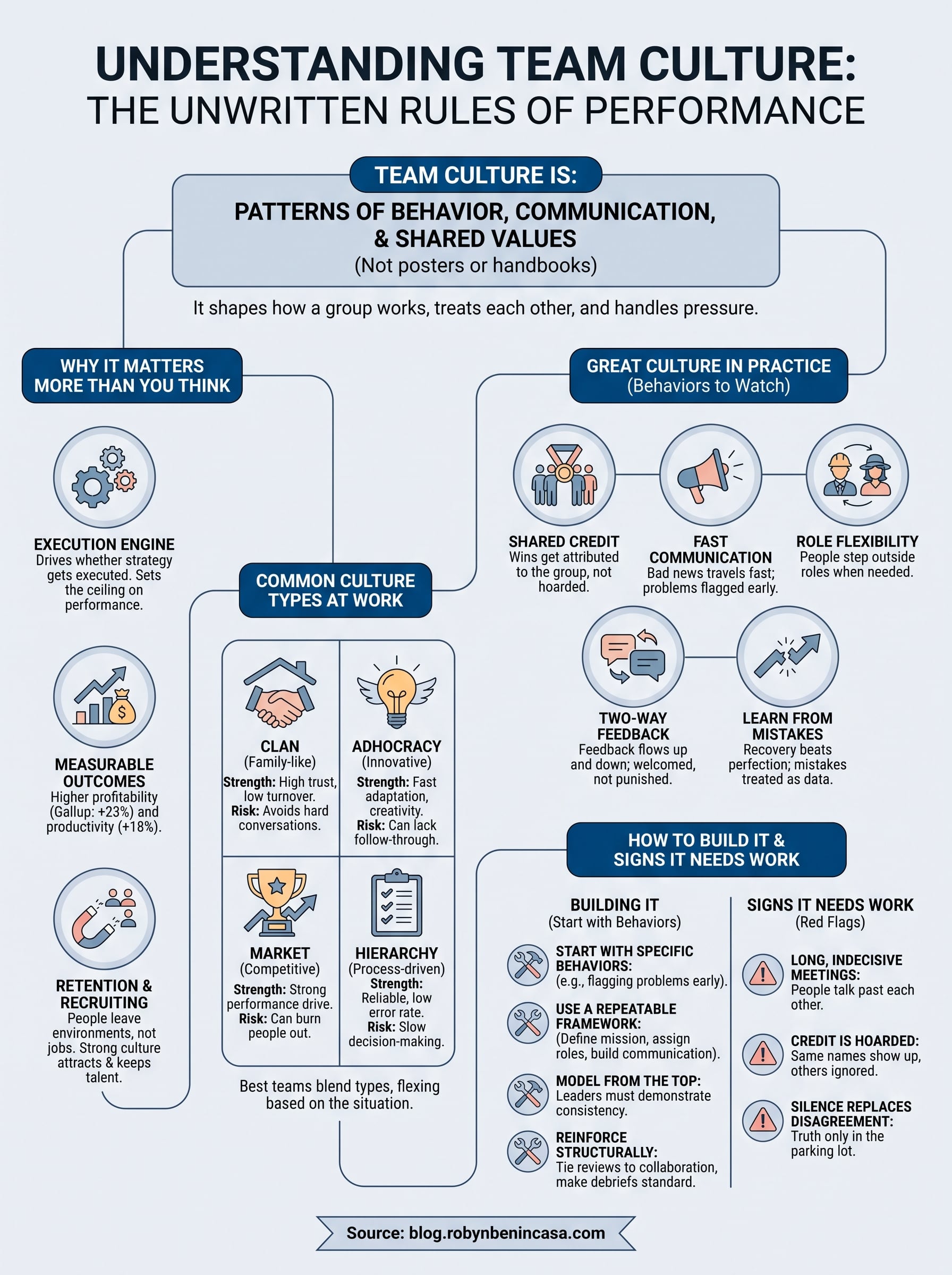
So what is team culture, exactly? It’s the unwritten set of norms, attitudes, and habits that shape how a group works, treats each other, and handles pressure. A great team culture shows up in small, repeatable moments: how a team reacts when a deadline slips, whether people speak up in meetings, whether wins get shared credit. Look at any high-performing team and you’ll find a culture of a team that was built on purpose, not left to chance.
I spent 15 years racing on world championship adventure racing teams and another 20 as a San Diego firefighter, and both jobs taught me the same lesson: talent loses to culture almost every time. In this article, I’ll walk you through the real definition of team culture, concrete examples of what it looks like at work, and the practical steps that turn a group of individuals into a team that actually performs like one.
Why team culture matters more than you think
Most leaders treat culture as a soft topic, something to address after the numbers get fixed. That’s backwards. Team culture at work drives the numbers. When I raced Primal Quest and Eco-Challenge with my adventure racing teammates, we weren’t the strongest athletes in the field most years. We won because our team culture meant nobody quit on each other at hour 80 of a 100-hour race. The same principle plays out in offices, hospitals, and fire stations every single day: culture sets the ceiling on performance, and no amount of individual talent breaks through it.
Culture isn’t the soft stuff. It’s the stuff that decides whether your strategy actually gets executed.
The business case is measurable
Companies love to call culture "intangible," but the outcomes are anything but. I’ve worked with sales organizations that moved from 17th to 1st in national rankings after we rebuilt how their teams communicated and supported each other under pressure. That’s not a motivational anecdote. That’s a culture of team behavior translating directly into revenue. Gallup’s research backs this up at scale: business units with highly engaged teams see 23% higher profitability and 18% higher productivity compared to those with low engagement, underscoring the well-documented link between organizational culture and performance (gallup.com). Engagement doesn’t happen in a vacuum. It’s a byproduct of culture.
Here’s what shifts when culture improves versus when it’s ignored:
Metric
Weak Culture
Strong Culture
Turnover
High, frequent backfilling
Low, longer tenure
Decision speed
Slow, bottlenecked by silos
Fast, distributed trust
Response to setbacks
Blame, finger-pointing
Adjust, own the fix
Innovation
Rare, risk-averse
Frequent, psychologically safe
Customer experience
Inconsistent
Reliable, team-backed
Retention and recruiting ride on it
People don’t leave jobs, they leave environments. If your definition of team culture in practice is "everyone for themselves," your best performers will eventually find a place where that’s not the case. I’ve sat across from HR leaders at companies like Allstate and Boston Scientific who weren’t dealing with a talent shortage, they were dealing with a culture leak. Talented people were walking out the door because the day-to-day experience of working there didn’t match what was promised in the interview. Fixing that leak is cheaper and faster than constantly refilling the pipeline.
Recruiting benefits just as directly. Candidates today ask about team dynamics before they ask about ping-pong tables. When your current team genuinely likes working together, that reputation travels through referrals, Glassdoor reviews, and LinkedIn posts, whether you’re managing it or not.
Culture determines how teams handle pressure
Any team looks fine when nothing’s going wrong. The real test is what happens during a merger, a missed quarter, or a crisis. As a firefighter for over 20 years, I watched crews perform under conditions where hesitation or ego could cost lives. The crews that performed best weren’t necessarily the most experienced, they were the ones who had built trust and clear communication habits long before the fire started. Corporate teams face a version of this every time market pressure hits or leadership changes. What is team culture if not the operating system a group falls back on when the pressure is highest? Teams with strong cultures adapt. Teams without one fracture.
It shapes how change actually lands
Organizations leading teams through change during mergers, reorgs, or new leadership shifts often assume resistance is about the change itself. Usually it’s about culture. A team that trusts its leaders and each other will absorb disruption and keep moving. A team without that foundation will treat every change as a threat, and productivity stalls while people protect themselves instead of the mission. If you’re planning a major shift and haven’t addressed organizational culture and change management first, you’re building on sand.
The bottom line: culture isn’t a nice-to-have sitting next to strategy, compensation, and process. It’s the mechanism that determines whether all three actually work. Ignore it, and you’ll keep solving the same performance problems on a loop without understanding why they keep coming back.
Types of team culture you’ll find at work
Walk into ten different companies and you’ll find ten different flavors of team culture, and most of them fall into a handful of recognizable patterns. Researchers who study organizational behavior, including the widely cited organizational culture framework developed by University of Michigan professors Kim Cameron and Robert Quinn, have mapped these patterns for decades. You don’t need an academic framework to spot them, though. Examples of organizational culture show up the moment you sit through one staff meeting or watch how a team handles a missed deadline.
Four common team culture types
Here’s how the major types break down, along with what tends to go right and wrong in each:
Culture Type
Core Focus
Typical Strength
Typical Risk
Clan/Family
Loyalty, mentorship, collaboration
High trust, low turnover
Can avoid hard conversations
Adhocracy/Innovation
Risk-taking, new ideas, speed
Fast adaptation, creativity
Can lack follow-through
Market/Competitive
Results, targets, winning
Strong performance drive
Can burn people out
Hierarchy/Process
Structure, consistency, control
Reliable, low error rate
Can slow decisions to a crawl
Most real teams are a blend. A sales floor might run heavy on Market/Competitive energy while the operations team behind it leans Hierarchy/Process to keep things consistent. Neither is wrong on its own. Problems start when the blend doesn’t match the work in front of the team, like a crisis-response unit stuck in slow, process-heavy habits when speed is what actually saves the day.
Which type actually wins
Over 15 years of adventure racing against teams from every kind of background, the teams that consistently outperformed us weren’t pure clan or pure market types. They combined the loyalty and trust of a clan culture with the results-driven push of a competitive one. That combination is close to what I mean by an organizational culture definition built for teams: a shared identity strong enough that people protect each other, paired with a shared scoreboard everyone actually cares about hitting.
The best team cultures don’t pick one lane. They borrow trust from family, urgency from competition, and discipline from process, then apply whichever one the moment demands.
That’s the real insight most typologies miss. Categorizing your team’s culture is useful diagnostically, but the goal isn’t to pin a label on it and stop there. The goal is building a culture flexible enough to shift gears depending on what’s in front of you: warm and patient during onboarding, sharp and fast during a launch, disciplined and careful during a safety-critical process. Rigid teams that only know one mode eventually break under conditions that call for a different one. Teams that understand the full range, and can move between them deliberately, are the ones that hold up under real pressure.
What great team culture looks like in practice
Talk is cheap when it comes to culture. Great team culture isn’t a value statement on the wall, it’s a set of behaviors you can actually watch happen. Picture a team where someone admits a mistake in a meeting and the response is "okay, how do we fix it" instead of silence or blame. That single reaction tells you more about culture than any mission statement ever could. If you’re trying to spot an example of team culture in action, stop reading brochures and start watching how people react in the moments that actually matter.
You don’t build culture in the mission statement. You build it in how people react when something goes wrong.
The behaviors that separate great from average
Over two decades of racing and firefighting, I noticed the same handful of behaviors showing up again and again on teams that outperformed everyone else. They’re specific enough to check for on your own team this week:
Credit flows outward. Wins get attributed to the group, not hoarded by whoever presented last.
Bad news travels fast. Problems get flagged early instead of hidden until they’re unfixable.
Roles flex under pressure. People step outside their job description when the team needs it, without being asked twice.
Feedback goes both directions. Junior team members feel safe correcting senior ones, one of the clearest examples of collaboration in the workplace, and it’s welcomed, not punished.
Recovery beats perfection. Mistakes get treated as data, not evidence for a performance review.
Notice none of these show up on a values poster. They show up in Slack threads, status updates, and hallway conversations.
A real example from the field
During one 100-hour adventure race, our navigator made a call that cost us six hours. The old version of that team would have spent the next day rehashing whose fault it was. Instead, we recalculated the route, redistributed gear weight to our fastest paddler, and kept moving. Nobody brought it up again until the post-race debrief, and even then it was framed as "what do we adjust next time," not "who screwed up." That’s what a functioning culture of a team actually looks like when the stakes are real. Corporate teams face smaller versions of this constantly, a blown deadline, a lost account, a bad quarter, and the ones with strong cultures handle it the exact same way: assess, adjust, move.
What it sounds like in daily conversation
Listen closely to how a team talks and you’ll hear culture before you see it in any metric. Strong teams use "we" language even when describing individual contributions. Weak ones default to "they" when something goes wrong and "I" when something goes right. Meetings in a healthy team culture at work end with clear next steps and shared ownership, not vague nods and unanswered questions. If you want a fast diagnostic, sit in on one status meeting and count how often people interrupt to help versus interrupt to protect themselves. That ratio tells you almost everything you need to know.
How to build a strong team culture
Building team culture on purpose starts with the assumption that it’s already forming whether you plan it or not. Every team has a culture right now, the question is whether it’s the one you’d choose if you were designing it from scratch. Culture doesn’t come from a kickoff meeting or a new set of core values printed on mugs. It comes from what leaders repeat, reward, and tolerate every single day. If you want to shift how your team works, start by auditing those three things before you change anything else.
You don’t announce a new culture. You demonstrate one, repeatedly, until it becomes the default.
Start with behaviors, not slogans
Forget the values workshop for a minute. Pick three to five specific behaviors you want to see, things like flagging problems early, sharing credit, or backing up a teammate under deadline pressure. Then build systems that make those behaviors visible and rewarded. On my adventure racing teams, we didn’t talk about how to build trust in a team at work in the abstract, we practiced specific habits, like calling out fatigue before it became dangerous, until they were automatic. That’s the version of a culture of team behavior that actually sticks.
Use a repeatable framework
Don’t rely on inspiration alone. Teams that know how to create a high-performance culture that sustains itself over years, not just during a good quarter, tend to follow a structure. In my keynotes and in How Winning Works, I break this down into eight elements that world-class teams share, covering everything from communication under pressure to how a team defines and celebrates wins together. Here’s a simplified version you can start applying this week:
Define the mission clearly so everyone knows what winning actually looks like.
Assign roles based on strength, not just title or tenure.
Build communication habits before a crisis forces you to.
Reward team outcomes, not just individual heroics.
Debrief honestly after both wins and losses.
Model it from the top
Leaders set the ceiling for what’s acceptable. If a manager takes credit publicly but assigns blame privately, no amount of team-building activities will fix the resulting team culture at work. Consistency matters more than charisma here. Show up the same way during an easy week and a brutal one, and your team will start mirroring that stability. Watching a leader stay calm and solution-focused during a real setback teaches more about culture than any offsite ever will.
Reinforce it structurally
Finally, build culture into your systems, not just your speeches. Tie performance reviews partly to collaboration behaviors. Make debriefs a standing part of every project, not an afterthought. Small structural choices like these turn a good intention into a habit that survives turnover, growth, and pressure, which is the real test of whether a culture was ever built at all.
Signs your team culture needs work
Some teams limp along for years without anyone naming the problem out loud. Nobody says "our culture is broken," they just say "we’re understaffed" or "people are stressed right now," and those excuses cover for the real issue longer than they should. If you’re asking what does team culture mean for your own group, the honest answer often shows up in the patterns leaders avoid looking at directly: who stays quiet in meetings, who’s already checked out, and who’s covering for gaps that never get fixed.
Signs you can spot from your desk
Certain warning signs don’t require a survey or a consultant, you can see them within a week of paying attention:
Meetings run long and decide little. People talk past each other instead of to each other.
Credit gets hoarded. The same one or two names show up in every update, regardless of who did the work.
Problems surface late. Issues get flagged only after they’ve become expensive to fix.
Turnover clusters. Your strongest performers leave first, not your weakest.
Silence replaces disagreement. Nobody pushes back in the room, then everyone complains about the decision afterward.
If people only tell the truth in the parking lot after the meeting, your culture already has a problem.
Quieter signs that take longer to notice
Other signals build slowly enough that leaders miss them until the damage is done. Watch for teams that hit their numbers but burn people out doing it, that’s a team culture at work problem disguised as a performance win. Notice whether new hires adopt the existing habits within their first 90 days or start bringing bad habits of their own because nobody modeled anything different. Track whether feedback flows upward as easily as it flows down. A team where junior employees never correct senior ones isn’t respectful, it’s afraid, and fear is one of the fastest ways to kill the kind of trust a strong culture of a team depends on.
Watching how a team handles a shared loss tells you more than watching how it handles a win. Ask yourself honestly whether your last missed deadline or lost account got debriefed constructively or quietly buried. If it got buried, that silence is data. It means the team has learned that honesty about failure gets punished, so they’ve stopped offering it, and you’ve lost your best early-warning system in the process.
What to do once you spot them
Diagnosing the problem is only useful if you act on what you find. Start by naming the specific behavior you want to change rather than the vague feeling behind it, then treat it the same way you’d treat any other performance issue: with a clear expectation, a way to measure progress, and consistent follow-through from leadership. Rebuilding a damaged culture takes longer than building one from scratch, but the same principles apply either way. The teams I’ve worked with who turned things around didn’t wait for a perfect moment, they started with one honest conversation and one changed behavior, then built from there.
Bringing your team culture to life
Every team already has a culture, whether anyone designed it or not. The question is whether yours is the one you’d actually choose. Team culture isn’t built in a single offsite or fixed with a new values poster. It’s built in the small, repeated choices leaders make about what gets rewarded, what gets tolerated, and what gets modeled when things go wrong. A great team culture doesn’t happen by accident, and it doesn’t survive on good intentions alone. It survives on habits, structure, and leaders who show up the same way on the hard days as the easy ones.
If you’re ready to move past reading about culture and start rebuilding it inside your own organization, working with an organizational culture consultant is exactly the work I do with teams facing this challenge every day. Explore more insights on building winning team cultures and see what it takes to turn your group into one that actually performs like a team.
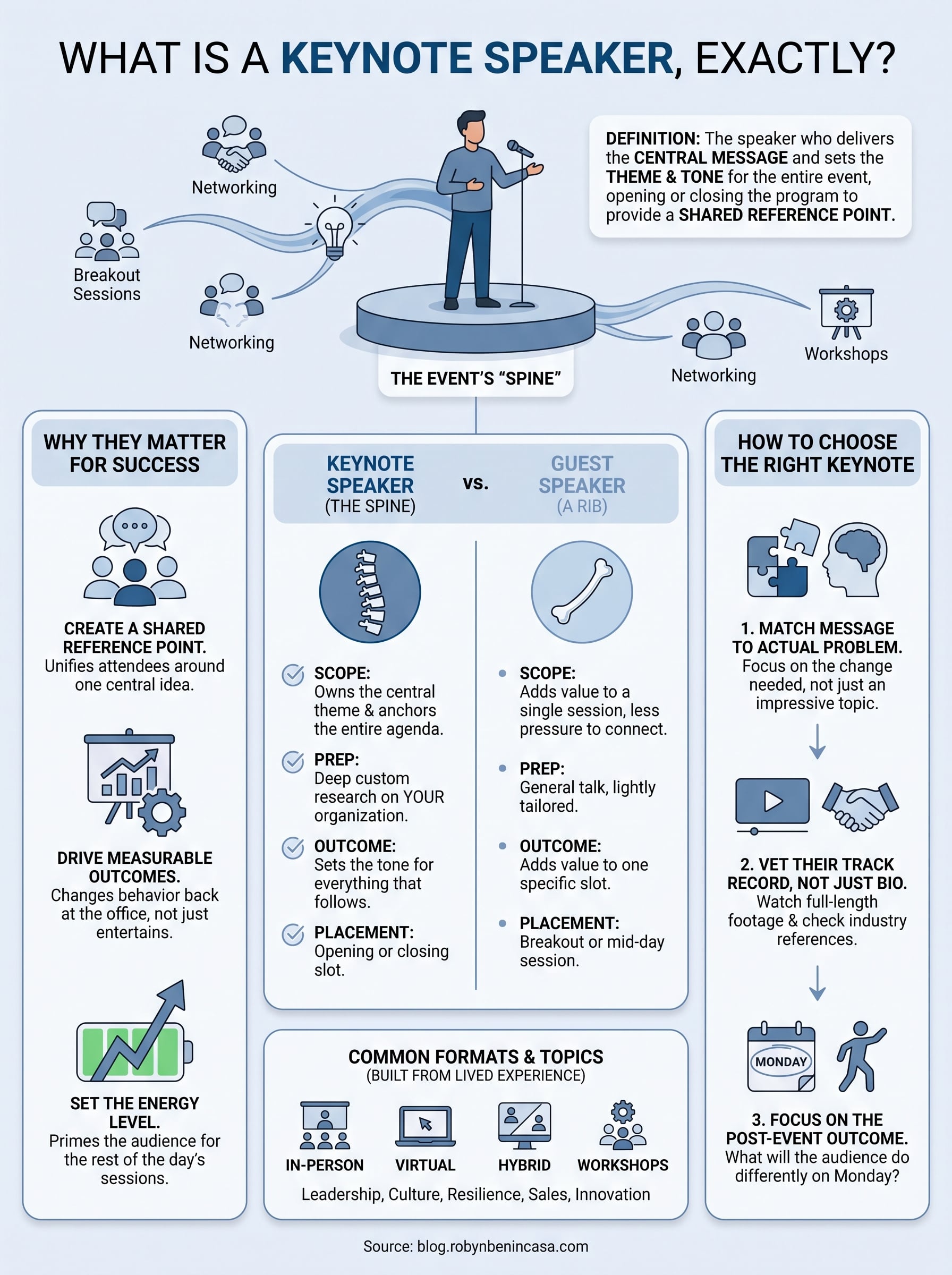
You’re planning a conference or sales meeting, and someone on your team says, "We need a keynote speaker." But what does that actually mean, and how is that role different from the breakout presenters, panelists, and emcees also on your agenda? If you’ve been Googling the term hoping for a straight answer, you’re not alone. Plenty of event planners book the wrong kind of speaker simply because nobody defined the job clearly.
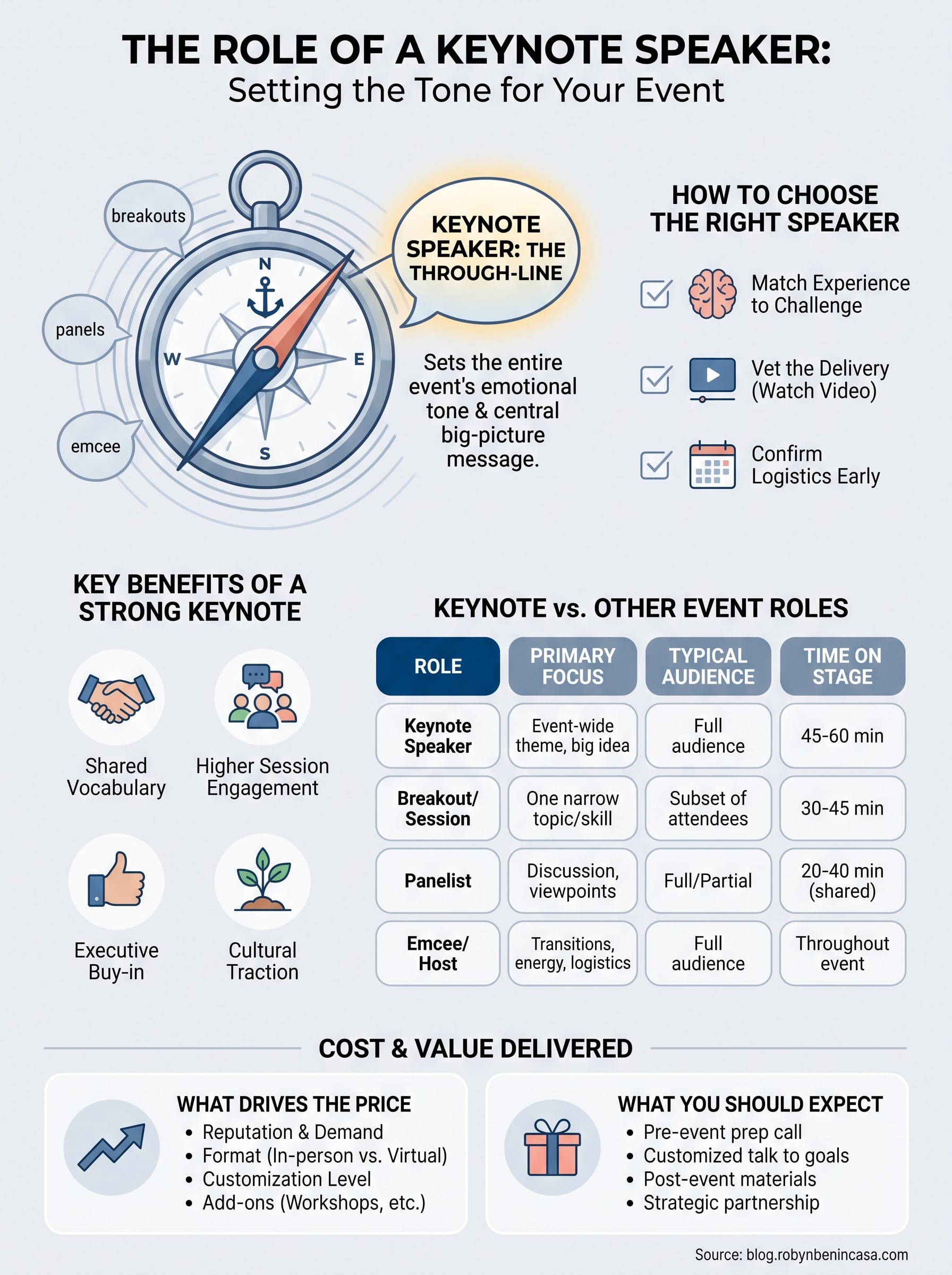
A keynote speaker sets the tone and central message for your entire event. Unlike a session leader covering one narrow topic, a conference keynote speaker delivers the big-picture theme that ties every other presentation back to one idea, whether that’s leadership, resilience, or team performance. That distinction matters when you’re deciding who opens your program and who fills the smaller rooms.
In this article, we’ll break down exactly what separates a keynote from a speaker keynote slot buried mid-agenda, what makes a keynote address effective, and what to look for when you’re ready to book one. Drawing on decades of experience speaking to corporate audiences about leadership and team culture, we’ll give you a practical framework for making this decision with confidence.
Why a keynote speaker matters for your event’s success
Ask any event planner what makes or breaks a conference, and most will point to the opening act. A strong keynote speaker doesn’t just fill a slot on the agenda, they set the emotional and intellectual tone that carries through every breakout session, panel, and hallway conversation that follows. Get that opening wrong, and you spend the rest of the day fighting an energy deficit. Get it right, and the keynote becomes the shared reference point your attendees quote back to each other for months.
The keynote sets your event’s throughline
Before you book anyone, think about the single idea you want people to carry out of the room. A great conference keynote speaker takes that idea and turns it into a story people remember, not a slide deck they forget by lunch. When I speak about the eight elements of a world-class team culture, I’m not delivering a standalone talk, I’m handing the audience a lens they’ll use to interpret every session that follows. That’s the real function of a keynote: it becomes the throughline that makes an otherwise disconnected agenda feel like one coherent experience.
A keynote isn’t the biggest speech on your agenda, it’s the idea that holds the whole event together.
It shapes how attendees engage with everything else
Opening momentum matters more than most planners give it credit for. Research on audience attention consistently shows that engagement set in the first hour of an event predicts how attentive people stay for the rest of the day, which is one reason organizations like the Association for Talent Development emphasize strong openers in conference design. Sales meetings in particular live or die on this. I’ve worked with teams that moved from 17th to 1st in national rankings after rallying around a single cultural message delivered at their kickoff. That kind of shift doesn’t come from a good PowerPoint. It comes from a speaker who can connect a personal, tested experience to the specific challenge your team is facing.
Shared vocabulary: attendees start using the speaker’s framework in their own meetings weeks later
Higher session attendance: people who feel energized by the opener are more likely to stay engaged through breakouts
Executive buy-in: leadership sees a tangible return on the event budget, not just a feel-good moment
Cultural traction: HR and team leads get a reference point they can build training around long after the event ends
None of that happens by accident. It happens because someone on your planning team treated the keynote decision as strategic, not ceremonial. If you’re weighing whether a themed talk like T.E.A.M.W.O.R.K. fits your event, the test is simple: does the message give your audience something they’ll still be talking about at next year’s meeting? If the answer is yes, you’ve found your opener.
How to choose the right keynote speaker for your event
Picking a keynote speaker is less about star power and more about fit. Start with your event’s central problem, not your wish list of famous names. Are you trying to unify teams after a merger? Rebuild morale after a rough sales quarter? Launch a new strategic direction? The speaker you book should have lived experience that maps directly onto that challenge, not a generic motivational talk they recycle for every industry.
Match experience to your event’s real challenge
A conference keynote speaker with firsthand experience building teams under pressure will land differently than someone who only talks theory. When I speak to sales organizations, I draw on what actually moved a team from 17th to 1st nationally, not abstract leadership principles pulled from a textbook. Ask any speaker you’re considering how their material connects to your specific industry and goals. If they can’t answer with a concrete example, keep looking.
The right keynote speaker fits your problem, not just your budget or your guest list.
Vet the delivery, not just the resume
A polished bio doesn’t guarantee a strong room. Watch full-length video of the speaker in front of a live audience, not just a highlight reel. Check how they handle audience energy, timing, and unexpected moments like AV issues or a distracted crowd. Ask for references from planners who booked the same speaker in the last 12 months, since availability, delivery style, and even talk content can shift over time.
Use this checklist when narrowing your shortlist:
Relevance: does their core message map to your event’s theme or business challenge?
Proof: do they cite measurable outcomes from past engagements, not just applause?
Format flexibility: can they deliver the talk in-person and as a speaker keynote for a virtual or hybrid event without losing impact?
References: have recent clients confirmed the talk delivered what was promised?
Logistics: do their fee, travel needs, and AV requirements fit your event budget and venue?
Confirm the logistics early
Booking timelines for in-demand speakers often run three to six months out, longer for peak conference season in spring and fall. Confirm availability before you lock your agenda, then work backward on contracts, AV specs, and any pre-event calls the speaker needs with your planning team. Skipping that step is how planners end up settling for whoever’s still open two weeks before the event, which rarely produces the result you were hoping for.
How keynote speakers differ from other event speakers
Confusion about who does what on an agenda causes more booking mistakes than budget ever does. A keynote speaker owns the big-picture message that frames your whole event, while breakout presenters, panelists, and emcees each play a narrower, supporting role. Understanding those differences before you sign a contract keeps you from paying keynote fees for a session speaker’s job, or asking a session speaker to carry weight they were never hired to carry.
Different roles, different jobs
Each role on your agenda serves a distinct function, and mixing them up leads to mismatched expectations on event day. Here’s how the roles typically break down:
Role
Primary Focus
Typical Audience Size
Time on Stage
Keynote speaker
Event-wide theme, big idea
Full audience
45-60 minutes
Breakout/session speaker
One narrow topic or skill
Subset of attendees
30-45 minutes
Panelist
Discussion, multiple viewpoints
Full or partial audience
20-40 minutes shared
Emcee/host
Transitions, energy, logistics
Full audience
Throughout the event
A keynote speaker owns the whole room’s takeaway; every other speaker owns a slice of it.
Scope, preparation, and audience expectations
Breakout presenters go deep on one skill, like negotiation tactics or a software rollout, for a smaller, self-selected group. Panelists trade perspectives in real time, which works well for debate but rarely delivers one unified message. Emcees keep the day moving and the energy up, but they’re not there to teach a framework your audience carries home. A conference keynote speaker, by contrast, is booked specifically to give the entire room one shared story and one shared lens for everything that follows.
Getting this distinction right shapes your entire agenda, not just one slot. If you book a breakout-style speaker to open the day, you’ll likely get a solid talk that doesn’t connect to anything else on the program. If you book a true keynote to fill a 30-minute panel slot, you’re wasting their strongest material on the wrong format. Match the role to the job, and the rest of your agenda falls into place around it.
What keynote speakers typically cost and deliver
Budget questions come up early in every planning conversation, and for good reason. Fees for a keynote speaker vary widely based on name recognition, industry demand, and the complexity of the event, and understanding that range helps you set realistic expectations before you start reaching out to agents or speaker bureaus.
What drives the price
Cost isn’t random. A handful of factors push fees up or down, and knowing them helps you negotiate from an informed position rather than guessing at what’s fair:
Reputation and demand: speakers with a bestselling book or major media coverage command higher fees
Format: virtual keynotes typically cost less than in-person events because travel and setup drop out of the equation
Customization: talks tailored to your industry or company data take more prep time and often carry a premium
Add-ons: workshops, breakout facilitation, or executive Q&A sessions usually get priced separately from the main talk
Exclusivity: some contracts include a no-compete clause for your industry within a set window, which can raise the fee
The fee buys more than a speech; it buys the prep work that makes the message fit your room.
What you should expect in return
A fair fee comes with more than 45 minutes on stage. Most professional speakers, including those booked through a platform like Robyn Benincasa’s speaking page, include a pre-event call to understand your audience and business goals, a customized talk that references your company or industry directly, and post-event materials your team can use to reinforce the message. Some engagements also come with a companion resource, like a free downloadable guide summarizing the core framework, which gives HR and team leads something concrete to build follow-up training around.
Questioning what’s included before you sign protects you from surprises later. Ask specifically whether the fee covers travel, whether there’s a separate charge for a book-signing add-on, and whether the speaker offers a shortened version for a speaker keynote slot at a virtual town hall versus a full in-person conference. Vague answers here usually signal a vague experience for your audience too. Clear answers, on the other hand, tell you the speaker treats your event as a partnership, not a transaction.
Setting the tone for your next event
A keynote speaker is the difference between an agenda that feels like a string of disconnected sessions and one that builds toward a message your audience carries home. Once you understand how the role differs from breakout presenters, panelists, and emcees, the booking decision gets much simpler: match the speaker’s real experience to your event’s real challenge, vet the delivery, and confirm the logistics early.
Getting this right pays off long after the closing session ends. Teams reference the framework in meetings months later, leadership sees the return on the event budget, and your planning team has a proven playbook for next year. That’s what a well-chosen conference keynote speaker actually delivers.
Most company retreats fail before they even start, not because the venue was wrong or the budget too small, but because the activities felt disconnected from how the team actually works. You book a nice location, schedule a few icebreakers, and hope something sticks. It rarely does. If you’re planning team building activities for a company retreat, you need options that create real trust and communication, not just a fun afternoon everyone forgets by Monday.
This list gives you exactly that: activities tested against what actually moves teams forward, drawn from lessons I learned leading world championship adventure racing teams and working two decades as a San Diego firefighter, where team performance wasn’t optional. Every exercise here builds something specific, whether that’s problem-solving under pressure, better cross-departmental communication, or a shared sense of purpose your team can carry back to the office.
Below, you’ll find 14 corporate retreat team building activities organized by team size, goal, and setting, so you can match the right exercise to your group instead of guessing. Some require an afternoon, others fill a full day, and each one is built to produce results your leadership team will actually notice.
1. Start with a leadership keynote that sets shared goals
Every activity on this list works better when your team already understands why they’re doing it. That’s the case for opening your retreat with a leadership keynote built around teamwork and shared goals rather than generic motivation. A strong keynote gives people a common language before they hit the ropes course or sit down for trivia, so the rest of the retreat isn’t just fun, it’s connected to something real about how your team performs together.
A retreat without a shared framework is just a series of unrelated activities, no matter how well they’re run.
How it works
A speaker who’s actually led high-performing teams, not just studied them, opens the retreat by framing what a world-class team culture looks like and why it matters to your specific business right now. I do this by drawing on lessons from world championship adventure racing and two decades as a firefighter, where team trust wasn’t theoretical, it was the difference between finishing a race or not, or making it out of a building safely. The keynote typically runs 45 to 60 minutes, live or virtual, and closes with clear takeaways your team can reference during every other activity that follows.
Team skills it builds
This sets the tone for the whole retreat. Specifically, it builds:
Shared vocabulary around trust, accountability, and communication
Alignment on goals so every department understands the same target
Buy-in from skeptical employees who see team building as filler
A framework for giving feedback that carries past the retreat itself
Best for group size
Keynotes scale better than almost any other activity on this list. Groups of 50 work well, and so do audiences of 2,000 at a company-wide conference. Virtual formats mean remote and hybrid teams get the same content without travel costs, which matters if your retreat spans multiple offices or time zones.
Time and cost
Budget one hour for the keynote itself, plus 15 to 20 minutes for Q&A if your schedule allows it. Costs vary widely by speaker experience and format. Virtual keynotes run lower than in-person events, since travel and staging costs disappear. If you want the keynote to actually anchor the retreat, book it as the opening session, not an afterthought squeezed in after lunch.
2. Run an adventure-race style outdoor challenge
Outdoor challenges modeled on adventure racing put your team through real physical and mental obstacles instead of a scripted icebreaker. Think orienteering with a map and compass, a paddling leg on a lake, a rope traverse, or a timed obstacle course that forces the group to make decisions under pressure. I built my career on exactly this format, and I’ve watched strangers become a functioning team within a single afternoon once they’ve navigated a real obstacle together.
How it works
Split your group into teams of four to six and hand each one a checkpoint map or a set of coordinates. Teams navigate a course together, often carrying gear or completing a physical task at each checkpoint, and the clock keeps everyone honest. A trained facilitator or race director sets the course and manages safety, so you’re not improvising logistics on site.
Team skills it builds
Nothing exposes a team’s real dynamics faster than a course where getting lost costs you the win.
This format builds:
Decision-making under pressure, since teams can’t overthink every choice
Trust in teammates’ judgment, especially when someone else holds the map
Physical collaboration across different fitness levels and skill sets
Best for group size
This works best with 20 to 200 people split into small teams. Larger groups need more course space and additional facilitators, so confirm venue capacity before you book.
Time and cost
Plan for three to five hours including setup and debrief. Costs run from $150 to $400 per person depending on location, equipment rentals, and whether you hire outside race organizers or use retreat venue staff.
3. Untangle the human knot
The human knot is a classic for a reason: it’s cheap, fast, and forces a group to solve a physical puzzle with their whole bodies while talking through every move. You don’t need equipment, a venue, or a facilitator with special training, which makes it one of the easiest team building activities for company retreats to slot into a tight schedule. Groups that resist "trust falls" and forced vulnerability tend to loosen up here because the goal is concrete and the stakes are low.
How it works
Gather six to ten people in a circle, shoulder to shoulder. Each person reaches across and grabs two different hands belonging to two different people, not the person next to them. Once everyone’s tangled, the group has to untangle themselves without letting go, ending in either a circle or a couple of interlocking rings. It takes real communication to figure out who steps over whom and in what order.
The knot only comes apart when the group agrees on one plan and actually follows it.
Team skills it builds
This simple exercise develops:
Verbal communication under mild physical stress
Patience with people who move slower or think differently
Group problem-solving without a designated leader
Best for group size
Six to ten people per knot is the sweet spot. Run multiple knots simultaneously for larger retreats and compare untangling times afterward for a light competitive edge.
Time and cost
Budget 10 to 20 minutes per group. It costs nothing beyond the time itself, making it an easy addition between bigger, pricier activities.
4. Play two truths and a lie
Two truths and a lie works best when your retreat schedule needs a low-key reset between bigger physical activities. Each person shares three statements about themselves, two real and one invented, and the group guesses which is the lie. It sounds simple, but it forces people to reveal something genuine while the rest of the team practices reading, questioning, and listening closely. For remote teams meeting in person for the first time, this is often the fastest way to turn names on a screen into actual people.
How it works
Go around the room, or breakout groups of six to eight if your headcount is large, and give each person a minute to share their three statements. The group discusses and votes before the person reveals the lie. Push people toward specifics, a statement like "I once ran a marathon" invites better questions than something vague. A facilitator can keep pace so one enthusiastic talker doesn’t eat the whole session.
The best version of this game happens when people share something surprising enough that colleagues actually want to ask follow-up questions later.
Team skills it builds
This activity strengthens:
Active listening, since guessing correctly requires paying attention to tone and detail
Psychological safety, as people share something personal without much risk
Early rapport building between departments or offices that rarely interact
Best for group size
This scales from a table of six to a full retreat of 150, as long as you break larger groups into smaller circles. Anything past ten people per circle drags the pace and loses energy fast.
Time and cost
Plan for 20 to 30 minutes depending on group size. It costs nothing and needs zero setup, which makes it a reliable filler between transportation, meals, or bigger scheduled sessions.
5. Send teams on a scavenger hunt
Scavenger hunts turn a retreat’s downtime into a structured challenge that gets people moving through unfamiliar spaces together. Teams work through a list of clues, photo challenges, or physical objects scattered across a hotel, city block, or conference venue, racing against a clock and each other. Unlike a lot of team building activities for company retreats, this one doubles as a way to introduce people to a new city or campus, so it works especially well when your group is meeting somewhere unfamiliar.
How it works
Break the group into teams of four to six and hand out a list of 10 to 15 tasks, ranging from trivia questions about the company to photo challenges that require finding a specific landmark or interacting with a stranger. Teams submit proof through a shared app or by texting photos to a coordinator, who tracks scores in real time. Set a hard time limit, usually 60 to 90 minutes, so teams have to prioritize instead of chasing every clue.
A good scavenger hunt rewards teams that divide tasks smartly, not the ones that simply run the fastest.
Team skills it builds
This format sharpens:
Task delegation across a small group with limited time
Resourcefulness, since some clues require creative problem-solving
Light competition that energizes the group without real stakes
Best for group size
Scavenger hunts handle large retreats well, from 20 people up to several hundred, as long as you have enough facilitators to track multiple teams and verify submissions.
Time and cost
Plan for 90 minutes to two hours including setup, briefing, and a wrap-up where teams share highlights. Costs range from $50 to $150 per person depending on whether you use an app-based platform or run it manually with printed clue sheets.
6. Solve an escape room together
Escape rooms put a small group in a locked space with a puzzle that only opens through shared thinking, not individual smarts. Corporate retreats have leaned on these for years because the format forces quiet analysts and loud talkers into the same problem at the same time, and neither type wins alone. Mobile escape room companies now travel to hotels and conference centers, so you don’t need to find a dedicated venue near your retreat location.
How it works
Groups of six to eight enter a themed room, or a portable setup built for the retreat, and work through a series of locks, codes, and hidden clues within a set time limit, usually 60 minutes. A game master monitors progress remotely or from an adjoining room, dropping hints if the team stalls too long. Teams either escape, or run out the clock, but most facilitators build a debrief into the session regardless of outcome.
A locked room with a 60-minute clock tells you more about how a team makes decisions than a full day of scheduled icebreakers.
Team skills it builds
This activity strengthens:
Collaborative problem-solving, since no single person usually holds enough clues to finish alone
Time management under a visible, ticking deadline
Recognition of who naturally leads and who quietly contributes the winning idea
Best for group size
Six to eight people per room works best. Larger retreats run multiple rooms in parallel, which also opens the door to comparing completion times across departments.
Time and cost
Budget 90 minutes total, including briefing and debrief. Mobile escape room vendors typically charge $50 to $100 per person, depending on room complexity and travel distance.
7. Build a tower with spaghetti and marshmallows
The marshmallow challenge is a design exercise disguised as a party game. Teams get 20 sticks of dry spaghetti, one yard of tape, one yard of string, and a single marshmallow, then they have 18 minutes to build the tallest freestanding structure that holds the marshmallow on top. It’s cheap, fast, and exposes planning habits better than almost any other team building activities for company retreats on this list, because the failures show up in real time when a tower collapses in front of everyone.
How it works
Split your group into teams of three to five and give each team an identical kit. Set an 18-minute timer and let teams build without interference. Facilitators measure the finished towers at the end and award a quick prize to the tallest one still standing with the marshmallow on top. The real value shows up in the debrief, where you ask teams to walk through their process, not just their result.
Teams that spend the first five minutes planning almost always beat the ones that start building immediately.
Team skills it builds
This exercise builds:
Rapid prototyping and comfort with early failure
Time management under a hard, visible deadline
Structured planning before jumping into execution
Best for group size
Teams of three to five work best, and you can run as many teams in parallel as you have kits and table space. Retreats of 100 or more handle this easily since setup scales with folding tables, not facilitators.
Time and cost
Budget 30 to 40 minutes total, including instructions, the 18-minute build, and a short debrief. Materials cost almost nothing, usually under $5 per team, making this one of the most affordable options on the whole list.
8. Line up in silence
Silent lineups strip away the easiest tool a team has, talking, and force everyone to solve a simple sorting problem using only gestures and observation. It sounds almost too basic to matter, but groups that rely on verbal shortcuts in daily meetings often struggle here, which makes it a useful diagnostic disguised as a game. This is one of the quieter team building activities for company retreats on this list, and that’s exactly the point.
How it works
Ask your group to line up by birthday, height, or years at the company, without speaking a single word. Teams can use hand signals, mouthed numbers, or written notes if you want to add a layer of difficulty. Once everyone believes they’re in order, have each person call out their birthday or metric out loud to check accuracy. Run a second round with a harder category, like alphabetical order of middle names, to see if the group communicates faster the second time.
Silence forces people to actually watch each other instead of waiting for their turn to talk.
Team skills it builds
This exercise sharpens:
Nonverbal communication and reading body language
Patience with a slower, less efficient process than talking
Awareness of who defaults to leading when the usual tools disappear
Best for group size
Groups of 15 to 40 work well as a single lineup. Split larger retreats into multiple lines running at once, then compare completion times for a light competitive edge.
Time and cost
Budget 10 to 15 minutes per round. It costs nothing and needs no materials, so it slots easily between scheduled sessions or right after lunch.
9. Draw back to back
Draw back to back pairs people up, sits them spine to spine, and hands one person a simple image while the other holds a blank sheet and a pencil. The describer explains the shape without naming it outright, no saying "house" or "cat", while the artist draws based purely on verbal instructions. It’s one of the fastest team building activities for company retreats to reveal exactly how instructions get lost between the person who has information and the person who needs it.
How it works
Pair up your group and seat each pair back to back so neither can see the other’s paper or gestures. Hand the describer a card with a simple line drawing, geometric shapes work best, and give them three to five minutes to talk their partner through recreating it from scratch. No peeking, no showing, only words. When time runs out, compare the original card against the drawing and ask what instructions helped versus what caused confusion.
The gap between what you said and what someone heard is usually bigger than either person expects.
Team skills it builds
This exercise sharpens:
Precise verbal instructions without relying on visual cues
Clarifying questions from the listener instead of silent guessing
Awareness of jargon or assumptions that make sense to the speaker but confuse everyone else
Best for group size
This works in pairs, so it scales to almost any retreat size. Groups of 20 to 60 run smoothly with one facilitator managing timing and card distribution.
Time and cost
Budget 20 minutes total, including instructions, the drawing round, and a quick debrief. Materials cost under $10 for paper, pencils, and printed image cards, making this another nearly free option on the list.
10. Pitch a solution to a mock business case
A mock business case pulls your team out of icebreaker mode and into something closer to actual work, minus the real stakes. Small groups get a realistic problem, a shrinking market, a product launch gone wrong, a staffing shortage, and a deadline to pitch a fix to a panel of judges. This is one of the more results-driven team building activities for company retreats, because it mirrors the kind of pressure your team already faces, just with room to fail without consequences.
How it works
Hand each team of four to six a one-page brief describing a fictional company problem loosely tied to your industry. Give them 45 minutes to build a pitch, then five minutes each to present to a judging panel made up of executives or outside facilitators. Judges score on creative problem-solving, feasibility, and how well the team defends their idea under follow-up questions.
A pitch that survives tough questions from judges tells you more about a team than a polished slide deck ever will.
Team skills it builds
This format strengthens:
Strategic thinking under time pressure
Persuasive communication in front of an audience
Cross-functional collaboration when teams mix departments
Best for group size
Groups of 20 to 80 work best, split into teams of four to six with a panel of three to five judges. Larger retreats need multiple rooms running simultaneously so judges can rotate.
Time and cost
Budget 90 minutes total, including brief distribution, prep time, pitches, and judge feedback. Costs stay low, usually under $20 per person for printed materials and prizes, unless you bring in outside facilitators to write custom case studies.
11. Take a team cooking class
Cooking classes pull people away from screens and seating charts and put them shoulder to shoulder at a stove, which changes the energy of a retreat fast. Chefs split your group into small teams and walk everyone through a multi-course meal, from prep to plating, so nobody sits on the sidelines watching someone else work. This activity earns a spot on almost every list of team building activities for company retreats because it combines hands-on collaboration with a reward everyone enjoys together at the same table.
How it works
Venues or catering companies bring in a chef instructor who assigns stations, ingredients, and a shared recipe to teams of four to six. Each team divides tasks, someone chops, someone sauces, someone plates, and the instructor circulates to correct technique and keep timing on track. The meal usually wraps with everyone eating together, which turns the exercise into a shared meal rather than just a workshop.
A kitchen under a deadline exposes who takes charge and who quietly keeps things organized faster than most meetings ever will.
Team skills it builds
This format sharpens:
Task division under real time pressure
Communication between stations working on the same dish
Patience with mistakes that show up immediately, not weeks later
Best for group size
Teams of four to six per station work best, with total retreat groups of 20 to 100 depending on kitchen space and instructor availability.
Time and cost
Budget two to three hours including instruction, cooking, and the shared meal. Costs typically run $75 to $150 per person depending on menu complexity and venue.
12. Volunteer together for a local cause
Volunteering gives your retreat a purpose beyond the retreat itself, and teams often remember a service project longer than any activity built purely for entertainment. Packing meals for a food bank, building furniture for a shelter, or cleaning up a local park puts your group to work on something that matters outside the office, which tends to build a different kind of trust than games do. Among team building activities for company retreats, this one carries the most weight when your organization wants the retreat to reflect its values, not just fill a schedule.
How it works
Partner with a local nonprofit ahead of time and confirm exactly what your group will do on site, since vague plans waste time once people arrive. Split into teams of six to ten for tasks like sorting donations, assembling care packages, or painting a community space, and assign a point person from the nonprofit to keep the group on task. Build in fifteen minutes at the end for the group to see the finished result together, whether that’s stacked boxes ready for delivery or a completed mural.
A team that works toward someone else’s need together usually returns to the office more connected than one that only competed against itself.
Team skills it builds
This activity strengthens:
Shared purpose that connects directly to company values
Collaboration across departments that rarely interact
A sense of collective accomplishment tied to a real outcome
Best for group size
Groups of 20 to 150 work well, depending on the nonprofit’s capacity and available tasks. Confirm headcount limits with your partner organization early, since some sites cap volunteers per shift.
Time and cost
Budget two to four hours including travel, orientation, and the project itself. Costs stay low, often just materials or a donation to the nonprofit, typically $20 to $50 per person.
13. Hold an appreciation circle
An appreciation circle gives your team a structured way to say things out loud that usually stay unsaid, like who covered for someone during a rough quarter or who always answers the 9 p.m. email. Retreats that skip this step often end with people feeling entertained but not necessarily closer, and this is the activity that closes that gap. It works especially well toward the end of a retreat, once people have already shared a few physical or creative challenges together and have real moments to point back to.
How it works
Gather the full group, or break into circles of 10 to 15 for larger retreats, and ask each person to name one specific thing they appreciate about a colleague, tied to something concrete rather than a general compliment. A facilitator sets the tone early by modeling a specific example, since vague praise like "you’re great" falls flat compared to "you stayed late to help me finish the client deck." Keep the pace moving so the circle doesn’t stall on one long story.
Specific appreciation lands harder than generic praise, and it’s the difference between a compliment and a memory.
Team skills it builds
This exercise strengthens:
Emotional connection built on specific, earned recognition
Psychological safety, since people practice giving and receiving praise openly
A habit of noticing contribution that can carry back into regular team meetings
Best for group size
Groups of 10 to 15 per circle work best for pacing. Larger retreats run multiple circles simultaneously, then bring everyone back together for a few highlights shared with the whole room.
Time and cost
Budget 20 to 30 minutes depending on group size. It costs nothing beyond the time, which makes it easy to schedule right before a closing session or dinner.
14. Compete in company trivia
Company trivia closes a retreat with energy instead of exhaustion, and it works because everyone can play regardless of fitness level or seniority. Mix general knowledge categories with rounds built specifically around company history, inside jokes, and industry facts, so long-tenured employees and new hires both get a chance to shine. It’s one of the easiest team building activities for company retreats to run on a tight final-day schedule, since it needs almost no physical space and works just as well in a hotel ballroom as it does outdoors.
How it works
Build five or six rounds of eight to ten questions each, mixing pop culture, sports, and company-specific trivia written by someone on your planning team. Split the retreat into tables of six to eight, hand out answer sheets or use a phone-based quiz platform, and score rounds as you go so teams can track their standing. Keep a live leaderboard visible if you can, since watching rankings shift keeps energy high through the final round.
Company trivia works because it rewards curiosity and memory over athleticism, so every employee has a real shot at winning.
Team skills it builds
This format sharpens:
Collaborative recall, since teams pool partial knowledge to land full answers
Light competition that energizes a group without physical risk
Cross-departmental bonding at tables mixed on purpose rather than by seating chart
Best for group size
Trivia scales from 20 people to several hundred, as long as you have enough facilitators to score rounds quickly and keep the pace moving.
Time and cost
Budget 60 to 90 minutes for a full trivia night. Costs stay low, usually under $10 per person for prizes, unless you rent a professional quiz platform or hire an outside host.
15. How to choose the right activities for your retreat
Matching the right mix of team building activities for a company retreat starts with a clear goal, not a list of fun options. Ask what your team actually needs before you book anything: are you rebuilding trust after a rough merger, breaking down silos between departments, or simply rewarding a team that already works well together? A retreat aimed at repairing communication needs different activities than one built to celebrate a strong year, and picking activities without that distinction is how you end up with a fun afternoon that changes nothing.
Group size and venue constraints narrow the list further. A 400-person sales conference can’t run six-person escape rooms without serious logistics, but it handles a keynote, trivia, or a scavenger hunt without much strain. Budget matters too, since some activities cost nothing beyond staff time while others run into the hundreds of dollars per person.
Retreat goal
Best-fit activities
Build trust fast
Human knot, adventure-race challenge, silent lineup
Improve communication
Draw back to back, appreciation circle, mock business case
Energize a large group
Trivia, scavenger hunt, keynote
Reward and reconnect
Cooking class, volunteering, appreciation circle
Nothing on this list works in isolation, though. Layering a leadership keynote at the start gives every later activity a shared frame, so people connect the human knot or the mock pitch back to something real about how your team performs.
The right activity depends less on what’s trendy and more on the specific problem your team needs to solve.
Once you’ve matched activities to goals, sequence them deliberately: open with something that sets context, alternate high-energy and low-key sessions, and close with a moment that lets people reflect on what actually shifted.
Building momentum long after the retreat ends
Great retreats don’t end when the buses leave. The activities you’ve just read about only pay off if you build in a way to carry the lessons back into daily work, whether that’s a follow-up meeting, a shared document of takeaways, or a manager who references the human knot the next time a project stalls. Momentum fades fast without that deliberate follow-through, and that’s the real difference between a retreat people enjoyed and one that actually changed how a team operates.
If you’re still shaping your agenda, start with the piece that gives every other activity its meaning: a keynote that frames why teamwork matters to your specific business right now. I’ve watched that single session turn a scattered schedule into something a team references for years. Book Robyn to open your next retreat and give your team a shared foundation before they hit the ropes course, the trivia table, or the kitchen station.
You’ve been handed the task of planning the next company offsite, and the same tired trust falls and scavenger hunts keep coming up. Everyone’s done them. Nobody remembers them a month later. If you’re searching for corporate event team building activities that actually change how people work together, you need options that go beyond a checklist of icebreakers.
The short answer: the best activities create a real shared challenge, one where people have to communicate, adapt, and rely on each other to win, not just stand in a circle and toss a ball around. Whether you’re planning for 20 people in a conference room or 500 at a national sales meeting, the format matters as much as the activity itself, and fun activities for corporate team building only stick when there’s a clear takeaway tied to how your team actually operates.
I’ve spent years building winning cultures on adventure racing teams and now help organizations translate that into their own workplaces. Below are 15 corporate team building activities for large groups and small ones alike, ranging from quick energizers to full-day experiences, each one built to leave your team with something more than a nice memory.**
1. A team-building keynote from Robyn Benincasa
Start your event with a keynote that reframes what teamwork actually requires, not another motivational speech people forget by lunch. A team-building keynote from someone who has led teams through 24-hour adventure races and worked as a San Diego firefighter gives your group a real-world framework for how high-performing teams behave under pressure. This isn’t theory pulled from a textbook. It’s lessons pulled from teams that had to trust each other to survive, translated directly into how your sales floor, leadership team, or cross-functional group operates day to day.
How it works
Robyn delivers her signature talks, including T.E.A.M.W.O.R.K. and WIN AS ONE, either live or virtually, tailoring the content to your industry and the specific challenges your group is facing, whether that’s a merger, a sales slump, or simple culture fatigue. Audiences walk away with concrete leadership lessons drawn from her New York Times best-selling book, How Winning Works, rather than generic platitudes about synergy.
A great keynote doesn’t just entertain your team, it gives them a shared language for how they want to work together going forward.
Ideal group size
This format scales better than almost anything else on this list. A keynote works for an intimate leadership retreat of 25 people just as well as it does for a national conference of 2,000, which makes it one of the few corporate team building activities for large groups that doesn’t require breaking people into smaller units to stay effective.
Skills it builds
Expect your team to walk away thinking differently about:
Communication under pressure
Trust and accountability across roles
Resilience when plans fall apart
What separates a group of talented individuals from an actual team
Planning tips
Book early, especially if you’re targeting a specific quarter tied to a sales kickoff or leadership summit, since calendars fill fast for in-demand speakers. Coordinate with the speaker’s team on your event’s specific pain points ahead of time. Robyn’s team typically asks about your industry, recent challenges, and event goals so the talk lands as relevant rather than generic. Pair the keynote with a smaller breakout activity afterward if you want people to immediately practice the concepts in a lower-stakes setting.
2. Icebreaker games to open any event
Before you dive into any deeper activity, you need a way to get people talking who might not otherwise say a word to each other all day. Icebreaker games are the quick, low-stakes exercises that break the initial awkwardness of a room full of coworkers from different departments, offices, or even time zones. They’re not the main event, but skipping them means your bigger activities start cold, with people still guarding themselves instead of engaging.
How it works
Most icebreakers run five to fifteen minutes and rely on simple prompts: two truths and a lie, human bingo, or rapid-fire partner interviews where people introduce someone else to the group. The goal is fast, low-pressure interaction, not depth. Keep the tone light and the instructions dead simple so nobody hesitates to jump in.
A room warms up the moment people laugh together, and that’s exactly what a good icebreaker is built to do.
Ideal group size
This is one of the few good corporate team building activities that works at any scale. Pair people up in groups of two or three regardless of whether your total headcount is 15 or 1,500, then rotate who reports back to the larger room.
Skills it builds
Quick, informal communication across unfamiliar coworkers
Comfort speaking up in a group setting
Early rapport that carries into later sessions
Planning tips
Match the icebreaker’s tone to your event’s culture. A conservative insurance team might prefer a structured interview format, while a creative agency might enjoy something looser. Always have a backup prompt ready in case the first one falls flat with a quiet crowd.
3. Problem-solving challenges like egg drop and tower build
Give small teams a pile of ordinary materials, a tight deadline, and one hard constraint, and you’ll see how they actually solve problems together. Problem-solving challenges like the classic egg drop or spaghetti tower build strip away job titles and force people to test ideas, fail fast, and adjust on the fly. These are among the good corporate team building activities that work because the constraint does the teaching, not a facilitator lecturing about collaboration.
How it works
Hand each team a limited kit, such as straws, tape, string, and a raw egg, and give them 20 to 30 minutes to build a structure that survives a drop test or holds the most weight. Teams present or test their builds in front of the group, which adds a bit of friendly pressure and a clear, visible outcome everyone can rally around.
The best problem-solving challenges don’t reward the smartest person in the room, they reward the team that listens fastest.
Ideal group size
Keep individual teams between four and six people so everyone has a real role in the build. This activity scales easily by running multiple teams in parallel, making it practical for anywhere from 20 to 200 participants without losing engagement.
Skills it builds
Creative problem-solving under time pressure
Delegating tasks based on individual strengths
Handling failure and iterating quickly
Making decisions with incomplete information
Planning tips
Set a hard time limit and stick to it, since urgency is what drives real teamwork here. Mix people from different departments into each team rather than letting existing cliques stay together, and debrief afterward by asking what almost worked and why, not just who won.
4. Escape room adventures
Lock a group in a themed room with a countdown clock, and watch how fast people stop waiting for someone else to take charge. Escape room adventures put teams under a shared deadline where every clue depends on someone speaking up, and that pressure tends to surface who naturally organizes, who spots details, and who keeps the group calm when the clock hits single digits. Companies now book mobile escape room trailers or private rooms at local venues specifically as corporate team building fun activities because the format is self-contained and requires almost no setup on your end.
How it works
Teams of six to eight work through a locked scenario, typically 45 to 60 minutes, solving puzzles, ciphers, and hidden clues to "escape" before time runs out. A game master monitors progress and can drop hints if a team stalls, which keeps frustration from tanking the mood.
An escape room reveals your real decision-makers faster than any org chart ever will.
Ideal group size
Most commercial rooms cap out around eight to ten people, so larger groups need multiple rooms running simultaneously or a mobile provider who can bring several setups on-site, which makes this workable for both a small department and a 150-person conference.
Skills it builds
Rapid information-sharing under time pressure
Recognizing and using teammates’ strengths
Staying calm and focused when stuck
Collaborative decision-making with limited time
Planning tips
Book a provider that offers corporate packages and can run parallel rooms if you’re working with more than one team. Mix departments within each group, and schedule a short debrief afterward so people connect the experience back to how they actually communicate at work.
5. Scavenger hunts for the office or city
Send teams out with a list of clues, a time limit, and a map of your office or downtown core, and you get a mix of problem-solving and exploration that works almost anywhere. A scavenger hunt turns a familiar building or neighborhood into a puzzle, pushing coworkers to split up tasks, decode clues, and race the clock together. Unlike a pure trivia contest, these hunts get people physically moving and talking to strangers along the way, whether that’s a barista or a stranger in the lobby who happens to know the answer.
How it works
Teams receive a list of locations, photo challenges, or riddles, often delivered through an app that tracks progress and scores in real time. Groups of five to eight navigate the route together, dividing up who researches clues, who navigates, and who documents proof at each stop. Most hunts run 90 minutes to two hours, ending with a group reveal of photos and stories back at a home base.
A scavenger hunt works because it turns your city block into a shared story your team tells for months afterward.
Ideal group size
This is one of the more flexible team building activities for large corporate groups, since you can run dozens of teams simultaneously across the same route without any team interfering with another.
Skills it builds
Delegating research and navigation roles
Creative problem-solving on the move
Time management under a ticking clock
Building rapport through shared discovery
Planning tips
Scout the route yourself beforehand, confirm venue permissions if you’re sending teams into public businesses, and build in a rain plan if you’re hosting an outdoor city hunt.
6. Outdoor adventure racing challenges
Take your team out of the conference room and onto a trail, a lake, or an obstacle course, and you strip away every excuse people use to hide from real teamwork. Outdoor adventure racing challenges borrow directly from the sport I spent years competing in, where teams navigate checkpoints by kayak, mountain bike, and foot, relying entirely on each other’s stamina, navigation skills, and encouragement to finish. Nobody coasts through an adventure race. That’s exactly why it works as one of the top corporate team building activities for groups who’ve outgrown indoor icebreakers and want something that actually tests them.
How it works
A guided course leads teams through a sequence of physical and navigational checkpoints, often mixing orienteering, light obstacles, and timed relay-style tasks. Professional race organizers scale the difficulty to your group’s fitness level, so nobody needs athletic experience to finish, just a willingness to push through discomfort alongside their teammates.
A team that finishes a hard race together trusts each other in ways a boardroom never teaches.
Ideal group size
Teams of four to six work best per course, with multiple courses running in parallel for larger events, making this practical for groups from 30 up to a few hundred participants.
Skills it builds
Endurance and mutual encouragement under physical strain
Navigation and quick decision-making
Trusting teammates with unfamiliar tasks
Celebrating shared wins instead of individual finishes
Planning tips
Hire an experienced outdoor event company with proper safety staff and equipment, check the weather forecast closely, and offer a lower-intensity track for anyone with physical limitations so nobody feels excluded from the challenge.
7. Cooking classes and culinary competitions
Hand a group aprons, a recipe card, and a shared stove, and watch the hierarchy flatten fast. Cooking classes and team-based culinary competitions put coworkers shoulder to shoulder over a cutting board, which forces the same division-of-labor conversations you’d want in any project: who preps, who plates, who reads the recipe aloud. These count among the more memorable corporate team building fun activities because everyone leaves with a meal they made together, not just a certificate of participation.
How it works
Groups of four to six get assigned a dish or a full menu, then compete or collaborate under a chef’s guidance to prep, cook, and plate within a set time. Some formats run as a friendly competition judged on taste and presentation, while others skip the scoring entirely and just aim for a shared dinner at the end.
Nothing exposes who takes charge, and who quietly does the dishes, faster than a shared kitchen under a deadline.
Ideal group size
Most venues cap kitchen stations around six teams, so this suits corporate groups of 20 to 80 comfortably, with larger events needing multiple venues or a mobile catering company that brings extra stations on-site.
Skills it builds
Dividing tasks based on real-time skill and speed
Working under a shared physical deadline
Creative improvisation when an ingredient runs short
Celebrating a tangible, shared result
Planning tips
Confirm dietary restrictions ahead of time, choose a venue with enough stations for your headcount, and pick a menu simple enough that nobody with zero kitchen experience feels lost.
8. Mixology classes for a relaxed vibe
Hand a group shakers, fresh citrus, and a recipe card, and the mood shifts almost instantly from stiff networking to genuine conversation. Mixology classes work as a lower-key alternative to cooking competitions, built around teamwork rather than pressure, since nobody’s racing a clock or getting judged on plating. This is one of the easier corporate team building fun activities to slot into an evening reception or the closing night of a conference, when people want to unwind rather than compete.
How it works
A bartender or mixologist leads small groups through building two or three classic cocktails, teaching technique like shaking ratios and garnish while pairs or trios work stations together. Some venues run it as a light competition judged on presentation, but most keep it collaborative, with teams tasting each other’s creations and swapping tips as the session unfolds.
A relaxed activity still builds a team, it just does it through conversation instead of competition.
Ideal group size
Most mixology setups handle groups of 20 to 60 comfortably, with stations of four to six people each, though larger conferences can add stations or run back-to-back sessions to accommodate more.
Skills it builds
Informal rapport-building outside a work context
Following shared instructions as a small team
Comfortable conversation across departments
Patience and turn-taking at a shared station
Planning tips
Offer a mocktail option for anyone who doesn’t drink, confirm the venue allows outside alcohol service if you’re using an off-site space, and schedule this later in the day when people are ready to loosen up rather than dive into serious work.
9. Volunteer days and community service projects
Give your team a shared cause instead of a shared game, and something different happens. Volunteer days put coworkers to work on a real project, building a home, packing meals, cleaning a park, and the shared purpose tends to create bonds that outlast a typical happy hour. These count among the good corporate team building activities for organizations that want their offsite budget to leave a mark beyond the conference room.
How it works
Partner with a local nonprofit to organize a half-day or full-day project, such as a Habitat for Humanity build, a food bank packing shift, or a park cleanup. Teams work in small crews toward a group goal set by the organization, with staff on-site to guide the actual labor so nobody needs prior experience.
A team that builds something for someone else learns more about each other than any icebreaker could teach them.
Ideal group size
This scales well since most nonprofits can absorb groups from 15 to 200 by splitting people into crews of six to ten, though you’ll want to confirm capacity with the organization well ahead of your date.
Skills it builds
Working toward a shared goal outside normal job roles
Physical collaboration under a supervisor’s direction
Empathy and perspective built through service
Pride in a tangible, visible outcome
Planning tips
Vet the nonprofit’s capacity for corporate groups before committing, confirm what physical work is actually required so people can dress and prepare appropriately, and schedule time afterward for the group to reflect together on what they accomplished.
10. Company olympics for large groups
Split your whole organization into color-coded teams, hand out a bracket of events, and you’ve got one of the most reliable top corporate team building activities for a full-day company gathering. A company olympics event strings together relay races, tug of war, trivia stations, and lighthearted physical challenges into one tournament, giving everyone from the loading dock to the C-suite a reason to cheer for the same team jersey. Few formats handle a massive headcount as gracefully as this one.
How it works
Organizers divide the full group into teams of 15 to 30, mixing departments so nobody competes only with their usual desk neighbors. Teams rotate through stations, earning points for each event, with a final scoreboard and awards ceremony closing out the day.
A company olympics turns hundreds of coworkers into a handful of teams everyone can actually root for.
Ideal group size
This is arguably the single best answer among corporate team building activities for large groups, since the format was built to absorb anywhere from 100 to 1,000 people without losing structure.
Skills it builds
Cross-departmental camaraderie
Friendly competition and encouragement
Coordinating logistics across a large team
Celebrating collective wins over individual glory
Planning tips
Assign team captains ahead of time to keep each group organized, stagger events so lines don’t bottleneck, and hire enough staff or volunteers to run stations smoothly. Weather backup matters too if you’re hosting outdoors.
11. Trivia nights and game shows
Gather your team around buzzers and a projector screen, and you get one of the easiest corporate team building activities to run with almost no setup. A trivia night or game show format works because it taps into something people already enjoy doing on their own time, then turns it into a team sport where knowledge, guessing, and a little bluffing all matter. This is a reliable pick when you want fun activities for corporate team building that don’t require anyone to leave their chair or get physical.
How it works
Host a live trivia session with rounds covering company history, pop culture, and industry trivia, or hire a company that runs a full game show format like a corporate version of Family Feud. Teams buzz in or submit written answers, with a host keeping score and building energy between rounds through banter and bonus challenges.
A good trivia night proves that the smartest team isn’t the one with the most facts, it’s the one that argues fastest and trusts a final answer.
Ideal group size
Trivia scales cleanly from a department of 15 up to a ballroom of 500, since teams of six to eight can compete side by side without needing extra space or equipment beyond a microphone and screen.
Skills it builds
Quick group decision-making under pressure
Confidence speaking up with an answer
Friendly competition across departments
Listening to teammates before locking in a response
Planning tips
Write questions specific to your company alongside general trivia so people feel personally invested, hire a professional host if your budget allows it, and keep rounds short so energy doesn’t dip halfway through.
12. Sports tournaments and field days
Book a field, split people into brackets, and let a little friendly rivalry do the rest. A sports tournament or field day brings back the pure recess energy of kickball, flag football, or volleyball, minus the awkward gym class memories, and it works because everyone already understands the rules without a briefing. These rank among the good corporate team building activities for companies that want a full afternoon outdoors without the complexity of an obstacle course or race.
How it works
Organizers set up a rotating bracket of two or three sports, mixing softball, tug of war, and relay races, so no single skill set dominates the whole day. Teams play short matches against each other throughout the afternoon, with standings tracked on a scoreboard and a champion crowned at the end.
A field day works because it reminds adults how much easier it is to bond over a shared scoreboard than a shared spreadsheet.
Ideal group size
Teams of eight to twelve per squad keep matches competitive, and running multiple fields or courts in parallel means this format handles anywhere from 50 to 500 people without anyone standing around waiting.
Skills it builds
Coordinating strategy under a live scoreboard
Encouraging teammates through wins and losses
Cross-departmental camaraderie outside the office
Quick physical and mental adjustments mid-game
Planning tips
Schedule a rain date if you’re outdoors, provide water and shade stations for longer events, and offer a non-athletic role like scorekeeper or photographer so nobody feels forced to sit out entirely.
13. Leadership and communication workshops
Gather your managers and rising leaders in a room for a structured session on how they actually talk to each other, and you address problems no trust fall ever will. Leadership and communication workshops focus on real skills like active listening, giving feedback, and resolving conflict, using role-play and guided exercises instead of lecture slides. This format works well as one of the corporate team building activities ideas for companies dealing with silos between departments or friction between new hires and tenured staff.
How it works
A facilitator runs the group through practical exercises: feedback role-plays, communication style assessments, and small-group scenarios drawn from real workplace tension. Sessions typically run half a day, mixing short lessons with exercises where participants practice the skill immediately rather than just discussing it.
A workshop only counts as team building if people leave able to have a harder conversation than they could that morning.
Ideal group size
Keep it to 20 to 40 people so the facilitator can circulate and give real feedback during exercises. Larger groups can still work if you break into smaller breakout rooms led by trained facilitators.
Skills it builds
Active listening and asking better questions
Giving and receiving direct feedback
Managing disagreement productively
Recognizing different communication styles across a team
Planning tips
Hire a facilitator with real leadership experience, not just a slide deck, and share your team’s specific friction points beforehand so exercises hit close to home. Schedule follow-up check-ins a month later to see what actually stuck.
14. Casino nights and themed galas
Dress your team up, hand out fake chips, and watch people who barely speak at their desks start cheering for each other at a blackjack table. Casino nights and themed galas trade physical challenges for social ones, giving coworkers an excuse to mingle across ranks and departments without the pressure of a work agenda hanging over the room. It’s one of the more polished corporate team building activities ideas for a closing dinner or an end-of-year celebration where you want elegance alongside connection.
How it works
Venues bring in professional dealers for blackjack, poker, and roulette, using play money that converts to raffle tickets or small prizes at the end of the night. Add a theme like a Great Gatsby gala or a James Bond casino to give people a reason to dress up and lean into the fun.
A themed gala works because it gives people permission to be playful together outside their usual job titles.
Ideal group size
This format flexes easily from an intimate leadership dinner of 40 up to a full company celebration of 600, since venues simply add more tables and dealers as headcount grows.
Skills it builds
Informal networking across seniority levels
Reading social cues in a low-stakes setting
Friendly competition without real financial risk
Confidence engaging with unfamiliar coworkers
Planning tips
Book a licensed casino rental company that supplies trained dealers and equipment, confirm your venue allows the setup, and set a clear end time for the games so the night doesn’t outlast people’s energy.
15. Virtual and hybrid team building games
Remote and scattered teams still need shared moments, and pretending a video call substitutes for connection doesn’t work. Virtual team building games solve for distributed teams by giving people structured, screen-based challenges instead of another status meeting disguised as bonding time. This is one of the few corporate team building activities ideas built specifically for the reality that plenty of teams now sit across five time zones instead of one office floor.
How it works
A facilitator runs the session over video, using breakout rooms for smaller group challenges like virtual escape rooms, online trivia, or collaborative drawing games where remote coworkers solve a puzzle together in real time. Hybrid versions mix in-office and remote participants on mixed teams, using shared digital boards so nobody at home feels like a spectator watching the office have fun without them.
A virtual game only works as team building when remote employees have exactly as much to do as everyone in the room.
Ideal group size
Breakout rooms of four to six keep everyone engaged, and the format scales from a department of ten to a company-wide event of several hundred, since adding more breakout rooms costs nothing extra beyond facilitator time.
Skills it builds
Clear written and verbal communication without in-person cues
Comfort with unfamiliar digital tools
Inclusion across in-office and remote employees
Quick collaboration despite screen delays or time zone gaps
Planning tips
Test your platform and breakout room setup before the event, send a simple tech guide to anyone unfamiliar with the tools, and assign a co-host to manage the chat and troubleshoot so the main facilitator can keep the energy up.
Finding the right fit for your next event
Picking the right activity comes down to matching the format to your actual goal, not just filling a slot on the agenda. A large sales conference needs something that scales without losing energy, like a company olympics or a keynote. A leadership team working through friction needs a workshop or a smaller physical challenge where trust gets tested directly. Budget, headcount, and whether you’re remote or in-person will narrow the list fast, but don’t skip the step of asking what you actually want people to walk away understanding about each other.
Whatever you choose, pair it with a message that ties the experience back to how your team operates day to day, or the memory fades by next quarter. If you want that framework built in from the start, book Robyn to speak at your next event and give your team something that actually changes how they work together.
You’ve seen the term on every conference agenda: keynote speaker. But if you’re planning an event and trying to figure out who to book, or why that slot matters more than the others, you need a straight answer, not marketing fluff. What is a keynote speaker, exactly, and why does that person often set the tone for the entire event?
Here’s the short version: a keynote speaker delivers the central message of an event, the one idea everyone else’s sessions build around or respond to. They open or close the program, set the theme, and give the audience something to carry with them long after the coffee breaks and breakout sessions are forgotten. That’s different from a general session speaker or a panelist filling a smaller slot on the schedule.
I’ve spent two decades speaking to corporate audiences about leadership and team culture, so I know what separates a forgettable keynote from one that changes how a room thinks about work. In this article, I’ll walk you through the role of a keynote speaker, how it differs from a guest speaker, and what actually makes one worth the investment for your next event.
Why keynote speakers matter for your event’s success
A strong keynote does more than fill a slot on the agenda. It sets the emotional and intellectual tone for everything that follows, which is exactly why the role of a keynote speaker carries so much weight in event planning. When you open a conference with a speaker who nails the theme, attendees walk into every breakout session primed to connect the dots. When you close with one, you send people home with a story they’ll repeat at the office Monday morning instead of a vague memory of slides and coffee.
They create a shared reference point for the whole room
Think about the last conference you attended where hundreds of people sat in dozens of different sessions. Without a unifying idea, those attendees leave with fragmented takeaways that don’t add up to much. A keynote speaker gives everyone in that room the same starting point. I’ve watched sales teams walk out of a keynote using a single phrase, like "win as one," and then hear that same phrase echoed in breakout sessions, hallway conversations, and follow-up emails for months. That’s not an accident. It’s the definition of keynote speaker in action: someone whose message becomes the connective tissue for an entire event.
A great keynote gives hundreds of people the same starting point, so every other session at the event has something to build on.
They drive measurable outcomes, not just applause
Event planners increasingly get asked to justify the speaker budget, and rightly so. A keynote that lands doesn’t just entertain, it changes behavior back at the office. I’ve had sales organizations tell me they moved from 17th to 1st in national rankings after building their culture around ideas introduced in a keynote. That’s the kind of return an executive team can point to when someone asks why the company spent five figures on a speaker slot. If your keynote speaker can’t connect their message to a business outcome your audience actually cares about, whether that’s retention, morale, safety, or performance, you’re paying for entertainment, not impact.
They set the energy level for the rest of the day
Anyone who has run a conference knows the first twenty minutes decide the mood for the next eight hours. A flat opening keynote means you’re fighting an uphill battle all day to keep people engaged. A sharp one means your breakout facilitators get an audience that’s already leaning forward. This matters just as much for closing keynotes, which need to send people out the door energized rather than checking their phones for flight times.
A quick comparison of what’s at stake
Without a strong keynote
With a strong keynote
Sessions feel disconnected
Sessions build on a shared theme
Attendees forget the event by Friday
Attendees repeat the message for months
Energy dips after lunch
Momentum carries through breakouts
Hard to justify the speaker budget
Easy to tie back to business results
Feels like a checkbox on the agenda
Becomes the thing people talk about afterward
Why this matters even more for virtual and hybrid events
Distributed teams have fewer chances to feel like one organization, so the stakes go up, not down, when everyone is watching from a laptop instead of a ballroom. A keynote speaker who can hold attention on a screen and still deliver a message that unifies a scattered workforce is doing real work for your culture, not just checking a box on the run sheet. If you’re planning a virtual leadership offsite or an all-hands meeting spread across time zones, the keynote slot is often the only moment the entire company experiences together, which makes picking the right person for it even more important than it would be at an in-person event.
Keynote speaker vs. guest speaker: what’s the difference
Planners mix these two terms up constantly, and it costs them when they’re negotiating fees or building an agenda. The definition of keynote speaker centers on ownership of the event’s central theme. A guest speaker, by contrast, gets invited to add value to a single session without carrying the responsibility for tying the whole event together. Neither role is lesser, but they’re built for different jobs, and confusing them leads to mismatched expectations on both sides.
Scope of responsibility
Most guest speakers walk into a room, deliver their material, and walk out, with little pressure to connect their content to anything happening in the rest of the program. A keynote speaker, on the other hand, is expected to research the organization, understand why the event is happening, and shape a message that speaks directly to that context. This is the meaning of keynote speaker that most event planners eventually learn the hard way: you’re not booking a performance, you’re booking someone to anchor your entire agenda.
A guest speaker fills a slot. A keynote speaker gives the whole event a reason to make sense.
Placement, pay, and preparation
The practical differences show up in scheduling and budget too. Here’s how they typically compare:
Factor
Keynote speaker
Guest speaker
Placement on agenda
Opening or closing slot
Breakout or mid-day session
Audience size
Entire event
Subset of attendees
Prep involved
Custom research on your organization
General talk, lightly tailored
Fee range
Higher, reflects top billing
Lower, reflects narrower reach
Expected outcome
Sets tone, drives shared takeaway
Adds value to one session
Think of it this way: a keynote is the spine of the event, and every guest speaker’s session is a rib attached to it. Where a guest speaker might repeat a talk almost word for word at ten different conferences a year, a keynote speaker usually customizes the opening, the examples, and the call to action for your specific audience, your industry, and the outcome you’ve told them you’re chasing. That level of customization is exactly why the fee, and the impact, tend to run higher.
How to choose the right keynote speaker for your event
Picking a keynote speaker is less about star power and more about fit. You’re not casting a celebrity, you’re hiring someone to deliver the one message your entire audience needs to hear and remember. Get the fit wrong and you’ve spent five figures on an entertaining hour that evaporates by Monday. Get it right and you’ve bought a cultural reference point that outlasts the event itself.
Match the message to your actual business problem
Start with the outcome you need, not the topic that sounds impressive on a save-the-date. If your sales team is sliding in the rankings, you need someone who can speak directly to performance and accountability, not generic motivation. If you’re recovering from a merger and half the room doesn’t trust the other half yet, you need a speaker whose whole framework is built around trust and team culture. I always ask planners the same question before we talk topics: what do you want your audience doing differently the Monday after I leave? If they can’t answer that, we’re not ready to pick a theme yet.
Choose a keynote speaker based on the problem you need solved, not the topic that sounds best on the program.
Vet their track record, not just their bio
A polished speaker page tells you almost nothing about how a person performs in front of your specific audience. Ask for video of a full talk, not a two-minute highlight reel. Ask for references from event planners in your industry. Ask how they customize content for different audiences, because a speaker who gives the identical talk everywhere isn’t thinking about your people at all.
A practical checklist for the decision
Confirm relevant experience: has this speaker addressed audiences in your industry or facing a similar challenge?
Watch full-length footage: a highlight reel hides pacing problems and weak audience engagement.
Ask about customization: will they reference your company, your goals, and your terminology, or recycle a stock talk?
Check virtual delivery skills separately: holding a room is different from holding a screen.
Talk to at least one past client: ask what changed at their organization after the talk, not just how the talk felt.
Run through that list before you sign a contract, and you’ll avoid the most common mistake planners make: booking a name instead of a fit.
What to expect: keynote speaker topics, formats, and fees
Once you understand the keynote speaker meaning, the next question is practical: what does booking one actually involve? Topics, formats, and fees vary widely, but knowing the general ranges helps you plan a realistic budget and timeline instead of guessing.
Common topic categories
Keynote topics tend to fall into a handful of buckets, even though every speaker builds a unique version of each one. Leadership and team culture, resilience and change management, sales performance, safety, and innovation are the most requested categories across corporate events. My own keynotes, like T.E.A.M.W.O.R.K. and WIN AS ONE, live in that leadership and culture bucket because that’s where I’ve spent 20 years building expertise, first as a firefighter, then as a world champion adventure racer leading teams through conditions where sloppy communication gets people hurt.
The best keynote topic is the one built from lived experience, not a slide deck assembled the week before the event.
Formats have expanded well beyond the ballroom stage
A decade ago, "keynote" almost always meant one person on a stage with a clicker. That’s changed. Planners now book:
In-person keynotes: the traditional format, still the standard for large conferences and annual meetings
Virtual keynotes: delivered live over video for distributed teams or all-hands meetings
Hybrid formats: an in-person speaker addressing both a live room and a remote audience simultaneously
Workshop add-ons: a shorter follow-up session that turns the keynote’s ideas into a working exercise for smaller teams
Each format asks something different of the speaker. Virtual delivery, especially, separates speakers who can only work a room from those who can hold attention through a screen.
Fees depend on more than name recognition
Rates for professional keynote speakers typically range from a few thousand dollars for regional or niche speakers to well into five figures for speakers with a strong track record, published books, and national media recognition. Factors that move the number include travel requirements, exclusivity requests, the amount of custom research involved, and whether you’re booking a single talk or a talk plus workshop package. Speakers who invest in your organization’s specific goals before they ever set foot on stage, or in front of a camera, tend to price accordingly, and event planners who’ve seen the difference in audience impact usually agree it’s worth it.
The takeaway on keynote speakers
At its core, a keynote speaker is the person who gives your event a spine, someone who owns the central message and hands your audience a shared takeaway instead of a pile of disconnected sessions. That’s the real definition of keynote speaker, and it’s why the booking decision deserves more thought than picking the biggest name on a speakers bureau list. Match the message to the problem you’re actually trying to solve, vet the track record instead of the highlight reel, and treat the fee as an investment in what your team does differently the Monday after the event ends.
If you’re planning a leadership offsite, sales kickoff, or company-wide meeting and want a keynote built around real team culture rather than generic motivation, explore Robyn’s keynote topics and see which one fits the outcome you’re chasing.
You’ve got a budget line for a keynote speaker and no idea if it should read $5,000 or $50,000. Keynote speaker costs vary so widely that a straight answer is hard to find, and most bureau websites just tell you to
Why keynote speaker fees vary so widely
Ask five event planners what a keynote speaker costs and you’ll get five different numbers, because speaker fees aren’t set by a formula. They’re driven by a mix of name recognition, travel logistics, content customization, and plain old supply and demand. A speaker who fills a stadium commands a different price than one who fills a conference room, even if both deliver a genuinely great talk. Understanding these variables helps you stop guessing and start comparing apples to apples.
Fame and market demand
Celebrity status and media exposure push keynote speaker prices up fast. A speaker who’s been on a bestseller list, hosted a national show, or built a massive following commands a premium simply because their name sells tickets and drives attendance. This isn’t about the quality of the message. It’s about scarcity and brand recognition. A former Olympic athlete with a book deal and a documentary will typically cost more than an equally skilled speaker without that media footprint, even if the second speaker delivers more practical takeaways for your team.
The fee reflects the speaker’s market value, not necessarily the value of the lesson they teach.
Travel, logistics, and exclusivity
Location matters more than most planners expect. A speaker traveling from across the country, requiring flights, hotel nights, and ground transportation, adds real cost on top of the base fee. Some speakers also charge more for exclusivity within an industry or region, especially if your event is a direct competitor to another client they’ve worked with recently. Date flexibility plays a role too. Booking during a speaker’s peak season, like spring conference season or Q4 sales kickoffs, often means less room to negotiate.
Content customization and prep time
A speaker who shows up with a generic talk costs less than one who spends weeks studying your industry, interviewing your leadership team, and weaving your company’s specific challenges into the presentation. Custom content demands real preparation hours, and that time gets built into the fee. If you want a keynote that references your actual sales numbers, your merger, or your team’s specific friction points, expect to pay for that depth. Generic inspiration is cheaper than a tailored roadmap your team can actually use the Monday after the event.
How to budget for the true cost of a speaker
The number on the contract is rarely the number you actually pay. Hidden costs like travel, lodging, ground transportation, and audiovisual requirements can add 10% to 30% on top of the base fee, and planners who forget to budget for these get surprised at invoice time. Ask upfront whether the quote includes travel or if you’ll be billed separately, and get that answer in writing before you sign anything.
If your budget only covers the fee, you haven’t budgeted for the speaker yet.
What to build into your line item
Before you lock in a number, walk through the full cost picture with your finance team. Here’s what typically factors into the true cost of hiring a speaker:
Base speaking fee: the headline number most bureaus quote
Travel and lodging: flights, hotel, meals, and ground transport
Technical requirements: staging, microphones, or custom AV setups
Merchandise or book bundles: signed copies for attendees
Virtual platform fees: if the event includes a livestream component
Missing even one of these can throw off a tight budget by thousands of dollars.
Questions to ask before you commit
Getting a clear answer to how much does it cost to hire a speaker for your specific event means asking direct questions early. Confirm whether the fee is flat or scales with audience size, whether a deposit locks in the date, and what the cancellation policy looks like if your event shifts. Speakers and their teams expect these questions, and a professional bureau or agent will answer them without hesitation. Vague or evasive answers about pricing structure are a warning sign worth taking seriously before you commit your budget.
Typical fee ranges by speaker experience level
Once you understand what drives the cost, the next question is simple: what should you actually expect to pay? Keynote speaker fees generally fall into tiers based on experience, reputation, and proven results, not just how polished someone sounds on stage. Knowing where a candidate sits in this hierarchy helps you sanity-check a quote before you negotiate.
Emerging and niche experts
Speakers early in their careers, or those addressing a narrow niche audience, typically charge in the $2,500 to $10,000 range. They often bring fresh energy and specific expertise, but lack the track record or media exposure that pushes fees higher. This tier works well for smaller internal events or when budget matters more than brand recognition.
Established professional speakers
Mid-career speakers with a solid client list, a published book, or a recurring presence on the corporate circuit generally land between $10,000 and $30,000. This is where most seasoned business and leadership speakers sit, including those with real-world credentials like a documented performance turnaround or a compelling personal story tied to measurable outcomes.
Celebrity and top-tier keynote speakers
Household names, former athletes with major media deals, and bestselling authors with national name recognition often command $30,000 to $100,000 or more per engagement.
Fee tier tells you about market demand, not whether the talk will actually move your team.
Experience Level
Typical Fee Range
Emerging/niche expert
$2,500 – $10,000
Established professional
$10,000 – $30,000
Celebrity/top-tier
$30,000 – $100,000+
Budgeting how much does it cost to hire a motivational speaker starts with picking the tier that matches your goals, not just your ceiling.
Speaker bureau fees and virtual event pricing
Working through a bureau changes how you see the number on the invoice. Speaker bureau fees aren’t a separate line item you pay on top of the speaker’s rate. Bureaus typically build their commission, often 20% to 30%, directly into the quoted fee, so the price you’re given already reflects that markup. This makes bureau quotes easy to compare at a glance, but it also means going direct to a speaker’s team doesn’t always save you money if the speaker still uses a bureau for booking logistics.
How bureaus structure their quotes
A reputable bureau will break out logistics separately from the base fee, covering things like travel coordination, contract negotiation, and rescheduling support. That service has real value when you’re managing a multi-speaker event or a tight timeline, since the bureau handles the back-and-forth you’d otherwise manage yourself. Ask any bureau directly whether their quote is all-inclusive or whether travel and AV get billed separately later.
Virtual keynotes cost less, but not as much as you’d think
Remote formats cut travel and lodging entirely, which trims the total cost, but speaker fees for virtual events usually run 40% to 60% of the in-person rate rather than dropping to a token amount. The speaker still spends the same hours preparing custom content, and many now invest in professional studio setups, lighting, and production support to make a virtual talk feel polished rather than like a webcam call.
A virtual keynote saves you a flight, not the speaker’s expertise.
Hybrid formats, where a speaker presents live to part of the audience and streams to the rest, typically land between the full in-person fee and the virtual rate, since they demand both travel and remote production coordination.
Matching your budget to the right speaker
Getting the right number for your event isn’t about finding the cheapest option or chasing the biggest name. It’s about matching keynote speaker costs to what your audience actually needs and what your organization can realistically absorb once travel, AV, and prep time get added in. A $10,000 speaker who nails your industry’s specific challenges beats a $50,000 name who delivers a generic talk your team forgets by Monday. Once you know the fee ranges, the hidden costs, and how bureau pricing works, you’re equipped to compare quotes with confidence instead of guessing.
If you’re looking for a speaker with a proven track record of turning team performance around through real leadership and adventure racing experience, not just a polished stage presence, explore Robyn Benincasa’s keynote topics and see which one fits your team’s goals.
You’ve got a budget, a date on the calendar, and a mandate from leadership to make this event count. That pressure is exactly why so many planners start searching for celebrity speakers instead of settling for another generic keynote. A recognizable name draws people into the room, gets the agenda shared internally before the event even happens, and sets a tone that this meeting matters.
But a big name alone won’t fix a disengaged sales team or a culture struggling through a merger. If you want to hire a celebrity speaker, the real question is which ones actually deliver a message your audience will use, not just remember for a week. That’s the gap this list closes: speakers with genuine stories and practical frameworks, not just a familiar face on stage.
Below, you’ll find ten celebrity keynote speakers worth considering for your next conference, sales meeting, or leadership offsite, including athletes, authors, and performers who’ve proven they can hold a corporate room. I’ll cover what each one brings to the stage, the kind of event they fit best, and what to know before you start the celebrity speakers booking process.
1. Robyn Benincasa, world champion adventure racer and team culture expert
Robyn Benincasa spent 15 years leading teams to world championships in adventure racing, a sport that strands you in the wilderness for days with strangers you have to trust with your life. That background makes her one of the more unusual celebrity keynote speakers on any list, because her material comes from lived experience, not a highlight reel. She’s also a 20-plus year San Diego firefighter and author of the New York Times bestseller "How Winning Works," so her talks connect extreme performance under pressure to the everyday grind of hitting quarterly numbers or holding a team together through a merger.
The best celebrity speakers for corporate events don’t just entertain, they hand your team a framework they can use the Monday after the event.
What separates her from a typical motivational booking is the follow-through. Audiences leave with her T.E.A.M.W.O.R.K. framework, eight concrete elements of a world-class culture, not just an inspiring story. Companies like Allstate, Northrop Grumman, and Boston Scientific have used her talks to move real metrics, including one sales team that climbed from 17th to 1st nationally after her keynote.
Signature keynote topics
T.E.A.M.W.O.R.K.: 8 Essential Elements of a World-Class Team Culture
WIN AS ONE
Inspiring Greatness Through G.R.I.T.
Why Winners Win
Best for
Organizations dealing with silos, low morale, or a sales team that needs a cultural reset benefit most from booking Robyn. She’s a strong fit for leadership offsites, sales kickoffs, and conferences where the goal is behavior change, not just a memorable afternoon. Both virtual and in-person formats are available, which matters for planners juggling hybrid audiences or tighter travel budgets.
Typical fee range
Fees vary based on format, location, and whether you want a workshop added to the keynote. Reach out directly through her booking page for a quote tailored to your event, along with access to her free 18-page team-building guide as a planning resource.
2. Daymond John, Shark Tank investor and entrepreneurship icon
Daymond John built FUBU from a $40 startup into a $6 billion apparel brand, then spent over a decade as a Shark Tank investor evaluating pitches on live television. That combination makes him one of the more sought-after celebrity motivational speakers for corporate audiences who want practical business lessons wrapped in a story about relentless hustle. He speaks directly to entrepreneurship, branding, and financial literacy, drawing on real deals and real failures rather than borrowed theory.
A celebrity keynote speaker earns his fee when the audience walks out with a strategy, not just a selfie.
John’s delivery works because he treats the audience like future founders, even inside a large corporation. He’ll break down how brand loyalty gets built, how to pitch an idea in under sixty seconds, and how to recover from public failure, since he’s lived through all three.
Signature keynote topics
The Power of Broke
Rise and Grind
Brand building and financial literacy
Best for
Sales conferences, entrepreneurship summits, and any event where leadership wants to spark an ownership mindset among employees fit John well. Companies launching new products or rebuilding a brand identity tend to get the most out of his framework.
Typical fee range
Expect a six-figure fee range for John, with travel, format, and add-ons like meet-and-greets shifting the final quote. Booking typically runs through a speaker agency rather than direct contact.
3. Deion Sanders, NFL Hall of Famer and championship coach
Deion Sanders won a Super Bowl, a World Series, and a Pro Football Hall of Fame induction before turning to coaching, where he rebuilt Jackson State and Colorado into winning programs almost overnight. That resume makes him one of the more commanding celebrity keynote speakers for audiences who respect results over rhetoric. He talks about turning around a losing culture fast, holding people accountable without losing their buy-in, and recruiting talent that fits a specific mission, all lessons he’s applied on the field and in the locker room.
Sanders doesn’t sell hype, he sells the discipline behind every turnaround he’s ever led.
What makes him land with corporate crowds is the blunt, no-excuses delivery. He’ll tell a sales team exactly what a losing mindset looks like and how he replaced it, which suits leadership audiences tired of soft, feel-good messaging.
Signature keynote topics
Building a winning culture from scratch
Accountability and discipline in leadership
Talent evaluation and team turnaround strategy
Best for
Companies facing a performance turnaround or a leadership change benefit most from Sanders. He also fits sports-adjacent brands, sales organizations chasing an underdog comeback story, and conferences that want high energy paired with tough love.
Typical fee range
Sanders commands a premium fee, typically six figures, reflecting his dual celebrity in sports and coaching. Booking runs through a speaker agency, and availability narrows during football season.
4. Sean Astin, actor and resilience advocate
Sean Astin built a career playing underdogs who refuse to quit, from Rudy Ruettiger to Samwise Gamgee in The Lord of the Rings, and that theme carries directly into his keynotes. Corporate audiences respond to him as one of the more relatable inspirational celebrity speakers on the circuit because he talks openly about being told he wasn’t talented enough, tough enough, or tall enough, then building a 30-year career anyway. His message centers on perseverance, teamwork, and finding purpose in supporting roles, which lands well with employees who rarely get the spotlight but carry the workload.
Astin’s appeal comes from proving that persistence beats raw talent, a lesson every team needs restated.
Beyond film credits, he brings genuine warmth and humor to the stage, making him a strong choice when planners want inspiration without heavy corporate jargon.
Signature keynote topics
Overcoming rejection and self-doubt
The power of supporting roles on a team
Perseverance through Rudy and Lord of the Rings stories
Best for
Employee appreciation events, sales kickoffs, and conferences aiming for an emotional, feel-good tone suit Astin well. Teams that undervalue non-leadership contributors benefit especially from his supporting-cast message.
Typical fee range
Expect a mid five-figure to low six-figure fee, depending on format and travel. Bookings typically go through a speaker agency rather than direct outreach.
5. Alex Honnold, free soloist and fearless performance expert
Alex Honnold became a household name by free soloing El Capitan, a 3,000-foot granite wall, without ropes, a feat captured in the Academy Award-winning documentary "Free Solo." Corporate audiences book him as one of the top celebrity speakers for events focused on risk management and mental preparation, since his entire career depends on eliminating fear through obsessive preparation rather than raw nerve. He breaks down how he trains for months on a route before ever leaving the ground, a process that maps directly onto how teams should approach high-stakes launches, negotiations, or crisis response.
Honnold’s real lesson isn’t fearlessness, it’s that extreme preparation removes the need for it.
Given his quiet, methodical stage presence, he suits audiences that want substance over showmanship, and he often includes footage from his climbs to ground the message in something tangible.
Signature keynote topics
Fear management through preparation
Calculated risk-taking in high-stakes decisions
Mental performance under extreme pressure
Best for
Leadership teams navigating major transitions, R&D groups tackling ambitious projects, and conferences centered on innovation or risk get the most from Honnold. He also fits well as a celebrity guest speaker at events pairing adventure content with a business performance theme.
Typical fee range
Honnold typically falls in the low to mid six-figure range, with fees shifting based on travel and whether the booking includes a Q&A or screening. Agencies handle nearly all of his corporate bookings.
Finding the right fit for your event
The right pick among these celebrity speakers for hire comes down to what your team actually needs to walk away with, not just who draws the biggest applause. A struggling sales org needs a different message than a company celebrating a merger or rallying around innovation. Match the speaker’s core lesson to your event’s real goal, and the fee will feel justified long after the applause fades.
If you’re weighing options, start with the speaker whose framework you can put into practice immediately. That’s where Robyn Benincasa stands apart from other celebrity keynote speakers: her T.E.A.M.W.O.R.K. principles come with a structure your team can apply the following Monday, not just a story to remember. Ready to see if she’s the right match for your event? Visit her booking page to check availability, request a quote, and grab her free 18-page team-building guide while you plan.