Author: admin

  • 6 Essential Leadership Skills and Training Options to Build Them

    6 Essential Leadership Skills and Training Options to Build Them

    Most leadership development budgets get spent on generic workshops that never change how people actually lead. If you’re researching leadership skills and training, you already know the gap between sitting through a seminar and building real behavior change on your team. That gap is where most programs fail.

    This article gives you a straight answer: the six skills that separate teams that perform under pressure from teams that fall apart, and the training formats that actually build stronger teams behind each one. You’ll get practical ways to develop communication, decision-making, and accountability, not just theory about what good leaders look like.

    I’ve spent 20 years as a San Diego firefighter and 15 years leading world champion adventure racing teams through some of the toughest conditions on earth. Those environments don’t tolerate weak leadership, so I’ve watched exactly which skills and training approaches produce results and which ones waste time. This guide breaks down what works, so you can build a leadership pipeline that holds up when things get hard.

    1. Team building and relationship building

    Every expedition race I’ve won came down to one thing: a team that trusted each other before the gun ever went off. Team building and relationship building sits at the top of this list because no other skill matters if people don’t trust the person leading them. You can have the smartest strategist in the room, but if the team doesn’t believe in each other, they’ll fall apart the moment conditions get hard.

    1. Team building and relationship building

    What it involves

    This skill means creating shared purpose across people with different backgrounds, skill levels, and tenure. It’s not team lunches or trust falls. It’s building the kind of connection where a teammate covers for you at 2 a.m. on hour 30 of a race because they know you’d do the same. In a corporate setting, that looks like cross-department collaboration, mentorship, and leaders who actively invest in knowing their people beyond their job titles.

    Why it matters for leaders

    Organizations navigating mergers, layoffs, or market pressure lose cohesion fast without this skill actively managed. Weak relationships create silos, and silos kill performance. I’ve watched sales teams jump from 17th to 1st nationally once leadership stopped managing tasks and started building a strong team culture.

    A team that trusts each other outperforms a team of individual stars every single time.

    How to develop this skill

    Building this skill takes structured practice, not just good intentions. Some proven approaches:

    • Cross-functional projects that force collaboration across functions outside normal reporting lines
    • Shared adversity exercises, like outdoor challenges for work teams or simulations, that mirror real pressure
    • Regular one-on-ones focused on the person, not just the metrics
    • Keynote and workshop training that gives teams a shared language around culture

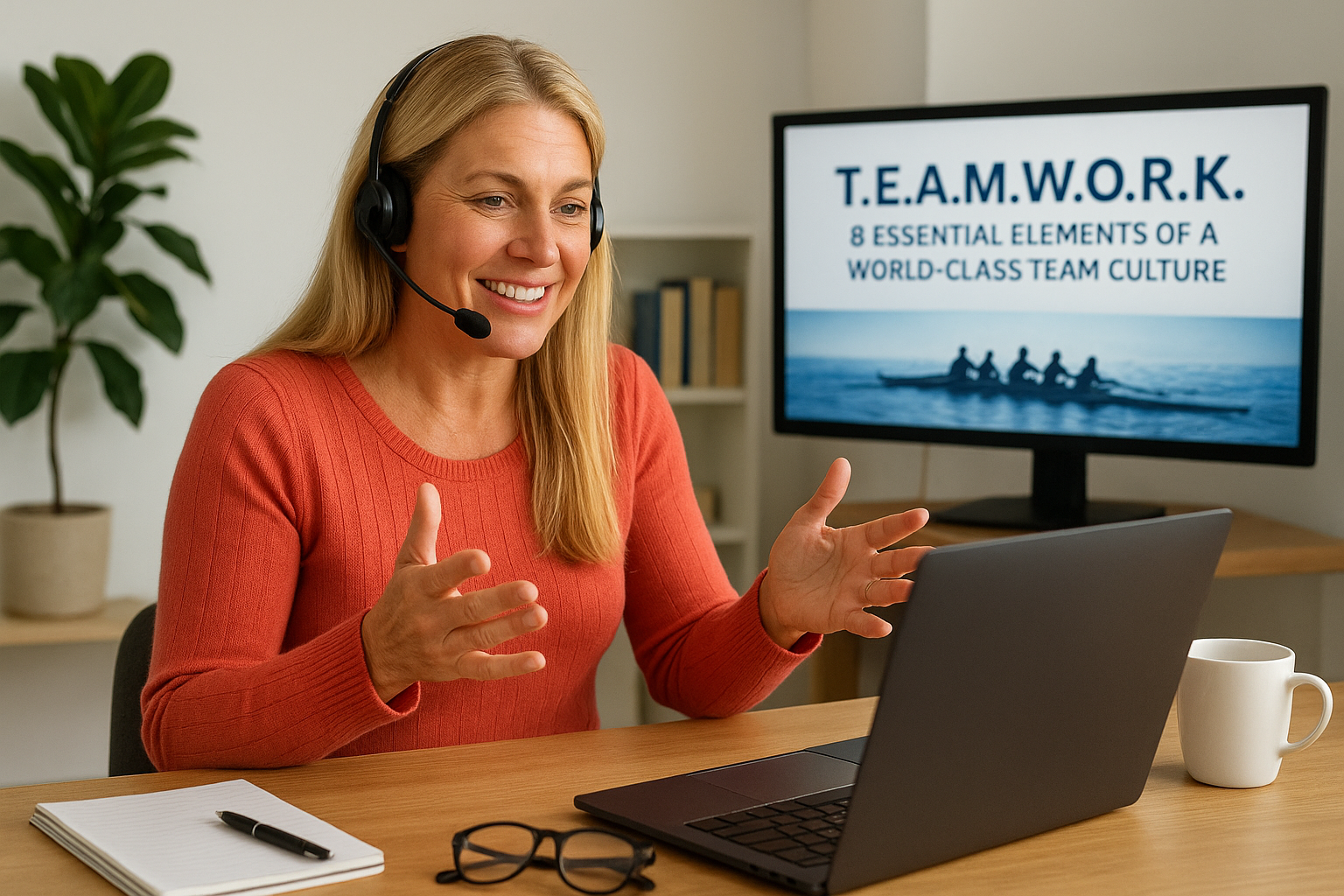
    This is exactly what I cover in my T.E.A.M.W.O.R.K. keynote, where I walk audiences through the eight elements that built world champion teams under real pressure, elements any organization can apply starting the next morning.

    2. Communication and active listening

    On a race course, a garbled radio call at mile 80 can cost you the win. In the office, a garbled directive costs you deadlines and trust. Communication and active listening rank second on this list because every other skill, from team building to conflict resolution, depends on people actually understanding each other.

    What it involves

    This skill covers more than talking clearly. It means active listening, where you repeat back what you heard before responding, and reading what’s not being said, like a teammate going quiet when they’re exhausted or a direct report hedging on a deadline they know they’ll miss.

    Why it matters for leaders

    Leaders who talk more than they listen miss early warning signs. I’ve seen expedition teams lose hours because a navigator assumed everyone understood the plan instead of checking. Corporate teams lose the same time to unclear handoffs and assumptions nobody questioned out loud.

    The best leaders spend more time confirming they’ve understood than proving they’re right.

    How to develop this skill

    Good training in leadership skills here focuses on repetition under pressure, not lecture format, so lean on communication exercises for teams that force real practice:

    • Practice reflective listening in real meetings, not just role-play
    • Run debriefs after every project, asking what got miscommunicated
    • Record yourself in a high-stakes conversation and review the ratio of talking to listening

    3. Decision-making and critical thinking

    Every adventure race throws a moment where the map is wrong, the weather turns, and someone has to call it in thirty seconds. Decision-making and critical thinking rank third because leadership eventually comes down to choosing a direction with incomplete information and owning what happens next.

    What it involves

    This skill means gathering just enough data, weighing risk against time pressure, and committing. It’s not endless analysis. It’s critical thinking under a deadline, spotting the one variable that actually matters and ignoring the noise that doesn’t change the outcome.

    Why it matters for leaders

    Teams stall when leaders freeze or flip-flop. I’ve watched racers lose hours because a captain couldn’t commit to a route change, and I’ve watched corporate teams miss quarters the same way, waiting for perfect certainty that never arrives.

    A good decision made fast beats a perfect decision made too late.

    How to develop this skill

    Sharpen this through training and development for leadership that puts people in real pressure, not case studies alone:

    • Run scenario drills and problem solving activities for teams with a hard time limit and no do-overs
    • Debrief every major call, good or bad, to find the reasoning gap
    • Give junior leaders real decision authority on smaller stakes first
    • Study post-mortems from your own past calls, not just textbook examples

    Decision-making improves with reps, not lectures. The goal is a leader who commits, then adjusts fast when new information arrives.

    4. Emotional intelligence and empathy

    Exhaustion strips people down to who they really are, and I’ve seen racers snap at teammates over nothing at hour 40 simply because their body was breaking down. Emotional intelligence and empathy rank fourth because leaders who can’t read what their people are carrying will misjudge every decision that involves those people.

    What it involves

    This skill means noticing shifts in tone, energy, and body language before someone tells you something’s wrong. It’s self-awareness about your own stress leaking into your leadership, plus enough empathy to ask a struggling teammate what’s actually going on instead of just pushing harder for output.

    Why it matters for leaders

    High performers rarely announce burnout. They go quiet, get short in meetings, or start missing details they normally catch. Leaders with strong emotional intelligence catch that early and adjust the workload or the conversation before it turns into a resignation letter or a blown deadline.

    The leaders who last are the ones who notice the quiet ones struggling before they have to say so.

    How to develop this skill

    Build this through deliberate observation, not personality tests alone:

    • Check in on energy and workload, not just task status, in every one-on-one
    • Ask open questions and wait through the silence instead of filling it
    • Get honest feedback from your team on how your stress shows up to them
    • Debrief tough weeks by naming the emotional toll, not just the missed numbers

    5. Adaptability and change management

    Weather doesn’t care about your race plan, and neither does the market care about your five-year strategy. Adaptability and change management rank fifth because the leaders who win aren’t the ones with the best original plan, they’re the ones who adjust fastest when that plan falls apart.

    What it involves

    This skill means scrapping a strategy mid-execution without losing the team’s confidence in you. It requires reading conditions in real time, whether that’s a course reroute at midnight or a sudden reorg, and communicating the pivot clearly enough that people follow without panic.

    Why it matters for leaders

    Organizations facing mergers, leadership turnover, or shifting markets lose momentum fast when leaders cling to outdated plans instead of learning change management for leaders. I’ve watched racing teams lose a podium finish because a captain refused to abandon a route everyone else knew was broken. Corporate teams do the same thing with dead strategies.

    The leader who adapts first usually wins, even with a worse starting position.

    How to develop this skill

    Good training and leadership skills work here means rehearsing disruption, not just discussing it:

    • Run tabletop drills where the scenario changes halfway through
    • Rotate leaders through unfamiliar roles to build comfort with uncertainty
    • Review past pivots and ask what signal you missed before committing to a new direction
    • Reward people who flag problems early, not just those who execute the original plan well

    6. Conflict resolution and negotiation

    Two exhausted teammates arguing over a route choice at hour 50 can end a race faster than any storm. Conflict resolution and negotiation close this list because tension is guaranteed on any team pushing hard, and the leader’s job isn’t preventing conflict, it’s channeling it before it turns into resentment or silence.

    6. Conflict resolution and negotiation

    What it involves

    This skill means stepping into disagreement instead of avoiding it, naming the real issue underneath the argument, and finding a path both sides can accept without either one losing face. It’s negotiation built on understanding what each person actually needs, not just splitting the difference to end the discomfort quickly.

    Why it matters for leaders

    Unresolved conflict festers and spreads. I’ve seen a two-person disagreement on a race team poison morale for the rest of the crew within hours. Corporate teams see the same pattern, where one unresolved dispute between managers trickles down into disengaged staff and missed handoffs.

    Conflict you avoid today becomes the culture problem you can’t fix next year.

    How to develop this skill

    Effective training leadership skill development here means practicing hard conversations, not reading about them:

    • Address disagreements within 48 hours, before positions harden
    • Separate the person from the problem in every mediation
    • Practice naming the unspoken issue out loud in low-stakes disputes first
    • Debrief resolved conflicts to confirm both sides actually feel heard, not just quieted

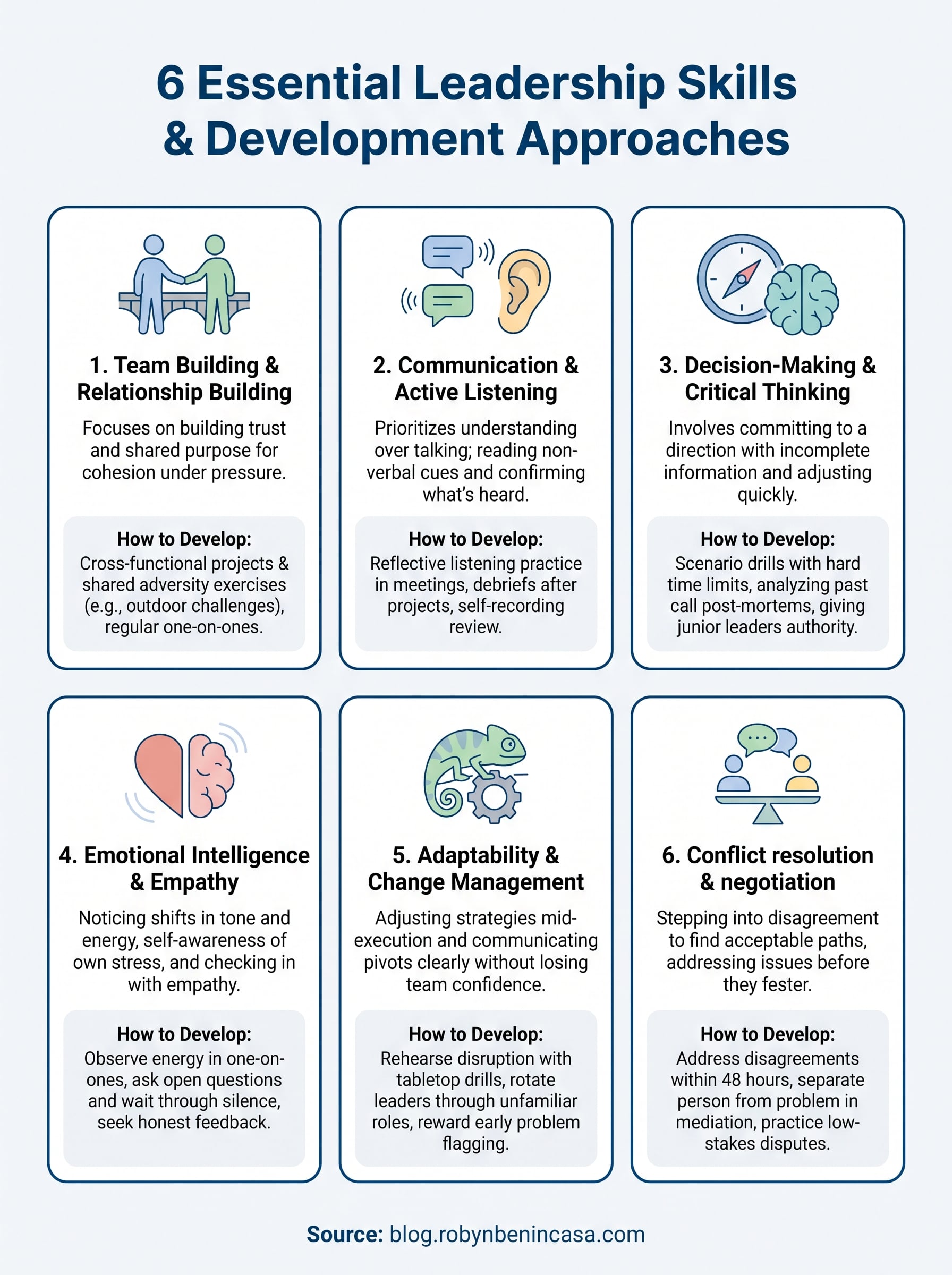
    leadership skills and training infographic

    Turning these skills into everyday leadership

    None of these six skills work in isolation. Trust built at work through team building gives you the room to communicate honestly. Honest communication feeds sharper decisions. Sharper decisions, made with empathy, hold up when conditions change and conflict flares. Skip one, and the whole chain weakens under pressure.

    Reading about leadership skills and training won’t build any of this. Reps will. Pick one skill from this list, the one costing your team the most right now, and run a drill on it this month. Debrief it. Adjust. Then move to the next.

    Organizations serious about this shift usually need a shared starting point, a moment where the whole team hears the same language around culture and accountability at once. That’s exactly what I built my keynotes to deliver. If you want your team to hear this framework directly and start applying it the next morning, here’s how to hire a keynote speaker for your next event, and how to book Robyn.

  • Management and Leadership Skills Training: What It Is and Why It Matters

    Management and Leadership Skills Training: What It Is and Why It Matters

    You’ve probably noticed the gap: someone gets promoted for being great at their job, then struggles to actually lead the people who report to them. That’s the exact problem management and leadership skills training is built to fix. It’s not one workshop or one skill. It’s the deliberate development of both the operational side of managing (deadlines, processes, performance reviews) and the human side of leading (trust, motivation, communication under pressure).

    If you’re searching for this, you likely want a straight answer to what separates leadership and management training from generic professional development, and whether it actually changes outcomes on your teams. It does, but only when it’s built around real team dynamics instead of theory. I’ve spent 15 years leading championship adventure racing teams and two decades as a firefighter, and the same principles that keep a team alive on a mountain apply directly to a sales floor or an IT department.

    In this article, I’ll break down what this training actually covers, who needs it most, and how manager and leadership training translates into measurable results like higher retention, stronger culture, and teams that perform under pressure instead of falling apart.

    Why management and leadership skills training matters

    Most companies promote based on tenure or individual performance, not leadership ability, which is exactly why team building training for managers matters so much after the promotion. That’s how you end up with a top salesperson running a demoralized team or a brilliant engineer who can’t hold a difficult conversation. Untrained managers default to micromanaging, avoiding conflict, or copying whatever leadership style they experienced, good or bad. None of that builds a team that can handle pressure, change, or a bad quarter without falling apart.

    Gallup has found that manager quality accounts for roughly 70% of the variance in team engagement across business units, which means the person running the meeting matters more than the mission statement on the wall. I saw the inverse play out on expedition teams: the strongest athletes lost races because nobody managed the pace, the communication, or the morale when things got hard. Business teams fail the same way, just slower and quieter.

    A team’s performance ceiling is set by its manager’s skill, not its talent.

    What untrained leadership actually costs

    The damage from skipping training on management and leadership doesn’t show up as a single dramatic failure. It shows up as slow leaks: your best people leaving, projects stalling in silos, and decisions bottlenecking at the top because nobody below the executive level feels empowered to make a call. Consider what changes when a manager actually gets trained versus when they’re left to figure it out alone:

    What untrained leadership actually costs

    Without training With structured training
    High performers promoted, then quietly struggle Clear framework for leading people, not just tasks
    Feedback avoided until annual review Regular, direct communication becomes normal
    Team culture forms by accident Culture is built deliberately around shared goals
    Turnover treated as unavoidable Retention improves because people feel led, not managed

    Why this matters more during change

    Training pays off hardest when conditions get difficult, not when things are calm. Organizations navigating a merger, a leadership transition, or a rough sales quarter need managers capable of leading teams through change and holding people together under stress, and that skill doesn’t appear on its own. Whether it’s called training management leadership or management leadership training, the goal is the same: give managers the tools to lead through friction instead of just administering around it.

    You’ve likely watched a team hit a wall and either come together or fall apart. The difference almost always traces back to the manager in the room, and that’s not luck. It’s a skill set. If you’re weighing what that skill set actually looks like in practice, a leadership keynote speaker session on building world-class team culture breaks down the exact behaviors that separate teams that unify under pressure from teams that splinter.

    Core skills covered in leadership and management training

    Good leadership training for it managers, sales directors, or operations leads all comes back to the same handful of core competencies, just applied to different environments. The best programs don’t teach abstract theory. They build specific, repeatable behaviors: how to give feedback that lands, how to delegate without micromanaging, and how to read a team’s morale before it tanks. This is the practical core of any managerial leadership training, regardless of industry.

    Communication under pressure

    Every expedition team I’ve led has fallen apart at the same moment: when communication broke down under stress. Business teams fail identically. Training should cover direct feedback, active listening, and how to have hard conversations without avoiding them or blowing them up. This is the single most transferable skill in any curriculum.

    Communication under pressure

    The teams that survive pressure are the ones that kept talking through it.

    Decision-making and delegation

    Managers who can’t delegate become bottlenecks. Strong training in leadership and management teaches people to hand off real authority, not just tasks, so decisions get made closer to the problem. This includes:

    • Setting clear ownership for outcomes, not just to-do lists
    • Building decision-making frameworks the team can use without you
    • Recognizing when to step in and when to let people fail small so they learn fast

    Building and protecting culture

    Team culture doesn’t happen by accident, it’s built through consistent behavior from the top. Programs covering leadership management training should address how to align a team around shared goals, handle conflict without letting it fester, and recognize contribution in ways that actually motivate people. Skip this piece and you get a technically competent manager who still can’t hold a team together when things get hard.

    How to choose the right leadership and management training program

    Plenty of programs promise leadership and management training and deliver a slideshow, a personality quiz, and nothing that changes behavior back on the job. Before you sign a contract, ask what happens in week three after the workshop ends. If the answer is nothing, keep looking. The strongest leadership training programs build around real scenarios your managers will actually face, not generic case studies pulled from a textbook.

    Match the content to your real gaps

    Start by naming the specific problem you’re solving. A team drowning in turnover needs different training for leadership and management than one struggling with cross-department silos. Ask any program these questions before committing:

    • Does it separate management skills (process, deadlines, performance tracking) from leadership skills (trust, motivation, communication)?
    • Is the content customized to your industry, or is it the same deck used for every client?
    • Does the speaker or facilitator have first-hand experience leading teams under real pressure, not just academic credentials?

    Training that ignores your team’s actual pressure points is just expensive entertainment.

    Look for built-in accountability

    Format matters less than what happens after the room empties. Programs worth paying for build in follow-up: manager check-ins, measurable behavior changes, or a framework teams keep using months later. Online leadership training programs and in-person formats both work, but only if the content connects directly to your team’s daily friction points rather than staying theoretical. When you’re evaluating options, ask for outcomes from past clients, not just satisfaction scores. You can see how that structure works firsthand through a keynote built around measurable team outcomes, rather than a one-off lecture that fades by Monday.

    How to make leadership training stick beyond the classroom

    A great workshop that ends without follow-through is a wasted budget line. Leadership for managers training only changes behavior if the organization builds structure around it after the event, not just during it. The biggest mistake companies make is treating training as a single date on the calendar instead of the start of a habit-building process.

    Build in reinforcement, not just recall

    Managers forget most of what they hear in a room within weeks unless someone holds them to it. Reinforcement means scheduled check-ins where a manager reports what they actually tried, what worked, and what didn’t. It means giving managers a short list of behaviors to practice weekly rather than a binder to shelve. Consider requiring:

    • A 30-day follow-up session to troubleshoot real situations
    • Peer accountability pairs so managers coach each other
    • A shared language across the team so feedback and delegation habits stick

    Training that isn’t reinforced fades faster than the memory of the workshop itself.

    Make it visible from the top

    Executives who skip the same leadership training management expects of their managers send a clear signal that it’s optional. When senior leaders visibly use the same feedback frameworks and language taught in training, managers take it seriously because they see it modeled, not just mandated. Culture change starts at the top or it doesn’t start at all.

    Ownership matters just as much as reinforcement. Assign someone, whether that’s HR or a designated internal champion, to track whether the specific behaviors from training actually show up in team meetings, one-on-ones, and performance reviews three months later. Without that accountability loop, even the best training becomes a pleasant memory instead of a lasting change in how people lead, which is why knowing how to create a culture of accountability matters as much as the workshop itself.

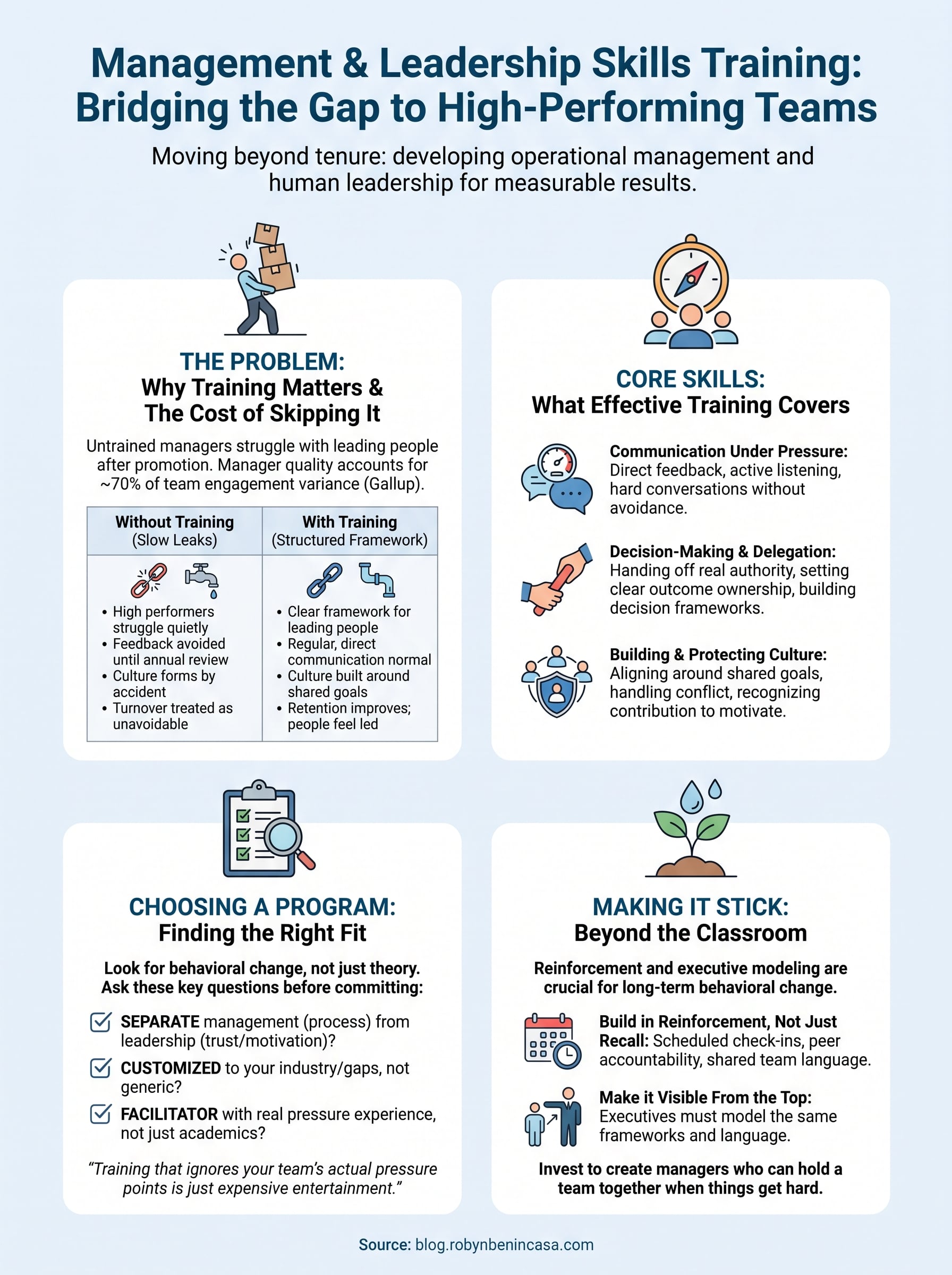
    management and leadership skills training infographic

    Turning training into stronger teams

    Strip away the jargon and management and leadership skills training comes down to one question: can your managers hold a team together when things get hard? Everything else, the frameworks, the workshops, the follow-up check-ins, exists to answer that one question. Skip the training and you’re betting your culture on whoever happened to get promoted last. Invest in it properly and you get managers who communicate under pressure, delegate real authority, and build culture on purpose instead of by accident.

    Going forward, treat leadership development the same way you’d treat any skill that determines whether your team wins or loses under pressure: deliberately, consistently, and with real accountability attached. If you’re ready to see what that looks like for your organization, start with team culture building and turn training into results that outlast the workshop.

  • Leadership Training Programs: What They Are and Why They Work

    Leadership Training Programs: What They Are and Why They Work

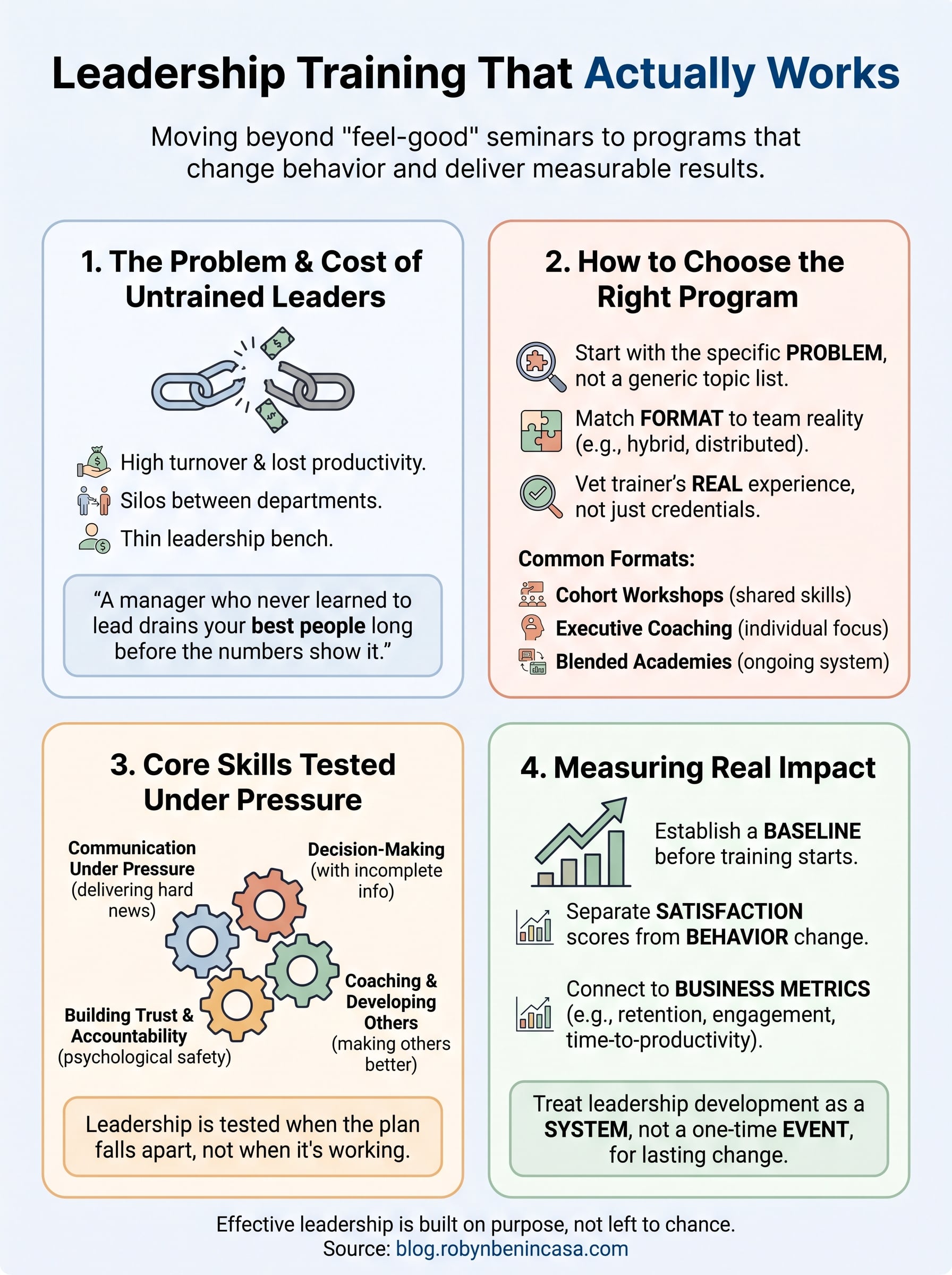
    Most leadership training programs get judged on how they make people feel during the workshop, not on what changes back at the office three months later. That gap is why so many HR leaders end up skeptical of the whole category, even when they know their organization needs it. If your teams are dealing with turnover, silos between departments, or a leadership bench that looks thin heading into next year, you’re not wrong to want something more rigorous than a one-day seminar with a feel-good speaker.

    This article breaks down what leadership training actually means, the core skills and qualities it should build, and how the strongest programs are structured to produce results you can measure, not just applause in the room. You’ll see the difference between programs that inform and programs that change behavior.

    I’ve spent 20 years leading firefighting crews and world-championship adventure racing teams, where a bad leadership decision doesn’t just hurt a quarterly number, it puts people in danger. That’s the lens I bring to this: practical, tested frameworks drawn from high-stakes team environments, translated for the corporate teams that book me to speak. By the end, you’ll know exactly what to look for when you’re evaluating options for your own organization.

    Why leadership training programs matter now

    The cost of skipping leadership development

    Untrained managers cost you more than a bad quarter. Most leaders get promoted because they hit their sales number or wrote clean code, not because anyone ran them through team building training for managers or taught them how to run a team. Poor management is one of the biggest drivers of voluntary turnover, and every open seat you have to backfill costs real money. The Society for Human Resource Management puts the price of replacing a single employee at six to nine months of that person’s salary once you count recruiting, onboarding, and lost productivity. A leadership development program that actually changes how managers operate pays for itself the first time it prevents one resignation on a team you can’t afford to lose.

    A manager who never learned to lead will quietly drain your best people long before the numbers show it.

    What’s different about today’s workforce

    Hybrid and remote arrangements have erased the hallway conversations that used to let new managers absorb leadership skills by watching someone else do it well. Four generations now often work side by side on the same team, each with different expectations for feedback, recognition, and career growth, so a one-size approach to managing people doesn’t land the way it used to. Flatter org charts push decision-making further down the chain too, which means more people are making judgment calls under pressure with less preparation than the managers who came before them. This is exactly the environment where corporate leadership training built around real scenarios, not a lecture, builds the judgment people need when things go sideways.

    Where most organizations fall short

    Most companies still treat leadership development as an event instead of a system. They send a cohort to a two-day offsite, hand out a workbook, and call it finished, with no coaching, no follow-up, and no way to tell whether behavior actually changed once everyone got back to their inbox. I’ve watched this play out with corporate teams I speak to directly: the room is fully engaged on day one, and then nothing structural shifts because the training was never connected to how people are managed, measured, or held accountable afterward. Common gaps look like this:

    Where most organizations fall short

    • Promoting people based on tenure or technical skill rather than readiness to lead
    • Treating training as a single event instead of an ongoing practice
    • Skipping manager coaching or peer accountability once the session ends
    • Never tying the program to a metric beyond a same-day satisfaction survey

    Numbers make the case better than opinions do:

    Statistic What it tells you
    Roughly 6 in 10 new managers receive no formal training before stepping into the role Leadership skills are being learned on the job through trial and error, often at your customers’ expense
    Replacing an employee costs 6 to 9 months of their salary Weak management shows up directly on the P&L through turnover, not just in exit interviews
    Gallup has found manager quality accounts for a large share of the variance in team engagement The person leading the team matters more to output than almost any other single factor

    Organizations that ignore this data keep hiring for skills and hoping leadership shows up on its own. It rarely does. The teams I’ve led in wildland fires and in expedition racing taught me the same lesson corporate data now confirms: what team culture is and why it matters comes down to building it deliberately or not at all, and the cost of leaving it to chance shows up everywhere from turnover to safety incidents to missed targets.

    How to choose the right leadership training program

    Start with the problem, not the topic list

    Before you look at a single vendor, name the specific problem you’re trying to solve. Are new managers struggling with conflict, is turnover concentrated in one department, or is the leadership bench too thin to survive a promotion wave? A vague goal like "improve leadership" gets you a generic program that nobody remembers by Friday. Corporate leadership training works best when it’s built around a problem you can point to and a behavior change you can name in advance, not a topic on a menu.

    Match the format to how people actually work

    Once you know the problem, match the delivery format to your team’s reality. A distributed sales team spread across time zones needs something different than a single-site manufacturing plant where everyone’s on the floor together. Consider these questions before you commit:

    • Can the program run virtually, like the stronger online leadership training programs, or in person or as a hybrid, and does that match how your teams actually work?
    • Does it include follow-up coaching, or does it end when the workshop does?
    • Is content customized to your industry, or is it the same deck every client gets?
    • Does the vendor offer a manager’s guide or toolkit so learning gets reinforced back on the job?

    A program that stops the moment the workshop ends was never built to change behavior in the first place.

    Vet the trainer’s actual experience

    Credentials on a slide don’t tell you whether someone has actually led people through pressure. Ask who’s delivering the content and what they’ve actually led, not just studied. A facilitator with a consulting certificate can walk a room through a framework, but someone who has run a team through a real crisis, whether that’s a hospital floor, a fire scene, or an expedition race, brings judgment that no case study can replicate. This is exactly why organizations often look for the best keynote speaker for a corporate event with hands-on team leadership experience to open a training initiative or reset momentum mid-year. If you’re evaluating options for a kickoff event or a leadership offsite, look at how a speaker like Robyn Benincasa frames team culture around real, high-stakes decisions rather than theory, since that’s often the piece that makes a program stick with a room full of managers.

    Ask how success gets measured before you sign

    Every vendor will tell you their program works. Push past that and ask exactly how they define success and what data they’ll hand you at the end. A serious leadership development program should be able to tell you what metric moves, whether that’s manager retention, engagement scores, or time-to-productivity for new hires, and over what timeframe you should expect to see it. If a provider can’t answer that question specifically, or the answer is limited to a same-day satisfaction survey, that’s a signal the program was built to fill a room, not change how people lead. Comparing a shortlist of vendors side by side on format, measurement, and real-world credibility will surface the differences faster than any sales pitch will.

    Common types of leadership training programs

    Leadership training isn’t one product, it’s a category with several distinct formats, each suited to a different problem. Knowing the differences helps you stop comparing apples to oranges when you’re evaluating proposals, and it keeps you from buying a format that doesn’t match the behavior change you actually need.

    Cohort-based workshops

    Workshops bring a group of managers together, usually over one to three days, to work through a shared framework and practice it in real scenarios. Strong versions build in role-play, peer feedback, and small-group problem-solving instead of slide after slide of theory. Weak versions are lecture with a workbook attached, and everyone can tell the difference by lunch on day one. Cohort programs, including many of the best leadership training programs for building stronger teams, work best when you have a group being promoted at the same time, since shared language and shared experience make it easier for new managers to support each other after the room empties out.

    Executive coaching and one-on-one development

    Coaching pairs a single leader with a trained coach over weeks or months, usually to work through a specific gap: delegation, difficult conversations, or executive presence. It’s slower and more expensive per person than a workshop, but the personalization drives change that group training can’t match for senior leaders whose blind spots are individual, not shared. Companies often layer coaching on top of a cohort program, using workshops to build shared skills and coaching to reinforce them where it matters most.

    Coaching changes one leader at a time; workshops change how a whole team talks about leadership. You usually need both, not one or the other.

    Keynote-driven kickoffs and offsites

    A keynote isn’t a substitute for ongoing training, but it’s an effective way to open an initiative, reset momentum after a rough quarter, or unify a room before breaking into workshop tracks. The right speaker sets a shared vocabulary and an emotional hook that the rest of the program can build on. This is where corporate leadership training initiatives often start, and it’s why organizations bringing teams together for a sales kickoff or leadership offsite learn how to hire a keynote speaker with real high-stakes team experience to open the day, rather than a motivational speaker with no operational background.

    Keynote-driven kickoffs and offsites

    Blended academies and ongoing programs

    The most durable leadership development programs run over months, not days, combining live sessions, coaching check-ins, peer accountability groups, and manager toolkits that reinforce the material back on the job. These cost more up front and take longer to show results, but they’re the format most likely to change how people actually manage.

    Format Best for Typical length Follow-up built in?
    Cohort workshop New managers, shared skill gaps 1 to 3 days Rarely, unless purchased separately
    Executive coaching Senior leaders, individual blind spots Weeks to months Yes, by design
    Keynote kickoff Momentum, alignment, culture reset Half day to full day No, needs a follow-on program
    Blended academy Organization-wide culture change 3 to 12 months Yes, built into the structure

    Most organizations end up combining two or three of these, not picking just one. A keynote can open the conversation, a workshop can teach the framework, and coaching can make it stick for the leaders carrying the most weight.

    Core skills and topics the best programs teach

    Strip away the branding and every strong program teaches the same handful of leadership and team building skills that show up again and again, no matter the industry. Leadership training programs that skip these in favor of personality quizzes or generic communication tips end up forgettable, because they never touch the moments where leadership actually gets tested: the layoff conversation, the missed deadline, the team that’s stopped trusting its manager. Here’s what the best ones cover, and why each one earns its place on the agenda.

    Communication under pressure

    Giving feedback when things are going well is easy. The skill that separates trained leaders from untrained ones is delivering hard news clearly, without softening it into confusion or letting it turn into a blowup. Programs worth their price teach specific frameworks for structuring a difficult conversation, then have managers practice it out loud with a peer, not just read about it in a workbook. On a fire scene, an unclear order costs seconds you don’t have. In an office, an unclear conversation costs weeks of confusion and a team that stops trusting what its manager tells them.

    Communication under pressure

    Decision-making with incomplete information

    Most real decisions get made without all the facts, on a deadline, with people watching to see how the leader handles it. Good programs run managers through scenario-based exercises and problem solving activities for teams where they have to choose, act, and then debrief what worked, building the kind of judgment that no slide deck can install on its own.

    Leadership isn’t tested when the plan is working. It’s tested in the ten seconds after the plan falls apart.

    Building trust and accountability

    Teams don’t perform because someone told them to; they perform because they trust the person leading them, which is why knowing how to build trust in a team at work matters as much as any framework. Strong programs use culture of accountability training to teach managers how to set clear expectations, follow through consistently, and create the kind of psychological safety where a team member will flag a mistake before it becomes a crisis instead of hiding it until it’s unfixable. This is the backbone of what I call T.E.A.M.W.O.R.K., the eight elements I’ve watched separate world champion teams from everyone else chasing the same finish line, and it translates directly into how corporate teams function under deadline pressure.

    Coaching and developing others

    A manager’s job isn’t to be the best individual performer on the team, it’s to make everyone around them better. The best leadership development programs dedicate real time to coaching skills: asking better questions, giving feedback that builds capability instead of defensiveness, and knowing when to step back and let someone else own a decision.

    Here’s how these core areas typically map to the problems they solve:

    Core skill Problem it solves How it’s usually taught
    Communication under pressure Miscommunication, avoided conflict Role-play, scripted difficult conversations
    Decision-making Hesitation, poor judgment calls Scenario simulations, after-action debriefs
    Trust and accountability Silos, hidden problems Team culture frameworks, peer feedback
    Coaching others Bottlenecked teams, weak succession One-on-one practice, manager toolkits

    Organizations that build training around these four areas, rather than a rotating list of soft-skill topics, see the difference in how their managers handle the next real crisis, not just how they rate the workshop on a feedback form.

    How to measure the impact of leadership training

    Establish a baseline before training starts

    Most organizations skip this step entirely, then wonder why they can’t prove the program worked. Before you run a single session, pull the numbers that matter: manager retention, engagement scores by team, time-to-productivity for new hires, and exit interview themes tied to management. Without a baseline, you’re left comparing a post-training survey to nothing, which tells you how the room felt, not whether anything changed. Treat this the same way you’d treat any capital investment: you wouldn’t approve a new piece of equipment without knowing the output it’s replacing.

    Separate satisfaction scores from behavior change

    Satisfaction surveys measure whether people enjoyed the day, not whether they lead differently three months later. A leadership development program worth the budget tracks behavior indicators instead: are managers holding regular one-on-ones, are difficult conversations happening before problems escalate, is feedback showing up in peer reviews or 360 assessments run 90 days out. These signals take longer to surface than a same-day survey, but they’re the ones that predict whether turnover actually drops.

    If the only data point you have is a same-day survey score, you don’t have a measurement plan, you have applause.

    Connect training to business metrics

    Eventually the program has to show up in numbers the rest of the organization already tracks, the same way change management metrics and KPIs do. Connect the dots explicitly rather than hoping someone else does it for you:

    Metric What to track Reasonable timeframe
    Voluntary turnover Manager-level attrition before and after training 6 to 12 months
    Engagement scores Pulse survey results by team, not company-wide averages Quarterly
    Time-to-productivity Ramp time for new hires under trained vs. untrained managers 3 to 6 months
    Internal promotion rate Percentage of leadership roles filled internally Annually

    Quantifying this way keeps the conversation with finance grounded in numbers instead of impressions, and it protects the program’s budget the next time cuts get discussed.

    Build a review cadence that outlasts the workshop

    Reviewing results once, right after the workshop, tells you almost nothing. Schedule check-ins at 30, 90, and 180 days to see whether behavior change is holding or fading, and loop in the managers who went through training to hear what’s sticking and what isn’t. This is also where corporate leadership training initiatives either earn a renewed budget or quietly disappear, depending on whether anyone can point to a number that moved. Organizations that build this cadence into the calendar from day one, rather than scrambling to justify the spend after the fact, are the ones that keep leadership development funded year over year. If you’re building this kind of measurement plan around a keynote or workshop kickoff, my guide to creating a strong team culture can help you frame what to track before the first session even happens.

    leadership training programs infographic

    Turning training into lasting leadership

    Good leadership training programs don’t end when the workshop does. They start with a real problem, use a format that matches how your people actually work, teach the handful of skills that get tested under pressure, and get measured against numbers finance already cares about. Skip any one of those steps and you’re back to a feel-good day that fades by the following Monday.

    Organizations that treat leadership development as a system, not an event, are the ones that see turnover drop and bench strength grow year over year. The teams I led through wildfires and world championship races won because culture was built on purpose, not left to chance. Your teams can win the same way.

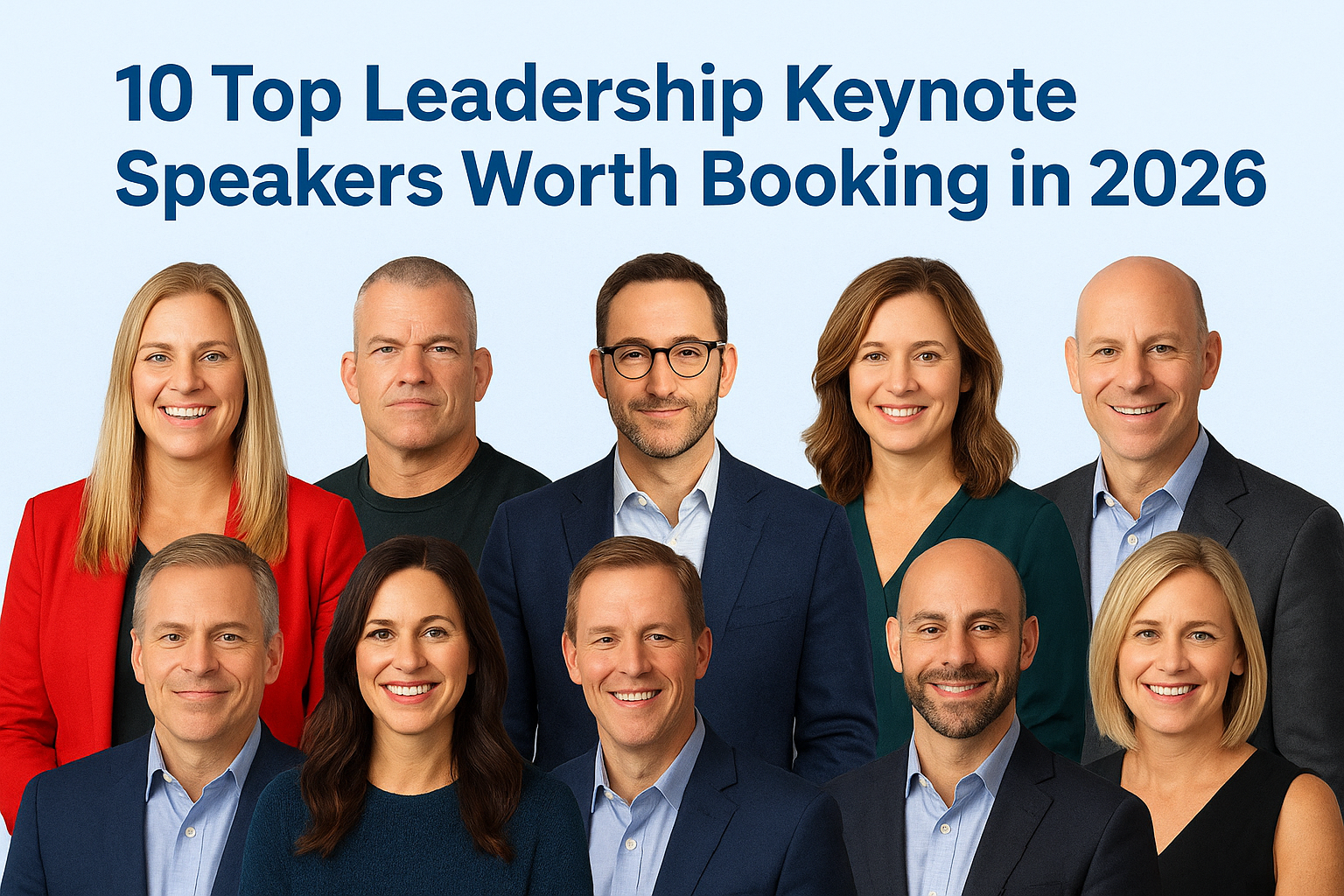
    If you’re planning a kickoff, offsite, or training initiative and want a speaker who brings that kind of tested, high-stakes team experience into the room, see which leadership keynote speakers are worth booking and what fits your team.

  • Training Grit: What It Is and How It Builds Mental Toughness

    Training Grit: What It Is and How It Builds Mental Toughness

    You’ve probably heard someone mention training grit at the gym or seen a class called GRIT on the schedule and wondered what it actually involves. Is it a workout, a mindset, or both? That question matters if you’re trying to build real toughness instead of just breaking a sweat.

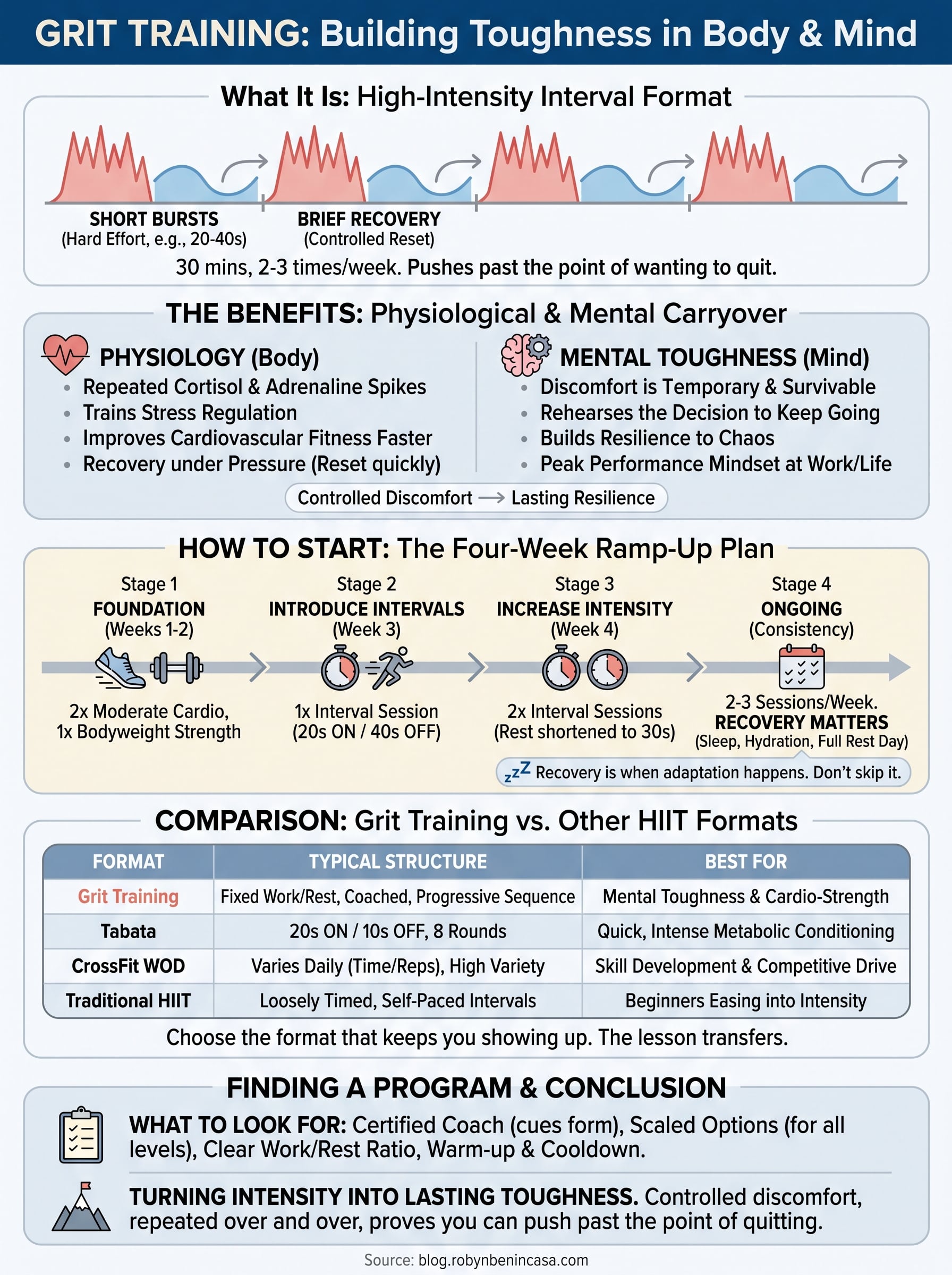
    Here’s the short answer: grit training usually refers to a high-intensity interval format, popularized by programs like Les Mills GRIT, that combines short bursts of hard effort with brief recovery periods. Most grit training programs run 30 minutes, two to three times a week, and they’re built to push you past the point where your body wants to quit, which is exactly where mental toughness gets forged.

    In this article, we’ll break down what grit training looks like in practice, the physical and mental benefits it delivers, and how often you should do it to see results. We’ll also connect the dots between physical grit and the kind of high performance culture that separates good organizations from great ones, a topic Robyn Benincasa has spent her career studying on adventure racing courses, in burning buildings, and on stages in front of teams who need to hear it.

    Why grit training builds more than physical fitness

    Grit training earns its name because it does more than torch calories. The stop-start structure of a HIIT workout forces your nervous system to practice recovery under pressure, teaching your body to reset quickly after maximal effort instead of shutting down. That skill, the ability to catch your breath and go again, is physical proof that discomfort is temporary and survivable, a lesson that sticks with you long after the class ends. Even five minutes of that rhythm teaches your brain more about handling pressure than an hour of steady, predictable cardio ever will.

    The physiology behind mental toughness

    Short, hard intervals spike your heart rate and flood your system with cortisol and adrenaline, the same stress hormones that surface during a tense negotiation or a missed deadline. Repeated exposure to that spike, followed by controlled recovery, trains your body to regulate stress more efficiently over time instead of staying stuck in fight-or-flight mode. Research on high-intensity interval training backs this up: the American Heart Association notes that HIIT improves cardiovascular fitness and stress resilience faster than steady-state cardio alone. A typical grit training program builds this adaptation through:

    The physiology behind mental toughness

    • Repeated bursts of near-maximal effort, usually 20 to 40 seconds long
    • Short, incomplete recovery windows that keep your heart rate elevated
    • Compound movements that demand full-body coordination while fatigued
    • A finisher round designed to test what you have left when you think you’re empty

    Grit training doesn’t just condition your muscles, it conditions your response to stress itself.

    Why the mental carryover matters

    Athletes and firefighters have known this for decades: the person who trains for chaos handles chaos better. Pushing through a brutal final round of intervals rehearses the exact mental sequence you need when a project falls apart or a team hits a wall, the moment where you decide to quit or keep working the problem. Robyn Benincasa has built an entire keynote career around this parallel, showing corporate teams that the discomfort tolerance built in a gym or on an expedition translates directly into a peak performance mindset at work. Ultimately, that’s the real payoff of grit training: you’re not just building endurance, you’re rehearsing the decision to keep going, a skill you need to build a high-performing team that holds together when conditions turn hard.

    How to start grit training the right way

    Jumping into a full grit training program on day one is the fastest way to get hurt or burned out before you see any benefit. Your body needs a base level of conditioning before it can handle repeated max-effort intervals, so give yourself two to three weeks of moderate cardio and strength work first. This isn’t about being cautious for its own sake, it’s about making sure the toughness you build actually sticks instead of getting derailed by a pulled hamstring in week two.

    Build a foundation before you sprint

    Start with movements you already know well, like squats, push-ups, and rows, so your form doesn’t break down when fatigue sets in. Once those feel automatic, layer in short intervals, 20 seconds of hard effort followed by 40 seconds of rest, and gradually shrink the recovery window as your fitness improves.

    The goal isn’t to survive your first grit training class, it’s to still be standing for your tenth.

    A simple four-week ramp-up

    • Week 1-2: Two moderate cardio sessions plus one bodyweight strength session
    • Week 3: One true interval session at 20 seconds on, 40 seconds off
    • Week 4: Two interval sessions, shortening rest to 30 seconds
    • Ongoing: Two to three sessions per week, no more, since recovery is when the adaptation actually happens

    Recovery matters as much as the workout

    Sleep, hydration, and at least one full rest day between sessions determine whether training grit builds resilience or just wears you down. Skipping recovery doesn’t make you tougher, it just delays the injury. Pay attention to nagging soreness that doesn’t fade within 48 hours, since that’s your body’s signal to scale back before pushing forward again.

    Grit training versus other HIIT workouts

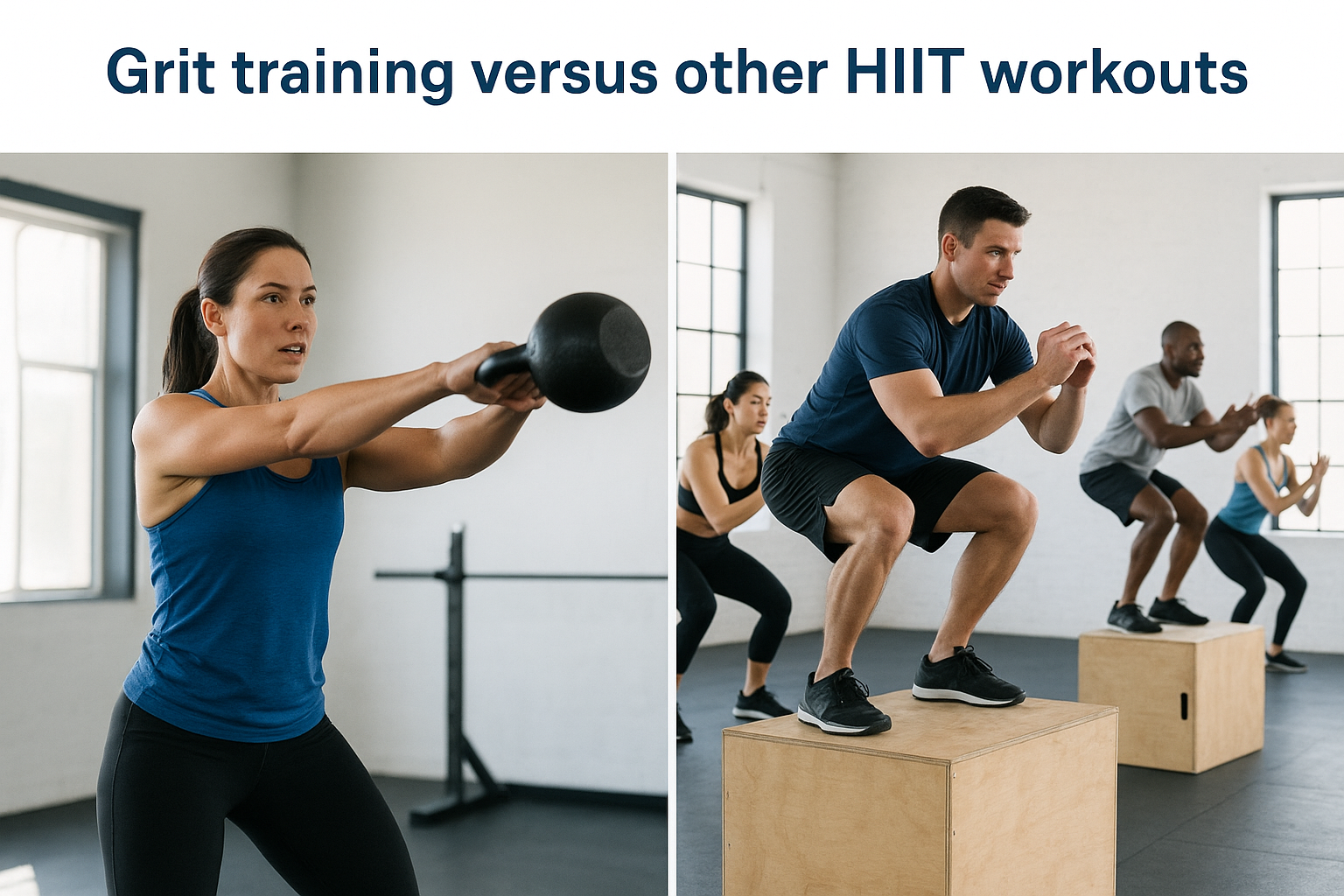
    Not every high-intensity class is built the same, even though they all get lumped under the HIIT umbrella. Grit training typically follows a structured, coached format like Les Mills GRIT, with prescribed work-to-rest ratios and a specific sequence of strength, cardio, and plyometric moves designed by exercise physiologists. Other HIIT styles, like Tabata or CrossFit-based WODs, give you more variety session to session but less consistency in intensity curve, which matters if you’re trying to track progress over weeks rather than just show up and sweat.

    Grit training versus other HIIT workouts

    The format matters less than the consistency, but knowing the differences helps you pick a program you’ll actually stick with.

    Understanding these distinctions helps you choose the right tool for your goal, whether that’s raw conditioning, skill development, or mental toughness specifically.

    Format Typical structure Best for
    Grit training Fixed work/rest intervals, coached, progressive Building mental toughness and cardio-strength together
    Tabata 20 seconds on, 10 seconds off, 8 rounds Quick, intense metabolic conditioning
    CrossFit WOD Varies daily, often for time or max reps Skill variety and competitive drive
    Traditional HIIT Loosely timed intervals, self-paced Beginners easing into intensity

    Selecting between these isn’t about which one burns more calories, since most deliver similar cardiovascular benefit when done consistently. The real question is which format keeps you showing up, because the toughness payoff only compounds with repetition. If you thrive on structure and coaching cues, grit training programs tend to hold people accountable better than open-ended workouts. If variety keeps you motivated, a rotating format might serve you longer. Either way, the underlying lesson, that discomfort is temporary, transfers regardless of which class you choose.

    How to find a grit training class or program

    Finding a quality grit training program starts with looking past the marketing and checking the actual structure behind it. Not every gym labels its high-intensity offering "GRIT," so search for terms like HIIT class, "conditioning circuit," or "interval training" if your local studio skips the branded name. Most major gym chains and independent studios run some version of this format, often built on the same work-to-rest principles as the licensed programs, so don’t rule out a class just because the name on the schedule looks different.

    A program is only as good as the coach who can spot bad form when your legs are shaking.

    What to look for before you sign up

    Use this quick checklist before committing your money and your recovery days to a new class:

    • A certified instructor who cues form corrections during the workout, not just before it
    • Scaled options for every movement so beginners aren’t forced to match advanced athletes
    • A clear work-to-rest ratio posted or announced before the session starts
    • A warm-up and cooldown built into the schedule, not left to chance

    Trying before committing

    Almost every studio offers a free trial class or a discounted first week, which is the fastest way to judge coaching quality and class energy before buying a membership. Arrive early, introduce yourself to the instructor, and ask how they modify the workout for injuries or fitness levels, since their answer reveals a lot about how seriously the program takes safety.

    Virtual and app-based options

    Suppose your schedule or location rules out in-person classes. In that case, on-demand apps now offer structured interval programming you can follow at home, which works well once you already understand proper form and simply need the interval structure to push you.

    training grit infographic

    Turning intensity into lasting toughness

    Grit training works because it puts you in controlled discomfort on purpose, over and over, until your body and mind learn that hard moments end. That’s the whole point. Whether you’re chasing better conditioning or trying to build the kind of mental toughness that carries into your job, your relationships, or your team, the interval format gives you repeated proof that you can push past the point where you wanted to quit.

    Organizations need that same lesson. Teams that fold under pressure rarely lack talent, they lack practice handling discomfort together. That’s the exact gap Robyn Benincasa addresses when she works with corporate teams, translating lessons from adventure racing and firefighting into frameworks leaders can actually use. If your organization needs that kind of resilience built deliberately rather than left to chance, see how the best motivational keynote speakers to hire bring these same principles to your team, well beyond the gym.

  • 9 Escape Room Team Building Activities Worth Trying

    9 Escape Room Team Building Activities Worth Trying

    You’ve got a team offsite coming up, a budget for one activity, and a group of people who’ve done the trust falls and the ropes courses already. So you’re searching for team building activities escape room style because you want something that actually forces people to communicate under pressure, not just stand around holding hands. Fair instinct. A good puzzle room compresses hours of team dynamics into 60 minutes and shows you, in real time, who steps up, who shuts down, and who solves problems out loud versus alone.

    This list covers nine escape room team building activities you can actually book or build, from commercial venues with corporate packages to DIY versions you can run in a conference room for teams scattered across offices. You’ll find options for small groups, distributed teams, and budgets that range from free to a few thousand dollars.

    I’ve spent 20 years leading teams through actual life-or-death scenarios as a firefighter and adventure racer, and the same principles that win world championship races show up in a well-designed escape room: clear roles, fast decisions, shared ownership of the outcome. These picks reflect that lens, not just novelty.

    1. Commercial escape room venues

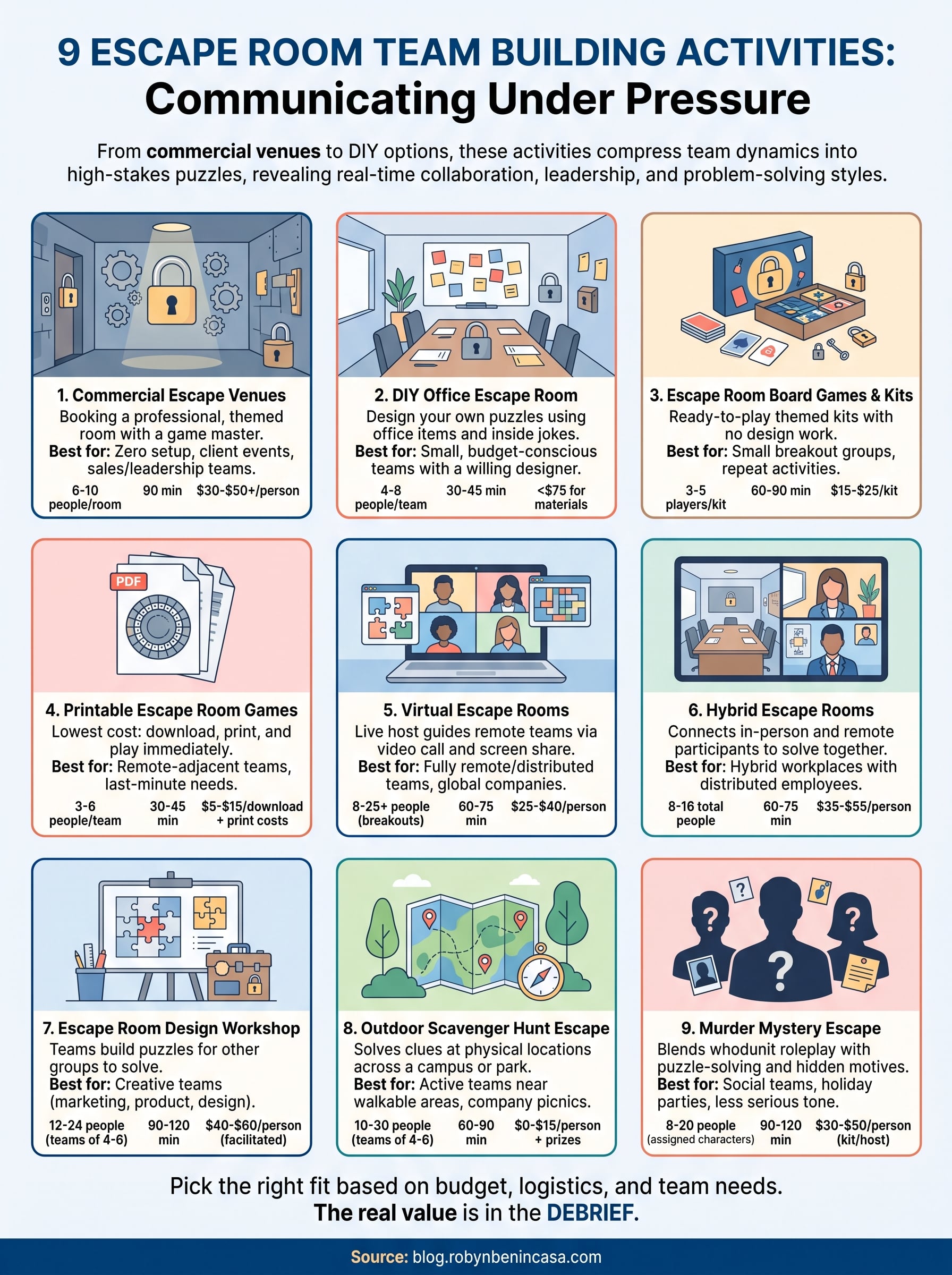
    Commercial escape rooms are the original version of this activity, and they’re still the easiest way to get a polished experience without doing any setup yourself. You book a room at a local venue, show up with your group, and a trained game master runs the whole thing while you focus on the puzzles. These businesses exist specifically to sell immersive puzzle experiences, so the production value tends to be high: themed sets, sound effects, hidden mechanisms, sometimes actors who play a role in the story.

    1. Commercial escape room venues

    How it works

    Your group gets locked in a themed room (a bank vault, a spaceship, a detective’s office) and has 60 minutes to find clues, crack codes, and solve a chain of puzzles to "escape." A game master watches through cameras and can offer hints if you’re stuck, which keeps frustration from tanking morale. Most venues now run a debrief afterward where staff highlight what worked and what didn’t in your group’s problem-solving, which is the part that actually makes this a team building activities escape room exercise instead of just a fun outing.

    Best for

    This format suits teams that want a done-for-you experience with zero setup on your end. It works well for client-facing events too, since the polish reflects on your company, and it slots neatly alongside other corporate event team building activities you may already be planning. Sales teams, leadership cohorts, and cross-departmental groups who don’t normally work together all do well here because the shared novelty flattens hierarchy fast.

    A locked room with a ticking clock tells you more about how your team communicates than a year of status meetings.

    Group size and time needed

    Most commercial rooms hold 6 to 10 people comfortably, though some venues offer larger rooms or let you book multiple rooms and compare times. Budget 90 minutes total: a 10-minute briefing, the 60-minute game, and a debrief.

    Cost and what to book

    Group size Typical cost per person What’s included
    6-10 $30-$45 One room, game master, standard debrief
    11-20 (multiple rooms) $30-$50 Head-to-head rooms, comparison debrief
    Corporate packages $500-$2,000 flat Private booking, custom debrief, sometimes catering

    Ask specifically for their corporate team building package, not the general public booking. Most venues have one, and it usually includes a facilitator who ties the puzzles back to workplace behavior instead of just handing you a completion time.

    2. DIY escape room built in your office

    Building your own escape room in a conference room costs almost nothing and gives you total control over the puzzles, which makes it one of the more flexible indoor team building activities for work and lets you tie them directly to your company’s real work. Instead of a generic spy theme, you write clues around your product, your org chart, or an inside joke from last year’s sales conference. This is one of the more overlooked escape room team building activities because people assume it takes professional design skills. It doesn’t. It takes an afternoon and a willingness to hide sticky notes in weird places.

    How it works

    One person on your team (usually whoever loves puzzles) designs a chain of 4 to 6 clues locked behind a final combination lock or sealed envelope. Clues get taped under chairs, inside binders, or behind a whiteboard. Teams race to solve the chain and "escape" the room before time runs out.

    Best for

    Small companies or single departments with a designer willing to spend a few hours building the puzzle. It’s a strong fit for budget-conscious teams and for groups who already know each other well enough to enjoy inside-joke clues, and it pairs well with other low-cost team building activities for employees.

    Group size and time needed

    Works best with 4 to 8 people split into two small teams, running 30 to 45 minutes. Larger offices can build two identical rooms and race departments against each other.

    Cost and materials needed

    The best DIY escape rooms use what’s already in your building, not what’s in a party supply catalog.

    • Combination locks or lockboxes ($10-$20 each on Amazon)
    • Sticky notes, envelopes, string, and tape
    • A printed answer key for the facilitator
    • Total cost: usually under $75 for a reusable kit

    3. Escape room board games and kits

    Escape room board games package the whole experience into a box you can order online and run at your next team meeting with zero design work. Brands like Exit: The Game and Unlock! sell dozens of themed escape room kits, each built around a self-contained story with cards, locks, and puzzle sheets instead of a physical room. They’re a fast way to run team building activities escape room style without booking a venue or building anything from scratch.

    How it works

    Your group opens the box, reads a short story setup, and starts working through numbered cards and physical props (paper wheels, code cards, sometimes small locks). Each solved puzzle reveals the next card or unlocks a code that advances the story until the group reaches the final solution.

    Best for

    Kits suit smaller teams or breakout groups within a bigger offsite, since most are designed for 3 to 5 players per box, which puts them squarely among the better team building ideas for small groups. They’re also a good fit for repeat activities, since you can buy a new theme every quarter without repeating a venue.

    A twenty-dollar box can produce the same huddle-and-argue dynamic as a two-thousand-dollar venue booking.

    Group size and time needed

    Most kits run 60 to 90 minutes and support 1 to 5 players each. Buy multiple copies of the same kit to run several small groups in parallel, then compare finish times.

    Cost and what you’ll need

    • One kit per small group: $15-$25
    • A timer (phone app works fine)
    • A table per group and a quiet corner
    • Total cost for a 20-person offsite: roughly $75-$125 for four kits

    4. Printable escape room games

    Printable escape room games strip the concept down to its cheapest form: a PDF you download, print, and hand out with zero shipping time or physical props to buy. Sites and marketplaces sell printable puzzle packs built around office themes, holiday parties, or generic mystery plots, and you can run one the same afternoon you find it. For teams planning a last-minute team building activities escape room session with no budget for kits or venues, this is the fastest path to yes.

    How it works

    You print a set of puzzle sheets, cipher wheels, and a final answer card, then scatter or stack them for teams to work through in order. Groups solve each sheet to get a code or word that unlocks the next page, ending in a final phrase or number that "opens" the last envelope.

    A stack of paper and a printer can deliver the same suspense as a locked steel door.

    Best for

    This format suits remote-adjacent offices running the activity across multiple small conference rooms at once, since you just print more copies. It also works for teams on a hard deadline who need something ready in an hour, not a week, much like other quick team building activities for meetings.

    Group size and time needed

    Best run in teams of 3 to 6, with each round taking 30 to 45 minutes. Print several sets to run parallel groups and compare completion times at the end.

    Cost and what you’ll need

    • A printable pack: $5-$15 per download
    • Access to a printer and paper
    • Scissors and envelopes for sealing clues
    • Total cost for a full office: usually under $20

    5. Virtual escape rooms for remote teams

    Virtual escape rooms solve a real problem: your team is spread across four time zones and a physical venue just isn’t an option. These experiences run entirely over video call, with a live host walking your group through a themed story while sharing puzzle images, videos, and interactive digital clues on screen. They’ve become one of the go-to virtual team building activities for corporate teams for companies that went remote or hybrid and never fully came back together.

    5. Virtual escape rooms for remote teams

    How it works

    Everyone joins a single video call, and a host shares their screen to present the mystery, drop hints, and reveal new puzzle pieces as the group solves each stage. Some platforms split large groups into breakout rooms first, then reunite everyone for the final puzzle so the whole team shares the win.

    Distance stops being an excuse for disconnection once your whole team is staring at the same puzzle at the same time.

    Best for

    This format suits fully remote or distributed teams who rarely see each other on camera, let alone in person, and it sits comfortably next to other team building activities for remote teams. It also works for global companies running the same session twice to cover different time zones without asking anyone to stay up until midnight.

    Group size and time needed

    Most virtual hosts comfortably manage 8 to 25 people on one call, with larger groups split into breakout teams of 4 to 6. Sessions typically run 60 to 75 minutes, including intro and debrief.

    Cost and what you’ll need

    • Booking with a live host: $25-$40 per person
    • A stable video call platform (Zoom, Google Meet)
    • One device per small group if using breakout rooms
    • Total cost for 20 people: roughly $500-$800

    6. Hybrid escape rooms for mixed teams

    Hybrid escape rooms exist for the reality most companies actually have: half the team in the office and half working from home. These setups connect an in-person group to remote participants through a shared video feed, so everyone solves the same puzzle chain even though they’re not in the same building. It’s a practical answer for anyone planning team building activities escape room style for a workforce that’s never fully in one place.

    How it works

    A facilitator runs the physical room while streaming key clues to remote participants on a call, who then feed solutions back to the in-room team through chat or voice. Some vendors split puzzles deliberately, giving remote players information the in-person group can’t see and vice versa, which forces both sides to actually talk instead of one group carrying the whole game.

    The moment your in-office team needs the person on the video call to solve it, the hierarchy of "who’s really here" disappears.

    Best for

    This format suits hybrid workplaces where remote employees often feel like an afterthought in office events. It also works well for companies with one satellite office joining a headquarters offsite.

    Group size and time needed

    Plan for 8 to 16 people total, split roughly evenly between the room and the call, running 60 to 75 minutes including a joint debrief.

    Cost and what you’ll need

    • Hybrid-specific booking with vendor: $35-$55 per person
    • A room with a large screen and good camera angle
    • Stable internet on both ends
    • Total cost for 12 people: roughly $500-$650

    7. Escape room design workshop

    An escape room design workshop flips the whole premise: instead of solving a puzzle someone else built, your team builds one from scratch for another group to solve. A facilitator gives each small team a theme, a prop kit, and a deadline, then the teams swap creations and try to break each other’s rooms. This format works because building a puzzle forces the same collaboration skills as solving one, plus a layer of creative problem solving activities for teams that most escape room team building activities skip entirely.

    How it works

    Groups get 45 to 60 minutes to design a mini escape room using a supplied kit of locks, cards, and a theme card, then hand their creation to another team. Each team then has 20 to 30 minutes to solve the room the other group built, followed by a group debrief on design choices and problem-solving approaches, much like structured communication exercises for teams.

    Building the puzzle teaches your team more about each other’s thinking than solving one ever could.

    Best for

    This format suits creative teams and marketing, product, or design departments who enjoy building things as much as solving them. It also works well as a second-day activity at a multi-day offsite, since it changes the energy after a day of passive sessions.

    Group size and time needed

    Works best with 12 to 24 people split into teams of 4 to 6, running 90 to 120 minutes total including the design phase, the swap, and debrief.

    Cost and what you’ll need

    • Facilitator-led kits: $40-$60 per person
    • Prop supplies: locks, index cards, envelopes, string
    • A separate table or room per team
    • Total cost for 16 people: roughly $700-$900

    8. Outdoor scavenger hunt escape challenge

    An outdoor scavenger hunt team building escape challenge takes the locked-room concept and spreads it across a campus, park, or downtown block. Instead of one sealed space, your team moves between physical checkpoints, solving clues that unlock the next location instead of the next envelope. This variation on escape room team building activities trades claustrophobia for fresh air, which matters if your group includes anyone who dreads a small locked room.

    8. Outdoor scavenger hunt escape challenge

    How it works

    Teams get a starting clue that points to a physical location, where they find the next puzzle hidden in a planter, taped under a bench, or coded into a landmark’s plaque. Solving each clue reveals a code or coordinate for the next stop, and the first team to reach the final checkpoint and crack the closing puzzle wins.

    Fresh air and a countdown clock pull the same focus out of a group that four walls usually get credit for.

    Best for

    This format suits active teams and companies based near a walkable downtown, campus, or large park. It also works well for company picnics or half-day offsites where you want an activity that doubles as exercise, alongside other outdoor team building activities for work.

    Group size and time needed

    Plan for 10 to 30 people split into teams of 4 to 6, with the full hunt running 60 to 90 minutes depending on how spread out your checkpoints are.

    Cost and what you’ll need

    • A GPS-based scavenger hunt app or a printed clue map: $0-$15 per person
    • Weatherproof envelopes or lockboxes for outdoor clues
    • Walkie-talkies or a group text thread for check-ins
    • Total cost for 20 people: roughly $150-$300, including a small prize budget

    9. Murder mystery escape experience

    A murder mystery escape experience blends a whodunit dinner party with a locked-room puzzle chain, giving each person a character, a secret, and a stake in the outcome. Unlike a standard puzzle room where everyone shares the same goal, this format hands out hidden motives and private clues, so solving the case means getting people to reveal information they’d rather keep to themselves. It’s one of the more social escape room team building activities on this list, built for groups who like a story as much as a puzzle.

    How it works

    Each participant receives a character sheet with a backstory, an alibi, and one or two secrets tied to the murder. Teams question each other, trade physical clues, and solve a handful of locked puzzles that reveal evidence, all while a facilitator keeps the story moving toward a final accusation.

    Getting a coworker to admit their character’s secret takes the same trust you need to admit a real mistake at work.

    Best for

    This format suits social teams who enjoy roleplay and don’t mind a little theater with their team building. It works especially well at holiday parties or year-end offsites where the mood calls for something lighter, like the funny team building activities that keep the room laughing instead of grinding through puzzles.

    Group size and time needed

    Plan for 8 to 20 people, with everyone assigned a character. Sessions typically run 90 to 120 minutes, including character introductions, investigation time, and a final reveal.

    Cost and what you’ll need

    • Hosted murder mystery kit or facilitator: $30-$50 per person
    • Printed character sheets and props
    • A large room where people can mingle freely
    • Total cost for 15 people: roughly $500-$750

    team building activities escape room infographic

    Picking the right fit for your team

    Nine options is a lot of choice, so narrow it down by budget and logistics first, then by what your team actually needs to work on. A distributed team gets more out of a virtual or hybrid room than a downtown scavenger hunt. A group that’s already tight-knit will enjoy the inside jokes of a DIY office build more than strangers at a commercial venue. Whatever escape room team building activities you pick, the puzzle itself is just the container. The real value shows up in the debrief, when you talk through who led, who went quiet, and who solved the thing everyone else missed.

    That’s the same lens I use when I work with organizations on building team culture that outlasts a single offsite. If you want help turning a day like this into a lasting shift in how your team performs, here’s how to hire a keynote speaker for your next event and what comes after the locked door opens.

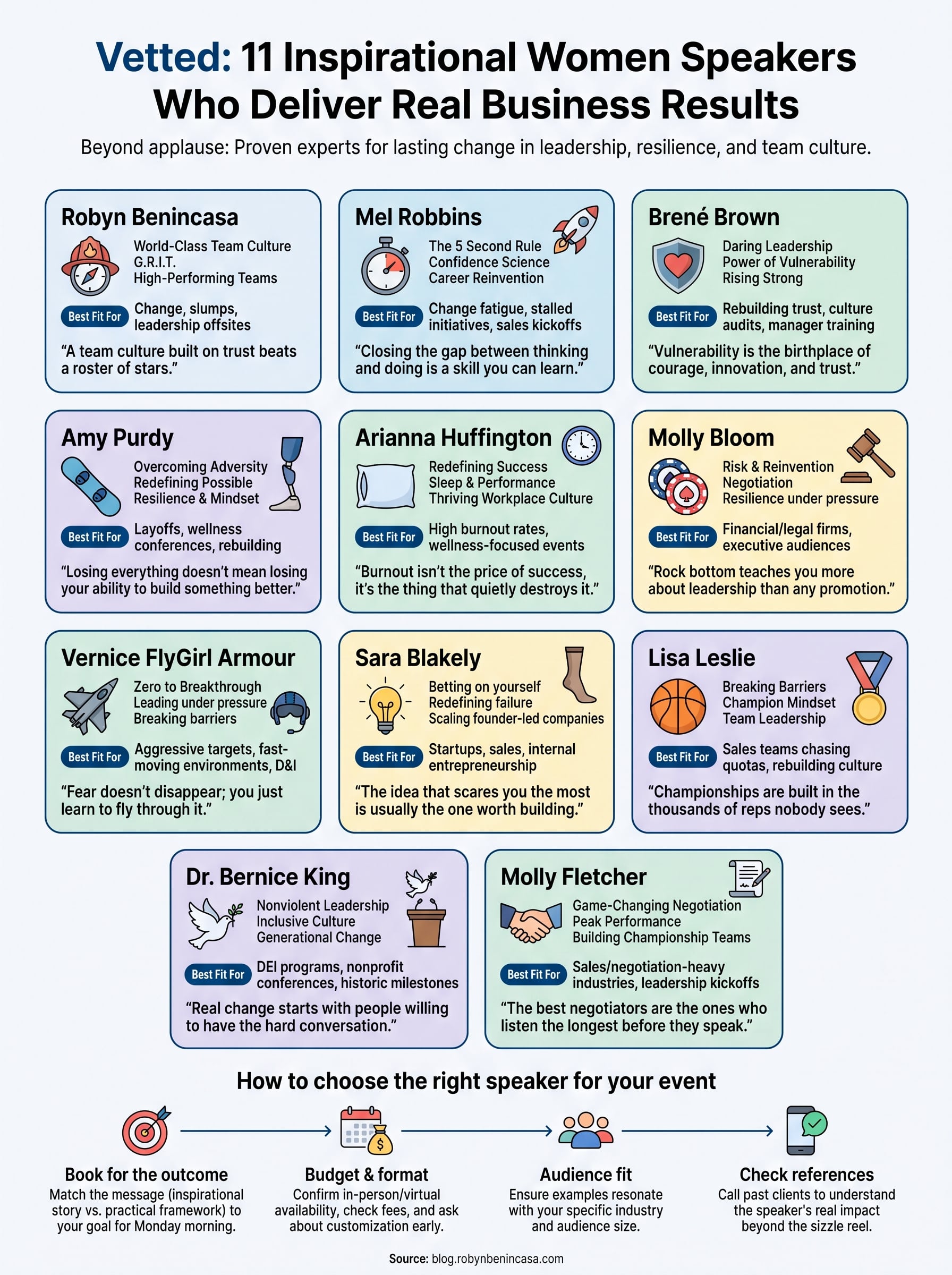
  • 11 Inspirational Women Speakers to Book for Your Event

    11 Inspirational Women Speakers to Book for Your Event

    You have a budget, a date on the calendar, and a room full of people who need more than another PowerPoint. Finding the right inspirational women speaker for that slot is harder than it looks, because the search results are full of generic "top 50" roundups written by people who have never booked a keynote in their life. You need someone who has actually vetted these speakers, watched them work a room, and knows which ones deliver a real business message instead of just a feel-good story.

    This list solves that problem. Whether you’re planning a sales kickoff, a leadership offsite, or an annual conference, the women motivational speakers below bring proven track records, distinct expertise, and stage presence that translates into lasting change for your team, not just applause that fades by Monday morning.

    Below, you’ll find 11 women public speakers covering leadership, resilience, team culture, and personal growth, each with a short breakdown of their background, signature topics, and the kind of audience they fit best. I’ve included my own experience building championship team cultures as a firefighter and adventure racer, alongside other respected names in the industry, so you can compare options and book the speaker who actually matches what your event needs.

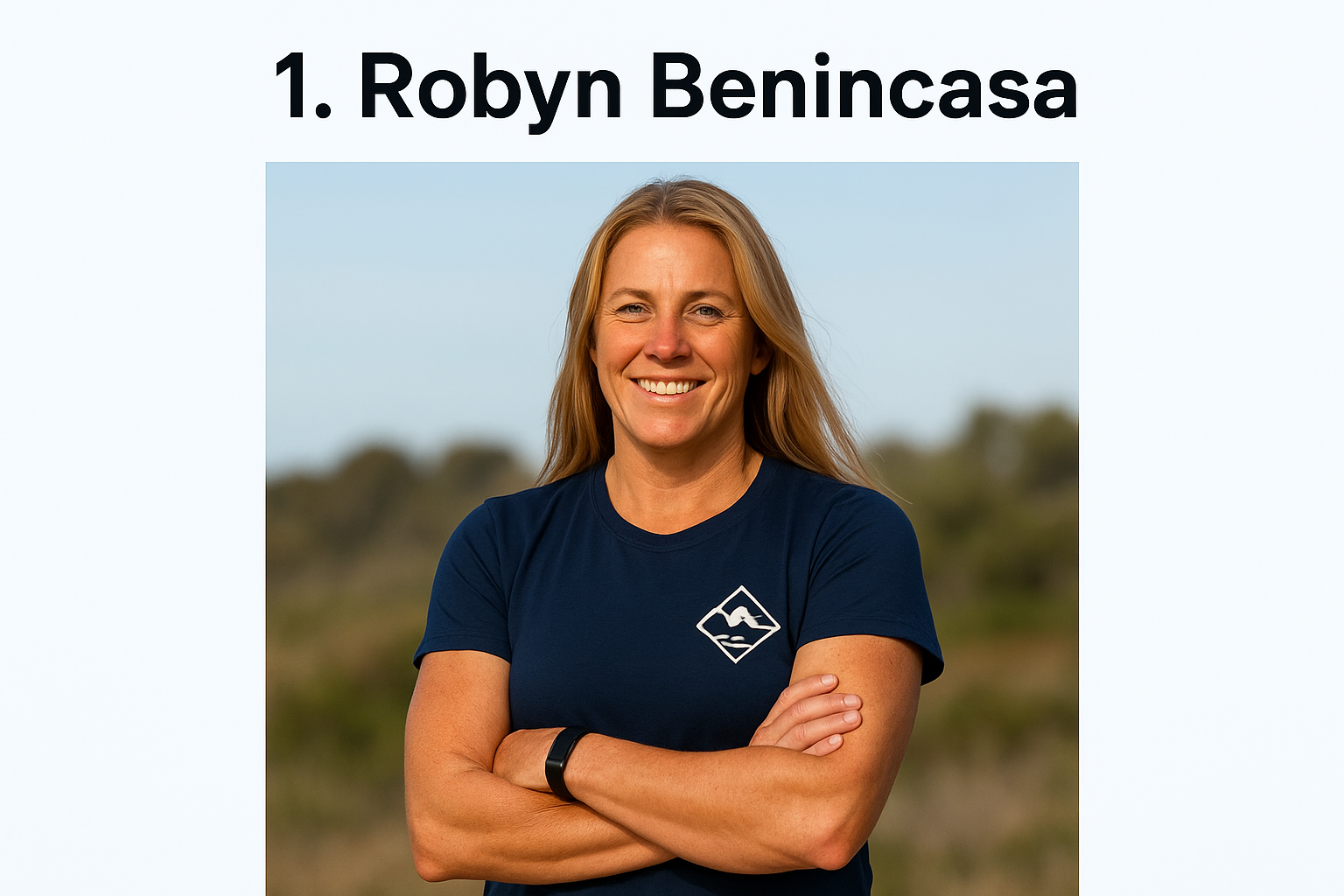
    1. Robyn Benincasa

    I built this list from decades of hands-on experience, so it only makes sense to start with what I bring to the stage myself. For 20-plus years I worked as a San Diego firefighter while also captaining world champion adventure racing teams, and those two worlds taught me the same lesson: team culture wins, talent alone doesn’t. As one of the top female keynote speakers worth booking, I translate lessons from wilderness expedition racing and high-stakes firehouse teamwork into practical frameworks that executives and sales teams can use the next morning, not just admire from the audience.

    1. Robyn Benincasa

    A team culture built on trust beats a roster of stars every single time.

    Signature speaking topics

    My keynotes center on what actually makes teams perform under pressure, drawn from races across deserts, jungles, and mountain ranges where quitting wasn’t an option. Corporate audiences book me for:

    • T.E.A.M.W.O.R.K., the 8 Essential Elements of a World-Class Team Culture
    • WIN AS ONE, focused on breaking down silos between departments
    • INSPIRING GREATNESS THROUGH G.R.I.T., built around resilience and grit under pressure
    • WHY WINNERS WIN, a deep dive into the habits of high-performing teams and how to build one

    You can review the full keynote topics and formats, including virtual options, before you book.

    Best fit for

    Organizations facing change, mergers, or performance slumps get the most out of my message, because as one of the change management keynote speakers planners call first, I speak directly to what breaks teams apart and how to rebuild them. HR leaders and sales executives at companies like Allstate, Northrop Grumman, and Boston Scientific have brought me in for leadership offsites, sales kickoffs, and annual conferences where the goal is measurable behavior change, not just morale for a day. Planners looking for a women empowerment speaker who also delivers hard business results tend to find my approach a strong match.

    Notable achievements

    Quantifying impact matters to me, and my track record backs up the message I deliver on stage.

    • New York Times bestselling author of "How Winning Works"
    • Founder of the Project Athena Foundation, earning recognition as a CNN Hero
    • Led adventure racing teams to championship titles over a 15-year span
    • Helped client sales teams move from 17th to 1st nationally after implementing these principles

    Event planners who want proof a speaker’s message translates into real performance gains can contact my team to check availability and discuss your event’s goals.

    2. Mel Robbins

    Mel Robbins built her name on one deceptively simple idea: the five-second rule. She’s a former CNN legal analyst turned bestselling author whose blunt, no-nonsense delivery style has made her one of the most requested motivational speakers women in corporate America. Robbins doesn’t sell inspiration for its own sake; she hands audiences a mental trick they can use the moment they walk out of the ballroom, which is why her talks stick long after the applause ends.

    The gap between thinking and doing is where most people lose, and closing it is a skill you can learn.

    Signature speaking topics

    Robbins built her reputation on translating behavioral science into stage-ready action. Her most requested topics include:

    • The 5 Second Rule, a countdown technique for beating hesitation and self-doubt
    • Confidence and motivation science, backed by research on habit formation
    • Career reinvention, drawn from her own transition from lawyer to media personality

    Best fit for

    Companies dealing with change fatigue or stalled initiatives often book Robbins because her message targets the exact moment people freeze instead of act. Sales organizations and HR teams running culture-change programs find her practical tools easier to implement than abstract leadership theory, which puts her alongside the business motivational speakers worth booking for kickoffs and training-heavy conferences.

    Notable achievements

    Robbins has built a media and publishing career that reinforces her stage credibility.

    • Author of the bestselling book "The 5 Second Rule"
    • Former legal analyst for CNN
    • One of the most-watched TEDx speakers globally
    • Host of a widely syndicated podcast on motivation and habit change

    3. Brené Brown

    Few researchers have reshaped corporate leadership language as thoroughly as Brené Brown. A research professor at the University of Houston, she spent two decades studying vulnerability, shame, and courage before turning that data into one of the most requested keynote messages in business today. Her talks blend academic rigor with personal storytelling, which is why she consistently ranks among the best women keynote speakers hired for leadership development programs.

    Vulnerability isn’t weakness, it’s the birthplace of courage, innovation, and trust.

    Signature speaking topics

    Brown’s research forms the backbone of every talk she delivers, and her most booked topics include:

    • Daring Leadership, on building trust and accountability inside teams
    • The Power of Vulnerability, her most-viewed talk on courage and connection
    • Rising Strong, focused on resilience after failure or setback

    Best fit for

    Organizations rebuilding trust after layoffs, restructuring, or leadership turnover often bring in Brown because her research gives managers language for hard conversations they’ve been avoiding. HR departments running culture audits or manager training programs value her academic credibility, and she suits conferences where the audience expects substance over polish.

    Notable achievements

    Brown’s body of published research and media reach back up the authority she brings to the stage.

    • Author of five #1 New York Times bestsellers, including "Dare to Lead"
    • Delivered one of the five most-viewed TED talks of all time
    • Host of two chart-topping podcasts on leadership and vulnerability
    • Holds a PhD in social work with two decades of shame and courage research

    4. Amy Purdy

    Amy Purdy lost both legs below the knee to bacterial meningitis at 19, then went on to become a Paralympic bronze medalist in snowboarding and a finalist on Dancing with the Stars. She co-founded Adaptive Action Sports to open competitive snowboarding to athletes with disabilities, and that same drive shows up in every keynote she delivers. Audiences don’t hire Purdy for sympathy; they hire her because she rebuilt her life and her sport from nothing, and she explains exactly how she did it.

    4. Amy Purdy

    Losing everything doesn’t mean losing your ability to build something better.

    Signature speaking topics

    Like most motivational and inspirational speakers with a survival story, Purdy focuses her talks on rebuilding identity and performance after catastrophic setback. Event planners typically book her for:

    • Overcoming adversity, drawn from her own recovery and reinvention story
    • Redefining possible, on setting goals that others assume are out of reach
    • Resilience and mindset training for teams facing major disruption

    Best fit for

    Companies navigating layoffs, restructuring, or a major setback often bring in Purdy because her story reframes what a team can recover from. She also fits wellness-focused conferences and healthcare or medical device audiences looking for a women motivation speaker whose credibility comes from lived experience, not theory. Sales teams rebuilding after a rough quarter respond well to her message too.

    Notable achievements

    Purdy’s competitive and creative résumé gives her stage presence real weight.

    • Paralympic bronze medalist in snowboard cross
    • Co-founder of Adaptive Action Sports
    • Finalist on Dancing with the Stars
    • Author of the memoir "On My Own Two Feet"

    5. Arianna Huffington

    Arianna Huffington co-founded the Huffington Post and built it into one of the largest news sites on the internet, then walked away from the hustle culture that came with it after a collapse from exhaustion changed how she thought about success. She now runs Thrive Global, a company built entirely around the idea that burnout is a leadership failure, not a personal one. As a women empowerment speaker, she challenges the assumption that overwork equals commitment, and corporate audiences respond because she’s lived both sides of that argument.

    Burnout isn’t the price of success, it’s the thing that quietly destroys it.

    Signature speaking topics

    Huffington’s talks pull directly from her own reversal on productivity culture. Planners typically book her for:

    • Redefining success, moving beyond money and power as the only measures
    • Sleep, stress, and performance, backed by research from Thrive Global
    • Building a thriving workplace culture that reduces turnover and burnout

    Best fit for

    Companies with high burnout rates or demanding sales and executive schedules get real value from Huffington, since her message targets the exact behaviors driving attrition. Wellness-focused conferences and organizations rolling out mental health initiatives find her credibility hard to match, and she works well as a closing keynote for events aimed at long-term culture change rather than a single day of motivation.

    Notable achievements

    Huffington’s publishing and business record supports the authority she carries into the room.

    • Co-founder of the Huffington Post, sold to AOL for $315 million
    • Founder and CEO of Thrive Global
    • Named one of Time’s 100 Most Influential People
    • Author of multiple bestsellers, including "Thrive" and "The Sleep Revolution"

    6. Molly Bloom

    Molly Bloom ran the highest-stakes underground poker game in Los Angeles and New York, dealing to celebrities, athletes, and financiers before a federal indictment took the whole operation down. Her story became the basis for the film Molly’s Game, which puts her on most shortlists of celebrity speakers to book, but the keynote version goes deeper than the movie ever could. She talks about ambition, risk, and what happens when you rebuild a reputation from zero, and that combination makes her one of the more unexpected best women speaker bookings on the corporate circuit today.

    6. Molly Bloom

    Rock bottom teaches you more about leadership than any promotion ever will.

    Signature speaking topics

    Bloom draws directly from her rise, collapse, and comeback to build talks that resonate with executives facing real consequences. Her most requested topics include:

    • Risk and reinvention, on rebuilding a career after public failure
    • Negotiation and high-stakes decision making, drawn from years reading rooms full of powerful people
    • Resilience under legal and financial pressure, a topic few speakers can address with firsthand credibility

    Best fit for

    Financial services firms, legal teams, and executive audiences respond strongly to Bloom because she’s operated at the exact intersection of ambition and consequence that many of them navigate daily. She also suits conferences looking for a women public speaker who challenges the room instead of simply encouraging it, particularly where the audience already expects a polished, safe message.

    Notable achievements

    Bloom’s public rebuild gives her story unusual staying power beyond a single news cycle.

    • Subject of the film Molly’s Game, directed by Aaron Sorkin
    • Author of the bestselling memoir "Molly’s Game"
    • Rebuilt a public career and consulting business after federal prosecution
    • Frequent commentator on negotiation and risk in business media

    7. Vernice FlyGirl Armour

    Vernice "FlyGirl" Armour became America’s first Black female combat pilot in the U.S. Military, flying missions over Iraq before transitioning to keynote speaking full time. Her callsign came from a fighter pilot mentality she now translates into a leadership system for business teams under pressure. As a women empowerment speaker, she doesn’t lean on abstract metaphors about flying; she breaks down the exact cockpit decision-making process pilots use and shows executives how to apply it when a deal, a deadline, or a crisis is on the line.

    7. Vernice FlyGirl Armour

    Fear doesn’t disappear before a mission, you just learn to fly through it anyway.

    Signature speaking topics

    Armour’s material draws straight from combat aviation training and applies it to corporate performance under stress. Planners typically book her for:

    • Zero to Breakthrough, her signature framework for pushing through fear and hesitation
    • Leading under pressure, built around split-second decision-making from combat missions
    • Breaking barriers, on succeeding as a first or only in a male-dominated field

    Best fit for

    Sales organizations facing aggressive targets and teams operating in high-stakes, fast-moving environments get the most from Armour’s message, since her framework was built for exactly that kind of pressure. She also fits diversity and inclusion programs well, given her firsthand experience as a trailblazer, and event planners searching for a women motivational speaker with military discipline and real command experience consistently shortlist her for leadership conferences.

    Notable achievements

    Armour’s military record and business career give her stage presence rare authority.

    • First Black female combat pilot in U.S. military history
    • Former Marine Corps officer and Iraq War combat veteran
    • Author of "Zero to Breakthrough"
    • Founder of a leadership training company built on combat aviation principles

    8. Sara Blakely

    Sara Blakely cut the feet off a pair of pantyhose in her apartment, and that small hack turned into Spanx, a billion-dollar company she built with no fashion background and no outside funding for the first several years. She sold fax machines door to door before that idea hit, and she still tells that part of the story on stage because it explains why she wasn’t afraid to pitch a product nobody understood yet. As a women motivation speaker, Blakely talks openly about failure as a required ingredient, not a footnote, which sets her apart from speakers who only show the highlight reel.

    The idea that scares you the most is usually the one worth building.

    Signature speaking topics

    Blakely’s talks center on entrepreneurship, self-funding, and reframing failure as data. Planners typically book her for:

    • Betting on yourself, on launching a product with no industry connections or capital
    • Redefining failure, drawn from her father’s dinner-table question asking what she failed at that week
    • Scaling a founder-led company without losing the original vision

    Best fit for

    Startup teams, sales conferences, and women’s leadership programs get the most out of Blakely because her story removes the excuse that you need connections or a perfect plan to start. Companies encouraging internal entrepreneurship or intrapreneurship also book her often, since her framework applies inside a corporation just as well as it did in her spare bedroom.

    Notable achievements

    Blakely’s business record speaks louder than any bio a speaker bureau could write.

    • Founder of Spanx, built into a billion-dollar company
    • Youngest self-made female billionaire at the time, per Forbes
    • Named one of Time’s 100 Most Influential People
    • Pledged half her wealth to charity through The Giving Pledge

    9. Lisa Leslie

    Lisa Leslie spent 12 seasons dominating the WNBA, became the first woman to dunk in a professional game, and walked away with three Olympic gold medals before she ever stepped onto a corporate stage. She built that career during years when women’s basketball barely got television coverage, which means every accolade came from performance alone, not hype. Now she translates that competitive mindset into keynotes for business audiences who want a women motivational speaker who has actually operated at the highest level of a results-only profession.

    Championships aren’t won on game day, they’re built in the thousands of reps nobody sees.

    Signature speaking topics

    Leslie draws on two decades of elite competition to build talks focused on sustained high performance. Planners typically book her for:

    • Breaking barriers, on becoming a first in a sport that doubted women could compete at that level
    • Building a champion mindset, tying practice discipline to business consistency
    • Team leadership under pressure, drawn from Olympic and WNBA playoff experience

    Best fit for

    Sales teams chasing aggressive quotas and organizations rebuilding a competitive culture after a slump respond well to Leslie, since her career is a case study in outperforming low expectations. She also fits women’s leadership summits and sports-adjacent brands looking for a best women speaker whose credibility comes from a stat sheet, not just a story.

    Notable achievements

    Leslie’s résumé reads like a highlight reel of women’s basketball history.

    • Three-time Olympic gold medalist
    • First woman to dunk in a WNBA game
    • WNBA MVP and Hall of Fame inductee
    • Broadcast analyst covering basketball at the national level

    10. Dr. Bernice King

    Dr. Bernice King grew up watching her father, Dr. Martin Luther King Jr., lead a movement, and she’s spent her career turning that inheritance into a message about nonviolent leadership rather than trading on the family name alone. She currently serves as CEO of The King Center in Atlanta, and her keynotes connect civil rights history to the everyday work of building inclusive workplaces. Corporate audiences booking a women empowerment speaker for diversity programs consistently name her as one of the few voices who can speak on justice with lived, generational authority.

    Real change in any organization starts the same way it always has, with people willing to have the hard conversation first.

    Signature speaking topics

    King’s material draws on decades of civil rights advocacy applied to modern organizational life. Planners typically book her for:

    • Nonviolent leadership, on resolving conflict without losing ground on principle
    • Building inclusive culture, tying her family’s legacy to modern DEI initiatives
    • Leading through generational change, on carrying a mission forward without diluting it

    Best fit for

    Organizations running diversity, equity, and inclusion programs get the clearest value from King, since her framework gives managers language for difficult conversations they’ve been avoiding. She also suits nonprofit conferences, faith-based events, and companies marking historic anniversaries or social justice milestones where a women public speaker with true generational credibility matters more than a polished sales pitch.

    Notable achievements

    King’s institutional role and public record give her message unusual staying power.

    • CEO of The King Center, founded by her mother Coretta Scott King
    • Ordained minister and attorney by training
    • Author of multiple books on nonviolence and leadership
    • Frequent commentator on civil rights and social justice in national media

    11. Molly Fletcher

    Molly Fletcher spent nearly two decades as a sports agent negotiating contracts for MLB, NBA, and PGA clients, earning the nickname "the female Jerry Maguire" from major sports outlets before she ever picked up a microphone. She built her negotiation career on relationship management rather than pressure tactics, closing deals worth hundreds of millions of dollars for her clients. Now she runs her own leadership institute and delivers keynotes that translate sports-agent negotiation skills into a system business teams can use in any high-pressure deal or internal conflict.

    The best negotiators aren’t the toughest people in the room, they’re the ones who listen the longest before they speak.

    Signature speaking topics

    Fletcher’s talks draw straight from two decades of high-value negotiations and client management. Planners typically book her for:

    • Game-changing negotiation, on winning deals through relationship-building instead of pressure
    • Peak performance under pressure, drawn from managing elite athletes through career-defining moments
    • Building championship teams, applying agent-side lessons to internal team dynamics

    Best fit for

    Sales organizations and negotiation-heavy industries like real estate, finance, and procurement get the most from Fletcher, since her framework was built inside real deals with real money on the table. Companies looking for a motivational women speaker who blends business strategy with performance psychology also find her a strong fit for leadership conferences and sales kickoffs where practical takeaways matter more than a purely inspirational message.

    Notable achievements

    Fletcher’s client list and publishing record back up the credibility she brings to the stage.

    • Former sports agent representing over 300 professional athletes and coaches
    • Author of multiple bestselling books, including "Game Changers" and "A Winner’s Guide to Negotiating"
    • Founder of the Molly Fletcher Company, a leadership training firm
    • Inducted into the Speaker Hall of Fame

    12. How to choose the right speaker for your event

    Matching a speaker to your event starts with your goal, not their resume. If you need a room energized for one afternoon, a story-driven inspirational women speaker like Amy Purdy or Molly Bloom will land hard. If you need managers to change how they run meetings six months from now, you want someone who hands out a repeatable framework, like a female keynote speaker with a research background such as Brené Brown or a systems-driven speaker like me.

    Book for the outcome you need on Monday morning, not just the applause you’ll get that night.

    Budget and format matter just as much as message, so know what you’ll really pay to hire a keynote speaker before you start calling. Confirm early whether you need in-person or virtual delivery, since not every speaker on this list tours the same way, and ask directly about customization. A generic version of a talk feels generic to your audience too, no matter how strong the speaker’s bio reads.

    Consider these factors before you sign a contract:

    Factor Why it matters
    Audience size and industry Some speakers tailor examples to sales, healthcare, or defense audiences better than others
    Format (live vs. virtual) Confirm availability and tech requirements before booking
    Post-event resources Workbooks, guides, or follow-up coaching extend the message past the keynote
    Fee transparency Ask for a clear rate card, not a vague range, before you go further

    References also tell you more than a highlight reel ever will. Ask any speaker’s team for two or three client contacts from events similar to yours, and actually call them. A best women keynote speakers list only helps you if you do the homework to find the right match inside it.

    inspirational women speaker infographic

    Finding the right voice for your stage

    Every name on this list built credibility the hard way, through decades of results, not a polished sizzle reel. The right inspirational women speaker for your event depends on what your team needs to hear and what you want them doing differently after the lights come back on. A story that moves people for an afternoon has value, but a framework that changes behavior for months pays off long after the invoice is settled.

    Giving your audience both is the real goal, and it’s exactly what I aim for on every stage I step onto. I’ve built teams that won world championships and pulled people out of burning buildings, and I bring those same lessons on trust, grit, and shared commitment to corporate audiences ready for real change. If you’re planning your next event, here’s how to hire a keynote speaker who gives your team something to act on Monday morning.

  • 10 Top Leadership Keynote Speakers Worth Booking in 2026

    10 Top Leadership Keynote Speakers Worth Booking in 2026

    Booking the wrong speaker wastes a budget and a room full of goodwill. You’ve got one shot at your leadership offsite or sales kickoff, and picking a keynote speaker leadership teams will actually remember is harder than scrolling a bureau’s website. Everyone claims to be inspiring. Few can prove their message changes how people work together after the applause dies down.

    This list cuts through that noise. It’s built for event planners, HR leaders, and executives who need a leadership keynote speaker with real credentials, not just a good bio and a TED-style delivery. Each name here has a track record of moving audiences from passive listening to active culture change, backed by client results you can check.

    Below you’ll find ten speakers worth your consideration for 2026, including firsthand insight into what makes a top leadership keynote speaker stand out from the pack. You’ll see how their backgrounds, from elite athletics to military service to corporate turnarounds, translate into lessons your team can use the Monday after the event. If you’re weighing options for a conference, sales meeting, or leadership summit, this rundown will help you shortlist faster and book with confidence.

    1. Robyn Benincasa: adventure racing champion turned team culture expert

    Robyn Benincasa tops this list because she built her leadership philosophy in conditions where a bad decision could mean a lost limb or a lost race, not just a missed quarterly target. As a world champion adventure racer and a 20-plus year San Diego firefighter, she has spent her career studying what separates teams that fall apart under pressure from teams that win together. Event planners hunting for the best keynote speaker for a corporate event, someone a keynote speaker leadership audience will still be quoting a year later, consistently land on her name.

    Background and credibility

    Benincasa spent 15 years racing multi-day adventure races across jungles, deserts, and mountain ranges, leading teams to multiple world championships not through raw athletic talent but through deliberate culture-building under extreme stress. She paired that with a full career fighting fires and a stint in pharmaceutical sales, giving her a rare cross-section of high-stakes team environments to draw from. Her book, How Winning Works, became a New York Times bestseller and remains required reading for leadership teams looking to translate elite performance into everyday business habits.

    A speaker who has led teams through actual life-or-death stakes brings a credibility no slide deck can fake.

    Signature keynote topics

    Her flagship talk, T.E.A.M.W.O.R.K., breaks down eight essential elements of building a world-class team culture, while WIN AS ONE and WHY WINNERS WIN dig into collaboration and shared commitment as the real drivers of performance. She also delivers INSPIRING GREATNESS THROUGH G.R.I.T. for organizations wanting a resilience-focused message.

    Best for these events

    Sales kickoffs, leadership offsites, and conferences dealing with silos or merger fatigue get the most value from Benincasa’s frameworks. Companies like Allstate, Boston Scientific, and Northrop Grumman have booked her for exactly these situations, often reporting measurable jumps in team performance afterward.

    Speaking fee range

    Fees vary by format and location, typically landing in the mid five figures for in-person keynotes, with lower rates available for virtual engagements. Reach out through her booking page for an exact quote tied to your event.

    2. Jocko Willink: extreme ownership from the battlefield to the boardroom

    Jocko Willink built his reputation commanding SEAL Team Three’s Task Unit Bruiser during the Battle of Ramadi, one of the most decorated units of the Iraq War. That combat record gives him a blunt authority that few leadership keynote speakers can match when he tells executives to stop blaming their teams and start owning the outcome.

    2. Jocko Willink: extreme ownership from the battlefield to the boardroom

    Background and credibility

    After retiring from the Navy, Willink co-founded Echelon Front, a leadership consulting firm, and co-wrote Extreme Ownership, a bestseller that turned combat lessons into a corporate playbook. His military record and consulting client list, spanning Fortune 500 companies and startups alike, back up every claim he makes on stage.

    Ownership without excuses is the one leadership habit Willink insists no team can succeed without.

    Signature keynote topics

    His core talk centers on Extreme Ownership, the idea that leaders must own every failure on their team without deflecting blame. He also covers Decentralized Command, teaching mid-level managers to make decisions without waiting on approval from above.

    Best for these events

    Organizations facing accountability gaps or slow decision-making chains benefit most. This message lands hardest with leadership event speakers rosters built for management training days, sales leadership summits, and executive retreats focused on operational discipline.

    Speaking fee range

    Willink typically commands six-figure fees for in-person keynotes, reflecting the celebrity speaker status he earned from podcasting and publishing. Budget-conscious planners should expect this to be one of the pricier bookings on any shortlist.

    3. Simon Sinek: purpose-driven leadership that starts with why

    Simon Sinek turned a single TED Talk into one of the most-watched leadership ideas of the last two decades, and event planners still book him hoping to bottle that same spark. His central premise, that people don’t buy what you do but why you do it, reshaped how companies talk about culture, hiring, and loyalty. For organizations searching for keynote speakers on leadership with mainstream name recognition, Sinek remains a safe, high-visibility choice.

    Background and credibility

    Sinek built his career as a marketing consultant before publishing Start With Why, which became a foundational text for leadership teams worldwide. His follow-up, Leaders Eat Last, drew on military case studies and organizational biology to explain why some teams trust each other and others don’t. He’s since built an entire consulting practice, The Optimism Company, around teaching his frameworks to executives.

    Teams don’t follow strategies, Sinek argues, they follow leaders who give them a reason to believe.

    Signature keynote topics

    His flagship talk remains Start With Why, walking audiences through his Golden Circle framework for purpose-driven leadership and Simon Sinek’s take on teamwork. He also delivers content on infinite versus finite mindsets in business and building trust-based cultures that retain talent.

    Best for these events

    Companies rebranding, launching new missions, or rebuilding culture after leadership turnover get the most mileage from Sinek’s message. He fits large conferences and association events better than intimate leadership offsites.

    Speaking fee range

    Sinek’s fees typically run in the six-figure range, reflecting his bestseller status and global brand recognition among best keynote speakers lists.

    4. Brené Brown: vulnerability and authentic leadership

    Brené Brown made vulnerability a boardroom word, not just a therapy term, and that shift changed how a generation of executives talk about trust. Her research on shame, courage, and connection gives best leadership keynote speakers lists a research-driven counterweight to the tough-talk military speakers dominating the circuit. Planners looking for a keynote speaker on leadership with academic rigor behind the message consistently shortlist her.

    Background and credibility

    Brown spent two decades as a research professor at the University of Houston, studying courage and shame before publishing Daring Greatly and Dare to Lead. Her TED Talk on vulnerability sits among the most-viewed of all time, and her Netflix special introduced her frameworks to an even wider audience. That academic foundation, paired with mainstream reach, gives her rare crossover credibility.

    Leaders who admit what they don’t know build more trust than leaders who fake certainty.

    Signature keynote topics

    Her Dare to Lead keynote teaches leaders to replace armor with vulnerability as a driver of team performance. She also covers shame resilience and rumbling with feedback, both drawn directly from her published research.

    Best for these events

    Organizations rebuilding trust after layoffs, restructuring, or leadership scandals get the most value here. Her message also resonates strongly at women’s leadership summits and HR-focused conferences, where she regularly appears alongside other top female keynote speakers.

    Speaking fee range

    Brown’s fees generally sit in the six-figure range, consistent with other bestselling authors turned top rated keynote speakers on the circuit.

    5. Adam Grant: organizational psychology for modern teams

    Adam Grant brings a researcher’s rigor to questions most executives only guess at, like why some teams give generously while others hoard credit. His work as an organizational psychologist turns academic studies into practical frameworks that reshape how companies think about hiring, feedback, and motivation. Planners building a roster of keynote speakers leadership teams will actually apply often put Grant near the top for his data-backed approach.

    Background and credibility

    Grant became the youngest tenured professor at Wharton and has published bestsellers including Give and Take, Originals, and Think Again. His research has appeared in outlets like the New York Times and Harvard Business Review, and his Wharton affiliation gives him academic weight that few business speakers can claim.

    The best teams aren’t full of takers chasing credit, Grant argues, they’re built by givers who make everyone around them better.

    Signature keynote topics

    His core talks cover Think Again, teaching leaders to rethink assumptions and stay intellectually flexible, and Give and Take, examining how generosity drives long-term team success. He also speaks on hidden potential and rethinking traditional measures of talent.

    Best for these events

    Companies focused on innovation, talent development, or culture change during rapid growth get the most from Grant’s frameworks. He fits leadership summits and HR conferences particularly well.

    Speaking fee range

    Grant’s fees typically run in the six-figure range, reflecting his bestseller status and standing among top 10 keynote speakers lists nationally.

    6. Patrick Lencioni: building organizational health from within

    Patrick Lencioni built his entire career on a simple, uncomfortable observation: most teams fail not from a lack of intelligence but from a lack of organizational health. His fable-style books turned dry management theory into stories executives actually finish, and that accessibility has made him one of the more requested leadership keynote speakers for companies trying to fix dysfunction at the root rather than patch symptoms.

    Background and credibility

    Lencioni founded The Table Group and worked as an organizational culture consultant after years advising executive teams at companies ranging from startups to Fortune 500 firms. His book The Five Dysfunctions of a Team has sold millions of copies and remains a staple in MBA programs and corporate book clubs alike, giving him a research base built on direct consulting work rather than academic study alone.

    Smart strategy fails in a dumb organization, Lencioni insists, and health always beats intelligence over the long run.

    Signature keynote topics

    His flagship talk walks through the Five Dysfunctions model, the core of Patrick Lencioni’s team building approach, teaching teams to build trust, engage in productive conflict, and commit to real accountability. He also presents on organizational health as a competitive advantage and the ideal team player framework for hiring.

    Best for these events

    Executive teams battling internal politics or slow decision-making get the clearest payoff. He suits leadership offsites and management training sessions better than large general-session conferences.

    Speaking fee range

    Lencioni’s fees generally fall in the mid to high five figures, positioning him as a strong value pick among best conference keynote speakers.

    7. Alison Levine: leadership lessons from the edge of the world

    Alison Levine has stood on the summit of Mount Everest and led the first American Women’s Everest Expedition, so when she talks about leading under pressure, she’s describing conditions where the margin for error is measured in oxygen, not quarterly targets. Planners hunting for top leadership keynote speakers who can prove grit rather than just talk about it tend to find her résumé hard to beat.

    7. Alison Levine: leadership lessons from the edge of the world

    Background and credibility

    Levine has climbed the Seven Summits and skied to both the North and South Poles, completing the Adventure Grand Slam achieved by only a handful of people worldwide. Before her expedition career took off, she worked in finance and later served as a team captain for the first American Women’s Everest Expedition, giving her direct experience managing teams where communication failures carry life-threatening consequences. Her book, On the Edge, translates those lessons into a leadership framework built for corporate audiences.

    The mountain doesn’t care about your title, Levine reminds audiences, only your preparation and your team.

    Signature keynote topics

    Her main talk covers leading through adversity, drawing on high-altitude decision-making to teach risk assessment and team cohesion under stress. She also speaks on building resilience and adapting plans when conditions change without warning.

    Best for these events

    Companies navigating uncertainty, restructuring, or aggressive growth targets get the most value from her message. She fits leadership summits and sales conferences seeking a high-energy, visual keynote.

    Speaking fee range

    Levine typically charges in the mid five-figure range for in-person events, positioning her competitively among established adventure-based speakers.

    8. Chad E. Foster: turning adversity into a leadership advantage

    Chad E. Foster lost his sight as a teenager and built a career in corporate sales leadership anyway, which gives him a different kind of authority when he talks about adaptability. Planners searching for keynote speakers on leadership who can reframe adversity as a competitive edge, rather than a liability, keep his name on their shortlist.

    Background and credibility

    Foster spent over two decades in corporate sales and leadership roles at major tech companies, rising through the ranks after going blind at 21. He wrote Blind Ambition, a book that captures how he adapted his approach to leadership, communication, and problem-solving when the old playbook no longer applied. That real-world business résumé, not just his personal story, is what separates him from motivational speakers who only cover survival narratives.

    Adversity doesn’t excuse a leader from performing, Foster argues, it just forces you to find a smarter way there.

    Signature keynote topics

    His main talk, Blind Ambition, teaches audiences to treat unexpected setbacks as a forcing function for creative problem-solving rather than a reason to slow down. He also speaks on building resilient teams and managing change as a leader when the familiar path disappears.

    Best for these events

    Companies facing major disruption, restructuring, or a leadership transition benefit most from Foster’s practical framing. He works well at sales conferences and leadership training programs.

    Speaking fee range

    Foster’s fees generally land in the five-figure range, making him accessible for mid-size corporate events without a headline-speaker budget.

    9. Daniel Pink: the behavioral science of motivation and leadership

    Daniel Pink built a career proving that traditional carrot-and-stick management is broken science, and that insight has made him a fixture among keynote speakers on leadership who want data behind the message. His work on intrinsic motivation reshaped how companies think about compensation, autonomy, and what actually drives people to do their best work.

    Background and credibility

    Pink served as chief speechwriter for Vice President Al Gore before turning to writing about workplace behavior full time. His books Drive, To Sell Is Human, and When have all landed on bestseller lists, and his research draws heavily on behavioral economics rather than personal anecdote alone.

    Pay people enough to take money off the table, Pink argues, and purpose and autonomy will drive performance further than any bonus.

    Signature keynote topics

    His flagship talk, Drive, breaks down autonomy, mastery, and purpose as the three real drivers of motivation. He also delivers content on the science of timing and persuasion, both useful for sales-focused leadership development keynote speaker bookings.

    Best for these events

    Organizations rethinking compensation structures, incentive programs, or remote-work engagement get the clearest payoff. He suits HR conferences, sales kickoffs, and leadership summits focused on employee retention.

    Speaking fee range

    Pink’s fees typically fall in the six-figure range, consistent with his standing among top rated keynote speakers who write their own bestsellers.

    10. Molly Fletcher: the champion mindset for resilient leaders

    Molly Fletcher spent nearly two decades negotiating contracts for professional athletes and coaches, earning the nickname "the female Jerry Maguire" from CNN. That background gives her a sharp read on what separates resilient performers from everyone else, and it’s why she keeps showing up on rosters of top leadership keynote speakers built for sales teams and executives facing constant pressure to close.

    10. Molly Fletcher: the champion mindset for resilient leaders

    Background and credibility

    Fletcher ran her own sports management agency, representing more than 300 professional athletes, coaches, and broadcasters before retiring from the industry to write and speak full time. She’s authored several books, including The Energy Clock and A Winner’s Guide to Negotiating, translating locker-room and negotiating-table lessons into frameworks for corporate leadership.

    Resilience isn’t a personality trait, Fletcher argues, it’s a skill you train the same way athletes train their swing.

    Signature keynote topics

    Her main talk, Championship Habits, covers how top performers manage energy, pressure, and setbacks without burning out. She also delivers content on negotiation strategy and building a game-changing mindset, both drawn from her agent career.

    Best for these events

    Sales organizations, revenue teams, and companies navigating high-pressure growth targets get the strongest results from Fletcher’s message. She fits sales kickoffs and leadership conferences looking for high energy paired with practical takeaways.

    Speaking fee range

    Fletcher’s fees generally land in the mid five-figure range, making her a strong option among best conference keynote speakers for organizations wanting proven athlete-world credibility without a six-figure commitment.

    11. How to choose the right leadership keynote speaker

    Matching the message to your actual problem matters more than chasing a famous name. A keynote speaker leadership teams remember is one whose story maps directly onto what your audience is dealing with right now, whether that’s merger fatigue, a stalled sales pipeline, or burnout after a rough year. Start by naming the specific outcome you want people to walk away with, then work backward to find the speaker whose framework actually produces it.

    The right speaker fits your problem first and your budget second, never the other way around.

    Budget and format come next, and they eliminate options fast once you’re honest about them. A six-figure headliner makes sense for a 2,000-person conference but wastes money at a 50-person leadership offsite where a more intimate, workshop-style session would land better, so it pays to know what you’ll really pay to hire a keynote speaker. Consider these factors before you request quotes:

    • Audience size and format: large general sessions favor big-name recognition, while smaller offsites reward interactive, discussion-heavy speakers.
    • Relevance to your industry: a speaker with case studies from insurance, healthcare, or defense will resonate faster than a generic motivational talk.
    • Proof of results: ask for client references and measurable outcomes, not just testimonials pulled from a website.
    • Availability for virtual formats: confirm early if you need a hybrid or fully remote option.

    Finally, watch how responsive a speaker’s team is during booking. Slow replies or vague answers about customization usually predict a canned keynote, not one tailored to your event.

    keynote speaker leadership infographic

    Finding the voice that fits your event

    Every speaker on this list can hold a room, but the right one depends on what your team needs to hear right now. A top leadership keynote speaker should leave your audience with a framework they can use Monday morning, not just a warm afterglow that fades by lunch. Match the story to the problem, confirm the fee fits your budget, and check that the speaker’s team answers your questions quickly and specifically.

    If your organization is wrestling with silos, merger fatigue, or a team that needs to start performing like a unit instead of a collection of individuals, Robyn Benincasa’s field-tested lessons from world championship racing and two decades as a firefighter offer exactly that kind of practical, lasting change. See how to hire a keynote speaker for your next event, book Robyn, and give your team a culture reset they’ll still be talking about next year.

  • 8 Best Online Leadership Training Programs Worth Trying

    8 Best Online Leadership Training Programs Worth Trying

    You’ve got managers who can hit their numbers but struggle to hold a team together, and a training budget that can’t stretch to fly everyone to a conference. That’s the exact gap online training leadership programs were built to fill. You get real skill-building on communication, accountability, and decision-making, the leadership and team building skills that matter most, without pulling people out of the field for a week.

    If you’re comparing virtual leadership training programs right now, you’re probably weighing the same things every HR leader and sales manager weighs: does this actually change behavior, or is it just another video series nobody finishes? The programs below get chosen because they mix real content with practical application, something you can point to when a VP asks what the training budget bought.

    I’ve spent years watching what separates high-performing teams from average ones, both on adventure racing courses and inside firefighting crews, and the pattern holds true in corporate training too. Below are eight online leadership training programs for managers worth your time, part of the broader landscape of leadership training programs that build stronger teams, along with what makes each one worth the investment and who it fits best.

    1. Robyn Benincasa’s virtual leadership keynotes and workshops

    What it offers

    Robyn Benincasa built her virtual leadership training sessions around a simple idea behind all high performance culture training: teams win or lose based on culture, not individual talent. Her signature keynote, T.E.A.M.W.O.R.K. (8 Essential Elements of a World-Class Team Culture), breaks down the exact habits her championship adventure racing teams used to outlast bigger, better-funded competitors for 15 years. She also offers WIN AS ONE, INSPIRING GREATNESS THROUGH G.R.I.T., and WHY WINNERS WIN, each pulling from a different angle on the same core question: what makes people choose to give their best for each other. As a former 20-year San Diego firefighter, she also brings crisis-tested lessons on trust and accountability that most online leadership training programs simply don’t have access to.

    1. Robyn Benincasa's virtual leadership keynotes and workshops

    A training program only works if it changes how people show up for each other on Monday morning.

    Who it’s for

    This fits organizations that already tried generic e-learning modules and watched completion rates stall out. It’s built for HR leaders and executives managing teams through mergers, sales slumps, or the kind of silos that quietly kill morale and call for cross-functional collaboration training. Companies like Allstate, Boston Scientific, and Northrop Grumman have brought Robyn in specifically because their leadership needed more than theory, they needed the shared language that real accountability training creates, something a sales floor or an engineering team could actually use the next day.

    Format and pricing

    Sessions run as live virtual keynotes, workshops, or blended engagements paired with in-person events and virtual team building activities for corporate teams, so you’re not locked into one delivery style. Pricing depends on format, audience size, and whether you want a single keynote or an extended workshop series, so the best move is requesting a quote directly through her booking page. Many clients also grab the free 18-page leadership guide first to gauge fit before committing budget, which makes this a lower-risk way to test whether her approach matches your team’s needs.

    2. Center for Creative Leadership’s online programs

    What it offers

    CCL has spent over 50 years researching what makes leaders effective, and its online catalog reflects that research base rather than generic advice. You’ll find programs like Leadership Development Program Online and Boss to Coach, both built around CCL’s assessment-feedback-practice model. Online leadership training programs from CCL lean heavily on 360-degree feedback tools, so participants see how their behavior actually lands with peers and direct reports, not just how they think it lands.

    Feedback only changes behavior when it’s specific enough to act on by Monday.

    Who it’s for

    This suits mid-to-senior managers at larger organizations, especially ones in regulated industries like finance or healthcare where leadership training programs online need academic credibility behind them. HR departments building a formal leadership pipeline, rather than a one-off event, tend to get the most value here. If your team already has buy-in and just needs structured development, CCL fits better than a motivational push.

    Format and pricing

    Programs run as cohort-based virtual sessions spread across several weeks, mixing live instruction with individual coaching calls. Expect to pay between $2,500 and $9,000 per participant depending on program length and coaching intensity, according to pricing listed on CCL’s own site. That’s a meaningful investment, so it works best when paired with a clear plan for applying the material afterward, not as a standalone credential.

    3. Harvard Professional and Executive Development courses

    What it offers

    Harvard’s Division of Continuing Education runs short, intensive courses through Harvard Professional Development and the longer executive programs through Harvard Business School Online. These aren’t generic leadership training online programs repackaged with a famous name attached, they’re built by Harvard faculty around case studies and frameworks pulled straight from HBS classrooms. Courses like Leadership Principles or Management Essentials walk you through real business decisions using the same case method Harvard’s been refining for decades, so you’re applying frameworks to messy, ambiguous situations rather than memorizing slides.

    3. Harvard Professional and Executive Development courses

    A leadership credential only matters if the thinking behind it survives contact with a real decision.

    Who it’s for

    This fits mid-career professionals and senior managers who want the Harvard name on a certificate and don’t mind paying for it. Executives prepping for a bigger role, or HR teams building a bench of future VPs, tend to get the most out of the case-method approach. It’s less useful for frontline managers who need tactical, day-to-day coaching rather than strategic frameworks.

    Format and pricing

    Courses run asynchronously over several weeks, with recorded lectures, case discussions, and cohort-based peer interaction built into the schedule. Pricing for training leadership online through Harvard typically runs $1,600 to $3,000 per course, according to details listed on the Harvard Business School Online site, with executive programs costing more. Budget extra time too, most courses expect 4 to 6 hours weekly, which is a heavier lift than a typical corporate e-learning module.

    4. LinkedIn Learning’s leadership and management library

    What it offers

    LinkedIn Learning stocks thousands of short courses on leadership, management, and communication, taught by working practitioners rather than academics. You’ll find titles like "Leading with Emotional Intelligence" and "Management Tips Weekly" sitting alongside deeper multi-part series on delegation and conflict resolution. Because it’s owned by LinkedIn, your online leadership training progress can sync with your profile, and managers get a lightweight way to sample leadership training online programs without committing to a full cohort or academic schedule.

    A library of short courses only helps if someone’s tracking which ones actually get finished.

    Who it’s for

    This fits busy managers who need a quick answer to a specific problem, not a semester-long commitment. It also suits HR teams building a self-serve learning library for hundreds of employees at once, since licenses scale easily across a whole department. Skip it if you’re looking for cohort accountability or live coaching, because nothing here forces application beyond finishing the video.

    Format and pricing

    Courses run as short, on-demand videos, most under 30 minutes, so it fits into a lunch break rather than blocking out a full afternoon. Individual subscriptions cost around $19.99 to $39.99 monthly, while enterprise licenses for virtual leadership development training get negotiated per seat based on headcount, according to pricing on LinkedIn’s own site. Many companies already have access bundled into an existing LinkedIn Premium or Microsoft 365 plan, worth checking before you buy anything new.

    5. Coursera’s leadership courses and certificates

    What it offers

    Coursera partners with universities like the University of Michigan and Northwestern’s Kellogg School to deliver online leadership training programs built around specializations rather than single courses. You’ll work through multi-course tracks like "Leading People and Teams" or "Strategic Leadership and Management," each ending in a certificate you can post to LinkedIn. Unlike a single keynote or workshop, Coursera stacks video lectures, peer-graded assignments, and quizzes into a structured path, so leadership training programs online here feel closer to a college minor than a weekend seminar.

    A certificate only proves something if the work behind it actually stretched you.

    Who it’s for

    Early-to-mid career managers who want a recognized credential without quitting their job to get it will get the most from this format. It also suits self-directed learners who prefer working at 10pm after the kids are asleep over sitting in a scheduled cohort call. Skip it if your team needs live coaching or a shared language to fix an actual culture problem right now, because Coursera teaches concepts, not team dynamics.

    Format and pricing

    Most specializations run asynchronously over four to six weeks, with graded assignments due on a rolling schedule rather than fixed class times. Coursera Plus subscriptions run about $59 monthly or $399 annually for unlimited access, while individual specializations cost $49 to $79 monthly until you finish, according to pricing on Coursera’s site. Financial aid is available for many courses, which keeps this among the cheaper options on this list.

    6. edX leadership courses from top universities

    What it offers

    edX runs online leadership training programs built by universities like MIT, Berkeley, and the University of Maryland, and it keeps the academic rigor that made those schools worth attending in the first place. You’ll find MicroMasters programs in leadership and management alongside standalone courses like "Becoming a Successful Leader" or "Leading Diverse Teams and Organizations." Most courses combine video lectures with written assignments graded against a rubric, so leadership training online here reads closer to a graduate seminar than a corporate webinar.

    A certificate carries weight only when the university behind it would put its name on your work publicly.

    Who it’s for

    Professionals chasing a credential that holds up on a resume, not just a LinkedIn badge, tend to get the most value from edX. Analysts and specialists eyeing a management track, but who aren’t ready to commit to a full MBA, use these courses as a lower-cost test run. Skip this option if your team needs live coaching or a shared vocabulary for solving a culture problem this quarter, since edX teaches theory at an academic pace, not team dynamics.

    Format and pricing

    Courses run on a fixed schedule with weekly deadlines, usually spanning six to ten weeks depending on the program. Individual courses cost $50 to $300, while full MicroMasters programs run $600 to $1,200, according to pricing listed on edX’s own site. Financial assistance is available for many courses, which keeps this accessible for individual learners footing their own bill.

    7. NonprofitReady’s free leadership training

    What it offers

    NonprofitReady runs a full library of free leadership training courses aimed at nonprofit staff, though nothing stops a for-profit manager from signing up and using it too. You’ll find courses like "Leadership Fundamentals" and "Managing Yourself" built by nonprofit sector veterans, covering the same ground as pricier online leadership training programs minus the university branding. Every course runs as a short video paired with a downloadable worksheet, so you walk away with something concrete rather than just a certificate of completion.

    Free training only earns its price tag when the content matches what paid programs charge for.

    Who it’s for

    This fits small nonprofits, community groups, and startups where the training budget rounds to zero but the leadership gaps are real. It also works for individual managers testing whether leadership training online actually holds their attention before committing money elsewhere on this list. Skip it if your organization needs live coaching, cohort accountability, or a shared vocabulary to fix a specific culture problem, since NonprofitReady teaches concepts without any follow-up structure.

    Format and pricing

    Courses run entirely on-demand, most under an hour, so you can knock one out between meetings. Registration and every course on the platform stays completely free, according to details on NonprofitReady’s own site, funded through corporate and foundation sponsors rather than user fees. That makes this the easiest entry point on this list, even if it won’t replace deeper coaching down the line.

    online training leadership infographic

    Finding the right fit for your leadership goals

    Eight programs, eight different answers to the same question: what actually changes how your managers lead? Free platforms like NonprofitReady work fine for testing the waters, and academic tracks through Coursera or edX build credentials that look good on a resume. But if you need something that shifts culture, not just knowledge, credentials alone won’t get you there. Leadership training online only pays off when it gives your team a shared language for accountability they’ll actually use under pressure, not just theory they forget by Friday.

    That’s the gap Robyn Benincasa’s keynotes and workshops close. Her background racing adventure teams and running into burning buildings as a firefighter gives her a credibility no case study can replicate, and her sessions leave teams with language they can use the next morning. If your organization needs more than another video series, see how to hire a keynote speaker for your next event and book a session with Robyn to find out whether her approach fits where your team is right now.

  • 12 Top Female Keynote Speakers Worth Booking in 2026

    12 Top Female Keynote Speakers Worth Booking in 2026

    You’re planning a conference or leadership offsite for 2026, and someone on your committee just said

    1. How to choose the right female keynote speaker

    Booking a female keynote speaker for the sake of a diversity checkbox misses the real opportunity. The right speaker should solve a specific problem your organization is facing right now, whether that’s a merger that’s shaken trust between departments or a sales team that’s lost its edge. Start by naming the outcome you want attendees to walk away with, then work backward to find someone whose material, tone, and track record actually deliver it.

    Once you know your goal, run every candidate through the same short checklist, the same way you would when working out how to hire a keynote speaker for any major event. A women leadership speaker with decades of relevant field experience will almost always outperform one who only speaks in generalities, no matter how polished the delivery.

    • Relevance to your industry: Has she worked with organizations like yours, or does her content require your team to do the translation themselves?
    • Content depth: Does she offer a repeatable framework attendees can apply Monday morning, or just an inspiring story with no follow-through?
    • Delivery style: Is her energy right for your room, whether that’s a 200-person sales kickoff or an intimate executive offsite?
    • Availability and format: Can she do live, virtual, or hybrid, and does her schedule match your event date?
    • References and reviews: What do past event planners say about her reliability and audience response?

    The best keynote speaker isn’t the most famous name on the list, it’s the one whose message maps directly onto your team’s actual challenge.

    Budget matters too, and it varies more than most planners expect when they set out to find the best keynote speaker for a corporate event. A top female keynote speaker with a New York Times bestseller and decades of media coverage will command a different fee than an emerging voice, but a higher price tag doesn’t guarantee a better fit for your specific room. Ask each speaker’s team for a clear fee range up front, including travel, so you can compare options honestly.

    Virtual delivery has also changed what you should ask for. Many speakers now offer custom virtual keynotes with the same interactivity as a live stage, so don’t assume in-person is your only path to real engagement. Finally, talk to the speaker’s team directly before you commit. A quick call tells you more about how a woman keynote speaker will customize her content for your audience than any highlight reel ever will. With that framework in mind, here are twelve speakers worth serious consideration for your 2026 event, starting with a leadership expert whose credentials come from two very different high-stakes worlds.

    2. Robyn Benincasa, teamwork and leadership keynote speaker

    Robyn Benincasa built her leadership philosophy in two arenas most speakers never touch: a 20-plus year career as a San Diego firefighter and 15 years as a world champion adventure racer. That combination gives her a rare credibility when she talks about high-stakes teamwork, because she’s tested her ideas in situations where a broken team culture has real consequences, not just missed quarterly targets. She’s also a New York Times bestselling author, having written "How Winning Works: 8 Essential Leadership Lessons From The Toughest Teams on Earth," and she founded The Project Athena Foundation, work that earned her recognition as a CNN Hero.
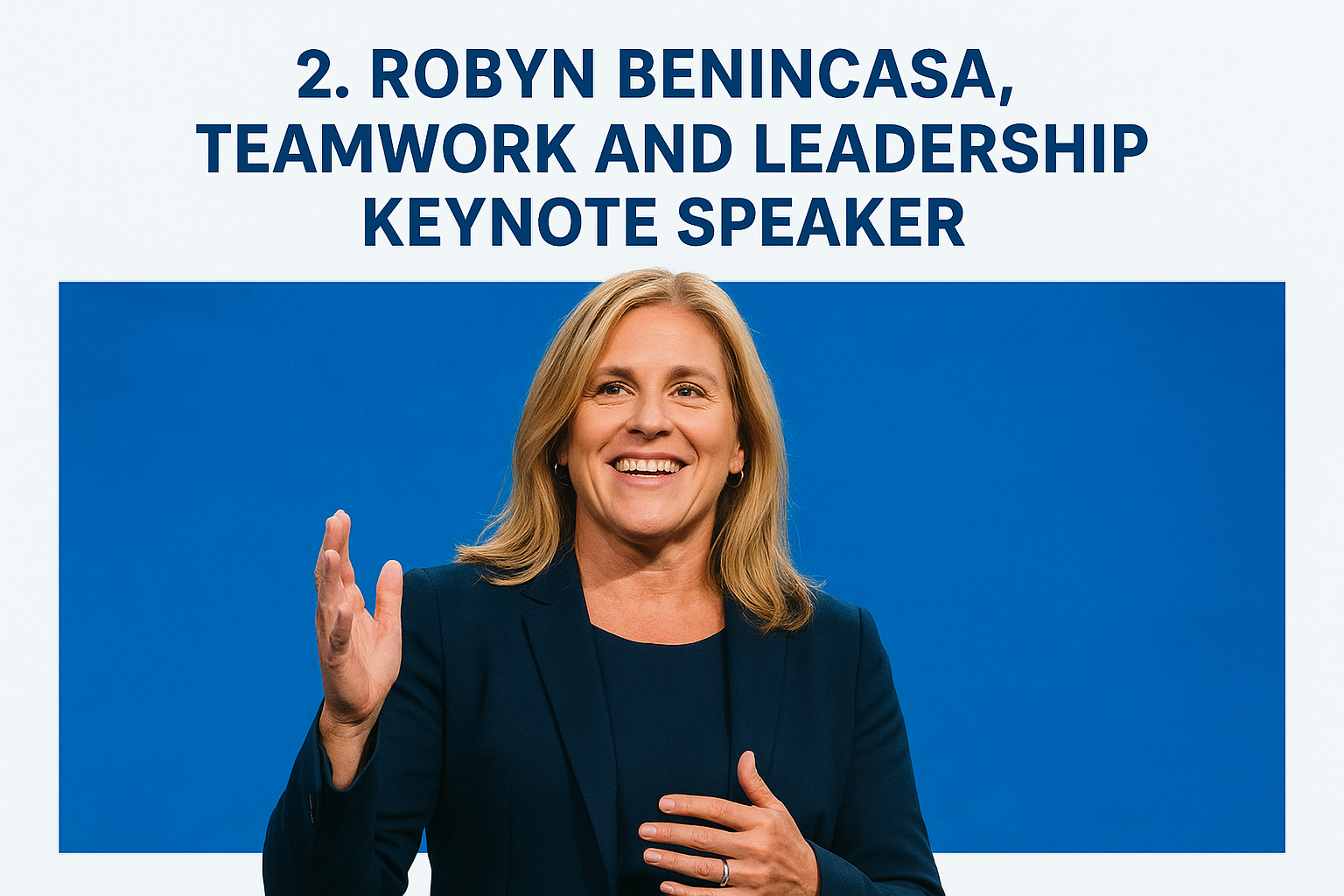
    2. Robyn Benincasa, teamwork and leadership keynote speaker

    A team culture built under real pressure translates directly into a business team culture that performs under pressure too.

    Signature keynote topics

    Robyn’s flagship talk, T.E.A.M.W.O.R.K., breaks down the eight essential elements of building a strong team culture into a framework any department can apply immediately. She also delivers WIN AS ONE and INSPIRING GREATNESS THROUGH G.R.I.T., both built around the same core idea: winning teams are made, not born, through deliberate collaboration.

    Best for

    Organizations navigating mergers, sales slumps, or silos between departments get the most out of Robyn’s material. She’s a strong fit as a women’s leadership keynote speaker for sales kickoffs, leadership offsites, and any group that needs a practical framework rather than just inspiration.

    Notable clients and credentials

    Robyn has spoken for Allstate, Northrop Grumman, Boston Scientific, InterWest Insurance, and Indivior, with case studies showing measurable results like a sales team jumping from 17th to 1st nationally. Visit her booking page to check availability and request her free 18-page guide to team-building activities that actually strengthen teams.

    3. Erica Dhawan, expert on collaboration and teamwork

    Erica Dhawan built her reputation studying how teams communicate in a world where email, Slack, and video calls have replaced hallway conversations. As the author of "Digital Body Language: How to Build Trust and Connection, No Matter the Distance," she gives audiences a language for reading tone and intent in written communication, a skill most organizations never formally teach. Her earlier book, "Get Big Things Done: The Power of Connectional Intelligence," laid the groundwork for her core message: teams that connect well outperform teams that simply work hard. Educated at Harvard and MIT, she brings an academic rigor that pairs well with practical, immediately usable takeaways.

    Hybrid teams don’t fail from lack of effort, they fail from misread signals nobody taught them to catch.

    Signature keynote topics

    Her flagship talk, Digital Body Language, teaches attendees to decode tone across written channels and reduce the friction that kills collaboration. She also delivers sessions on connectional intelligence, helping teams build trust across time zones, generations, and hybrid work arrangements.

    Best for

    Companies wrestling with remote or hybrid friction, generational miscommunication, or cross-functional silos find her material especially useful, particularly alongside practical ways to improve collaboration in the workplace. She works well as a women in leadership speaker for HR-driven events focused on communication skills rather than pure motivation.

    Notable clients and credentials

    Erica has spoken for organizations including Accenture, Pfizer, and Cisco, and her work has been featured in Harvard Business Review and the Wall Street Journal. She’s frequently ranked among the top women keynote speakers covering modern workplace collaboration.

    4. Liz Wiseman, bestselling author of Multipliers

    Liz Wiseman spent 17 years as a global HR executive at Oracle before turning her research into the book that made her name in leadership circles. Her bestseller, "Multipliers: How the Best Leaders Make Everyone Smarter," identifies why some leaders drain the intelligence out of a room while others multiply it, a distinction she backs with data from thousands of leaders across dozens of organizations. She runs The Wiseman Group, a research and leadership development firm, which gives her keynotes an academic backbone that most inspirational speakers can’t match.

    The best leaders don’t need to be the smartest person in the room, they need to make everyone else smarter.

    Signature keynote topics

    Her flagship talk, Multipliers, teaches leaders to spot the five "Diminisher" behaviors that quietly shrink team output and replace them with practices that expand it. She also delivers sessions on Impact Players, drawn from her follow-up book of the same name, focused on what separates high-contribution employees from merely competent ones.

    Best for

    Organizations promoting new managers or overhauling their leadership development pipeline get the most value from her frameworks. She’s a strong choice as a female leadership keynote speaker for management training summits, executive offsites, and any group where the goal is behavioral change, not just morale.

    Notable clients and credentials

    Liz has spoken for Apple, Google, Microsoft, Salesforce, and Twitter, and her research has appeared in Harvard Business Review and Fortune. "Multipliers" spent years on bestseller lists and is frequently assigned reading in MBA leadership courses, cementing her as one of the best female keynote speakers on management effectiveness.

    5. Vernice FlyGirl Armour, trailblazing combat pilot

    Vernice "FlyGirl" Armour became America’s first African American female combat pilot, flying two tours in Iraq as a Cobra gunship pilot for the U.S. Marine Corps. Before that, she broke barriers as a police officer in Tempe, Arizona, so her leadership material comes from two careers where hesitation gets people hurt. She built her keynote framework, Zero to Breakthrough, from the mental strategies that got her through flight school, combat missions, and the split-second decisions that came with both. Audiences respond to her because she doesn’t talk about pressure in the abstract, she’s flown through it.

    5. Vernice FlyGirl Armour, trailblazing combat pilot

    Courage isn’t the absence of fear, it’s deciding your mission matters more than your fear does.

    Signature keynote topics

    Her flagship talk, Zero to Breakthrough, gives attendees a five-step process for pushing past self-doubt and executing under pressure, drawn directly from combat aviation training. She also delivers sessions on resilience and adversity, tailored for sales teams and leadership groups facing high-stakes deadlines or organizational change.

    Best for

    Sales kickoffs, leadership conferences, and any event needing a jolt of momentum benefit most from her high-energy delivery, which puts her among the most motivational keynote speakers to hire. She’s a compelling female keynote speakers usa booking for organizations that want a speaker who embodies grit rather than just describes it, particularly ahead of a challenging quarter or major launch.

    Notable clients and credentials

    Vernice has spoken for Chevron, GE, and Coca-Cola, and she’s been featured on Oprah and in People magazine. Her memoir, "Zero to Breakthrough," and her military honors give her a résumé that few top female keynote speakers can match for sheer battle-tested credibility.

    6. Cassandra Worthy, change enthusiasm keynote speaker

    Cassandra Worthy spent years as a chemical engineer and Fortune 500 change management consultant before she noticed something every corporate transformation initiative kept missing: nobody was teaching people how to actually feel about change while it was happening to them. She built her signature concept, Change Enthusiasm, around that gap, reframing the emotional turbulence of a merger, reorg, or new system rollout as fuel rather than something to suppress. Her book, "Change Enthusiasm: How to Harness the Power of Emotions for Transformational Change," turns that idea into a practical model leaders can teach their teams. Certified Emotional Intelligence practitioner training backs up the framework, so her material holds up under scrutiny from HR and OD professionals, not just enthusiastic applause.

    Change doesn’t fail because people resist it, it fails because nobody shows them what to do with the emotions it stirs up.

    Signature keynote topics

    Her flagship talk, Change Enthusiasm, gives audiences a repeatable process for converting frustration and fear during transformation into productive energy. She also delivers sessions on emotional agility for leaders, aimed at managers leading teams through change who need to model steady behavior while guiding people through uncertainty.

    Best for

    Companies mid-merger, mid-reorg, or rolling out major technology changes get the most direct value from her material, and she belongs on any shortlist of change management speakers to book in 2026. She’s a smart pick as a women leadership speaker for change management kickoffs and any leadership team bracing employees for disruption ahead.

    Notable clients and credentials

    Cassandra has spoken for Coca-Cola, Google, and Adobe, and her Change Enthusiasm framework has been adopted by internal change management programs at several Fortune 500 companies. She’s built a reputation as one of the best female keynote speakers specifically for organizational transformation work.

    7. Sara Blakely, Spanx founder on entrepreneurial grit

    Sara Blakely turned $5,000 in savings into a billion-dollar hosiery company after cutting the feet off a pair of pantyhose and refusing to accept "no" from manufacturer after manufacturer. That origin story alone makes her a favorite booking for events built around entrepreneurial grit, but what keeps planners coming back is how openly she talks about failure. Blakely credits her father for asking her every week what she’d failed at recently, a habit she now teaches audiences as a reframe for risk-taking inside any organization, not just startups. As one of the most recognizable female keynote speakers in the business world, she brings a founder’s scrappiness to rooms that usually only hear from career executives.
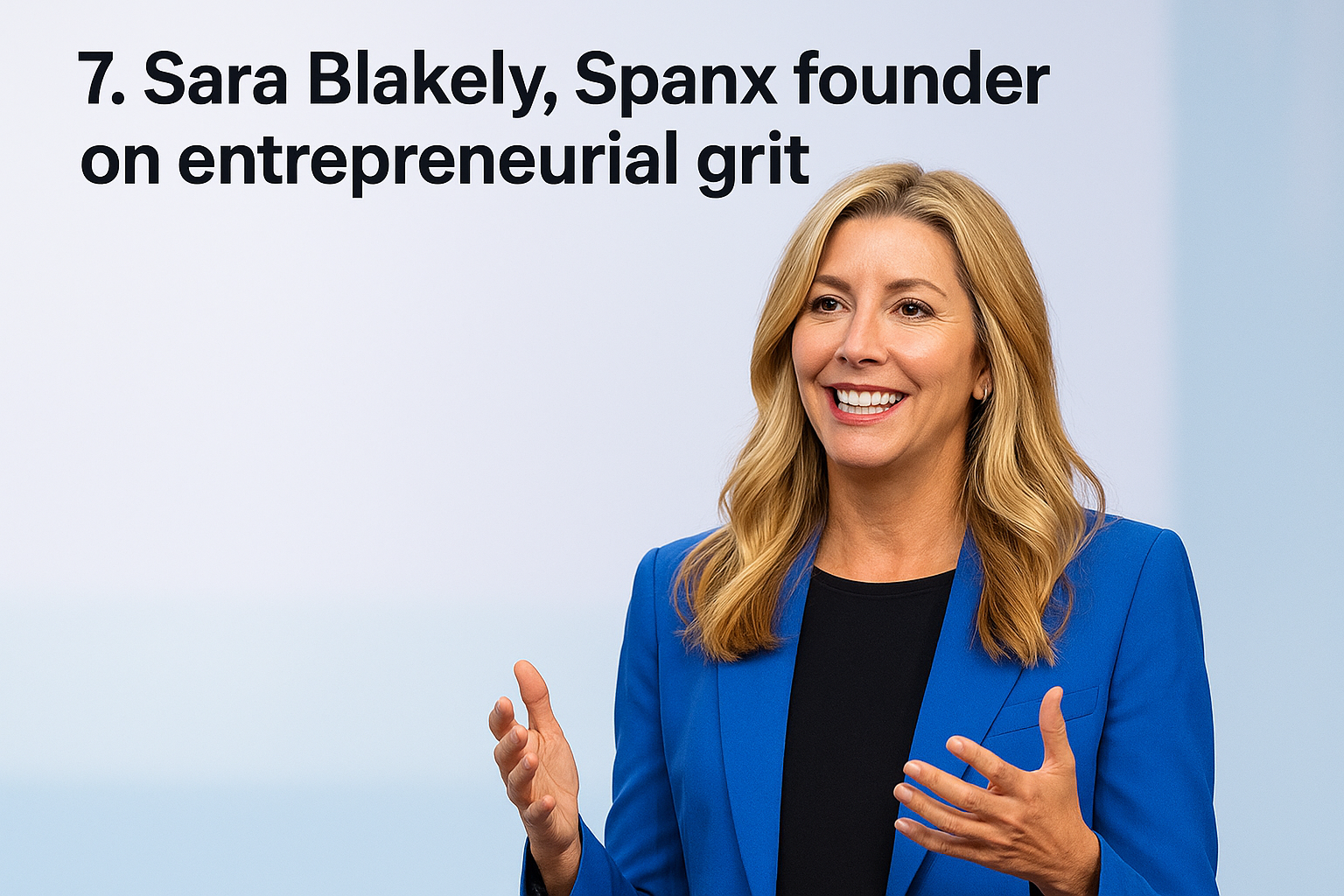
    7. Sara Blakely, Spanx founder on entrepreneurial grit

    Failure isn’t the opposite of success, it’s the tuition you pay to get there.

    Signature keynote topics

    Her flagship talk centers on redefining failure, walking attendees through the mindset shifts that let her keep pitching Spanx after repeated rejection. She also speaks on bootstrapped growth and self-belief, drawing on the years she sold the product out of her apartment before landing a spot on Oprah’s favorite things list.

    Best for

    Sales conferences, entrepreneurship summits, and women’s leadership events looking for a founder’s perspective get the most out of Blakely’s energy, and she ranks high among business motivational speakers worth booking. She works well as a top female keynote speaker for audiences that need permission to take bigger swings, especially teams launching a new product or entering an unfamiliar market.

    Notable clients and credentials

    Blakely built Spanx into a billion-dollar brand without outside funding and later signed away half her stake to Blackstone in a landmark deal, giving her material rare credibility on ownership and equity. She’s appeared on Forbes’ billionaire list and speaks regularly at major entrepreneurship and retail industry conferences.

    8. Katty Kay, journalist and confidence code co-author

    Katty Kay spent decades as a BBC and PBS anchor interviewing world leaders before she turned her reporting instincts toward a question that kept nagging her: why do capable women so often underplay their own abilities? That question became "The Confidence Code," the bestselling book she co-authored with Claire Shipman, drawing on neuroscience and interviews with high achievers to explain the confidence gap between men and women in the workplace. Kay brings a journalist’s rigor to the topic, citing research rather than platitudes, which gives her keynotes a credibility that pure motivational speakers rarely match. Her follow-up work extends the framework into practical exercises teams can use to close that gap in real meetings, not just in theory.

    Confidence isn’t a personality trait you’re born with, it’s a skill you build through action, and Kay’s research proves it.

    Signature keynote topics

    Her flagship talk, The Confidence Code, walks audiences through the science behind confidence and gives concrete practices for building it under pressure. She also delivers sessions on women’s advancement in leadership, addressing the specific barriers that keep qualified women from stepping into bigger roles.

    Best for

    Companies running women’s leadership programs, mentorship initiatives, or employee resource group events get strong results from her material. She’s a natural fit as a women’s leadership keynote speaker for organizations serious about closing gender gaps in promotion and retention, not just discussing them.

    Notable clients and credentials

    Kay has spoken for major financial services firms, media companies, and Fortune 500 employee resource groups, and her book has sold well over a million copies worldwide. Her television career, including years anchoring BBC World News America, adds a layer of polish few female keynote speakers bring to the stage.

    9. Mariana Atencio, storyteller on authenticity

    Mariana Atencio left a career as an Emmy-nominated journalist at Univision and NBC to build something more personal: a movement around authenticity called Perfectly You. Her viral TED-style talk, viewed millions of times, tells the story of growing up in Venezuela and constantly feeling like she didn’t fit any single mold, an experience she now turns into a framework for why authentic leaders build more trust than polished ones. As one of the more compelling female keynote speakers working the corporate circuit today, Atencio pairs a journalist’s storytelling instinct with real vulnerability, and audiences notice the difference between her and speakers who just recite talking points.

    People don’t follow the most polished leader in the room, they follow the one willing to be real.

    Signature keynote topics

    Her flagship talk, Perfectly You, challenges attendees to drop the performance of leadership and lead from genuine identity instead. She also delivers sessions on storytelling for connection, teaching executives and sales teams how to use personal narrative to build trust faster than data or slides ever could.

    Best for

    Companies rebuilding trust after a rocky stretch, or hosting diversity and inclusion events, get strong mileage from her material. She’s a fitting women in leadership speaker choice for conferences that want emotional resonance alongside practical takeaways, especially in industries where teams feel pressure to hide who they really are at work.

    Notable clients and credentials

    Atencio has spoken for Google, American Express, and Harvard Business School, and her TEDx talk remains one of the most-watched of its kind. Her book, "Perfectly You: Embracing the Power of Being Real," extended her message into a bestselling guide, reinforcing her standing among top women keynote speakers on authenticity and personal brand.

    10. Heather McGowan, futurist on the future of work

    Heather McGowan spent years studying how automation, shifting demographics, and generational expectations are rewriting what work even means, and she turned that research into a career advising organizations through the disruption. Co-author of "The Adaptation Advantage: Let Go, Learn Fast, and Thrive in the Future of Work," she argues that the skill separating winning organizations from stalled ones isn’t technical expertise, it’s the ability to keep learning faster than the environment changes. As a future of work speaker, McGowan draws on advisory work with governments, universities, and Fortune 500 leadership teams, giving her material a policy-level view most corporate keynotes never reach. She’s a frequent name among top female keynote speakers covering workforce transformation because she backs her ideas with labor market data, not just observation.

    The organizations that survive disruption aren’t the ones with the most talent, they’re the ones that learn the fastest.

    Signature keynote topics

    Her flagship talk, The Adaptation Advantage, walks leaders through why traditional career ladders are breaking down and what skills actually future-proof a workforce. She also delivers sessions on leading through disruption, built for executive teams navigating automation, AI adoption, or major workforce restructuring.

    Best for

    Organizations facing technology-driven disruption, workforce restructuring, or generational shifts in their talent pipeline get the most from her frameworks. She suits leadership summits and HR-driven conferences as a women leadership speaker focused squarely on preparing teams for what’s next, not just reacting to it.

    Notable clients and credentials

    McGowan has advised MIT, Harvard, and multiple Fortune 500 companies on future-of-work strategy, and her insights have appeared in the New York Times and on the World Economic Forum’s stage.

    11. Colette Carlson, expert on human behavior and connection

    Colette Carlson spent years studying why smart, capable people still struggle to connect with the colleagues sitting three desks away. A Certified Speaking Professional, she built her keynote practice around a simple observation: technical skill gets people hired, but human connection gets teams to actually perform together. Her material draws on behavioral research rather than motivational platitudes, which is why HR departments trust her to headline events focused on trust, communication, and engagement rather than pure hype. Planners looking for a women’s leadership keynote speaker who backs her message with real behavioral science tend to shortlist her early.

    Teams don’t break down from lack of talent, they break down from a lack of honest, human connection.

    Signature keynote topics

    Her flagship talk, Speak Your Truth With Tact, teaches attendees how to give honest feedback without damaging relationships, a skill most managers never receive formal training on. She also delivers sessions on building trust in a team at work, aimed at leaders trying to close the gap between what employees say in surveys and what they actually experience day to day.

    Best for

    Organizations dealing with low engagement scores, communication breakdowns between departments, or leadership teams that avoid difficult conversations get the most value from Carlson’s frameworks. She’s a strong choice as a female leadership keynote speaker for HR conferences and management training events where the goal is changing daily behavior, not just morale for a day.

    Notable clients and credentials

    Carlson has spoken for Cisco, Wells Fargo, and Kaiser Permanente, and her book "Business Negotiation Basics" reinforced her reputation among best female keynote speakers covering workplace communication. Her Certified Speaking Professional designation, held by fewer than 15 percent of professional speakers worldwide, signals a consistency planners can count on.

    12. Molly Bloom, entrepreneur behind Molly’s Game

    Molly Bloom ran the most exclusive high-stakes poker game in Hollywood and Wall Street before federal agents shut it down, a story she turned into her bestselling memoir and the film "Molly’s Game." She built and lost an empire on her own terms, then rebuilt her reputation by turning that collapse into a framework for resilience under public scrutiny. Few female keynote speakers can speak as candidly about hitting rock bottom in front of the entire country and still finding a way back to relevance and respect.
    12. Molly Bloom, entrepreneur behind Molly's Game

    Rock bottom isn’t the end of your story, it’s the moment you decide what the next chapter is going to say about you.

    Signature keynote topics

    Her flagship talk, Molly’s Game: Betting on Yourself, walks audiences through the risk calculations that built her poker empire and the mistakes that brought federal charges to her door. She also delivers sessions on reinvention after failure, giving leaders a practical lens for rebuilding trust and momentum after a public or professional setback.

    Best for

    Companies recovering from a scandal, a failed launch, or a bruising financial quarter get real value from Bloom’s material. She’s a compelling top female keynote speaker for sales conferences and executive retreats that want a speaker who has actually lived through consequence and comeback, not just theorized about it.

    Notable clients and credentials

    Bloom has spoken for major financial services firms and entertainment companies drawn to her rare combination of business acumen and legal jeopardy survived. Her memoir, "Molly’s Game," and the Aaron Sorkin film adaptation gave her a media profile that few women keynote speaker bookings can match, and she remains a sought-after voice on risk, reputation, and recovery.

    13. Amy Webb, futurist and AI strategy keynote speaker

    Amy Webb founded the Future Today Institute and spent years building forecasting models that help organizations see technology shifts years before competitors notice them. She’s the author of "The Big Nine: How the Tech Titans and Their Thinking Machines Could Warp Humanity," a book that pushed AI governance into boardroom conversations long before ChatGPT made the topic mainstream. As a professor at NYU Stern and a rigorous quantitative researcher, Webb backs every prediction with data, not hunches, which sets her apart from speakers who treat AI strategy as a buzzword rather than a discipline requiring real methodology.

    The companies that survive the next decade won’t be the ones reacting to AI, they’ll be the ones who forecasted it years in advance.

    Signature keynote topics

    Her flagship talk, The Future of Artificial Intelligence, walks executive audiences through emerging technology trends and the strategic decisions leaders need to make now, not after competitors act. She also delivers sessions on strategic foresight, teaching leadership teams a repeatable process for scanning weak signals and building scenario plans instead of reacting to disruption after it hits.

    Best for

    Boards, executive leadership teams, and technology-driven organizations wrestling with AI adoption get the most value from Webb’s frameworks. She suits innovation summits and strategic planning offsites as a female leadership keynote speaker for companies that need rigorous forecasting rather than hype about the next big platform shift.

    Notable clients and credentials

    Webb has advised the U.S. Department of Defense, Fortune 500 boards, and major media companies on long-range technology strategy, and her research has appeared in the Harvard Business Review and on the TED main stage. Her academic post at NYU Stern and her Future Today Institute reports make her one of the top female keynote speakers working at the intersection of technology and business strategy today.

    14. Frequently asked questions about female keynote speakers

    How much does a female keynote speaker cost? Keynote speaker fees vary widely, from a few thousand dollars for an emerging voice to six figures for a bestselling author with major media coverage. Ask each speaker’s team for a written quote that includes travel and any customization work, since a female keynote speaker with a lighter public profile can sometimes deliver more relevant content for less money than a household name.

    The right fee isn’t the lowest number, it’s the one that matches the outcome you actually need from the room.

    Generally, most corporate events book their speaker three to six months out, though a top female keynote speakers roster tends to fill fast around January and September, the busiest seasons for conferences and sales kickoffs. Booking earlier gives you more room to negotiate on both fee and format.

    Often, planners ask whether virtual delivery holds up compared to a live stage. It does, provided the speaker builds in real interaction rather than just narrating slides at a webcam; many women keynote speaker bookings now include breakout discussion prompts or live polling to keep a remote audience engaged.

    Sometimes the question is really about fit rather than fame. A woman keynote speaker with deep experience in your specific industry, whether that’s healthcare, defense, or financial services, will usually connect faster with your audience than a generalist with a bigger name. Ask for references from planners in your sector before you commit.

    Finally, don’t skip the customization conversation. The strongest female keynote speakers usa clients keep rebooking are the ones who take a real call with your team beforehand and tailor examples to your industry, not just swap your company name into a generic slide deck.
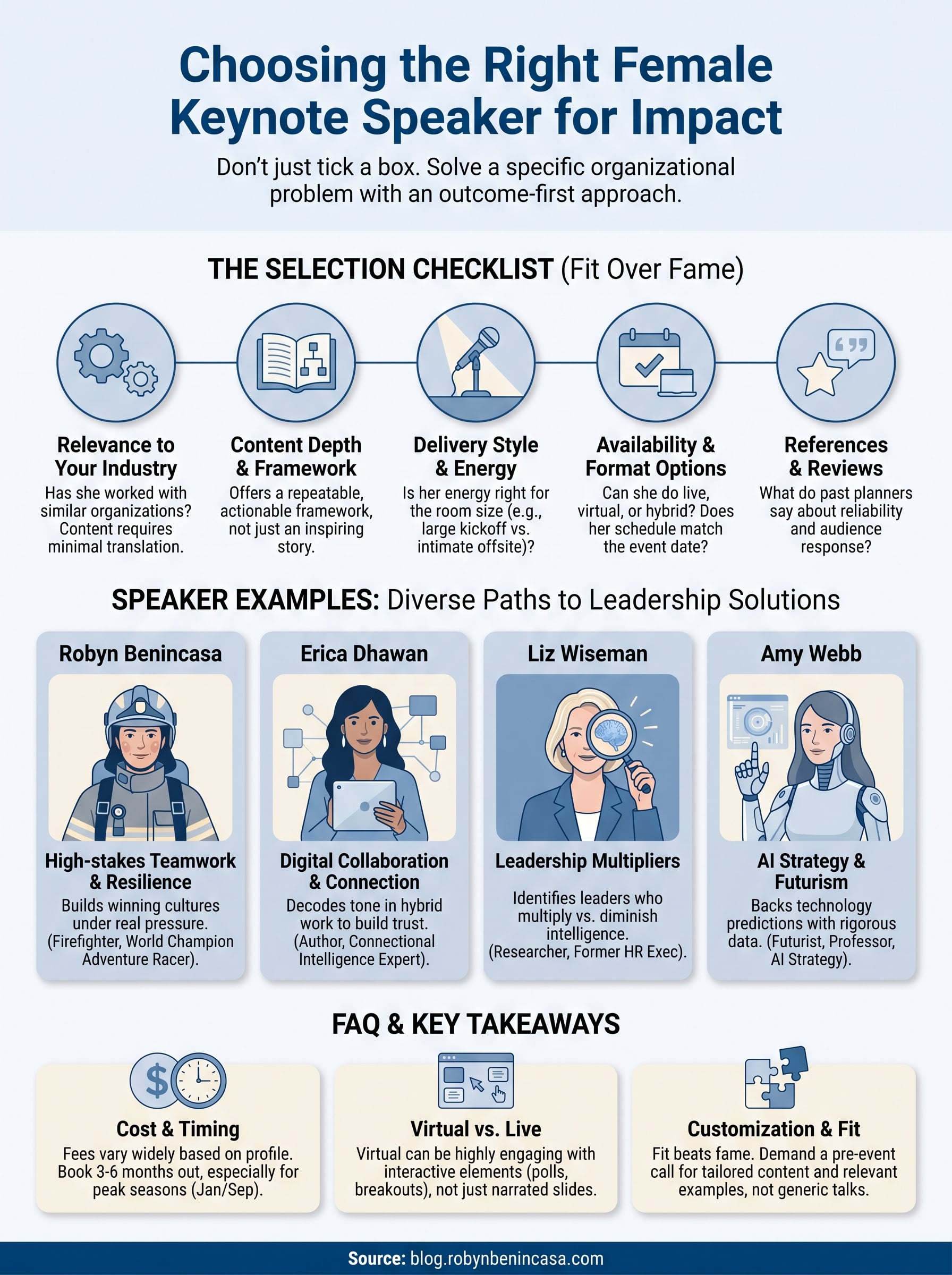
    female keynote speaker infographic

    Finding the right voice for your next event

    Twelve speakers, twelve different paths to the same goal: a room full of people who leave with something they’ll actually use. The best female keynote speaker for your event won’t necessarily be the biggest name on this list. She’ll be the one whose framework matches the specific challenge your organization is facing right now, whether that’s rebuilding trust after a merger, reigniting a sales team, or preparing leaders for the next wave of disruption.

    Run your shortlist through the checklist from earlier, get a real quote, and talk to each speaker’s team before you sign anything. Fit beats fame every time.

    If your team needs a practical, battle-tested framework for building a winning culture under real pressure, see which good motivational speakers are worth hearing, starting with Robyn Benincasa and what her 8 Essential Elements can do for your people.
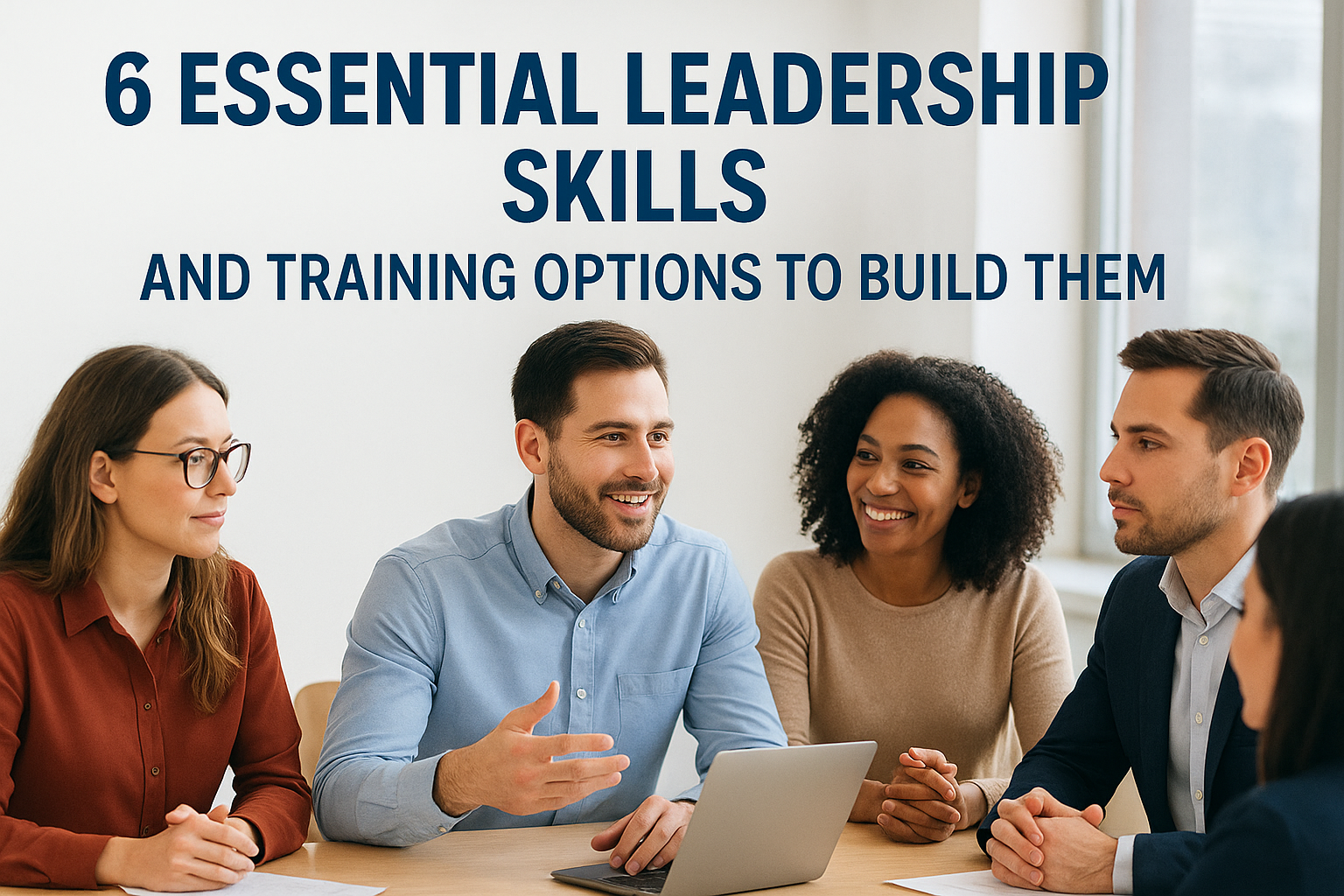

  • How to Write and Deliver a Keynote Speaker Speech

    How to Write and Deliver a Keynote Speaker Speech

    You’ve got a keynote coming up, and the blank page is staring back at you. Writing a keynote speaker speech that actually lands isn’t about stringing together inspiring quotes. It’s about structure, a strong opening, and a message your audience still remembers three months later. Most speeches fail before they’re ever delivered because the writer skipped the hard part: figuring out what the room actually needs to hear.

    If you’re wondering how professionals build a talk that holds a room for 45 minutes, the answer comes down to a few repeatable moves. You need a clear narrative arc, an opening that earns attention in the first 30 seconds, and a close that ties back to your core idea instead of trailing off. Skip any of these and even great content falls flat.

    I’ve spent 20 years on stages talking to sales teams, executives, and conference crowds about how to build a high performing team, and the speech itself matters as much as the message. In this guide, you’ll get a practical structure you can copy, real opening techniques that work, and examples pulled from talks that actually changed how audiences think about leadership and teamwork.

    What sets a keynote speech apart

    A keynote speaker speech isn’t just a longer version of the quarterly update or the sales training deck. It sets the tone for the entire event, whether that’s a sales kickoff, a leadership offsite, or a three-day conference. Everything else on the agenda, breakout sessions, panels, workshops, gets filtered through the lens the keynote created. That’s why a keynote address carries more weight than its runtime suggests, and why the role a keynote speaker actually plays shapes the whole event: it’s the emotional anchor the rest of the day builds on.

    A keynote speech vs. a business presentation

    Business presentations inform. Keynote speeches transform how people think about a problem, then hand them a reason to act differently once they leave the room. The differences show up clearly when you line them up side by side, much like how keynote speakers differ from other speakers on the same agenda.

    Element Business presentation Keynote speech
    Primary goal Share information or data Shift perspective, inspire action
    Structure Agenda-driven, sequential Narrative arc with a single throughline
    Audience role Passive receivers of updates Active participants in a shared experience
    Memorable takeaway A list of action items One core idea tied to a story
    Delivery style Reads from slides Speaks from experience, slides support

    Why the audience remembers the story, not the slides

    Executives forget bullet points within a day. They remember the moment a speaker told a story that mirrored their own struggle. That’s the whole game with a conference keynote: you’re not competing with other speakers on information density, you’re competing on whether your story sticks. I’ve watched sales teams quote a single line from a talk two years later, not because it was clever, but because it connected to something they were already wrestling with at work.

    A keynote lives or dies on whether the audience can repeat its one idea a week later.

    Great keynotes also demand something a standard talk doesn’t: first-hand credibility. Audiences can tell within minutes whether a speaker has actually lived what they’re describing or is reciting borrowed frameworks. When I talk about creating a strong team culture, it comes from leading adventure racing teams through 24-hour expeditions and running into burning buildings with a crew whose lives depended on trust, not from a textbook. That lived experience is what separates a forgettable keynote address from one people bring up in meetings a year later. If you’re evaluating speakers or building your own talk, start by asking whether the content reflects something the speaker has actually done, not just studied.

    Step 1. Know your audience and event goal

    Before you open a blank document, find out who’s actually sitting in the room. A corporate keynote written for a sales kickoff needs a different energy and vocabulary than one for a leadership offsite grappling with a merger. Skip this research and you’ll write a generic talk that could be delivered to anyone, which means it lands with no one.

    Research before you write a word

    Start by getting specifics from the event planner or HR contact, not just a vague theme. Ask directly:

    • What’s the state of the team right now? Growing, restructuring, recovering from layoffs?
    • What keeps leadership up at night this quarter?
    • What talks have landed well at past events, and which ones fell flat?
    • Is this a celebration, a course correction, or a kickoff?

    These answers shape everything from tone to which stories you pull from your own experience.

    Match your message to the event goal

    Every keynote address serves a business purpose, even when it’s framed as inspiration. A sales meeting keynote needs to connect to numbers and competitive drive. A leadership summit needs language around culture and trust, which is the territory a corporate culture keynote speaker lives in. When I worked with a national insurance company whose team had slipped to 17th in sales rankings, the goal wasn’t motivation for its own sake, it was giving that team a concrete framework for rebuilding trust that translated into results.

    A keynote built for the wrong room is just a good speech delivered to the wrong people.
    Getting this step right before you write a single line saves you from rewriting the entire speech later. It also gives you the raw material, real details about real people, that makes Step 2 far easier to nail.

    Step 2. Define your one core message

    Once you know the room, narrow your entire keynote speech down to a single sentence. Not a theme, not a topic area, one specific idea the audience should be able to repeat to a coworker the next morning. If you can’t say it in one breath, it’s not ready yet. Most first drafts fail here because the speaker tries to cover five good ideas instead of committing to one.

    Write your core message before you write anything else

    Before you draft a single story or slide, write your core message at the top of the page. Test it against these questions:

    • Can I say this in under 15 words?
    • Does it connect directly to the event goal I identified in Step 1?
    • Would this idea change how someone approaches their job on Monday?
    • Can I back it up with a specific story from my own experience?

    If the answer to any of those is no, keep revising before you move forward.

    Let every story serve the message

    Stories, data, and examples earn a spot in your motivational speech only if they reinforce that one sentence. When I build a talk around "winning teams choose trust over ego," every adventure racing story, every firefighting example, gets filtered through that lens. Anything that doesn’t serve it gets cut, no matter how good the anecdote is on its own.

    If a story doesn’t reinforce your one core message, it doesn’t belong in the speech, no matter how good it is.

    This discipline matters more in a corporate keynote than in casual speaking because executives and sales teams are pattern-recognition machines. They’ll spot a wandering message within minutes, and once they check out, you won’t get them back. A tightly defined message is also what makes Step 3’s structure possible, since every section of your speech now has a clear job to do.

    Step 3. Structure your speech from hook to close

    Once your core message is locked, build the skeleton that carries it. A keynote speech structure doesn’t need to be complicated, it needs to be reliable. Think of it as five moves: hook, stakes, story, lesson, close. Each one has a job, and skipping a move is why so many talks feel like they wander instead of build toward something.
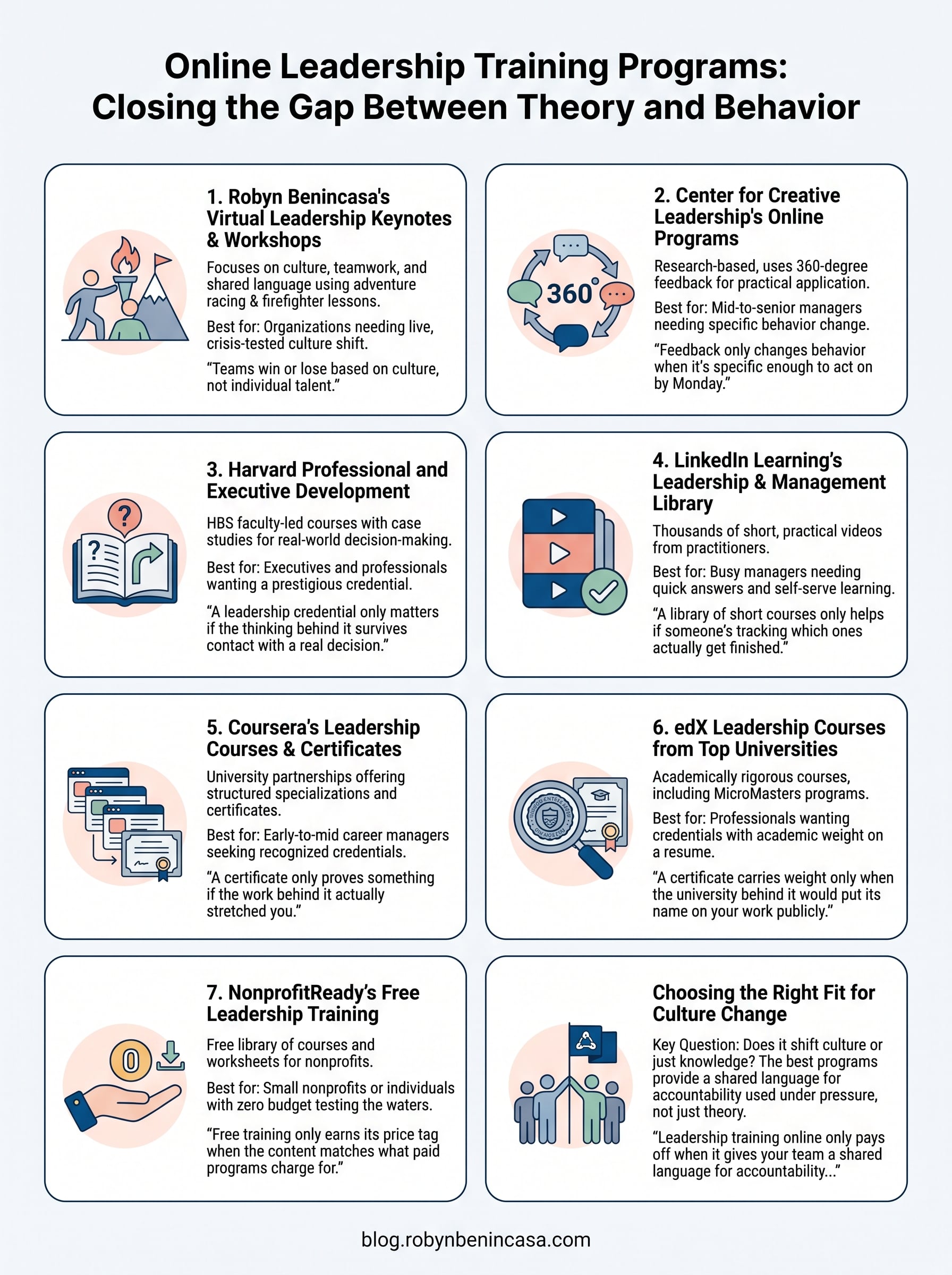
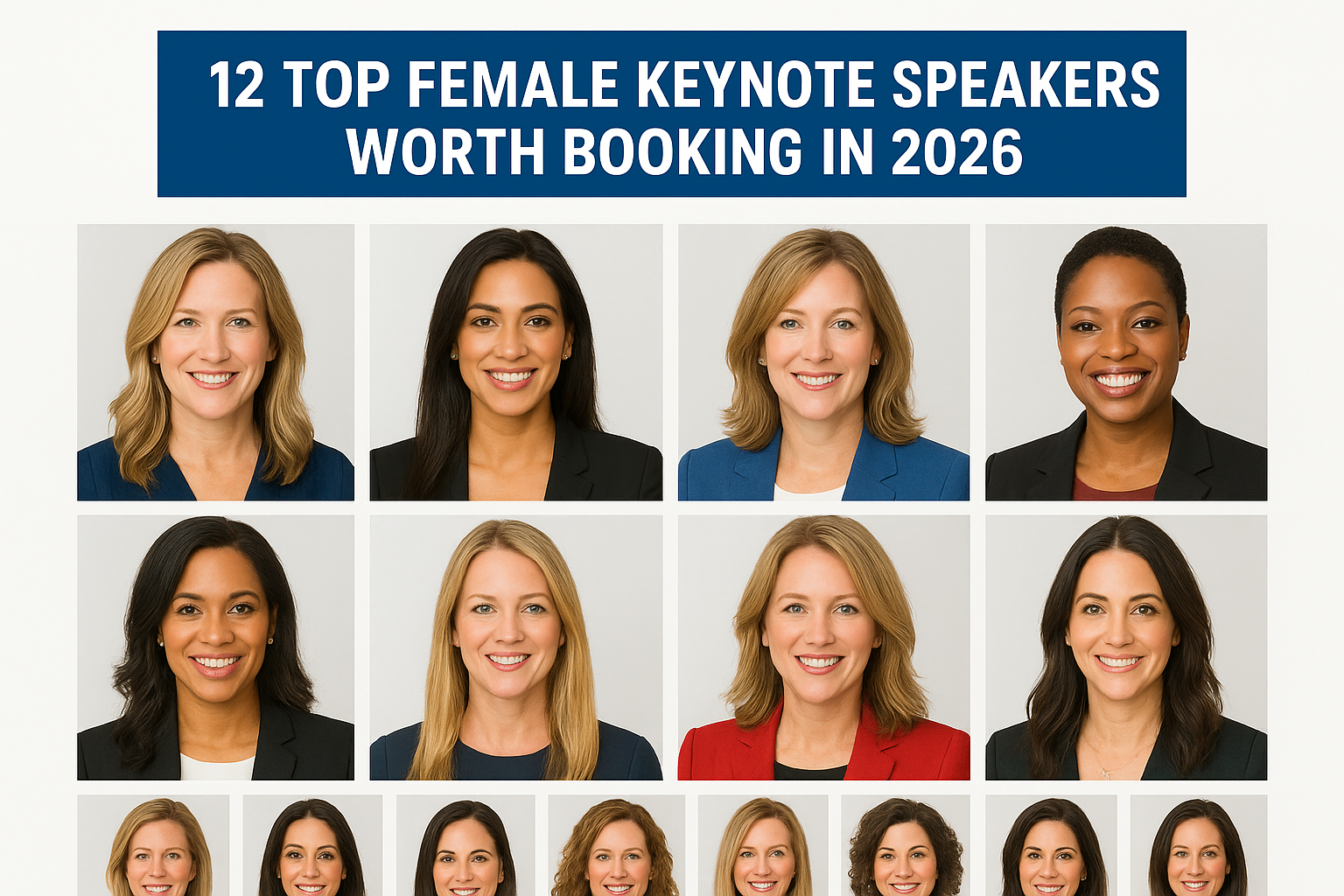
    Step 3. Structure your speech from hook to close

    The five-part arc that holds a room

    Here’s the breakdown I use for nearly every keynote presentation, whether it’s 20 minutes or a full hour:

    Section Time allotment Purpose
    Hook First 2 minutes Earn attention, plant your core message
    Stakes Next 3-5 minutes Show why this problem matters to this room
    Story Bulk of the talk Prove the message through lived experience
    Lesson 5-10 minutes Translate the story into a usable framework
    Close Final 3-5 minutes Return to the hook, issue a clear call to action

    Open with a hook, not a warm-up

    Skip the "thank you for having me" opener entirely. Start mid-scene, drop the audience straight into a moment of real tension, a burning building, a race gone wrong, a deal that almost collapsed. That’s what earns the first 30 seconds.

    A speech that opens with small talk has already lost the room before the real content starts.

    Close by returning to where you started

    Your ending should echo your opening image, now recontextualized by everything the audience just learned. If you opened with a race against the clock, close by revisiting that same moment and naming what changed. That callback is what makes a conference keynote feel complete instead of just finished. It’s also what makes your one core message stick long after the applause fades, because you gave the audience a full circle instead of a fade-out.

    Step 4. Rehearse and deliver with presence

    Writing the speech gets you halfway there. Delivery is where a keynote speaker speech either earns its reputation or falls apart under the lights. I’ve watched speakers with a strong script lose a room because they read from notes, rushed their pacing, or never rehearsed out loud until the day of the event. Presence isn’t a personality trait, it’s a skill you build through repetition.

    Rehearse out loud, not just in your head

    Silently reviewing your talk in your mind tricks you into thinking it’s ready. Say every word out loud, standing up, at the pace and volume you’ll use on stage. Do this enough times that your transitions become automatic, freeing you to focus on the room instead of your next line.

    • Record yourself on video and watch it back for filler words and rushed pacing
    • Time each section against the structure from Step 3 so no part runs long
    • Practice in front of one honest colleague who’ll tell you where it drags
    • Rehearse your opening line until it feels conversational, not memorized

    A speech rehearsed only in your head is a speech you haven’t actually practiced.

    Bring physical presence into the room

    Your body communicates before you say a word. Stand still during key lines instead of pacing nervously, use pauses to let a point land, and make eye contact across sections of the audience rather than scanning the front row. These public speaking tips apply whether you’re on a physical stage or delivering a virtual keynote through a camera, where presence has to come through even more deliberately since you lose the room’s energy feedback.

    Bring physical presence into the room

    When it’s time to deliver, trust the rehearsal. Confidence on stage comes from knowing your material cold, not from winging it and hoping the energy carries you.

    keynote speaker speech infographic

    Turning preparation into a memorable keynote

    Great keynotes aren’t luck. They come from knowing your audience, committing to one message, building a structure that carries that message from hook to close, and rehearsing until delivery feels effortless. Skip any one of those steps and even a talented speaker ends up with a talk that entertains for an hour and disappears by Monday. Follow all four and you get something rarer: a room full of people who repeat your idea to coworkers who weren’t even there.

    If you’re planning an event and want a keynote speaker speech built on twenty years of leading teams through burning buildings and championship adventure races, not borrowed frameworks, that’s exactly what I bring to the stage. See how to choose the best keynote speaker for a corporate event, then start the conversation about what your next sales kickoff, leadership offsite, or conference really needs to hear.