
If you need to book a keynote speaker, the hard part is rarely finding names. It is knowing who fits your audience, what the speaker will really cost, and whether to go through a bureau or call the speaker directly. Get it wrong and you pay five figures for an hour your team forgets by lunch.
Here is the short answer. Start 9 to 12 months out for a large conference, and 3 to 6 months for a smaller meeting. Set your budget first. Fees run from about $5,000 for a emerging speaker to $50,000 or more for a celebrity, plus travel. A bureau costs you little or nothing, since the speaker’s fee usually covers its commission. Booking direct can be faster when you already know who you want.
Below, you will get the step-by-step booking process, a realistic cost breakdown, how bureaus compare with direct booking, and the contract details that protect you. I speak to corporate teams on leadership and teamwork, so I have seen this process from both sides of the table.
What to know before you book a keynote speaker
Before you open a single speaker profile, get three things straight: what a keynote speaker is, who you will deal with, and what the market charges. Ten minutes spent here saves you weeks of misdirected emails.
What a keynote is, and what it is not
A keynote is the anchor talk of your event. It runs 30 to 60 minutes and reaches everyone in the room at once. Its job is to set the tone and give your audience a shared story that the rest of the agenda can build on.
Many buyers blur the formats, and that is how they overpay or get the wrong session. Match the format to the need using this table.
| Format | Typical length | Best for |
|---|---|---|
| Keynote | 30 to 60 minutes | Setting a theme for the whole group |
| Breakout session | 45 to 60 minutes | Going deeper with a smaller group |
| Workshop | 2 to 4 hours | Building skills through exercises |
| Fireside chat | 30 to 45 minutes | Interview style, lighter prep |
Who you will deal with
You can reach a speaker through three routes, and each one changes who answers your emails and who negotiates the fee:
- Speakers bureau: a broker that represents many speakers and manages the paperwork.
- Agent or manager: a rep for one speaker or a small roster.
- The speaker’s own office: a direct line, often run by a single coordinator.
Step 2 compares these in detail. For now, just know that the route does not change the talk, only the process around it.
What the market charges
Fees follow demand, not talent. A great speaker with a small following can cost less than a famous one with a thin message. These keynote speaker fees are typical for in-person U.S. events, and they vary by speaker.
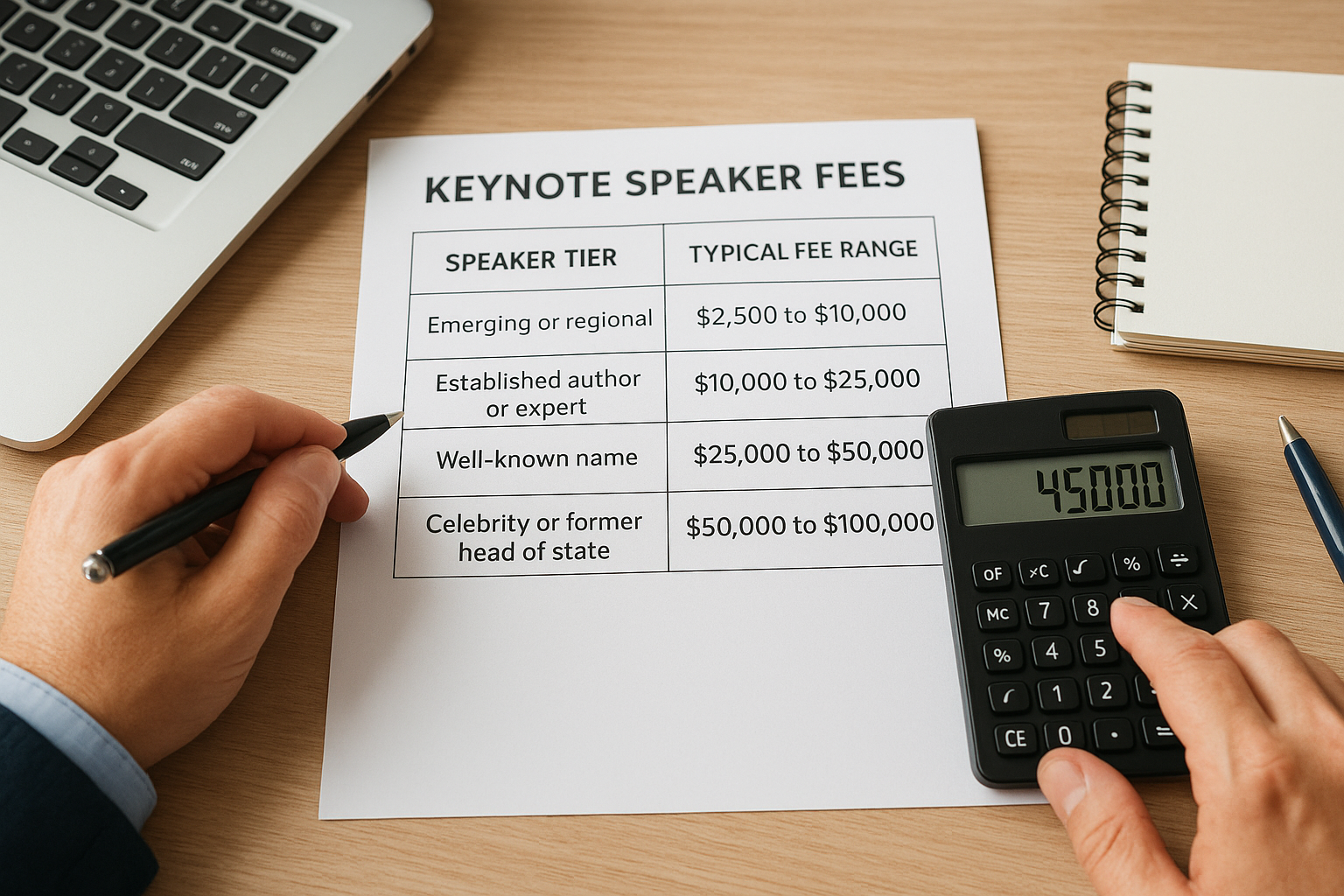
| Speaker tier | Typical fee range |
|---|---|
| Emerging or regional | $2,500 to $10,000 |
| Established author or expert | $10,000 to $25,000 |
| Well-known name | $25,000 to $50,000 |
| Celebrity or former head of state | $50,000 to $100,000+ |
Travel is usually extra. Expect to cover business-class airfare, hotel, and ground transport for the speaker, and sometimes a team member. Virtual keynote speakers often cost less because there is no travel, though top names rarely discount by much.
Price is the loudest signal in the market, but it is not the best one. Your audience will not remember the fee. They will remember whether the talk spoke to them.
Book for fit with your audience first, and let fame and price come second.
Hold that rule in mind as you work through the steps below.
Step 1. Define your event goals, audience, and budget
Every smooth booking starts with a one-page brief. Write it before you contact anyone, because vague requests get vague proposals. When you book a keynote speaker with a clear brief, a bureau or speaker can tell you in one reply whether they are a real fit.
Name the one outcome you want
Finish this sentence: "After the keynote, I want attendees to ___." Pick one outcome, not five. A sales meeting might need reps to share leads across regions. A merged company might need two cultures to see themselves as one team.
A speaker can only hit the target you hand them.
Profile your audience
Audience details shape the talk more than the topic does. A room of new hires needs a different message than a room of 20-year veterans, even when the theme is the same. Gather these facts, and share them with every speaker you talk to:
- Headcount and seniority mix
- Tenure, from new hires to long-time staff
- Industry and current pressure, such as a merger or a missed quarter
- Format: in person, virtual, or hybrid
- Speakers they heard in the past two years
Set a budget that covers everything
Budget comes last, but it is not an afterthought. Set a range instead of a single number, and count more than the fee. My rule of thumb is to hold back 15 to 20 percent above the fee for travel, AV, and surprises. Then name a decision date, since the best speakers’ calendars fill early.
Put it all on one page you can paste into an email:
Event name:
Date and city:
Audience size and mix:
Desired outcome:
Format and length:
Budget range (fee + travel):
Decision date:
Step 2. Decide between a bureau and booking direct
With your brief done, choose a route. You can book a keynote speaker through a speakers bureau or go straight to the speaker’s office. Neither wins every time. The right pick depends on how much time you have and how well you know your options.

How the two routes compare
| Factor | Bureau | Direct |
|---|---|---|
| Cost to you | Same quoted fee, commission built in | Speaker’s fee, rarely lower |
| Choice | Hundreds of speakers | One speaker |
| Speed | Several proposals in days | Fast if you know the name |
| Paperwork | Bureau handles contracts and logistics | You and the speaker’s office |
| Best for | Open search | A speaker you already chose |
Bureaus typically earn 25 to 30 percent commission, and it comes out of the speaker’s fee, so you rarely pay extra. Many buyers assume going direct saves that money. It usually does not, because speakers hold one price to stay on good terms with their bureaus.
When a bureau makes sense
Choose one of the top speaker bureaus when you have no name in mind, need options at different price points, or lack time to vet people yourself. A good rep will ask about your audience, then send three to five matched options with video and fees. That saves you hours of searching.
Be aware that a bureau earns money when you book, so push for honesty. Ask, "Are these your best matches for my brief, or just who is available?" Also ask whether any speaker pays for placement in your results.
A bureau is a search service, and booking direct is a shortcut for when your search is already over.
When to go direct
Go direct when you have seen the speaker live, got a strong referral, or want to talk about customizing the content with the person who will deliver it. You skip the middleman and often get faster answers about what the speaker can tailor.
Start with the booking page on the speaker’s website. Send the one-page brief from Step 1 and expect a reply within a few business days. If you hear nothing in a week, follow up once, then move to your backup choice.
Step 3. Build a shortlist and vet speakers
Now you turn names into finalists. When you book a keynote speaker, this is where most mistakes happen, because a polished demo reel hides a lot. Aim for three to five candidates and no more, so you can give each one a fair look.
Check each candidate against your brief
Sort every name by three questions. Does the message support your one outcome? Has the speaker worked with audiences like yours? Does the fee fit your range? Cut anyone who fails two of the three. Then compare the survivors side by side in a simple spreadsheet, one row per speaker.
Vet what you can see and hear
Highlight reels exist to impress you. Ask for a full-length video of a recent talk, ideally 20 minutes or more, and watch how the speaker handles the room, not just the best story. Then run this checklist:
- Is the footage from the past two years?
- Does the speaker teach something, or just recite slogans?
- Can you name one takeaway after watching?
- Does the audience laugh, lean in, and respond?
- Does the style suit your format, live or virtual?
Call the references
Video shows delivery. References show how the speaker works with clients. Ask for two past buyers with events like yours, and put four questions to them: Did the speaker return calls quickly? Did they customize the talk? Did people still mention it a month later? Did anything go wrong?
A reference who still quotes the talk a month later tells you more than any testimonial on a website.
Finally, keep one backup. Rank your finalists, and tell your bureau rep or the speaker’s office that you are holding a date while you decide. Good speakers book up fast, and a ranked list means a lost date does not send you back to square one.
Step 4. Understand fees, travel, and contract terms
Quotes rarely tell the whole story. When you book a keynote speaker, the fee is one line in a longer bill, and the contract decides what happens when plans change. Read both closely, and ask the bureau rep or speaker’s office to explain anything unclear.
Read the quote line by line
Ask for an itemized quote so you can compare finalists fairly. A $12,000 fee plus a flat $6,000 travel charge costs more than a $15,000 fee with travel billed at cost, which often runs $2,000 to $4,000. Use this table to check what each quote covers.
| Cost item | Typical arrangement |
|---|---|
| Speaking fee | Flat amount for one talk |
| Airfare | Business class, billed at cost |
| Hotel and ground transport | Billed at cost, sometimes capped |
| Extra sessions (Q&A, VIP meet-and-greet) | Included or priced as add-ons |
| Recording or livestream rights | Often a separate fee |
Before you sign, ask for a travel cap or a flat travel fee. It keeps your final invoice close to the number you approved.
Contract terms that protect you
Most disputes come from details nobody wrote down. Get every promise in writing, including the ones made on friendly calls. Look for these clauses:
- Payment schedule: a 50 percent deposit at signing is common, with the balance due before or on the event day.
- Cancellation and rescheduling: who owes what if you move the date, and what happens if the speaker cancels.
- Recording rights: whether you can film the talk, and whether you can share it internally or publicly.
- Customization: the pre-event calls and tailoring the speaker has agreed to.
- Backup plan: what happens if illness or a travel failure keeps the speaker away, including a virtual fallback.
- Tech needs: the microphone, stage, and slides the speaker expects.
If it is not in the contract, it is not part of the deal.
Have your legal or procurement team review the agreement, since terms vary by speaker and bureau. A reputable bureau or speaker will expect edits and will not take offense.
Step 5. Hold the pre-booking call and lock it in
Your last task before signing is a 20 to 30 minute call with the speaker, not just the rep. If you plan to book a keynote speaker for five figures, insist on this call with your top finalist. A speaker who won’t take one is telling you how the rest of the process will go.
Questions to ask on the call
Come with a short list and let the speaker talk. These five questions cover most of what matters:
- What do you already know about our audience, and what would you like to learn?
- What would you change in your talk for us?
- How will you prepare with our leaders before the event?
- What does your day-of routine need, such as arrival time, sound check, and Q&A?
- What is your backup plan if travel or illness gets in the way?
Listen for specifics. A strong speaker asks you more questions than you ask them, and they offer concrete ideas for customizing the content. Vague answers like "I’ll tailor it" mean the talk is probably canned.
The call shows you what no demo reel can: whether the speaker will build the talk around your audience.
Lock it in
Once you have a clear winner, move quickly. Most speakers hold a date only until someone else signs, so a verbal yes protects nothing. Tell your runners-up thanks and keep their contact details for next year.
Then work through this checklist:
- Confirm the fee, travel terms, and date in writing.
- Return the signed agreement and the deposit.
- Book a prep call two to four weeks before the event.
- Send the agenda, run-of-show, venue details, and your tech contact.
- Share any news that could change the room, such as layoffs or a big win.
That last item matters more than most buyers expect. Late context is what makes a keynote feel written for your team, and a speaker can only use what you tell them. Keep the line open until the day itself, and you will get far more than an hour on stage.
Putting your booking plan into action
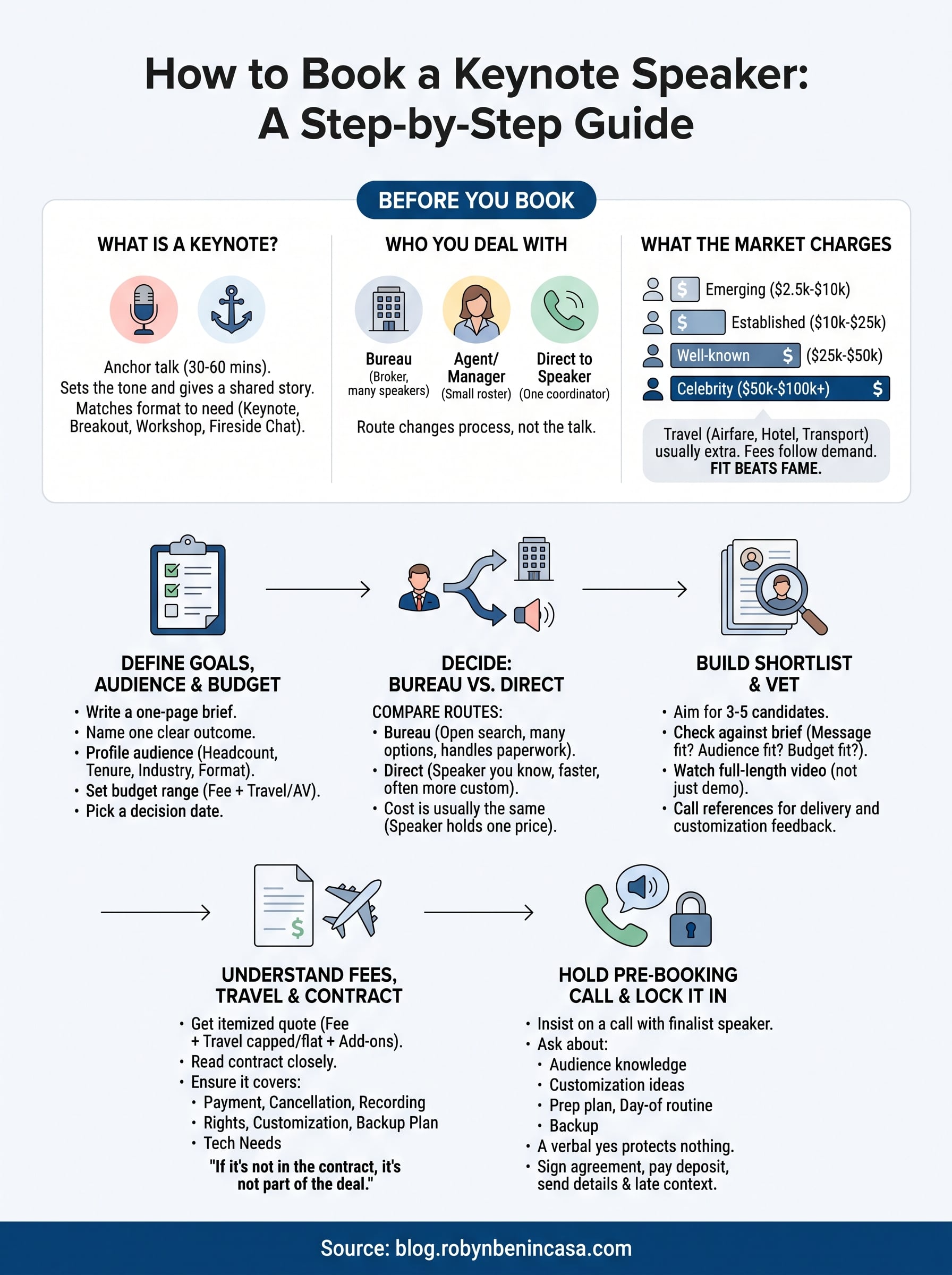
Booking well comes down to order. Write the brief first, pick your route, vet three to five finalists, read the quote and contract line by line, and finish with a call to the speaker. Skip a step and you pay for it later, usually in fees you did not expect or a talk that misses your room.
Remember the rule from the start: fit beats fame. When you book a keynote speaker who understands your audience, the fee becomes an investment instead of a gamble, and your team leaves with something to act on.
If you are ready to start, I would be glad to hear about your event. See how I work with teams as a leadership keynote speaker on leadership and culture, then send me your one-page brief and we can talk about whether my keynotes fit your audience and goals.