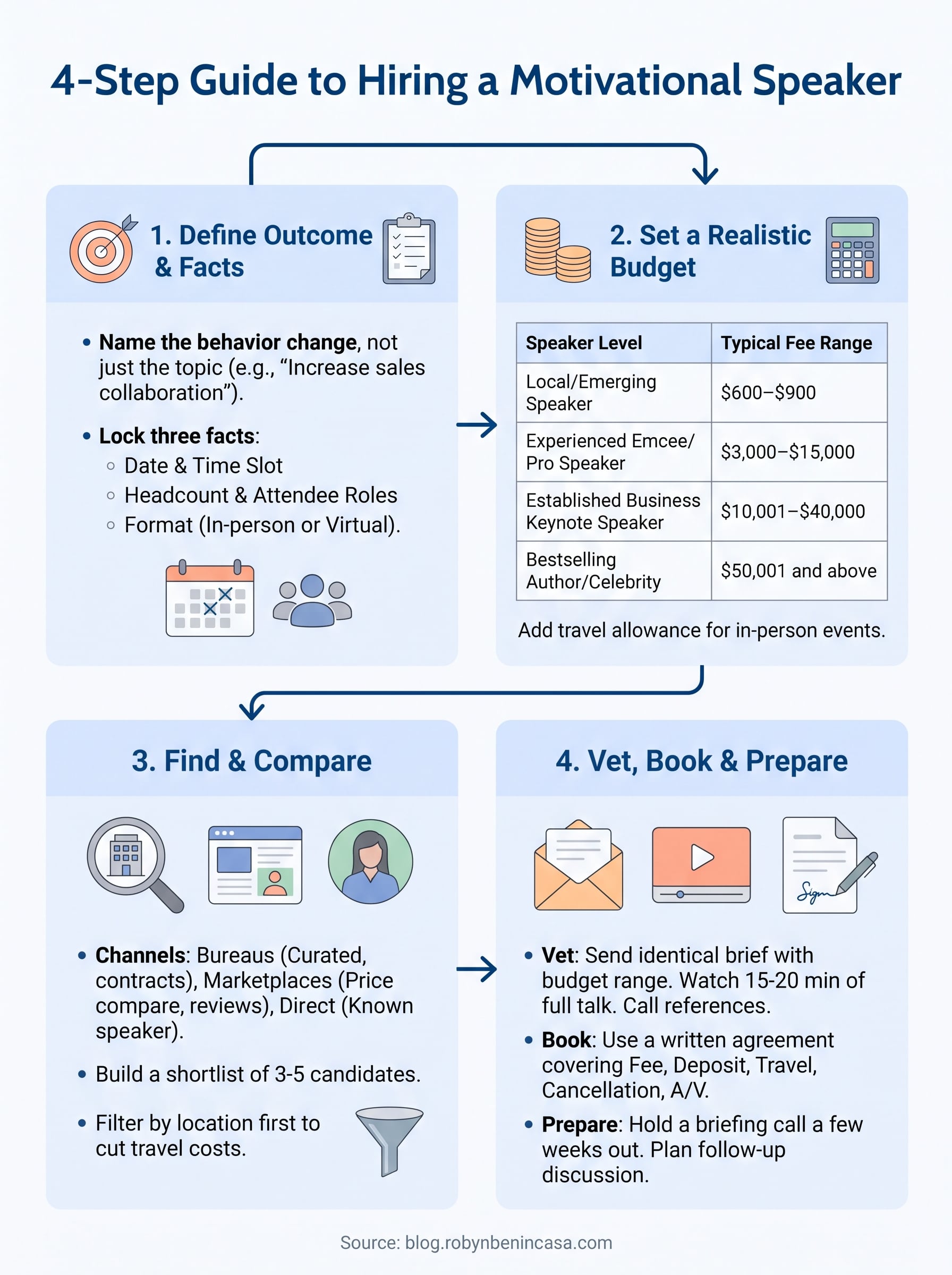
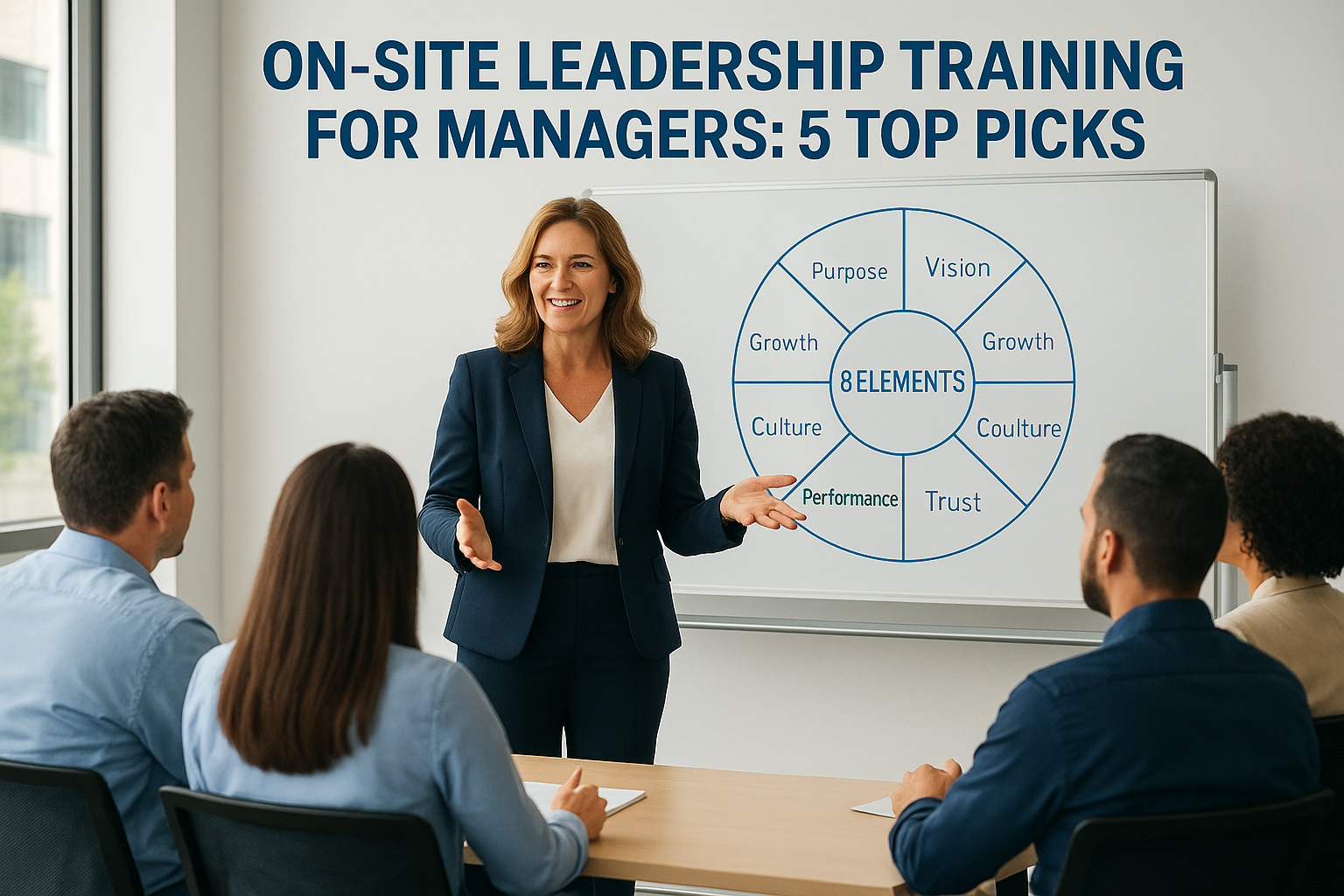
The fastest way to hire a motivational speaker is to work in four steps. Set a budget and a specific outcome. Find candidates through a speaker bureau, an event marketplace, or the speaker’s own team. Vet a shortlist of three to five with full-length video and references. Then book with a written agreement. Fees run from a few hundred dollars for local talent to $50,000 and above for household names, and the best speakers book months ahead.
The problem is that a search returns thousands of profiles and very few straight answers. Many listings say "please inquire" instead of showing a price, and fees span two orders of magnitude. It is easy to book someone charismatic on stage whose message the room forgets by lunch. The keynote is the one session everyone attends, so a weak choice is expensive.
Robyn Benincasa has spoken with Fortune 1000 organizations for two decades, and the steps below reflect what a well-run booking looks like. You will get a goal-to-topic table, a price table, a channel comparison, a copy-ready inquiry email, and a contract checklist.
What to settle before you search
Before you contact anyone, decide what the room should do differently after the talk, and fix three facts: the date, the audience size, and the format. Speakers and agents will ask for all of these in the first reply.
Name the outcome, not the topic
"Motivational" can mean a comedian, an Olympian, a CEO, or a researcher. Start from the result you need. "Our reps miss targets when they work alone" is a brief a speaker can answer. "We need motivation" is not. Match your situation to a topic, then ask candidates how they cover it.
Your situation
Topic to request
Example keynote format
Sales kickoff, competitive team
Winning together, high performance
Why Winners Win (30–60 min)
Culture reset, silos, merger
Team culture
Extreme T.E.A.M.W.O.R.K. (45–60 min)
AI change, industry disruption
Adapting as a team
Adapt, Overcome, and Win as One (45–60 min)
Tough year, stretch goals
Resilience and perseverance
Inspiring Greatness through G.R.I.T. (45–60 min)
A good brief names a behavior change, not a feeling.
Lock the three facts every speaker will ask for
Give each candidate the event date and time slot, the headcount and attendee roles, and whether the talk is in person or virtual. Many keynotes run 30 to 60 minutes, so decide whether you also want Q&A or a breakout. A virtual format widens your pool, because location stops mattering.
Step 1. Set a realistic budget
Expect to pay roughly $600 to $900 for a local or emerging speaker booked through an event marketplace, and $10,000 to $40,000 for an established business keynote speaker. Names that everyone recognizes start at $50,000. Published fees vary a lot by channel, so use the table as a starting range.
What speakers charge
Speaker level
Typical fee
Where you see it
Local or emerging speaker
$600–$900 average
Event marketplaces
Experienced emcee or professional speaker
$3,000–$15,000 per event
Marketplace listings of established performers
Established business keynote speaker
$10,001–$40,000
Speaker bureau fee bands
Bestselling author, executive, or celebrity
$50,001 and above, or "please inquire"
Speaker bureaus
A reasonable fee is one that fits the band of speakers who have solved your kind of problem. Fame, topic demand, and travel distance push the price up. A virtual talk usually costs less than an in-person one because there is no travel.
A worked budget example
Say you run a 300-person sales kickoff and aim for the $10,001 to $20,000 band. Set aside $15,000 for the fee. Add a planning allowance of $1,500 to $3,000 for flights, hotel, and ground transport if the speaker travels. Your all-in speaker line is $16,500 to $18,000. The allowance is a rule of thumb, not a quote, so confirm what each speaker’s fee includes.
The fee is only the starting number, and travel and extras decide the total.
Step 2. Find and compare speakers
To book a motivational speaker, search three channels: speaker bureaus or agencies, event marketplaces, and the speaker’s own team. Which one fits depends on how much help you want and how well you already know who you want.
Fees often hidden behind "please inquire." Ask how the bureau is paid.
Event marketplace
Comparing prices, reviews, and local talent fast
Quality varies. Check verified bookings and read the full reviews.
Direct booking
You already know the speaker you want
You handle comparison and paperwork yourself.
Build a shortlist of three to five
Most listings of motivational speakers for hire let you filter by city, state, topic, and fee. Use the location filter first. A local speaker cuts travel cost and often knows your regional industry. If the event is virtual, drop the filter and search nationally.
Then narrow to three to five candidates with experience in your industry and audience size. That is enough to compare and few enough to vet properly.
Three to five candidates is enough to compare and few enough to vet properly.
Step 3. Vet your shortlist
To hire motivational speakers well, send every candidate the same brief, then check their claims against full-length video and references. The goal is to learn how each speaker performs for an audience like yours.
Send one brief to every candidate
An identical brief makes answers comparable. Stating your budget range saves everyone time. A speaker who responds with a better idea for your goal, rather than a generic pitch, is usually the stronger choice.
Subject: Keynote inquiry for [event name], [date]

Hi [name or team],

We are planning [event name] on [date] in [city or virtual] for about [number] [attendee roles].

Goal: [one sentence, e.g., help regional sales teams share leads and work as one team after a tough quarter].
Slot: [length] keynote at [time], with [Q&A / no Q&A].
Budget: [fee range] for the speaker, travel handled [by us / by the speaker].

Could you tell us:
1. Your availability on that date
2. Your fee and what it includes
3. How you customize the talk for our audience
4. Who we would speak with before the event

Thanks,
[Your name, company, phone]
Watch full talks and call references
Demo reels flatter everyone. Watch 15 to 20 minutes of a full talk to a similar audience. Then call one or two planners who booked the speaker for a comparable event. Ask whether the speaker arrived prepared, kept to time, and whether anything stuck with the team three months later.
Pay attention to customization. A speaker who asks about your team’s real challenges before quoting a price is worth more than one with a polished script.
A demo reel shows the speaker at their best, while a full talk and a reference show how they perform for you.
Step 4. Book and prepare
Book as early as your date allows. In-demand speakers can be booked 8 to 10 months ahead, although 60 days can work if you stay flexible on the speaker. Once you choose, put every term in a signed agreement.
What the agreement must cover
Date, start time, and keynote length
Fee, deposit, and payment schedule
Who pays for travel and lodging, and what is capped
Cancellation and rescheduling terms for both sides
Recording and sharing rights for the talk
Audio-visual and room requirements
A pre-event call with you or your planning team
Prepare the day itself
Hold a 20 to 30 minute briefing call a few weeks out. Share attendee roles, recent wins and setbacks, topics to avoid, and the agenda around the keynote. Run a tech check the day before, and send your host a short introduction to read.
Plan the follow-up too. Ask each team to discuss one idea from the talk within the following week. That is what turns an inspiring hour into a change in behavior.
Signed terms protect the date, and a briefing call protects the message.
Booking with confidence
To hire a motivational speaker well, start with the outcome you want. Set a budget that includes travel, compare bureaus, marketplaces, and direct options, and vet three to five candidates with full talks and references. Book early and put the terms in writing.
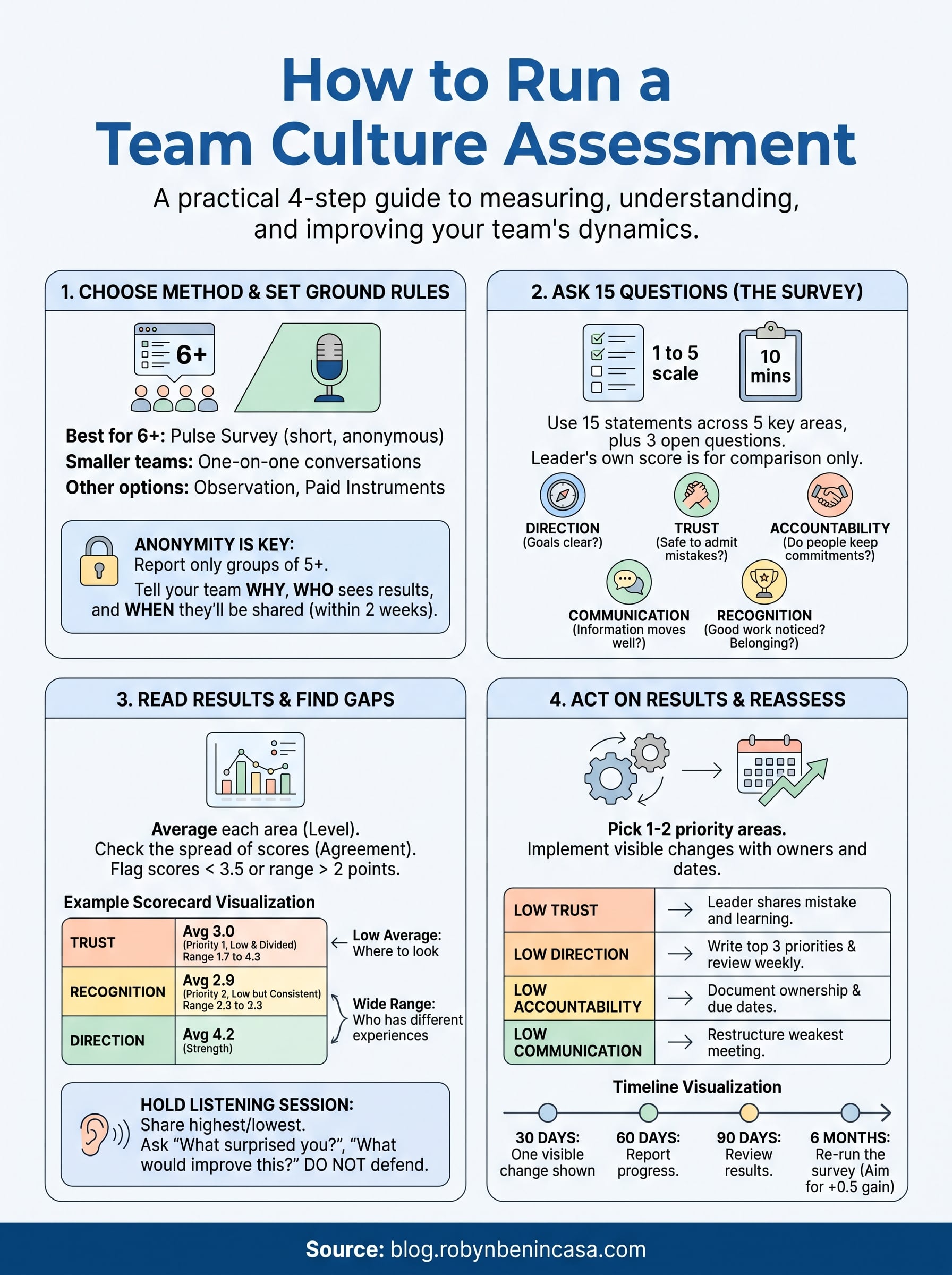
To run a team culture assessment, pick a method, ask your team 15 short rating questions across five areas, find the lowest and most divided scores, and commit to one or two visible changes. Then repeat the same questions six months later. The whole cycle takes about three weeks of light effort, and you can do it with a free survey tool.
Most leaders sense a problem long before they can name it. People go quiet in meetings, deadlines slip, and the same disagreement keeps coming back. Gut feel tells you something is off, but not what or where to start. Many assessments fail for one reason: they produce a report, and nothing changes afterward.
This guide walks through the full process, from a plain definition to a copy-ready question set, a worked example of reading the scores, and a plan for acting on them. Robyn Benincasa has spent more than 20 years as a San Diego firefighter and led adventure racing teams to world championship level. Those are settings where culture has real consequences, and they shape the practical approach here.
What a team culture assessment measures and when to run one
A team culture assessment is a structured check on how your team really works together, built from survey scores, conversations and observation. It compares the culture you describe with the culture people experience day to day.
The five areas worth scoring
Culture is too broad to measure as one number, so split it. This guide scores direction (do people know the goals), trust (can they speak up and admit mistakes), accountability (do people keep commitments), communication (do information and conflict move well), and recognition (does good work get noticed, and do people belong).
Some frameworks sort whole organizations into types instead. The Competing Values Framework uses four quadrants: collaborate, create, control and compete. That helps you name a company style. For a single team, scores you can track and change are more useful.
You cannot fix "culture" in general, but you can raise a score for trust or recognition.
Signs it is time to run one
Run an assessment when something changes or something repeats. Common triggers:
A new leader, merger or reorganization has changed how the team works
The same conflicts or missed deadlines keep returning
Turnover or absenteeism is climbing
Remote or hybrid work has changed how people communicate
You have never measured it, and a yearly baseline would help
Step 1. Choose your method and set ground rules
For most teams of six or more, the best method is a short anonymous survey followed by a listening session to explain the numbers. Smaller teams should skip the survey and use one-on-one conversations.
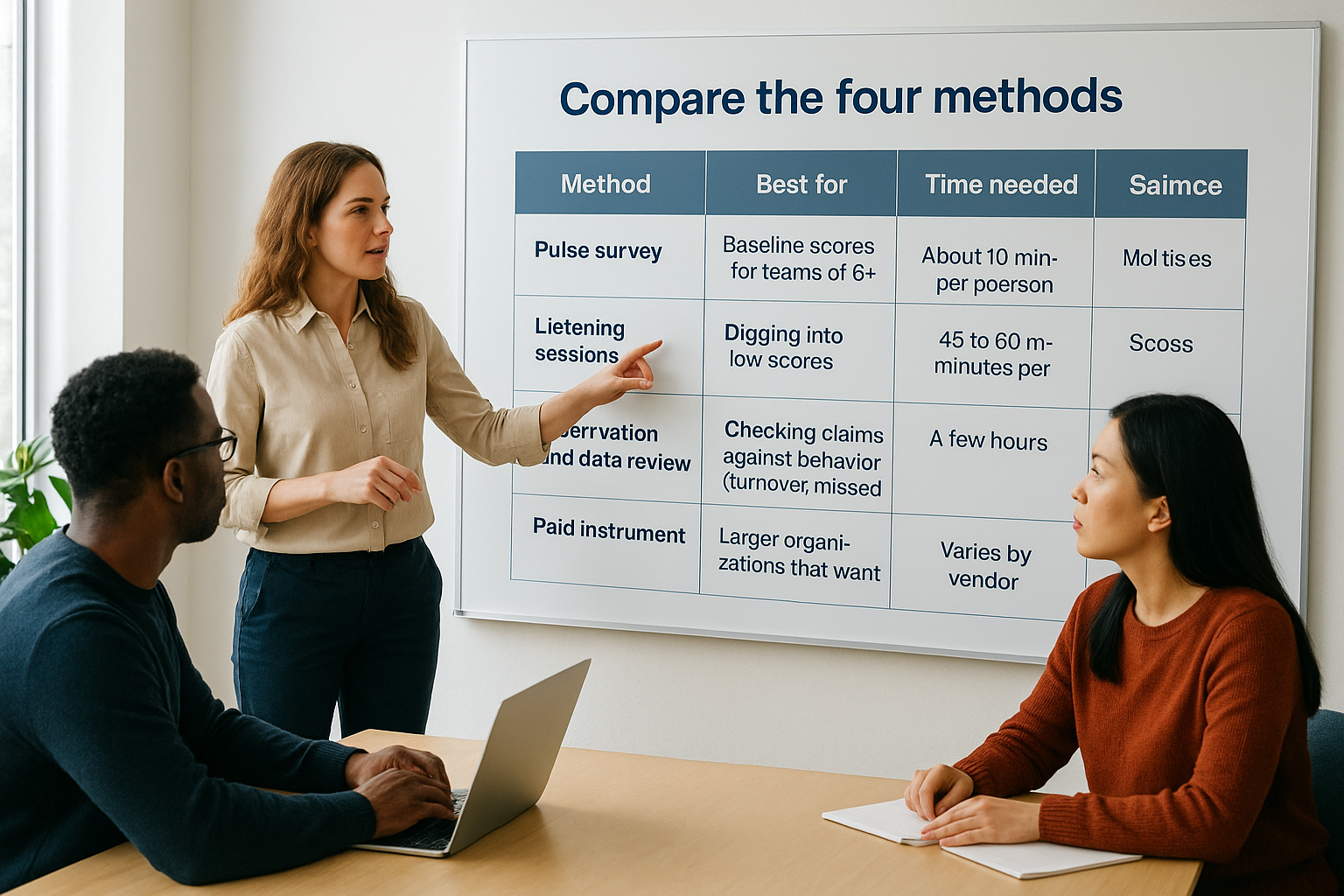
Compare the four methods
Method
Best for
Time needed
Main limit
Pulse survey
Baseline scores for teams of 6+
About 10 minutes per person
Shows what, not why
Listening sessions
Digging into low scores
45 to 60 minutes per session
People hold back with the boss in the room
Observation and data review
Checking claims against behavior (turnover, missed deadlines, meeting habits)
A few hours
Indirect evidence
Paid instrument (for example, Denison or Five Behaviors)
Larger organizations that want benchmarks
Varies by vendor
Cost, and it works best with a facilitator
Set ground rules before you send anything
Tell your team why you are asking, who will see the results, and when you will share them. Promise results within two weeks of the survey closing, then keep that promise. Silence after a survey teaches people that honesty is pointless.
Protect anonymity. Collect no names, and report only groups of five or more so no one can be identified from a score. If your team is smaller than five, use conversations instead.
People answer honestly only when they believe the answers will be used and cannot be traced.
Step 2. Ask these 15 questions
Use 15 statements rated from 1 (strongly disagree) to 5 (strongly agree), three per area, plus three open questions. This works as a team culture assessment template and takes about 10 minutes to complete.
Copy-ready sample questions
Paste this into Google Forms or Microsoft Forms and set the rating questions to a 1 to 5 scale.
Rate each statement: 1 = Strongly disagree, 5 = Strongly agree

DIRECTION
1. I can explain our team's top three priorities this quarter.
2. I know how my work contributes to those priorities.
3. Decisions on this team are consistent with our goals.

TRUST
4. I can admit a mistake without fear of blame.
5. I can disagree with the team lead and be heard.
6. Teammates support each other when work gets hard.

ACCOUNTABILITY
7. People on this team do what they say they will do.
8. Expectations for my role are clear.
9. Missed commitments are addressed directly and fairly.

COMMUNICATION
10. I get the information I need on time.
11. Conflict gets resolved, not avoided.
12. Our meetings are a good use of my time.

RECOGNITION
13. Good work gets noticed here.
14. I feel I belong on this team.
15. I can see a future for myself here.

OPEN QUESTIONS
A. What is one thing this team should keep doing?
B. What is one thing that gets in your way?
C. If you could change one thing about how we work together, what would it be?
Send it and collect responses
Keep the window to one week and send a single reminder on day three. Explain in the invitation that the survey is anonymous and takes about 10 minutes. Do not ask for names, and skip demographic questions on small teams, because they make people traceable.
Answer the survey yourself, but keep your scores out of the team average. Compare them later. A leader who rates trust at 5 while the team averages 3 has found the most important gap in the whole exercise.
A leader’s own scores matter most when they differ from the team’s.
Step 3. Read the results and find the gaps
Average each area, check how widely people disagreed, and flag any area that scores below 3.5 or has a range wider than 2 points. Averages show the level, and the range shows whether the team shares one experience.
Score each area
First average the three questions for each person. Then average those results across the team. Look at a single item to see the effect of spread: if eight people score question 4 as 5, 4, 4, 3, 3, 2, 2 and 1, the total is 24 and the average is 3.0. The range is 4 points, so some people feel safe admitting mistakes and others clearly do not.
A sample result for a team of eight looks like this:
Area
Average
Lowest to highest
Reading
Direction
4.2
3.7 to 4.7
Strength, keep it
Trust
3.0
1.7 to 4.3
Priority one, low and divided
Accountability
3.6
3.0 to 4.0
Acceptable, watch it
Communication
3.8
3.3 to 4.3
Acceptable
Recognition
2.9
2.3 to 3.3
Priority two, low but consistent
A low average tells you where to look, and a wide range tells you who is having a different experience.
Look for the story behind the numbers
Read the open answers next and group them into themes. Then hold a 45-minute listening session. Share the two highest and two lowest areas, and ask: "What surprised you?" and "What would make this score higher?" Take notes, and do not defend yourself. If trust scored low, your reaction in that room is the real test.
Step 4. Act on the results and reassess
Choose no more than two priority areas, give each a visible change with an owner and a date, and re-run the same 15 questions in six months. More than two priorities dilutes effort and tells the team that nothing is really a priority.
Turn low scores into specific changes
Match the fix to the symptom:
Low area
First move
Direction
Write the top three priorities on one page and review them in every weekly meeting
Trust
Leaders share a recent mistake and what they learned, then open meetings with "what did not go well"
Accountability
Document who owns each commitment and its due date, and address misses privately and promptly
Communication
Cut or restructure the weakest recurring meeting and set a clear rule for urgent messages
Recognition
Add a weekly shout-out and name specific work, not general praise
Track progress and keep momentum
Show one visible change within 30 days, report progress at 60 days, and review results at 90. Then re-run the survey after six months and aim for a gain of at least 0.5 points in each priority area. If a score has not moved, change the action, not the question.
Some teams also benefit from a shared reset moment before the work begins. Robyn’s Extreme T.E.A.M.W.O.R.K. keynote runs 45 to 60 minutes and teaches the 8 elements of a winning culture. It helps only when it is followed by concrete changes like those above.
Scores improve when a leader changes visible behavior, and rarely because of a presentation alone.
Start with one honest score
A team culture assessment is simple: choose a method, protect anonymity, ask 15 clear questions, read both averages and spread, and act on no more than two areas. The value is not the report. It is the conversation that follows and the changes your team can see within a month.
You do not need a large budget or a consultant to begin. A free survey form, an hour of listening and the willingness to hear a low score from your own team are enough. Run it, share what you find, and fix one thing visibly.
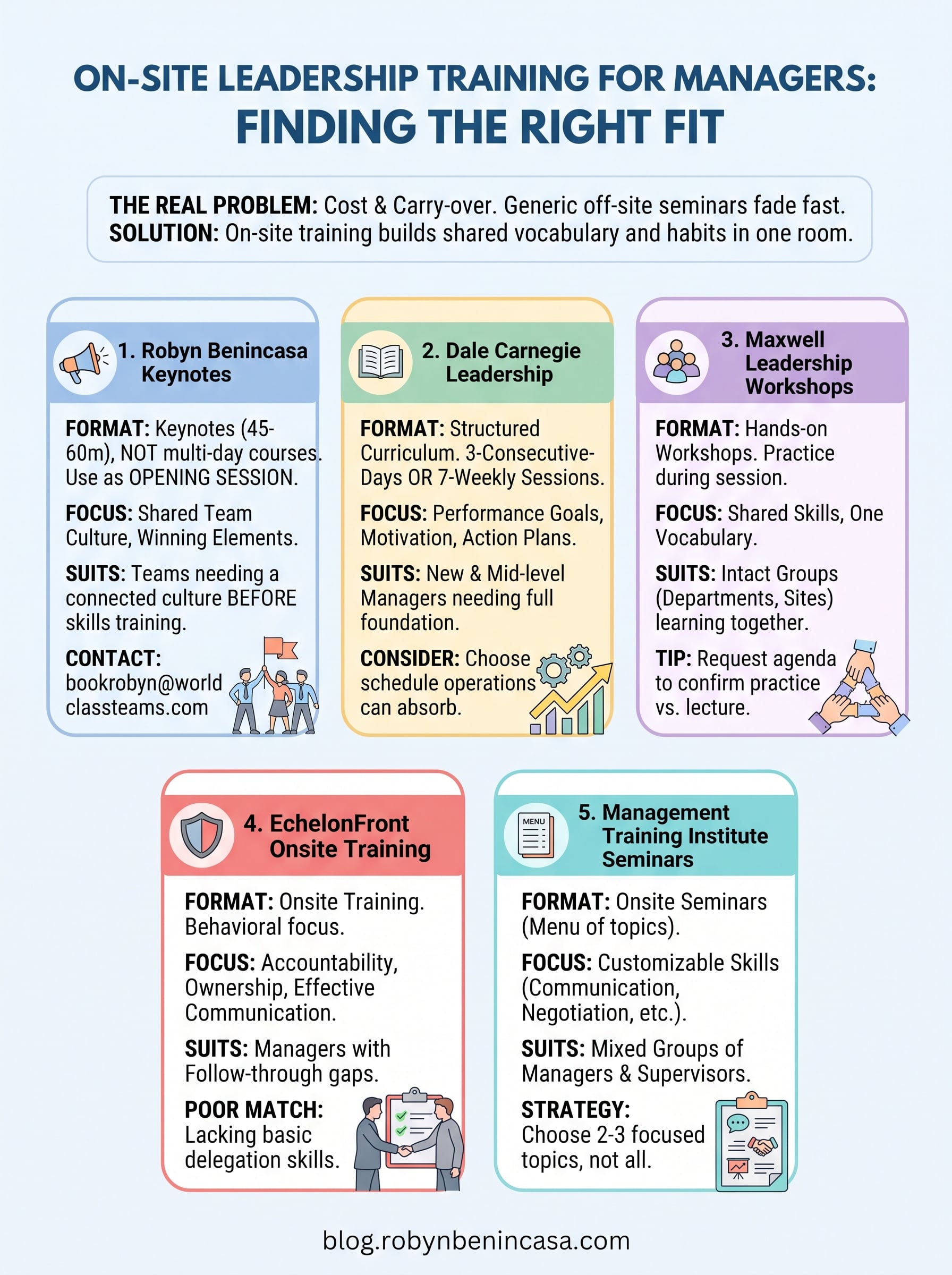
The best on-site leadership training for managers fits the managers’ level and the one behavior you need to change. Dale Carnegie suits new and mid-level managers who need a full curriculum, including a three-day format. Maxwell Leadership and EchelonFront suit groups that need one shared standard fast. Management Training Institute suits mixed groups of managers and supervisors who need several skills. Robyn Benincasa’s keynotes suit teams that need a shared culture before any skills training starts.
The real problem is cost and carry-over. Sending managers away takes them off the floor, and a generic public seminar fades within weeks because nobody back at work heard the same ideas. Training that comes to your workplace puts managers, supervisors and their leaders in one room, using one vocabulary.
Below are five options, each judged on how it works, who it suits, and what to confirm before you book. Robyn comes first because this is her blog, but she delivers keynotes, not multi-day courses, and her entry says so plainly. Use the other four to build the skills layer.
1. Robyn Benincasa keynotes for management teams
How it works
Robyn’s talks are keynotes, not multi-day courses. She spent 23+ years as a San Diego firefighter and led world championship adventure racing teams for 17 years. Her talks teach the 8 elements of a winning team culture, drawn from her New York Times bestseller Make Winning Inevitable. They use storytelling and video, so a talk works as the opening session of a management program rather than the whole program.
Keynote
Length
Built for
Extreme T.E.A.M.W.O.R.K.
45–60 min
Teams facing next-level challenges that need a connected culture
Adapt, Overcome, and Win as One
45–60 min
AI transformation, industry disruption, culture resets
Why Winners Win
30–60 min
Sales meetings, revenue kickoffs, competitive teams
Inspiring Greatness through G.R.I.T.
45–60 min
Teams facing adversity, tough years, stretch goals
Who it suits
Choose this when your managers and supervisors need a shared reason to work as one team before they learn techniques. Robyn has worked with Fortune 1000 organizations for two decades, and clients include Boston Scientific and Addepar.
Skip it if your goal is skills practice, such as running one-on-ones or giving feedback. A keynote sets the standard for how managers lead together, and a workshop provider from this list builds the habits.
A keynote sets the standard for how managers lead together. A workshop teaches them the mechanics.
Format and booking
Keynotes are available in person at your site or virtually. To check dates and request a quote, email bookrobyn@worldclassteams.com.
A practical setup is a keynote to open the day and a skills workshop after it. That way managers hear why the team standard matters before they practice how to meet it.
2. Dale Carnegie Leadership Training for Managers
How it works
Dale Carnegie’s course is a structured curriculum, not a motivational talk. It is built around the "5 Drivers of Leadership Success" and an eight-step planning process for defining performance goals. The company has been teaching for more than 100 years.
Managers leave with:
A performance-goal plan built through the eight-step process
Methods to motivate their teams and strengthen trust
An action plan that ties organizational objectives to individual development goals
Who it suits
This course targets new and mid-level managers who must coach their people, align goals and drive engagement. It is the clearest answer if you want leadership training for managers in three days, because a three-consecutive-day format is one of its two schedules.
Do the math before you choose a schedule. Twelve managers in a three-day format means 36 manager-days away from daily work. The seven-week format spreads the same cohort over weekly sessions, so no single week loses everyone for long.
Pick the schedule that your operations can absorb, not the one that looks shortest on paper.
Format and booking
The course page lists in-person delivery, either once a week for seven weeks or over three consecutive days. Groups of 10 or more employees can use the inquiry form on the course page.
Before you commit, ask whether sessions can be held at your workplace or only at a Dale Carnegie location. Also ask how the follow-up on each manager’s action plan works.
3. Maxwell Leadership on-site workshops
How it works
Maxwell Leadership brings hands-on workshops to your people, so a whole team builds the same skills in the same room on the same day. The workshop format means managers practice during the session instead of only listening.
Ask for the agenda before you book and confirm:
Which leadership topics the session covers
How much of the time is practice versus lecture
What materials managers keep afterward
Who it suits
This option fits organizations that want managers and supervisors learning together. A shared session creates one vocabulary, so a supervisor and the manager above them stop describing the same problem in different words.
It works best for an intact group, such as a department, a site or a regional management team. It is a weaker fit for a single manager with a very specific gap, where coaching serves better.
Training the whole group at once is worth more than training its best individuals separately.
Format and booking
Delivery is at your location. Length, topics and group size are scoped with the provider, so request a written proposal.
When you compare quotes, put them on the same basis. Ask whether the price is per participant or a flat fee for the group, and whether travel is included.
4. EchelonFront onsite leadership training
How it works
EchelonFront’s onsite training focuses on building high-performing teams through accountability, ownership and effective communication. The program targets behavior more than theory, so the question for you is whether your managers’ problem is behavioral.
Good signs that it fits: commitments slip without anyone owning them, problems travel upward instead of getting solved, or handoffs between teams break down.
Who it suits
Managers and supervisors whose main gap is follow-through are the best match. If your people know what to do but do not do it consistently, accountability training addresses the real issue.
It is a poorer match for managers who lack basics such as delegating or running a meeting. For them, a broader curriculum like Dale Carnegie’s comes first.
Accountability training helps only when the managers already know the work and are not owning the result.
Format and booking
The training is delivered at your site. Ask how many sessions the engagement includes, how long each runs, and how the provider reinforces the lessons once they leave.
Also request a sample agenda. Compare it with the specific failures you want to fix, and drop the provider if the agenda does not name them.
5. Management Training Institute onsite seminars
How it works
Management Training Institute offers onsite seminars that cover management skills, leadership skills, communication, negotiation and presentation skills. It works like a menu. You pick the topics that match your managers’ gaps instead of buying one fixed course.
Who it suits
HR leaders building a program for a mixed group of managers and supervisors get the most from this model. A new supervisor may need communication basics while a senior manager needs negotiation, and one menu can serve both.
Choose two or three topics, not all of them. A program with a clear focus beats a sampler where nothing sticks.
A short list of well-chosen topics beats a long menu every time.
Format and booking
Seminars are delivered at your workplace. If you want a multi-day block, ask whether the provider can sequence three topics into three consecutive days, one topic per day.
Request the topic outlines in writing, then match each one to a problem you can name. If you cannot name the problem, the topic does not belong in your program.
Choosing the right program for your managers
Start with the gap, not the brand. Use a keynote for culture, a full curriculum such as Dale Carnegie’s for new managers, a workshop or accountability program for a team that must change together, and a seminar menu for a mixed group of managers and supervisors. Whatever you choose, make sure the whole group attends together and that someone owns the follow-up.
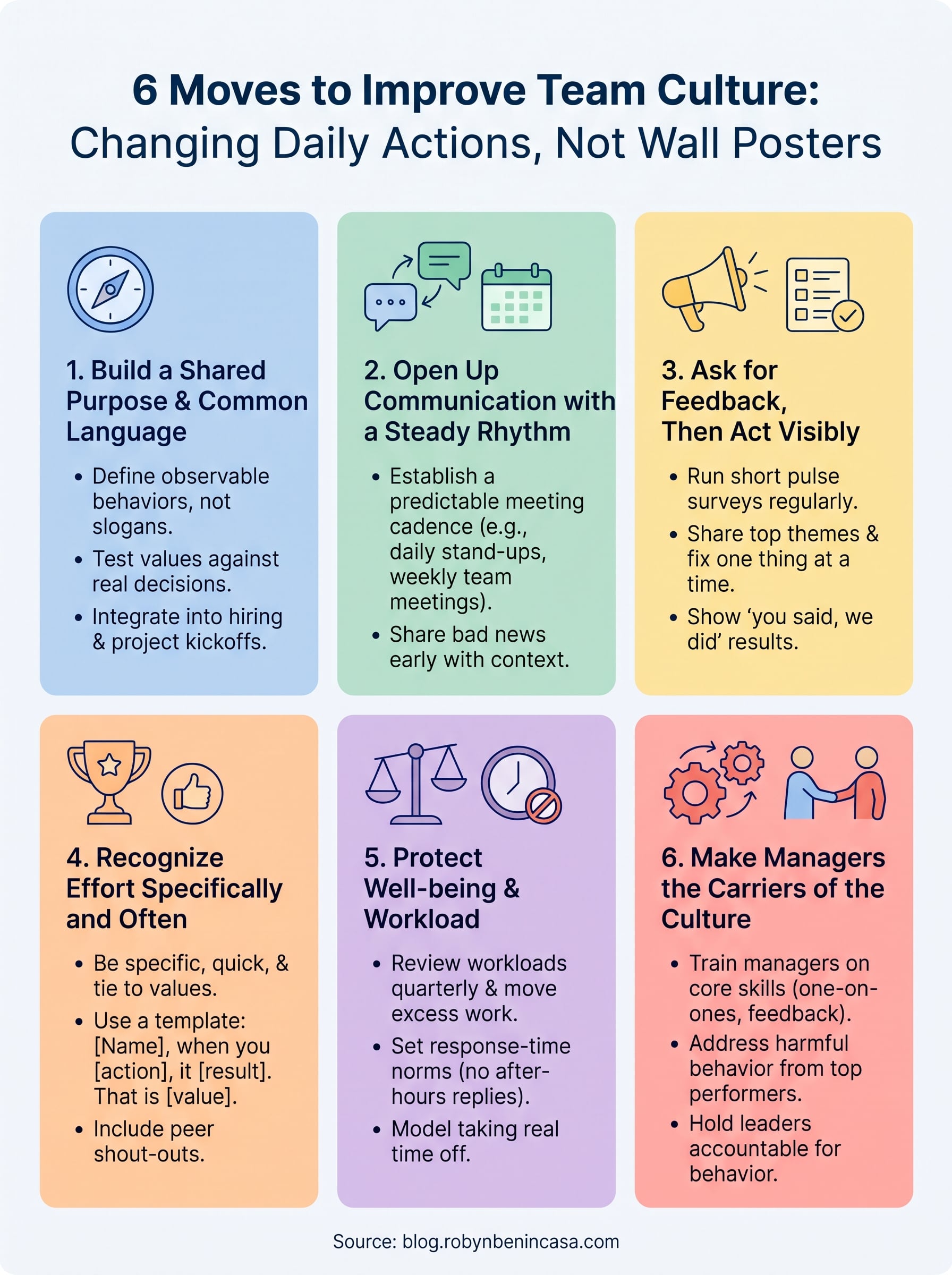
The most reliable way to improve team culture is to change what people do every week, not what the wall poster says. The six moves below do that: a shared purpose, steady communication, real feedback, specific recognition, protected well-being, and managers who model the culture. If your team is new or drifting, start with purpose and communication. If trust is low, start with feedback. If morale is flat, start with recognition and well-being. If your managers are the bottleneck, start with the last item.
Most advice on improving team culture reads like a menu of perks. Pizza Fridays and a trivia night will not fix unclear priorities, silent leaders, or a workload nobody can sustain. Culture is simply how things get done around here, and people read it from what gets rewarded, what gets ignored, and what leaders do under pressure.
This guide draws on the team-culture lessons of Robyn Benincasa, a San Diego firefighter and world champion adventure racer who teaches organizations how to build winning teams. Each of the six ways follows the same format, so you can compare them quickly: why it works, then how to start this month.
1. Build a shared purpose and a common language
A team culture improves fastest when everyone can say what the team is trying to win and how its members agree to treat each other. Start there before you touch perks, rituals, or policies.
Why it works
Values that stay abstract get ignored. Values written as observable behaviors get used, because people can point to them in a meeting. In adventure racing, a team stays together for days of racing, so a shared goal is not optional. Office teams are no different, they just hide the cost of misalignment better.
A value only counts when you can see it in a Tuesday afternoon decision.
How to start
Pick three to five behaviors, not slogans, and test them against real decisions. Then build them into the work:
Write each value as a behavior, such as "We raise problems early" instead of "Integrity."
Add one value to every hiring scorecard and every project kickoff.
Open your weekly meeting by naming one moment where the team lived a value.
Consider an outside spark. A keynote like Extreme T.E.A.M.W.O.R.K., which runs 45 to 60 minutes and teaches the 8 elements of a winning culture through storytelling and video, can launch the conversation.
Watch out for the one-and-done kickoff. A talk or offsite only works when managers reinforce it in the weeks that follow.
2. Open up communication with a steady rhythm
Better communication comes from a predictable schedule, not from telling people to communicate more. Decide what gets shared, how often, and in which setting.
Why it works
When leaders go quiet during a reorganization, a layoff, or a missed target, gossip fills the gap. People assume the worst when they hear nothing. A set rhythm tells the team that information will arrive, so they stop hunting for it.
Silence from leadership is never neutral, because the team writes its own story.
How to start
Use a simple cadence and keep it for at least a quarter before judging it:
Rhythm
Format
Purpose
Daily
10-minute stand-up or written update
Priorities and blockers
Weekly
30 to 45 minute team meeting
Wins, decisions, what is changing
Weekly or biweekly
30-minute one-on-one
Employee sets the agenda
Monthly
Open Q&A with the leader
Hard questions, answered live
Quarterly
Goal review
Explain the why behind changes
Share bad news early, with the reason and the next step. A leader who explains a decision people dislike earns more trust than one who only announces good news.
3. Ask for feedback, then act on it visibly
You improve team culture through feedback only when people see something change afterward. Ask regularly, share what you heard, and fix one thing at a time.
Why it works
Leaders usually guess what the team thinks. Anonymous input surfaces the issues people will not raise in a meeting, such as an unfair workload or a manager who plays favorites. Acting on it proves that speaking up is safe, which makes the next round of feedback more honest.
Asking without acting teaches people that honesty is a waste of time.
How to start
Run a short pulse survey every month or quarter instead of one long annual survey:
Ask five questions or fewer, such as "What slows you down most?" and "Do you know what success looks like this quarter?"
Keep responses anonymous and share the top three themes within two weeks.
Pick one fix, assign an owner, and report back with "you said, we did."
Add upward feedback so managers hear how they are doing.
The common mistake is collecting data and going silent. A survey with no follow-up does more damage than no survey at all.
4. Recognize effort specifically and often
Recognition works when it is specific, quick, and tied to your values. A vague "great job" feels like a pat on the head, while a precise note shows you noticed.
Why it works
Recognition tells people which behaviors the team actually rewards. When you praise a person for catching an error early, you reinforce the value of speaking up better than any poster could. It also costs almost nothing, which makes it the easiest culture move to repeat.
What you recognize is what you will get more of.
How to start
Use a simple three-part message within 48 hours of the behavior, and copy this template:
[Name], when you [specific action], it [result for the team or customer].
That is exactly what we mean by [team value]. Thank you.
Then build the habit around it:
Add a two-minute peer shout-out segment to your weekly meeting.
Celebrate milestones such as work anniversaries and project launches.
Ask each person how they like to be recognized, since some dislike public praise.
Avoid rewarding only the loudest or highest-revenue people. Quiet contributors who hold the team together deserve a name in the room too.
5. Protect well-being and workload
A healthy team culture needs workloads people can sustain. If your team is stretched, no recognition program will make up for it.
Why it works
Chronic overload, unclear roles, and constant urgency are common causes of burnout, and burnout spreads through a team quickly. Exhausted people stop sharing ideas, stop helping each other, and eventually leave. Protecting capacity is a culture move, not a perk.
A team that is always sprinting is not building culture, it is spending it.
How to start
Begin with honest numbers on who is carrying too much, then set norms leaders actually follow:
Review workloads each quarter and move work off anyone who is over capacity.
Set response-time norms, such as no expectation of replies outside working hours.
Use a weekly check-in question: "What is your capacity this week, from 1 to 10?"
Model time off. When the manager takes a real vacation, the team believes it is allowed.
Skip the wellness app on top of an impossible workload. Tools help only after the load is fair.
6. Make managers the carriers of the culture
Managers shape team culture more than any program does, so train and measure them. Gallup research attributes about 70% of the variance in team engagement to the manager.
Why it works
Employees judge culture by their direct manager’s behavior, not by the company values page. A manager who handles conflict fairly, admits mistakes, and follows through makes the whole system credible. A manager who tolerates a bullying top performer undoes years of good work in a week.
People copy what leaders do, not what leaders say.
How to start
Treat management as a skill that needs practice, then hold people to it:
Use the upward feedback from item 3 as part of manager reviews.
Address harmful behavior from high performers quickly and visibly.
Have leaders go first. Share a recent mistake and what you learned from it.
The usual error is promoting your best individual contributor into management with no preparation. Great performers often need new skills to lead well.
Pick one move and run it for a quarter
You do not need all six at once. Choose the one that matches your biggest gap, run it for a full quarter, and check whether people behave differently. Culture changes through repetition, so a small habit kept up beats a big launch that fades.
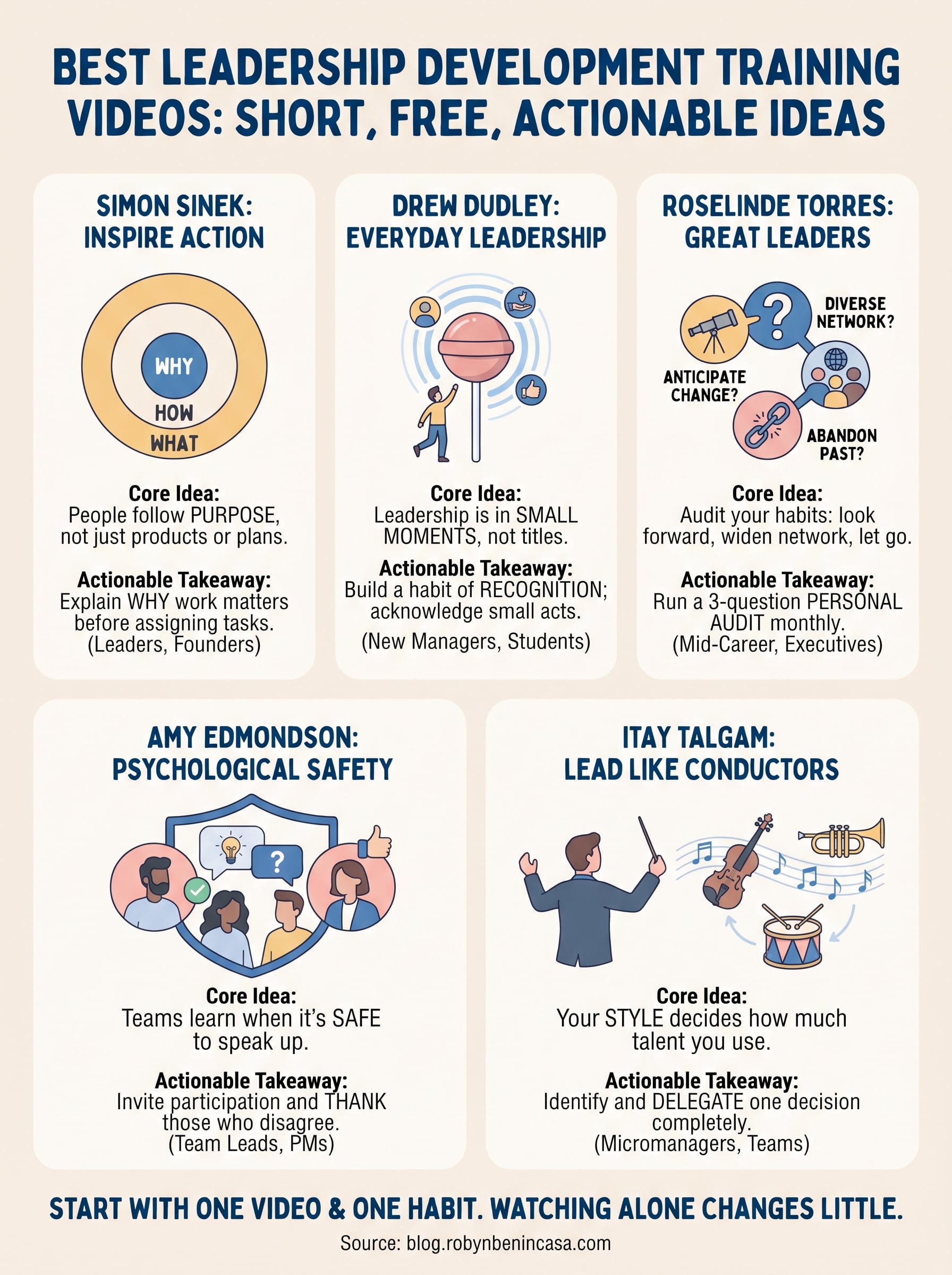
The best leadership development training videos are short, free, and built around one idea you can try the same day. If you are a new manager, start with Drew Dudley’s six-minute talk on everyday leadership. If you want your team to speak up, watch Amy Edmondson on psychological safety. If you need to set direction, watch Simon Sinek. If you are preparing for a bigger role, watch Roselinde Torres. If you want to change how you run meetings, watch Itay Talgam.
Most searches for this topic return hour-long lectures and motivational montages. They feel good for ten minutes and change nothing on Monday. I picked these five on three tests. Each is free, each runs about 20 minutes or less, and each teaches a behavior you can name and practice. Search the title and speaker on YouTube or TED’s site to find it.
Each entry covers what the video teaches, who it suits, and how to use it with a team. That last part comes from experience. Robyn Benincasa, a world champion adventure racer and longtime San Diego firefighter, builds her keynotes around stories and video clips that start team conversations. A clip only develops leaders when people discuss it afterward.
1. Simon Sinek: How great leaders inspire action
Simon Sinek’s TED talk is the best starting point for leaders who must explain why their team exists. It runs about 18 minutes and is free.
What it teaches
Sinek introduces the Golden Circle: why, how, and what. Most organizations communicate from the outside in, starting with what they sell. Sinek argues that great leaders start from the inside, with the purpose that makes people care. He backs this with Apple, the Wright brothers, and Martin Luther King Jr., who gave a speech about a dream rather than a plan.
Speaker: Simon Sinek, author and leadership speaker
Format: TEDx talk, about 18 minutes
Core idea: People follow a clear purpose before they follow a product or a plan
Leaders earn commitment by explaining why the work matters before they explain what to do.
Who it suits and how to use it
This video suits leaders who must set direction, such as new team leads, department heads, and founders. It also helps anyone whose team follows instructions without understanding the goal.
After watching, ask each person to write one sentence that begins "We do this work because…" for a current project. Compare the answers. Mismatched answers show you where your purpose is unclear, and that gap is the real lesson.
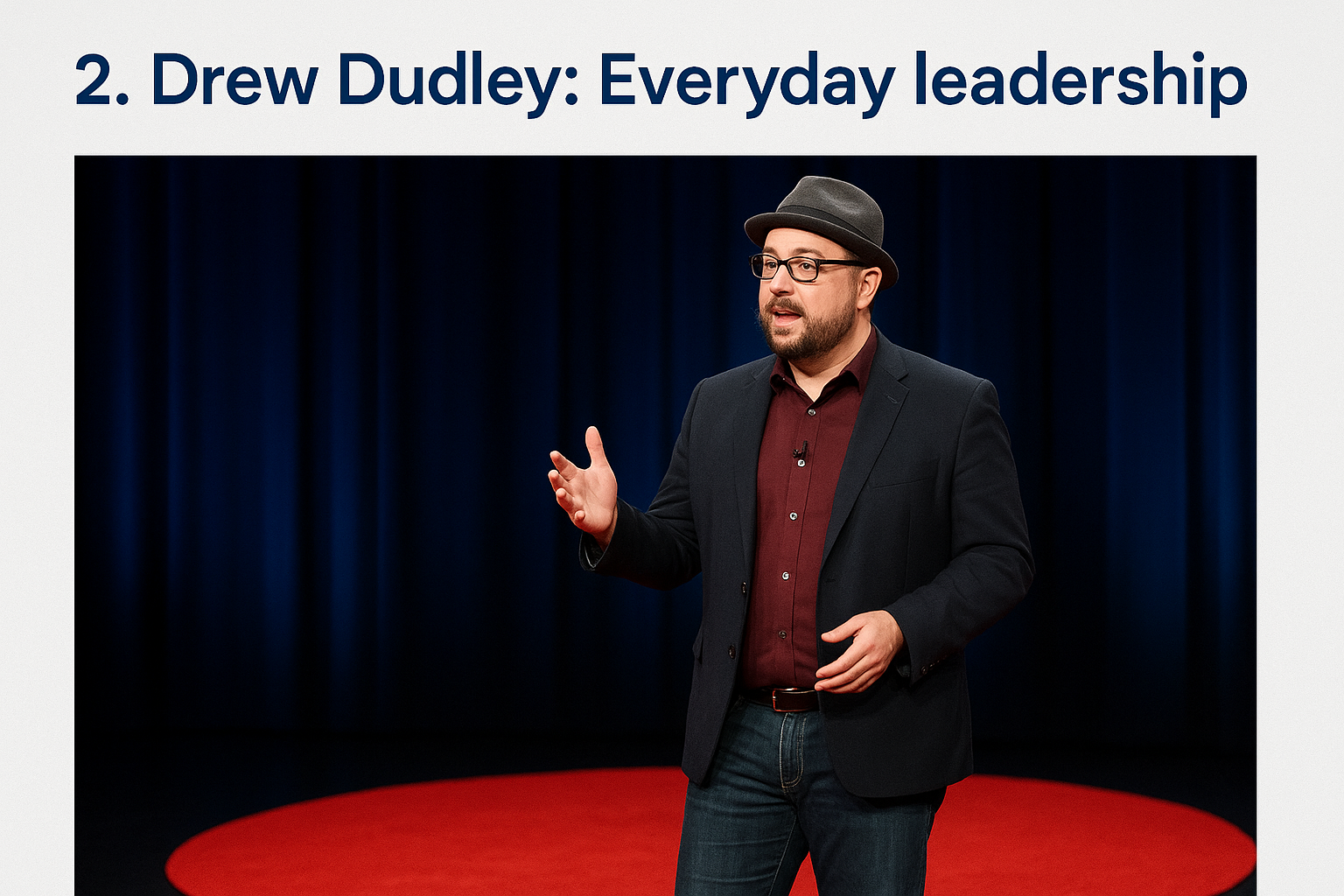
2. Drew Dudley: Everyday leadership
Drew Dudley’s TEDx talk is the best short leadership video for students and first-time managers. It runs about six minutes, so you can use it in the first five minutes of a meeting.
What it teaches
Dudley argues that we make leadership too big. We picture a title or a grand achievement, so ordinary people dismiss themselves as leaders. He tells the story of a small act, a lollipop moment, that someone remembered for years while he had forgotten it. His point is that leadership is a series of small moments in which you make someone’s day better.
Speaker: Drew Dudley, leadership educator
Format: TEDx talk, about six minutes
Core idea: Leadership is built from everyday moments, not from rank
You do not need a title to lead, only a willingness to act in the small moments.
Who it suits and how to use it
It suits students, early-career staff, and new managers who do not yet see themselves as leaders. It also works for teams that wait for permission to take initiative.
Play it at the start of a team meeting. Then ask everyone to name one person who made their work easier this month. Have them tell that person directly. The exercise takes ten minutes and builds a habit of recognition that no policy can order.
3. Roselinde Torres: What it takes to be a great leader
Roselinde Torres gives you the most practical self-assessment in this list. Her TED talk runs about nine minutes and turns leadership development into three questions you can answer today.
What it teaches
Torres draws on years of watching leaders at work. She says the leaders who last ask different questions than the ones who stall. She boils them down to three:
Where are you looking to anticipate change?
How diverse is your network?
Are you courageous enough to abandon the past?
Each question is a habit. The first is about looking outside your own industry and desk. The second is about who you spend time with. The third is about letting go of methods that once earned you success.
Great leaders spend their time looking forward, widening their networks, and dropping what no longer works.
Who it suits and how to use it
This talk suits mid-career managers preparing for senior roles. It also suits executives who suspect their calendar has become too internal.
Run the three questions as a personal audit. Check your calendar for the last month. How many hours went to people outside your function? How many to learning about changes in your market? Write down one habit to drop. Review it with a peer or mentor in 30 days.
4. Amy Edmondson: Building a psychologically safe workplace
Amy Edmondson’s talk is the best video for leaders whose teams stay quiet in meetings. It runs about 11 minutes and explains why silence is expensive.
What it teaches
Edmondson is a Harvard Business School professor who studies teams. She defines psychological safety as a shared belief that you can speak up with ideas, questions, or mistakes without being punished. Her early research in hospitals found that better teams appeared to report more errors, because people felt safe saying so. In the talk she offers three moves for leaders: set the stage, invite participation, and respond productively.
Speaker: Amy Edmondson, Harvard Business School professor
Format: TEDx talk, about 11 minutes
Core idea: Teams learn and perform when people can speak up safely
A team that cannot admit mistakes cannot learn from them.
Who it suits and how to use it
It suits team leads, project managers, and executives who want honest information. It matters most when your team is under pressure, because that is when people stop talking.
Use her three moves in your next meeting. Open by saying the work has real uncertainty. Ask a specific question such as "What are we missing?" Then thank the first person who disagrees before you respond to the content. Small signals decide whether people speak up next time.
5. Itay Talgam: Lead like the great conductors
Itay Talgam’s TED talk is the best pick if you want to see leadership styles in action. It runs about 20 minutes, the longest in this list, and it rewards the time.
What it teaches
Talgam, a conductor and leadership teacher, shows clips of famous conductors at work. Each leads an orchestra differently. Some control every gesture, and others give musicians room to contribute and respond. He uses the contrast to ask how much space a leader gives people to bring their own skill to the work.
Speaker: Itay Talgam, conductor and leadership teacher
Format: TED talk, about 20 minutes
Core idea: Leadership style decides how much of your team’s talent you can use
The way you lead decides how much of your team’s talent ever reaches the work.
Who it suits and how to use it
This talk suits managers who tend to micromanage, and teams that feel they are executing instructions rather than contributing. It also works as a discussion starter in leadership workshops because everyone sees the same clips.
After watching, ask the group which conductor your last team meeting most resembled. Then ask what you could hand over without losing quality. Pick one decision to delegate completely for a month and review the result.
Start with one video and one habit
The five videos solve different problems. Sinek gives you purpose, Dudley gives you permission, Torres gives you a self-audit, Edmondson gives you trust, and Talgam shows you your style. Choose the one that matches your biggest gap, then act on it before you watch another.
Watching alone changes little. The value comes from the conversation and the habit that follow. If you want more practical thinking on building a winning team culture, read Robyn Benincasa’s leadership and team-building articles.
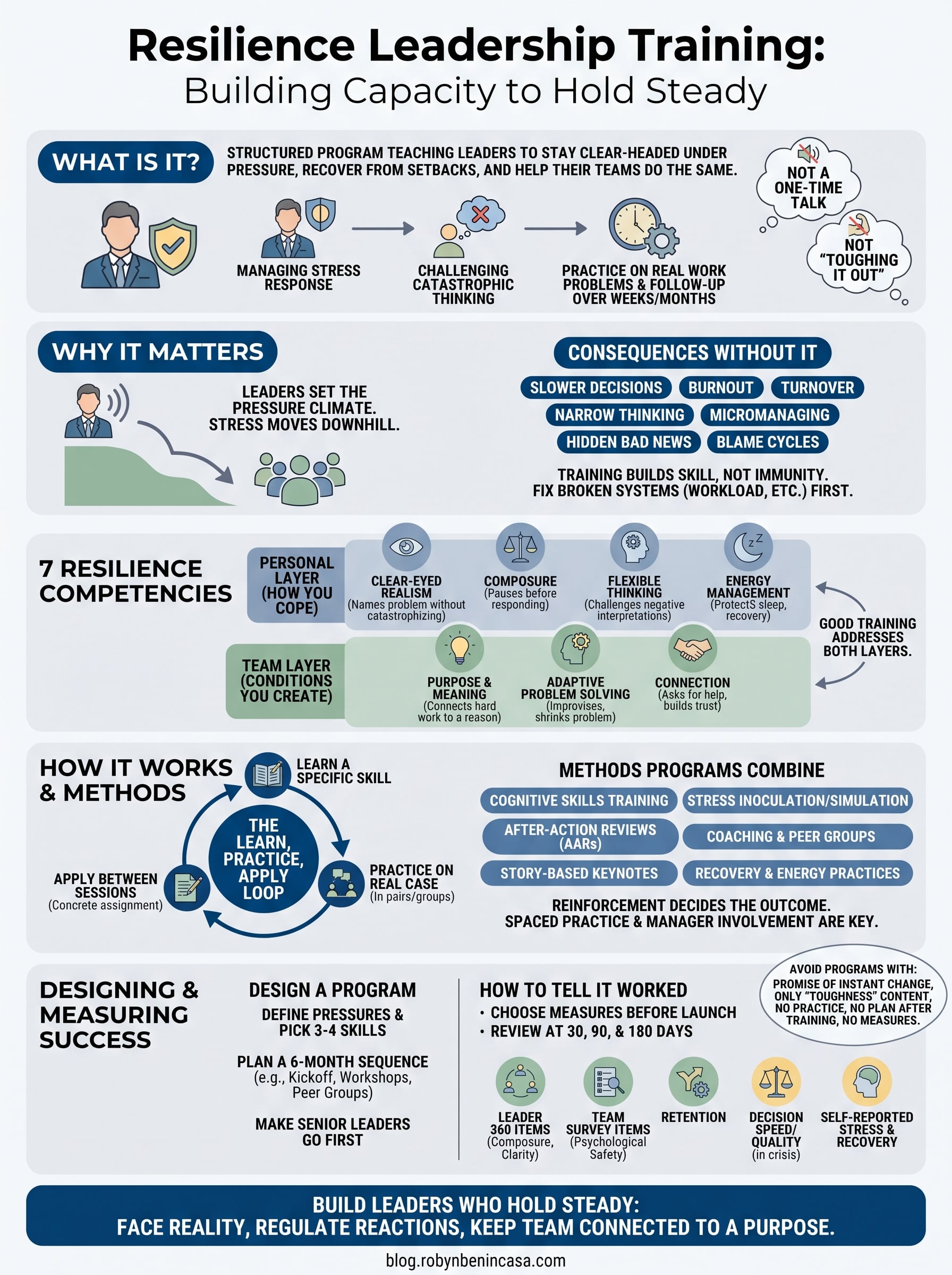
Resilience leadership training is a structured program that teaches leaders to stay clear-headed under pressure, recover from setbacks, and help their teams do the same. It pairs skill instruction, such as managing a stress response and challenging catastrophic thinking, with practice on real work problems and follow-up over weeks or months. A one-time motivational talk is not training, and a leader who simply "toughs it out" is not resilient.
This guide covers why resilience matters in the person at the top of a team, the qualities and skills that training builds, the methods programs use, and how to design or buy one. You will also see how to tell whether leadership resilience training changed anything, so you can defend the budget with evidence instead of enthusiasm.
The perspective here comes from the field. Robyn Benincasa spent more than two decades as a San Diego firefighter and led adventure racing teams through multi-day, nonstop world championship races. In both settings, the leader’s reaction to a setback set the team’s reaction. That pattern shapes everything below.
Why resilience leadership training matters
Resilience leadership training matters because a leader’s reaction to pressure spreads to everyone who reports to them. Organizations that skip it pay in slower decisions, burnout, and turnover. The effect is large because one manager has so much influence over how a team experiences work.
Leaders set the pressure climate
Teams watch their leader first when something goes wrong. If you go quiet, assign blame, or flood the channel with urgent messages, your team copies that behavior within days. If you stay specific and steady, they tend to do the same. Gallup’s research puts numbers on this influence: managers account for about 70% of the variance in team engagement. Its survey of followers in 52 countries found that people want hope, trust, compassion, and stability from leaders. Every one of those is hard to deliver while you are depleted.
Think of it as a transmission problem. Stress moves downhill. A leader who has practiced skills for interrupting their own stress response stops the transfer at the source, which is far cheaper than repairing the damage across a department later.
What goes wrong without it
Unprepared leaders fail in predictable ways under sustained pressure. You can usually spot these patterns before they show up in turnover numbers:
Narrow thinking. Leaders fall back on the old playbook and stop asking for other views, exactly when new views matter most.
Micromanaging or disappearing. Anxious leaders either grab every decision or avoid the team altogether.
Hidden bad news. When people fear the reaction, they delay reporting problems, so issues reach the leader later and larger.
Blame cycles. Energy goes into assigning fault instead of fixing the problem.
Leader burnout. The person holding the team together runs out of reserves and leaves, or stays and checks out.
What training can and cannot fix
Resilience training builds personal capacity, but it cannot repair a broken system. If your leaders are overloaded because three roles were cut and the targets stayed the same, a breathing technique will not help. Fix workload, unclear priorities, and staffing first. Then use training for what remains: how a person interprets and responds to difficulty.
Reviews of workplace resilience programs generally report modest gains in well-being and coping. Set expectations accordingly. You are building a skill, not installing immunity.
Resilience training builds a leader’s capacity to respond, but it never replaces fixing the conditions that cause the overload.
What resilient leaders do differently
A resilient leader accepts the facts of a hard situation, regulates their own reaction, and keeps the team moving toward a purpose. That is what resilience leadership means in practice. It works on two layers, personal and team, and the skills fall into seven groups you can teach and observe.
Two layers: personal and team
The personal layer covers how you cope, recover, and keep your judgment under strain. The team layer covers the conditions you create so that the group can absorb shocks: clear roles, safety to raise problems, and a shared sense of why the work matters. Most programs train only the first layer. Good leadership resilience training addresses both, because a calm leader with a fearful team still has a fragile team.
Resilience is also not stoicism. Leaders who hide every worry teach their teams to hide theirs. A resilient leader says "this is hard" out loud and then moves to the next action. That honesty is a skill you can practice, not a personality trait you either have or lack.
Seven competencies you can train
There is no single official list, so treat this as a practical working model. It builds on Diane Coutu’s widely cited Harvard Business Review research, which identified acceptance of reality, a sense of meaning, and the ability to improvise as the core of resilience. The other four competencies add what leaders specifically need. If you want a short version, the qualities are realism, composure, purpose, adaptability, and connection.
Competency
What it looks like
How training builds it
Clear-eyed realism
Names the problem in plain words, without minimizing or catastrophizing
Pre-mortems, scenario drills, honest status reviews
Composure
Notices a stress reaction and pauses before responding
Breathing and reset techniques, rehearsal under pressure
Flexible thinking
Challenges "this is a disaster" or "this is all my fault" interpretations
Learning to spot thinking traps and test them against facts
Purpose and meaning
Connects hard work to a reason the team cares about
Values and purpose exercises, story practice
Adaptive problem solving
Improvises with what is available and shrinks the problem to a next step
Constraint-based case exercises, after-action reviews
Connection
Asks for help, builds trust, keeps the team close
Peer groups, feedback practice, team norms
Energy management
Protects sleep, breaks, and recovery for self and team
The first three are about how a leader thinks, the next three about how a leader acts with others, and the last one keeps the whole system running over months instead of days.
An example of resilient leadership in action
Picture a regional sales director whose team loses its largest account in the last week of the quarter. A low-resilience response is easy to imagine: a sharp email to the account owner, a late-night spiral, and a vague message to the team that "we need to push harder."
A resilient response looks different. The director states the loss plainly to the team the same day. She takes ten minutes before replying to the executive team. She separates what is controllable (two pipeline deals, one renewal) from what is not. She sets a 48-hour plan, checks on the account owner personally, and schedules a review after the quarter closes.
The same logic applies on a multi-day adventure race. At the worst hour, the leader’s job is to say what is true, shrink the problem to the next checkpoint, and keep the team together.
Resilient leaders tell the truth about the situation, steady themselves first, and then give the team the next clear step.
How resilience training for leaders works
Resilience training for leaders works by teaching a small set of mental and behavioral skills, having leaders practice them on real situations, and reinforcing them over time until they become default responses. The sequence matters more than the topic list.
The learn, practice, apply loop
Most effective programs run the same three-part loop. First, leaders learn a specific skill in a workshop, for example how to catch a thinking trap such as assuming a setback will last forever. Second, they practice it on a real case from their own work, usually in pairs or small groups where someone can challenge their interpretation. Third, they apply it between sessions with a concrete assignment and report back at the next meeting.
This is close to how the U.S. Army’s Master Resilience Training operates. It builds on the University of Pennsylvania’s Penn Resilience Program and teaches skills such as spotting thinking traps, putting problems in perspective, and responding in real time. You do not need a military budget to use the structure. You need skills that are specific, practice that is realistic, and a reason to use both next week.
Methods programs combine
Few programs use only one method. These are the ones you will see most often, and what each is best for:
Method
What leaders do
Best for
Cognitive skills training
Learn to spot and challenge unhelpful interpretations of events
Composure and flexible thinking
Stress inoculation and simulation
Rehearse a crisis in a tabletop or scenario exercise at controlled difficulty
Decision quality under pressure
After-action reviews
Debrief what was expected, what happened, why, and what to change
Learning from setbacks
Coaching and peer groups
Work through live problems with a coach or a small group of peers
Application and accountability
Story-based keynotes
Hear real accounts of adversity and how teams got through it
Shared language and kickoff energy
Recovery and energy practices
Plan sleep, breaks, and boundaries, then model them for the team
Sustaining performance over months
A solid design uses at least three of these. A keynote alone builds motivation but rarely builds skill. A skills workshop without peer follow-up tends to fade.
Why reinforcement decides the outcome
A familiar pattern: a team leaves a good program energized, and three or four weeks later the old habits are back. That is not a failure of motivation. It is how skills decay without use.
Plan reinforcement from the start. Short weekly practices of about ten minutes, monthly peer sessions, and managers who ask "which skill did you use this week?" keep the learning alive. Spaced practice beats a single intensive day, and manager involvement beats good intentions.
Training changes leaders only to the extent that the skills are used again within the first month.
How to design a program for your leaders
To design a program, start with the pressures your leaders actually face, choose three or four skills to target, and build a six-month sequence that mixes sessions with practice on the job. Trying to cover all seven competencies at once is the most common reason programs feel thin.
Define the pressures and pick the skills
Interview eight to ten leaders across levels and ask what has been hardest in the last year. A reorganization, a missed target, an acquisition, or a technology shift each calls for a different emphasis. Leaders in the middle of a merger may need connection and realism most. Leaders facing constant disruption may need adaptive problem solving and energy management.
Then pick three or four competencies from the seven and write one observable behavior for each. "Pauses before replying to bad news" is observable. "Becomes more resilient" is not. Observable behaviors give you something to teach, coach, and measure.
A six-month sequence, worked through
Here is a sequence for an organization with 150 leaders. Cohorts of 25 give you six groups.
Component
Format
Time per leader
Kickoff keynote
All leaders together, one session
1 hour
Skills workshops
Two half-day sessions per cohort
8 hours (2 × 4)
Peer practice groups
One session per month for six months
6 hours (6 × 1)
Total
15 hours over six months
That is about 2.5 hours per leader per month, which is realistic even for busy leaders. For the organization it means one kickoff session, 12 workshop sessions (6 cohorts × 2), and monthly peer groups running throughout. Add a ten-minute weekly practice that each leader runs on their own, and you have the reinforcement the previous section called for.
Make senior leaders go first
Put the executive team through the program before everyone else, or at least alongside the first cohort. When senior leaders visibly use the language, such as saying "I’m in a thinking trap on this one," the rest of the organization sees that the skills are for real work, not a side project. It also exposes system problems that executives can fix, which protects you from the trap of training people to cope with conditions that should change.
A program that senior leaders skip teaches everyone else that resilience is optional.
How to choose a program or provider
Choose a program by checking whether it teaches specific skills, includes practice on real work, plans reinforcement, and defines how it will measure results. If a provider cannot show you these four things, keep looking, however polished the pitch is.
Questions to ask any provider
Use these questions in a first call. Good providers answer them without hesitation:
Which specific skills will my leaders be able to demonstrate afterward?
How much of each session is practice on our own situations versus presentation?
What happens in the 30, 60, and 90 days after the last session?
How do you involve the participants’ own managers?
What do you measure, and how do you share it with us?
How do you tailor the content to our industry and our pressures?
What do you say to leaders when the real problem is workload, not mindset?
The last question is the most revealing. A provider who says every problem is a mindset problem is selling something other than training.
Where a keynote fits
A keynote is a strong opener, not a full program. It gives a whole group of leaders the same stories and vocabulary on the same day, and it builds energy for the work that follows. Two of Robyn Benincasa’s keynotes map to resilience goals. Inspiring Greatness through G.R.I.T. (45 to 60 minutes) is built for teams facing adversity, tough years, or stretch goals, and it shows where real grit comes from: connection. Adapt, Overcome, and Win as One (45 to 60 minutes) fits organizations moving through disruption, such as AI transformation or an industry shift.
Use either as the kickoff in the sequence above, and let workshops and peer groups carry the skill-building. Be wary of any speaker, including this one, who claims a single hour can change how leaders behave for years.
Red flags to avoid
Walk away or ask hard follow-ups when you see any of these:
A promise of lasting change from one session
Content that is only about toughness, grit, or "pushing through"
No practice on participants’ real situations
No plan for the weeks after training
No measures, or measures limited to a happy-sheet rating at the end of the day
How to tell whether the training worked
You can tell whether resilience training worked by choosing a few measures before launch and comparing them at 30, 90, and 180 days. Satisfaction scores right after a workshop tell you whether people enjoyed it, not whether they changed.
Choose measures before launch
Pick four or five indicators that connect to the behaviors you trained. Baseline each one before the first session:
Leader 360 items on composure and clarity under pressure, rated by direct reports
A team survey item such as "People on my team can raise bad news without fear," as a read on psychological safety
Retention among participants and in their teams over the following year
Decision speed or quality in a crisis exercise run before and after
Self-reported stress and recovery, kept confidential and used for trends, not for evaluation
No single number proves the program worked. Together they show a pattern. Expect the self-reported and 360 measures to move first, and retention to lag by months.
Review at 30, 90, and 180 days
At 30 days, ask whether leaders are still using the skills at all. If usage has dropped, add reinforcement before anything else. At 90 days, check the 360 and team survey items against baseline. At 180 days, look at the harder outcomes and decide what to change in the next cohort.
Share the results with participants. Leaders who see that the organization is tracking behavior, not just attendance, take the practice more seriously. And if a measure does not move, treat that as information about the design, not as a verdict on the people.
Measure the behaviors you trained at three checkpoints, because satisfaction scores prove only that the session was pleasant.
Build leaders who hold steady
Resilience leadership training teaches leaders to face reality, manage their own reactions, and keep a team connected to a purpose. It works when it targets a few specific skills, uses practice on real problems, reinforces them for months, and is measured honestly. It fails when it is a single inspirational day or a way to ask people to absorb problems the organization should fix.
Start small. Pick one pressure your leaders face right now, choose three skills that address it, and build the six-month sequence around them. If you want a live opener that gets your leaders talking about adversity and teamwork in the same language, explore Robyn Benincasa’s keynote Inspiring Greatness through G.R.I.T. and see whether it fits the pressure your organization is under.
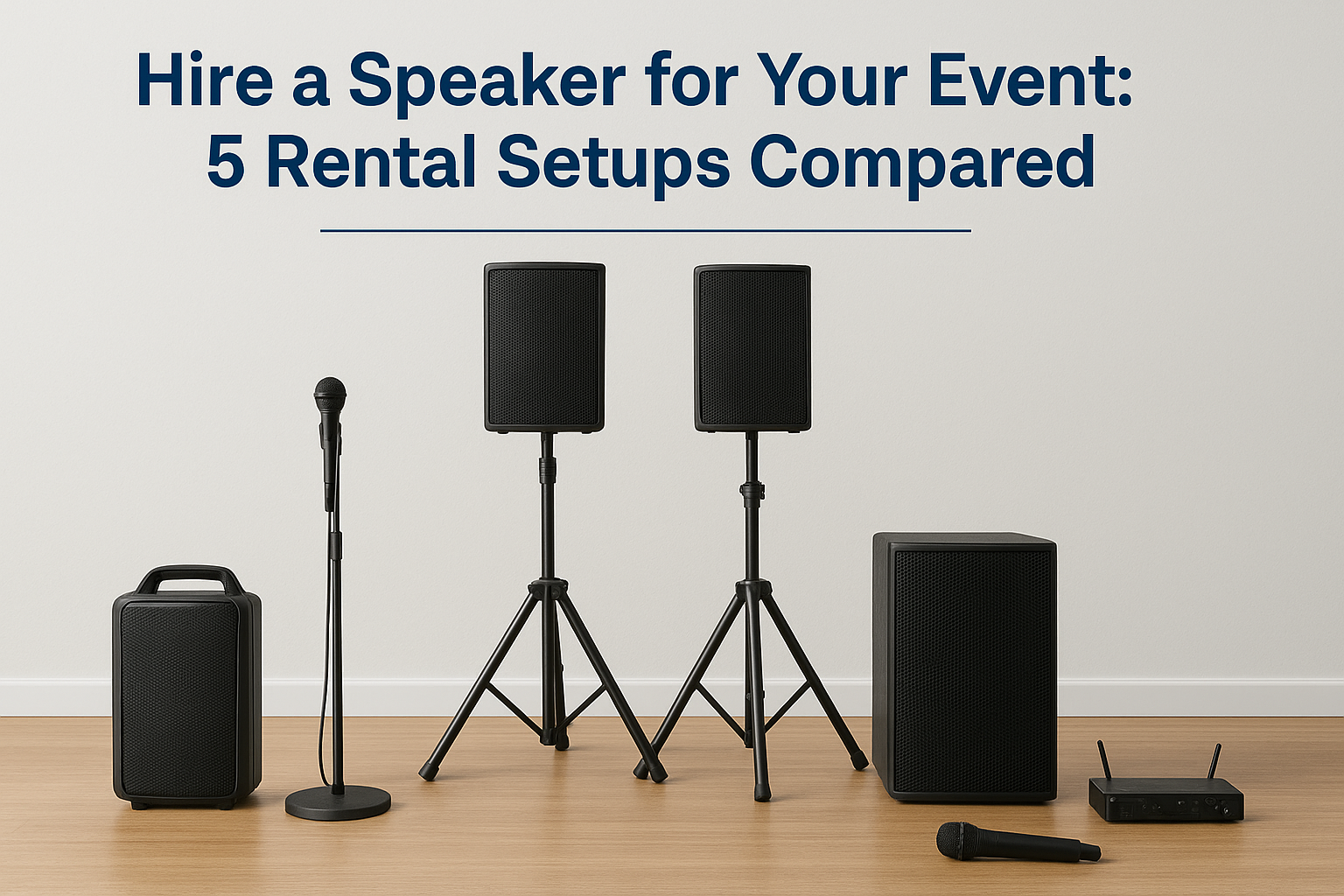
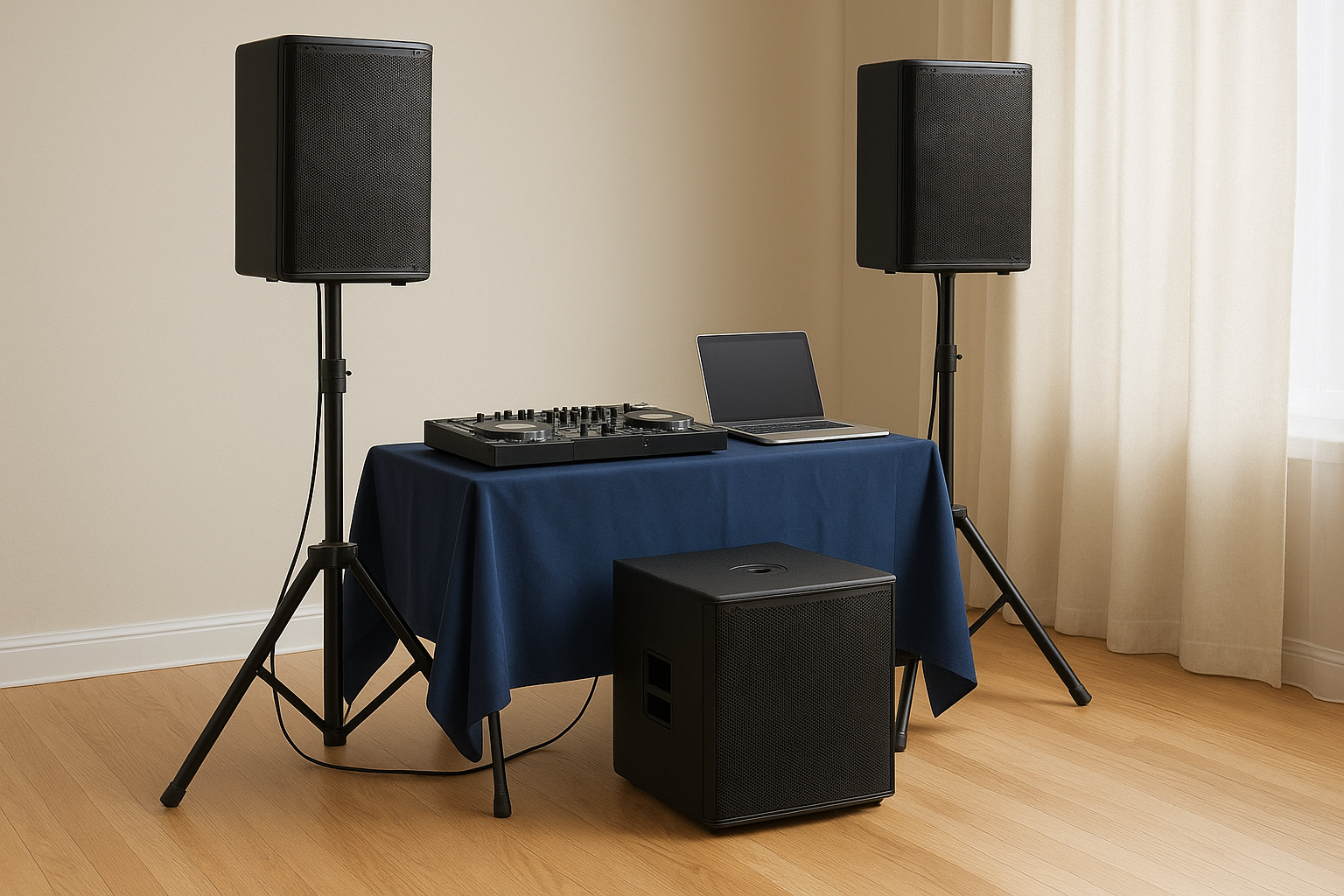
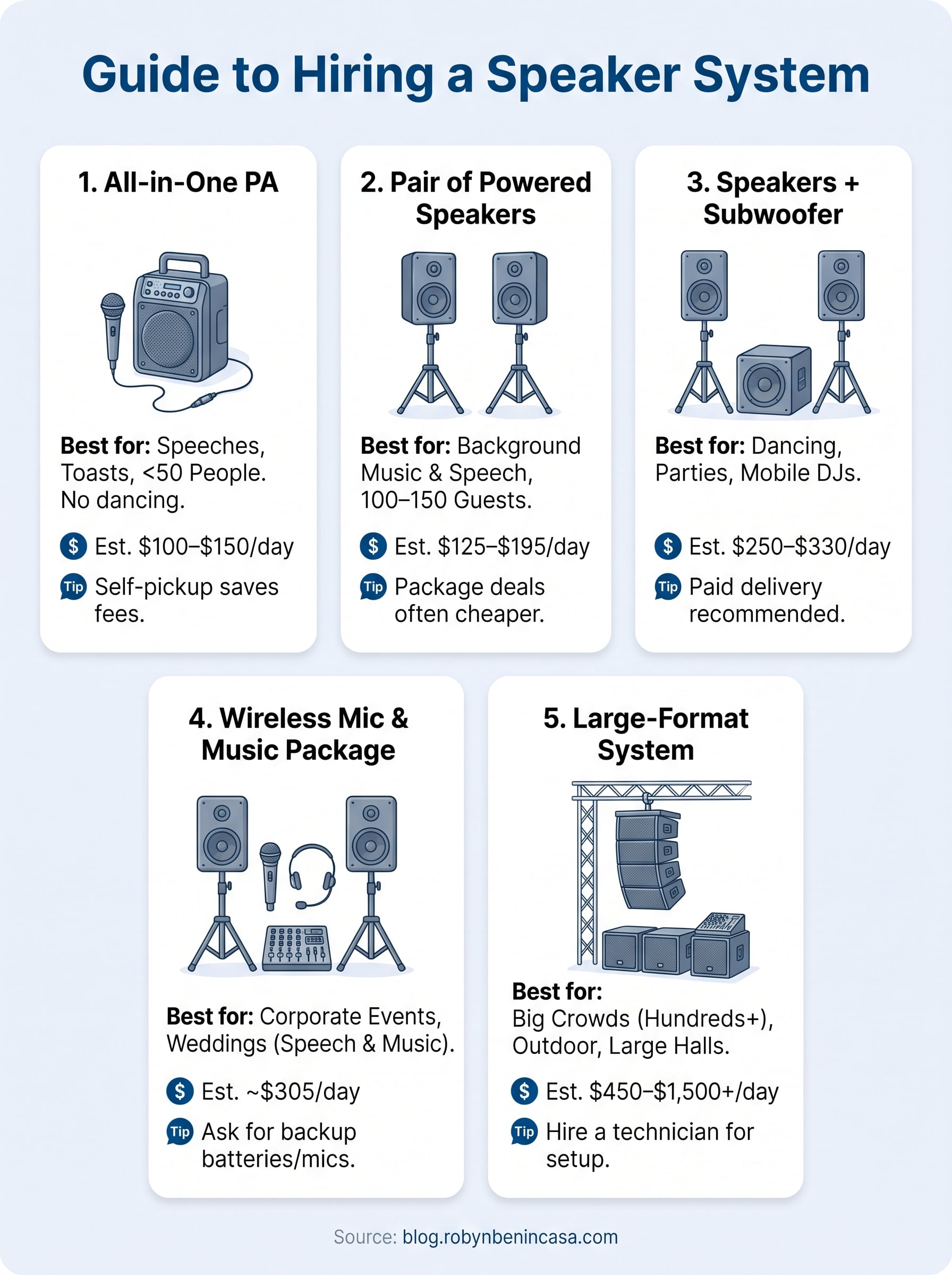
The best way to hire a speaker system for a party is to match the rig to your crowd and your music, then book a rental company that can deliver and set up on your date. An all-in-one PA covers speeches and toasts. A pair of powered speakers handles a backyard party. Add a subwoofer if people will dance, and move to a large-format system only when the crowd passes a few hundred or the event is outdoors.
The hard part is that rental catalogs list dozens of boxes by model number and wattage, and none of them tells you which one fits a 60-person birthday. Day rates run from $75 for a single speaker to well over $1,000 for a line array. This article ranks five setups from simplest to biggest. For each one you get typical rates, delivery options, and the questions to ask any provider near you before you pay a deposit.
Robyn Benincasa is a keynote speaker who has worked with Fortune 1000 organizations for two decades. If you came looking for a human speaker rather than sound gear, the end of this article points you to her.
1. All-in-one portable PA with a microphone
What you get and who it suits
An all-in-one portable PA bundles the speaker, a small mixer and a microphone input, so setup takes minutes. Rental catalogs list these from about 150 W to 500 W, and the Fender Passport line is a typical example. It suits speeches, toasts, ceremonies and meetings of roughly 50 people or fewer, where a clear voice matters more than bass.
One speaker or a speaker pair with a built-in mixer
A wired microphone
Power and signal cables, sometimes a stand
Not built for a dance floor or loud music
If nobody is dancing, an all-in-one PA is usually all you need.
Price, delivery and what to ask
Every rate in this article is a single-day figure from big-city rental catalogs, so treat them as a ballpark and expect your local quotes to differ. Those catalogs list a 150 W unit near $100, a 300 W unit near $125 and a 500 W unit near $150. The kit fits in a hatchback, so self pickup usually saves the delivery fee.
Is a second microphone available?
Does the cable reach from the speaker to your nearest outlet?
Is the return due the same night or the next morning?
2. A pair of powered speakers on stands
What you get and who it suits
Two powered 10 to 12 inch speakers on stands are the standard party rig. JBL PRX and QSC K series models are the ones rental houses stock most, and a JBL speaker rental is easy to find in most markets. As a rule of thumb, a pair covers background music and speech for about 100 to 150 guests indoors, or a backyard party of similar size.
Two powered speakers, 8 to 12 inches
Two stands
XLR or audio cables
You supply the music source, such as a phone or laptop
Renting a ready-made package beats adding up single items.
Price, delivery and what to ask
Packages usually include stands and cables, which is why package pricing often beats à la carte. Two JBL PRX710 speakers at $75 each plus two stands at $10 each come to $170 a day. Catalog packages sit in the same range.
Setup
Ballpark day rate
Entry two-speaker package
from $125
QSC K8 package
$150
QSC K10 package
$165
QSC K12 package
$195
Ask whether the price covers delivery or only pickup. Also ask for the cable length included and the deposit policy for damage.
3. Speakers plus a subwoofer for dancing
What you get and who it suits
A subwoofer adds the low bass that small speakers cannot produce, and dancing needs that weight. Mobile DJs typically rent a pair of 12 inch tops with one or two powered subs. It suits birthday parties, school dances, receptions and any event where the music is the main attraction.
Two top speakers on stands or poles
One or two powered subwoofers
Power and signal cables
Your DJ controller or laptop as the source
If people will dance, budget for at least one subwoofer.
Price, delivery and what to ask
Catalogs list two 12 inch tops with one 3,600 W sub at about $250 a day and with two subs at about $330, so the second sub adds roughly $80. Other bundles run from $185 to $275. A lone subwoofer rents for around $95.
Subs are heavy and awkward to carry, so paid delivery is worth it. Ask how many subs the package includes and whether your venue’s outlet can carry the load. A shared household circuit can trip under a big system.
4. Wireless mic and music package
What you get and who it suits
This bundle pairs speakers with one or more wireless microphones and a music input, so a host can talk, move around and play songs without swapping gear. It suits corporate events, weddings with a ceremony and reception, and panels. A presenter who walks the room wants a headset or lapel mic, not a handheld.
Two speakers on stands
One or more wireless microphones
A mixer with a music input
A portable column array, such as the 2,000 W Turbosound iNSPIRE iP3000, is an alternative for long, narrow rooms
Decide how many people will speak before you choose the package.
Price, delivery and what to ask
Catalogs list a wireless mic and music bundle at about $305 a day, and the column array at $300. That is the best value when you need both speech and music. Ask about backup, because wireless mics run on batteries. You want fresh batteries, a spare mic, and a sound check before guests arrive.
How many mics are included, and which types?
Is setup on site offered, or only drop-off?
What is the cancellation window?
5. Large-format system for big crowds
What you get and who it suits
Large systems of 8,000 W and up, or line arrays, are for crowds of several hundred, outdoor events and big halls. Smaller boxes simply run out of headroom at that scale, and the sound gets harsh before it gets loud. Most providers send a technician with these systems.
Multiple tops and subs, or a hanging or stacked line array
Mixing console and cabling
Often a delivery truck and a crew
Past a few hundred guests, hire the technician along with the speakers.
Price, delivery and what to ask
Catalogs list an 8,000 W package with subs at about $450, a 16,000 W package at about $725 and a JBL VRX line array package at about $1,500 a day. Confirm that delivery, setup and teardown are quoted separately from the equipment. Ask about load-in time, weather cover for outdoor events, and any noise rules at the venue or from your city.
Pick the rig, then book early
Start with the crowd and the music. A voice-only gathering needs an all-in-one PA. A party needs a pair of powered speakers, and dancing needs a subwoofer. Speeches mixed with music call for wireless mics, and big crowds call for a large system with a technician. Whichever setup you pick, get quotes from providers that deliver to your venue, compare what each package includes, and book early for peak weekends.
If your event also needs a speaker on the stage, Robyn Benincasa delivers keynotes on leadership and team culture. See how to hire a keynote speaker for your event, and use her leadership and team-building resources to start planning.
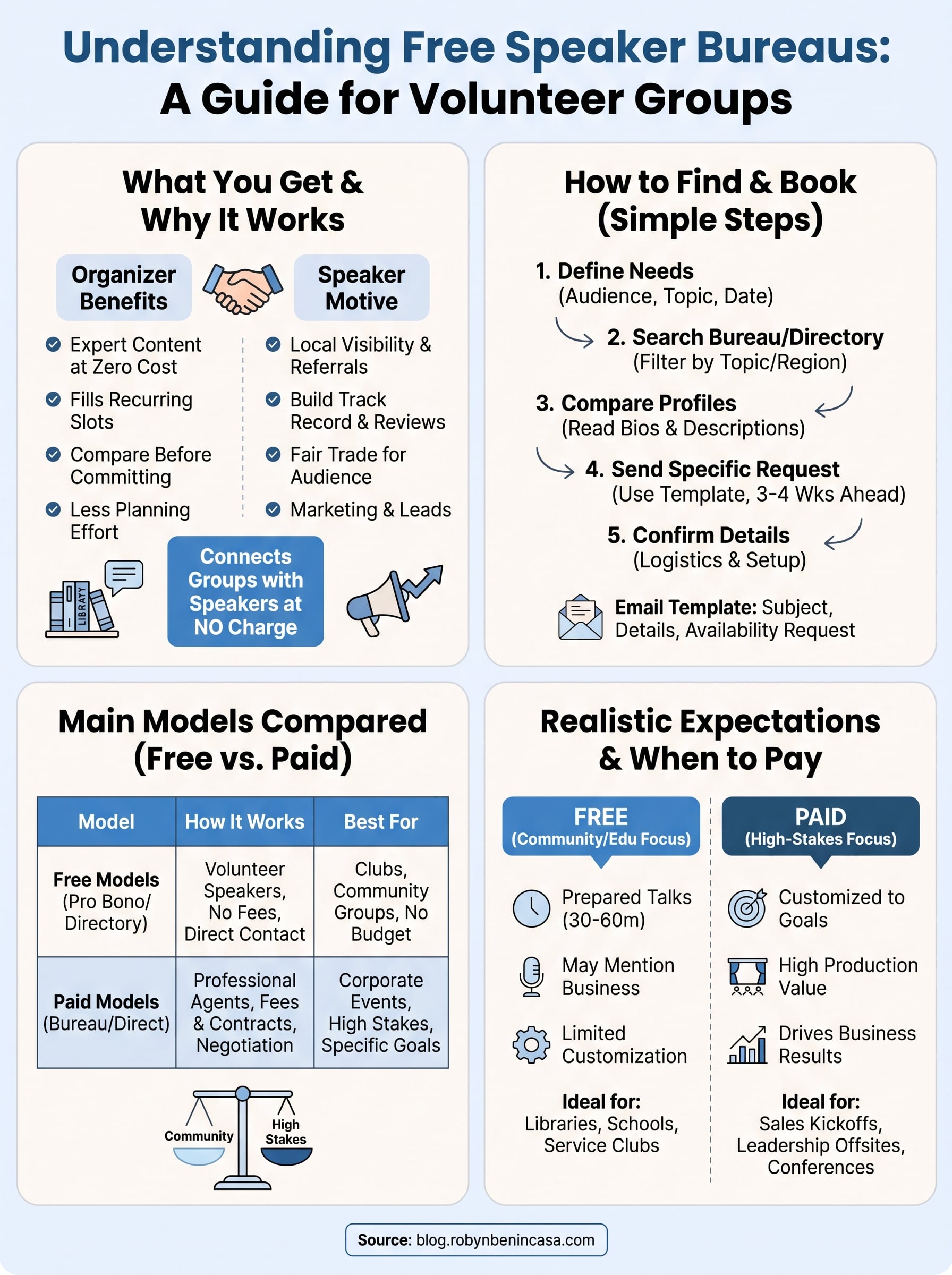
A free speaker bureau is a service that connects clubs, associations, and community groups with speakers who present at no charge. There is no speaker fee, no honorarium, and in most cases no travel bill. You browse topics or speakers, send a request, and the speaker contacts you to confirm the date and details.
Speakers agree to this because a free talk is marketing. It puts them in front of a target audience, builds their reputation, and sometimes leads to paid work. You get an expert for your meeting. They get visibility. Nobody pays, which is why these bureaus work for volunteer-run groups with no program budget.
This article explains why a free speaker bureau is worth using, how to find and book a speaker, how the main bureau types differ, and where free stops being the right choice. Robyn Benincasa is a paid keynote speaker. We will tell you plainly when free is enough and when it is not.
Why a free speaker bureau is worth using
A free speaker bureau gives you expert content at zero cost and takes the hardest part of program planning off your plate: finding someone credible who will show up prepared. For a Rotary club, library, senior center, chamber of commerce, or school group, that is often the difference between a full calendar and a scramble.
What your group gets
Most groups use these bureaus to fill recurring meeting slots. Typical users include:
Service clubs and chambers of commerce
Libraries and senior centers
Schools and parent groups
Professional associations and nonprofits
Employee lunch-and-learn programs
Topics usually span business, finance, health, self-improvement, education, and motivation. A bureau also lets you compare several speakers before you commit, which beats cold-emailing strangers.
Why speakers work for free
Every speaker in a free bureau has a reason. Many are consultants, coaches, financial planners, or authors who want local visibility and referrals. New speakers use free talks to build a track record and collect reviews. Experienced speakers keep a few free talks on the calendar because audiences become clients.
That motive shapes what you receive: a useful talk, often with a short mention of the speaker’s work.
A free speaker is not charity. It is a fair trade of your audience’s attention for the speaker’s expertise.
How to find and book a free speaker for your event
To book a free speaker, search a bureau by topic or region, compare profiles, send a clear request, and confirm the details directly with the speaker. The whole process usually takes a few emails.
The booking steps
Define your needs. Write down the audience, the topic, the date, and the time slot.
Search a bureau. Filter by topic, keyword, or location.
Compare two or three speakers. Read their bios and topic descriptions.
Submit a request. Use the bureau’s form or contact the speaker directly.
Confirm the details. Settle date, length, room setup, and technology.
What to put in your request
Speakers say yes faster when the request is specific. Copy and adapt this:
Subject: Speaker request for [Group Name] on [Date]

Hello [Speaker Name],

I organize programs for [Group Name], a group of about [number] [members/employees/residents].
We meet on [date] from [start time] to [end time] at [venue or online platform].

Your talk "[Topic Title]" fits our members well. Would you be available?
We can offer a projector, microphone, and a short introduction from our chair.

Please let me know your availability and any setup you need.

Thank you,
[Your name, role, phone]
Finding one near you
Most pro bono bureaus are regional, so start by searching your city or metro area plus "pro bono speakers bureau." Check that the bureau actually serves your area before you invest time. Online directories with location filters work the same way, and they let you contact speakers directly. If nothing local exists, look at other places to find speakers, such as professional association chapters, community colleges, and chamber programs, which often keep informal speaker lists.
Send the request three to four weeks ahead, and a free speaker becomes easy to book.
Types of free speaker bureaus compared
Not every bureau works the same way, and the difference decides who contacts whom and who pays. Four models cover nearly everything you will find.
Model
Who pays
How it works
Best for
Pro bono regional bureau
No one
Volunteer speakers list free topics. You submit a request and the speaker follows up.
Clubs and community groups in one area
Free online directory
No one (listing is free for speakers)
You search, compare, and contact speakers yourself.
Groups wanting to browse widely
Paid speaker bureau
Your organization, through the speaker’s fee
An agent matches you with a professional and handles the contract.
Corporate events with a budget
Direct booking
Your organization
You hire the speaker yourself.
Events built around one known speaker
How a speaker bureau works in general
A speaker bureau sits between two parties who would struggle to find each other. Speakers supply profiles and topics. Organizers supply needs and dates. The bureau handles discovery and matching. Paid bureaus also negotiate fees and contracts, and they earn money through a commission that is typically built into the quoted price. A free bureau skips the commission because no fee changes hands.
Which model to choose
If you run a volunteer group with no budget, start with a pro bono bureau or a free directory. If you have a budget and need a polished, customized keynote, go to a paid bureau or book the speaker directly.
The question is not which bureau is best, but whether your event needs a volunteer or a professional.
What free speakers can and cannot offer
Free speakers can deliver a solid, informative talk on their area of expertise. They cannot promise a customized, high-production keynote built around your company’s goals. Knowing that boundary keeps expectations realistic.
Limits to expect
Free talks commonly run 30 to 60 minutes and follow a prepared presentation. The speaker may mention their business at the end. Customization is limited, and availability depends on volunteers, so popular topics and dates fill up. Ask up front whether the talk is educational or promotional, and whether the speaker takes questions. Most speakers are glad to answer.
When to pay for a speaker
Pay when the talk has to move a business result. A sales kickoff, leadership offsite, or conference keynote needs a speaker who studies your audience and ties the message to your goals. Robyn Benincasa’s keynotes, for example, are built for organizations working on teamwork and culture, and her Why Winners Win keynote runs 30 to 60 minutes. That is a different job from a volunteer’s lunchtime talk. Free fits community programming. Paid fits high-stakes events.
If you are the speaker
To get on a speaker bureau, complete a full profile, list specific talk titles with short descriptions, and describe your audience. Say yes to early free talks, ask each host for a review, and follow up within a day. Reviews and referrals build the track record that bureaus and organizers look for.
Match the speaker to the stakes: volunteers for community meetings, professionals for events that must deliver results.
Booking your next speaker
A free speaker bureau gives volunteer-run groups a practical way to get credible speakers without a budget. Search by topic and region, send a specific request well ahead of time, and agree on the details in writing. Know the trade you are making: the speaker donates the talk, and you give them an audience.
When your event carries more weight, such as a leadership meeting, a sales conference, or a team culture initiative, a paid keynote is the better tool. If that is where you are headed, learn how to hire a keynote speaker and see how a professional speaker can fit your program.
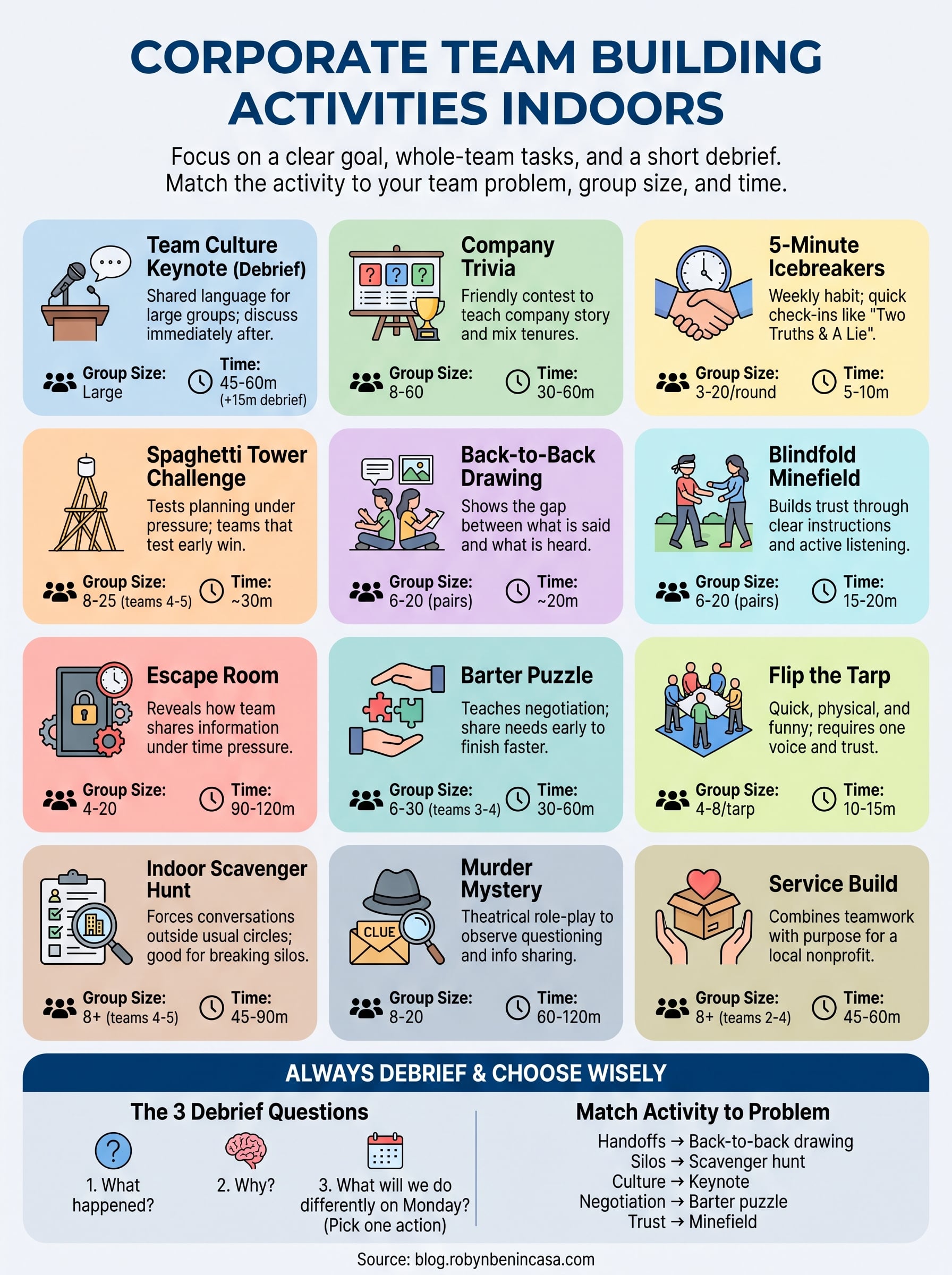
The best corporate team building activities indoor share three traits: a clear goal, a task that needs every person, and a short debrief afterward. For a large all-hands, start with a culture keynote or company trivia. For a small team that needs trust, try back-to-back drawing or the blindfold minefield. If you have ten minutes and no budget, a quick icebreaker still beats skipping team time altogether.
Most lists hand you 50 games and no way to choose between them. That wastes your time. A game that works for eight people in a conference room can fall flat with sixty people in a ballroom. A competitive game can backfire on a team that is already tense. Below you get 12 formats, each with steps, group size, time, budget, and the situation it fits. A comparison table and a debrief you can reuse follow the list.
This blog comes from Robyn Benincasa, a keynote speaker, world champion adventure racer, and longtime San Diego firefighter. Both worlds taught her that a team wins or loses together. Every activity here makes people rely on each other and then asks what they learned.
1. Team culture keynote with a table debrief
A culture keynote is the fastest way to give a large group a shared language for teamwork, and it works best when people talk it through right afterward. It is the one item on this list where you listen first and act second, so plan the discussion before you book the speaker.
A keynote starts the conversation, and the table debrief is where your team finishes it.
How it works
Robyn Benincasa’s Extreme T.E.A.M.W.O.R.K. keynote teaches the 8 elements of a winning team culture through storytelling and video of ordinary people doing extraordinary things together. It draws on her bestseller Make Winning Inevitable. The talk becomes team building only when you add a structured follow-up:
Schedule the keynote at the start of a meeting or offsite day, not at the end.
Ask each attendee to jot down one thing their team does well and one thing it struggles with.
Seat people in mixed-department tables of six to eight.
After the talk, give each table 15 minutes to pick one element and one action, then report back in a single sentence.
Group size, time and cost
Plan around these numbers:
Format: it can run in person or virtually.
Time: 45 to 60 minutes for the talk, plus 15 minutes for the table debrief.
Choose a keynote when the whole organization needs to hear the same message at once, such as after a merger, a reorg, or at a new-year kickoff. Match the talk to your situation:
Why Winners Win (30 to 60 minutes): sales meetings, revenue kickoffs, and competitive teams.
Adapt, Overcome, and Win as One (45 to 60 minutes): disruption, change, and AI transformation.
Inspiring Greatness through G.R.I.T. (45 to 60 minutes): teams coming off a tough year or facing a stretch goal.
Watch one trap. A great talk followed by a rushed "any questions?" changes nothing. Protect the debrief time on the agenda, and ask a senior leader to share the action their own table chose.
2. Escape room
An escape room is the easiest paid activity to book, because the venue supplies the puzzles, the host, and the clock. It reveals how your team shares information under time pressure.
In an escape room, the puzzle matters less than who speaks up, who listens, and who hoards the clues.
How it works
Your team is locked in a themed room and has about 60 minutes to find clues and solve a chain of puzzles. A game master watches and offers hints when you stall. To make it count, follow this routine:
Book a private session so your group is not mixed with strangers.
If you have more people than one room holds, split into teams and compare results.
Do not assign roles. Let leaders and listeners emerge on their own.
Debrief in the same room or over coffee: who led, who went quiet, and how clues moved around.
Group size, time and cost
Here is what to budget:
Group size: 4 to 20 people. Larger groups run in waves or across several rooms.
Time: about 60 minutes in the room, 90 to 120 minutes with briefing, travel, and debrief.
Cost: venues price per player, so ask for a group quote. A cheaper route is a DIY kit with padlocks and a box of clues.
Who it suits and what to watch
Pick this for mid-sized teams that want a change of scene and a shared story to retell on Monday. The activity rewards people who think out loud, so the quiet analyst can get squeezed out. Say up front that everyone’s find counts.
Check accessibility before you book. Some rooms are tight, dark, or require crawling. Ask the venue about mobility options and whether anyone can step out without ending the game for the team.
3. Spaghetti tower challenge
The spaghetti tower challenge gives small teams 18 to 20 minutes to build the tallest freestanding structure from a few cheap supplies. It shows how teams handle planning, testing, and time pressure.
Teams that build early and test often beat teams that plan until the clock runs out.
How it works
Each team gets 20 sticks of uncooked spaghetti, one yard of tape, one yard of string, and one marshmallow. The marshmallow must sit on top, and the tower must stand on its own, not taped to the table. Run it like this:
Split the group into teams of four or five.
Hand out identical kits and start an 18 to 20 minute timer.
Call time and measure from table to the top of the marshmallow.
Debrief before announcing the winner, so the lesson lands first.
Group size, time and cost
Keep the logistics simple:
Group size: 8 to 25 people in teams of four or five.
Time: about 30 minutes total, with the build plus a 10 to 12 minute debrief.
Cost: roughly $5 per team for supplies.
Who it suits and what to watch
This works well for project teams and cross-functional groups who need to practice moving from talk to action. Ask when each team first tested the marshmallow’s weight. Teams that waited until the last minute usually watched the tower collapse, and that is a lesson about delayed feedback they will recognize from real projects.
Be careful that it does not turn into a pure race. Hand out a second round with a ten-minute limit and a rule that everyone must touch the structure. The second round is where teams show what they learned.
4. Back-to-back drawing
Back-to-back drawing shows how much gets lost between what you say and what the other person hears. It needs only paper, pens, and printed pictures, so it is one of the cheapest communication activities for teams.
The gap between what the speaker said and what the listener drew is the same gap that causes handoff errors at work.
How it works
Pairs sit back to back. One person describes a picture without naming it, and the other draws what they hear. Then you compare. Follow these steps:
Print simple images such as a house, a bicycle, or a few overlapping shapes.
Pair people across departments when you can.
Round one: the listener may not ask questions. Round two: questions are allowed, with a new image and swapped roles.
Compare drawings with the originals and ask what changed between rounds.
Group size, time and cost
The numbers are modest:
Group size: 6 to 20 people in pairs. It also works with just two.
Time: about 20 minutes with both rounds.
Cost: free beyond paper, pens, and a printer.
Who it suits and what to watch
Use it with teams that pass work between functions, such as sales to operations or design to engineering. The comparison between round one and round two makes a strong point about two-way questions. Teams usually draw better in round two, and the debrief practically runs itself.
Keep the images simple. A complex picture frustrates people and turns the game into a drawing contest. If you suspect a pair is uncomfortable, let them choose a shape instead of a scene.
5. Company trivia
Company trivia turns what your people know about the business into a friendly contest. It is one of the best indoor options for large groups because teams run in parallel and one host can manage everything.
Good trivia teaches new hires the company story while letting veterans show off.
How it works
You write the questions, split people into teams, and keep score. Questions about history, products, customers, and light coworker facts all work. Set it up this way:
Write 30 to 40 questions in rounds of eight to ten, mixing easy and hard.
Build teams of four to six and mix tenures so new hires are not stranded.
Read each question aloud and give teams 30 seconds to write an answer.
Swap papers to mark, tally the scores, and keep a visible scoreboard.
Group size, time and cost
Plan for:
Group size: 8 to 60 people in teams of four to six.
Time: 30 to 60 minutes.
Cost: free to run. Small prizes are optional.
Who it suits and what to watch
Use trivia after an acquisition, a hiring wave, or a reorg, when people need a shared picture of the company. It also suits hybrid groups, because teams can play on a video call with a shared slide deck.
Skip questions that are too personal or that embarrass anyone. Avoid obscure details only one executive would know. Aim for questions that half the room can answer, so every team scores.
6. Indoor scavenger hunt
An indoor scavenger hunt sends teams around your building to complete tasks and collect items. It is a strong choice when you want people to meet colleagues outside their usual circle.
Put people on teams with strangers, and the hunt does the introductions for you.
How it works
Give each team a list of tasks with point values and a time limit. Tasks should push them into areas they rarely visit. Here is the plan:
Write 15 to 20 tasks. Examples: find the oldest product brochure, photograph the team in front of the loading dock, or get a signature from someone in another department.
Form teams of four or five with people from different floors.
Set a 45 to 60 minute limit and a clear meeting point.
Tally points and ask each team for the one thing they learned about the building or the company.
Group size, time and cost
The basics are:
Group size: 8 or more people in teams of four or five. It scales to large groups.
Time: 45 to 90 minutes.
Cost: free.
Who it suits and what to watch
Choose this for multi-department groups, new offices, or companies recovering from a merger where people still sit in tribes. It forces conversations that a meeting never would.
Set boundaries. Tell teams to stay out of areas where people are working with customers or confidential material. Get consent before photos, and give people an alternate role, such as navigator or scorekeeper, if walking the building is hard for them.
7. Barter puzzle
The barter puzzle gives each team a jigsaw puzzle, then mixes a few pieces from each puzzle into other teams’ piles. Teams have to negotiate to finish. It turns a quiet puzzle into a lesson in trading and persuasion.
Teams that share what they need early finish faster than teams that guard their pieces.
How it works
Every team starts with a different puzzle of equal difficulty. Some pieces are missing, and those pieces sit with rivals. Run it as follows:
Pick puzzles of 100 to 300 pieces so that bartering, not assembling, takes the time.
Pull ten or so pieces from each box and distribute them to other teams.
Tell teams they may trade pieces, offer favors, or swap team members, but every decision must be made as a team.
The first team to finish wins. Stop the clock after 30 to 45 minutes if nobody does.
Group size, time and cost
Here is the budget:
Group size: 6 to 30 people in teams of three or four. You need at least three teams for the trading to get interesting.
Time: 30 to 60 minutes.
Cost: roughly $10 to $20 per puzzle. You can reuse them.
Who it suits and what to watch
Use it with sales, procurement, and cross-functional teams that negotiate every day. The debrief question is simple: when did you ask for help, and when did you wait? You will hear who treated other teams as partners and who treated them as threats.
Count the pieces in each box before you start. One lost piece can sink a team and turn the exercise into frustration instead of strategy.
8. Murder mystery
A murder mystery gives your team a fictional crime to solve, with roles, clues, and a vote. It is theatrical, which makes it a good fit for social teams and end-of-year events.
The mystery is a disguise. What you are really watching is who asks questions and who shares information.
How it works
A facilitator narrates the crime. Each person gets a role, such as townsperson, detective, witness, or culprit, and the group questions each other to find the guilty party. Follow these steps:
Choose a host, or buy a ready-made kit that includes role cards and clues.
Hand out roles in sealed envelopes so nobody knows who is guilty.
Run two or three rounds of questioning, with a few minutes of open conversation in each.
Call a vote, reveal the culprit, and spend five minutes on how the group shared and tested information.
Group size, time and cost
Keep these in mind:
Group size: 8 to 20 people.
Time: one to two hours, depending on the script.
Cost: free if you write it yourself. Kits and hosted events cost extra, so check prices with the provider.
Who it suits and what to watch
This is a good pick for established teams that already feel comfortable together. It breaks up a long offsite day and gives people a shared story to joke about later.
Some people hate acting. Give them observer or detective roles with plenty to do and little to perform. Avoid scripts with edgy themes that could make anyone uncomfortable at work.
9. Blindfold minefield
The blindfold minefield pairs a guide with a blindfolded partner who must cross a floor of obstacles using only spoken directions. It is a short, vivid lesson in clear instructions and building trust in a team.
The guide learns that "a little to the left" means something different to every listener.
How it works
You scatter soft objects across a room and have pairs cross it one at a time or in waves. Set it up safely:
Clear the floor and use only soft obstacles such as pillows, paper balls, and stuffed toys.
Form pairs. One partner is the guide, and the other walks with a blindfold or closed eyes.
The guide may speak but not touch. The walker may not talk.
Swap roles and rearrange the obstacles so the second round is not memorized.
Group size, time and cost
The details:
Group size: 6 to 20 people in pairs.
Time: 15 to 20 minutes.
Cost: free if you borrow items from around the office.
Who it suits and what to watch
Use it with teams where instructions get lost, such as managers and their reports, or project leads and contributors. Ask the guides what they would say differently, and ask the walkers what made them feel safe. The answers usually map neatly onto how people give and receive direction at work.
Make it optional and offer a role for everyone. Some people cannot walk blindfolded because of vision, balance, or mobility. Let them guide, observe, or place the obstacles.
10. Flip the tarp
Flip the tarp asks a team to turn a tarp over while everyone stays standing on it. It is quick, physical, and funny, which makes it a good energy boost in the middle of a long meeting day.
The teams that finish first are the ones that pick one voice and trust the plan.
How it works
The team stands on a small tarp or blanket and has to flip it without anyone touching the floor. Here is how to run it:
Lay one tarp per team on a clear, non-slippery floor, preferably carpet.
Have each team stand on it with all feet on the fabric.
Give the goal: flip it completely, with nobody stepping off.
Start with a larger tarp, then use a smaller one for a second round.
Group size, time and cost
Expect:
Group size: 4 to 8 people per tarp. Run several tarps at once for a bigger group.
Time: 10 to 15 minutes.
Cost: under $15 per tarp.
Who it suits and what to watch
Choose it for small, tight teams that need a laugh and a shared win. A debrief of just three minutes is enough. Ask how the team decided on a plan and who gave the instructions.
Watch for physical contact and balance. Skip it on polished floors, and let anyone opt out into a coach role. Remind people that touching is incidental, not required.
11. Service build for a local nonprofit
A service build has teams assemble kits or items for a local charity. It combines teamwork with purpose, which many employees find more meaningful than a game.
People bond fastest when the work in front of them matters to someone else.
How it works
You partner with a nonprofit that tells you exactly what it needs, then set up stations and targets. Use this plan:
Ask the nonprofit what items it can use, such as hygiene kits or care packages, and how many.
Buy or collect the materials and set up one station per team.
Give each team a quantity target and a time limit, then rotate roles every 15 minutes.
Deliver the finished items, and ask the nonprofit to send a short note about how they will be used.
Group size, time and cost
Plan for:
Group size: 8 or more people in teams of two to four.
Time: 45 to 60 minutes.
Cost: depends on materials. The nonprofit can usually give you a shopping list.
Who it suits and what to watch
Use it after a stressful quarter, at a year-end event, or whenever you want to give a team a reason to feel proud together. It is a good fit for groups that find competitive games draining.
Confirm in advance that the charity actually wants the items. A build that produces things nobody asked for feels performative. Keep the tone light, and do not ask people for donations beyond what the company provides.
12. Five-minute icebreakers
Five-minute icebreakers fit into the start of any meeting. They cost nothing and need no prep, so they are the easiest way to build team habits weekly instead of once a year.
A five-minute habit repeated every week does more than a once-a-year event.
How it works
Rotate three simple formats so they stay fresh:
Two truths and a lie: each person shares three statements, and the group guesses the lie.
Lucky penny: pull a coin from a hat and tell a short story from the year stamped on it. If the year is before you were born, draw again.
One-word check-in: everyone writes one word about how they feel about the meeting’s topic, and you read them aloud.
Group size, time and cost
The figures:
Group size: 3 to 20 per round. Split larger groups into pods of eight.
Time: 5 to 10 minutes.
Cost: free.
Who it suits and what to watch
These fit weekly team meetings, onboarding sessions, and kickoffs with new members. The one-word check-in is especially useful before a hard conversation, because it shows you the mood in seconds.
Keep every round optional and low-stakes. Skip questions that push people to disclose personal details they would rather keep private. Change the format every few weeks, or the routine becomes a chore.
How to choose and debrief any indoor activity
Pick by group size, available time, and the one team problem you want to surface, then run a short debrief. The best indoor team building activities for corporate employees are the ones where the activity exposes a real work habit and the debrief ties it back to Monday.
Choose the activity for the problem you have, not for the game that looks fun.
Comparison by size, time and budget
This table sets the 12 formats side by side:
#
Activity
Group size
Time
Budget
1
Culture keynote
–
45–60 min plus 15 min debrief
–
2
Escape room
4–20
90–120 min
Paid, per player
3
Spaghetti tower
8–25 (teams of 4–5)
30 min
About $5 per team
4
Back-to-back drawing
6–20 (pairs)
20 min
Free
5
Company trivia
8–60 (teams of 4–6)
30–60 min
Free, prizes optional
6
Indoor scavenger hunt
8+ (teams of 4–5)
45–90 min
Free
7
Barter puzzle
6–30 (teams of 3–4)
30–60 min
$10–$20 per puzzle
8
Murder mystery
8–20
60–120 min
Free DIY or paid kit
9
Blindfold minefield
6–20 (pairs)
15–20 min
Free
10
Flip the tarp
4–8 per tarp
10–15 min
Under $15 per tarp
11
Service build
8+ (teams of 2–4)
45–60 min
Varies by materials
12
Five-minute icebreakers
3–20 per round
5–10 min
Free
Match the activity to the problem
Start with the symptom you see at work, then pick from the matching group:
Messages get lost in handoffs: back-to-back drawing (4), blindfold minefield (9), spaghetti tower (3).
Silos between departments: scavenger hunt (6), service build (11), escape room (2).
Negotiation and trading: barter puzzle (7).
Shared culture or morale: culture keynote (1), company trivia (5), five-minute icebreakers (12).
Social bonding and fun: murder mystery (8), flip the tarp (10).
Debrief questions that make it count
Take five to ten minutes after any activity and ask three questions. What happened? Why did it happen that way? What will we do differently on Monday? Write the answers down, pick one action, and name an owner.
The debrief is what separates team building from a nice afternoon. In adventure racing, teams that review a bad leg in the next checkpoint make fewer repeat mistakes. Your team works the same way.
Pick one activity and debrief it
You do not need all 12 activities. Pick one that fits your group size, your time, and the problem you actually see, then spend a few minutes afterward turning what you saw into one action. A culture keynote suits a large group that needs a shared message. A tarp flip or minefield suits a small team that needs trust. A five-minute icebreaker suits everyone else, every week.
If your company needs a stronger starting point for a leadership offsite, sales kickoff, or all-hands, you can book Robyn Benincasa for your next team event and pair her keynote with one of the table debriefs above.
The fastest way to learn how to change team culture is to stop talking about culture and start changing what people do. Define the new culture as a short list of observable behaviors. Get the team to help shape it. Change the meetings, rewards, and decisions that drive those behaviors, then reinforce them for months. Culture is the result of those changes, not the starting point.
Most leaders do the opposite. They call an offsite, unveil new values, and hang posters. For a week, people nod. Then a deadline hits, the old habits return, and the team decides the new culture was another speech. That cynicism makes the next attempt harder, so a failed push can leave a team worse off than before it started.
This guide gives you four steps that work for a team of ten or an organization of a thousand. They come from the way Robyn Benincasa learned to build teams: in adventure racing, where a team lives or dies by how its members treat each other after days of exhaustion, and in more than 20 years as a San Diego firefighter. Whether you lead a department or are asking how to change the culture of a team you just inherited, you can start this week.
Why team culture changes through behavior
Team culture changes when people do different things, not when they hear different words. Culture is how your team behaves when pressure is high and nobody is watching. You cannot order it into existence, but you can change the conditions that produce it.
What you are actually changing
Culture sounds abstract until you look at what it produces every day. You can see it in four places:
How decisions get made, and who gets a say
How bad news travels, and how fast
How people treat a mistake, with curiosity or with blame
How a new hire is welcomed in their first two weeks
Those are the things you will change. Everything else is a label.
Why speeches and value posters fail
Speeches fail because they describe a culture without changing the incentives that created the current one. If your team hoards information because the person who closes the deal gets the bonus, a talk about collaboration loses to the bonus plan every time. People follow what gets rewarded, not what gets announced.
Adventure racing makes this obvious. Teams race together for days, and nobody cares about the team’s stated values at hour sixty. What matters is whether the strongest member takes weight from the weakest one without being asked. That behavior was built in training and reinforced in small moments long before race day.
Culture is a byproduct of how people work together, so change the work and the culture follows.
What to settle before step one
Check four things before you start:
A business reason you can state in one sentence, such as "handoffs between sales and operations cost us customers."
A sponsor with authority over budgets and rewards. If that is you, good.
Patience for 90 days. Visible shifts take a quarter, and lasting ones take longer.
Your own willingness to change. If you are part of the problem, the team will notice.
Step 1. Define the culture in observable behaviors
To define the culture you want, replace each value with a behavior someone could see on a video. "Collaboration" cannot be seen or measured. "Anyone stuck for a day posts the problem in the team channel" can be both.
Measure where you are now
Start with a baseline. Run a short anonymous survey of five or six statements, each rated 1 to 5, such as "I can admit a mistake without fear" or "People here share leads and information freely." Then talk to people one-on-one and ask, "What is it like to work here on a bad week?" Compare the answers. The gap between the survey and the stories tells you where trust is thin.
Consider a team of 12 account managers who guard their best leads. The survey shows low scores on sharing and high scores on individual pride. That is your baseline, and it points straight at the behavior to change.
Write the target as behaviors
Pick three or four behaviors, no more. For each one, ask what a stranger would see in a meeting, a message, or a handoff if it were happening. Use this table to translate:
Vague value
Observable behavior
Collaboration
Anyone stuck for a day posts it in the team channel, and a teammate replies within one business day
Accountability
Owners report a missed deadline themselves, before the manager finds out
Respect
Disagreement is voiced as a question about the work, never about the person
Transparency
Leaders explain the reason behind a decision, including bad news, within 48 hours
For the account managers, the target might be: "Every lead that doesn’t fit your territory goes on the shared board within 24 hours."
If a stranger could not see the behavior on video, you have not defined it yet.
Step 2. Get buy-in before you announce anything
You get buy-in by telling the team the truth about why change is needed, then letting them shape how it happens. People support what they help build. They resist what is handed down, however good it is.
Tell the truth about why
Open with the real problem, including your part in it. Spin creates a vacuum, and gossip fills it. Share the baseline numbers, name the cost, and say what you got wrong. Use this script for your kickoff, and fill in the brackets with specifics:
Here is what I see: [specific problem, with one fact or number].
Here is why it matters: [consequence for customers, results, or the team].
Here is what I got wrong: [your contribution to the problem].
Here is what I want to change: [the 3 or 4 target behaviors].
I don't have every answer on how. I want your input at [meeting date].
Anything you raise, I will respond to by [date].
Then stop talking and listen. The first few minutes of silence are normal. Do not fill them.
Let the team shape the how
Hold small working sessions of six to eight people, and ask two questions: "What gets in the way of this behavior today?" and "What would make it easy?" Your team knows where the friction lives. You will get ideas you would never have found alone, and each idea you adopt creates an advocate.
Seek out the respected skeptics, not only the enthusiasts. A skeptic who helps design the fix will defend it in the hallway. Also assign visible proponents, peers who live the behaviors early and talk about them honestly.
Announce the why and invite the how, and people will carry the change for you.
Step 3. Change behaviors through real work and systems
You change behavior by changing the work itself and the systems around it, not by asking people to try harder. Pick one high-impact behavior, build it into the real work, and align the systems that reward it.
Start with one high-impact behavior
Trying to change four behaviors at once changes none. Choose the one that unlocks the others. For the account managers, that is posting unneeded leads to the shared board within 24 hours. Build it into the week: a ten-minute lead review every Monday, run by a rotating team member. The behavior now happens as part of normal work, not as a special initiative.
Give it a clear owner, a clear start date, and a clear signal of success, such as the number of leads passed and closed by a teammate.
Align meetings, rewards, and rules
A new behavior dies if the old systems punish it. Walk through each lever and ask what it currently teaches:
Lever
Question to ask
Example fix
Meetings
Who talks, and who is ignored?
Rotate the facilitator; start with problems, not status
Recognition
What did we celebrate last month?
Praise leads passed to a teammate by name
Pay and promotion
Does it reward solo wins only?
Add a team-result component to bonuses
Feedback
Is it used to judge or to teach?
Use short, specific, forward-looking notes
Hiring and onboarding
Do we select for the behaviors?
Ask candidates how they helped a struggling teammate
If a rule or incentive contradicts your target behavior, fix it or the team will conclude you are not serious.
Teams believe what the incentives say, so make the incentives say the same thing you do.
Step 4. Make the change stick
Culture change sticks when you model the behavior, hold everyone to it, and review progress on a schedule. Expect the old habits to return under pressure, and plan for it.
Model it where everyone can see
Your team watches you more closely than you realize. If you say "bring me bad news," then react sharply the first time someone does, the culture resets to silence. Respond to the first piece of bad news with a thank-you and a question. Admit your own mistakes in front of the group. When you slip, say so and correct it.
Hold high performers to the same standard. A top seller who ignores the new behaviors without consequence tells the team that the values are optional. Hold a private conversation first. If nothing changes, the consequences must follow.
Track and adjust on a schedule
Use a simple 30-60-90 rhythm:
Day 30: Repeat two or three survey statements and ask the team what is working. Fix one obstacle they name.
Day 60: Check the behavior metric, such as leads passed and closed. Share the numbers openly and celebrate one specific win.
Day 90: Rerun the full baseline survey. Compare it to Step 1, then choose the next behavior to add.
Resistance to change is normal. Treat it as information, since it often points to a broken incentive or an unclear expectation. Keep communicating the reason for the change, and keep the pace steady.
Culture holds when leaders repeat the same behaviors long after the excitement fades.
Start with one behavior
Changing team culture is not a speech or an offsite. It is a sequence: define the behaviors, win buy-in, change the work and systems that shape habits, and reinforce them through your own example. Pick one behavior this week, write it so a stranger could spot it, and bring your team into the conversation.
If you want help getting a larger group moving together, explore Robyn Benincasa’s team culture resources. Her keynotes build on the eight elements of a winning team culture and the lessons of teams that won by committing to each other.