You’re planning a conference or sales meeting, and someone on your team says, "We need a keynote speaker." But what does that actually mean, and how is that role different from the breakout presenters, panelists, and emcees also on your agenda? If you’ve been Googling the term hoping for a straight answer, you’re not alone. Plenty of event planners book the wrong kind of speaker simply because nobody defined the job clearly.
A keynote speaker sets the tone and central message for your entire event. Unlike a session leader covering one narrow topic, a conference keynote speaker delivers the big-picture theme that ties every other presentation back to one idea, whether that’s leadership, resilience, or team performance. That distinction matters when you’re deciding who opens your program and who fills the smaller rooms.
In this article, we’ll break down exactly what separates a keynote from a speaker keynote slot buried mid-agenda, what makes a keynote address effective, and what to look for when you’re ready to book one. Drawing on decades of experience speaking to corporate audiences about leadership and team culture, we’ll give you a practical framework for making this decision with confidence.
Why a keynote speaker matters for your event’s success
Ask any event planner what makes or breaks a conference, and most will point to the opening act. A strong keynote speaker doesn’t just fill a slot on the agenda, they set the emotional and intellectual tone that carries through every breakout session, panel, and hallway conversation that follows. Get that opening wrong, and you spend the rest of the day fighting an energy deficit. Get it right, and the keynote becomes the shared reference point your attendees quote back to each other for months.
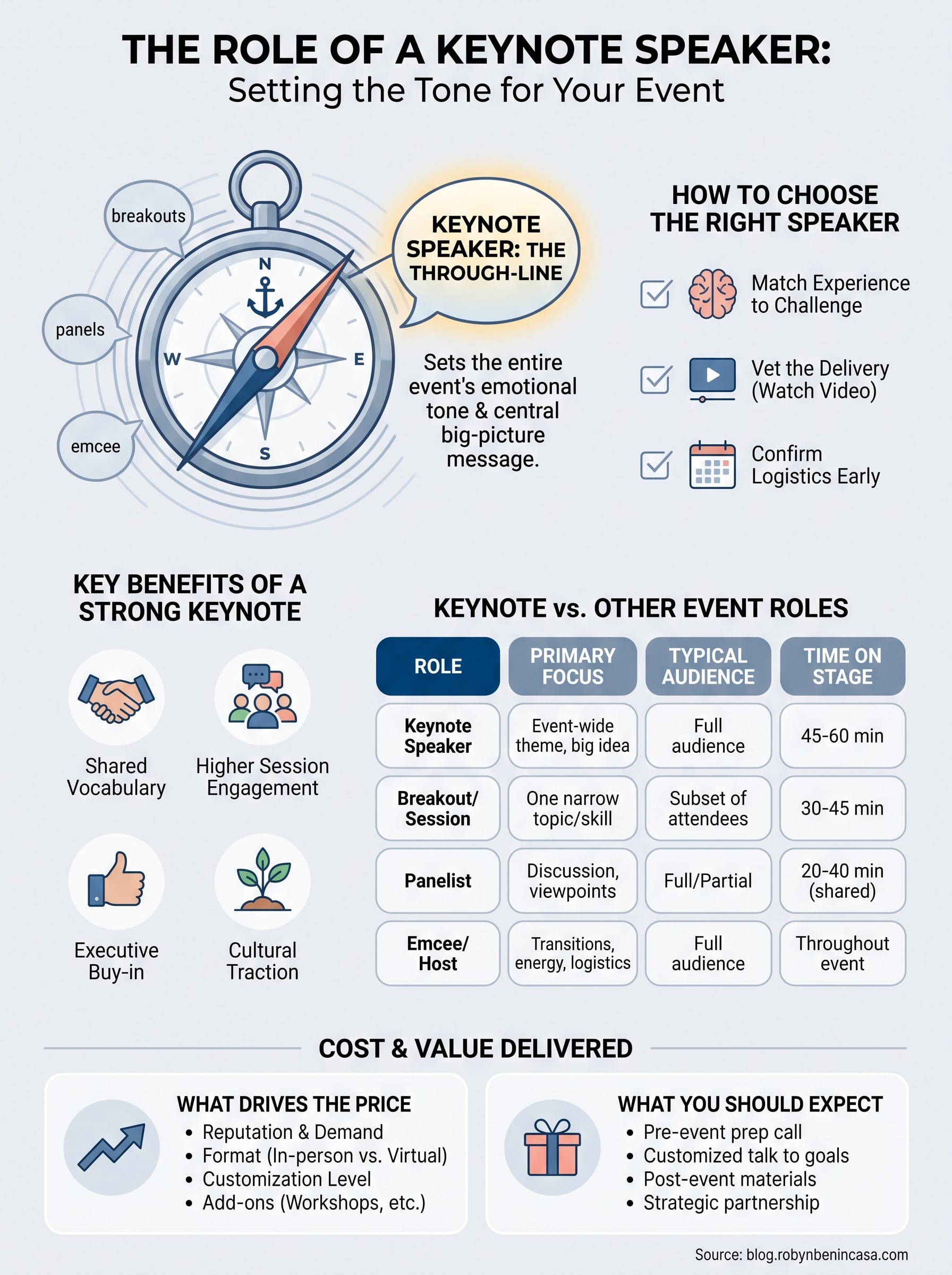
The keynote sets your event’s throughline
Before you book anyone, think about the single idea you want people to carry out of the room. A great conference keynote speaker takes that idea and turns it into a story people remember, not a slide deck they forget by lunch. When I speak about the eight elements of a world-class team culture, I’m not delivering a standalone talk, I’m handing the audience a lens they’ll use to interpret every session that follows. That’s the real function of a keynote: it becomes the throughline that makes an otherwise disconnected agenda feel like one coherent experience.
A keynote isn’t the biggest speech on your agenda, it’s the idea that holds the whole event together.
It shapes how attendees engage with everything else
Opening momentum matters more than most planners give it credit for. Research on audience attention consistently shows that engagement set in the first hour of an event predicts how attentive people stay for the rest of the day, which is one reason organizations like the Association for Talent Development emphasize strong openers in conference design. Sales meetings in particular live or die on this. I’ve worked with teams that moved from 17th to 1st in national rankings after rallying around a single cultural message delivered at their kickoff. That kind of shift doesn’t come from a good PowerPoint. It comes from a speaker who can connect a personal, tested experience to the specific challenge your team is facing.
What a well-chosen keynote actually delivers
When you land the right speaker, the payoff shows up in concrete ways:
- Shared vocabulary: attendees start using the speaker’s framework in their own meetings weeks later
- Higher session attendance: people who feel energized by the opener are more likely to stay engaged through breakouts
- Executive buy-in: leadership sees a tangible return on the event budget, not just a feel-good moment
- Cultural traction: HR and team leads get a reference point they can build training around long after the event ends
None of that happens by accident. It happens because someone on your planning team treated the keynote decision as strategic, not ceremonial. If you’re weighing whether a themed talk like T.E.A.M.W.O.R.K. fits your event, the test is simple: does the message give your audience something they’ll still be talking about at next year’s meeting? If the answer is yes, you’ve found your opener.
How to choose the right keynote speaker for your event
Picking a keynote speaker is less about star power and more about fit. Start with your event’s central problem, not your wish list of famous names. Are you trying to unify teams after a merger? Rebuild morale after a rough sales quarter? Launch a new strategic direction? The speaker you book should have lived experience that maps directly onto that challenge, not a generic motivational talk they recycle for every industry.
Match experience to your event’s real challenge
A conference keynote speaker with firsthand experience building teams under pressure will land differently than someone who only talks theory. When I speak to sales organizations, I draw on what actually moved a team from 17th to 1st nationally, not abstract leadership principles pulled from a textbook. Ask any speaker you’re considering how their material connects to your specific industry and goals. If they can’t answer with a concrete example, keep looking.
The right keynote speaker fits your problem, not just your budget or your guest list.
Vet the delivery, not just the resume
A polished bio doesn’t guarantee a strong room. Watch full-length video of the speaker in front of a live audience, not just a highlight reel. Check how they handle audience energy, timing, and unexpected moments like AV issues or a distracted crowd. Ask for references from planners who booked the same speaker in the last 12 months, since availability, delivery style, and even talk content can shift over time.
Use this checklist when narrowing your shortlist:
- Relevance: does their core message map to your event’s theme or business challenge?
- Proof: do they cite measurable outcomes from past engagements, not just applause?
- Format flexibility: can they deliver the talk in-person and as a speaker keynote for a virtual or hybrid event without losing impact?
- References: have recent clients confirmed the talk delivered what was promised?
- Logistics: do their fee, travel needs, and AV requirements fit your event budget and venue?
Confirm the logistics early
Booking timelines for in-demand speakers often run three to six months out, longer for peak conference season in spring and fall. Confirm availability before you lock your agenda, then work backward on contracts, AV specs, and any pre-event calls the speaker needs with your planning team. Skipping that step is how planners end up settling for whoever’s still open two weeks before the event, which rarely produces the result you were hoping for.
How keynote speakers differ from other event speakers
Confusion about who does what on an agenda causes more booking mistakes than budget ever does. A keynote speaker owns the big-picture message that frames your whole event, while breakout presenters, panelists, and emcees each play a narrower, supporting role. Understanding those differences before you sign a contract keeps you from paying keynote fees for a session speaker’s job, or asking a session speaker to carry weight they were never hired to carry.
Different roles, different jobs
Each role on your agenda serves a distinct function, and mixing them up leads to mismatched expectations on event day. Here’s how the roles typically break down:
| Role | Primary Focus | Typical Audience Size | Time on Stage |
|---|---|---|---|
| Keynote speaker | Event-wide theme, big idea | Full audience | 45-60 minutes |
| Breakout/session speaker | One narrow topic or skill | Subset of attendees | 30-45 minutes |
| Panelist | Discussion, multiple viewpoints | Full or partial audience | 20-40 minutes shared |
| Emcee/host | Transitions, energy, logistics | Full audience | Throughout the event |
A keynote speaker owns the whole room’s takeaway; every other speaker owns a slice of it.
Scope, preparation, and audience expectations
Breakout presenters go deep on one skill, like negotiation tactics or a software rollout, for a smaller, self-selected group. Panelists trade perspectives in real time, which works well for debate but rarely delivers one unified message. Emcees keep the day moving and the energy up, but they’re not there to teach a framework your audience carries home. A conference keynote speaker, by contrast, is booked specifically to give the entire room one shared story and one shared lens for everything that follows.
Getting this distinction right shapes your entire agenda, not just one slot. If you book a breakout-style speaker to open the day, you’ll likely get a solid talk that doesn’t connect to anything else on the program. If you book a true keynote to fill a 30-minute panel slot, you’re wasting their strongest material on the wrong format. Match the role to the job, and the rest of your agenda falls into place around it.
What keynote speakers typically cost and deliver
Budget questions come up early in every planning conversation, and for good reason. Fees for a keynote speaker vary widely based on name recognition, industry demand, and the complexity of the event, and understanding that range helps you set realistic expectations before you start reaching out to agents or speaker bureaus.
What drives the price
Cost isn’t random. A handful of factors push fees up or down, and knowing them helps you negotiate from an informed position rather than guessing at what’s fair:
- Reputation and demand: speakers with a bestselling book or major media coverage command higher fees
- Format: virtual keynotes typically cost less than in-person events because travel and setup drop out of the equation
- Customization: talks tailored to your industry or company data take more prep time and often carry a premium
- Add-ons: workshops, breakout facilitation, or executive Q&A sessions usually get priced separately from the main talk
- Exclusivity: some contracts include a no-compete clause for your industry within a set window, which can raise the fee
The fee buys more than a speech; it buys the prep work that makes the message fit your room.
What you should expect in return
A fair fee comes with more than 45 minutes on stage. Most professional speakers, including those booked through a platform like Robyn Benincasa’s speaking page, include a pre-event call to understand your audience and business goals, a customized talk that references your company or industry directly, and post-event materials your team can use to reinforce the message. Some engagements also come with a companion resource, like a free downloadable guide summarizing the core framework, which gives HR and team leads something concrete to build follow-up training around.
Questioning what’s included before you sign protects you from surprises later. Ask specifically whether the fee covers travel, whether there’s a separate charge for a book-signing add-on, and whether the speaker offers a shortened version for a speaker keynote slot at a virtual town hall versus a full in-person conference. Vague answers here usually signal a vague experience for your audience too. Clear answers, on the other hand, tell you the speaker treats your event as a partnership, not a transaction.
Setting the tone for your next event
A keynote speaker is the difference between an agenda that feels like a string of disconnected sessions and one that builds toward a message your audience carries home. Once you understand how the role differs from breakout presenters, panelists, and emcees, the booking decision gets much simpler: match the speaker’s real experience to your event’s real challenge, vet the delivery, and confirm the logistics early.
Getting this right pays off long after the closing session ends. Teams reference the framework in meetings months later, leadership sees the return on the event budget, and your planning team has a proven playbook for next year. That’s what a well-chosen conference keynote speaker actually delivers.
If you’re ready to see what that looks like in practice, explore Robyn Benincasa’s keynote topics and start the conversation about your next event.