Most company retreats fail before they even start, not because the venue was wrong or the budget too small, but because the activities felt disconnected from how the team actually works. You book a nice location, schedule a few icebreakers, and hope something sticks. It rarely does. If you’re planning team building activities for a company retreat, you need options that create real trust and communication, not just a fun afternoon everyone forgets by Monday.
This list gives you exactly that: activities tested against what actually moves teams forward, drawn from lessons I learned leading world championship adventure racing teams and working two decades as a San Diego firefighter, where team performance wasn’t optional. Every exercise here builds something specific, whether that’s problem-solving under pressure, better cross-departmental communication, or a shared sense of purpose your team can carry back to the office.
Below, you’ll find 14 corporate retreat team building activities organized by team size, goal, and setting, so you can match the right exercise to your group instead of guessing. Some require an afternoon, others fill a full day, and each one is built to produce results your leadership team will actually notice.
1. Start with a leadership keynote that sets shared goals
Every activity on this list works better when your team already understands why they’re doing it. That’s the case for opening your retreat with a leadership keynote built around teamwork and shared goals rather than generic motivation. A strong keynote gives people a common language before they hit the ropes course or sit down for trivia, so the rest of the retreat isn’t just fun, it’s connected to something real about how your team performs together.
A retreat without a shared framework is just a series of unrelated activities, no matter how well they’re run.
How it works
A speaker who’s actually led high-performing teams, not just studied them, opens the retreat by framing what a world-class team culture looks like and why it matters to your specific business right now. I do this by drawing on lessons from world championship adventure racing and two decades as a firefighter, where team trust wasn’t theoretical, it was the difference between finishing a race or not, or making it out of a building safely. The keynote typically runs 45 to 60 minutes, live or virtual, and closes with clear takeaways your team can reference during every other activity that follows.
Team skills it builds
This sets the tone for the whole retreat. Specifically, it builds:
- Shared vocabulary around trust, accountability, and communication
- Alignment on goals so every department understands the same target
- Buy-in from skeptical employees who see team building as filler
- A framework for giving feedback that carries past the retreat itself
Best for group size
Keynotes scale better than almost any other activity on this list. Groups of 50 work well, and so do audiences of 2,000 at a company-wide conference. Virtual formats mean remote and hybrid teams get the same content without travel costs, which matters if your retreat spans multiple offices or time zones.
Time and cost
Budget one hour for the keynote itself, plus 15 to 20 minutes for Q&A if your schedule allows it. Costs vary widely by speaker experience and format. Virtual keynotes run lower than in-person events, since travel and staging costs disappear. If you want the keynote to actually anchor the retreat, book it as the opening session, not an afterthought squeezed in after lunch.
2. Run an adventure-race style outdoor challenge
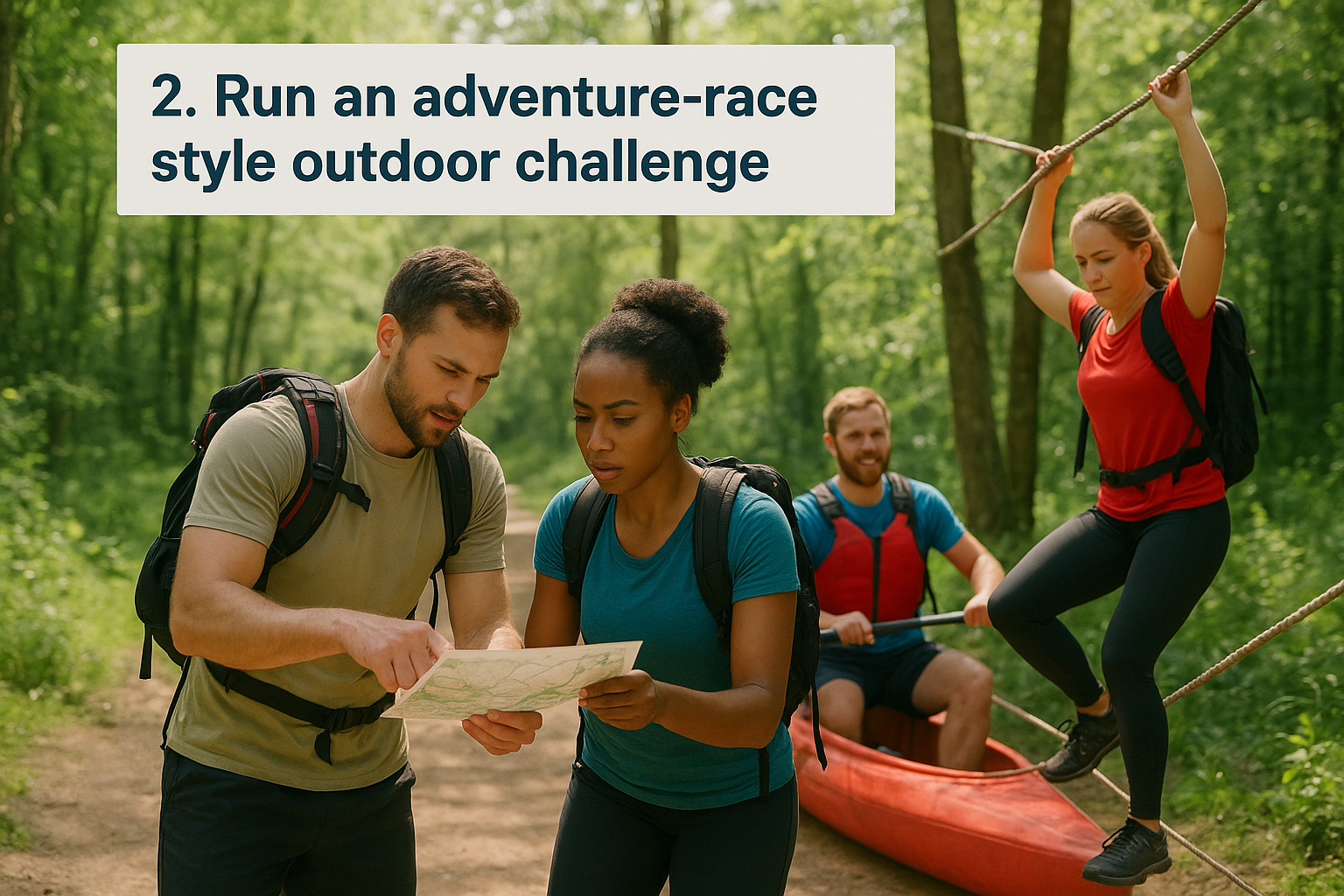
Outdoor challenges modeled on adventure racing put your team through real physical and mental obstacles instead of a scripted icebreaker. Think orienteering with a map and compass, a paddling leg on a lake, a rope traverse, or a timed obstacle course that forces the group to make decisions under pressure. I built my career on exactly this format, and I’ve watched strangers become a functioning team within a single afternoon once they’ve navigated a real obstacle together.
How it works
Split your group into teams of four to six and hand each one a checkpoint map or a set of coordinates. Teams navigate a course together, often carrying gear or completing a physical task at each checkpoint, and the clock keeps everyone honest. A trained facilitator or race director sets the course and manages safety, so you’re not improvising logistics on site.
Team skills it builds
Nothing exposes a team’s real dynamics faster than a course where getting lost costs you the win.
This format builds:
- Decision-making under pressure, since teams can’t overthink every choice
- Trust in teammates’ judgment, especially when someone else holds the map
- Physical collaboration across different fitness levels and skill sets
Best for group size
This works best with 20 to 200 people split into small teams. Larger groups need more course space and additional facilitators, so confirm venue capacity before you book.
Time and cost
Plan for three to five hours including setup and debrief. Costs run from $150 to $400 per person depending on location, equipment rentals, and whether you hire outside race organizers or use retreat venue staff.
3. Untangle the human knot
The human knot is a classic for a reason: it’s cheap, fast, and forces a group to solve a physical puzzle with their whole bodies while talking through every move. You don’t need equipment, a venue, or a facilitator with special training, which makes it one of the easiest team building activities for company retreats to slot into a tight schedule. Groups that resist "trust falls" and forced vulnerability tend to loosen up here because the goal is concrete and the stakes are low.

How it works
Gather six to ten people in a circle, shoulder to shoulder. Each person reaches across and grabs two different hands belonging to two different people, not the person next to them. Once everyone’s tangled, the group has to untangle themselves without letting go, ending in either a circle or a couple of interlocking rings. It takes real communication to figure out who steps over whom and in what order.
The knot only comes apart when the group agrees on one plan and actually follows it.
Team skills it builds
This simple exercise develops:
- Verbal communication under mild physical stress
- Patience with people who move slower or think differently
- Group problem-solving without a designated leader
Best for group size
Six to ten people per knot is the sweet spot. Run multiple knots simultaneously for larger retreats and compare untangling times afterward for a light competitive edge.
Time and cost
Budget 10 to 20 minutes per group. It costs nothing beyond the time itself, making it an easy addition between bigger, pricier activities.
4. Play two truths and a lie
Two truths and a lie works best when your retreat schedule needs a low-key reset between bigger physical activities. Each person shares three statements about themselves, two real and one invented, and the group guesses which is the lie. It sounds simple, but it forces people to reveal something genuine while the rest of the team practices reading, questioning, and listening closely. For remote teams meeting in person for the first time, this is often the fastest way to turn names on a screen into actual people.
How it works
Go around the room, or breakout groups of six to eight if your headcount is large, and give each person a minute to share their three statements. The group discusses and votes before the person reveals the lie. Push people toward specifics, a statement like "I once ran a marathon" invites better questions than something vague. A facilitator can keep pace so one enthusiastic talker doesn’t eat the whole session.
The best version of this game happens when people share something surprising enough that colleagues actually want to ask follow-up questions later.
Team skills it builds
This activity strengthens:
- Active listening, since guessing correctly requires paying attention to tone and detail
- Psychological safety, as people share something personal without much risk
- Early rapport building between departments or offices that rarely interact
Best for group size
This scales from a table of six to a full retreat of 150, as long as you break larger groups into smaller circles. Anything past ten people per circle drags the pace and loses energy fast.
Time and cost
Plan for 20 to 30 minutes depending on group size. It costs nothing and needs zero setup, which makes it a reliable filler between transportation, meals, or bigger scheduled sessions.
5. Send teams on a scavenger hunt
Scavenger hunts turn a retreat’s downtime into a structured challenge that gets people moving through unfamiliar spaces together. Teams work through a list of clues, photo challenges, or physical objects scattered across a hotel, city block, or conference venue, racing against a clock and each other. Unlike a lot of team building activities for company retreats, this one doubles as a way to introduce people to a new city or campus, so it works especially well when your group is meeting somewhere unfamiliar.
How it works
Break the group into teams of four to six and hand out a list of 10 to 15 tasks, ranging from trivia questions about the company to photo challenges that require finding a specific landmark or interacting with a stranger. Teams submit proof through a shared app or by texting photos to a coordinator, who tracks scores in real time. Set a hard time limit, usually 60 to 90 minutes, so teams have to prioritize instead of chasing every clue.
A good scavenger hunt rewards teams that divide tasks smartly, not the ones that simply run the fastest.
Team skills it builds
This format sharpens:
- Task delegation across a small group with limited time
- Resourcefulness, since some clues require creative problem-solving
- Light competition that energizes the group without real stakes
Best for group size
Scavenger hunts handle large retreats well, from 20 people up to several hundred, as long as you have enough facilitators to track multiple teams and verify submissions.
Time and cost
Plan for 90 minutes to two hours including setup, briefing, and a wrap-up where teams share highlights. Costs range from $50 to $150 per person depending on whether you use an app-based platform or run it manually with printed clue sheets.
6. Solve an escape room together
Escape rooms put a small group in a locked space with a puzzle that only opens through shared thinking, not individual smarts. Corporate retreats have leaned on these for years because the format forces quiet analysts and loud talkers into the same problem at the same time, and neither type wins alone. Mobile escape room companies now travel to hotels and conference centers, so you don’t need to find a dedicated venue near your retreat location.
How it works
Groups of six to eight enter a themed room, or a portable setup built for the retreat, and work through a series of locks, codes, and hidden clues within a set time limit, usually 60 minutes. A game master monitors progress remotely or from an adjoining room, dropping hints if the team stalls too long. Teams either escape, or run out the clock, but most facilitators build a debrief into the session regardless of outcome.
A locked room with a 60-minute clock tells you more about how a team makes decisions than a full day of scheduled icebreakers.
Team skills it builds
This activity strengthens:
- Collaborative problem-solving, since no single person usually holds enough clues to finish alone
- Time management under a visible, ticking deadline
- Recognition of who naturally leads and who quietly contributes the winning idea
Best for group size
Six to eight people per room works best. Larger retreats run multiple rooms in parallel, which also opens the door to comparing completion times across departments.
Time and cost
Budget 90 minutes total, including briefing and debrief. Mobile escape room vendors typically charge $50 to $100 per person, depending on room complexity and travel distance.
7. Build a tower with spaghetti and marshmallows
The marshmallow challenge is a design exercise disguised as a party game. Teams get 20 sticks of dry spaghetti, one yard of tape, one yard of string, and a single marshmallow, then they have 18 minutes to build the tallest freestanding structure that holds the marshmallow on top. It’s cheap, fast, and exposes planning habits better than almost any other team building activities for company retreats on this list, because the failures show up in real time when a tower collapses in front of everyone.

How it works
Split your group into teams of three to five and give each team an identical kit. Set an 18-minute timer and let teams build without interference. Facilitators measure the finished towers at the end and award a quick prize to the tallest one still standing with the marshmallow on top. The real value shows up in the debrief, where you ask teams to walk through their process, not just their result.
Teams that spend the first five minutes planning almost always beat the ones that start building immediately.
Team skills it builds
This exercise builds:
- Rapid prototyping and comfort with early failure
- Time management under a hard, visible deadline
- Structured planning before jumping into execution
Best for group size
Teams of three to five work best, and you can run as many teams in parallel as you have kits and table space. Retreats of 100 or more handle this easily since setup scales with folding tables, not facilitators.
Time and cost
Budget 30 to 40 minutes total, including instructions, the 18-minute build, and a short debrief. Materials cost almost nothing, usually under $5 per team, making this one of the most affordable options on the whole list.
8. Line up in silence
Silent lineups strip away the easiest tool a team has, talking, and force everyone to solve a simple sorting problem using only gestures and observation. It sounds almost too basic to matter, but groups that rely on verbal shortcuts in daily meetings often struggle here, which makes it a useful diagnostic disguised as a game. This is one of the quieter team building activities for company retreats on this list, and that’s exactly the point.
How it works
Ask your group to line up by birthday, height, or years at the company, without speaking a single word. Teams can use hand signals, mouthed numbers, or written notes if you want to add a layer of difficulty. Once everyone believes they’re in order, have each person call out their birthday or metric out loud to check accuracy. Run a second round with a harder category, like alphabetical order of middle names, to see if the group communicates faster the second time.
Silence forces people to actually watch each other instead of waiting for their turn to talk.
Team skills it builds
This exercise sharpens:
- Nonverbal communication and reading body language
- Patience with a slower, less efficient process than talking
- Awareness of who defaults to leading when the usual tools disappear
Best for group size
Groups of 15 to 40 work well as a single lineup. Split larger retreats into multiple lines running at once, then compare completion times for a light competitive edge.
Time and cost
Budget 10 to 15 minutes per round. It costs nothing and needs no materials, so it slots easily between scheduled sessions or right after lunch.
9. Draw back to back
Draw back to back pairs people up, sits them spine to spine, and hands one person a simple image while the other holds a blank sheet and a pencil. The describer explains the shape without naming it outright, no saying "house" or "cat", while the artist draws based purely on verbal instructions. It’s one of the fastest team building activities for company retreats to reveal exactly how instructions get lost between the person who has information and the person who needs it.
How it works
Pair up your group and seat each pair back to back so neither can see the other’s paper or gestures. Hand the describer a card with a simple line drawing, geometric shapes work best, and give them three to five minutes to talk their partner through recreating it from scratch. No peeking, no showing, only words. When time runs out, compare the original card against the drawing and ask what instructions helped versus what caused confusion.
The gap between what you said and what someone heard is usually bigger than either person expects.
Team skills it builds
This exercise sharpens:
- Precise verbal instructions without relying on visual cues
- Clarifying questions from the listener instead of silent guessing
- Awareness of jargon or assumptions that make sense to the speaker but confuse everyone else
Best for group size
This works in pairs, so it scales to almost any retreat size. Groups of 20 to 60 run smoothly with one facilitator managing timing and card distribution.
Time and cost
Budget 20 minutes total, including instructions, the drawing round, and a quick debrief. Materials cost under $10 for paper, pencils, and printed image cards, making this another nearly free option on the list.
10. Pitch a solution to a mock business case
A mock business case pulls your team out of icebreaker mode and into something closer to actual work, minus the real stakes. Small groups get a realistic problem, a shrinking market, a product launch gone wrong, a staffing shortage, and a deadline to pitch a fix to a panel of judges. This is one of the more results-driven team building activities for company retreats, because it mirrors the kind of pressure your team already faces, just with room to fail without consequences.
How it works
Hand each team of four to six a one-page brief describing a fictional company problem loosely tied to your industry. Give them 45 minutes to build a pitch, then five minutes each to present to a judging panel made up of executives or outside facilitators. Judges score on creative problem-solving, feasibility, and how well the team defends their idea under follow-up questions.
A pitch that survives tough questions from judges tells you more about a team than a polished slide deck ever will.
Team skills it builds
This format strengthens:
- Strategic thinking under time pressure
- Persuasive communication in front of an audience
- Cross-functional collaboration when teams mix departments
Best for group size
Groups of 20 to 80 work best, split into teams of four to six with a panel of three to five judges. Larger retreats need multiple rooms running simultaneously so judges can rotate.
Time and cost
Budget 90 minutes total, including brief distribution, prep time, pitches, and judge feedback. Costs stay low, usually under $20 per person for printed materials and prizes, unless you bring in outside facilitators to write custom case studies.
11. Take a team cooking class
Cooking classes pull people away from screens and seating charts and put them shoulder to shoulder at a stove, which changes the energy of a retreat fast. Chefs split your group into small teams and walk everyone through a multi-course meal, from prep to plating, so nobody sits on the sidelines watching someone else work. This activity earns a spot on almost every list of team building activities for company retreats because it combines hands-on collaboration with a reward everyone enjoys together at the same table.

How it works
Venues or catering companies bring in a chef instructor who assigns stations, ingredients, and a shared recipe to teams of four to six. Each team divides tasks, someone chops, someone sauces, someone plates, and the instructor circulates to correct technique and keep timing on track. The meal usually wraps with everyone eating together, which turns the exercise into a shared meal rather than just a workshop.
A kitchen under a deadline exposes who takes charge and who quietly keeps things organized faster than most meetings ever will.
Team skills it builds
This format sharpens:
- Task division under real time pressure
- Communication between stations working on the same dish
- Patience with mistakes that show up immediately, not weeks later
Best for group size
Teams of four to six per station work best, with total retreat groups of 20 to 100 depending on kitchen space and instructor availability.
Time and cost
Budget two to three hours including instruction, cooking, and the shared meal. Costs typically run $75 to $150 per person depending on menu complexity and venue.
12. Volunteer together for a local cause
Volunteering gives your retreat a purpose beyond the retreat itself, and teams often remember a service project longer than any activity built purely for entertainment. Packing meals for a food bank, building furniture for a shelter, or cleaning up a local park puts your group to work on something that matters outside the office, which tends to build a different kind of trust than games do. Among team building activities for company retreats, this one carries the most weight when your organization wants the retreat to reflect its values, not just fill a schedule.
How it works
Partner with a local nonprofit ahead of time and confirm exactly what your group will do on site, since vague plans waste time once people arrive. Split into teams of six to ten for tasks like sorting donations, assembling care packages, or painting a community space, and assign a point person from the nonprofit to keep the group on task. Build in fifteen minutes at the end for the group to see the finished result together, whether that’s stacked boxes ready for delivery or a completed mural.
A team that works toward someone else’s need together usually returns to the office more connected than one that only competed against itself.
Team skills it builds
This activity strengthens:
- Shared purpose that connects directly to company values
- Collaboration across departments that rarely interact
- A sense of collective accomplishment tied to a real outcome
Best for group size
Groups of 20 to 150 work well, depending on the nonprofit’s capacity and available tasks. Confirm headcount limits with your partner organization early, since some sites cap volunteers per shift.
Time and cost
Budget two to four hours including travel, orientation, and the project itself. Costs stay low, often just materials or a donation to the nonprofit, typically $20 to $50 per person.
13. Hold an appreciation circle
An appreciation circle gives your team a structured way to say things out loud that usually stay unsaid, like who covered for someone during a rough quarter or who always answers the 9 p.m. email. Retreats that skip this step often end with people feeling entertained but not necessarily closer, and this is the activity that closes that gap. It works especially well toward the end of a retreat, once people have already shared a few physical or creative challenges together and have real moments to point back to.
How it works
Gather the full group, or break into circles of 10 to 15 for larger retreats, and ask each person to name one specific thing they appreciate about a colleague, tied to something concrete rather than a general compliment. A facilitator sets the tone early by modeling a specific example, since vague praise like "you’re great" falls flat compared to "you stayed late to help me finish the client deck." Keep the pace moving so the circle doesn’t stall on one long story.
Specific appreciation lands harder than generic praise, and it’s the difference between a compliment and a memory.
Team skills it builds
This exercise strengthens:
- Emotional connection built on specific, earned recognition
- Psychological safety, since people practice giving and receiving praise openly
- A habit of noticing contribution that can carry back into regular team meetings
Best for group size
Groups of 10 to 15 per circle work best for pacing. Larger retreats run multiple circles simultaneously, then bring everyone back together for a few highlights shared with the whole room.
Time and cost
Budget 20 to 30 minutes depending on group size. It costs nothing beyond the time, which makes it easy to schedule right before a closing session or dinner.
14. Compete in company trivia
Company trivia closes a retreat with energy instead of exhaustion, and it works because everyone can play regardless of fitness level or seniority. Mix general knowledge categories with rounds built specifically around company history, inside jokes, and industry facts, so long-tenured employees and new hires both get a chance to shine. It’s one of the easiest team building activities for company retreats to run on a tight final-day schedule, since it needs almost no physical space and works just as well in a hotel ballroom as it does outdoors.
How it works
Build five or six rounds of eight to ten questions each, mixing pop culture, sports, and company-specific trivia written by someone on your planning team. Split the retreat into tables of six to eight, hand out answer sheets or use a phone-based quiz platform, and score rounds as you go so teams can track their standing. Keep a live leaderboard visible if you can, since watching rankings shift keeps energy high through the final round.
Company trivia works because it rewards curiosity and memory over athleticism, so every employee has a real shot at winning.
Team skills it builds
This format sharpens:
- Collaborative recall, since teams pool partial knowledge to land full answers
- Light competition that energizes a group without physical risk
- Cross-departmental bonding at tables mixed on purpose rather than by seating chart
Best for group size
Trivia scales from 20 people to several hundred, as long as you have enough facilitators to score rounds quickly and keep the pace moving.
Time and cost
Budget 60 to 90 minutes for a full trivia night. Costs stay low, usually under $10 per person for prizes, unless you rent a professional quiz platform or hire an outside host.
15. How to choose the right activities for your retreat
Matching the right mix of team building activities for a company retreat starts with a clear goal, not a list of fun options. Ask what your team actually needs before you book anything: are you rebuilding trust after a rough merger, breaking down silos between departments, or simply rewarding a team that already works well together? A retreat aimed at repairing communication needs different activities than one built to celebrate a strong year, and picking activities without that distinction is how you end up with a fun afternoon that changes nothing.
Group size and venue constraints narrow the list further. A 400-person sales conference can’t run six-person escape rooms without serious logistics, but it handles a keynote, trivia, or a scavenger hunt without much strain. Budget matters too, since some activities cost nothing beyond staff time while others run into the hundreds of dollars per person.
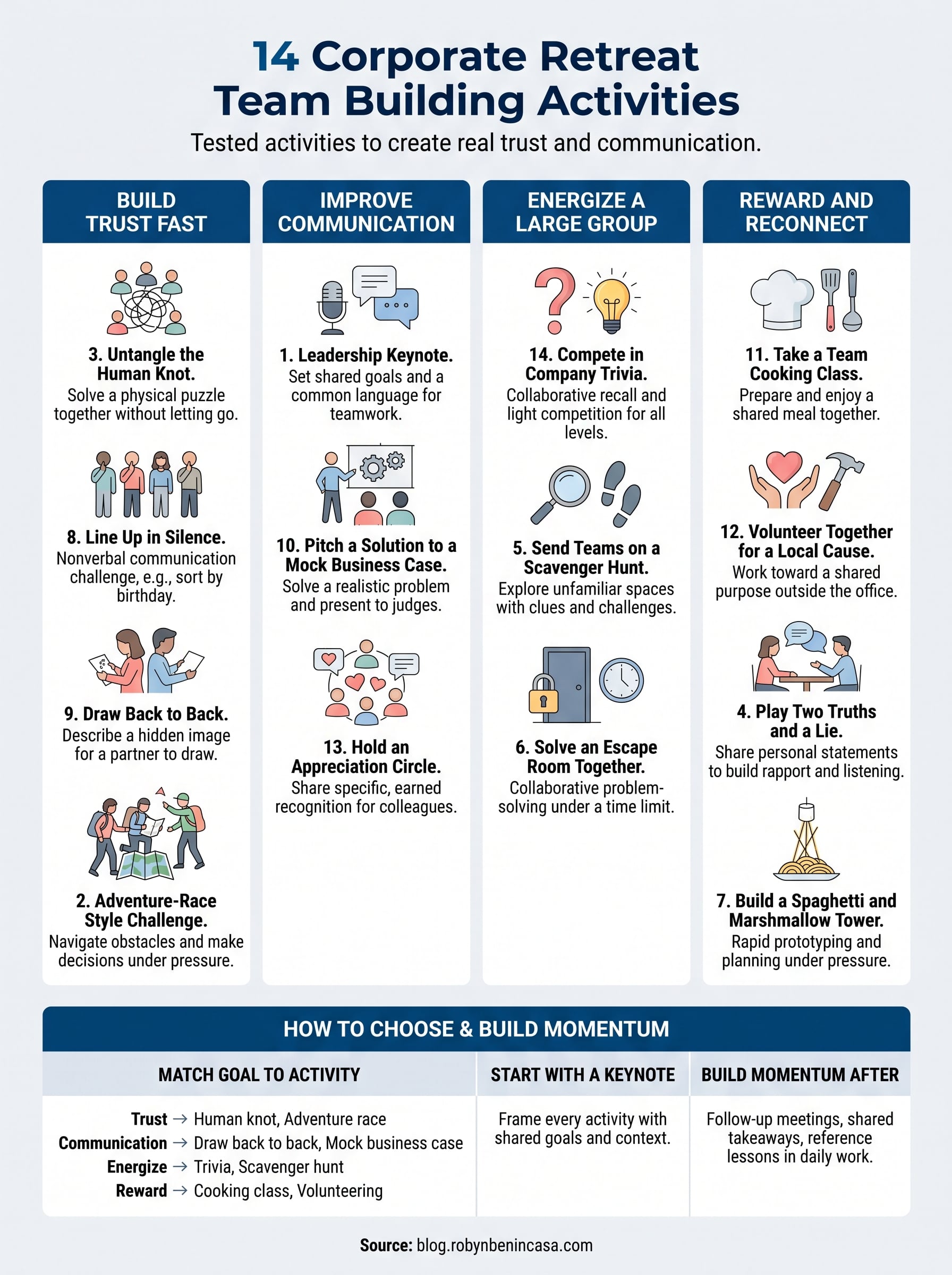
| Retreat goal | Best-fit activities |
|---|---|
| Build trust fast | Human knot, adventure-race challenge, silent lineup |
| Improve communication | Draw back to back, appreciation circle, mock business case |
| Energize a large group | Trivia, scavenger hunt, keynote |
| Reward and reconnect | Cooking class, volunteering, appreciation circle |
Nothing on this list works in isolation, though. Layering a leadership keynote at the start gives every later activity a shared frame, so people connect the human knot or the mock pitch back to something real about how your team performs.
The right activity depends less on what’s trendy and more on the specific problem your team needs to solve.
Once you’ve matched activities to goals, sequence them deliberately: open with something that sets context, alternate high-energy and low-key sessions, and close with a moment that lets people reflect on what actually shifted.
Building momentum long after the retreat ends
Great retreats don’t end when the buses leave. The activities you’ve just read about only pay off if you build in a way to carry the lessons back into daily work, whether that’s a follow-up meeting, a shared document of takeaways, or a manager who references the human knot the next time a project stalls. Momentum fades fast without that deliberate follow-through, and that’s the real difference between a retreat people enjoyed and one that actually changed how a team operates.
If you’re still shaping your agenda, start with the piece that gives every other activity its meaning: a keynote that frames why teamwork matters to your specific business right now. I’ve watched that single session turn a scattered schedule into something a team references for years. Book Robyn to open your next retreat and give your team a shared foundation before they hit the ropes course, the trivia table, or the kitchen station.