Category: Uncategorized

  • 12 Quick Team Building Activities for Meetings (No Prep)

    Most team building falls flat because it feels forced, a trust fall nobody asked for, a trivia game that drags on while everyone checks their phones under the table. But here’s what I’ve learned from racing across jungles, deserts, and mountains with teams whose lives depended on each other: connection doesn’t require a weekend retreat. It requires the right moment and the right prompt. That’s exactly where quick team building activities for meetings come in.

    After two decades of studying what makes teams actually work, as a world champion adventure racer, San Diego firefighter, and leadership speaker who’s trained organizations from Allstate to Northrop Grumman, I can tell you that the smallest interactions often build the strongest bonds. A five-minute exercise before a Monday standup can shift a team’s dynamic more than a full-day offsite that everyone quietly resents. The key is choosing activities that feel natural, not performative, and that create real moments of shared experience.

    This list includes 12 activities you can drop into any meeting with zero prep, zero awkward silences, and zero eye rolls. Each one is designed to strengthen the kind of trust and collaboration that I outline in my T.E.A.M.W.O.R.K. framework, the same principles that help teams perform under pressure, whether they’re navigating a boardroom or a Class V rapid. Let’s get into it.

    1. T.E.A.M.W.O.R.K. quick huddle

    This activity uses my T.E.A.M.W.O.R.K. framework to structure a short, focused team conversation that actually goes somewhere. It’s one of the most adaptable quick team building activities for meetings because you can drop it into any agenda without rearranging what comes next. Each letter in the acronym represents a different element of elite collaboration, which means you get eight different conversation starters built right into the name.

    What it builds

    The huddle builds shared awareness across your team by surfacing how each person is showing up that day. When people know where their teammates are mentally and emotionally, they collaborate more deliberately and cover for each other better under pressure. Teams that practice this regularly develop a habit of voluntary transparency, which is one of the hardest things to create in a corporate environment.

    How to run it in 8 minutes

    Pick one letter from the T.E.A.M.W.O.R.K. acronym and ask each person to rate themselves on that element from 1 to 5, then give one sentence about why. Keep a visible timer running. With a team of up to eight people, eight minutes gives everyone enough time to speak and still leaves you a moment to close with a quick observation about what you heard.

    The goal isn’t a perfect score. The goal is honest awareness of where your team stands right now.

    Prompts to keep it practical, not personal

    Avoid open-ended questions that invite oversharing. Instead, anchor every prompt to work context: "On a scale of 1 to 5, how much ownership are you feeling over your current project?" or "Rate your attitude toward this quarter’s goal right now." Keeping prompts task-focused means people answer honestly without feeling put on the spot or pressured to disclose something personal.

    Remote and hybrid variations

    For remote teams, use the chat function to have everyone type their number simultaneously before anyone speaks. This prevents anchoring, where the first person’s answer pulls everyone else in the same direction. For hybrid settings, designate a remote-first format so virtual attendees share their responses before the in-room group, giving distributed teammates equal weight in the conversation.

    Common facilitation mistakes to avoid

    The most common mistake is turning this into a status update. If someone gives a low score, resist the urge to problem-solve it on the spot. Acknowledge it, keep moving, and follow up privately afterward. The second mistake is abandoning the framework entirely and asking "how is everyone?" instead. That question gets one-word answers. Structured prompts produce specific, usable responses that actually help you lead the room.

    2. Rose, thorn, bud check-in

    This three-part check-in gives every person in your meeting a structured way to share how they’re doing without turning the room into a venting session. It works as one of the most reliable quick team building activities for meetings because it covers past, present, and future in under ten minutes with no materials and no setup.

    What it builds

    The format builds psychological safety by normalizing the idea that not everything is going well, which is the first step toward honest team communication. When people hear teammates name real challenges openly, trust accumulates fast because vulnerability stops feeling like a liability.

    Repeated use also trains teams to think in three horizons rather than getting stuck in the present moment, a habit that improves both problem-solving and forward planning.

    How to run it in 5-10 minutes

    Ask each person to share one rose (a recent win), one thorn (a current challenge), and one bud (something they’re looking forward to). Keep responses to 30 seconds per person and move through the group without commentary.

    The bud is the most underused part. It shifts your team’s energy forward and gives people something to connect around before the real agenda starts.

    Prompts for different meeting types

    Adjust the framing to match your meeting type so responses stay grounded in real work:

    • Sales meetings: thorn as a deal blocker, bud as a prospect worth watching
    • Project check-ins: thorn as a scope risk, bud as an upcoming milestone
    • All-hands: rose as a team win, bud as a company initiative ahead

    Remote and hybrid variations

    On remote calls, display the three categories visually on a shared screen so everyone holds the same structure throughout the exercise. This prevents people from skipping the bud or turning the thorn into an extended update.

    For hybrid settings, ask remote participants to go first so in-room energy does not anchor the responses of people joining virtually.

    Common facilitation mistakes to avoid

    Avoid letting the thorn section become a complaint spiral. Your job as the facilitator is to acknowledge each one briefly, keep moving, and follow up one-on-one after the meeting if something real needs attention.

    3. One-word kickoff round

    The one-word kickoff round is exactly what it sounds like: every person in the room shares a single word that describes where they are right now before the meeting agenda starts. It takes under five minutes, requires nothing, and consistently ranks as one of the most effective quick team building activities for meetings because the constraint is the point. One word forces clarity, and clarity creates connection.

    What it builds

    This activity builds emotional awareness across the team without asking anyone to overshare or get vulnerable on demand. Hearing one word from each person gives you a real-time read on the room’s energy before you drive into the agenda, which helps you calibrate how hard to push and where to offer support.

    A single word from each person tells you more about your team’s state than a five-minute status update ever will.

    How to run it in 3-5 minutes

    Go around the room or call list in order. Ask each person to say one word and only one word, no explanations unless someone asks. Keep the pace fast. The speed is intentional because it prevents overthinking and produces more honest responses.

    Prompt bank for teams and leaders

    Vary the prompt so it stays fresh across meetings:

    • "One word for how you’re feeling about this week"
    • "One word for your energy level right now"
    • "One word that describes this project to you today"

    Remote and hybrid variations

    For remote teams, use the chat function so everyone types their word simultaneously before anyone speaks out loud. This keeps early answers from influencing the rest of the group.

    Common facilitation mistakes to avoid

    The most common mistake is allowing explanations to creep in. Once one person explains their word, everyone else feels obligated to follow, and you lose the speed that makes this activity work. Hold the format firm and redirect gently if someone starts to expand.

    4. This or that lightning poll

    This or that lightning polls give your team a fast, low-stakes way to share preferences before diving into a meeting agenda. You ask a simple either/or question, everyone picks a side, and the whole thing wraps up in five minutes. Among quick team building activities for meetings, this one requires the least facilitation effort because the format does the work for you.

    What it builds

    This activity builds familiarity between teammates by surfacing small, surprising facts about the people they work with every day. Knowing that your colleague picks early mornings over late nights, or process over improvisation, gives you a working mental model of how they think, which pays off when you need to collaborate under pressure.

    The fastest way to understand how someone works is to watch what they choose when the stakes are low.

    How to run it in 5 minutes

    Ask one either/or question and give everyone five seconds to commit to a side. In a live room, people can raise hands or move to opposite sides physically. Keep moving through two or three questions without pausing to debate anyone’s choice. Speed keeps the energy up and prevents the activity from turning into a discussion.

    Question bank that stays work-relevant

    Keep questions light but relevant to how people operate at work:

    • Meetings or async updates?
    • Plan ahead or figure it out as you go?
    • Present the data or tell the story first?
    • Solve alone, then share vs. brainstorm as a group?

    Remote and hybrid variations

    For remote teams, use polling features in Zoom or Microsoft Teams so everyone responds at once. This avoids the pile-on effect where late responders just echo whoever answered first.

    Common facilitation mistakes to avoid

    Avoid questions that feel like personality tests or hidden assessments. If people sense they’re being evaluated, they answer strategically instead of honestly, and you lose the authentic connection the activity is designed to create.

    5. Two truths and a lie

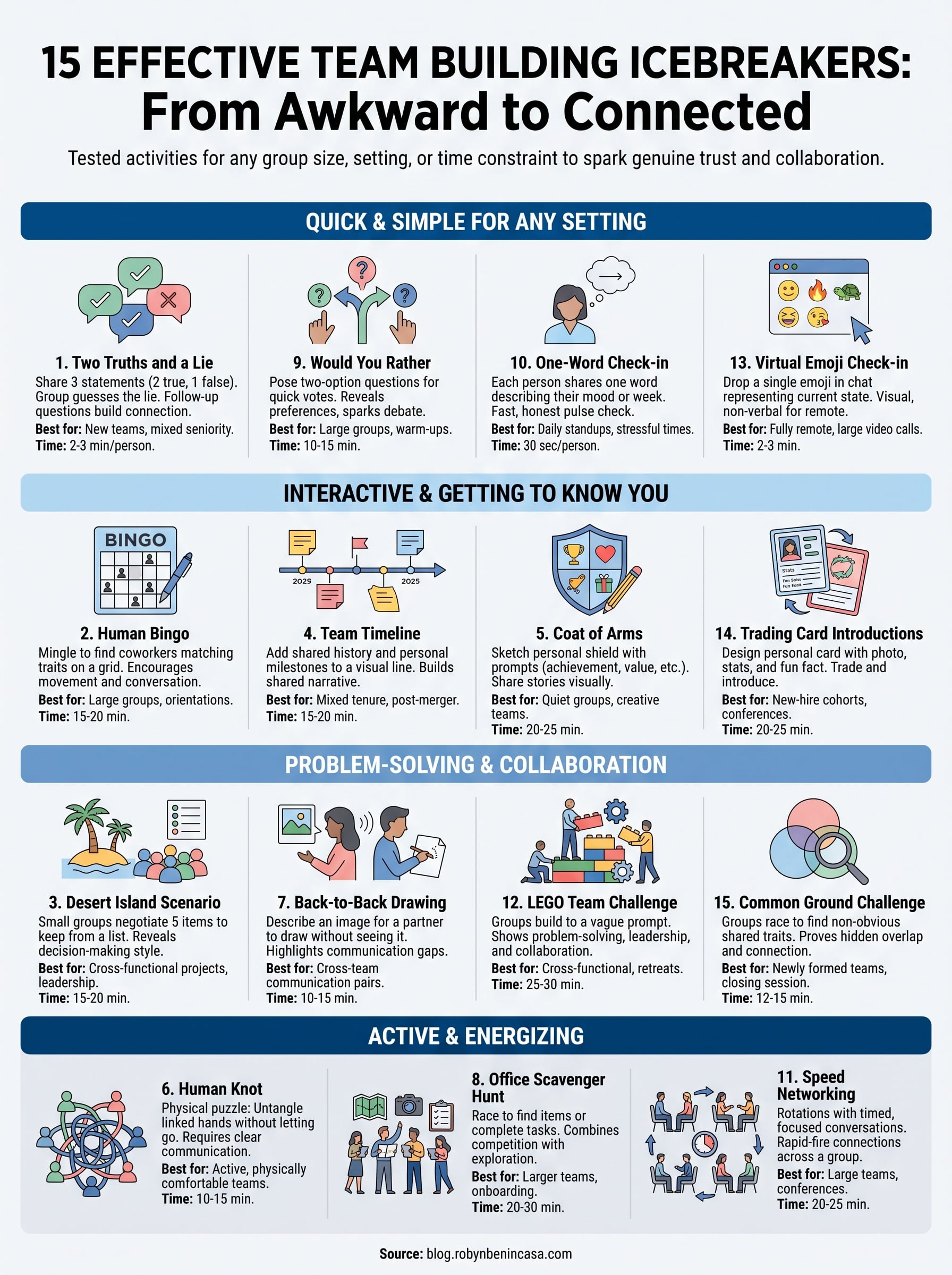
    Two truths and a lie is one of the most recognizable quick team building activities for meetings for a reason: it works. Each person shares three statements about themselves, two true and one false, and the group tries to spot the lie. The activity creates genuine surprise and laughter in under 12 minutes, which builds the kind of informal connection that formal agendas rarely produce.

    What it builds

    This activity builds personal knowledge between teammates who may have worked side by side for years without knowing much about each other beyond their job titles. Discovering that a colleague ran a marathon or speaks three languages changes how you see them, and stronger personal context leads directly to stronger working relationships.

    How to run it in 10–12 minutes

    Give everyone 60 seconds to think of their three statements before the round starts. Then move through each person in order, let the group vote on the lie, and have the person reveal the answer. Keep each reveal to 30 seconds or less so the pace stays tight.

    The reveal is where the real connection happens, so give it a beat before moving on.

    Guardrails to keep it from getting awkward

    Ask people to keep all statements work-safe and professionally appropriate before the round begins. Setting that boundary upfront prevents anyone from sharing something that makes the room uncomfortable and keeps the energy light instead of tense.

    Remote and hybrid variations

    For remote teams, use the chat or a poll to collect guesses simultaneously so no one anchors the group before others have a chance to form their own read.

    Common facilitation mistakes to avoid

    Avoid letting people share statements that are too obscure or too obvious because both kill the energy fast. Coach your team to aim for statements that feel plausible but deliver a genuine surprise when the truth lands.

    6. Back-to-back drawing

    Back-to-back drawing pairs two people who sit with their backs to each other: one person describes a simple shape or object while the other draws it without asking questions. It is one of the most effective quick team building activities for meetings because it makes communication breakdowns visible in real time, giving your team something concrete to analyze right after.

    What it builds

    This activity builds listening precision and verbal clarity by forcing people to give and receive instructions without visual cues or the ability to ask clarifying questions. It surfaces the specific habits that create miscommunication on your team:

    • Assuming shared context that does not exist
    • Giving direction without enough specificity
    • Skipping confirmation steps under time pressure

    How to run it in 10–15 minutes

    Pair up your team and give each pair a simple geometric shape or icon for the describer to reference. Run two rounds so both partners experience both roles. Keep each round to four minutes, then give teams one minute to compare their drawings before the full-group debrief.

    The gap between what someone said and what someone drew is exactly where your team’s real communication problems live.

    Debrief questions that translate to work

    Anchor the debrief to actual work scenarios so the lesson connects beyond the exercise:

    • Where do we hand off instructions like this on real projects?
    • What assumptions did you make that turned out to be wrong?
    • How do we create better checkpoints before work ships?

    Remote and hybrid variations

    Remote teams can use the whiteboard feature in Zoom or Microsoft Teams for drawing while the describer gives instructions over audio only.

    Common facilitation mistakes to avoid

    Avoid skipping the debrief entirely. The drawing is not the deliverable; the conversation about how your team communicates under constraint is where all the value sits.

    7. Common ground sprint

    The common ground sprint challenges small groups to find as many shared traits as possible within a tight time window. It is one of the most deceptively simple quick team building activities for meetings because it looks easy on the surface but consistently produces genuine surprise when people discover shared experiences with colleagues they thought they already knew well.

    What it builds

    This activity builds cross-team familiarity by surfacing the personal and professional overlap that normal work conversations never reach. When people discover genuine common ground, they develop a natural basis for trust that accelerates real collaboration.

    How to run it in 6–10 minutes

    Split your team into groups of three to five and give each group six minutes to list everything they share without mentioning job roles, the company, or the current project. The group with the longest list wins. Keep a timer visible and call a one-minute warning so energy peaks at the end rather than fizzling out.

    The rule that bans job titles forces people to find real common ground instead of defaulting to the work they already share.

    Ways to make it inclusive for new hires

    Pair new team members with tenured colleagues rather than grouping new hires together. This ensures newer people connect immediately with teammates who know the culture, which makes those shared discoveries feel grounded rather than awkward.

    Remote and hybrid variations

    For remote teams, use a shared Google Doc so each group types their list simultaneously. For hybrid settings, pair remote and in-room participants deliberately so no single group holds a natural conversation advantage.

    Common facilitation mistakes to avoid

    Avoid letting groups default to surface observations like "we all like coffee." Push them deeper by offering one example of a meaningful connection before the timer starts. A specific prompt consistently produces richer, more memorable results.

    8. Throw your troubles away

    Throw your troubles away is one of the more cathartic quick team building activities for meetings you can run. Each person writes down a current frustration or obstacle on a piece of paper, then physically crumples it up and throws it across the room. Someone else picks it up, reads it aloud anonymously, and the group spends one minute brainstorming a single actionable response before moving on.

    What it builds

    This activity builds collective problem ownership by shifting individual frustrations into shared team territory. When people hear their anonymous challenge treated seriously by the group, they feel less isolated and more supported, which directly increases their willingness to raise real issues in future meetings.

    The physical act of throwing the paper is not a gimmick. It signals a genuine shift from holding a problem to releasing it.

    How to run it in 12–15 minutes

    Give everyone 90 seconds to write one challenge on a piece of paper, no names. On your signal, everyone crumples and throws their paper across the room. Each person picks up the paper nearest them and reads it aloud. The group offers one practical suggestion per challenge, then moves to the next paper.

    How to keep it constructive and safe

    Set a clear boundary before the round starts: no personal criticisms of named individuals and no complaints that have no actionable solution. This keeps the energy focused on problems the team can actually influence.

    Remote and hybrid variations

    Remote teams can submit challenges via an anonymous form or the chat function, then the facilitator reads them aloud while participants respond in turn.

    Common facilitation mistakes to avoid

    Avoid letting the group linger on a single challenge for more than 90 seconds per response. Spending too long on one item signals that the activity is a complaint forum rather than a fast-moving problem-solving exercise, which kills the energy you built getting here.

    9. Meeting trivia about the team

    Meeting trivia flips the usual format: instead of testing what people know about the world, you test what they know about each other. Among quick team building activities for meetings, this one consistently delivers the most laughter because the questions are personal, the gaps in people’s knowledge are always bigger than expected, and the whole thing runs without any materials beyond a few questions you can write in two minutes.

    What it builds

    This activity builds interpersonal awareness between teammates who assume they know each other well and often discover they do not. Closing those gaps matters because teams that know each other personally coordinate faster, communicate more directly, and cover for each other more willingly when pressure hits.

    The moment someone learns a surprising fact about a colleague they have worked with for years is exactly when the relationship deepens.

    How to run it in 10–15 minutes

    Read each question aloud and give everyone ten seconds to write their answer before the reveal. Move fast enough that people commit to an answer rather than waiting to see what others say. Aim for eight to ten questions to keep the round brisk and leave time for a quick debrief at the end.

    Question templates that work in any company

    Use questions that reveal personality without requiring personal disclosure:

    • What city did [teammate] grow up in?
    • How many years has [teammate] been with the company?
    • What did [teammate] study in college?
    • What is [teammate’s] go-to productivity habit?

    Remote and hybrid variations

    For remote teams, use a shared polling tool so everyone submits answers simultaneously before the reveal. This prevents early answers from influencing the rest of the group.

    Common facilitation mistakes to avoid

    Avoid questions that put anyone in an uncomfortable or exposed position. Stick to facts people have shared voluntarily in past meetings or company profiles, and always get verbal consent from teammates before featuring them as the subject of a question.

    10. Paper tower challenge

    The paper tower challenge is one of the few quick team building activities for meetings that produces visible, tangible results in under 20 minutes. Give each group a fixed stack of paper and one roll of tape, then challenge them to build the tallest freestanding tower they can before time runs out. The constraints are simple, but the team dynamics that surface are anything but.

    What it builds

    This activity builds role clarity and real-time negotiation skills by forcing small groups to make fast decisions with limited resources. You will see who steps up as a planner, who executes immediately, and who bridges the gap between ideas and action. These patterns mirror exactly how your team operates on actual projects.

    How to run it in 15–20 minutes

    Give each group 15 sheets of paper and a short strip of tape, set a 12-minute timer, and let them build. Keep groups to three or four people so everyone has a meaningful role. Measure towers at the end and announce a winner before moving straight into the debrief.

    The winning tower matters less than what you observe while teams are building it.

    Debrief questions for process and roles

    Use these questions to connect the activity directly to your team’s real work:

    • Who made final decisions when your group disagreed?
    • Where did you waste time or material due to poor communication?
    • What would you do differently with 60 more seconds?

    Remote and hybrid variations

    Remote teams can run a virtual version using index cards or sticky notes at home, with participants showing their towers on camera for a live comparison.

    Common facilitation mistakes to avoid

    Avoid skipping the debrief entirely because the physical challenge is just the setup. The real value comes from naming the patterns your team noticed in themselves and applying that awareness to the next real deadline they share.

    11. Silent line-up

    Silent line-up is one of those quick team building activities for meetings that looks deceptively simple until your team actually attempts it. Everyone must arrange themselves in a specific order, by birthday, height, or years with the company, without speaking a single word. The constraint forces non-verbal coordination and reveals how your team organizes under pressure in ways that a normal conversation never would.

    What it builds

    This activity builds non-verbal communication and real-time coordination skills by stripping away the verbal shortcuts your team normally relies on. When people cannot speak, they have to read signals, make gestures, and establish a shared system on the fly, which mirrors what happens during high-pressure project moments when there is no time to over-explain.

    How to run it in 8–12 minutes

    Give your team a single ordering criterion and start the timer. No talking, no mouthing words, no writing allowed. Set a clear signal for when they believe the order is correct, then verify as a group. For larger teams, split into groups of six to eight so everyone stays active rather than watching from the sidelines.

    The teams that finish fastest are rarely the loudest ones in your regular meetings.

    Fun criteria to use beyond birthdays

    Keep the activity fresh by rotating the ordering prompt across meetings so it never feels repetitive:

    • Number of states or countries visited
    • Years spent in current profession
    • Alphabetical order of middle names

    Remote and hybrid variations

    Remote participants can use the chat or numbered reactions to signal their position while the facilitator sequences the on-screen order visually in real time.

    Common facilitation mistakes to avoid

    Avoid choosing criteria that surface sensitive personal information. Stick to neutral, low-stakes facts so everyone participates with confidence rather than reluctance.

    12. Virtual scavenger hunt

    The virtual scavenger hunt rounds out this list of quick team building activities for meetings because it works for both remote and in-person groups with zero preparation. You give your team a short list of items to find in their immediate environment, set a timer, and let the race begin. The spontaneity is the entire point.

    What it builds

    This activity builds energy and informal connection by pulling people out of their usual passive meeting posture and giving them a shared, low-stakes goal to chase together. Finding and showing a random object on camera creates a brief, genuine moment of personality that most meetings never allow.

    Teams that laugh together before a tough agenda consistently handle disagreement more constructively once the real work begins.

    How to run it in 5–10 minutes

    Call out three to five items simultaneously and give your team 90 seconds to find them. The first person back on camera with all items wins. Keep rounds short so the energy stays high and the activity does not bleed into your core agenda.

    Item lists for different comfort levels

    Match your list to how well your team knows each other:

    • Early-stage teams: something blue, something with a logo, a book you’ve read recently
    • Established teams: something that represents your weekend, an object that reflects your work style, something you’re proud of

    Remote and hybrid variations

    For hybrid meetings, in-room participants can search the physical space while remote teammates search their home or office. Keep the same timer for both groups so no one holds an unfair advantage.

    Common facilitation mistakes to avoid

    Avoid lists that feel invasive or too personal because they make people hesitate rather than move. Stick to neutral, visible objects so everyone jumps in immediately without second-guessing what they reveal.

    Next step

    You now have 12 quick team building activities for meetings that require zero prep, zero materials, and zero tolerance for wasted time. Pick one that fits your team’s current dynamic and run it at your next meeting. The goal is not to run all 12. The goal is to build a consistent habit of connection before diving into the agenda, because teams that connect regularly perform better when the pressure is real.

    If you want to go deeper than a five-minute exercise, the principles behind every activity on this list come from the same T.E.A.M.W.O.R.K. framework I use with organizations like Allstate, Northrop Grumman, and Boston Scientific. Real team performance starts with trust, and trust starts with small, repeated moments of genuine human contact. Visit Robyn Benincasa’s leadership programs to learn how to build a team that performs when it counts.

  • How To Implement Organizational Change Without Losing Momentum

    Most organizations don’t fail at change because they chose the wrong strategy. They fail because the energy that launched the initiative evaporates before it reaches the finish line. Departments stall. People revert to old habits. And leadership wonders why a plan that looked bulletproof on a whiteboard collapsed under its own weight. If you’re searching for how to implement organizational change that actually sticks, the answer almost never lives in a better framework alone, it lives in how your people move through the process together.

    I’ve seen this dynamic play out in boardrooms, on fire crews, and at the starting lines of thousand-mile expedition races across some of the most unforgiving terrain on the planet. Whether you’re navigating a corporate merger or hauling your team through a jungle at 2 a.m., the principle is the same: sustained momentum is a team sport. No single leader, no matter how talented, can carry an entire organization through a major transition alone.

    This guide breaks down the practical steps to drive organizational change from announcement through adoption, without losing steam along the way. You’ll walk away with a clear sequence of actions, from building your coalition and communicating the vision to embedding change into everyday operations. Each step draws on the same collaboration principles behind the T.E.A.M.W.O.R.K. framework I use with leadership teams at companies like Allstate, Northrop Grumman, and Boston Scientific: real accountability, shared ownership, and a relentless bias toward forward progress.

    What organizational change needs to succeed

    Before you figure out how to implement organizational change, you need to understand what makes it fall apart first. Most initiatives collapse not from bad planning but from missing foundations. You can have a brilliant strategy, a generous budget, and a motivated executive sponsor, and still watch the whole effort stall because the conditions for change were never established in the first place. Think of these foundations as the terrain you have to prepare before you move any equipment onto it.

    The work before the work is what determines whether the actual work gets done.

    Leadership alignment that goes beyond nodding in a meeting

    Surface-level agreement among your senior leaders is not alignment. Real alignment means every person in a leadership role can articulate the same "why" behind the change and deliver that message consistently to their own teams. When a VP of Sales explains the change one way and a VP of Operations explains it a different way, employees read that gap as a signal to wait and see rather than move. Before you announce anything publicly, your leadership team needs to rehearse the narrative and pressure-test it against the toughest questions your people will raise.

    One practical check: pull three different leaders aside separately and ask them to explain the change without preparation. If you get three different answers, you have an alignment problem that will fracture your rollout. Resolve it at the leadership level first, because once confusion spreads to the broader organization, it becomes significantly harder to walk back and correct.

    Psychological safety for the people carrying the work

    Change asks people to abandon routines they built over years and perform unfamiliar tasks in front of their peers. That requires a culture where people feel safe enough to ask questions, make mistakes, and surface problems early without fear of being labeled resistant or incompetent. Without that safety, your people will comply silently and fail quietly, and you will not discover the breakdown until months into the rollout.

    Building psychological safety is a daily leadership behavior, not a one-time kickoff speech. Your managers need to actively invite questions, openly acknowledge what they do not know yet, and reward early adopters who raise problems rather than bury them. Organizations that skip this step consistently underestimate how much hidden resistance bleeds momentum, and how much of that resistance could have been converted into forward energy with the right environment established from day one.

    Step 1. Define the change and outcomes

    You cannot lead people through a transition that nobody can describe in plain terms. The first action in learning how to implement organizational change is to define exactly what is changing, why it is changing, and what success looks like at 90 days, six months, and one year out. Vague goals produce vague effort, and vague effort stalls the moment pressure builds.

    Write a one-sentence change statement

    Before you brief any team or build a rollout plan, write a single sentence that captures the change and its direct purpose. This is not a mission statement or a vision paragraph. It is a plain, specific declaration your managers can repeat verbatim to their teams without improvising.

    Use this template:

    "We are [specific action] by [target date] so that [measurable outcome for the business or customer]."

    For example: "We are consolidating regional approval processes into one centralized platform by Q3 so that deal cycles drop from 14 days to 5." If you cannot fill in that template cleanly, your change is not defined well enough to execute yet.

    Attach numbers to every outcome

    Outcomes without numbers are opinions. Every change initiative needs at least three quantifiable success metrics tied to a timeline so your team can track adoption and leaders can course-correct before small delays compound into full stops.

    Metric Baseline 90-Day Target 6-Month Target
    Process adoption rate 0% 40% 85%
    Time per task 14 days 10 days 5 days
    Employee confidence score N/A 6/10 8/10

    Build this table before your kickoff meeting, not after. It gives every stakeholder a shared scoreboard from day one and removes the guesswork about whether the initiative is actually moving forward.

    Step 2. Build alignment and a change team

    Once you’ve defined the change and its outcomes, your next move is to build the human infrastructure that carries the initiative forward. No plan survives contact with reality without a dedicated team whose sole job is to drive adoption and remove blockers at every level of the organization. This is where knowing how to implement organizational change shifts from strategy into execution, and where most leadership teams consistently underinvest their time.

    Identify your change champions

    Your change team should not be limited to senior leaders. The most effective change networks include frontline managers and respected individual contributors who already carry informal influence with their peers. These are the people others turn to when they want an honest, unfiltered read on a new direction. Recruit them deliberately and early, before resistance has time to organize itself.

    Use this selection checklist when identifying candidates:

    • High trust with peers and direct reports
    • Track record of adapting quickly to new processes
    • Willingness to give and receive direct feedback
    • Capacity to commit 3 to 5 hours of change-related work per week

    The people who shape culture day-to-day are rarely sitting at the top of the org chart.

    Assign clear roles and decision rights

    A change team without defined roles becomes a committee, and committees rarely move fast. Each member needs a specific accountability zone tied to a department, region, or functional process, along with explicit authority to make low-level decisions without escalating every issue upward. Map out who owns what before your first team meeting so that no one wastes time waiting for permission to act.

    Role Responsibility Decision Authority
    Change Lead Overall rollout coordination High
    Departmental Champion Adoption within their team Medium
    Feedback Collector Surface resistance and gaps Low

    Step 3. Communicate, train, and remove friction

    Knowing how to implement organizational change means accepting that a single announcement is never enough. People need repeated, consistent communication through multiple channels before new behaviors become automatic. Your job at this stage is to run communication like a campaign, deliver training that matches actual job tasks, and actively hunt down the friction points that slow adoption before they compound.

    Build a communication cadence

    Your communication plan needs a fixed schedule, not an occasional update. Send brief, direct progress messages to the full organization every two weeks for the first 90 days. Each message should cover three things: what has been completed, what is coming next, and where people can ask questions.

    Use this communication template for each update:

    "Here is where we are: [milestone]. Here is what happens next: [upcoming action]. Here is where to bring your questions: [contact or channel]."

    Consistency builds trust faster than volume. One predictable message every two weeks outperforms five scattered announcements that arrive without pattern.

    Run targeted training sessions

    Generic training rarely moves people to competency. Break your training into role-specific sessions that show each team exactly how their daily work changes, not how the overall system works in theory. Keep sessions under 60 minutes and include a live practice component so people leave with a skill they can use the next day.

    Remove friction points before they stall adoption

    After your first two weeks of rollout, survey your change champions for the top three blockers they are hearing from their teams. Common examples include outdated approval templates, conflicting processes left over from the old system, and unclear reporting lines. Fix these immediately and publicly, so your team sees that raising problems leads to solutions rather than silence.

    Step 4. Execute in sprints and track adoption

    Executing change in one massive push invites exhaustion and compounding errors that are hard to reverse. The most reliable way to maintain progress when you learn how to implement organizational change is to break your rollout into 30-day sprints, giving your team a shorter horizon to focus on and making course corrections far cheaper. Each sprint ends with a brief retrospective so your change team can identify what worked, what stalled, and what to approach differently before moving into the next cycle. This rhythm keeps the initiative alive without burning people out.

    Set sprint goals and a weekly check-in rhythm

    Each sprint needs three to five specific deliverables assigned to named owners with a firm due date. This removes ambiguity and gives your change champions a concrete target to hit rather than a vague instruction to "drive adoption." Before each sprint starts, publish the goals to the full change team so everyone operates from the same list.

    Use this sprint planning template:

    Sprint Goal Owner Due Date Status
    1 Onboard 40% of target users Champion A Week 4 In progress
    2 Retire legacy process in Dept. X Champion B Week 8 Not started
    3 Reach 85% adoption rate Change Lead Week 12 Not started

    What gets tracked gets done, and what gets reported publicly gets done faster.

    Measure adoption weekly, not quarterly

    Quarterly reviews are too slow to catch adoption gaps before they turn into rollback pressure from frustrated stakeholders. Build a simple weekly scorecard that tracks the metrics you defined in Step 1, and send it to all change champions every Monday so they start the week with a clear picture of where the initiative stands and where it needs support.

    Your scorecard does not need to be elaborate. Three rows covering adoption rate, open blockers, and team confidence score give you everything you need to spot problems early and act within the same week rather than discovering a full breakdown months down the road.

    Keep the pace after launch

    Most teams treat launch day as the finish line. It is not. The hardest phase of how to implement organizational change is the six months after go-live, when urgency fades, attention shifts to new priorities, and the behaviors you worked to install start slipping without consistent reinforcement. Your job shifts from activation to maintenance, and that requires a deliberate rhythm of recognition, review, and recalibration to keep the initiative from quietly reverting.

    Run a formal retrospective at 90 days and again at six months. Celebrate the teams that hit their adoption targets publicly, not just in a Slack message but in front of the full organization. Address the teams that fell short with specific coaching, not vague pressure. Change that sticks is change that leaders actively tend over time, not change they announce and abandon.

    If you want a framework that turns these principles into lasting team performance, explore Robyn Benincasa’s leadership programs and see how world-class collaboration drives real results.

  • Managing Resistance To Change: A Leader’s Playbook For Teams

    You’ve built the strategy. You’ve secured buy-in from leadership. The rollout plan is locked. And then, pushback. Silence in meetings. Passive non-compliance. Talented people suddenly polishing their résumés. Managing resistance to change is where most transformation efforts either gain traction or quietly fall apart, and it’s rarely about the change itself. It’s about how people experience the process of getting there.

    I’ve spent decades leading teams through situations where resistance wasn’t optional, it was life-threatening. As an adventure racer and San Diego firefighter, I’ve learned that the teams who move through chaos together aren’t the ones who eliminate doubt or fear. They’re the ones whose leaders know how to acknowledge it, redirect it, and channel it into forward momentum. That same principle applies inside every organization I work with, whether it’s a Fortune 500 navigating a merger or a sales team adapting to a new operating model.

    This guide breaks down why people resist organizational change, how to spot it before it derails your initiative, and what specific actions leaders can take to move their teams from opposition to ownership. You’ll walk away with a practical framework, grounded in behavioral science and real-world team dynamics, that you can apply the next time your team hits a wall.

    Why people resist change at work

    Resistance to change isn’t a character flaw. It’s a rational, predictable response to uncertainty, and every leader who skips this understanding will keep fighting the wrong battle. Before you can start managing resistance to change effectively, you need to know what’s actually driving it, because what looks like stubbornness is almost always something else underneath.

    It starts with the brain, not the attitude

    The human brain is wired to flag the unfamiliar as a threat. When a new process, structure, or strategy disrupts someone’s established routine, the brain’s threat-detection system activates, the same system that fires in response to physical danger. This isn’t weakness or disloyalty. It’s biology. Research into social threat and reward responses shows that workplace threats, things like loss of status, uncertainty about the future, or being cut out of decisions, activate the same neural pathways as physical pain.

    When people feel threatened, their cognitive capacity narrows. They shift into self-protection mode, and the last thing on their mind is helping you land your initiative successfully.

    Your job as a leader is to recognize that the way you introduce and frame change can either trigger that threat response or sidestep it. People don’t resist because they don’t care about the organization. They resist because something about the change signals danger to them, whether that’s about their role, their competence, or their place on the team.

    The most common triggers of workplace resistance

    Understanding the specific triggers driving your team’s resistance gives you something concrete to act on. Most resistance traces back to a predictable set of root causes, and once you name what’s actually happening, you can address it directly instead of reacting to the surface behavior.

    Here are the most frequent drivers you’ll encounter:

    • Loss of control: People had no input into the decision and feel the change is being done to them, not with them.
    • Fear of incompetence: The change demands new skills, and people worry they won’t be able to perform at the same level they’ve built their reputation on.
    • Loss of identity: A role, title, or team that’s part of someone’s professional identity gets restructured or eliminated.
    • Distrust of leadership: Past changes were handled poorly or commitments weren’t honored, so your credibility going into this one starts in a deficit.
    • Unclear purpose: People don’t understand why the change is happening, so they fill the information gap with their worst assumptions.
    • Social disruption: Established relationships and team dynamics get broken up, creating anxiety about belonging and connection.

    Resistance looks different depending on the person

    Not every form of resistance is visible, and that’s exactly what makes it dangerous. Some people will tell you directly they disagree, which is actually useful. Others will nod in the meeting and do nothing. The people who deserve your closest attention are the quiet resisters: the high performers who start disengaging, the informal leaders who stop endorsing the initiative to their peers, and the previously vocal contributors who go silent without explanation.

    Visible resistance is easier to address because at least you know where the friction is. Passive resistance, the kind that surfaces as delayed adoption, minimal compliance, or subtle undermining of the initiative in hallway conversations, is what quietly kills transformation efforts over months. Catching both types early, before they compound and spread, is what separates leaders who successfully navigate change from those who spend a year wondering why adoption never happened.

    Step 1. Define the change and the stakes

    You cannot lead people through something you haven’t clearly defined yourself. Vague change initiatives create information vacuums, and people fill those vacuums with fear. Before you communicate a single thing to your team, sit down and articulate exactly what is changing, what is not changing, and why the organization cannot stay where it is. This is the foundation of managing resistance to change effectively, because resistance grows fastest in the space between "something is happening" and "here’s what it actually means for you."

    Get specific about what is actually changing

    Most leaders announce change at the vision level and leave their teams to figure out the details. That gap is where resistance takes root. You need to define the change in concrete, operational terms: which processes shift, which roles evolve, which systems get replaced, and what the timeline looks like from now through full adoption. Naming the specifics removes the ambiguity that feeds anxiety.

    The more precisely you can describe the change, the less room there is for rumor to fill the space.

    Work through these four questions before you communicate anything:

    • What is specifically changing? Name the process, system, role, or structure.
    • What is not changing? Explicitly stating this reduces anxiety about scope.
    • Why is this happening now? Connect it to a real business driver, not corporate language.
    • What does success look like in 90 days? Give people a concrete, near-term target.

    Write a change definition statement

    Once you’ve worked through those questions, consolidate your answers into a single change definition statement that your entire leadership team can speak from consistently. Inconsistent messaging from different managers is one of the fastest ways to lose credibility and fuel skepticism, so alignment at the leadership level comes before any broader communication.

    Use this template as your starting point:

    We are [changing X] by [date/timeframe]
    because [specific business reason].
    
    This means [specific impact on the team].
    It does not mean [common fear or misconception].
    
    We will know we're on track when [measurable milestone].
    

    Fill in every blank before your first all-hands communication. If you can’t complete the template, you aren’t ready to announce the change. Announcing it before you have the answers will cost you more trust than waiting another week would. Run the completed statement by two or three trusted team members first to pressure-test whether it lands clearly or raises more questions than it answers.

    Step 2. Map stakeholders and predict resistance

    Not everyone on your team will experience the same change in the same way. Stakeholder mapping gives you a structured view of who is most affected, who holds the most influence over others, and where resistance is most likely to concentrate before it surfaces as a visible problem. This is one of the most underused practices in managing resistance to change, and skipping it almost guarantees you’ll be caught off guard by opposition from people you assumed were on board. You need to know the terrain before you walk into it.

    Categorize stakeholders by influence and attitude

    Start by listing every person or group with a stake in this change. Then plot each one across two dimensions: their level of influence over others on the team, and their current attitude toward the change, whether that’s supportive, neutral, or resistant. This gives you a working map that tells you where to focus your energy before the rollout begins, not after the damage is already spreading.

    The people with high influence and uncertain attitudes are your highest-priority conversations, because they will shape what everyone else believes before you ever get to say a word.

    Use this grid to organize your stakeholders:

    Stakeholder Influence Level Current Attitude Priority Action
    Senior manager High Neutral Brief and align before launch
    Team lead High Resistant One-on-one conversation first
    Front-line staff Medium Unknown Early involvement in planning
    Cross-functional partner Low Supportive Use as informal advocate

    Fill this table with real names, not just job titles. Resistance is personal, and your response needs to match the individual, not the org chart.

    Predict where resistance will cluster

    Once you have your map, look for patterns across it. Resistance tends to concentrate around the people whose daily work is most disrupted, whose professional identity is tied to what’s being changed, or whose relationship with leadership was already strained before this initiative started. These are your highest-risk zones, and they require a fundamentally different approach than a team-wide announcement.

    For each high-risk individual, write one sentence that answers this: what specifically is this person likely to lose in this change? It could be autonomy, status, a process they designed, or a team they built from scratch. Naming the specific loss for each person gives you a real starting point for a productive conversation instead of a defensive standoff. Bring your completed stakeholder map into your leadership alignment meeting so your entire management team is operating from the same picture of where the friction will land and who needs to hear from a leader first.

    Step 3. Listen for root causes, not symptoms

    When you see someone slow-walking a new process or skipping adoption training, your first instinct might be to label that person as the problem. That instinct is wrong, and acting on it will cost you. The behavior you’re watching is a symptom. The actual cause is underneath it, and managing resistance to change requires you to get there before you respond. If you address only what you can see, you will fix nothing and likely make the resistance worse.

    Ask before you diagnose

    Most leaders skip straight from observation to conclusion. Someone misses a deadline tied to the new system, and the manager assumes disengagement. But the real cause might be a training gap, a scheduling conflict, or a legitimate concern about how the change affects a client relationship that team member manages personally. You won’t know until you ask, and asking requires a direct, private conversation rather than a group nudge or a manager-level memo.

    The goal of these conversations isn’t to convince anyone. It’s to collect information that helps you lead more accurately.

    Use this set of questions as your template for a one-on-one root cause conversation:

    • "What part of this change feels most uncertain to you right now?"
    • "Is there anything about the current process that you’re worried will get lost?"
    • "What would need to be true for you to feel confident in this new direction?"
    • "Is there anything blocking you from moving forward that I can help remove?"

    Write the answers down in real time. The patterns you spot across multiple conversations will tell you far more than any single response.

    Separate personal concerns from process problems

    Once you’ve run several conversations, sort what you heard into two buckets: personal concerns (fear of incompetence, loss of status, broken trust) and process problems (unclear steps, missing tools, competing priorities). These two categories require completely different responses. Treating a process problem like a personal concern wastes everyone’s time. Treating a personal concern like a process problem is worse because it tells people you weren’t actually listening.

    Personal concerns need acknowledgment and direct conversation. Process problems need operational fixes you can assign, track, and close out. Build a running log using this format and update it after each conversation:

    Person / Group Primary Concern Bucket Next Action
    Team lead Worried about losing team autonomy Personal concern Schedule one-on-one this week
    Front-line staff No training on new software Process problem Add to training calendar
    Cross-functional partner Unclear ownership after restructure Process problem Define RACI before launch

    That log becomes your action list for Steps 4 through 7, and it keeps your response calibrated to what’s actually driving the friction instead of what it looks like on the surface.

    Step 4. Build trust with clear, consistent comms

    Information gaps and trust deficits work together to accelerate resistance, and communication is the primary tool you have to close both. Once you understand the root causes driving your team’s concerns, the next job is managing resistance to change through a communication strategy that is deliberate, consistent, and tied to the specifics your team actually needs to hear. Most leaders communicate too little, too late, and then wonder why rumors spread faster than facts.

    Communicate early, often, and in plain language

    Waiting until you have a fully polished plan before saying anything is one of the most common and costly mistakes leaders make during change initiatives. People don’t need perfect information. They need to know that you know what’s happening, that you’re being straight with them, and that you’ll keep updating them as the picture clarifies. Silence reads as concealment, not caution.

    Frequent, honest communication, even when the message is "we don’t have that answer yet," builds more trust than a single polished announcement delivered too late.

    Set a communication cadence before your rollout begins and stick to it. A simple weekly update, even two or three sentences, signals that you haven’t gone dark. Use formats your team actually reads, whether that’s a brief standup, a direct email, or a shared status document. Match the channel to the urgency and the audience, but never let more than a week pass without something substantive from you.

    Align your leadership team before the message goes out

    Inconsistent messaging from different managers is one of the fastest ways to lose credibility across a team, because people compare notes, and contradictions become evidence that leadership doesn’t have a handle on what’s happening. Before any broad communication, make sure every manager who speaks to this change is working from the same facts, the same language, and the same answers to the most predictable questions.

    Run a brief leadership alignment session before each major communication milestone. Use this template to keep your team synchronized:

    Change update: [date]
    What we're announcing: [one sentence summary]
    Key message for all managers to reinforce: [one sentence]
    Questions we can answer now: [list 2-3]
    Questions we cannot answer yet: [list 1-2, with expected timing]
    What managers should NOT speculate on: [list]
    

    Distribute this before every significant update and ask managers to confirm they’ve read it. Closing that gap is what keeps your message from fracturing into four different versions by the time it reaches the people doing the actual work.

    Step 5. Turn skeptics into contributors

    Your most vocal skeptics are often your most valuable assets, if you’re willing to use them correctly. Managing resistance to change requires you to stop treating opposition as a problem to silence and start treating it as energy you can redirect. A skeptic who becomes an advocate carries more credibility with the rest of your team than any top-down announcement you can make, because their peers watched them push back and then change their mind based on real involvement.

    The goal isn’t to eliminate skepticism. It’s to give it somewhere productive to go.

    Give skeptics a meaningful role

    Most leaders try to convert skeptics through persuasion, presenting more data, repeating the rationale, or escalating pressure. That approach rarely works because it leaves the skeptic in a passive position, someone being talked at rather than someone with a stake in the outcome. What actually shifts people is ownership and accountability. When a skeptic has a specific role in making the change succeed, their relationship to the initiative changes with it.

    Identify your two or three most influential skeptics from the stakeholder map you built in Step 2. Then assign each one a concrete, visible responsibility tied to the change initiative, not a token committee seat, but a real task with a real deliverable. Examples include leading the rollout communication for their team, piloting the new process first and documenting what breaks, or co-designing the training for their department. These are roles that require them to engage deeply with the change rather than observe it from the outside.

    Structure the involvement so it produces results

    Giving skeptics a role without structure creates confusion and frustration, which reinforces their resistance rather than reducing it. You need to be explicit about what the role involves, what success looks like, and what authority they have to flag problems and recommend adjustments. Use this brief template to assign each skeptic contributor:

    Skeptic contributor brief
    
    Name: [Name]
    Role in initiative: [Specific task or responsibility]
    Deliverable: [What they will produce or lead]
    Timeline: [Key dates]
    Authority: [What they can change, flag, or escalate]
    Check-in cadence: [Weekly / Bi-weekly with whom]
    

    Review this brief together with the individual, not through email. The conversation itself signals that you’re treating them as a genuine contributor, not a checkbox. Follow up at every check-in to remove blockers and recognize the progress they’re making publicly, because visible recognition of a former skeptic doing good work signals to the rest of the team that contribution is what gets rewarded.

    Step 6. Train, support, and remove friction

    People resist what they don’t feel equipped to do. Even when someone is willing to adopt a change, if the training is inadequate or the friction in the new process is high, their goodwill runs out before their adoption takes root. Managing resistance to change at this stage means treating the operational side of the rollout with the same seriousness you gave to the emotional side in the earlier steps.

    Design training around real gaps, not general awareness

    Most change training fails because it’s built around what the system does, not what the person needs to do differently on a specific Tuesday morning. Before you schedule a single training session, go back to the root cause log you built in Step 3 and identify which concerns were process problems: missing skills, unclear steps, or tools people haven’t used before. Build your training directly from that list, not from a vendor’s default onboarding deck.

    Training that isn’t tied to a real, named gap in your team’s current capability is just time lost.

    Structure each training module around a specific task your team needs to complete, not a feature of the new tool or process. Use this format for each module:

    Training module brief
    
    Task: [What the person needs to do]
    Current gap: [What they can't do yet]
    Format: [Live demo / job aid / video / practice session]
    Who delivers it: [Manager / peer / vendor]
    When: [Before go-live / at go-live / within first week]
    How success is measured: [Observable behavior or output]
    

    Run every module past one person who will actually attend it before you finalize the design. If they can’t describe what they’ll do differently after the session, redesign it before it goes to the full group.

    Remove the friction that makes avoidance easier than compliance

    Even well-trained people will default to old behaviors when the new process has unnecessary steps, broken integrations, or unclear ownership. Your job is to make the right path easier than the wrong one, and that requires you to walk the new process yourself before you ask your team to do it. Find every point where someone has to stop, ask for help, or work around a problem, and fix each one before it becomes a standing excuse not to adopt.

    Build a friction log and review it weekly during the rollout:

    Friction point Who flagged it Root cause Fix assigned to Target date
    Login error in new system Front-line staff IT permission gap IT lead Day 3
    Unclear approval step Team lead Process not documented Process owner Week 1
    Missing data in dashboard Cross-functional partner Integration not configured Systems admin Week 2

    Assign every item to a specific owner with a deadline, and close it out publicly so your team sees that their feedback is driving real action rather than disappearing into a shared inbox.

    Step 7. Reinforce adoption and track progress

    Getting people to try something new once isn’t the same as making the change stick. Adoption without reinforcement decays, and the teams that regress are almost always the ones whose leaders stopped paying attention after go-live. The final step in managing resistance to change is building a feedback loop that shows you, in real numbers, whether the change is taking hold, and then using what you find to reward progress and correct drift before it compounds.

    Measure adoption with specific indicators

    Most leaders track the wrong things after a change rollout. They count training completions and attendance rates, then assume adoption is happening. Those metrics tell you who showed up, not whether anyone changed their behavior. What you actually need to track are observable behaviors tied to the specific tasks the change requires: are people using the new system to log requests instead of emailing the old inbox, are they following the updated approval process, and are the right outputs appearing in the right places on time?

    Attendance at a training session proves nothing. Behavior three weeks later proves everything.

    Define your adoption indicators before the rollout begins using this template:

    Adoption indicator log
    
    Behavior to track: [Specific observable action]
    Baseline (before change): [Current state / frequency]
    Target (post-adoption): [Expected state / frequency]
    How measured: [System data / manager observation / output review]
    Review cadence: [Weekly / bi-weekly]
    Owner: [Who checks and reports this]
    

    Fill in one row for each critical behavior your change initiative requires, and assign a specific owner to each indicator so nothing defaults to "we’ll check eventually."

    Reinforce what you want to see more of

    Tracking progress only matters if you act on what you find. When someone hits an adoption milestone, name it publicly in your next team meeting, a brief mention in a shared channel, or a note from a senior leader goes further than most managers expect. People repeat what gets recognized, and visible reinforcement signals to the rest of the team which behaviors actually matter to leadership.

    When you spot someone sliding back to old habits, address it directly and privately. Ask whether something is making the new process harder than it should be, because sometimes regression signals a friction point you missed rather than a motivation problem. Correct the environment before you correct the person, and document every pattern you find so your adoption indicator log stays current and your next intervention is based on evidence rather than impression.

    Keep the team moving forward

    Managing resistance to change is not a one-time event you solve before go-live. It’s an ongoing leadership practice that runs through every phase of your initiative, from the first announcement to the point where the new behavior is simply how your team operates. The seven steps in this guide give you a concrete sequence to follow, but the underlying principle stays constant: people move forward when they feel heard, equipped, and recognized for the progress they’re making.

    Your job is not to eliminate discomfort. Discomfort is part of how growth works. Your job is to make sure that discomfort leads somewhere productive rather than turning into prolonged resistance that stalls your entire initiative. Keep your listening sharp, your communication consistent, and your recognition visible, and your team will follow you further than you expect. If you want to build a team that moves through hard things together, learn how Robyn works with organizations to make that happen.

  • Culture of Accountability Training: How to Make It Stick

    Most organizations don’t have an accountability problem, they have a culture of accountability training problem. They run a workshop, hand out a workbook, maybe pin some new values to the breakroom wall, and then wonder why nothing changes six weeks later. The issue isn’t that people don’t understand accountability. It’s that the training never gets embedded into how teams actually operate day to day.

    I’ve seen this pattern play out everywhere, from expedition teams racing across Patagonia to Fortune 500 boardrooms. As a world champion adventure racer and career firefighter, I’ve learned that accountability isn’t a concept you teach once; it’s a behavior you build into the fabric of a team. In adventure racing, there’s no room for finger-pointing when you’re 400 miles into a course with no sleep. Everyone owns the outcome. That same principle is what makes the difference between corporate teams that perform and teams that just participate.

    This guide breaks down how to design and deliver accountability training that actually sticks, not just for the week after the offsite, but for the long run. You’ll find practical frameworks for building ownership at every level, from senior leadership to front-line teams, along with the common mistakes that cause most programs to fail. Whether you’re navigating a merger, breaking down silos, or simply trying to raise the bar on team performance, this is your playbook for making accountability part of your organization’s operating system.

    What a culture of accountability looks like at work

    A culture of accountability in a real workplace isn’t about blame or punishing mistakes. It’s about clarity and consistent follow-through at every level of the organization. When accountability is genuinely embedded into how your team operates, you can feel it in daily interactions. Meetings end with clearly named owners and specific deadlines. Problems surface early instead of getting buried. Leaders own their results publicly, and that behavior ripples down through every layer of the team.

    The behaviors that signal real ownership

    Accountability shows up in small, repeated actions, not grand gestures. In a healthy team environment, people name themselves as the owner of an outcome rather than waiting to be assigned blame when something goes wrong. They ask for help before a deadline is missed, not after. They report progress accurately, even when the news is bad.

    When a team can deliver difficult updates without fear of punishment, accountability becomes a feature of the culture, not a threat.

    The contrast with an unaccountable team is stark. You’ll see finger-pointing after failures, vague language around who owns what, and a pattern of missed commitments with no consequences. Your culture of accountability training has to address the root of that pattern, not just train people to say the right words in a workshop.

    What accountability is not

    Many organizations confuse accountability with surveillance or micromanagement. Real accountability isn’t about tracking every hour or demanding explanations for every small delay. It’s about building shared standards that the whole team agrees to uphold, and then trusting people to do exactly that. Here’s a quick contrast to guide your training design:

    Accountability Micromanagement
    Named owners per outcome Manager tracks every task
    Voluntary progress updates Updates required on demand
    Self-reported mistakes and fixes Problems hidden until forced out

    Step 1. Set clear outcomes, roles, and deadlines

    Accountability collapses when people aren’t sure what they own. Before your culture of accountability training can change any behavior, you need to give every team member precise outcomes, defined roles, and hard deadlines to anchor their ownership to. Vague goals create wiggle room, and wiggle room is where accountability goes to die.

    Use a one-page ownership charter

    The fastest way to eliminate that ambiguity is a simple ownership charter for every project or initiative. Each row names one person, one outcome, and one due date. Avoid listing a department or a team as the owner. When two people own something, nobody actually owns it.

    If you cannot name a single person responsible for an outcome, that outcome will not get done on time.

    Here’s a template you can drop into your next team meeting:

    Outcome Owner Deadline Status
    Q3 revenue report Dana S. July 15 In progress
    New onboarding deck Marcus T. July 22 Not started
    Client feedback survey Priya N. July 10 Complete

    Review this charter every week in your team meeting. Public visibility of ownership turns accountability from a concept into a weekly operating habit. People behave differently when their name sits next to a deadline in a shared document everyone can see.

    Step 2. Train leaders to model ownership in public

    Your culture of accountability training will stall if senior leaders aren’t practicing what the training teaches. People watch leadership behavior more closely than they follow any policy. When a manager deflects blame or stays silent after missing a commitment, the entire team reads that as permission to do the same.

    Lead with public accountability statements

    Train your leaders to name their own misses openly in team settings. This one behavior shifts more organizational culture than any workshop. A simple format works: state what you committed to, what happened, what you own in the outcome, and what changes next.

    When leaders model ownership publicly, they give the rest of the team permission to do the same without fear.

    Here’s a script leaders can use in team meetings:

    • "I committed to delivering the client proposal by Monday. It went out Wednesday."
    • "I underestimated the legal review time. That’s on me."
    • "Going forward, I’ll build a two-day buffer into any proposal with a legal component."

    This format is direct, non-defensive, and reproducible by anyone on your team. Practice it in leadership development sessions before expecting it from the people below them.

    Step 3. Build team routines that force follow-through

    Training alone won’t sustain accountability. Routines and recurring rituals are what turn one-time training insights into lasting team behavior. Your culture of accountability training needs a structural home inside your team’s weekly calendar, or the lessons fade within a matter of weeks and everyone defaults back to old patterns.

    Run a weekly commitments check-in

    Short, structured weekly check-ins are the single most effective routine for keeping commitments visible and alive. Keep it to 15 minutes maximum. Each team member answers three questions out loud:

    • What did I commit to last week?
    • Did I deliver it? If not, what got in the way?
    • What do I own this week?

    Consistency beats intensity. A 15-minute weekly check-in does more for long-term accountability than a two-day annual offsite ever will.

    This format creates a predictable rhythm where follow-through is expected, not optional. When people know they will answer for their commitments every Monday morning, they plan their week differently from the start. Put it on the calendar as a recurring event and protect it from cancellation. Skipping the check-in itself becomes a visible accountability signal your entire team will notice immediately.

    Step 4. Reinforce with fair consequences and metrics

    Accountability without consequences is just a suggestion. Your culture of accountability training needs a feedback loop that connects performance to real outcomes, both positive and negative. Without clear metrics, people can’t tell whether they’re actually delivering on their commitments or just staying busy.

    Track the right numbers

    Pick two or three team-level metrics that directly measure follow-through, not effort. Good examples include on-time delivery rate, commitments kept per week, and escalation response time. Post these numbers visibly and consistently so every team member can see exactly where the team stands.

    What gets measured gets managed. When your team can see accountability data in real time, ownership becomes a shared team standard.

    Apply consequences that are consistent and proportional

    Many managers avoid this step because it feels uncomfortable. But inconsistent consequences destroy accountability culture faster than no training at all. When someone repeatedly misses commitments with no visible response, the whole team recalibrates their own standards downward.

    Fair consequences don’t have to mean discipline. Start with a direct conversation that names the specific miss, its impact on the team, and the expected standard going forward. Use this table to guide your response:

    Pattern Response
    First miss Direct one-on-one conversation
    Repeated miss Formal performance discussion
    Consistent delivery Public recognition in team meeting

    Make accountability stick after training ends

    Training creates the spark, but your daily systems keep it burning. The biggest reason culture of accountability training fails to stick isn’t the content of the program. It’s that organizations treat training as an event rather than a starting point. Once the facilitator leaves, old habits rush back in to fill the vacuum.

    Protect your routines as if they are non-negotiable. Keep the weekly check-ins on the calendar. Keep the ownership charter updated. Keep recognizing consistent follow-through in team meetings. These small, repeated actions compound over time into a team identity where accountability becomes how your group operates, not a value written on a poster.

    If you’re ready to build a team that owns outcomes at every level, explore Robyn Benincasa’s keynotes and leadership programs to find the right fit for your organization.

  • Leading Teams Through Change: Practical Playbook For Leaders

    Every leader will face a moment when the plan changes mid-stride, a merger gets announced, a restructure rolls out, or the market shifts overnight. The difference between teams that collapse under that pressure and teams that adapt comes down to one thing: how well they’re led through it. Leading teams through change isn’t about having all the answers. It’s about building the kind of trust and clarity that keeps people moving when the ground beneath them won’t stay still.

    I’ve seen this play out at 14,000 feet in the Himalayas, waist-deep in a jungle river during a ten-day adventure race, and on the fireground as a San Diego firefighter. Change doesn’t send a calendar invite. It shows up fast and rewards the teams with leaders who’ve already done the hard work of creating real cohesion, not just org-chart alignment. That same operating system I’ve used to lead teams through some of the most extreme environments on earth is exactly what I bring to organizations through my keynotes and consulting work, because the principles don’t change when you swap a headlamp for a conference room.

    This guide breaks down a practical, step-by-step playbook for leading your team through any transition, whether it’s a company-wide transformation or a shift in team structure. You’ll walk away with frameworks you can implement immediately, rooted in real experience, not theory. If you’re a leader staring down a period of change and wondering how to keep your people engaged, aligned, and performing, this is where to start.

    What leading teams through change really means

    Most leaders confuse change management with change leadership, and that confusion costs them. Change management is about the process, the timelines, the project plans, the rollout schedules. Change leadership is about the people who have to live through it. You can execute a flawless change management plan and still watch your best people disengage, lose trust, or quietly start updating their resumes. The plan isn’t the hard part. The people are.

    Leading teams through change requires you to understand that your team isn’t just adjusting to a new system or a new structure. They’re grieving the old one. They’re recalibrating their sense of safety, relevance, and belonging. Before you can lead them forward, you have to acknowledge where they actually are.

    The difference between managing change and leading people through it

    Change management treats people as variables in a project plan. Change leadership treats them as the whole point of the project. When a company announces a restructure, the change management checklist might include communication templates, training sessions, and HR milestone reviews. But what your team actually needs is a leader who can hold steady while acknowledging the difficulty, someone who can say "this is real, this is hard, and here’s how we’re going to move through it together."

    The best leaders during change aren’t the ones who pretend everything is fine. They’re the ones who tell the truth and stay in the room.

    That distinction matters at every level of leadership. A frontline manager leading a team of eight through a merger faces the same core challenge as a VP leading a division of 800: people need to feel seen, informed, and connected to purpose before they’ll commit their best effort to something new.

    What your team is actually experiencing

    Change disrupts three things your team depends on: certainty, identity, and belonging. Certainty means knowing what tomorrow looks like. Identity means feeling clear about your role and your value. Belonging means trusting that you’re still part of something worth showing up for. When change hits, all three get shaken at once.

    Understanding this helps you lead with more precision. Instead of pushing harder on execution timelines, you start asking better questions. Which people on your team are most at risk of disengaging right now? Who is struggling with role ambiguity? Who has lost a peer or a leader they trusted? The answers shape how you communicate, how you prioritize, and where you spend your time.

    Your team isn’t looking for you to have every answer. They’re looking for evidence that you’re paying attention.

    The mindset shift that makes the difference

    Here’s the reframe that changes everything: your job during change is not to make the discomfort go away. Your job is to increase your team’s capacity to move through it. That means building resilience, not removing friction. It means staying present in hard conversations instead of defaulting to polished talking points.

    In adventure racing, the teams that fall apart mid-race aren’t usually the ones that face the most brutal conditions. They’re the teams where trust broke down before the conditions got hard. The same is true in organizations. The groundwork you lay now, before the change gets messy, determines whether your team holds together or fractures when the pressure peaks.

    Leading people through transition is a skill you build deliberately, not a talent you’re born with. The steps that follow in this guide are designed to give you a concrete way to do exactly that.

    Set the conditions for change to land

    Before you execute any change initiative, you need to prepare the environment it lands in. Think of it like soil before planting: rocky, dry ground won’t support growth no matter how strong the seed. If trust is low, communication is fractured, or people feel like decisions happen to them rather than with them, even a well-designed change initiative will stall. Setting the conditions means doing deliberate pre-work before the announcement goes out.

    Build psychological safety first

    Your team’s ability to adapt is directly tied to how safe they feel to speak up. If people worry that raising concerns will be seen as resistance, they go quiet. Quiet people aren’t aligned people; they’re disengaged people. You need a culture where honest feedback flows upward without consequences, especially before a major transition.

    Here’s a simple test: ask each person in a one-on-one, "What’s one thing about how we work that we don’t talk about enough?" If people hesitate or give polished, safe answers, you have a trust gap to close before you layer change on top of it.

    Psychological safety isn’t a soft nice-to-have. It’s the foundation that determines whether your team tells you what you need to hear or what they think you want to hear.

    Clarify decision-making authority before the change starts

    One of the fastest ways to lose momentum during a transition is confusion about who decides what. People stall when they don’t know if they’re empowered to act or if they need to wait for approval. Before the change rolls out, map decision rights clearly across every level of your team.

    Use this template to align authority levels before the transition begins:

    Decision Type Who Decides Who Is Consulted Who Is Informed
    Strategic direction Senior leadership Division heads All staff
    Process changes Team leads Frontline staff Full department
    Day-to-day execution Individual contributors Direct manager Immediate team

    Leading teams through change works best when people know where their authority starts and stops. Adapt the rows above to fit your specific situation. Building this table forces the kind of clarity that prevents the bottlenecks and blame cycles that derail most change efforts before they gain any traction.

    Step 1. Diagnose the change and the impact

    You can’t lead what you don’t understand. Before you build a communication plan or reassign roles, you need to get an honest picture of what the change actually is and what it will cost your team in terms of time, identity, and energy. Skipping this step is one of the most common mistakes leaders make when leading teams through change. They move straight to execution and wonder why people aren’t following.

    Understand the type and scope of change

    Not all change hits teams the same way. A technology upgrade and a full organizational restructure create completely different levels of disruption, even if both require the same rollout timeline. Before you communicate anything to your team, categorize the change across two dimensions: scope (how much of the organization it touches) and depth (how significantly it alters how people work, who they report to, or what they’re responsible for).

    Use this quick diagnostic framework:

    Change Type Scope Depth Leadership Priority
    Process update Team or department Low Clarify new steps, train quickly
    Structural reorganization Division or company-wide High Address identity and role clarity first
    Technology implementation Varies Medium Focus on capability and confidence
    Culture or values shift Company-wide Very high Model the new behaviors visibly

    Completing this table for your specific situation forces you to think before you talk, and it shapes every decision you make in the steps that follow.

    Map the human impact

    Once you understand the scope, shift your focus to who gets most affected and how. This isn’t about surveying every employee. It’s about sitting down with your direct reports and identifying the people, teams, and functions where the disruption will land hardest.

    The people closest to the work always know where the friction points are. Ask them before the rollout, not after.

    A simple impact map works well here. For each affected group, note three things: what they’re losing, what stays the same, and what they’re gaining. This gives you concrete talking points when you have individual conversations, and it prevents you from accidentally dismissing concerns that feel very real to the people living through them.

    Step 2. Build alignment and roles across leaders

    When change hits an organization, the cracks in your leadership team become visible fast. If your managers are sending mixed messages to their teams, or if two leaders are making conflicting decisions about the same process, you lose credibility before the transition gets any traction. This step is about getting every leader on the same page before the change reaches the people they lead.

    Get your leadership team aligned on the narrative

    Before any manager says a word to their team, every leader in your chain needs to understand and agree on three things: what the change is, why it’s happening, and what success looks like. This sounds obvious, but most organizations skip the alignment conversation and assume that a shared slide deck is enough. It is not.

    Alignment isn’t about every leader using the same words. It’s about every leader believing in the same direction.

    Run a dedicated alignment session with your leadership group before the rollout. Give each person time to ask hard questions, voice concerns, and stress-test the rationale. When leaders feel heard and genuinely clear, they walk into their team conversations with conviction rather than uncertainty. That confidence is visible to the people they lead.

    Assign ownership across the leadership layer

    Role clarity at the leadership level is just as critical as it is on the frontline. During change, decisions need owners and communication gaps need owners. If every task belongs to everyone, nothing moves forward. Use this ownership map to assign accountability before the transition begins:

    Change Responsibility Owner Backup Deadline
    Communicating change rationale Senior leader HR lead Before rollout
    Answering team-level questions Direct managers Change lead Ongoing
    Tracking adoption and friction points Team leads Operations Weekly
    Escalating blockers Direct managers Senior leader As needed

    Filling out this table with your actual leadership team creates the kind of explicit accountability that prevents the blame cycles and confusion that typically stall transitions. When you’re leading teams through change, the clarity you build at the top determines what your frontline people experience. Ambiguity flows downhill, and so does confidence when every leader owns their lane.

    Step 3. Communicate with clarity and consistency

    When you’re leading teams through change, communication isn’t a one-time announcement. It’s an ongoing discipline. Most leaders communicate once at the top of a transition and then assume the message landed. It didn’t. People need to hear the same clear information multiple times, through multiple channels, from leaders they trust, before they can internalize it and actually act on it.

    Make your message repeatable

    The most effective change communication is simple enough to repeat from memory. If your managers can’t summarize the change rationale in two sentences without looking at their notes, the message is too complex. Before any communication goes out, build a core message framework your whole leadership team can use consistently:

    Message Element What to Include Example
    What is changing Specific, concrete description "Our sales teams are consolidating from four regions to two."
    Why it’s happening The business reason, stated plainly "This aligns resources closer to where our customers are."
    What stays the same Anchors that reduce anxiety "Your compensation, benefits, and direct manager stay in place."
    What happens next Clear next step with a timeline "You’ll hear from your manager by Friday with your new team details."

    Clarity isn’t about saying everything. It’s about making sure the things that matter most are impossible to miss.

    Set a communication cadence and hold to it

    Silence during change breeds speculation, and speculation is almost always worse than the actual news. You need a defined communication rhythm so your team knows when to expect updates, even when the update is "we don’t have new information yet."

    A weekly check-in, a shared status document, or a standing team meeting all work. The format matters less than the consistency of showing up. Pick a cadence that fits your team’s size and situation, and then protect it. When leaders disappear mid-transition, people fill the gap with their own interpretations, and those interpretations are rarely optimistic.

    Here’s a simple communication cadence template you can adapt immediately:

    • Daily (if transition is active): Brief team check-in, 10-15 minutes, focused on blockers and open questions
    • Weekly: Formal update covering progress, open decisions, and next steps
    • Bi-weekly: One-on-one conversations with direct reports to surface individual concerns
    • As needed: A clearly defined escalation channel for urgent issues

    Create space for questions

    Two-way communication separates functional change leadership from leaders who just broadcast information. After every update, build in structured time for your team to ask questions, not as a formality but as a genuine signal that their concerns shape how you lead. Collect unanswered questions in a running document and respond publicly so the whole team benefits from the answer, not just the one person who asked.

    Step 4. Turn change into new habits and results

    Announcements don’t create change. Repeated behaviors do. Most transitions stall at the implementation stage because leaders communicate the change well but never build the structures that turn the new direction into daily practice. When you’re leading teams through change, your job doesn’t end once the rollout happens. It shifts to actively reinforcing the actions and decisions that make the change real over time.

    Reinforce the behaviors that support the new direction

    Your team takes cues from what you recognize and reward, not from what you say in a slide deck. If the change calls for more cross-functional collaboration, start publicly acknowledging the moments when people do exactly that. If it calls for faster decision-making at the frontline level, stop overriding those decisions in meetings. What you reward shapes what becomes normal, and what you ignore signals that the old way is still acceptable.

    The fastest way to kill a change initiative is to ask for new behavior while continuing to reward old behavior.

    Use this reinforcement template to make the connection between the change and daily behavior explicit for your team:

    New Behavior Required How You’ll Recognize It How You’ll Correct the Old Pattern
    Cross-team problem-solving Call it out publicly in team meetings Stop accepting siloed solutions without pushback
    Faster frontline decisions Approve without second-guessing when criteria are met Avoid stepping in unless safety or risk is involved
    Direct, timely feedback Reference specific examples in one-on-ones Redirect vague or delayed feedback to immediate follow-up

    Adapt this table to reflect the specific behaviors your change initiative requires. Sharing it with your leadership team creates a consistent reinforcement environment across every part of your organization.

    Measure adoption, not just outcomes

    Results take time, but behaviors are measurable right now. Most leaders track outcome metrics like revenue or productivity and miss the early adoption signals that predict whether the change will stick. Build a short set of leading indicators that tell you whether people are actually working differently, not just whether the final numbers have moved yet.

    Check in on adoption weekly during the first 90 days. Ask your direct reports: "Where are you seeing the new approach being used?" and "Where are people still defaulting to the old way?" Those two questions give you exactly the information you need to course-correct before small resistance patterns become permanent habits.

    Bring your team with you

    Leading teams through change is never a solo act. The frameworks in this guide give you a starting point, but the real work happens in the conversations you have, the behaviors you model, and the consistency you bring every single week. Your team doesn’t need a perfect leader. They need a present one who stays the course when the transition gets uncomfortable.

    Every step in this playbook builds on the one before it. Diagnose before you communicate. Align your leaders before you address the frontline. Reinforce behaviors before you measure for results. Follow that sequence and you stop reacting to change and start leading through it with real clarity and traction.

    If you want to go deeper on building the kind of team culture that handles change, adversity, and high-pressure performance, explore Robyn Benincasa’s keynotes and leadership programs and find the right fit for your organization.

  • What Is Team Building? Definition, Benefits & Examples

    Most people hear "team building" and immediately picture trust falls or awkward icebreakers in a hotel conference room. But what is team building, really? Strip away the stereotypes and you’ll find something far more fundamental, it’s the deliberate process of turning a group of individuals into a unit that actually performs better together than apart. That distinction matters, especially when your organization’s goals depend on people collaborating under pressure, not just coexisting on the same org chart.

    As a world champion adventure racer and 20-year veteran firefighter, I’ve learned this lesson in environments where poor teamwork doesn’t just cost revenue, it costs lives. Every expedition, every structure fire, every 500-mile race through jungles and mountains has reinforced a single truth: the teams that win aren’t the ones with the most talented individuals. They’re the ones with the strongest operating system for collaboration. That principle sits at the core of everything I teach organizations through my keynote programs and the T.E.A.M.W.O.R.K. framework.

    This article breaks down team building from the ground up, what it actually means, why it drives measurable business results, and how to put it into practice with your own people. Whether you’re leading a department through a merger, trying to bust silos between divisions, or simply looking for a clearer playbook for how winning teams work, you’ll walk away with a definition you can use and examples you can act on.

    What team building is and is not

    Team building gets misrepresented constantly, which is exactly why so many organizations invest in it and see nothing change afterward. Understanding what team building actually is starts with separating the concept from its watered-down, activity-based imitation. At its core, team building is a structured, ongoing process designed to improve the way people work together, communicate under pressure, trust one another, and move toward shared goals. Get that definition wrong and everything that follows, the planning, the budget, the time, gets wasted.

    What team building actually is

    When you ask "what is team building" in a serious organizational context, the answer goes well beyond scheduling an off-site activity. Team building is the intentional development of skills, systems, and relationships that allow a group of individuals to function as a cohesive unit. It directly addresses the friction points that hold most teams back: unclear roles, competing priorities, low psychological safety, and the persistent gap between individual talent and collective output.

    The teams that outperform their competition aren’t assembled from the best individuals. They’re built through deliberate, repeatable processes for working better together.

    Real team building involves deliberate design. Someone with organizational awareness and authority identifies where the team is breaking down, then creates structured opportunities to address those specific gaps. That might look like a workshop on communication norms, a leadership challenge that forces cross-functional collaboration, or a shared goal that requires people to depend on one another in ways their daily work simply doesn’t demand. The common thread is intentionality. You’re not hoping chemistry develops on its own. You’re engineering the conditions for it to develop on purpose, and you’re doing it consistently over time, not just once.

    What team building is not

    Here’s where most organizations lose the plot. Team building is not a one-time event you schedule annually and check off a list. A single afternoon of activities doesn’t change how your team communicates on Monday morning, and it doesn’t change how they handle conflict when a project goes sideways under pressure. Treating team building as a calendar item rather than an ongoing practice is one of the most expensive mistakes a leader can make, because the costs show up as turnover, missed targets, and dysfunction that quietly compounds.

    Team building is also not the same as entertainment. Escape rooms, cooking classes, and trivia nights can be genuinely enjoyable, and there’s real value in people liking each other. But enjoyment alone doesn’t build the trust that survives a hard conversation, clarify roles when responsibilities overlap, or sharpen the feedback loop between team members when the stakes are high. Those social activities have their place, and you’ll find that distinction covered in detail later in this article. For now, know that fun and functional are not interchangeable, and treating them as if they are will leave your team having a good time without actually improving how they perform together when it counts.

    Finally, team building is not a substitute for good leadership. If your team is underperforming because of unclear expectations, poor accountability structures, or broken communication from the top, no group activity will fix that. Team building works when it runs alongside strong leadership and reinforces a culture that people already believe in. If your people don’t trust their manager, they are not going to suddenly trust their teammates because they completed a workshop or finished a ropes course together. Honest self-assessment at the leadership level is the prerequisite, not the afterthought, for any team building investment to return real results.

    Core elements of effective team building

    When you understand what is team building at a foundational level, the next question becomes: what actually makes it work? The difference between team building that changes behavior and team building that people forget by the following week comes down to a handful of specific, repeatable elements. Miss even one of them and the whole effort loses traction. Get them right and you create the conditions for a team that performs under pressure, not just during structured activities.

    Shared goals that create genuine interdependence

    Shared goals are the single most powerful driver of cohesion on any team. When your people know exactly what they are working toward together, and when they understand they cannot reach that goal alone, the dynamics of how they interact shift automatically. In adventure racing, no one finishes unless every teammate finishes. That reality removes internal competition at the root. Your organization needs the same structural clarity: goals that are specific, visible to the whole team, and impossible to achieve through individual effort alone.

    The moment people understand they need each other to win, collaboration stops being a value statement and starts being a practical necessity.

    Those shared goals also need to be reviewed and reinforced regularly. A goal mentioned once in a kickoff meeting and never referenced again loses its binding power quickly. Build the habit of returning to your shared objectives in team conversations, and the goal itself becomes the accountability mechanism that holds everything else together.

    Psychological safety and honest communication

    Psychological safety is the condition where team members feel secure enough to speak up, admit mistakes, and challenge ideas without fear of embarrassment or punishment. Research from Google’s Project Aristotle identified it as the most critical factor in high-performing teams. Without it, your people protect themselves instead of the mission. With it, they surface problems early, share information freely, and hold each other accountable in ways that actually improve outcomes.

    Building this environment takes consistent leadership behavior. You model it by admitting when you are wrong, rewarding candor over compliance, and responding to bad news with curiosity rather than blame.

    Structure, roles, and accountability

    Even the most motivated team will stall without clear role definition and accountability structures. People need to know who owns what, who makes final calls when disagreement happens, and how performance gets measured and discussed openly. Ambiguity in these areas creates friction that no amount of trust-building can fully overcome.

    Your team building efforts should always address this structural layer alongside the relational one. Defined roles reduce conflict, speed up decisions, and give people the confidence to act without waiting for permission at every step.

    Why team building matters at work

    Once you understand what is team building at a structural level, the business case for investing in it becomes straightforward. Teams that work well together consistently outperform collections of individuals, even when those individuals are highly skilled on their own. The returns show up in revenue numbers, retention rates, and project velocity, as well as in your organization’s ability to hold its performance level when external conditions get difficult.

    It drives measurable business performance

    The connection between team cohesion and output is well-documented. Gallup’s research on employee engagement consistently shows that highly engaged, well-aligned teams produce significantly better results across productivity, profitability, and customer satisfaction. When your people trust each other, communicate clearly, and operate from shared goals, they make faster decisions, surface problems earlier, and spend far less energy on internal friction. That recovered energy flows directly into the work.

    The cost of a dysfunctional team isn’t just missed targets. It’s the compounding drag of wasted time, duplicated effort, and decisions made without the right people in the room.

    Think about where your team loses time each week. Misaligned priorities, repeated conversations about who owns what, meetings that resolve nothing. Each of those friction points is a team-building gap in disguise, a place where the system for working together broke down.

    It reduces costly turnover

    People don’t leave companies. They leave teams. When someone on your staff feels isolated, undervalued, or unsupported by the people around them, no compensation package holds them long enough to matter. Voluntary turnover is expensive, with replacement costs typically ranging between 50% and 200% of an employee’s annual salary depending on the role. Strong team building directly addresses the relational conditions that drive people out the door before that cost ever hits your budget.

    Building a cohesive team also increases individual resilience. People who feel connected to their teammates handle setbacks differently. They ask for help instead of quietly struggling, absorb pressure without disengaging, and come back from failure faster. That resilience compounds across the whole team and gives your organization a meaningful buffer during high-stakes periods.

    It builds a culture that sustains itself

    Strong team building doesn’t just solve today’s problems. It installs habits and norms that carry forward without constant intervention from leadership. When your people internalize how to communicate well, hold each other accountable, and support shared goals, those behaviors persist through restructuring and market pressure.

    Culture becomes the operating system, and team building is how you build it deliberately rather than waiting for it to emerge on its own. The teams that consistently outperform over years aren’t lucky. They built something durable and transferable that holds its shape even as people and conditions change.

    Team building vs team bonding

    These two terms get used interchangeably, but they describe fundamentally different activities with different outcomes. Knowing the distinction helps you spend your time, budget, and energy on the right intervention for what your team actually needs. If you’re trying to answer what is team building and keep landing on recreational activities, you’re likely blending these two concepts together in a way that shortchanges both.

    What team bonding actually does

    Team bonding focuses on the social and emotional connection between people. Shared meals, escape rooms, volunteer days, trivia nights, these experiences create positive associations and help people see each other as human beings rather than just coworkers. That matters. People who genuinely like each other communicate more openly, give each other more benefit of the doubt, and recover faster from conflict. Bonding lays a relational foundation that makes everything else easier.

    Bonding makes team building more effective, but it cannot replace it.

    The limitation of bonding is that it doesn’t address how your team actually works together under pressure. Two people can enjoy each other’s company at a team dinner and still completely fail to communicate clearly when a project deadline moves up or a client escalates. Positive relationships don’t automatically produce effective systems, shared accountability, or the ability to have hard conversations without things breaking down. Bonding builds warmth. Team building builds capability.

    Why both matter, and which one to prioritize first

    The most cohesive teams run both tracks deliberately. They invest in relational experiences that create genuine connection and in structured development that sharpens how they collaborate on real work. The order matters, though. If trust is severely fractured, no workshop will land the way it needs to. In that situation, start with bonding to restore basic goodwill, then layer structured team building on top once people are willing to engage honestly.

    Most organizations, however, have the opposite problem. They invest heavily in bonding activities because they feel accessible and low-risk, while avoiding the harder conversations about roles, accountability, and shared goals that actual team building requires. The result is a team that has enjoyed several nice off-sites together but still struggles with the same friction points every quarter. Use the table below to identify which type of intervention fits your current situation:

    Situation Right investment
    People don’t know each other well Team bonding
    Communication breaks down under pressure Team building
    Morale is low after a difficult period Team bonding
    Roles and accountability are unclear Team building
    Cross-functional silos are limiting output Team building
    A new team is forming Both, bonding first

    Types of team building activities

    When most people ask what is team building, they’re already picturing a specific type of activity. The reality is that team building activities cover a wide spectrum, and matching the right format to your team’s actual friction points is what separates a productive investment from a forgettable afternoon. Understanding the main categories helps you make that match deliberately rather than defaulting to whatever is easiest to schedule.

    Skill-based development activities

    Skill-based activities target specific capabilities your team needs to perform better together, things like delivering direct feedback, running meetings that actually resolve something, or navigating conflict without it going sideways. These sessions are typically facilitated by someone with expertise in team dynamics and built around scenarios drawn from your team’s real work context. The closer the content is to your actual challenges, the faster the skills transfer from the session into daily performance.

    A structured workshop on communication norms or a live exercise in giving and receiving feedback under realistic pressure are strong examples here. These activities produce behavioral changes that persist, provided leadership reinforces them consistently rather than treating the session as a one-time fix.

    Problem-solving and collaborative challenges

    These activities require your team to solve an unfamiliar problem together, often under time pressure or with incomplete information. Simulations, scenario-based exercises, and case challenges all fall into this category. The point isn’t the solution itself. It’s what emerges during the process: who steps up naturally, who disengages when the path isn’t clear, and how your group handles genuine disagreement when there’s no obvious right answer.

    The best collaborative challenges are designed so no single person can carry the team through, because that’s exactly when real patterns of collaboration become visible.

    This format works especially well when you need to surface hidden team dynamics on an existing team or accelerate trust on one that’s newly formed.

    Communication and feedback exercises

    Structured communication exercises target the habits that either hold teams together or quietly erode them: active listening, direct requests, clear expectation-setting, and honest feedback delivery. These run in short formats, sometimes 30 to 45 minutes, which makes them easy to embed into existing team meetings without requiring a full off-site event.
    Running these exercises repeatedly across multiple sessions is where the real leverage comes from. One conversation about feedback norms raises awareness for a week. Consistent repetition over months builds the behavioral muscle memory that actually changes how your people communicate when the stakes are high and the pressure is real.

    How to run a team building plan that sticks

    Most team building efforts fail not because the activities were wrong but because there was no plan behind them. A single workshop or off-site event might spark useful conversations, but without a structured approach that extends beyond a single day, the insights fade and the old patterns return. Understanding what is team building at the planning level means treating it the same way you would treat any performance improvement initiative: with clear objectives, defined timelines, and someone accountable for driving the process forward.

    Start with a diagnosis, not a calendar

    Before you book a facilitator or reserve a room, identify the specific friction points holding your team back. Is communication breaking down between departments? Are roles unclear during high-pressure periods? Is trust low following a period of instability? The answers to those questions determine the right activities, sequencing, and success measures. Without that diagnostic step, you risk investing significant resources in an experience that addresses none of your actual performance gaps.

    A plan built around a real diagnosis produces results. A plan built around a convenient date produces memories.

    A simple way to run the diagnosis is to survey your team directly using three to five questions about where collaboration breaks down most often, then follow up with short conversations to validate what the data surfaces. This process also signals to your team that the investment is serious and specific, not just a scheduled feel-good event.

    Build in repetition and follow-through

    A single team building session is a starting point, not a solution. The behaviors you are trying to develop, clearer communication, stronger accountability, better feedback loops, need reinforcement across multiple touchpoints over time. Plan a sequence of shorter sessions spaced across the quarter rather than a single long event. Each session should build directly on the previous one so the learning compounds instead of resetting.
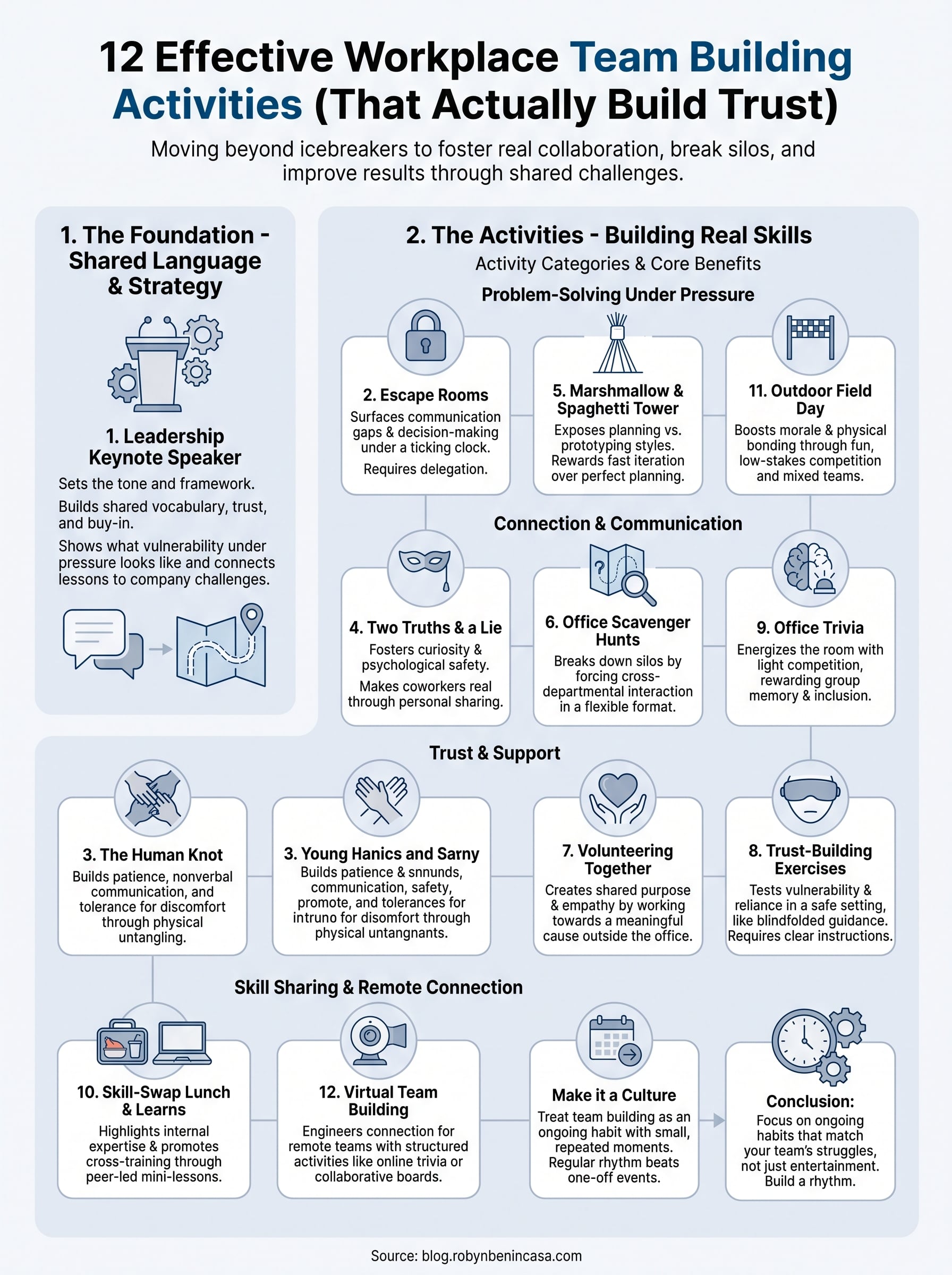
    Between sessions, your job as a leader is to reference the shared language and skills from those sessions in your regular team interactions. Bringing the framework into a Monday team meeting or a one-on-one conversation signals that the investment was real and the expectations around it are permanent.
    Assign ownership and track progress

    Every effective plan needs a named owner. That person doesn’t have to run every session, but they are responsible for keeping the initiative on track, gathering feedback after each touchpoint, and reporting progress against the goals you set during the diagnostic phase. Without clear ownership, the plan quietly loses priority as other demands fill the calendar. To keep the initiative moving, track these four items on a monthly basis:

    • Participation rates across sessions
    • Self-reported changes in communication or collaboration quality
    • Progress against the shared goals you defined upfront
    • Specific friction points that have resolved and which ones persist

    Assign the ownership role, schedule a recurring check-in, and treat this initiative with the same discipline you apply to any other business objective.

    Team building examples you can run this month

    Knowing what is team building in theory only gets you so far. Practical examples give you something you can actually schedule, run, and learn from before the month is out. Each of the examples below is designed to address a real performance gap, not just fill a calendar slot with activity.

    The cross-functional problem sprint

    Pick one genuine business challenge that requires input from at least two different departments or functional areas. Give a small, mixed group 90 minutes to build a solution proposal they present to a decision-maker at the end of the session. The time pressure and the real stakes force people to communicate across their usual silos in ways that a facilitated exercise simply cannot replicate. You learn immediately who bridges gaps and who defaults to their department’s standard position under pressure.

    The value of this exercise isn’t the proposal itself. It’s watching how your people handle genuine ambiguity together.

    The role clarity workshop

    Gather your team for a focused 60-minute session where each person states what they own, what they need from others to deliver it, and where they feel the most confusion about boundaries. Write it all on a shared board in real time. Most teams discover several overlapping assumptions that have been quietly generating conflict for months. Walking out of that session with a documented role map gives your team a shared reference point they can return to whenever clarity breaks down again.

    The feedback circuit

    Break your team into pairs and give each person five minutes to share one piece of specific, actionable feedback with their partner based on a recent project. Then rotate and repeat. This format removes the social awkwardness of public feedback while building the habit of direct and respectful communication in a low-stakes setting. Run it quarterly and you will notice a measurable shift in how openly your team discusses performance in their daily work.

    The shared challenge debrief

    After any significant project, win, or setback, schedule a structured debrief meeting with three questions: what did we do well, what broke down, and what will we do differently next time. Keep each person focused on team-level observations rather than individual blame. This format builds the discipline of learning from real experience together, which is exactly how high-performance teams in any field close the gap between where they are and where they need to be.

    How to measure results and keep momentum

    Most organizations invest in team building and then measure success by whether people seemed to enjoy themselves. That approach guarantees you’ll keep running the same low-impact programs year after year. Measuring real results means tracking specific behavioral and performance indicators that reflect whether your people are actually working better together, not just whether the room had good energy during the session.

    Define your success metrics before you start

    Before you run a single session, decide what measurable change you are trying to produce. Generic outcomes like "better communication" are too vague to track. Instead, define success in concrete terms: fewer escalations between departments, faster decision turnaround on cross-functional projects, or a measurable improvement in how team members rate psychological safety on a short monthly survey. These specifics give you something real to compare against your baseline once the work is underway.

    If you cannot describe what success looks like before you start, you will not recognize it when it happens.

    Pair your qualitative measures, like survey responses, with quantitative data you already track: project delivery timelines, voluntary turnover rates, or the number of cross-team handoff errors in a given quarter. Both types of evidence matter because they tell different parts of the story.

    Use pulse surveys to catch drift early

    Short, recurring surveys sent every four to six weeks give you real-time visibility into whether the gains from your team building investment are holding. Limit each survey to three to five questions focused on the behaviors you targeted: whether feedback conversations feel safe, whether roles feel clear, and whether the team is moving toward its shared goals. Keeping the survey short increases completion rates and makes the results easier to act on before small setbacks compound into larger ones.

    Reviewing these results as a team, not just as a leader, reinforces shared accountability. When your people see the data together, they take collective ownership of the trajectory rather than waiting for management to diagnose problems and hand down solutions.

    Return to the question of what is team building regularly

    Revisiting your definition of what is team building every quarter prevents the initiative from drifting back toward low-effort bonding activities when momentum slips. Ask yourself whether your current activities are still targeting the actual friction points in your team’s performance or whether you’ve started defaulting to comfort. Sustained momentum comes from treating team building as a live, evolving practice that adjusts as your team grows, not a program you run once and consider complete.

    Next steps

    You now have a working answer to what is team building, one grounded in real structure, not surface-level activities. The definition matters, but what matters more is what you do with it starting this week. Pick one friction point your team is dealing with right now, a breakdown in communication, unclear roles, or a shared goal that nobody can articulate clearly, and address it with one of the specific formats covered in this article. Start small, make it repeatable, and build from there.

    Team building is not a destination you reach after a single off-site. It is a discipline you practice consistently until collaboration becomes the default way your people operate, even under pressure. If you want a proven framework for turning that discipline into a high-performance culture, explore Robyn Benincasa’s keynote programs and T.E.A.M.W.O.R.K. system and find out what your team is actually capable of when you build it right.

  • How to Create a Culture of Collaboration: 8 Proven Moves

    Most teams don’t fail because they lack talent. They fail because talented people never learn to pull in the same direction. That gap, between a group of skilled individuals and a team that actually wins together, is exactly where the question of how to create a culture of collaboration becomes urgent.


    I’ve seen this play out in some of the most extreme environments on the planet. As a world champion adventure racer and 20-year veteran firefighter, I’ve led and been part of teams where collaboration wasn’t a corporate buzzword, it was the difference between finishing and getting airlifted out. When you’re dragging yourself through a jungle at 3 a.m. with teammates you didn’t choose, you learn fast that individual excellence means nothing without collective commitment. That’s the foundation of everything I teach through my keynotes and programs, including my T.E.A.M.W.O.R.K. framework, eight elements that turn groups of high-performers into unstoppable units.

    The good news? You don’t need to race through Borneo to build this kind of culture. The principles transfer directly to boardrooms, sales floors, and cross-functional project teams. Below, I’m breaking down eight proven moves that shift a workplace from siloed and sluggish to genuinely collaborative. These aren’t theoretical, they come from decades of leading teams through conditions where collaboration was a survival skill, then translating those lessons for organizations like Allstate, Northrop Grumman, and Boston Scientific.

    1. Use the Win As One approach to align the team

    Most teams operate with a shared calendar but not a shared mission. People show up, do their jobs, and hand things off, but nobody is genuinely invested in whether the person next to them succeeds. The Win As One approach fixes that by shifting your team’s identity from a collection of roles to a single unit pulling toward one common outcome. That shift changes everything about how people make decisions, distribute credit, and respond when a teammate hits a wall.

    What this move changes

    When you apply Win As One thinking, you replace individual scorecards with collective accountability. Instead of competing for credit or guarding their lane, your team members start asking "what does this group need right now?" That change in orientation is the foundation of how to create a culture of collaboration that holds up under real pressure, not just during a two-day offsite. Teams that operate with a shared identity make faster decisions, surface problems sooner, and recover from setbacks without finger-pointing.

    The moment your team stops asking "what’s my job?" and starts asking "what does the team need?", collaboration stops being a value on a poster and becomes a daily operating mode.

    How to do it step by step

    Start with one shared outcome that your entire team owns. Not a list of departmental targets, but a single result everyone is accountable for together. Then work through these steps:

    1. Name each person’s contribution toward that outcome in a group session so interdependencies become visible.
    2. Ask each team member to state their role out loud, including where they depend on others.
    3. Repeat this alignment conversation at the launch of every major initiative, not just at annual planning.

    What to watch for

    Watch for quiet disengagement, when someone stops offering ideas in group settings or defaults to "that’s not my department." That pattern signals the team identity hasn’t taken hold yet. Also monitor how recognition flows: if only individual wins get celebrated in your meetings, the Win As One frame needs reinforcement.

    How to measure progress

    Track two concrete signals: how often your people volunteer to help outside their defined role, and how credit is attributed when a win gets reported up the chain. If credit flows consistently to individuals rather than the group, you have alignment work left to do. Review your shared outcome definition every quarter so it stays connected to what actually matters.

    2. Turn your vision into clear shared goals

    A vision without specific goals is just a sentence on a wall. Most teams can recite their company’s mission, but far fewer can name the concrete outcome they’re personally accountable for this quarter. Connecting your vision to clear, shared goals is a cornerstone of how to create a culture of collaboration that holds under daily pressure.

    What this move changes

    Shared goals replace scattered priorities with a single focal point. When every person can trace their daily work back to one common outcome, territorial behavior drops and cross-functional cooperation becomes the obvious path.

    Shared goals turn your vision from something people believe in to something they act on together.

    How to do it step by step

    Follow these three steps to move from vision to shared goals your whole team owns:

    1. Translate your vision into one primary team goal with a measurable outcome and a firm deadline.
    2. Break that goal into individual contributions so each person sees exactly how their work connects.
    3. Review the goal together monthly so it stays relevant.

    What to watch for

    Watch for goal fragmentation, where each department quietly redefines the shared goal around its own metrics. Two warning signs to catch early:

    • Meetings where each team reports progress separately with no reference to the shared outcome
    • Recognition patterns that celebrate individual wins but ignore collective results

    How to measure progress

    Run a brief monthly check-in where each team member rates how connected their current work feels to the team goal. A consistent drop in that score signals misalignment, while a rising score confirms your shared foundation is holding.

    3. Build trust with psychological safety and candor

    Collaboration breaks down the moment people fear being judged for speaking up. If your team members stay quiet in meetings, soften honest feedback, or avoid raising problems, your culture has a trust deficit. Psychological safety is the foundation of how to create a culture of collaboration that doesn’t just look good on paper but actually holds under pressure.

    What this move changes

    When people feel safe to speak honestly, problems surface faster and solutions improve because everyone contributes their real thinking. Without that safety, your team’s best ideas stay buried and your leaders make decisions based on incomplete information.

    The most collaborative teams don’t agree on everything; they feel safe enough to disagree out loud.

    How to do it step by step

    Building trust requires deliberate, repeated behavior from you and every people leader on your team. Start here:

    1. Respond to bad news with curiosity, not blame, so people stop hiding problems.
    2. Share one of your own mistakes in a team setting to model honest candor.
    3. Explicitly invite dissent before decisions get finalized.

    What to watch for

    Watch for silence after hard questions in group settings. If only the same two or three people ever challenge a plan, most of your team has decided speaking up isn’t worth the risk. That pattern directly threatens genuine collaboration.

    How to measure progress

    Run a short anonymous pulse survey asking whether team members feel comfortable raising concerns. A rising positive response rate over three consecutive months confirms your trust-building is working.

    4. Make knowledge sharing the default, not a favor

    When team members hoard information, they do it for predictable reasons: protecting their position, staying indispensable, or simply not having a clear system to share what they know. Any of those patterns quietly kills how to create a culture of collaboration because collaboration depends on everyone working from the same information. If your team treats knowledge as leverage rather than a shared resource, you’re building on sand.

    What this move changes

    Shifting knowledge from personal asset to team property removes one of the biggest invisible barriers to collaboration. When people share freely, decisions improve, onboarding shortens, and duplicate work disappears because nobody wastes time solving a problem someone else already solved.

    Knowledge shared freely becomes a team advantage; knowledge hoarded quietly becomes a team liability.

    How to do it step by step

    Build sharing into the structure of how work gets done, not as an extra step:

    1. Create a single shared repository where decisions, processes, and lessons learned live by default.
    2. End every project with a brief documented debrief that captures what worked and what didn’t.
    3. Recognize team members publicly when they share something that helps a colleague.

    What to watch for

    Watch for information bottlenecks, specifically one person who becomes the only source of critical knowledge. That pattern signals hoarding behavior and creates fragility across the whole team.

    How to measure progress

    Track how often your team references shared documentation versus pulling the same individual repeatedly for answers. A rising rate of self-service problem solving confirms the habit is forming.

    5. Create cross-functional rituals that break silos

    Silos don’t form because people are selfish. They form because the structure rewards staying in your lane and nobody builds explicit bridges between teams. Regular cross-functional rituals do the structural work of connecting people who would otherwise only interact when something goes wrong.

    What this move changes

    Rituals create repeated, low-stakes contact between teams that normally operate in parallel. That contact builds familiarity, and familiarity builds the trust that makes how to create a culture of collaboration possible at scale. Without deliberate structure, silos deepen by default.

    Familiarity built in low-stakes moments pays off in high-stakes ones.

    How to do it step by step

    Start small and make the rituals consistent enough that skipping them feels like the exception, not the norm:

    1. Run a monthly cross-team debrief where two departments share one win and one challenge.
    2. Rotate project leads across functions so people build relationships outside their home team.
    3. Assign shared micro-goals to two departments for one quarter to force genuine interdependence.

    What to watch for

    Watch for rituals that lose participation over time. A meeting that starts with ten people and drops to three within two months hasn’t created a real ritual; it has created an obligation people are quietly avoiding and that signals deeper structural resistance.

    How to measure progress

    Track attendance consistency across your cross-functional sessions and ask participants whether the interactions changed their actual work habits. A rising positive response confirms the rituals are producing real collaboration, not just scheduled contact.

    6. Clarify decision rights and team accountability

    Unclear ownership stalls collaboration faster than almost any other obstacle. When nobody knows who makes the final call, teams either wait for approval that never comes or duplicate effort because two people assumed they owned the same task. Clarifying decision rights removes that ambiguity and builds the structural foundation for how to create a culture of collaboration that holds under real pressure.

    What this move changes

    When each person on your team knows exactly who owns which decisions, meetings run shorter and projects move faster. People stop waiting for the wrong approver and stop creating friction by overstepping into someone else’s territory.

    Shared accountability also shifts how your team handles setbacks. Instead of pointing fingers, people ask what the group can fix next because the ownership map makes improvement conversations specific and fair.

    Ambiguity about who decides is a hidden tax on collaboration that most leaders never audit.

    How to do it step by step

    Map your most common decisions and assign a clear owner for each one:

    1. Use a simple RACI chart (Responsible, Accountable, Consulted, Informed) to document decision ownership across your team.
    2. Review the chart at the start of each new project.
    3. Confirm every member knows what they can decide independently versus what requires group input.

    What to watch for

    Watch for repeated escalations on decisions that should resolve at the team level without involving senior leadership. That pattern signals gaps in your decision map that need immediate attention.

    How to measure progress

    Track how many decisions escalate unnecessarily each month. A declining escalation rate confirms your accountability structure is taking hold.

    7. Reward teamwork and remove solo-hero incentives

    Your incentive structure tells your team what you actually value, regardless of what your culture deck says. If your recognition programs, promotions, and bonuses consistently reward individual output over group results, you are actively training people to compete rather than collaborate.

    What this move changes

    Shifting your rewards toward collective outcomes is one of the most direct levers you have for how to create a culture of collaboration that sticks. People optimize for what gets recognized, so when the team win becomes the celebrated unit, solo-hero behavior loses its payoff and collaboration becomes the rational choice.

    Incentives are the loudest signal your culture sends, louder than any value statement you post on the wall.

    How to do it step by step

    Redesigning your rewards doesn’t require a full compensation overhaul. Start with these targeted changes:

    1. Add a team performance metric to your existing review criteria alongside individual goals.
    2. Publicly recognize moments when someone lifted a teammate over the finish line, not just when someone crossed it alone.
    3. Tie at least one quarterly bonus element to a shared team outcome.

    What to watch for

    Watch for top individual performers who resist the shift because their standing depended on the old system. Their resistance is a signal the change is working, but it also needs direct conversation to prevent quiet sabotage of group goals.

    How to measure progress

    Track what percentage of your formal recognition moments reference team outcomes versus individual ones. A rising share of team-attributed recognition over two quarters confirms the incentive shift is taking hold.

    8. Make leaders model collaboration every day

    Every behavior your leaders demonstrate in public teaches your team what collaboration actually looks like in your organization. If your managers hoard credit, avoid cross-functional conversations, or compete visibly with peers, your team will mirror that behavior, no matter what your stated values say.

    What this move changes

    Leader modeling is the single fastest way to answer how to create a culture of collaboration because behavior at the top sets the standard for every layer below. When your leaders visibly ask for input, share credit, and support peers, that behavior becomes the norm your team measures itself against rather than an aspirational slide in a deck.

    Culture moves at the speed of leadership behavior, not at the speed of policy changes.

    How to do it step by step

    Building visible modeling requires consistent, deliberate action from every leader on your team:

    1. Ask for input publicly in team meetings before stating your own opinion.
    2. Credit a colleague by name when presenting results to senior leadership.
    3. Volunteer to help a peer department solve a problem outside your own scope.

    What to watch for

    Watch for leaders who collaborate in full-group settings but revert to siloed behavior in smaller conversations. That gap between public and private behavior erodes trust quickly and signals that the modeling is performative rather than genuine.

    How to measure progress

    Survey your team quarterly on whether their direct leaders demonstrate collaborative behavior in daily interactions, not just formal settings. A rising score over two consecutive quarters confirms the modeling is real and consistent.

    Keep collaboration going

    Building a collaborative culture is not a one-time initiative you launch and then move on from. Every move in this list requires consistent reinforcement, because without it, old habits creep back and silos rebuild quietly. The eight strategies above give you a complete operating system for how to create a culture of collaboration that holds up under real pressure, not just during a peak performance quarter.

    Start with one move this week. Pick the area where your team feels the most friction and apply the steps directly. Then build from there, measuring progress as you go so the changes stick at every level of your organization.

    If you want to go deeper on translating these principles into real team results, explore Robyn Benincasa’s keynotes and team programs. The same framework that drives world-champion adventure racing teams can drive your team’s next impossible win.

  • 11 Change Management Best Practices That Actually Stick

    Most organizations don’t fail at change because they picked the wrong strategy. They fail because the people expected to carry out that strategy never truly got on board. Research from McKinsey consistently shows that roughly 70% of change initiatives fall short of their goals, and the root cause almost always traces back to employee resistance and lack of leadership alignment, not flawed planning.

    If you’re searching for change management best practices that go beyond theory, you’re already asking the right question. The gap between a well-designed change plan and one that actually transforms how a team operates is enormous. It’s the difference between a memo people skim and a mission people own.

    That gap is exactly where Robyn Benincasa’s work lives. As a world champion adventure racer, veteran San Diego firefighter, and founder of a leadership consulting practice built on real-world high-stakes teamwork, Robyn has spent decades studying what makes groups of people commit to hard pivots, not because a slide deck told them to, but because they believe in the team carrying it out. Her framework has helped organizations across industries like pharmaceuticals, finance, and aerospace navigate mergers, break down silos, and sustain momentum through major transitions.

    This article lays out 11 change management practices drawn from frontline experience, not just boardroom theory, so you can build transitions that hold up long after the initial rollout excitement fades.

    1. Define the why and rally people around it

    Before you send a single announcement or hold your first town hall, you need to answer one question clearly: why is this change happening, and why does it matter beyond cost savings or efficiency gains? People don’t resist change itself. They resist change that feels arbitrary or disconnected from something they care about. When you ground an initiative in genuine purpose from the start, you give people a reason to engage rather than simply wait for the disruption to pass.

    Turn the business case into a clear purpose

    Most executives can articulate the business case for a change. Fewer can translate that case into a purpose that resonates with someone on the shop floor or in a customer-facing role. Your job is to bridge that gap. Take the financial rationale and convert it into a statement that answers: what does this change make possible that wasn’t possible before? That statement becomes the foundation for everything your communication strategy builds on, and it needs to survive skeptical questions in a hallway conversation, not just sound good in a boardroom.

    A clear purpose is not a slogan. It is a specific answer to "why are we doing this" that holds up under pressure and honest pushback from the people most affected.

    Make the purpose personal for each impacted group

    A single overarching message rarely lands equally across a workforce with different roles, concerns, and daily realities. You need to segment your audience and translate the core purpose into language that speaks to each group’s specific situation. A sales team cares about how a new system affects their quota attainment and customer relationships. An operations team cares about workflow disruption and learning curves. Identify what each group stands to gain and lose, and build your messaging around those realities rather than offering generic reassurance that everything will be fine.

    Keep the message consistent from kickoff to sustainment

    One of the most common failures in change management best practices is message drift. Leadership sends a strong opening statement, then updates slow down, rumors fill the vacuum, and people construct their own narratives. You need to reinforce the core purpose at every project milestone, not just at launch. When leaders, managers, and project team members all deliver the same foundational reasoning in their own authentic words, the purpose becomes something your organization genuinely internalizes rather than begrudgingly tolerates.

    2. Secure active, visible executive sponsorship

    Research from Prosci consistently identifies active and visible executive sponsorship as the single most critical factor in change success. Yet most organizations treat sponsorship as a title rather than a role. Signing off on a project charter is not sponsorship. Showing up at the kickoff meeting is not sponsorship. People watch leaders during uncertainty, and what they see either builds confidence or confirms their suspicion that the change is not truly serious.

    Pick the right sponsor and define their job

    Your sponsor needs real authority over the people and resources affected by the change, not just a senior title. A sponsor who lacks the power to remove roadblocks or make final calls creates bottlenecks that frustrate everyone downstream. Define their role in writing: what decisions are theirs, how often they engage with the team, and which stakeholder relationships they personally own.

    The right sponsor is not the busiest executive who says yes. It is the leader with the right authority, the right relationships, and the genuine belief that this change needs to happen.

    Equip sponsors with talking points and a cadence

    Most sponsors want to lead well but lack structured support for doing so. Build a simple communication cadence for your sponsor: what to say at each phase, which audiences need to hear from them directly, and how to respond to common pushback. Prepared leaders communicate with more consistency and confidence.

    Hold sponsors accountable with simple metrics

    Track whether your sponsor is actually showing up. Visible participation metrics like town hall attendance, one-on-one conversations with skeptical leaders, and timely decision-making give you objective data to work with and reinforce that sponsorship is a real job, not a ceremonial one.

    3. Use a structured change approach from day one

    Improvising your way through a major transition is one of the fastest routes to confusion and lost trust. A structured approach gives your team a shared language and a repeatable process so that decisions, activities, and resources all point in the same direction. Without it, change management best practices become a loose collection of good intentions that never add up to a coherent plan.

    Choose a framework and scale it to the change

    Several proven frameworks exist, from Prosci’s ADKAR model to Kotter’s 8-Step Process. Your job is not to pick the most sophisticated one but to select a model your team will actually use and then scale it to match the size and complexity of your initiative. A small process update does not need the same machinery as a company-wide system rollout. Match the tool to the task, and you avoid both under-managing and over-engineering.

    A framework is only useful if the people running the change understand it well enough to explain it to someone who has never heard of it.

    Build a change plan that matches the project plan

    Your change plan and your project plan need to run side by side, not sequentially. When training activities, communication milestones, and readiness checks align with technical go-live dates, you eliminate the common failure mode where systems go live but people are not prepared to use them. Build a single integrated timeline that treats the human side of change as equal to the technical side.

    Set decision rules so you do not improvise under stress

    Before pressure hits, define who makes which calls. Clear decision rights prevent the paralysis that stalls initiatives at the worst possible moments. Document your escalation path, your risk thresholds, and your criteria for delaying a go-live so your team acts on pre-agreed logic rather than reacting emotionally when things get difficult.

    4. Map impacts and stakeholders before you communicate

    Sending communication before you understand who is affected and how is one of the most common mistakes in change management best practices. People immediately ask "what does this mean for me?" and if your messaging cannot answer that specifically, you lose credibility fast. Run your impact analysis first, and build your communication strategy from what you find.

    Identify who changes, what changes, and when

    Start by mapping every role, team, and process that the initiative touches. Document what each group currently does, what they will need to do differently after the change, and when that shift happens. This gives you a concrete picture of scale and scope rather than vague assumptions about who needs support.

    The more specific your impact map, the more targeted and credible your support plan becomes.

    Segment audiences and tailor support

    Not every group needs the same message, the same training, or the same timeline. Once you know who is impacted and how deeply, group your stakeholders by role type, location, or level of change burden. A team facing a complete workflow overhaul needs far more hands-on support than one with minor process adjustments. Tailored support signals respect for each group’s real situation rather than offering generic reassurance.

    Spot resistance early and plan responses

    Use your impact map to flag the audiences most likely to push back before your rollout begins. High-impact groups with little input into the decision carry the highest resistance risk. Build specific responses to their likely objections, assign owners to those conversations, and treat early resistance as useful information rather than a problem to suppress.

    5. Co-create with frontline employees

    Top-down change rarely sticks. When frontline employees have no say in how a change is designed or rolled out, they feel like recipients rather than participants, and their resistance becomes your biggest obstacle. One of the most underused change management best practices is bringing the people closest to the work into the process before decisions are final.

    Involve end users in design, testing, and rollout

    Pull end users into working sessions during the design phase, not just the training phase. People who help shape a solution have a personal stake in its success.

    During testing, ask them to stress-test workflows against their actual daily tasks rather than scripted scenarios. Their input surfaces practical gaps that a project team working in isolation will never catch.

    The people doing the work know where the friction lives. Involve them early and you solve real problems instead of imagined ones.

    Build a network of champions and peer helpers

    Identify respected, credible people within each affected team and give them a formal role in the change. Champions translate new processes into familiar language and provide peer-level support that a project team cannot replicate. Equip them with talking points, early access to training, and a clear channel back to the project team for escalating issues.

    Close the feedback loop so people feel heard

    Collect input through structured surveys, team huddles, or open-door sessions, but treat that input as a commitment, not a courtesy. When people see their feedback reflected in real adjustments, trust in the process grows steadily, and future input becomes far easier to gather.

    6. Communicate frequently and with the right senders

    Communication volume is rarely the core problem in failed change initiatives. The real issue is who delivers the message and whether the content matches what people actually need to know. A well-timed message from the wrong person lands with far less force than the same message delivered by someone with direct credibility in that relationship.

    Build a message map for what, why, and what changes

    A message map gives your team a single reference point for every communication decision. Document the answers to three questions: what is changing, why it is changing, and what shifts for each affected audience. This document prevents conflicting messages from spreading across departments and gives every sender a consistent foundation to work from, regardless of format or channel.

    • What: the specific change happening
    • Why: the purpose behind the decision
    • What changes: the concrete impact on each audience’s daily work

    Use leaders for direction and managers for local impact

    Senior leaders carry organizational authority, which makes them the right voice for communicating strategic direction and overall commitment. Direct managers carry relational credibility, making them more effective for translating change into what it means for daily tasks. Brief both groups separately so their messages reinforce rather than contradict each other.

    The most effective change management best practices treat communication as a two-sender system: leaders for the why, managers for the how.

    Repeat, reinforce, and correct rumors fast

    People rarely absorb new information on the first pass during a period of uncertainty. Plan to repeat core messages across multiple channels and formats. When rumors surface, address them directly and quickly with factual responses rather than waiting for the noise to fade on its own.

    7. Equip people managers to lead the change locally

    People managers sit at the most critical pressure point in any change initiative. They receive direction from senior leadership and field questions, concerns, and skepticism from their direct reports, often with little preparation for either. When managers are left to figure it out on their own, they either go quiet or improvise, and both outcomes hurt adoption significantly.

    Clarify manager responsibilities and boundaries

    Your managers need to know exactly what they’re expected to do during the transition, and equally important, what falls outside their scope. Document a simple one-page summary of their role: which conversations to lead, what decisions they can make locally, and where to escalate issues they cannot resolve. That clarity reduces the anxiety that pushes managers to avoid the topic entirely.

    Give managers a toolkit for coaching and pushback

    Equip managers with practical materials they can use in team huddles and one-on-one conversations. That means FAQ documents, conversation guides for handling common objections, and talking points that connect the change to their team’s daily work. When managers have concrete tools in hand, they approach difficult conversations with confidence rather than avoidance.

    A manager who understands the change and has a toolkit to address it becomes one of your most powerful reinforcement channels across the entire initiative.

    Support managers who feel squeezed or skeptical

    Some of your managers will be personally uncertain about the change while still being expected to champion it. Acknowledge that tension directly by building regular touchpoints where managers can share concerns, get updated information, and feel genuinely supported before they’re asked to support others. This is a core element of change management best practices that organizations consistently underinvest in.

    8. Integrate change management with project management

    Change management and project management solve different parts of the same problem, and when they operate in separate lanes, the gaps between them become the failure points of your initiative. Treating them as a single integrated effort from the start is one of the change management best practices that separates smooth transitions from costly restarts.

    Align milestones, dependencies, and go-live readiness

    Build one shared timeline that maps technical deliverables alongside training completion, communication waves, and readiness assessments. When a go-live date shifts on the project side, your change activities need to shift with it. Keeping both plans synchronized ensures that people are prepared before systems go live, not scrambling to catch up afterward.

    Readiness is not a checkbox. It is a verified state where the right people can perform the right tasks in the new environment before the cutover happens.

    Define roles so work does not fall through gaps

    Ambiguity about who owns which activities produces duplicated effort in some areas and complete neglect in others. Create a simple RACI-style responsibility document that distinguishes project management tasks from change management tasks. Shared ownership of the overall outcome does not mean shared ownership of every deliverable, so assign clear leads for each stream.

    Run joint risk reviews and issue escalation

    Schedule regular joint sessions between your project manager and change lead to surface risks that neither would catch alone. A technical delay carries people-side consequences, and a resistance spike in one department can create downstream project risk. Reviewing both sets of risks together lets your team respond with coordinated solutions rather than isolated fixes.

    9. Dedicate time, budget, and owners for change work

    Change work does not happen by willpower alone. One of the most consistent failures in change management best practices is treating the people side of change as a task that existing staff can absorb on top of their regular responsibilities. Without dedicated resources, explicit funding, and named owners, your change activities compete against operational priorities every single day, and operations win.

    Staff the change roles you actually need

    Identify the specific roles your initiative requires and fill them before the project gets moving, not after you notice gaps. A change lead, a communications owner, and a training coordinator are distinct functions that one person cannot effectively cover simultaneously. Document each role’s responsibilities so nothing defaults to "whoever has time."

    Understaffed change teams do not just move slowly. They create the conditions for resistance to grow unchecked because critical touchpoints get skipped entirely.

    Fund training, comms, and reinforcement explicitly

    Build change management costs into your project budget as a distinct line item, separate from technical and implementation costs. That means funding for training development, communication materials, champion networks, and post-launch reinforcement activities. When these costs are visible in the budget, they carry the organizational commitment that prevents them from being cut when pressure hits.

    Protect capacity so change work does not become extra work

    Talk with your change team members’ direct managers before the project starts. Confirm that realistic capacity is reserved for change activities and that competing demands get actively managed. When your change team is buried in their day jobs, your reinforcement and communication plans collapse quietly long before anyone notices.

    10. Train for real work, not just knowledge

    Generic training programs teach people what a system does. Effective training teaches people how to do their specific job in that system, starting on day one. When you design training around real tasks rather than feature walkthroughs, adoption rates climb because people leave the session able to work, not just informed.

    Build role-based training tied to daily tasks

    Start by listing the five to ten most critical tasks each role performs in the new process or system. Build your training modules around those exact tasks in the order people will encounter them. This approach cuts learning time and removes the guesswork that slows people down when they return to their desks.

    Training that mirrors real work converts classroom time into immediate on-the-job capability, which is the standard every strong set of change management best practices should hold.

    Practice in the tools and processes people will use

    Give your learners hands-on practice time in the actual system, not a slide deck that screenshots it. Sandbox environments, simulated scenarios, and guided walkthroughs of real workflows build the muscle memory and confidence that classroom instruction alone never produces. People need to make mistakes in a low-stakes environment before they make them in a live one.

    Verify readiness with checks before and after go-live

    Run short competency checks before go-live to confirm that each role can complete their core tasks independently. After launch, schedule follow-up assessments within the first two weeks to catch gaps that surface only under real conditions and close them before they become lasting workarounds.

    11. Reinforce, measure, and prevent backsliding

    Most change initiatives declare victory at go-live and then wonder why old habits resurface within weeks. Reinforcement is where your investment either compounds or evaporates. Without a deliberate plan to sustain new behaviors, people default to what they know, and your project results fade quietly in the background.

    Define adoption and performance metrics that matter

    Measuring system logins or training completion tells you very little about whether the change is working. Define metrics that reflect actual behavioral change, things like how often people use the new process correctly, how quickly they resolve issues in the new system, and whether performance outcomes are trending in the direction the change was meant to produce.

    The right metrics reveal whether people have genuinely shifted behavior, not just whether they sat through a training session.

    Remove barriers and reward the new way of working

    After go-live, collect data on where people get stuck and treat those friction points as a priority, not a nuisance. Removing a single persistent barrier often unlocks adoption across an entire team. Pair that barrier removal with visible recognition for teams and individuals who demonstrate the new way of working consistently.

    Run a post-change review and bake lessons into the next change

    Schedule a structured review 30 to 60 days after go-live to assess what worked, what slowed adoption, and where your change management best practices held up under real conditions. Document those findings in a format your team can reference for the next initiative. Organizational change capability builds only when lessons from each project feed directly into the next one.

    Your next move

    Every one of these change management best practices requires intentional effort, and none of them works in isolation. The organizations that navigate transitions successfully do not rely on a single tactic. They build a connected system where purpose, leadership, structured planning, and sustained reinforcement all point in the same direction at the same time.

    You now have a concrete checklist to work from. Start by identifying which of these eleven practices your current initiative handles well and which ones have visible gaps. Pick two or three of those gaps and assign an owner to each one this week. That is a more durable starting point than redesigning your entire approach from scratch.

    If you want to accelerate that process with expert-led guidance rooted in real-world high-stakes teamwork, connect with Robyn Benincasa to explore how her frameworks can help your organization lead change that actually holds.

  • 10 Change Management Metrics And KPIs To Track Success

    You can design the most brilliant change initiative your organization has ever seen, but without the right change management metrics and KPIs, you’re essentially navigating a race with no checkpoints. You have no idea whether your team is gaining ground or drifting off course.

    That’s something I’ve learned across decades of world-championship adventure racing and leading firefighting crews: gut feeling alone won’t cut it when the stakes are high. You need clear signals that tell you what’s working, what’s stalling, and where your people need more support. The same principle applies when organizations push through mergers, restructures, technology rollouts, or any shift that demands real behavioral change from real humans.

    The problem? Many leadership teams track activity, emails sent, training sessions completed, and mistake motion for progress. True change management measurement goes deeper. It captures adoption, resistance, engagement, and the cultural shifts that determine whether a change actually sticks or quietly dies six months later.

    This article breaks down 10 specific metrics and KPIs that give you an honest read on how your change initiative is performing, so you can adjust your approach before small problems become expensive ones.

    1. Sponsor alignment and leadership support score

    Research consistently shows that leadership support is the single biggest predictor of whether a change initiative succeeds or collapses. When senior sponsors are visible, vocal, and consistent in their backing, employees read the signals and adjust their behavior accordingly. When sponsors go quiet, people assume the initiative is optional.

    Active and visible executive sponsorship is the number one contributor to change success, according to Prosci’s longitudinal research spanning thousands of change projects.

    What it measures

    This metric tracks how actively and visibly your senior leaders are supporting the change, not just in approval meetings but in day-to-day behavior. It captures whether sponsors are communicating the case for change, removing barriers, and personally modeling the new behaviors you’re asking of your workforce.

    How to measure it

    You measure sponsor alignment through structured pulse surveys sent to direct reports and middle managers, asking specific questions about whether they observe leaders reinforcing the change. A simple 1-to-5 scale with three to five targeted questions gives you a quantifiable score over time. You should also use brief interviews with key stakeholders to surface qualitative gaps that surveys miss.

    Tools and data sources

    Your primary data sources for this metric are:

    • Survey tools like Microsoft Forms for lightweight pulse checks
    • HR platforms such as Workday or SAP SuccessFactors for embedded feedback modules
    • Change management team reports that aggregate scores across departments and time periods

    What good looks like

    A strong sponsor alignment score means 80% or more of respondents report observing their senior leaders promoting the change through concrete actions, not just verbal endorsements. You want to see consistency across all departments, rather than pockets of strong support surrounded by areas of complete disengagement.

    How to improve it

    If your scores are low, the fix starts with a direct conversation, not a memo. Coach your sponsors on what visible support actually looks like in practice:

    • Referencing the change in regular team meetings
    • Attending town halls and taking live questions
    • Addressing resistance publicly rather than letting it build unspoken

    Pair each sponsor with a specific set of actions and a timeline, so accountability is built into the role from day one rather than treated as optional.

    2. Stakeholder readiness and buy-in index

    Even the best-designed change will stall if the people affected by it aren’t mentally and operationally prepared to make the shift. Stakeholder readiness measures how ready your employees, managers, and key influencers are to adopt the new behaviors, tools, or processes you’re introducing before problems surface on the ground.

    What it measures

    This metric captures whether specific stakeholder groups understand the change, feel equipped to execute it, and are willing to commit to it. It separates passive awareness from genuine buy-in, which is the difference between employees who nod in a meeting and those who actually change what they do on Monday morning.

    How to measure it

    Run targeted readiness assessments broken out by department, role, or stakeholder group. Use a combination of Likert-scale questions and open-ended prompts that surface both confidence levels and specific concerns. Track this at multiple points across the change timeline, not just at launch.

    Readiness scores collected before go-live give you time to close gaps rather than manage the fallout after the fact.

    Tools and data sources

    Your main data sources for this metric include:

    • Survey platforms like Microsoft Forms or embedded HR system modules
    • Focus group notes gathered from front-line employees
    • Manager check-in reports from regular one-on-ones

    What good looks like

    70% or more of stakeholders should report readiness scores above your defined threshold, with no single group falling critically below baseline before a major rollout date.

    How to improve it

    Target low-readiness groups with tailored support sessions, dedicated Q&A access, and direct manager coaching rather than sending everyone the same blanket communication.

    3. Communication effectiveness score

    Most change initiatives send plenty of messages. The real question is whether those messages are landing clearly and driving the right understanding across your organization. A communication effectiveness score tells you whether your change communications are actually reaching people, resonating with them, and prompting the right actions, rather than disappearing into inboxes and forgotten all-hands presentations.

    What it measures

    This metric tracks how well your communication strategy cuts through noise and delivers the right information to the right people at the right time. It measures comprehension, reach, and perceived clarity rather than just counting emails sent or meetings scheduled.

    How to measure it

    Run short pulse surveys after major communication milestones, asking employees whether they understood the message, knew what action was required, and knew where to find more information. Track open rates and click-through rates on digital communications to add a behavioral layer to the self-reported data.

    A high open rate combined with low comprehension scores tells you people are curious but your message is unclear, which is a fixable problem once you spot it.

    Tools and data sources

    • Email platforms like Microsoft Outlook with built-in analytics
    • Intranet tools that log page visits and document downloads
    • Pulse survey tools for post-communication comprehension checks

    What good looks like

    You want 80% or more of employees to report understanding the core message and knowing their next step after each major communication push.

    How to improve it

    Segment your communications by audience rather than broadcasting one message to everyone. Front-line employees need different framing than managers, and targeted messaging consistently outperforms generic, one-size-fits-all announcements.

    4. Training participation and competency rate

    Training is where the rubber meets the road in most change initiatives. Participation rates tell you whether your people are showing up, and competency rates tell you whether the training is actually building the capability you need.

    What it measures

    This metric tracks two connected data points: how many employees complete required training and how well they can apply what they learned afterward. Tracking only completion without testing competency is a common mistake that leaves organizations believing they’re ready when they’re not.

    How to measure it

    Pull completion data directly from your learning management system and pair it with post-training assessments that test practical application, not just recall. Run skills assessments before and after training to generate a measurable competency delta for each role group.

    A 95% completion rate means little if post-training assessment scores show people still can’t perform the new process correctly.

    Tools and data sources

    • Learning management systems like Cornerstone OnDemand or SAP SuccessFactors Learning
    • Pre- and post-assessment tools built into your LMS or administered through survey platforms
    • Manager observation checklists for on-the-job competency validation

    What good looks like

    You want 90% or higher completion rates before go-live, combined with post-assessment scores showing that the majority of participants can perform the targeted tasks accurately and without support.

    How to improve it

    If completion lags, check whether training is accessible during normal work hours and whether managers are actively reinforcing attendance. For competency gaps, break training into shorter, role-specific modules rather than forcing everyone through the same generic content.

    5. Adoption speed

    Completing training and understanding the change are necessary steps, but they don’t tell you how quickly your people are actually shifting their behavior in practice. Adoption speed measures the rate at which employees move from using old processes to consistently using new ones, and it’s one of the most telling change management metrics and KPIs you can track during a rollout.

    What it measures

    This metric captures the time it takes for employees to transition from legacy behaviors or systems to the new standard. It shows whether your change is gaining momentum or stalling after launch.

    How to measure it

    Track the percentage of target users actively using the new process or system at defined intervals after go-live: week one, week four, and week twelve are common checkpoints. Compare actual adoption curves against your planned timeline to identify where slowdowns are occurring and in which groups.

    Early adoption gaps that go unaddressed in week one typically compound into significant performance problems by week eight.

    Tools and data sources

    • System usage logs from your ERP, CRM, or operational platform
    • HR and performance dashboards that surface behavioral compliance by team
    • Manager-reported observations gathered through structured check-ins

    What good looks like

    You want 60% or more of your target population actively using the new process within the first 30 days post-launch, with adoption reaching 90% or above by day 90.

    How to improve it

    Identify the specific groups or roles where adoption is lagging and assign dedicated change champions to provide hands-on support. Removing friction points in the new process, such as extra steps or unclear workflows, accelerates adoption faster than any additional communication alone.

    6. Utilization rate

    Adoption speed tells you how fast people start using something new. Utilization rate tells you how deeply and consistently they’re actually using it once they’ve crossed the initial threshold. An employee who logs into a new platform once a week and barely touches its core features is technically "adopted" but isn’t realizing the value the change was designed to deliver.

    What it measures

    This metric tracks the frequency, depth, and consistency of use of a new process, tool, or system after initial adoption. It separates surface-level compliance from genuine integration into daily work habits, which is the real goal of any change initiative.

    How to measure it

    Pull feature-level usage data from your system or platform to see which functions employees are using, how often, and for how long. Compare actual usage patterns against the expected baseline you defined when setting up the initiative.

    Low utilization after high adoption rates signals that employees are present in the system but haven’t internalized the new workflow.

    Tools and data sources

    • System analytics dashboards built into platforms like Salesforce, Microsoft 365, or your ERP
    • IT usage logs that track session frequency and feature engagement
    • Manager feedback reports capturing real-world workflow observations

    What good looks like

    You want core features being used by 80% or more of active users at the frequency your target workflow requires, sustained over at least 60 consecutive days post-launch.

    How to improve it

    If utilization is shallow, run targeted coaching sessions that show employees which features directly reduce their workload. Connecting specific system functions to personal time savings gives people a concrete reason to go deeper into the tool rather than defaulting to familiar old habits.

    7. Proficiency and performance improvement

    Adoption and utilization tell you that people are using the new process, but proficiency tells you whether they’re actually getting better at their jobs because of it. This metric connects your change initiative directly to measurable output quality, which is the clearest signal that your investment is paying off.

    What it measures

    This metric tracks whether employees are performing their roles more effectively after the change compared to before it. It captures quality of output, accuracy, speed, and the reduction of errors that result from genuinely internalizing new skills rather than just going through the motions.

    How to measure it

    Use pre- and post-change performance data pulled from existing performance management cycles, quality audits, or role-specific output metrics. Compare individual and team scores against a pre-change baseline established before training began, so your comparison is grounded in real data rather than assumption.

    Proficiency gains that show up in performance data give you the clearest evidence that your change management metrics and KPIs are tracking meaningful results, not just activity.

    Tools and data sources

    • Performance management platforms like Workday or SAP SuccessFactors
    • Quality audit logs tracked by operations or compliance teams
    • Manager scorecards that document observable skill application on the job

    What good looks like

    You want to see a measurable improvement in output quality for 75% or more of employees within 90 days post-go-live, with error rates and rework volumes trending downward.

    How to improve it

    Pair underperforming employees with peer coaches who have already reached target proficiency levels. Structured observation and real-time feedback close competency gaps far faster than repeat classroom training alone.

    8. Process compliance and exception rate

    Proficiency tells you whether people are performing well, but process compliance tells you whether they’re following the right path to get there. When employees bypass new processes, even with good intentions, they introduce risk, inconsistency, and data quality problems that undermine the value your change initiative was designed to create.

    What it measures

    This metric tracks how consistently employees follow the defined new process and how often they deviate from it through workarounds, manual overrides, or exception requests. It separates teams that have genuinely internalized the new standard from those who are still defaulting to familiar old behaviors under pressure.

    How to measure it

    Pull exception logs and non-compliance reports directly from your operational systems or quality audit records. Track both the frequency and the specific nature of each deviation so you can identify whether problems cluster around a particular step, role, or location. Review these at regular intervals, not just at the end of a reporting period.

    A spike in exception rates during weeks three through five post-launch is one of the clearest early warning signals in any set of change management metrics and KPIs.

    Tools and data sources

    • ERP and operational platforms that log process deviations automatically
    • Quality management systems with built-in audit trail functionality
    • Compliance dashboards maintained by your operations or risk team

    What good looks like

    You want compliance rates at 90% or above within 60 days of go-live, with exception rates trending consistently downward rather than plateauing.

    How to improve it

    Investigate each recurring exception pattern to determine whether the root cause is resistance, unclear guidance, or a genuine process design flaw. Fixing a broken step in the workflow eliminates more exceptions faster than disciplinary pressure ever will.

    9. Change-related incidents and support load

    When a change rolls out, your help desk ticket volume and incident reports tell you something that adoption dashboards often miss: how much friction your employees are actually experiencing in their daily work. A spike in support requests after go-live is normal, but the size, duration, and nature of that spike reveals whether your change management approach is closing gaps or creating new ones.

    What it measures

    This metric tracks the volume, type, and resolution time of support tickets, help desk calls, and reported incidents directly linked to a change initiative. It surfaces where employees are getting stuck, confused, or frustrated in real time.

    How to measure it

    Tag all incoming tickets and incidents with a change-related identifier so you can isolate them from routine support load. Track weekly ticket volume alongside average resolution time and categorize issues by type, such as training gaps, process confusion, or technical errors.

    A sustained increase in support load beyond week four post-launch signals an unresolved adoption barrier, not just a normal adjustment period.

    Tools and data sources

    • IT service management platforms like ServiceNow or Jira Service Management
    • Help desk ticketing systems with category and tagging functionality
    • Call center logs that capture frontline employee escalations

    What good looks like

    You want support ticket volume to peak within the first two weeks and return to near-baseline levels by week six, with resolution times trending downward throughout.

    How to improve it

    Analyze your most frequent ticket categories and convert them into targeted job aids, short video walkthroughs, or updated training modules. Reducing repeat issues at the source cuts your support load faster than adding more help desk capacity.

    10. Benefits realization and outcome KPIs

    Every change initiative starts with a business case that promises specific results: reduced costs, faster processing times, higher revenue, or improved customer satisfaction. Benefits realization is the metric that brings you back to that original promise and asks a direct question: did the change actually deliver what you said it would?

    What it measures

    This metric tracks whether the intended business outcomes from your change initiative are materializing in real operational and financial data. It connects all your process-level metrics to the results that actually matter to leadership and to your organization’s bottom line.

    How to measure it

    Compare pre-change baseline data against post-implementation results across the specific outcome indicators you defined in your original business case. Review these at structured intervals, such as 30, 90, and 180 days post-launch, to capture both early signals and sustained results.

    Tracking benefits realization at multiple time points separates genuine performance gains from short-term spikes that disappear once the initial attention fades.

    Tools and data sources

    • Business intelligence platforms like Microsoft Power BI for outcome dashboards
    • Financial reporting systems tracking cost and revenue metrics
    • Operational data sources from your ERP or CRM platform

    What good looks like

    You want measurable progress toward 80% or more of your defined outcome targets within 180 days of go-live, with a clear trajectory toward full realization across all key indicators.

    How to improve it

    If your benefits realization rate is lagging, revisit which change management metrics and KPIs you tracked upstream. Gaps in adoption, proficiency, or compliance almost always predict gaps in outcomes, so address the process-level breakdowns before expecting the business case numbers to shift.

    Wrap-Up and Next Steps

    These 10 change management metrics and KPIs give you a complete picture of whether your initiative is actually moving people and not just generating activity. Tracking all 10 together reveals the cause-and-effect chain from leadership alignment down to bottom-line results, so you can pinpoint exactly where your change is gaining ground and where it is stalling.

    Start by selecting the three or four metrics that most directly reflect your current initiative’s risk areas and build your measurement cadence from there. Every score you track should trigger a specific response from your leadership team when it falls below threshold. Measurement without a response plan is just data collection.

    Your team’s ability to sustain major change over time depends as much on the culture your leaders build as it does on the numbers you monitor. Strong leadership behavior drives the adoption and proficiency results you need to see. If you want to strengthen the human side of change leadership inside your organization, explore Robyn Benincasa’s keynotes and programs.

  • 15 Team Building Activities To Break Down Silos Fast

    Silos don’t just slow organizations down, they quietly erode trust, duplicate effort, and turn departments into competitors instead of collaborators. If you’ve been searching for team building activities to break down silos, chances are you’re already feeling the friction: missed handoffs, turf wars over resources, or teams that only talk to each other when something goes wrong. The cost is real, and it compounds fast.

    At Robyn Benincasa’s speaking and consulting practice, we’ve spent decades studying what makes teams perform under pressure, not from a boardroom, but from world-championship adventure racing courses and fire stations where collaboration isn’t optional. One lesson comes up again and again: silos collapse when people share experiences that demand genuine interdependence. Not trust falls. Not icebreakers that everyone forgets by lunch. Structured activities that force cross-functional groups to solve problems together, communicate under constraints, and build the kind of mutual reliance that carries back into daily operations.

    This article gives you 15 specific activities designed to do exactly that. Some work for teams of 10, others scale to organizations of hundreds. Some take 30 minutes, others need a full day. All of them target the root causes of siloed behavior, weak cross-departmental relationships, competing priorities, and communication gaps, rather than just treating the symptoms. Pick the ones that fit your situation, adapt them to your culture, and put them to work.

    1. Run a Win As One silo-busting session

    The Win As One framework is built around a core truth: peak performance happens when every person on the team feels genuinely responsible for the outcome of the whole group, not just their own lane. This session takes that principle and turns it into a structured, half-day working experience where participants from different departments collaborate on a shared challenge that none of them can solve alone.

    Outcome to target

    Your goal is for participants to leave with a new mental model about their colleagues. Specifically, you want people to stop thinking in terms of "my team’s problem" and start asking "what does the whole organization need from me right now?" When that shift happens, the silo walls start coming down before the session even ends.

    How to run it step by step

    Start with a 15-minute framing from a senior leader who names a real business challenge the organization is facing. Then break into mixed groups of six to eight people and give each group 60 to 90 minutes to develop a cross-functional response plan. Each group presents their plan in five minutes. Close with a full-room debrief focused on what collaboration made possible that siloed thinking would have missed.

    The most powerful part of this session is the presentation step. When people defend a plan built with colleagues they barely know, the experience of shared ownership becomes tangible and memorable.

    How to mix groups for real cross-silo friction

    Assign groups deliberately. Put sales with operations, engineering with marketing, finance with customer success. Avoid placing natural allies together. The friction that comes from genuinely different perspectives is the point, it forces people to negotiate priorities and find common ground in real time.

    Debrief questions that create behavior change

    Ask three questions to close the session. First: "What did you learn about another department’s constraints that you didn’t know before?" Second: "Where did you make assumptions that slowed the group down?" Third: "What is one thing you will do differently in your next cross-departmental interaction?"

    Follow-through in the next 7 days

    Send each participant a one-page summary of their group’s plan within 24 hours. Assign one cross-functional micro-action per person, a single conversation or handoff they commit to completing before the week ends. These team building activities to break down silos only stick when small behaviors change right after the session.

    2. Map the handoffs with a workflow wall

    Most teams have no clear picture of what actually happens between the moment they finish their work and when it reaches the next department. This activity makes the invisible visible by mapping every handoff in a real process across a wall or whiteboard, using sticky notes that each team can see, touch, and challenge together.

    Outcome to target

    Your goal is a shared picture of how work actually flows, not how people assume it flows. Gaps, delays, and redundancies appear fast once every department adds their steps to the same wall and sees the full sequence for the first time.

    How to run it step by step

    Give each department a distinct color of sticky notes and 20 minutes to document every step they own in a shared process, such as a product launch or customer onboarding. Post all notes in sequence on the wall. Then walk the full flow as a group, left to right, and identify where handoffs break down or where no single person takes clear ownership of a transition.

    The blank spaces between one department’s notes and the next are where your biggest collaboration problems live.

    How to mix groups for real cross-silo friction

    These team building activities to break down silos work best when no department maps their section in isolation. Pair each team with a downstream partner to co-write their sticky notes, which surfaces assumptions and friction points immediately rather than during the debrief.

    Debrief questions that create behavior change

    Ask: "Where did you assume someone else owned a step that nobody actually owns?" and "What single handoff creates the most friction for your downstream colleague?"

    Follow-through in the next 7 days

    Photograph the wall and send it to every participant within 24 hours. Assign one named owner to each gap identified, with a clear commitment to resolve or escalate it before the week ends.

    3. Build a shared customer journey across departments

    Most departments only see the slice of the customer experience they directly touch. Sales sees the pitch, support sees the complaint, and shipping sees the box that goes out the door. Nobody sees the full arc, and that blind spot is exactly where silos thrive. This activity forces every department to map their piece of the customer’s experience onto one shared timeline, so the team can finally see what customers actually live through from first contact to renewal.

    Outcome to target

    Your goal is a single, unified customer journey map that every department co-authored and can speak to. When teams see how their work affects the customer experience upstream and downstream, competing priorities start to align around a common reference point.

    How to run it step by step

    Give each department 15 minutes to write out the customer touchpoints they own on sticky notes, including what the customer feels at each step. Post all contributions on a shared timeline. Walk the journey as a full group and flag every moment where the customer experience drops, stalls, or feels inconsistent because of a transition between teams.

    The moments that hurt the customer most are almost always the moments that fall between departments, not inside them.

    How to mix groups for real cross-silo friction

    Pair each department with the team that hands off to them directly to co-present their section of the journey. This is one of the most effective team building activities to break down silos because it forces people to explain their decisions to those who inherit the consequences.

    Debrief questions that create behavior change

    Ask: "Where does the customer feel our internal friction?" and "What step did another department add that you had no idea was part of the customer’s experience?"

    Follow-through in the next 7 days

    Post the completed journey map in a shared channel or workspace every participant can access. Assign one cross-departmental fix to a named owner, focused on smoothing the single most painful transition point the group identified.

    4. Do cross-functional speed networking with prompts

    Most people in large organizations don’t know what their colleagues in other departments actually do, what they worry about, or what they need to succeed. Speed networking with structured prompts fixes that gap in under an hour by giving people a fast, low-stakes format to build real connections across the org chart. These team building activities to break down silos work because familiarity reduces friction, and friction is what keeps people from picking up the phone when a cross-departmental issue hits.

    Outcome to target

    Your goal is a room full of people who now have at least one personal connection outside their immediate team. Familiar faces are easier to call when a cross-departmental problem comes up, and that one phone call often prevents a two-week email thread that goes nowhere.

    How to run it step by step

    Set up pairs or groups of three. Each round runs five to seven minutes and ends when a facilitator signals a switch. Give every participant the same prompt card with two or three questions, such as: "What does your team need most from mine right now?" and "What’s one thing you wish other departments understood about your work?" Rotate through six to eight rounds so each person meets colleagues from at least four different departments.

    The prompts do the heavy lifting here. Without them, people default to small talk and leave having learned nothing useful.

    How to mix groups for real cross-silo friction

    Assign pairings in advance rather than letting people self-select. Use a rotation schedule that ensures no one spends a round with a direct teammate.

    Debrief questions that create behavior change

    Ask: "What surprised you most about another team’s challenges?" and "Where did you find an overlap you didn’t know existed?"

    Follow-through in the next 7 days

    Have each participant send one follow-up message to a new connection within 48 hours, referencing a specific detail from their conversation during the session.

    5. Run a role swap to surface hidden constraints

    Every department carries invisible constraints that other teams never see: compliance requirements, legacy system limitations, approval chains, or resource gaps that silently shape every decision they make. A role swap exercise forces participants to step into another department’s seat for a structured problem-solving session, and in doing so, it exposes exactly why collaboration breaks down. These team building activities to break down silos work because understanding replaces assumption.

    Outcome to target

    Your goal is for participants to experience the friction their cross-functional colleagues live with daily. When someone from marketing tries to solve a problem with an operations mindset, or a finance team member works through a sales scenario, blind spots disappear fast and judgment drops even faster.

    How to run it step by step

    Pair two departments and give each team a real problem the other department is currently solving. Allow 30 to 45 minutes for each group to develop a response using only the information and constraints they’ve been briefed on. Then have both groups present their approach to the original owners and discuss where their thinking diverged from reality.

    The gap between what a team assumed and what the actual constraints were is exactly where the most productive cross-departmental conversations begin.

    How to mix groups for real cross-silo friction

    Swap teams that depend on each other most but communicate the least, such as product and customer success, or legal and sales. The friction between high interdependence and low familiarity produces the most useful insights.

    Debrief questions that create behavior change

    Ask: "What constraint surprised you most about the other team’s work?" and "What decision of yours would you change knowing what you know now?"

    Follow-through in the next 7 days

    Have each participant write one commitment to change a behavior that their swap partner said would genuinely help them. Share those commitments across both teams by the end of the week.

    6. Host a cross-team shadowing sprint

    A shadowing sprint places someone from one department inside another team’s workday for a focused two to four hours. Unlike a job shadow that gets scheduled once and forgotten, this is a structured, reciprocal experience where both sides show up with specific questions and leave with documented observations. These team building activities to break down silos work because direct observation cuts through assumptions faster than any meeting ever will.

    Outcome to target

    Your goal is for participants to see the actual decisions, tools, and pressures their colleagues navigate daily. When people watch rather than just hear about another team’s work, empathy converts into operational insight that carries back into how they collaborate the following week.

    How to run it step by step

    Pair one person from each of two departments and give them a structured observation guide with three to five questions to answer during the session. The host team works normally while the observer watches, takes notes, and asks clarifying questions at designated breaks. Both partners then share their top three observations in a 15-minute closing debrief.

    What people see in 90 minutes of direct observation typically surfaces more friction points than six months of status meetings.

    How to mix groups for real cross-silo friction

    Send people to departments they interact with regularly but understand poorly, such as IT shadowing customer support or logistics shadowing product. High-frequency contact combined with low mutual understanding is the exact profile that produces the sharpest insights.

    Debrief questions that create behavior change

    Ask: "What did you see that you wish you had known six months ago?" and "What assumption about this team did the shadow disprove?"

    Follow-through in the next 7 days

    Have each observer write a one-page summary of their top findings and share it with their team lead within 48 hours. Commit to one concrete process adjustment based on what they witnessed before the week ends.

    7. Fix one process in a rapid Kaizen jam

    A Kaizen jam brings cross-functional teams together to improve one specific process in a single focused session. Instead of talking about collaboration in the abstract, participants do the actual work of fixing a shared problem, which makes this one of the most practical team building activities to break down silos you can run.

    Outcome to target

    Your goal is a concrete, documented process improvement that every participating department has co-authored and committed to. Teams that build a fix together are far more likely to follow it consistently than teams that receive a change handed down from above.

    How to run it step by step

    Choose one broken cross-departmental process before the session, such as a recurring approval delay or a recurring data error at handoff. Give mixed groups 60 to 90 minutes to map the current state, identify the root cause, and design a new process. Each group presents their solution in five minutes and the full room selects the strongest version to pilot.

    The constraint of one session forces teams to solve a real problem rather than debate it indefinitely.

    How to mix groups for real cross-silo friction

    Build each group with one representative from every department that touches the process. Avoid clustering people by function, since that simply recreates the silo structure inside the room.

    Debrief questions that create behavior change

    Ask: "Where did your group disagree most, and what resolved it?" and "What upstream decision was creating a downstream problem your team didn’t know about?"

    Follow-through in the next 7 days

    Assign a named owner to pilot the new process within five business days and report results back to the full group.

    8. Run a pre-mortem on a shared initiative

    A pre-mortem flips the standard planning process by asking teams to imagine the initiative has already failed and work backward to explain why. When you run this exercise across departments, it becomes one of the most direct team building activities to break down silos available, because every group surfaces risks the others never saw coming.

    Outcome to target

    Your goal is a shared risk register built by people from multiple departments who each brought a different failure scenario to the table. Teams that co-author a risk picture together are far more likely to watch out for each other’s blind spots once the real work begins.

    How to run it step by step

    Give each mixed group a single shared initiative, such as a product launch or system migration, and ask them to write down the three most likely reasons it fails. Allow 20 minutes, then have each group present their failure scenarios to the room. Capture every risk on a shared board and group them by theme.

    The risks that show up on multiple teams’ lists are the ones that will actually kill the initiative.

    How to mix groups for real cross-silo friction

    Put one person from each stakeholder department in every group. The goal is to get someone who owns the outcome in the same conversation as someone who delivers a key input, since those two roles almost never share failure assumptions.

    Debrief questions that create behavior change

    Ask: "Which failure scenario surprised you most?" and "What would have to be true for that risk to never land on this board again?"

    Follow-through in the next 7 days

    Assign a named owner to the top three risks identified and schedule a 15-minute cross-departmental check-in before the week ends to confirm each risk has a mitigation plan.

    9. Use the marshmallow challenge with mixed teams

    The marshmallow challenge is a rapid prototyping exercise that reveals how teams communicate, make decisions, and recover from failure under time pressure. When you run it with mixed cross-departmental groups, it becomes one of the most direct team building activities to break down silos because it shows exactly how people from different functions either integrate or fragment when stakes are high and time is short.

    Outcome to target

    Your goal is to surface each person’s default collaboration pattern under pressure. Some people immediately take charge, others disengage, and some propose ideas that never get heard because no one knows how to integrate input from an unfamiliar colleague yet. Seeing those patterns in a low-risk setting gives teams a concrete reference point for the real work that follows.

    How to run it step by step

    Give each team 20 pieces of spaghetti, one yard of tape, one yard of string, and one marshmallow. Their task is to build the tallest freestanding structure with the marshmallow on top in 18 minutes. The clock starts the moment they receive their materials, with no separate planning phase allowed.

    The teams that fail almost always spend 15 minutes planning and two minutes building, while the teams that succeed iterate quickly and put the marshmallow on early.

    How to mix groups for real cross-silo friction

    Build each group with four to five people from different departments and different seniority levels. Mixing a director with an analyst from a completely unrelated function removes the default status dynamics that normally govern cross-functional conversations.

    Debrief questions that create behavior change

    Close with two direct questions:

    • "Who held back an idea, and what stopped you from saying it?"
    • "What would you change about how your group made decisions under pressure?"

    Follow-through in the next 7 days

    Have each participant name one specific behavior they will bring into their next cross-departmental meeting, focused on either speaking up earlier or integrating others’ input more deliberately before the group commits to a direction.

    10. Do the Lego build to practice clear communication

    The Lego build is a structured communication exercise where one person describes a Lego structure and their partner rebuilds it from verbal instructions alone. When you run it across departments, it becomes one of the sharpest team building activities to break down silos because it isolates the exact breakdown point: unclear language from the sender or misread assumptions from the receiver.

    Outcome to target

    Your goal is to show teams that communication quality directly determines output quality. The exercise produces a physical artifact, two structures that either match or don’t, which makes the cost of unclear communication impossible to argue with.

    How to run it step by step

    Seat pairs back-to-back so neither can see the other’s work. Give one person a pre-built Lego structure and give their partner a matching set of loose pieces. The describer has 10 minutes to verbally guide their partner to recreate it. No visual contact is allowed and no questions from the builder’s side.

    The gap between what the describer meant and what the builder heard is the same gap that derails cross-departmental handoffs every single day.

    How to mix groups for real cross-silo friction

    Pair people from departments that regularly exchange technical information, such as engineering with sales or IT with operations. Different professional vocabularies produce the sharpest breakdowns and the most useful debrief material.

    Debrief questions that create behavior change

    Close with two direct questions:

    • "Where did your language assume shared context that didn’t exist?"
    • "What would a clearer handoff instruction look like in your actual work?"

    Follow-through in the next 7 days

    Have each participant rewrite one recurring instruction or handoff template they own and share it with their cross-departmental partner for a plain-language review before the week ends.

    11. Run a decision-making simulation under pressure

    A decision-making simulation places mixed cross-departmental groups inside a high-pressure scenario with incomplete information and a hard deadline. These are among the most revealing team building activities to break down silos because the pressure exposes exactly how people default to their own department’s logic when the stakes feel real, and it makes that pattern visible to everyone in the room.

    Outcome to target

    Your goal is for participants to recognize that fast, cross-functional decisions require both trust and a shared framework for weighing competing priorities. When teams see how differently each function approaches risk, speed, and resource trade-offs, coordination becomes a deliberate skill rather than something people hope happens on its own.

    How to run it step by step

    Build a realistic scenario rooted in a challenge your organization has actually faced, such as a sudden product recall, a key client at risk, or a budget cut mid-quarter. Give mixed groups 25 minutes to align on a decision and present their reasoning in three minutes flat. No extensions, no additional briefing materials after the clock starts.

    The best scenarios have no clean answer, which forces teams to negotiate priorities rather than solve a straightforward problem.

    How to mix groups for real cross-silo friction

    Put one representative from each key function in every group and make sure the scenario requires genuine input from every department present, so no single person can carry the group alone.

    Debrief questions that create behavior change

    Ask: "Which department’s priorities dominated the final call, and why?" and "Where did the group stall, and what finally broke the deadlock?"

    Follow-through in the next 7 days

    Have each group document the decision framework they used and share it with their department lead before the week ends.

    12. Create shared goals and one scoreboard

    Separate scorecards create separate allegiances. When sales tracks pipeline, operations tracks throughput, and finance tracks margin, each team optimizes for its own number and nobody owns the shared result. These team building activities to break down silos work because they replace competing metrics with a single visible scoreboard that every department contributes to and watches together.

    Outcome to target

    Your goal is a single shared objective that every department has a stake in hitting. When teams see their contribution reflected on the same scoreboard as their cross-functional colleagues, collective ownership replaces departmental defense and the incentive to protect turf starts to disappear.

    How to run it step by step

    Start by identifying one shared outcome that genuinely requires input from multiple departments, such as customer retention rate or time-to-market. Have representatives from each team map their specific contribution to that metric in a 60-minute working session. Then build one visible scoreboard, physical or digital, that updates weekly and displays each team’s input alongside the collective result.

    The scoreboard only works if every department can see how their actions move the shared number, not just their own slice.

    How to mix groups for real cross-silo friction

    Seat departments that rarely align on priorities next to each other during the goal-setting session. Require each team to explain how their metric connects to another department’s output before it earns a spot on the shared board.

    Debrief questions that create behavior change

    Ask these questions to close the session:

    • "Where does your team’s number directly conflict with another team’s number?"
    • "What would you do differently if you were scored on the shared result alone?"

    Follow-through in the next 7 days

    Post the scoreboard in a shared workspace every team accesses daily and assign one named person to update it publicly each week without exception.

    13. Write cross-team working agreements that stick

    Verbal commitments made in a meeting rarely survive contact with the next week’s workload. Working agreements give cross-departmental teams a written, co-authored set of norms that govern how they communicate, escalate, and make decisions together. These team building activities to break down silos work because the act of writing the agreement together is as valuable as the document itself.

    Outcome to target

    Your goal is a short, specific document that every participating team has helped write and publicly committed to follow. When people co-author their own norms, compliance stops being enforced from above and starts being maintained by the people who built it.

    How to run it step by step

    Give mixed groups 45 minutes to draft five to seven working agreements covering response times, decision rights, and escalation paths. Each statement must be specific and behavioral, such as "We respond to cross-team requests within 24 business hours," not "We respect each other’s time." Groups then present their draft to the full room for final consensus.

    Vague agreements produce vague behavior. Specific language is what converts a working session into a real operating norm.

    How to mix groups for real cross-silo friction

    Pair departments that share frequent handoffs but carry unspoken frustrations about how those handoffs get managed. Named tension points produce the most durable agreements because they address what people already live with daily.

    Debrief questions that create behavior change

    Ask: "Which agreement will be hardest to keep, and why?" and "What behavior has been missing from your cross-departmental work that this agreement now makes explicit?"

    Follow-through in the next 7 days

    Send the finalized working agreements to every participant within 24 hours. Schedule a 15-minute review at the end of the week to assess whether each norm held under real working conditions.

    14. Hold a cross-silo demo day and show the work

    Most teams have no idea what their colleagues actually produce every day. A cross-silo demo day fixes that by giving every department 10 minutes to show a current project, a recent win, or a live process to the rest of the organization. These team building activities to break down silos create visibility that briefings and email updates never achieve.

    Outcome to target

    Your goal is a room where every department walks away knowing what the others are building. When people see real work rather than hear summaries of it, collaboration requests start flowing naturally because participants finally know who to call and why.

    How to run it step by step

    Schedule two-hour blocks with five to six departments presenting per session. Each team gets 10 minutes to demo live work, a dashboard, a prototype, a workflow, anything tangible, followed by five minutes of open questions. A facilitator keeps time and ensures every question gets a direct answer before the next team presents.

    Teams that see each other’s work once will collaborate more in the following month than they did in the previous quarter.

    How to mix groups for real cross-silo friction

    Require each presenting team to invite one person from a department they rarely interact with to sit in the front row and ask the first question. That small structural choice drives genuine curiosity rather than polite attention.

    Debrief questions that create behavior change

    Ask: "What project did you see today that your team could directly support?" and "What did you learn about another team’s output that changes how you’ll plan your next quarter?"

    Follow-through in the next 7 days

    Send a one-paragraph summary of each demo to every participant within 24 hours. Have each attendee identify one cross-departmental connection they will act on before the week ends.

    15. Run an issue swap and solve each other’s pain

    An issue swap gives two departments the same amount of time to work on each other’s most pressing problem. This is one of the most direct team building activities to break down silos you can run because it builds goodwill through action, not conversation. When a team sees colleagues genuinely wrestling with their real challenges, the dynamic between those groups changes permanently.

    Outcome to target

    Your goal is for each department to walk away with at least one solution idea they didn’t generate themselves. Outside perspectives break internal blind spots, and the act of receiving that help creates a reciprocal sense of obligation that carries back into daily work.

    How to run it step by step

    Have each team write their single most painful cross-functional problem on a brief one-page summary before the session. Swap the documents and give each group 45 minutes to develop a practical response. Each group then presents their recommendations directly to the team that owns the problem.

    The team receiving the recommendations almost always finds one idea they had already dismissed internally but hadn’t fully tested.

    How to mix groups for real cross-silo friction

    Swap problems between departments that share direct dependencies but rarely discuss friction openly, such as procurement and product or HR and operations. High dependency with low candor is the exact profile that produces the most actionable output.

    Debrief questions that create behavior change

    Ask: "What solution surprised you most?" and "What kept you from solving this on your own?"

    Follow-through in the next 7 days

    Have each team select one recommendation to test immediately and report findings back to the group that proposed it before the week ends.

    Your next move

    Silos don’t dissolve on their own. They require deliberate, repeated cross-departmental experiences that give people a reason to trust, communicate, and depend on each other outside their immediate team. The 15 team building activities to break down silos in this article give you a direct path to that outcome, but only if you actually run them and follow through in the days after.

    Pick one activity that fits your team’s biggest friction point right now. Run it before the month ends. Debrief it honestly, assign the follow-through actions, and watch what shifts in the following two weeks. Then build from there.

    If you want to accelerate that process with a proven framework built from world-class athletic competition and real-world high-stakes leadership, explore Robyn Benincasa’s keynotes and team programs and find the right fit for your organization.