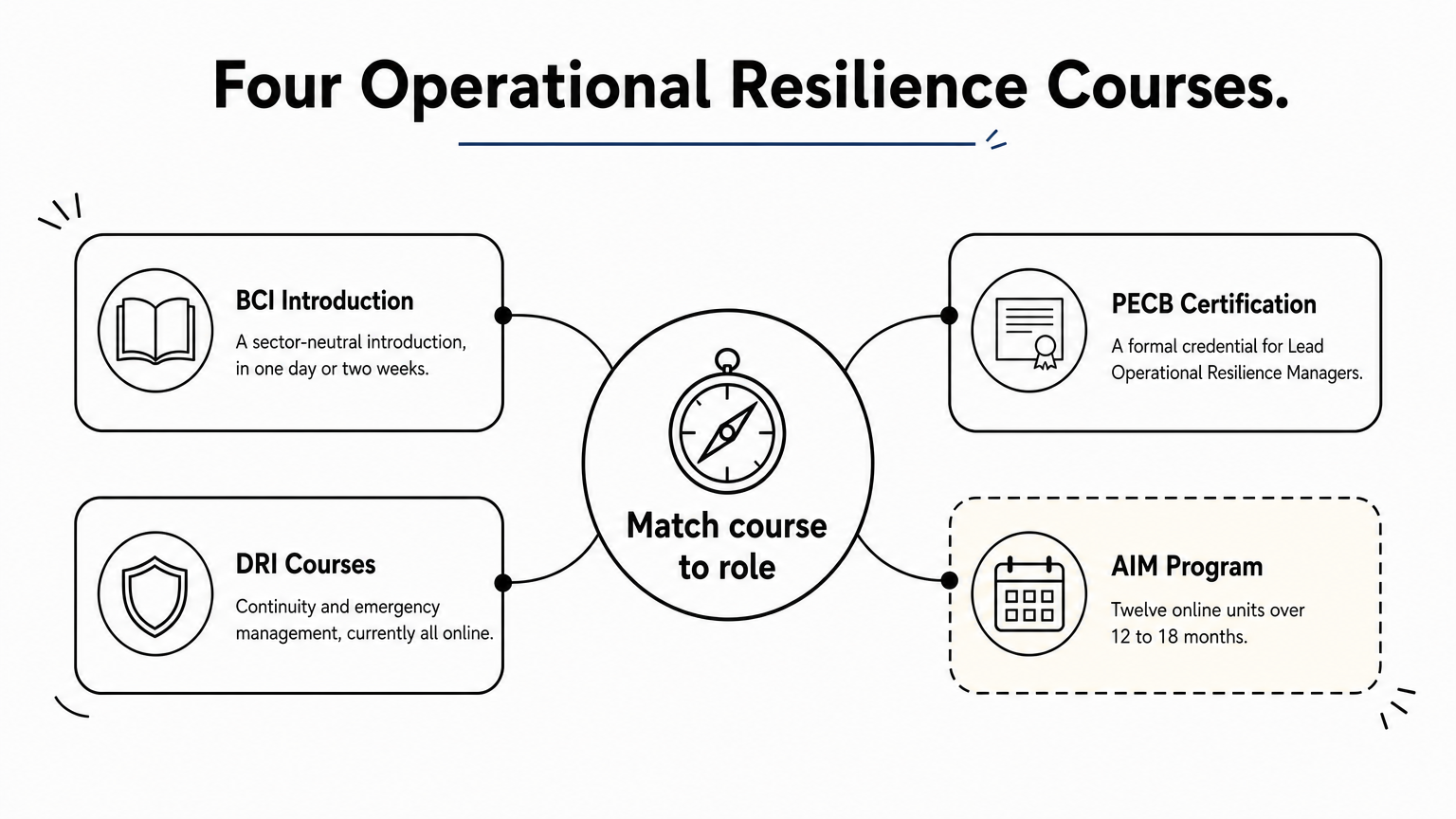
The best operational resilience training course is the one whose credential, format, and depth match your role. If you want a sector-neutral introduction, start with the BCI course. If you need a formal certification, look at PECB’s Lead Operational Resilience Manager. If your work is business continuity or emergency management, DRI is the closer fit. If you are a manager who wants a paced, structured program, AIM’s online course is built for that.
The trouble is that course pages describe resilience in nearly identical words. Length, delivery, and what the fee covers are often buried or missing. You end up with ten tabs open and no clear way to compare them.
This article sets four providers side by side on what you learn, how the course is delivered, how long it takes, and who it suits. It then shows you how to choose. Robyn Benincasa teaches teams to adapt and win through disruption, so we also cover how formal training connects to team culture.
1. BCI Introduction to Operational Resilience
The BCI course is the most accessible starting point for most professionals. It is short, sector-neutral, and built around the fundamentals of resilience.
What you learn
The course covers the scope and importance of operational resilience, the pillars that underpin it, and how to embed resilience into plans, procedures, and culture. Instructors use real examples and expect you to share your own experience.
- Definitions of operational resilience
- The pillars of resilience and what implementing them takes
- Requirements for effective response and recovery plans
- The role of governance and resilience culture
Format, length, and cost
You can take it two ways. BCI Licensed Training Partners deliver a one-day course, in class or online. BCI itself delivers a two-week part-time online course, which is 3.5 hours on each of two days, a week apart.
- In-house delivery is available for cohorts of at least 10 people
- In-house pricing is a bespoke quotation from the BCI team
- Public session prices are on the BCI course page
Who it suits
It suits professionals in any sector who need a working grounding fast. The course cites UK regulators, including the FCA, the Bank of England, and the PRA, whose final rules came in March 2021. Treat those as examples of good practice, not a requirement that you work under UK rules.
The BCI course is the cleanest first step: short, sector-neutral, and built around the pillars of resilience.
2. PECB Lead Operational Resilience Manager
PECB is the pick when you want a credential, not only knowledge. Its operational resilience certification is aimed at people who plan, manage, and improve resilience as part of their job.

What you learn
PECB defines operational resilience as an organization’s ability to anticipate, prepare for, respond to, and recover from disruptions while keeping core services running. The training focuses on impacts, risk appetite, and tolerance levels for service disruption.
- Operational resilience concepts and principles
- Building resilience management capabilities
- Integrating resilience into key activities and functions
- Continual improvement of resilience
Format, length, and cost
PECB delivers training through a published event schedule. Length, delivery mode, and fees depend on the session you pick, so confirm them on the course page before you commit.
- Ask whether the fee includes the exam and certificate
- Ask whether materials are included
- Ask your employer about funding, since PECB itself points candidates toward that conversation
Who it suits
Managers, consultants, and risk or continuity leads who want a recognized certification on their record will get the most from it. PECB says certification can support career advancement and industry recognition. Skip it if all you need is a quick orientation.
Choose PECB when the certificate matters as much as the learning.
3. DRI Center of Excellence in Resilience
DRI is the route for people whose work sits in continuity and emergency response. Its page lists a range of courses instead of one operational resilience course, so you choose the one that matches your role.

What you learn
DRI’s courses cover emergency management and business continuity, among other resilience topics. That is the response-and-recovery layer of operational resilience: how you keep services running once something has actually gone wrong.
- Business continuity planning
- Emergency management
- Resilience topics across the course catalog
Format, length, and cost
Courses are instructor-led, with a mix of in-person and online options. DRI states that all courses are currently available online. Length and price vary by course, so check each listing.
- Instructor-led, not self-paced
- Online delivery available for every course
- Fees and duration listed per course
Who it suits
Continuity planners, emergency managers, and anyone writing recovery plans will find the catalog relevant. If you need the strategic and governance side of resilience more than the planning mechanics, pair it with an introduction like BCI’s.
DRI fits practitioners who build and test recovery plans, not those who only need the concepts.
4. AIM Operational Resilience course
AIM’s course is the long-form option. It is built for people who want a structured program they can fit around a full-time job.
What you learn
The course targets managers responsible for maintaining critical services during business disruptions. That is the same goal behind most resilience programs, delivered as a longer course.
- Keeping critical services running through disruption
- Management responsibilities during incidents
- A structured sequence of units
Format, length, and cost
AIM lists the course as online, with 12 units and a 12 to 18 month timeframe. That is far longer than the one-day and two-day options above. Check the course page for current fees. AIM is an Australian provider, so confirm that the content fits your regulatory context.
- Fully online
- 12 units
- 12 to 18 months
Who it suits
It suits managers who prefer steady, paced learning over a single intensive session. It is a poor choice if you need a credential next month.
AIM trades speed for depth, so pick it only if you have a year to spend.
How to choose between the four courses
Pick by goal first, then by time, then check what the fee includes. The comparison below shows how the four differ on the details that matter most.
Compare them side by side
| Provider | Format | Length | Best for |
|---|---|---|---|
| BCI | One-day course (in class or online) or two-week part-time online | 1 day, or 3.5 hours on 2 days a week apart | Sector-neutral introduction |
| PECB | Certification course, Lead Operational Resilience Manager | Confirm on the schedule | A formal credential |
| DRI | Instructor-led, in person and online (currently all online) | Varies by course | Continuity and emergency management |
| AIM | Online, 12 units | 12 to 18 months | Managers wanting a paced program |
Questions to ask before you enroll
Ask each provider the same short list. The answers separate a certificate of attendance from a real credential, and they expose costs that the course page leaves out.
- What does the fee include: exam, certificate, materials?
- Who delivers the course, the provider or a partner?
- Is there an exam, and what does a retake cost?
- Can my team book a private session, and at what group rate?
Free resilience courses exist, but a free module rarely carries a recognized credential. If you need the credential, budget for one of the four above.
A course gives you the framework. Your team still has to act on it under pressure. For organizations facing AI transformation or industry disruption, Robyn’s Adapt, Overcome, and Win as One keynote runs 45 to 60 minutes and works as a culture kickoff alongside formal training, not a replacement for it.
Choose the course for the credential you need, then build the team culture that makes the plan work.
Choosing your next step
Start with your goal. Take BCI for a fast, sector-neutral grounding, PECB for a certification, DRI for continuity and emergency planning, and AIM for a longer managed program. Then ask each provider what the fee covers before you pay.
Training builds the plan, and culture decides whether people follow it when services are at risk. If you want your team to adapt together through disruption, explore how Robyn Benincasa helps organizations build winning teams.