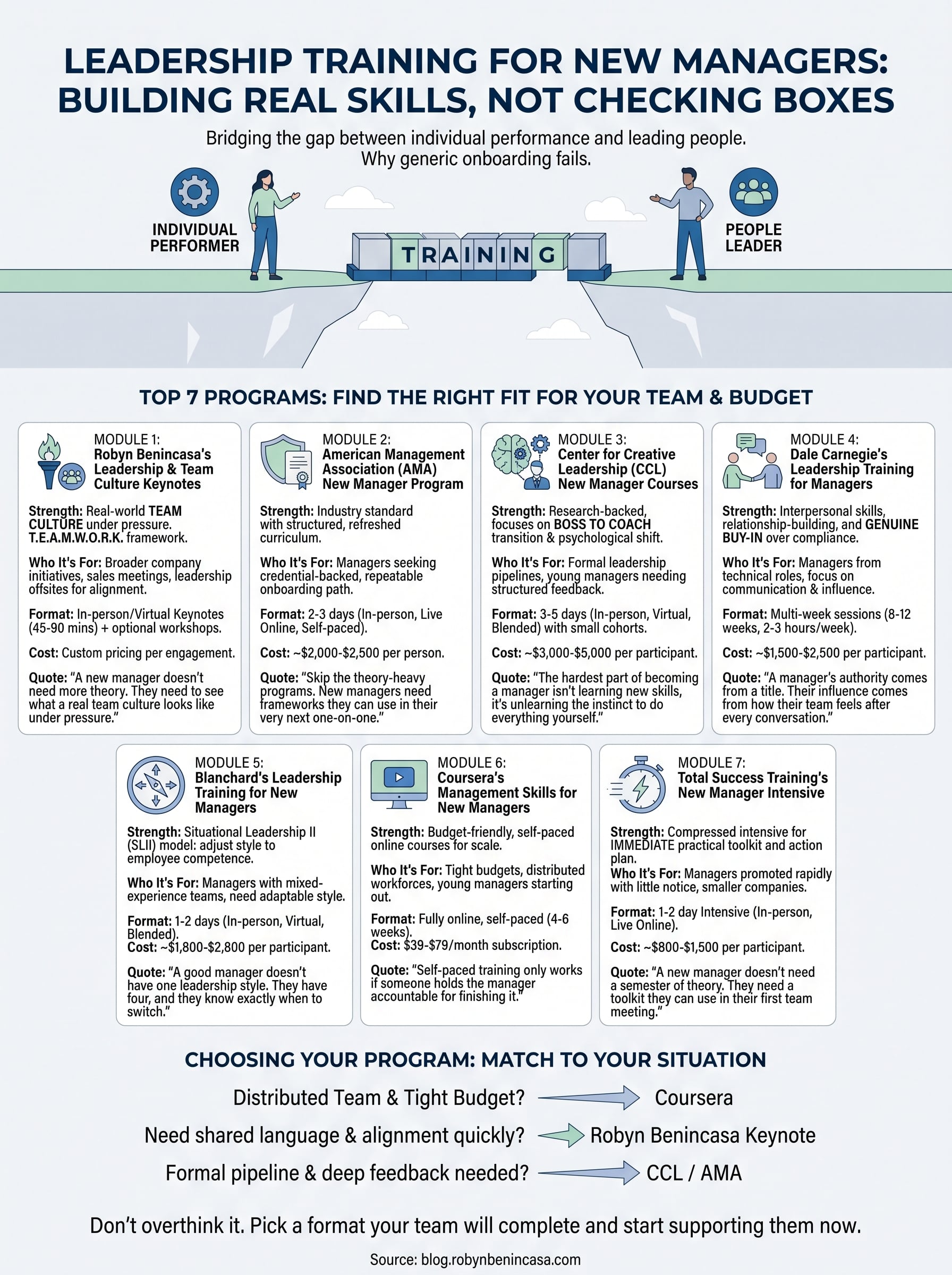
Typing "leadership training programs near me" into Google gets you a list of local colleges, chambers of commerce, and generic online courses. Some are solid. Many are outdated theory with no connection to how teams actually perform under pressure. If you’re an HR leader or executive trying to fix a real problem, low morale, siloed departments, a sales team stuck in the middle of the pack, you need more than a certificate on a wall.
This guide gives you a practical framework for evaluating local and virtual leadership training options, so you can tell the difference between a program that changes behavior and one that just fills a training budget line. You’ll learn what to look for, what questions to ask providers, and which red flags mean you should keep looking.
We’ll walk through where to search, how to vet instructors and content for real-world relevance, and why the best options often blend live, in-person sessions with virtual formats to reach distributed teams. Along the way, we’ll point to what separates a memorable, results-driven keynote or training experience, the kind built on tested team dynamics rather than recycled slides, from the forgettable ones filling most search results.
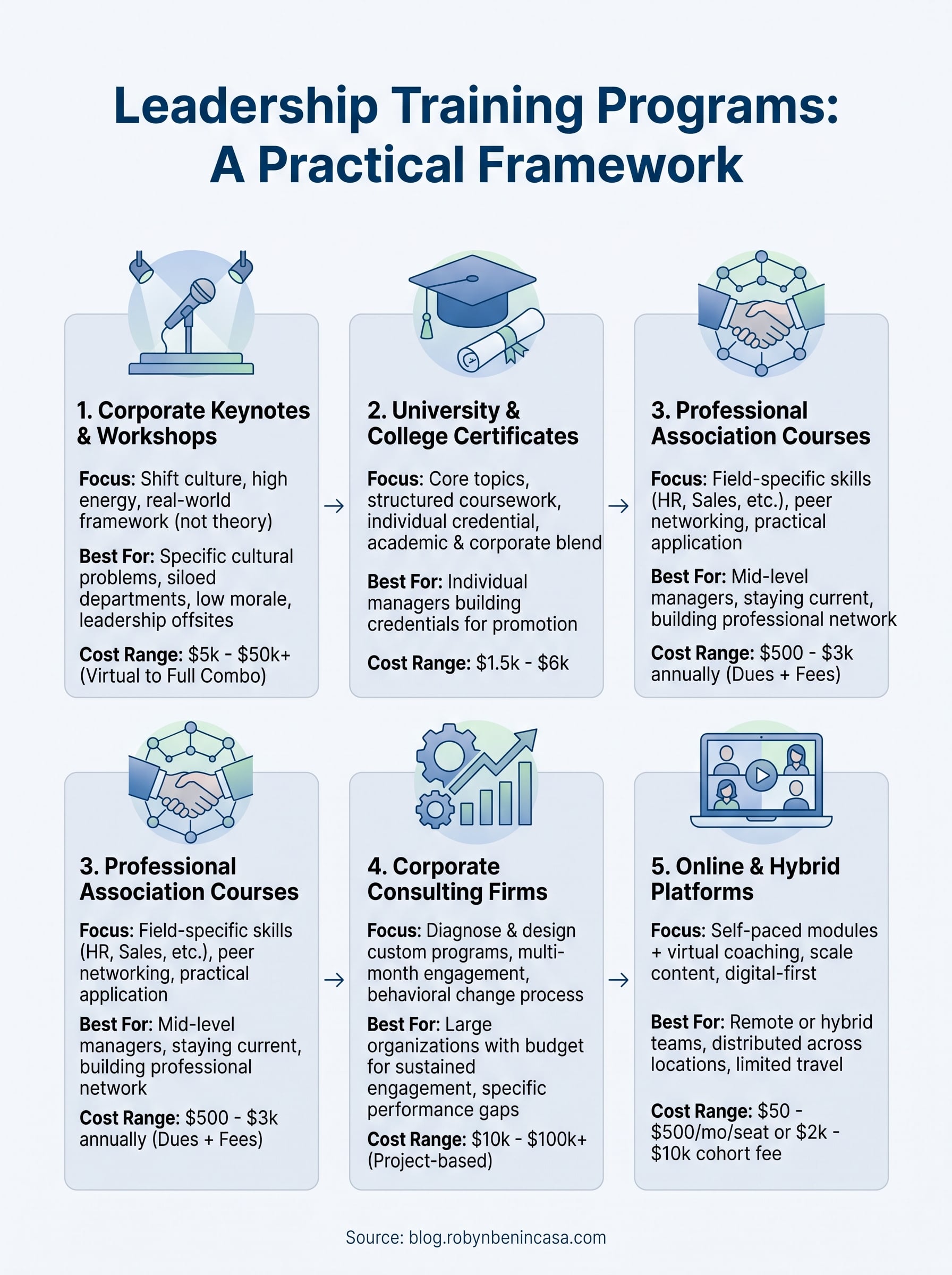
1. Corporate keynote speakers and team-building workshops
When you search for leadership training programs near me, a keynote speaker booked for a corporate event, sales kickoff, or offsite is one of the fastest ways to shift how a team thinks about performance. Unlike a semester-long course, a keynote delivers a concentrated, high-energy session that reframes leadership around real-world stakes, not textbook theory.
What it offers
A strong keynote pairs a compelling personal story with a repeatable framework your team can apply immediately. Robyn Benincasa’s keynote topics, built from her years as a world champion adventure racer and San Diego firefighter, translate directly into workplace behavior: communication under pressure, trust-building, and shared accountability. Many bookings pair the keynote with a hands-on team-building workshop, so the lessons get practiced, not just heard.
Who it’s best for
This format suits organizations facing a specific cultural problem, siloed departments, low morale, or a sales team stuck mid-pack that needs a sales motivational speaker, rather than a general skills gap. It works especially well for leadership offsites, annual conferences, and sales meetings where you need to energize a room and leave people with a shared vocabulary for teamwork.
A great keynote doesn’t just inspire for an afternoon. It gives your team language and tools they’ll reference for years.
Start by identifying your core problem, then search for speakers whose track record matches it. Check testimonials from comparable industries, confirm availability for your event date, and reach out directly through the speaker’s booking page to discuss virtual or in-person formats.
2. University and college leadership certificate programs
Search "leadership training courses near me" and you’ll find local universities and community colleges offering executive education certificates. These programs sit between academic theory and corporate practice, often taught by business school faculty with real consulting experience.
What it offers
Most certificate programs run 6 to 12 weeks, covering the core topics leadership training programs are built around, like organizational behavior, conflict resolution, and strategic decision-making. You’ll get structured coursework, case studies, and a credential you can list on a resume or LinkedIn profile. Some schools, including extension programs at state universities, offer evening or weekend formats built for working professionals.
Who it’s best for
These programs suit individual managers building credentials for promotion, not teams trying to fix a specific culture problem right now. HR departments sometimes subsidize tuition as part of a broader professional development benefit.
A certificate builds individual credibility. It rarely shifts how a whole team works together.
What it typically costs
Expect $1,500 to $6,000 depending on the institution and program length, with Ivy League and top-tier business schools charging more.
How to find and enroll
Check your local university’s continuing education or executive education division, compare syllabi against your actual goals, and confirm whether the format is in-person, hybrid, or fully online before enrolling.
3. Professional association leadership development courses
Industry groups like SHRM, ATD, and local chambers of commerce run their own leadership development courses, often tied to certification tracks in your specific field. If you search for leadership development courses near you, these associations usually rank high because they host regular in-person chapter events alongside national conferences.
What it offers
Expect workshops, multi-day seminars, and sometimes year-long cohort programs built around leadership development topics for a specific professional discipline, HR, project management, sales leadership, or engineering management. Content tends to be practical and field-specific, taught by practitioners rather than academics, with networking built into every session.
Who it’s best for
Mid-level managers who want to stay current in their profession while building a peer network benefit most. It suits individuals more than intact teams looking to fix a shared culture problem.
Association courses build your professional network as much as your leadership skills.
What it typically costs
Membership dues plus course fees typically run $500 to $3,000 annually, cheaper than university programs but requiring ongoing membership.
How to find and enroll
Search your industry’s national association website, then check for a local chapter offering in-person sessions near you.
4. Corporate training and consulting firms
Search for leadership training near you and you’ll also surface regional consulting firms that build custom leadership programs for a single company rather than open-enrollment classes. These firms diagnose your specific culture or performance gap first, then design training around it.
What it offers
Consulting firms typically start with an assessment, surveys, interviews, or 360-degree reviews, before building a multi-month engagement. Expect workshops, manager coaching, and follow-up sessions designed to change behavior over time rather than in a single event.
Consulting firms sell a process, not a single day of content.
Who it’s best for
This option fits larger organizations with budget for a sustained engagement and a specific, measurable problem, like declining retention or a leadership pipeline gap.
What it typically costs
Engagements run $10,000 to $100,000+ depending on company size, scope, and duration. Most firms price by project, not by seat.
How to find and book one near you
Search "leadership consulting firm" plus your city, compare it against organizational change management consulting firms, request references from similar-sized clients, and ask for a clear measurement plan before signing a contract.
5. Online and hybrid leadership training platforms
Searching for leadership training programs near me increasingly turns up platforms that aren’t local at all, they’re digital-first courses that blend recorded lessons with live virtual coaching. These options exist because distributed teams need training that doesn’t depend on everyone being in the same building.
What it offers
Expect self-paced video modules paired with live cohort calls, discussion boards, and sometimes a virtual keynote or workshop woven into the curriculum, much like the better-known online leadership training programs. Many platforms now license content from recognized speakers and authors, giving smaller companies access to material that once required a five-figure booking fee.
Who it’s best for
This format suits remote or hybrid teams spread across multiple offices or time zones, plus companies with limited travel budgets. It works less well when your real problem is trust or communication breakdowns that need face-to-face practice to fix.
Online platforms scale content cheaply, but they can’t replicate the energy of a room that’s actually working together.
What it typically costs
Subscriptions typically run $50 to $500 per seat monthly, while cohort-based programs with live coaching cost $2,000 to $10,000 per group.
How to find and enroll
Request a demo session before committing, and confirm whether live coaching is included or sold separately.
Finding the right program for your team
Five options, five different problems solved. Universities build individual credentials. Associations build professional networks. Consulting firms fix specific, measurable performance gaps over months. Online platforms scale content across distributed teams cheaply. None of them move a room the way a live keynote does when your real issue is culture, trust, or a team that’s stopped pulling in the same direction.
Go back to the problem you started with. If it’s a certificate you need, pick the university program. If it’s a genuine shift in how your people work together, under pressure, across silos, before the next big deadline, that’s what a results-driven keynote is built for. Robyn Benincasa has spent decades proving what actually builds winning teams, on racecourses, in firehouses, and in boardrooms.
Ready to see if she’s the right fit for your next event? See how she stacks up against the other keynote speakers near you, then book her for your team.
Picking a leadership program for yourself or your executive team is a real investment. You’re looking at tuition costs that run into five figures, weeks away from the office, and a bet that the curriculum actually changes how your leaders show up at work. Search around and you’ll find dozens of options that all claim to be the best executive leadership training programs, with little to help you tell them apart.
This article cuts through that noise. We reviewed executive leadership development training from top business schools and institutions, looking at curriculum depth, faculty credentials, format, cost, and the kind of measurable outcomes companies like Allstate and Northrop Grumman actually care about. Whether you’re an HR leader vetting corporate leadership development training for your whole bench or a director evaluating options for your own growth, you’ll find a program here that fits.
Below, we break down seven standout programs, what makes each one worth considering, who it’s built for, and what you can expect to pay. If you’re also weighing outside speakers and workshops as part of your leadership strategy, knowing how to hire a keynote speaker is exactly the kind of complementary investment worth exploring alongside formal coursework.
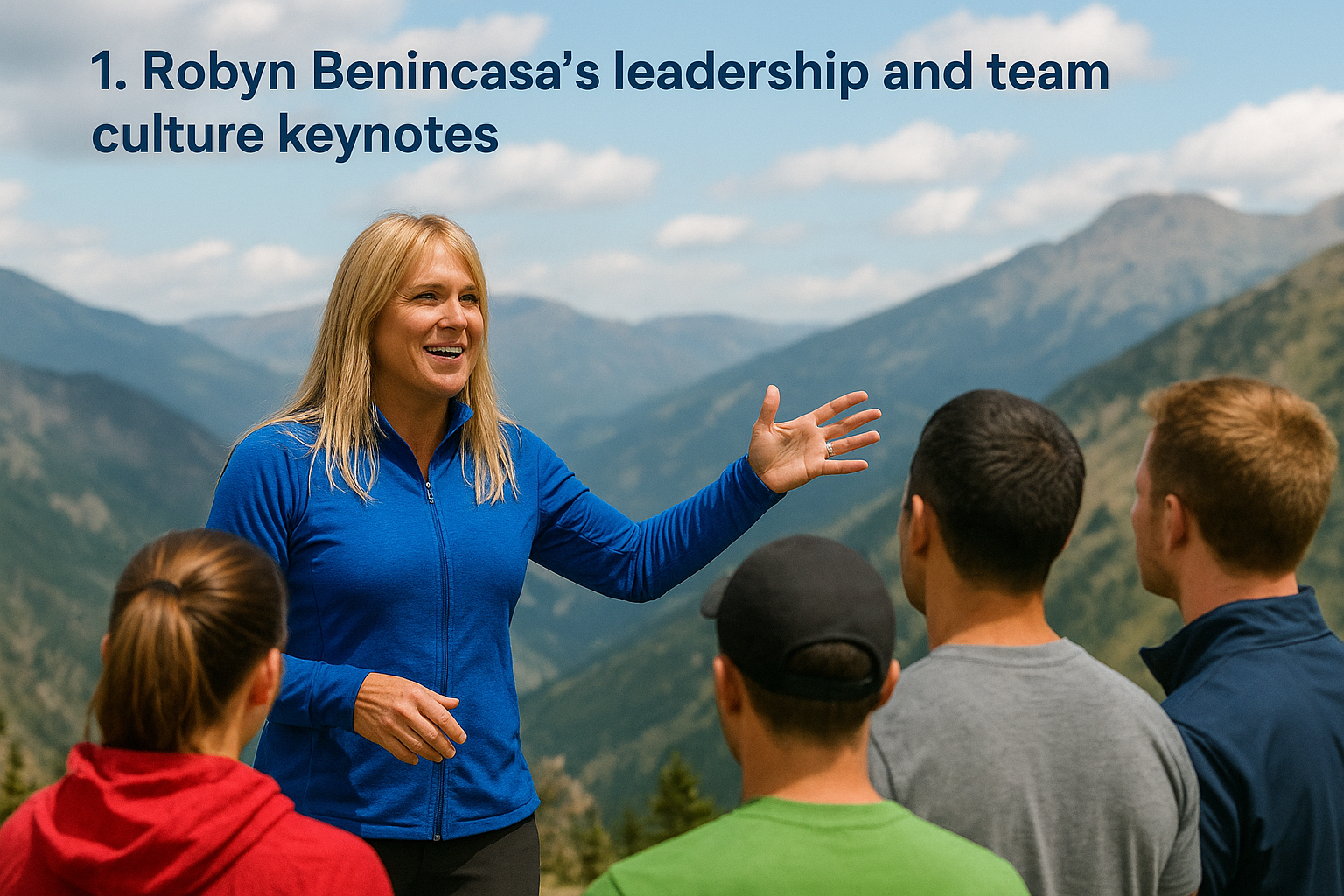
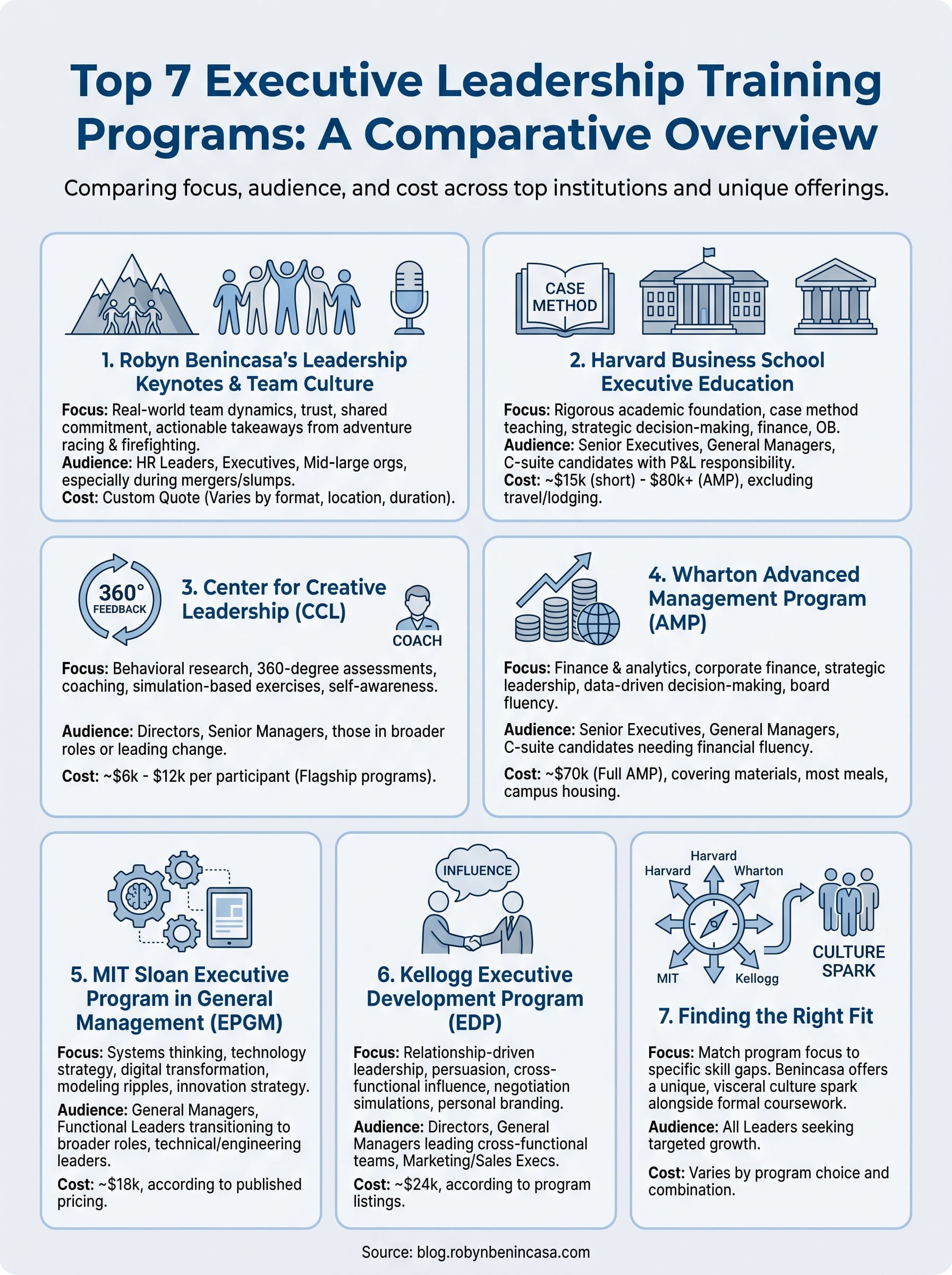
1. Robyn Benincasa’s leadership and team culture keynotes
Most executive leadership training programs teach frameworks from a whiteboard. Robyn Benincasa teaches them from a mountain ridge at mile 200 of an adventure race, where a team either pulls together or falls apart. As a world champion adventure racer and 20-plus year San Diego firefighter, she built her reputation leading teams through conditions where individual talent means nothing without trust and shared commitment. Her work as a corporate culture keynote speaker translates that hard-won field experience directly into corporate settings, making her one of the more distinctive entries among top executive leadership training programs on this list.
How it works
Robyn structures her sessions around signature frameworks like T.E.A.M.W.O.R.K. (the 8 Essential Elements of a World-Class Team Culture) and WIN AS ONE, both built from real case studies of teams she led to championship results. She pairs storytelling from her racing and firefighting careers with concrete, actionable takeaways that leaders can apply the following Monday, not abstract theory that stays in the conference room.
A team culture built on trust and shared commitment beats individual talent every time.
Who it’s for
These programs suit HR leaders and executives at mid-size to large organizations who need to unify teams around a common goal, especially during mergers, market pressure, or performance slumps. Companies like Allstate, InterWest Insurance, and Northrop Grumman have booked Robyn specifically to break down silos between teams and rebuild sales and operations culture from the ground up.
Format and duration
Engagements run as in-person or virtual keynote sessions, typically 45 to 90 minutes, and slot easily into sales meetings, leadership offsites, or full conferences. Organizations wanting deeper engagement often pair a keynote with team-building activities that actually strengthen teams or her book, "How Winning Works," for a longer cultural shift.
Cost
What a keynote speaker costs varies by format, location, and event length, so the best step is to request a custom quote directly through the booking page. Every organization also gets access to Robyn’s free 18-page leadership guide as a starting point before committing to a full engagement.
2. Harvard’s executive leadership training programs
Harvard Business School’s Executive Education division runs some of the most recognized executive leadership training programs in the world, built on the same case-method teaching that fills its MBA classrooms. Programs like the General Management Program and Advanced Management Program pull from decades of Harvard research on strategy, finance, and organizational behavior, giving participants a rigorous academic foundation rather than a single speaker’s point of view.
How it works
Sessions rely heavily on the Harvard Business School case method, where small groups debate real business dilemmas before faculty weigh in. Cohorts work through modules on negotiation, finance, and strategic decision-making, with heavy peer interaction built into every session.
Rigorous case debate forces leaders to defend their thinking, not just absorb it.
Who it’s for
These executive training programs in leadership target senior executives, general managers, and C-suite candidates who already carry P&L responsibility and want a credential that signals top-tier strategic training.
Format and duration
Most programs run in-person on Harvard’s Boston campus, ranging from two-week intensives to the Advanced Management Program’s eight-week residency, with limited hybrid options.
Cost
Tuition typically runs from $15,000 for shorter programs to over $80,000 for the full Advanced Management Program, not including travel and lodging.
3. Center for Creative Leadership’s executive programs
The Center for Creative Leadership (CCL) takes a different angle than the big business schools. Instead of case studies, it built its reputation on decades of behavioral research into what actually makes leaders effective, then packaged that research into hands-on leadership training programs for directors and senior managers navigating real organizational change.
How it works
CCL leans on 360-degree feedback assessments, one-on-one coaching, and simulation-based exercises rather than lectures. Participants get direct, sometimes uncomfortable, feedback from peers and direct reports, then work with coaches to build a personal leadership development plan they carry back to the job.
Feedback from the people you actually lead teaches more than any case study ever will.
Who it’s for
These programs suit directors and senior managers who need to sharpen self-awareness and influence skills, particularly those stepping into broader leadership roles or managing through organizational change. CCL also runs custom cohorts for companies wanting to train an entire management layer at once.
Format and duration
Most flagship programs, like the Leadership Development Program, run five to six days in person at CCL’s campuses in Colorado Springs, Greensboro, or San Diego. Virtual and blended formats are available for teams that can’t travel, spreading the same content across several weeks of shorter sessions.
Cost
Expect to pay between $6,000 and $12,000 per participant for flagship programs, depending on format and location, according to CCL’s own program listings.
4. Wharton’s advanced management program
Wharton’s Advanced Management Program (AMP) leans hard into finance and analytics, reflecting the school’s reputation as one of the top executive leadership training programs for leaders who need to speak fluently to boards and investors. Where Harvard debates cases, Wharton runs the numbers, pairing strategic leadership content with deep dives into valuation, risk, and data-driven decision-making.
How it works
Faculty structure the curriculum around modules in corporate finance and strategic leadership, blending lectures with small-group simulations that force participants to model real business scenarios under pressure. Executive coaching sessions run alongside the coursework, helping each participant translate financial insight into a personal leadership plan.
Numbers convince a boardroom faster than a good story ever will.
Who it’s for
Wharton built this program for senior executives and general managers who already understand strategy but want sharper financial fluency before stepping into a C-suite or board-facing role. It suits leaders from finance, operations, and general management backgrounds equally well.
Format and duration
The flagship residency runs about four weeks on Wharton’s Philadelphia or San Francisco campus, split into two two-week sessions with a break between them. A shorter, condensed version exists for executives who can’t commit to a full month away.
Cost
Tuition for the full Advanced Management Program runs roughly $70,000, covering materials, most meals, and campus housing, though travel costs sit outside that figure.
5. MIT Sloan’s executive program in general management
MIT Sloan built its Executive Program in General Management (EPGM) around a simple premise: leaders who understand systems thinking and technology strategy outperform those who only know finance and operations. Given MIT’s reputation in engineering and analytics, this program stands out among executive leadership development training options for leaders managing technical teams or digital transformation projects.
How it works
Faculty combine systems thinking frameworks with real-time business simulations, pushing participants to model how decisions ripple across an entire organization rather than just one department. Sessions also cover innovation strategy and organizational design, taught by researchers who consult directly with Fortune 500 companies on digital transformation.
Leaders who see the whole system make fewer decisions that backfire elsewhere.
Who it’s for
General managers and functional leaders transitioning into broader operational roles get the most from this program, especially those overseeing technology-heavy or engineering-driven businesses. It also suits directors who need to speak credibly with technical teams while still owning bottom-line results.
Format and duration
The program runs about three weeks in person on MIT’s Cambridge campus, structured as an intensive residency with limited breaks. Some cohorts split the schedule into two shorter sessions for executives who can’t leave the office for a full month.
Kellogg School of Management built its Executive Development Program (EDP) around relationship-driven leadership, reflecting the school’s reputation for marketing and organizational behavior research. Among corporate leadership development training options, Kellogg stands out for pushing participants to master persuasion and cross-functional influence, skills that matter as much as strategy once you’re leading peers who don’t report to you.
How it works
Faculty build the curriculum around negotiation simulations and team-based projects, forcing participants to practice influence tactics in real time rather than just discuss theory. Sessions also cover change management and personal branding, taught by professors who consult with Fortune 500 marketing and operations teams.
Influence without authority is the skill that separates good managers from great leaders.
Who it’s for
Kellogg designed this program for directors and general managers who lead cross-functional teams and need buy-in from stakeholders outside their direct chain of command, much like dedicated cross-functional collaboration training does. It also draws marketing and sales executives looking to sharpen their strategic storytelling.
Format and duration
The flagship residency runs three weeks on Kellogg’s Evanston campus, with a hybrid track available that splits content across shorter in-person modules and virtual coursework.
The seven programs above tackle leadership from different angles, and that’s the point. Harvard sharpens strategic debate, Wharton builds financial fluency, MIT Sloan teaches systems thinking, and Kellogg trains influence without authority. CCL digs into self-awareness through direct feedback. Each one works well for a specific gap in a leader’s skill set, but none of them replace the visceral, team-first culture shift that comes from hearing what actually happens when a team faces real stakes and no shortcuts.
That’s where Robyn Benincasa’s approach stands apart from typical executive leadership training programs. Her keynotes and team-building sessions give organizations the cultural spark that formal coursework often skips, the kind that gets a sales team talking about trust and shared commitment the next morning instead of filing a binder away. If your leaders need that jolt alongside their formal training, see which leadership keynote speakers are worth booking and find out what a battle-tested team culture actually looks like.
You’ve hit a wall a lot of women hit around mid-career: you’re good at your job, you’re delivering results, but the path to the next title isn’t obvious and nobody’s handing you a roadmap. That’s exactly why women leadership training programs exist, and why so many ambitious professionals go looking for one right now. If you’re vetting options for yourself or your team, you need a shortlist that separates real, credentialed development from generic workshops with a pink logo slapped on them.
This article gives you that shortlist. I’ve pulled together eight standout programs, from university-backed executive education to focused nonprofit leadership development training and industry-specific cohorts, so you can compare format, cost, and outcomes side by side instead of digging through a dozen browser tabs. Each one is built to sharpen decision-making under pressure and strengthen the influence skills that get women promoted, not just praised.
I’ve spent two decades building teams under extreme conditions, first as a firefighter, then as a world champion adventure racer, and I know the difference between training that changes behavior and training that just fills a day. As you read through these eight programs, think about which format matches your career stage and what specific gap you’re trying to close before your next performance review.
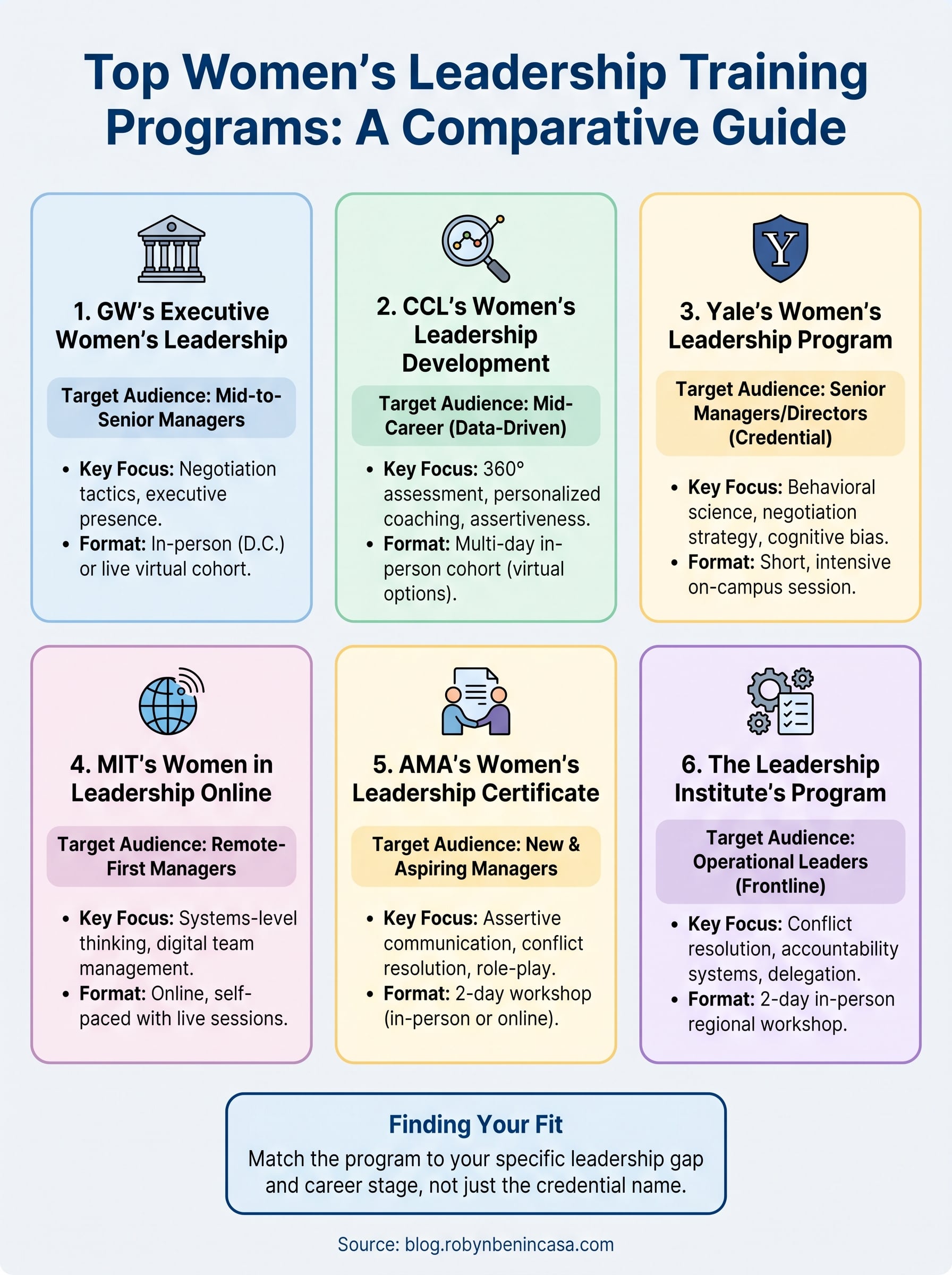
1. GW’s executive women’s leadership program
George Washington University runs one of the most established women leadership training programs in the country through its School of Business, and it’s built for women who already manage people but want the strategic fluency to sit at the executive table. This isn’t a motivational seminar. It’s structured around real organizational challenges: negotiating for resources, managing up, and building influence in rooms where you’re often the only woman present.
What it covers
The curriculum leans heavily on negotiation tactics and executive presence, taught through case studies pulled from GW’s own faculty research rather than generic leadership theory. You’ll work through modules on strategic decision-making, managing organizational politics, and building a personal brand that carries weight in performance reviews. Small group coaching sessions push you to apply each concept to a live situation from your own job, which is what separates this from a lecture-style course.
The program works because it forces you to practice the hard conversation before you have to have it for real.
Who it’s for
This program suits mid-to-senior level managers who are already leading teams but haven’t yet cracked the director or VP tier, the same audience served by leadership training for middle managers. If you’ve been told you’re "not quite ready" for the next promotion without a clear explanation why, this is the kind of leadership development program designed to close that gap. It’s less useful for early-career professionals who haven’t managed anyone yet; the case discussions assume you’ve already navigated team conflict and budget decisions firsthand.
Format and cost
GW offers the program both in-person on its Washington, D.C. campus and as a live virtual cohort, typically running over three to four days. Tuition runs in the $3,000 to $4,500 range depending on format and whether you book early. Details and current dates are listed on the GW School of Business executive education site. Many companies cover this through professional development budgets, so check with HR before you pay out of pocket. If you’re weighing this against other options, ask whether your organization prioritizes a credential from a known university or a more customized, culture-specific approach, since that distinction matters more than the price tag.
2. CCL’s women’s leadership development program
The Center for Creative Leadership has been researching leadership behavior for over 50 years, and its women’s program reflects that research base rather than trendy frameworks. Unlike a lot of women leadership training programs built around theory, CCL leans on data pulled from thousands of 360-degree assessments to show you exactly where your leadership style helps or hurts you.
What it covers
Participants get a personalized 360 assessment before the program even starts, so the sessions address your actual blind spots instead of generic leadership traits. The curriculum covers assertiveness, resilience under pressure, and how to build a support network that survives a promotion, which maps closely to the essential leadership skills most managers are measured on. Coaches walk you through your results one-on-one, which is rare at this price point.
Data-driven feedback beats a workshop full of feel-good affirmations every time.
Who it’s for
This fits women who want hard evidence before changing how they lead, not just encouragement. It works well for mid-career professionals moving into their first director-level role, especially those who’ve never received structured feedback on their management style. If you already know your weaknesses and just want tactics, this program might feel slower than you need.
Format and cost
CCL runs this as a multi-day, in-person cohort, with virtual options added in recent years. Pricing typically falls between $4,000 and $5,500, covering the assessment, coaching, and materials. Full details live on the Center for Creative Leadership site.
3. Yale’s women’s leadership program
Yale School of Management brings its academic weight to this program, and it shows in how the sessions are structured. Rather than a loose collection of tips, Yale organizes the curriculum around behavioral science, pulling from research on decision-making and persuasion that its faculty actually publish. It’s one of the more rigorous women’s executive education options on this list, and it draws a global cohort of professionals who want a credential that carries weight beyond the room.
What it covers
Expect deep work on negotiation strategy and how cognitive bias shapes the way women’s ideas get received in meetings. Sessions also cover conflict management and how to reframe setbacks as data rather than personal failure. Faculty use Yale’s case method throughout, so you’re debating real scenarios instead of absorbing slides.
Understanding the psychology behind why your ideas get dismissed matters more than any speaking trick.
Who it’s for
This program suits women already operating at a senior manager or director level who want an Ivy League credential attached to their leadership training. It’s a strong fit if your organization values pedigree when evaluating internal candidates for VP roles. Early-career professionals will likely find the material too abstract without prior management experience to anchor it.
Format and cost
Yale runs the program as a short, intensive on-campus session, usually two to three days, with tuition landing between $3,500 and $5,000. Check the Yale School of Management executive education page for current cohort dates.
4. MIT’s women in leadership online program
MIT Sloan takes a different approach than the campus-based programs above: this one runs entirely online, built for women who want an MIT credential without blocking off a week of travel. It’s a self-paced-meets-cohort model, structured around short video lectures from Sloan faculty paired with live discussion sessions, making it one of the more flexible online leadership training programs on this list.
What it covers
The curriculum focuses on systems-level thinking, teaching you to diagnose organizational dysfunction the way an engineer diagnoses a broken process rather than relying on personality-based leadership advice. Modules cover negotiation, digital-era team management, and building influence remotely, which matters if you’re leading a hybrid team. Peer discussion boards connect you with other participants working through the same case studies in real time.
A credential you can earn between meetings still counts if the material actually changes how you lead.
Who it’s for
This fits remote-first managers and women who can’t take a week away from the office for an in-person cohort. It also suits participants outside major metro areas who still want access to top-tier faculty. If you learn best through in-person debate and networking, the online format will feel isolating compared to Yale or GW.
Format and cost
The program runs six to eight weeks, a few hours weekly, with tuition around $2,800 to $3,200. Check the MIT Sloan Executive Education site for current cohort dates.
5. AMA’s women’s leadership certificate program
The American Management Association built this certificate program for women who want a credential recognized across industries, not tied to one university’s name. It’s practical by design, favoring workshop repetition over academic theory, which makes it one of the more accessible women’s leadership training programs for someone who wants tools she can use the following Monday.
What it covers
Sessions focus on assertive communication and conflict resolution, with heavy role-play so you practice pushback in real time instead of just discussing it. The curriculum also covers time management, delegation, and building credibility with peers who outrank you on paper. AMA layers in a strengths assessment early on, then ties every later module back to your specific results.
Practice under pressure sticks longer than any slide about assertiveness ever will.
Who it’s for
This program suits new and aspiring managers, women stepping into their first supervisory role who need concrete scripts more than strategic frameworks, and it sits alongside other strong training options for first-time managers. It’s a weaker fit for senior executives who’ve already mastered the basics of team management and want boardroom-level strategy instead.
Format and cost
AMA runs this as a two-day workshop, offered both in-person in several U.S. cities and live online. Tuition typically runs $2,000 to $2,500, with member discounts available. Current schedules are posted on the American Management Association site.
6. The leadership institute’s women’s leadership program
The Leadership Institute runs a lesser-known but well-regarded cohort aimed squarely at operational leaders, the women managing budgets, shift schedules, and cross-functional teams rather than sitting in a corner office yet. Compared to the university programs above, this one skips the academic framing and gets straight to the mechanics of running a team well under real deadline pressure.
What it covers
Sessions center on conflict resolution and building accountability systems that don’t require you to micromanage every task, the same ground covered by dedicated leadership communication training. You’ll also work through modules on delegation, giving feedback that actually changes behavior, and reading team dynamics before they turn into a morale problem. The program pairs each concept with a workplace scenario you bring in yourself.
A leadership program only earns its price tag if you leave with a system, not just a pep talk.
Who it’s for
This fits frontline and mid-level supervisors who inherited a team but never got formal training in how to lead one. It’s a strong choice among women’s leadership training programs for someone managing people day-to-day in operations, retail, or healthcare settings rather than steering enterprise strategy.
Format and cost
The program runs as a two-day, in-person workshop offered in regional cities throughout the year, with tuition typically landing between $1,800 and $2,400. Group discounts apply when an employer sends more than one participant, which makes it a practical pick for HR teams training several supervisors at once.
Finding the right program for your next step
Picking from these women leadership training programs comes down to one honest question: what specific gap is holding you back right now? A director who needs boardroom credibility belongs at Yale or GW, not in a two-day workshop built for new supervisors. A frontline manager drowning in scheduling conflicts needs the Leadership Institute’s practical systems, not academic case studies. Match the program to the actual problem, not the name on the certificate, and understand how leadership training programs actually work before you commit a budget to one.
Beyond enrolling in a course, real growth happens when you keep learning from people who’ve actually led teams through pressure and change. That’s the same reason organizations bring me in to speak, to give teams a shared language for building trust fast and performing when it counts. If you’re planning a leadership offsite or sales kickoff and want that conversation started for your team, see which female keynote speakers are worth booking and what fits your next event.
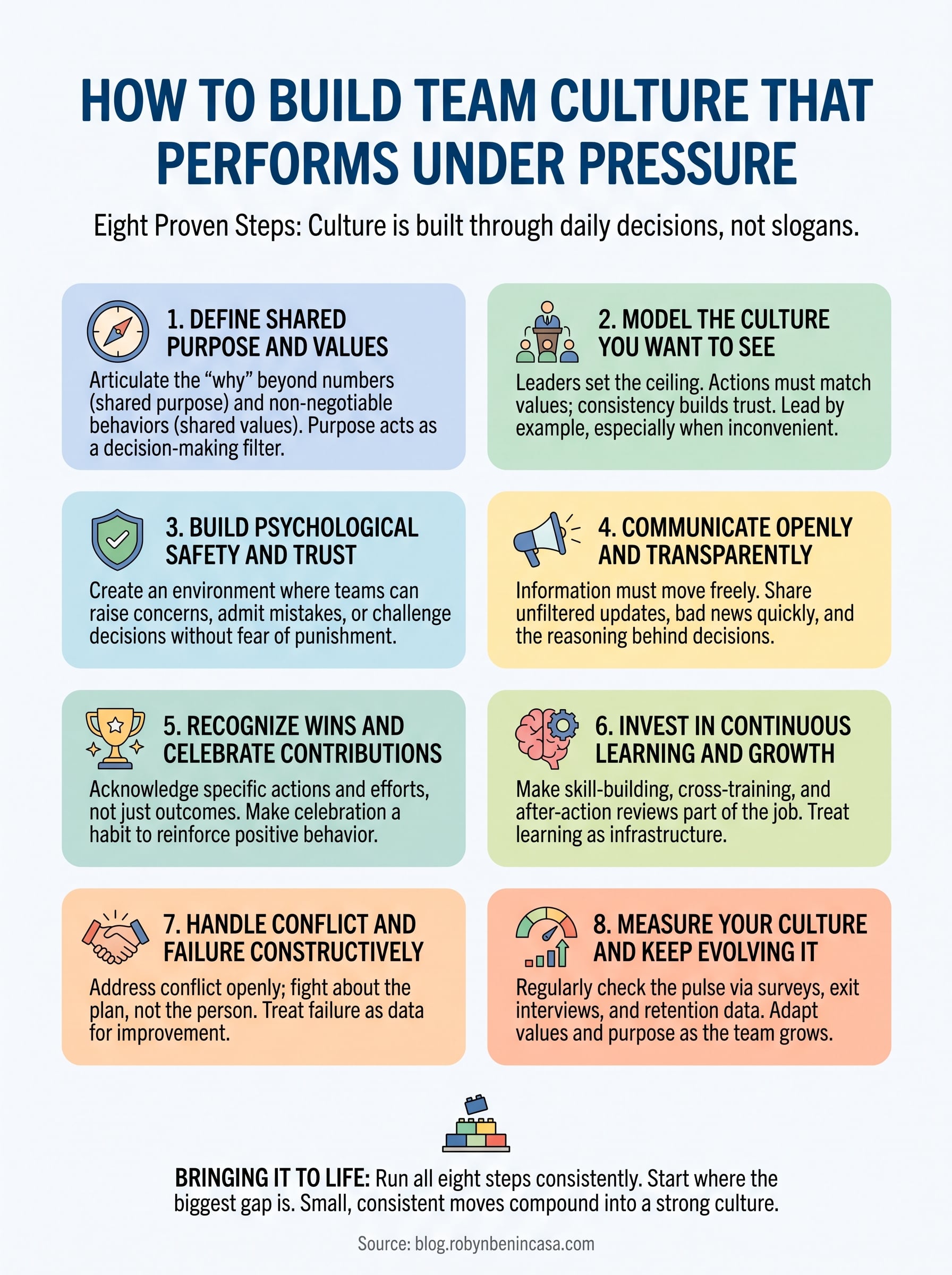
Most teams don’t fail because of talent. They fail because nobody deliberately built the culture holding them together. If you’re wondering how to build culture in a team that actually performs under pressure, you already know the free-pizza-Fridays approach isn’t cutting it. Culture is built through daily decisions, not slogans on a wall, and it helps to be clear on what team culture actually is before you try to shape it.
I spent 15 years racing on world championship adventure racing teams, where a bad culture doesn’t just hurt morale, it gets people hurt in the wilderness. I’ve since spent two decades as a San Diego firefighter watching the same principles save lives in burning buildings. The teams that win aren’t the ones with the most talented individuals. They’re the ones with a shared commitment to each other that shows up when things get hard, whether that’s a canyon at midnight or a quarter with missed targets.
This article breaks down eight proven steps for building a strong team culture at work, drawn from those extremes and translated for boardrooms, sales floors, and remote teams alike. You’ll get specific, actionable moves you can start using this week, not vague theory about values statements.
1. Define your team’s shared purpose and values
Every world-class team I’ve raced with or worked alongside inside a firehouse could answer one question instantly: why does this team exist, beyond hitting a number or crossing a finish line? That’s the starting point for creating a strong team culture from the ground up, and most organizations skip it entirely. They write a mission statement once, hang it in the break room, and wonder why nobody references it during a tough sprint or a bad shift.
What this step looks like
Defining shared purpose means your team can articulate, in their own words, what winning looks like and why it matters to them personally, not just to the shareholders. On my adventure racing teams, our purpose was never just "finish first." It was proving that ordinary people, working as one unit, could outlast athletes with far more raw talent. That purpose shaped every decision, from who we recruited to how we handled a broken paddle at 2 a.m. Shared values work the same way. They’re the non-negotiable behaviors your team agrees to live by, like "we never leave a teammate behind" or "we surface problems immediately instead of hiding them."
Why it matters for team culture
Purpose and values act as the decision-making filter when you’re not in the room. A team with a clear purpose doesn’t need a manager micromanaging every call because everyone already knows what matters. Without that filter, teams default to self-interest the moment pressure rises, and that’s exactly when culture cracks.
A team without a defined purpose will invent one under pressure, and it’s rarely the purpose you wanted.
This matters just as much for developing team culture in a brand-new group as it does for fixing a struggling one. Early teams that skip this step tend to drift toward whoever talks loudest, rather than what the mission actually requires.
How to put it into practice
Don’t outsource this to HR or a consultant deck. Get your actual team in a room, virtual or otherwise, and work through it together, the same way you’d run exercises built for leadership teams:
Ask each person to write down, privately, what they think the team’s purpose is. Compare answers. The gaps tell you everything.
Identify three to five behaviors that support that purpose, stated as actions, not adjectives ("we tell each other the truth even when it’s uncomfortable" beats "we value honesty").
Put those behaviors into onboarding, performance reviews, and team meetings, not just a poster.
Revisit the purpose statement quarterly. Markets shift, teams change, and a purpose that fit eighteen months ago might not fit now.
If you want a structured way to walk your leadership team through this exercise, my free team building and leadership guide breaks down the exact framework I use with corporate clients before I ever step on stage.
2. Model the culture you want to see as a leader
Leaders set the ceiling for every team’s culture, not the floor. On my racing teams, if the captain complained about the mud or cut corners on gear checks, that behavior spread through the group faster than any pep talk could counter it. Building a positive team culture starts with the person in charge deciding to go first, every single time, especially when it’s inconvenient.
What this step looks like
Modeling culture means your actions match the values you asked the team to adopt in step one. If you preach transparency but hide bad news from your own team, they’ll notice within a week. If you ask for accountability but blame others when a project slips, you’ve just taught everyone that accountability is optional, which is exactly the gap accountability training is designed to close. I learned this in firehouses too: the captain who shows up first to a call and stays last to clean the rig earns a kind of trust that no memo can manufacture.
Why it matters for team culture
Teams copy behavior, not language. Your daily conduct becomes the unwritten rulebook people actually follow, regardless of what the employee handbook says.
Culture isn’t what leaders say in meetings, it’s what they do when no one’s grading them.
This is why developing a team culture stalls out in so many organizations, and why organizational culture and leadership can never really be separated. Leadership drafts great values, then exempts themselves from living them, and the team quietly does the same.
How to put it into practice
Start small and stay consistent:
Admit your own mistakes out loud, in front of the team, before asking others to do the same.
Show up early to the hard shifts, not just the visible wins.
Ask for feedback on your leadership, then actually act on it publicly.
Never let a double standard slide, even a small one, because your team is always watching for the exception that proves the values were never real.
3. Build psychological safety and trust
Psychological safety sounds like a soft HR term until you’ve watched a teammate stay silent about a cracked carabiner because they didn’t want to look weak in front of the group. Building healthy team culture depends on people believing they can raise a concern, admit a mistake, or challenge a decision without getting punished for it. Trust isn’t a nice-to-have here. It’s the mechanism that gets the truth on the table before it becomes an emergency.
What this step looks like
Safety shows up in small moments: a junior team member questioning a senior leader’s plan in a meeting, or a firefighter radioing that they’re not ready to enter a structure yet. On my racing teams, we built a rule that anyone could call a stop, no explanation required, and nobody would second-guess them later. That single rule saved us from disaster more than once.
Why it matters for team culture
Google’s own Project Aristotle research found psychological safety was the single biggest predictor of high-performing teams, ahead of skill or experience. Teams without trust hide problems until they’re too big to fix quietly.
A team that’s afraid to speak up will let small problems become disasters before anyone says a word.
Without it, you get silence in meetings, quiet resentment, and talented people who stop volunteering ideas because it’s not worth the risk.
How to put it into practice
Start building trust deliberately, not by accident:
Respond to bad news with curiosity, not anger, especially the first time someone brings you a mistake.
Ask for dissenting opinions by name in meetings, not just "any objections?" to the room.
Share your own uncertainty openly instead of projecting false confidence.
Follow through visibly when someone raises a concern, so the team sees speaking up actually changes outcomes.
4. Communicate openly and transparently
Radio silence kills teams faster than bad news ever will. On adventure races, the moment someone stopped reporting their real condition, hydration, injuries, morale, we lost the ability to make good decisions as a group. Building team culture at work requires the same discipline: information has to move freely, in both directions, even when it’s uncomfortable to share.
What this step looks like
Open communication means people hear about layoffs, budget cuts, or strategy shifts from leadership directly, not through the rumor mill. It means status updates include the real number, not the rounded-up version that looks better in a meeting. In firehouses, incident commanders give unfiltered updates over the radio because a sanitized version gets someone killed. Businesses rarely face that literal stake, but the habit of plain, honest updates should be identical.
Why it matters for team culture
Teams fill information gaps with worst-case assumptions. Silence from leadership doesn’t read as neutral, it reads as something is being hidden.
Whatever you don’t communicate, your team will invent, and their version is almost always worse than the truth.
Transparent teams move faster because nobody wastes energy decoding hidden agendas or protecting themselves from surprises.
Share the bad news yourself, quickly, before it leaks out sideways.
Explain the reasoning behind decisions, not just the decisions themselves.
Hold a regular open forum where any question gets a straight answer, including "I don’t know yet."
Close the loop publicly once you do know, so people trust the next update too.
Get this right and you remove the guesswork that quietly erodes team trust over time, which is where the real work of building trust in a team at work happens.
5. Recognize wins and celebrate contributions
Crossing a finish line after 30 hours of racing means nothing if nobody acknowledges what it took to get there. Recognizing wins isn’t about trophies or plaques, it’s about making sure every person on the team knows their specific contribution mattered. Building a good team culture without recognition is like training for a race and never crossing the finish line, the effort just fades into the background.
What this step looks like
Genuine recognition names the specific action, not just the outcome. On my racing teams, we didn’t just celebrate the win, we called out the teammate who fixed a broken bike chain in the dark or the navigator who found the right trail after three wrong turns. In a firehouse, that looks like a captain naming the rookie who caught a mistake before it became a problem. Specific praise always beats generic applause because it proves someone actually paid attention.
Why it matters for team culture
People repeat behavior that gets acknowledged and quietly abandon behavior that gets ignored. Skip recognition and your best contributors start wondering why they bother going above the minimum.
A team that never celebrates its wins slowly stops trying to earn them.
This is a core part of building a winning team culture, and it’s the clearest link between culture and employee engagement, because recognition tells people their work is seen, not just measured against a quota.
How to put it into practice
Make recognition a habit, not an afterthought:
Call out contributions by name and by specific action, in front of the team, not just in a private message.
Celebrate the effort behind failed attempts, not just clean wins, especially when someone took a smart risk.
Let peers nominate each other for recognition, since credit from a teammate often lands harder than credit from a boss.
Keep celebrations proportional and frequent, small wins acknowledged weekly build more momentum than one big annual awards night.
6. Invest in continuous learning and growth
Stagnant teams lose their edge quietly, then all at once. On the racecourse, the teams that kept improving year after year were the ones who treated every finish, win or loss, as a debrief opportunity. Developing team culture means building an expectation that everyone is getting better at their craft, not just clocking hours until retirement.
What this step looks like
Continuous growth shows up as regular skill-building, cross-training, and honest after-action reviews, not just an annual training budget nobody uses. My racing teams reviewed every leg of every race, what worked, what nearly killed us, what we’d do differently next time. Firehouses run drills constantly even after decades on the job, because competence erodes the moment you stop practicing. Ongoing skill development should feel like part of the job, not an extra assignment squeezed in when things slow down.
Why it matters for team culture
People stay engaged with teams that invest in their future, and they disengage fast from teams that treat them as replaceable. Growth signals that leadership sees a long-term relationship, not just short-term output.
A team that stops learning together starts drifting apart, even if nobody notices right away.
Run a short after-action review after every major project, win or lose, asking what to repeat and what to change.
Pair newer team members with veterans for real mentorship, not a one-time orientation session.
Budget time, not just money, for skill-building, since a training budget nobody can use during work hours gets ignored.
Rotate stretch assignments so people grow into new capabilities before you desperately need them.
7. Handle conflict and failure constructively
Conflict isn’t the enemy of a strong culture, avoidance is. On my racing teams, the crews that imploded weren’t the ones who argued, they were the ones who stayed quiet while resentment built until someone quit mid-race. Creating team culture that lasts means training your team to fight about the right things, the plan, the process, the decision, without it turning personal.
What this step looks like
Constructive conflict looks like two people disagreeing loudly about strategy in a meeting, then grabbing coffee together an hour later. It looks like a firehouse crew doing a blunt post-incident review where nobody softens the truth to spare feelings. Failure gets treated as data, not a verdict on someone’s worth. When my team blew a navigation call and cost us six hours, we didn’t hunt for someone to blame, we asked what the map, the timing, and the communication broke down and how to fix all three.
Why it matters for team culture
Teams that suppress conflict don’t eliminate it, they just push it underground where it festers longer and does more damage, which is the heart of Patrick Lencioni’s team dysfunctions model. Unresolved tension shows up later as passive resistance, missed deadlines, or quiet quitting.
A team that never argues isn’t peaceful, it’s just hiding a problem that hasn’t exploded yet.
Handled well, conflict actually strengthens trust because people learn disagreement won’t cost them the relationship.
How to put it into practice
Build the habit deliberately:
Separate the person from the problem in every disagreement, attack the plan, never the individual.
Run a blameless post-mortem after failures, focused on systems and decisions, not fault.
Address tension within 48 hours instead of letting it simmer through another meeting.
Ask the quieter voice in the room what they see differently before closing the discussion.
8. Measure your culture and keep evolving it
Culture isn’t a project you finish, it’s a system you monitor. On my racing teams, we debriefed after every leg because a culture that worked at hour ten might crack by hour thirty. Building a positive team culture at work demands the same discipline: you check the pulse regularly instead of assuming last year’s values statement still fits this year’s team.
What this step looks like
Measuring culture means gathering real signals, not just gut feel from the leadership team. Pulse surveys built on the right culture survey questions, exit interviews, retention numbers, and honest one-on-ones all tell you something a quarterly all-hands never will. In firehouses, we track near-misses the same way, small warning signs that predict bigger failures if ignored. Tracking these signals consistently is how you catch culture drift before it shows up in your attrition report.
Signal
What it reveals
Pulse survey scores
Trust and engagement trends over time
Voluntary turnover
Whether people want to stay and grow here
Exit interview themes
Recurring, unresolved cultural gaps
Peer recognition volume
Whether wins are actually being noticed
Why it matters for team culture
What gets measured gets managed, and culture is no exception. Teams that never check their own health tend to discover problems only after their best people have already quit.
A culture you never measure is a culture you’re only guessing about.
Evolving deliberately beats reacting to a crisis every time.
Track voluntary turnover and exit interview themes as culture data, not just HR paperwork.
Revisit your purpose and values from step one annually, adjusting language as the team grows.
Bring in outside perspective when you’re too close to see your own blind spots, whether that’s a mentor, consultant, or a keynote that resets the whole room’s thinking.
Bringing these steps to life on your team
None of these eight steps work in isolation. Purpose without psychological safety collapses under pressure. Recognition without honest conflict resolution turns hollow fast. Building a strong team culture means running all eight at once, consistently, not picking your favorite and hoping it carries the rest. Start with whichever step exposes your biggest gap right now, then layer in the others over the next few quarters.
Your team is watching what you do this week, not what you posted about culture last year. Pick one practice from this list and put it into action tomorrow morning. Small, consistent moves compound into the kind of culture that holds together when things get hard, whether that’s a missed quarter or a canyon at midnight.
If you want help translating these principles into a live session for your leadership team or sales force, see what a corporate culture keynote speaker can do for where your team stands today.
You’re planning a conference or sales kickoff, and someone on your team says, "Let’s just call a speaker bureau." If you’re not sure what that means or whether it’s the right move, you’re not alone. Most event planners hear the term long before anyone explains it clearly.
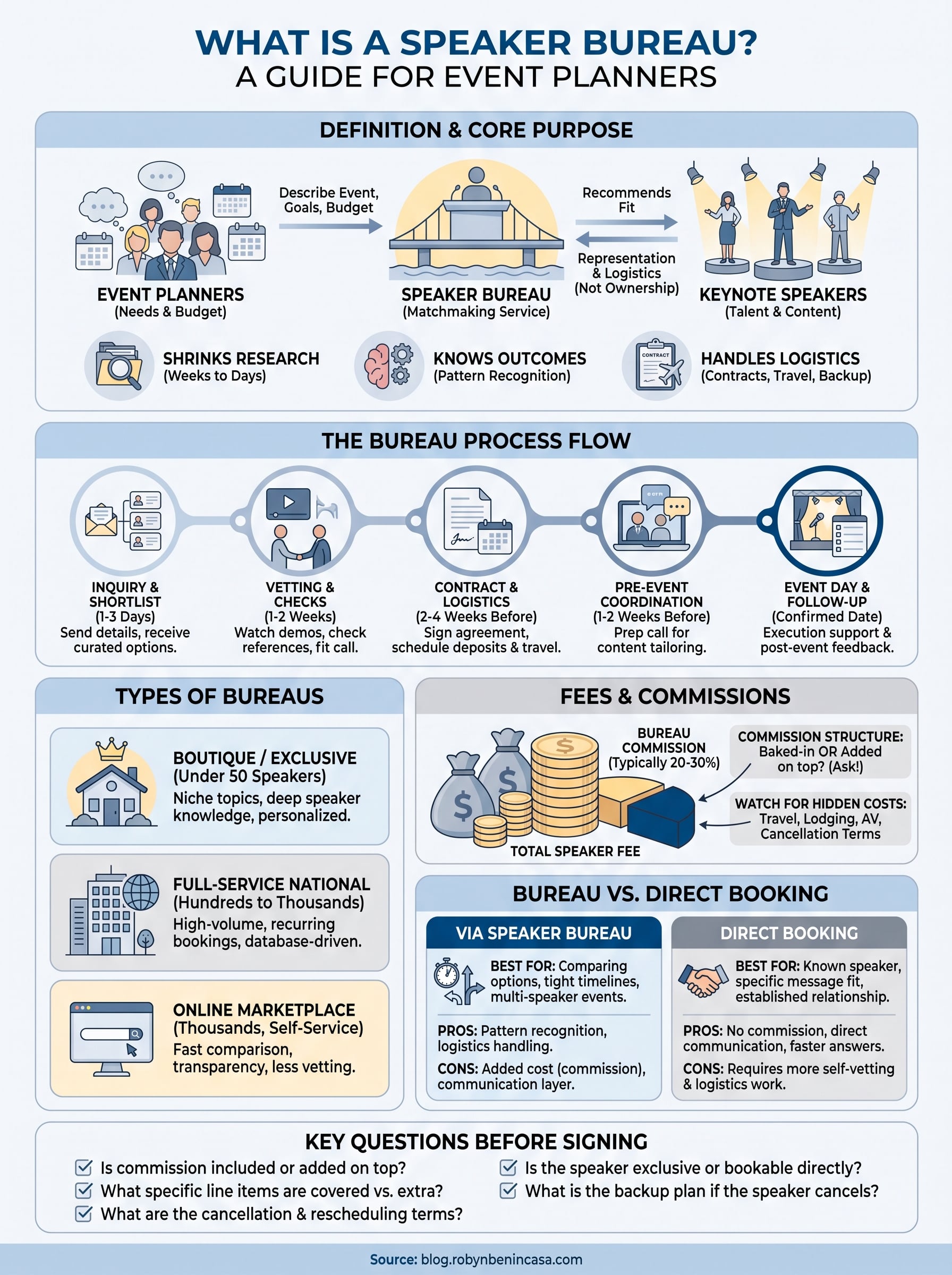
So what is a speaker bureau? In plain terms, it’s an agency that represents keynote speakers and connects them with organizations looking to book talent for events. Think of it as a matchmaking service: you describe your event, your budget, and your goals, and the bureau recommends speakers who fit. The speaker bureau meaning boils down to representation and logistics, not ownership of the speaker’s schedule or message.
This article breaks down how bureaus actually operate, what they charge, how they differ from booking a speaker directly, and what event planners need to know before signing a contract. Whether you’re weighing a bureau against a direct booking with a speaker like Robyn Benincasa, you’ll walk away knowing exactly how the process works and what to expect.
Why speaker bureaus matter for event planners
Event planners don’t call a speaker bureau because they’re lazy. They call one because vetting keynote speakers is a specialized skill most people only need once or twice a year. A good bureau has already screened hundreds of speakers for stage presence, audience fit, and reliability, so you’re not starting from a blank Google search and a pile of YouTube clips. That head start matters when you’re juggling catering, AV, and a dozen other event details at the same time.
They save you from a mountain of research
Finding the right voice for a leadership conference or sales kickoff takes real digging: watching demo reels, checking references, comparing fees, and figuring out who’s actually available on your date. A bureau does that legwork daily, which means they can hand you three or four solid options in a day or two instead of the two weeks it might take you to sort through the noise yourself. If you’ve got a tight timeline, that turnaround alone justifies the call.
A speaker bureau exists to shrink your search from weeks to days.
They know what actually works for your event
Bureaus track outcomes across hundreds of events, so they know which speakers land well with a room of insurance executives versus a sales team fresh off a rough quarter. That pattern recognition is hard to replicate on your own, especially if you’re booking a keynote speaker for the first time. A speaker bureau meaning something more than a directory becomes clear here: it’s a filter built on experience, not just a list of names and headshots.
They handle contracts, insurance, and logistics
Booking talent involves more than agreeing on a fee. Contracts need to cover cancellation terms, travel expectations, AV requirements, and liability, and getting any of that wrong can leave you scrambling days before the event. A bureau typically manages:
Contract negotiation and standard rider terms
Travel and lodging coordination
Backup plans if a speaker cancels
Coordination between your internal team and the speaker’s team on content and timing
That’s a meaningful chunk of administrative work off your plate, especially if you’re planning the event alone or as part of a small committee.
When a bureau isn’t the right fit
Here’s the honest counterpoint: bureaus add a layer between you and the speaker, and that layer comes with a cost, both in dollars and in how much direct input you get into the speaker’s message. If you already know exactly who you want, say you’ve seen Robyn Benincasa speak before or you’ve read her book and know her T.E.A.M.W.O.R.K. framework fits your culture goals, going straight to the speaker’s own booking page often gets you faster answers and a more tailored conversation about your event.
Organizations turn to bureaus most often in three situations: they’re booking a speaker for the first time and don’t know where to start, they need to compare multiple options quickly against a set budget, or they’re planning a large multi-speaker event and need one point of contact managing several bookings at once. If none of those describe your situation, a direct relationship with the speaker may serve you better, and we’ll walk through that comparison in more detail later in this article.
Understanding why bureaus exist sets up the rest of the picture. Once you know what problem they’re solving, it’s easier to judge whether the fee and the added layer of communication are worth it for your specific event, or whether a direct booking gets you the same result with less friction.
How speaker bureaus work, from inquiry to event day
Once you decide to work with a speaker bureau, the process follows a fairly predictable path. Knowing the sequence ahead of time helps you spot delays early and keeps you from getting blindsided by a step you didn’t expect, like a rehearsal call two weeks before your event.
The initial inquiry and shortlist
You start by contacting the bureau with your event details: date, location, audience size, budget range, and the general theme you’re going for, whether that’s leadership, sales performance, or team culture on stage. A booking agent then sends back a shortlist, usually three to six speakers who could be the best keynote speaker for a corporate event like yours, along with demo reels, sample topics, and fee ranges. This step typically takes anywhere from a few hours to a few days depending on how specific your request is and how many speakers fit your criteria.
Vetting and reference checks
From that shortlist, you narrow things down by watching more footage, checking references from past clients, and sometimes hopping on a call with the speaker or their team to talk through your event’s specific goals. This is where you find out if a speaker’s style actually matches your room. A speaker who kills it at a 200-person sales conference might not land the same way at an intimate 40-person leadership offsite, so ask pointed questions about audience size and format during this stage.
Contract and logistics
Once you pick a speaker, the bureau drafts a contract covering fee, cancellation terms, travel and lodging arrangements, AV requirements, and any content customization the speaker will build for your event. This is also when deposits get scheduled, usually a percentage upfront with the balance due closer to the event date. A typical timeline looks like this:
Stage
Typical timeframe
Initial inquiry to shortlist
1-3 days
Vetting and reference checks
1-2 weeks
Contract signed
2-4 weeks before event
Speaker prep call
1-2 weeks before event
Event day
Confirmed date
Pre-event coordination
In the weeks leading up to the event, the bureau usually facilitates a prep call between your team and the speaker so the speaker can tailor examples and language to your industry or company culture. This is the point where a speaker like Robyn Benincasa might ask about your recent wins, challenges, or team dynamics so her T.E.A.M.W.O.R.K. framework lands with specifics your audience recognizes rather than generic examples.
The best speaker bureau engagements feel less like a transaction and more like a relay handoff, with everyone clear on their leg of the race.
Event day and follow-up
On event day, the bureau’s job is mostly done, though a good one stays reachable in case a flight gets delayed or a tech issue pops up. Afterward, some bureaus follow up for feedback, which helps them recommend that speaker again to future clients with similar needs.
Types of speaker bureaus you may encounter
Not every speaker bureau operates the same way, and knowing the differences helps you pick the right partner instead of the first name that shows up in a search. Some bureaus represent a small, curated roster of speakers exclusively. Others work more like open marketplaces, pulling from thousands of names across every topic imaginable. The type you choose shapes how personalized the recommendations feel and how much the bureau actually knows about the speakers it’s pitching you.
Exclusive and boutique bureaus
Exclusive bureaus represent a limited roster, often fewer than fifty speakers, and they know each one well enough to match personality and message to your specific event. Boutique agencies fall into this category too, usually focusing on a niche like leadership, sales, or wellness. Because the roster is small, the recommendations tend to be sharper, and the agent on the phone can usually answer detailed questions about a speaker’s style without having to check notes.
The smaller the roster, the deeper the bureau’s knowledge of each speaker on it.
Full-service national bureaus
Full-service bureaus work with hundreds or even thousands of speakers across every industry and topic, and they typically handle large corporate accounts with recurring booking needs. These bureaus lean heavily on databases and filters rather than personal familiarity with every name on the list, which works fine if you know exactly what topic and budget you’re targeting. Where this model can fall short is nuance: an agent juggling thousands of speakers may not know that a particular keynote speaker’s team-building framework needs a specific audience size to really land.
Online marketplaces and aggregator platforms
A newer category has emerged in the form of online marketplaces, where you search a database yourself, compare rates and reviews, and contact speakers with little or no agent involvement. This model gives you speed and transparency on pricing, but you lose the vetting layer that a traditional agent provides. It works best for planners who already know the speaker they want and just need help with logistics.
Bureau type
Roster size
Best for
Exclusive/boutique
Under 50
Niche topics, personalized matches
Full-service national
Hundreds to thousands
High-volume, recurring bookings
Online marketplace
Thousands, self-service
Fast comparison, known speakers
Understanding what is speaker bureau structure fits your event helps you set expectations before you ever pick up the phone. A boutique agency might take longer to respond but offer sharper insight, while a marketplace gets you moving fast but leaves more of the vetting work on your plate.
How speaker bureau fees and commissions work
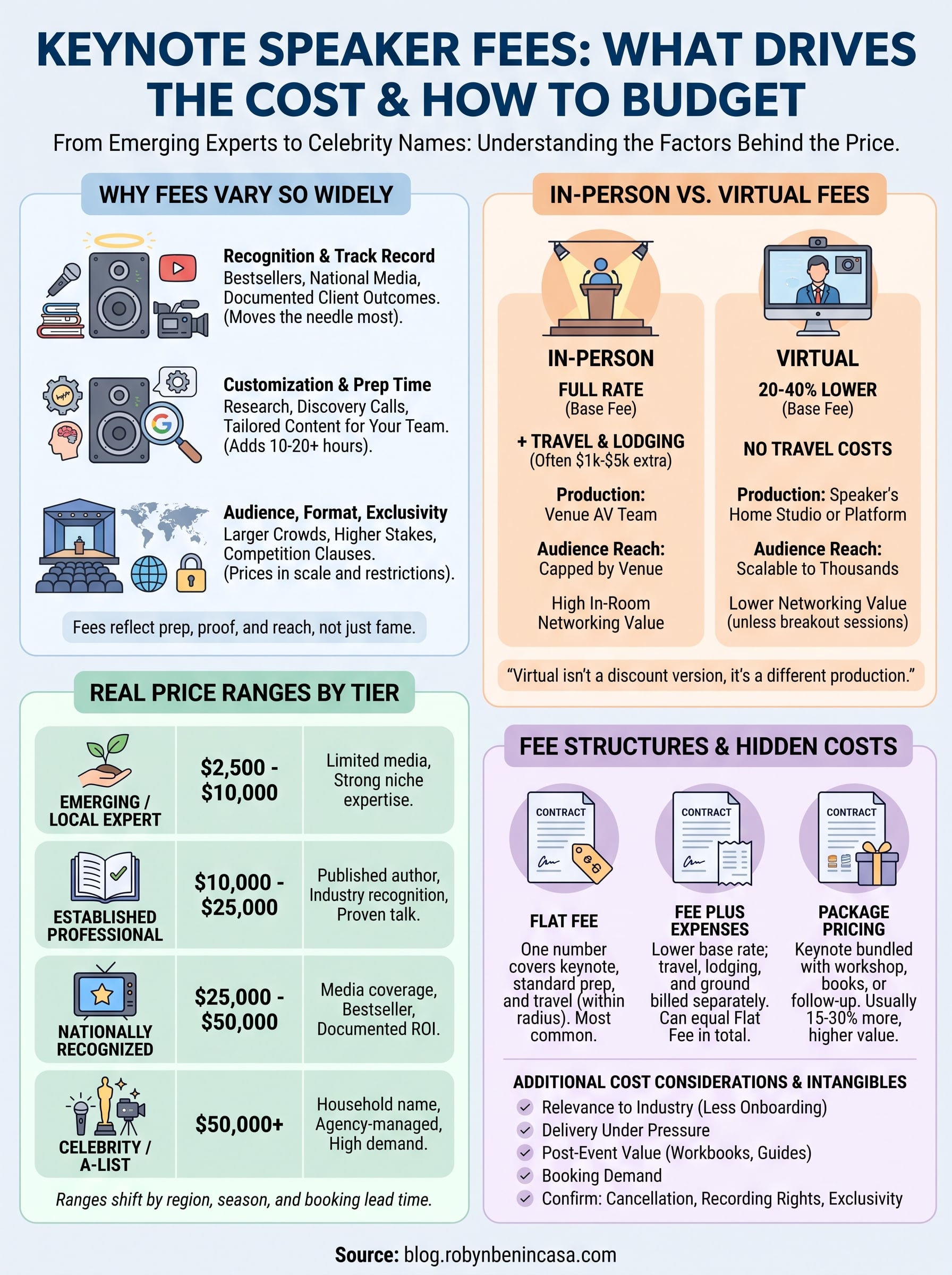
Money is usually the first question on an event planner’s mind, and it’s a fair one. A speaker bureau doesn’t charge you a separate invoice most of the time. Instead, it earns a commission built into what you’ll really pay to hire a keynote speaker, typically 20% to 30% of whatever the speaker charges for the engagement. So if a speaker’s standard fee is $20,000, the bureau might add its cut on top or take a percentage from that total, depending on the arrangement they have with the speaker.
Who actually pays the commission
Commission structures vary more than most planners expect, and it’s worth asking directly rather than assuming. Some speakers set one flat fee that already includes the bureau’s cut, so you never see the split. Others work on a straight percentage where the bureau adds its commission on top of the speaker’s quoted rate, meaning you pay more than you would booking directly. Neither approach is dishonest, but you deserve to know which one you’re dealing with before you sign anything.
Ask whether the bureau’s commission is baked into the fee or added on top. That single question tells you whether you’re getting a fair price.
Long-haul travel adds cost for flights and lodging
Custom content requests
Tailored keynotes cost more than off-the-shelf talks
Getting a speaker bureau to break down these line items upfront saves you from surprise add-ons two weeks before your event.
Negotiating through a bureau versus direct
Bureaus can sometimes negotiate a discount if you’re booking multiple speakers or committing to a multi-year relationship, since they want to keep your business coming back. But that negotiating room shrinks the commission, and some bureaus resist cutting their own cut even when it would help you close the deal. Reaching out to a speaker’s own team, the way you would through Robyn Benincasa’s booking page, sometimes opens up more flexibility because there’s no middleman commission to protect.
Watch for hidden costs
Specific line items to clarify before signing anything include travel and lodging reimbursement, cancellation and rescheduling penalties, and whether AV or recording rights carry an extra fee. None of these are unusual, but they catch planners off guard when they show up as surprises on the final invoice instead of the original quote.
Speaker bureau vs. booking a speaker directly
Once you understand how a speaker bureau operates, the real question becomes whether you need one at all. Booking a keynote speaker directly, without an agent in the middle, is a completely normal path, especially when you already know who you want on stage. The right choice depends less on which option is "better" and more on how much certainty you already have about your speaker and your event’s needs.
What you gain with a bureau
Working through a bureau makes the most sense when you’re comparing multiple speakers, booking on a tight deadline, or coordinating several speakers for one event. Agents bring pattern recognition from hundreds of past bookings, and they absorb the contract and logistics work that eats up hours you don’t have. That convenience carries a real cost, though, since the bureau’s commission gets folded into your total spend one way or another.
What you gain by booking direct
Going straight to the speaker cuts out the commission and often speeds up communication, since you’re talking to the person or team who actually knows the content inside and out. Direct booking also gives you a clearer read on customization. When you reach out through a page like Robyn Benincasa’s booking page, you’re talking to people who can immediately discuss how her T.E.A.M.W.O.R.K. framework applies to your industry, rather than relaying questions through a third party who has to check with the speaker’s team anyway.
The fewer people between you and the speaker, the fewer chances for your event’s specific needs to get lost in translation.
Side-by-side comparison
Factor
Speaker bureau
Direct booking
Cost
Commission built into fee (20-30%)
No commission markup
Speed of first response
Fast shortlist, slower final details
Slower shortlist, faster specifics
Customization depth
Filtered through agent
Direct conversation with speaker’s team
Best for
Comparing multiple speakers, first-time bookers
Known speaker, established relationship
Contract handling
Managed by bureau
Managed by speaker’s team or you
Which route fits your event
Questions about speaker bureau meaning and function usually resolve into one practical decision: do you need help finding a speaker, or do you already know who you want? If you’re still comparing five names against a budget, a bureau earns its keep. If you’ve already seen a speaker in action, read their book, or gotten a recommendation from a colleague whose event matched yours, reaching out directly usually gets you a faster answer and a lower total cost. Robyn Benincasa’s team, for example, handles contracts, travel, and content customization the same way a bureau would, just without the added layer or the commission on top.
Questions to ask before hiring a speaker bureau
Before you sign anything, a short list of pointed questions can save you from a mismatched speaker or a surprise invoice. Treat this like an interview, because you’re hiring the bureau just as much as you’re hiring the speaker they recommend. A speaker bureau that hesitates on any of these questions is telling you something worth paying attention to.
Questions about the roster and matching process
Getting clear on how a bureau builds its shortlist tells you whether you’re getting genuine matchmaking or a generic list pulled from a database. Ask directly:
How many speakers on your roster have you personally seen perform live?
What criteria do you use to match a speaker to our audience size and industry?
Can you connect me with a past client who booked a similar event?
Is this speaker exclusive to your bureau, or can I book them elsewhere for less?
That last question matters more than planners realize. If a speaker works with multiple bureaus, or takes direct bookings through their own site, you may find a lower total cost by skipping the middleman entirely.
If a speaker isn’t exclusive to the bureau, ask why you’d pay a commission to reach someone you could contact directly.
Questions about fees and contracts
Commission structures vary enough that you shouldn’t assume anything. Confirm these details before you get a formal quote:
Is the bureau’s commission included in the quoted fee, or added on top?
What’s covered in the base fee versus billed as an add-on, like travel, lodging, or recording rights?
What are the cancellation and rescheduling terms, for both us and the speaker?
Is there flexibility on price if we’re booking multiple speakers or a multi-year contract?
Having these answers in writing before you sign protects you from line items that show up on the final invoice instead of the original quote.
Questions about backup plans and guarantees
Events don’t always go according to plan, so it’s worth knowing what happens when they don’t. Wondering what a bureau does if a speaker cancels close to your event date is a fair concern, not a paranoid one. Ask about their backup process, whether they guarantee a replacement of comparable quality, and who absorbs the cost if a last-minute swap is needed. Verifying insurance and liability coverage rounds out the list, since a bureau that can’t answer basic contract questions clearly probably isn’t managing your event’s logistics as carefully as you’d want.
Running through this checklist takes maybe fifteen minutes on a call, but it separates bureaus that operate with real transparency from ones hoping you won’t ask.
Finding the right speaker for your event
A speaker bureau earns its fee when you need help narrowing options, comparing multiple names, or juggling several bookings at once. It’s a smart shortcut when you’re starting from scratch. But once you know what speaker bureau meaning actually covers, matchmaking, contracts, logistics, you can judge for yourself whether that layer adds value for your specific event or just adds cost.
If you already have a speaker in mind, or you’re drawn to someone whose message fits your team’s exact challenges right now, going direct usually gets you faster answers and a lower total spend. That’s especially true when the speaker’s team handles contracts and customization the same way a bureau would.
Most leadership development training activities you find online are recycled icebreakers dressed up as skill-building. They feel good for an hour, then nothing changes back at the office. If you’re an HR leader or executive planning a leadership offsite, you already know the difference between an activity that entertains and one that actually shifts how people lead.
This list gives you training activities for leadership development that produce real behavior change, the kind you can measure in team performance, not just post-event survey scores. Each one is built around a specific leadership muscle: decision-making under pressure, communication across silos, accountability, trust. No filler exercises, no trust falls for the sake of tradition.
I’ve spent 15 years leading world championship adventure racing teams and 20 years as a San Diego firefighter, both environments where weak leadership gets exposed fast. What follows are 12 leadership training activities for managers drawn from that experience and from working with companies like Allstate and Northrop Grumman. Whether you’re planning a single workshop or a full leadership program, you’ll find leadership training ideas for managers here that hold up once the offsite ends.
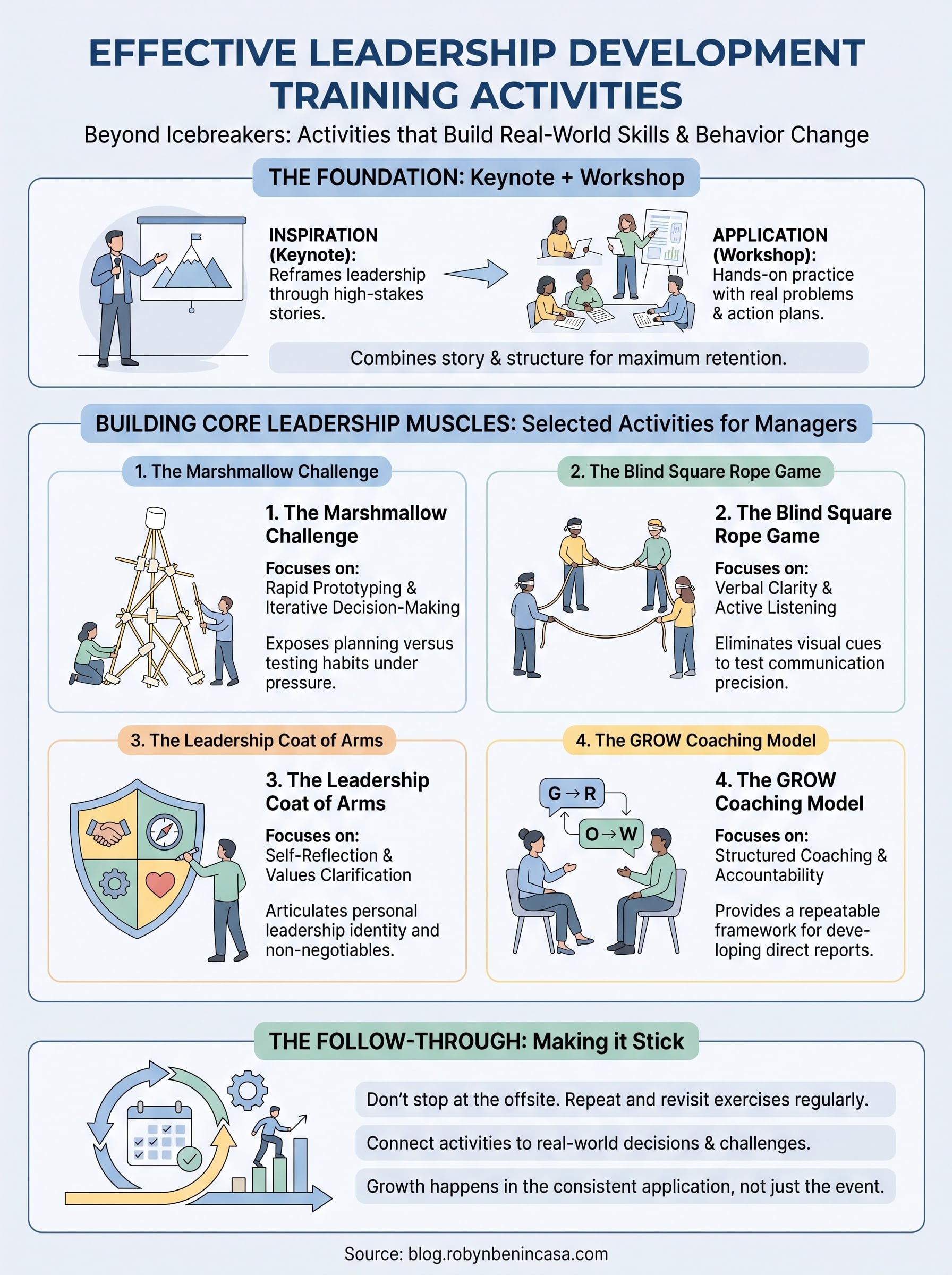
1. An experiential leadership keynote and workshop
Before you get to rope courses and marshmallow towers, start with the format that actually reframes how a room thinks about leadership: a live keynote paired with a hands-on workshop. This is the format I use most with clients like Allstate and Boston Scientific, because a talk alone rarely changes behavior, and an activity alone rarely sticks without the framework behind it. You need both the story and the structure.
How it works
A facilitator (often one of the leadership keynote speakers worth booking who has real leadership stakes, not just theory) opens with a keynote that reframes leadership through a high-stakes story: adventure racing across a jungle, running into a burning building, whatever context makes the stakes visceral. Then the room breaks into small-team exercises that apply the framework immediately, so people aren’t just nodding along, they’re testing the ideas on a real problem their team faces. My own T.E.A.M.W.O.R.K. keynote works this way: eight elements of world-class team culture, then a working session where teams identify which element is weakest in their own group and build an action plan around it.
A keynote without a workshop is entertainment. A workshop without a keynote is a tactic with no reason to believe in it.
Who it’s for
This format suits executives and HR leaders planning a leadership offsite, sales kickoff, or annual conference where you need something bigger than a breakout session but more actionable than a motivational speech. It works especially well when an organization is navigating a merger, a leadership transition, or a performance slump, situations where people need both a jolt of energy and a concrete next step. If your audience spans multiple departments or seniority levels, this format bridges that gap better than most single-purpose activities.
Time and materials needed
Most keynote-and-workshop combinations run 60 to 120 minutes total, though full-day leadership programs are common for larger initiatives.
Component
Typical duration
What you need
Keynote
30-45 minutes
Stage, AV setup, speaker
Workshop
30-75 minutes
Breakout tables, worksheets, facilitator guide
Debrief
15-20 minutes
Flip charts or shared doc for action items
Virtual formats work too. I run this same structure remotely for teams that can’t gather in person, using breakout rooms in place of tables, much like the virtual team building activities for corporate teams that keep distributed groups engaged. If you’re planning an event and want the keynote built around your organization’s specific challenges, you can book Robyn directly to design that pairing.
Leadership skills it builds
This format targets big-picture skills that smaller icebreakers can’t touch: aligning a team around a shared culture, translating a compelling story into a personal leadership commitment, and giving managers language they’ll actually use back at their desks. It’s the difference between telling people to build trust and showing them, through story and immediate practice, exactly what that looks like under pressure. Because it combines inspiration with application, it tends to produce the highest retention of any format on this list, especially when the follow-up activities below reinforce it in the weeks after.
2. The Marshmallow Challenge
After the big-picture format above, you need something fast and concrete to test whether teams actually apply what they heard. The Marshmallow Challenge is the classic for that: give small teams 20 sticks of spaghetti, one yard of tape, one yard of string, and a single marshmallow, then challenge them to build the tallest freestanding structure that holds the marshmallow on top. It exposes planning habits in about 18 minutes flat.
How it works
Teams get 18 minutes to design and build, no more materials allowed mid-build. Most groups spend the first 15 minutes planning and arguing over the perfect design, then panic-build in the last few minutes and watch the structure collapse. The teams that succeed usually start prototyping immediately, testing small structures before committing to one design. That gap between planners and builders is the entire lesson.
Teams that talk the longest about the perfect plan usually run out of time before they test anything.
Who it’s for
This exercise fits new managers and cross-functional teams who need a quick, low-stakes way to see their own decision-making patterns exposed, and it slots neatly into broader team building training for managers. It also works well as an opener before a longer workshop, since it warms up a room fast and gives you a shared reference point to call back to later in the day.
Time and materials needed
20 sticks of uncooked spaghetti per team
One yard of masking tape
One yard of string
One standard marshmallow
A tape measure and a timer
20 to 30 minutes total, including debrief
Leadership skills it builds
The challenge builds rapid prototyping and iterative decision-making, skills managers rarely get to practice in a safe setting. It also surfaces who defaults to control versus collaboration under a ticking clock, which makes for a sharp discussion afterward. Because failure is cheap here (nobody loses a client over a collapsed marshmallow tower), teams tend to be honest about what went wrong, which is exactly the kind of reflection that transfers back to real projects.
3. The Blind Square Rope Game
Once a team has felt the sting of poor planning in the Marshmallow Challenge, the Blind Square Rope Game pushes them into a harder problem: communicating without sight. Blindfold the entire group, hand them a long rope in a loop, and ask them to form a perfect square using only verbal instructions. No peeking, no exceptions. It’s a favorite in my workshops because it strips away every visual shortcut a team normally leans on and forces them to build shared understanding through words alone.
How it works
Participants put on blindfolds, grab the rope with both hands, and drop it on the ground in a loose pile. Someone (either assigned or self-appointed) has to organize the group into calling out distances, directions, and positions until the rope forms a square everyone agrees on. Set a time limit of 10 to 15 minutes, then have the group remove their blindfolds together to see the result. Most groups discover their square looks nothing like they imagined, which opens up a real conversation about what got lost in translation.
A team that can’t communicate without sight will struggle even more when the stakes are real and nobody can see the full picture.
Who it’s for
This game suits teams that rely heavily on remote or cross-departmental communication, where information passes through multiple people before it reaches a decision-maker, and it pairs well with other communication exercises for teams. It’s also a strong fit for new leaders learning to give instructions clearly instead of assuming their team already understands the context they’re picturing in their own head.
Time and materials needed
One long rope, at least 25 feet, tied or looped for a group of 8 to 12
Blindfolds for every participant
An open, obstacle-free space
15 to 25 minutes total, including debrief
Leadership skills it builds
Running this exercise sharpens verbal clarity and active listening, two skills that quietly break down in most organizations without anyone noticing until a project misses its mark. It also reveals who naturally steps into a coordinating role under ambiguity, giving you real data on emerging leaders long before a formal promotion decision comes up.
4. The Human Knot
After an exercise built on words alone, The Human Knot flips the challenge back to the physical: a group tangles itself into a knot of arms, then has to think and negotiate its way out without letting go. Have 8 to 12 people stand in a circle, reach across, and grab two different hands that aren’t the person directly next to them. Once every hand is paired, the group has to untangle itself into one large circle (or sometimes two smaller ones) without ever breaking a grip. Like the best icebreaker team building activities, it looks ridiculous for the first five minutes and then gets serious fast.
How it works
Once the knot forms, someone in the group has to start directing traffic, calling out who steps over whom, who ducks under an arm, and who needs to let go and reconnect if the knot proves impossible. Groups that appoint a single voice to call the moves untangle far faster than groups where everyone shouts instructions at once. Give the exercise 15 to 20 minutes; most groups solve it, but the ones that don’t learn just as much from the attempt.
A knot only comes undone when the group agrees on one voice to guide it, not when everyone pulls at once.
Who it’s for
This exercise works well for intact teams that already know each other, since the physical closeness requires a baseline of comfort that strangers rarely have on day one. It’s a strong choice for teams stuck in silo behavior, one of several team building activities to break down silos, since it forces cross-departmental hands to literally connect before the group can move forward together.
Time and materials needed
No equipment required beyond an open floor space
Group size of 8 to 12 works best; larger groups can split into two knots
20 to 30 minutes total, including debrief
Leadership skills it builds
Untangling the knot builds patience under frustration and shared problem-solving, since no single person can solve it alone no matter how confident they are. It also exposes who steps up to coordinate versus who waits for someone else to take charge, a pattern that maps directly onto how the same team handles a stalled project back at the office.
5. Minefield Navigation
With trust already tested by a knot of tangled arms, Minefield Navigation raises the stakes by putting one person’s safety entirely in another’s hands. Scatter cones, water bottles, or foam blocks across an open space to create an obstacle field, then blindfold one teammate while a partner stands at the edge and calls out verbal directions to guide them through without touching a single obstacle. It’s simple to set up and brutal at exposing whether a leader’s instructions actually make sense to someone who can’t see what the leader sees.
How it works
Pair participants up, blindfold one, and give the sighted partner two minutes to walk the field first and plan a route. Then the blindfolded partner enters the field and relies entirely on verbal cues, left, right, small step, stop, to cross without knocking anything over. Touch an obstacle and the pair starts over from the beginning. Rotate roles so everyone experiences both giving and receiving instructions under pressure.
A leader who can’t translate their own clear picture into someone else’s steps isn’t leading yet, they’re just watching.
Who it’s for
Managers who default to vague direction, the "just figure it out" style that leaves teams guessing, benefit most from this exercise. It also works well for teams preparing for a handoff or delegation-heavy project, where one person’s clarity of instruction determines whether the other succeeds or stumbles.
Time and materials needed
Cones, bottles, or soft obstacles, 15 to 20 per field
Blindfolds for half the group at a time
An open space roughly 20 by 20 feet
20 to 30 minutes total, including role rotation and debrief
Leadership skills it builds
Navigating blind exposes precision in instruction-giving, forcing leaders to drop vague language for specific, sequential direction. It also shows how to build trust in a team at work from the other side, since the blindfolded partner has to believe the instructions enough to actually move. That combination, clear direction paired with earned trust, is exactly what separates managers who delegate well from those who just assign tasks and hope.
6. Playing with Status
After exercises that expose trust and communication, Playing with Status targets something leaders rarely examine directly: how power shows up in a room before anyone says a word. Give each participant a playing card, face down, and have them tape it to their forehead without looking at it. That number, ace low, king high, becomes their status for the exercise. Teams then run a simple task, planning a mock project, negotiating a budget, while treating each other according to the status they see on everyone else’s forehead, not their actual job title.
How it works
Participants mingle and interact based purely on the number they can see on other people’s foreheads, deferring to high cards and dismissing low ones, without anyone confirming their own rank out loud. After 10 minutes of interaction, stop the group and have everyone guess their own card based on how people treated them. Pull the cards and compare guesses to reality, then run the same task again with cards revealed so people can contrast unconscious status behavior against conscious awareness of it.
People read status off each other in seconds, long before job titles ever get mentioned.
Who it’s for
This exercise suits senior leaders and managers who supervise former peers, since it surfaces how subtle status cues shape who gets listened to in a meeting. It also helps mixed-seniority groups see how junior voices get talked over regardless of the quality of their ideas.
Time and materials needed
A deck of playing cards, one per participant
Tape or sticky notes to attach cards to foreheads
A simple group task or discussion prompt
30 to 40 minutes total, including both rounds and debrief
Leadership skills it builds
This exercise sharpens self-awareness around unconscious bias and shows leaders exactly how their own behavior shifts based on assumed rank rather than actual merit. Watching yourself defer to a high card or dismiss a low one, then learning it was arbitrary, tends to stick with people longer than a slide about inclusive leadership ever could. It also builds a shared vocabulary for calling out status dynamics when they show up later in real meetings back at the office.
7. The Leadership Coat of Arms
Status games expose how people read power in a room, but the Leadership Coat of Arms exercise turns the lens inward and asks a quieter question: what do you actually stand for as a leader? Each participant sketches a personal shield divided into four or five sections, then fills each section with a symbol or short phrase answering a prompt, a moment they led well, a value they won’t compromise, a failure that taught them something, how they want their team to describe them. It sounds like a classroom activity, but in a room full of managers who’ve never had to articulate their leadership identity out loud, it lands harder than expected.
How it works
Hand out paper and markers, then give the group five prompts, one per shield section, with about three minutes to sketch each before moving to the next. Speed matters here because it forces instinct over overthinking. Once the shields are done, break into pairs or small groups and have each person explain their coat of arms to the others, out loud, no notes. The facilitator closes by asking the room what values kept repeating across different shields, since that pattern usually points straight at the culture already forming, whether anyone planned it or not.
A leader who can’t explain what they stand for in one drawing usually can’t explain it to their team either.
Who it’s for
This exercise suits new managers still forming their leadership identity and seasoned leaders who’ve never had to put their values into words. It’s a strong fit for leadership training programs for new managers and first-time supervisors, since it gives them language for decisions before they’re forced to make one under pressure.
Time and materials needed
Blank paper or printed shield templates, one per person
Markers or colored pencils
A discussion prompt sheet with four or five value questions
30 to 45 minutes total, including small-group sharing
Leadership skills it builds
Drawing forces self-reflection and values clarification, skills that rarely get scheduled time in a normal workweek. Sharing the shield out loud also builds vulnerability and trust, since a leader who names a real failure in front of peers sets a tone the whole team tends to follow.
8. Circles of Influence Mapping
Once a leader has named their values in the Coat of Arms exercise, Circles of Influence Mapping shows them where to actually spend energy. Draw three concentric circles on a whiteboard or worksheet: the center labeled Control, the middle ring Influence, and the outer ring Concern. Each participant lists their current work stressors, a missed deadline, a difficult peer, a budget cut, and sorts every item into the correct ring based on how much real power they have over it.
How it works
Give the group 10 minutes to brainstorm a list of frustrations or open problems, then another 10 to sort each item into one of the three circles. Most first attempts pile everything into Concern, since venting feels easier than categorizing. The facilitator pushes back on that instinct, asking what one action, however small, would move an item from Concern into Influence. That single question usually reframes the whole exercise from complaining into planning.
Leaders who spend their energy on what they can’t control burn out managing everything except what actually moves.
Who it’s for
This mapping exercise suits managers feeling stretched thin across too many priorities, especially during a reorg, budget crunch, or any stretch where morale sags because problems feel bigger than anyone’s authority to fix them. It also works well one-on-one in coaching sessions, not just group workshops.
Time and materials needed
A printed or hand-drawn three-circle template per person
Sticky notes for sorting items, if working in groups
30 to 40 minutes total, including individual work and group discussion
Leadership skills it builds
Mapping builds focus and energy management, a staple of management and leadership skills training, teaching leaders to stop treating every problem as equally solvable. It also strengthens delegation, since items that land in a peer’s or manager’s circle of control need to move there instead of sitting on one person’s plate out of habit.
9. The GROW Coaching Model
While the previous exercises run in a workshop setting, the GROW Coaching Model is built for the one-on-one conversations that happen every week between a manager and their direct report. GROW stands for Goal, Reality, Options, Will, and it gives leaders a simple structure to follow instead of winging every coaching conversation from memory. Managers who default to giving advice too fast tend to skip straight to solutions; GROW forces a pause at each stage before anyone jumps to a fix.
How it works
Sit down with a direct report and walk through four questions in order:
Goal: What outcome are you trying to reach?
Reality: Where do things stand right now, honestly?
Options: What could you try, even the options you’re hesitant about?
Will: Which option will you commit to, and by when?
Train managers on this sequence in pairs, with one person playing the coach and the other bringing a real work problem, so the model gets practiced on something that matters rather than a hypothetical.
A manager who asks four good questions in order coaches better than one who has ten quick answers.
Who it’s for
This model suits managers moving from individual contributor to people-leader, since it replaces the instinct to solve every problem personally with a repeatable way to draw out someone else’s thinking. It also works well as a refresher in leadership training for middle managers who’ve drifted back into giving orders instead of coaching.
Time and materials needed
A printed GROW question sheet, one per participant
A real or realistic work scenario for practice
Pairs or trios for role-play
45 to 60 minutes for initial training, including two rounds of practice
Leadership skills it builds
Practicing GROW sharpens structured coaching and disciplined listening, since the model only works if the manager resists jumping to Options before Reality gets fully explored. It also builds accountability, because the Will stage forces a specific commitment instead of a vague intention to "think about it."
10. Start, Stop, Continue Feedback
GROW gives managers a structure for one-on-one coaching, but Start, Stop, Continue gives whole teams a simple language for feedback that usually stays unspoken until a performance review forces it out. Each person, or each team member about a peer or manager, answers three prompts: what should this person start doing, what should they stop doing, and what should they keep doing because it’s working. The format strips away the vague, cushioned feedback most workplaces default to and replaces it with three concrete buckets nobody can hide inside.
How it works
Hand out three columns, on paper, a whiteboard, or a shared doc, labeled Start, Stop, and Continue. Give the group 10 minutes to write feedback for a specific person, a project, or the team as a whole, one sticky note per idea. Then read the notes aloud together, grouping similar ones, and let the person receiving feedback respond only after everyone has spoken, not defend themselves mid-read.
Feedback that hides behind "good job, keep it up" never changes anyone’s next move. Three clear buckets do.
Who it’s for
This format suits teams building a regular feedback rhythm, especially ones coming out of a project retrospective or a rocky quarter where issues have piled up unaddressed. It also works well for managers new to giving feedback, since the three-bucket structure removes the guesswork of how to open a hard conversation.
Time and materials needed
Sticky notes or a shared digital doc with three columns
A facilitator to keep the reading focused and non-defensive
30 to 45 minutes total for a team of 6 to 10
Leadership skills it builds
Running this exercise regularly builds directness and receiving feedback gracefully, two skills that atrophy fast in teams that avoid friction. It also normalizes feedback as routine maintenance rather than a rare, dreaded event, a habit that marks a genuine culture team and changes how quickly small problems get named before they turn into bigger ones.
11. The What I Need From You Exercise
Start, Stop, Continue fixes feedback between individuals, but The What I Need From You Exercise fixes something bigger: the unspoken assumptions between departments that never get named until a project stalls. Pair up two people or two teams that depend on each other but rarely talk directly, sales and operations, marketing and product, and have each side state plainly what they need from the other to do their job well. No hedging, no diplomatic softening, just a direct request.
How it works
Each side gets five minutes to write down three specific things they need from the other group, framed as requests rather than complaints. "We need budget numbers by the 3rd of each month" works. "We need better communication" doesn’t, since it gives the other side nothing to act on. Groups then take turns reading their list aloud while the other side listens without responding, and only after both lists are out does the conversation open up into negotiation over what each side can realistically commit to.
A team that finally says what it needs out loud stops guessing why the other side keeps missing the mark.
Who it’s for
This exercise suits cross-functional teams stuck in low-grade friction, the kind where nobody’s angry enough to escalate but everyone’s quietly frustrated, and it works as a first step toward real cross-functional collaboration training. It’s especially useful after a reorg or merger, when two groups that used to operate independently suddenly have to rely on each other and haven’t built the habit of asking directly.
Time and materials needed
Paper or a shared doc for each side to draft their list
A neutral facilitator to keep the reading phase from turning into a debate
A whiteboard to capture agreed commitments at the end
45 to 60 minutes total, including negotiation and follow-up planning
Leadership skills it builds
This exercise builds direct communication and cross-functional accountability, replacing vague resentment with specific, trackable commitments. It also teaches leaders to ask for what they need instead of hoping someone eventually notices, a habit that saves months of quiet friction once it becomes routine.
12. Team Canvas Goal Setting
While the previous exercise fixes what teams say to each other, Team Canvas Goal Setting fixes what a team agrees on together in the first place. Borrowed from the business model canvas world, this exercise gives a team one shared worksheet, divided into sections like purpose, goals, values, roles, rules of engagement, and needs, and forces the whole group to fill it out together instead of each person carrying their own private version of what the team is for. It’s a strong closer for a leadership offsite because it turns everything practiced in the earlier exercises into one written document the team actually owns.
How it works
Post a large canvas on the wall or share a digital template, then walk the team through each section one at a time, spending 10 to 15 minutes per box. Start with purpose (why does this team exist beyond its task list), move to goals, then values, then roles and rules for how the team will handle conflict or missed deadlines. Every section needs full agreement before the group moves to the next, not just a vote that leaves a third of the room unconvinced.
A team that writes its goals down together stops arguing later about what it agreed to.
Who it’s for
This exercise suits newly formed teams or teams resetting after a reorg, where old assumptions about roles and goals no longer apply, and it’s one of the clearest starting points for how to build a high performing team. It also works well as a capstone activity following a longer leadership training activities program, since it consolidates the values, feedback habits, and communication skills practiced earlier into one lasting reference.
Time and materials needed
A large printed canvas or digital whiteboard template
Markers, sticky notes, or shared editing access
A facilitator to keep sections moving and ensure full agreement
90 to 120 minutes total for a complete canvas session
Leadership skills it builds
Building the canvas together strengthens collective ownership and alignment, since a goal the team wrote itself sticks harder than one handed down from above. It also builds the habit of naming rules of engagement before conflict hits, so disagreements later have an agreed process instead of turning personal.
Making leadership development stick
None of these twelve exercises work as one-off events. Leadership development training activities only change behavior when you repeat them, revisit them, and connect them to real decisions your managers face the following week. Pick two or three that match your team’s actual gap, whether that’s vague delegation, buried feedback, or misaligned goals, build them into your wider leadership development training topics, and run them on a recurring cadence instead of cramming all twelve into a single offsite and calling it done.
Growth happens in the follow-through, not the workshop itself. The teams I’ve watched improve fastest are the ones that pair a structured exercise with a real framework and a facilitator who’s actually led under pressure, not just read about it. If you’re planning a leadership offsite, sales kickoff, or team-building day and want a keynote and workshop built around your organization’s specific challenges, see who the best keynote speaker for a corporate event would be for your team and start building a culture that holds up long after the event ends.
Your team hits a rough stretch, a merger, a brutal sales quarter, constant change, and some people bounce back while others stay stuck. That difference isn’t luck or personality. It’s a skill you can build, and that’s exactly what training in resilience teaches. If you’ve searched for this term, you’re probably trying to figure out whether it’s a mindset seminar, a stress-management workshop, or something with actual measurable impact on performance.
Here’s the direct answer: resilience training is a structured way to build the mental and emotional tools people need to handle pressure, setbacks, and uncertainty without losing focus or motivation. Done right, it’s not fluffy self-help. It’s practical, repeatable, and tied to real outcomes like retention, engagement, and how fast a team recovers after a hard hit. Workplace resilience training works because it targets specific habits and thinking patterns, not just morale in the moment.
In this article, I’ll break down what resilience training actually involves, what separates a solid resilience training program from a shallow one, and why the best programs borrow lessons from high-stakes teams, the kind I led through 15 years of world championship adventure racing and two decades as a firefighter.
Why resilience training matters for teams and leaders
Picture two sales teams hit with the same brutal quarter. One team spends weeks in a slump, missing calls, avoiding hard conversations, and losing people to burnout. The other team adjusts fast, keeps its numbers moving, and comes out sharper on the other side. I’ve watched this exact split happen on expedition teams racing through hundreds of miles of jungle with broken gear and no sleep. The teams that finished strong weren’t the most talented. They were the ones who’d trained for adversity before they ever needed it. That’s the case for resilience in the workplace training: it’s not a reaction to a crisis, it’s preparation for the next one.
Costs pile up fast when resilience is missing. Gallup has tied chronic burnout directly to absenteeism, lower confidence in performance, and higher turnover intent, and none of that shows up on a P&L line until it’s already expensive. Employee resilience training addresses this at the source instead of patching it after the fact with wellness perks that never touch the real problem, which is how people process pressure in real time.
A team that hasn’t trained for adversity will crack the first time it shows up. A team that has will barely break stride.
What resilience training changes in a team’s day-to-day
Nothing about resilience training is abstract once you see it working. Teams that go through solid stress resilience training show up differently in meetings, in how they handle a missed deadline, and in how quickly they stop blaming each other and start solving problems. Here’s what typically shifts:
Faster recovery time after setbacks, with projects back on track in days instead of weeks
Fewer defensive reactions in feedback conversations, so problems surface earlier
Higher engagement scores, because people feel equipped rather than overwhelmed
Lower attrition during high-change periods like reorgs or leadership turnover
Stronger peer support, since resilient individuals model calm under pressure for the rest of the team
Quantifying this matters to anyone signing off on a training budget. A team of insurance sales reps I worked with went from 17th to 1st nationally after building the exact habits I teach as one of the sales motivational speakers companies bring in, not because the market got easier, but because the team’s response to pressure got sharper.
Leaders need it more than anyone else
Resilience gaps at the top spread fast. Underneath every disengaged team, you’ll usually find a leader who’s running on fumes, reacting instead of steering. Mental resilience training for leaders isn’t a nice-to-add extra, it’s the multiplier that determines whether resilience training for the rest of the organization actually sticks. When a leader models steady decision-making under stress, that behavior gets copied. When a leader spirals, that spreads too.
Organizations leading teams through change like mergers, layoffs, or aggressive growth targets feel this most acutely. The American Psychological Association has documented how chronic workplace stress erodes decision quality and physical health over time, which is exactly why forward-thinking companies build resilience into leadership training programs instead of treating it as a personal problem employees should solve on their own.
Training doesn’t erase hard quarters or difficult mergers. It changes how fast your people and your leaders come back from them, and that speed is what separates teams that survive disruption from teams that use it as fuel.
How resilience training works, step by step
Good resilience training follows a sequence, not a single pep talk. It starts by identifying where people currently break down under pressure, then builds specific skills to close that gap, then tests those skills against real friction so they actually hold under stress. I’ve watched this same arc play out on expedition teams: assess weaknesses before the race, drill the specific skill that’s missing, then throw the team into a simulated crisis to see if the fix holds. Training on resilience that skips any of these steps, including formal approaches like master resilience training, tends to produce good intentions and no lasting change.
The core stages of a resilience training program
Most effective resilience training programs move through four stages, whether they’re delivered in a single workshop or spread across months.
Assessment: Surveys, interviews, or performance data pinpoint where stress currently derails the team, missed deadlines, conflict avoidance, burnout signals.
Skill-building: Participants learn specific techniques, reframing setbacks, managing physiological stress responses, structured problem-solving under pressure.
Simulation: Teams practice those skills against a realistic challenge, a mock crisis, a timed project sprint, or a difficult feedback scenario.
Reinforcement: Managers and peers reinforce the new habits in daily work, so the training doesn’t stay confined to a single session.
Resilience training only works if the skills get tested under real pressure before the real pressure arrives.
Why the sequence matters more than the content
Organizations often ask about specific frameworks or exercises, but the sequence itself is what determines whether workplace resilience training produces lasting change. Skipping the assessment step means teams practice skills they don’t actually need. Skipping simulation means the skills stay theoretical, something people nod along to in a conference room but never use when a real deadline collapses. Reinforcement is the step most programs cut for budget reasons, and it’s exactly the step that determines whether the training shows up three months later or fades by Friday.
Quality control belongs in every stage too. A program without a feedback loop, some way to measure whether recovery times are actually shrinking or engagement is actually climbing, is just a workshop with good intentions. The programs that hold up over years build in check-ins at 30, 60, and 90 days, treating resilience the same way an athlete treats conditioning: something you measure, adjust, and keep training, not something you finish once and file away.
Types of resilience training programs to consider
Not every "resilience training program" is built the same way, and picking the wrong format wastes budget and momentum. Some programs work best as a single keynote-driven event that ignites urgency across an entire company, while others need to run over months as ongoing coaching. Knowing which format fits your team’s actual problem determines whether the training becomes a memorable one-off or a habit that reshapes how people handle pressure.
Common formats you’ll encounter
Organizations typically choose from a handful of proven formats, each suited to different budgets, timelines, and team sizes.
Program Type
Format
Best For
Typical Duration
Keynote-based workshop
Live or virtual talk plus takeaway tools
Company-wide culture reset, kickoff events
1 session, 60-90 min
Multi-day certification
In-depth training with practice modules
HR teams building internal facilitators
2-5 days
Resilience online training
Self-paced digital modules
Distributed teams, ongoing reinforcement
Weeks to months
Manager-embedded coaching
1-on-1 or small group sessions
Leaders needing personalized skill-building
Ongoing, monthly
Leadership retreats
Off-site immersive experience
Executive teams facing major transitions
2-3 days
Matching the program to your team’s real problem
Choosing between these formats starts with naming the specific gap you’re trying to close. A team drowning in constant reorgs needs different resilience training workplace support than a sales floor trying to shake off a bad quarter. If leadership burnout is the core issue, a staff resilience training rollout aimed at individual contributors won’t move the needle nearly as fast as executive coaching paired with a keynote that resets the whole leadership team’s mindset at once.
The best resilience training program is the one built around your team’s actual failure points, not a generic template.
Programs that combine formats tend to outperform single-format efforts. A keynote that sets the vision, followed by online resilience training programs that reinforce specific skills, followed by manager coaching that keeps the habits alive, covers the assessment-skill-simulation-reinforcement sequence I described earlier far better than any single format alone. That’s the model I use when I design training in resilience for client teams: start with a keynote that gets buy-in fast, then hand off tools and follow-up resources so the shift outlasts the room. If you’re evaluating options for your organization, my programs are built around exactly this kind of layered approach, the same way you’d weigh the best keynote speaker for a corporate event.
Simple resilience exercises you can start today
You don’t need a certification or a big budget to start building resilience this week. Small, repeatable exercises done daily beat a single big workshop that never gets revisited. These are the same kinds of drills I used with expedition teams before a race, quick, low-cost, and built to work under real pressure rather than in a calm classroom setting.
The two-minute reset: When something goes wrong, pause for two minutes before reacting. Breathe slowly, name the actual problem out loud, then respond. This breaks the automatic panic-and-blame cycle.
Setback reframing: After a missed goal, ask each person to write one sentence on what the setback taught them. This trains the brain to search for lessons instead of looping on failure.
Pressure roleplay: Simulate a hard conversation, an angry client, a missed deadline explanation, before it happens for real. Teams that rehearse tough moments handle the real ones with far less friction.
Daily wins log: Have people jot down one thing that went right each day. This sounds simple, but it rebuilds confidence that erodes during long stretches of stress.
Peer check-ins: Pair people up to ask each other one honest question weekly: what’s draining you right now? Naming stress early keeps it from compounding into burnout.
Resilience isn’t built in one big moment. It’s built in five-minute habits repeated until they hold under real pressure.
Making the exercises stick
Consistency matters more than intensity here. A stress resilience training habit done for five minutes daily beats an hour-long session done once a quarter, because training grit happens through repetition, not intensity. Managers should model these exercises openly, since teams copy what leadership actually does, not just what gets announced in a memo.
Finally, treat these exercises as the entry point, not the whole program. Resilience training for employees works best when these small daily habits connect back to the bigger sequence: assessment, skill-building, simulation, and reinforcement. Used alone, they build awareness. Layered into a full program, they build the kind of resilience that shows up when a real crisis hits, not just when things are calm enough to practice.
Building resilience that lasts beyond the training room
Resilience isn’t a personality trait some people got lucky with. It’s a trainable skill, built the same way an expedition team builds endurance: through deliberate practice before the crisis, not scrambling after one hits. Training in resilience works when you treat it like conditioning, not a one-time event. Assess where your team breaks down, build the specific skills that close that gap, test them under real pressure, then reinforce them until they’re just how people operate.
The teams that come out of a brutal quarter sharper instead of shattered aren’t more talented. They prepared. If you’re ready to give your organization that same edge, whether that’s a company-wide reset or ongoing coaching for your leaders, learn how to hire a keynote speaker for your next event and let’s build a culture that gets stronger under pressure instead of cracking.
Most leadership programs get built the same way: someone grabs a generic slide deck, adds a few icebreakers, and calls it development. Then six months later, nobody remembers a single lesson because the content never connected to how teams actually perform under pressure. If you’re an HR leader or executive planning your next offsite, you already know a weak agenda wastes budget and burns goodwill with managers who are skeptical of "training" to begin with.
This article gives you leadership development training topics that hold up in real organizations, not just in theory. Each one comes from what actually moves the needle when teams are navigating change, tight deadlines, or growth. Whether you’re building a program for first-time supervisors or refreshing content for seasoned directors, these are leadership training topics for managers worth prioritizing over filler exercises.
I’ve spent 20 years leading teams under real stakes, first as a San Diego firefighter, then as captain of a world champion adventure racing team, and now helping corporations apply those lessons. Below you’ll find ten training topics for leadership development that consistently produce stronger, more accountable teams, along with practical ideas for putting each one into action with your own leadership pipeline.
1. Building a winning team culture
What it covers
This topic trains managers to see culture as a system they build on purpose, not something that just happens. It covers the shared values, unwritten rules, and daily habits that determine whether a team pulls together or pulls apart when things get hard. In my keynotes, I break this down using the T.E.A.M.W.O.R.K. framework, the eight elements I saw separate championship adventure racing teams from the ones that fell apart in the wilderness. Corporate teams face the same fork in the road, just with spreadsheets instead of mountains.
Why it matters
Organizations rarely fail because of a bad strategy. They fail because the people executing that strategy stopped trusting each other. Team culture determines whether your best people stay through a merger, a leadership change, or a brutal quarter, and it’s the single biggest predictor of whether a group performs above or below the sum of its individual talent.
A team with a strong culture will outperform a team of stars every single time.
When I raced with teammates who had less raw talent than our competitors, we still won world championships because we’d built a culture where nobody let anyone else fail. That’s not a metaphor for business, it’s the same mechanism.
How to build it into training
Most programs talk about culture in the abstract. Skip that. Give managers concrete tools they can use in their next team meeting.
Run a culture audit where teams identify their current unwritten rules versus the ones they want, the same starting point used in high performance culture training
Assign a shared mission statement exercise, written by the team, not handed down from leadership
Practice recognition rituals, like a five-minute weekly huddle where wins get named out loud
Introduce accountability partners so peers, not just managers, reinforce standards
Debrief real setbacks as a group instead of assigning blame privately
Particularly for new managers, this topic works best when it’s paired with a real story of a team overcoming adversity together. Stories stick in a way that bullet points never do, and they give managers language to use when they’re rebuilding trust after a rough project. Build this into the first module of any leadership program, because every other topic on this list works better once a team already trusts each other.
2. Emotional intelligence and self-awareness
What it covers
This topic teaches managers to recognize their own emotional triggers before those triggers show up in a meeting or a tense one-on-one. It covers reading body language, naming emotions accurately, and understanding how personal stress spills into team dynamics. Good emotional intelligence training also asks managers to solicit honest feedback about their blind spots, since most people rate their own self-awareness far higher than their teams do.
Why it matters
Underneath most leadership development training ideas, this one gets skipped first and needed most. A manager who can’t regulate their own frustration will pass that frustration downstream, whether they mean to or not, which is why leadership training for middle managers so often starts here. I watched this play out on fire calls, where a captain’s composure under pressure either steadied the crew or spread panic through it.
The way a leader manages their own emotions sets the ceiling for how the whole team performs under pressure.
Employees don’t quit companies, they quit managers who make them feel small, unheard, or unpredictable. Self-awareness is the fix that prevents that pattern from forming in the first place.
How to build it into training
Skip the personality quiz and go straight to practice:
Use 360-degree feedback so managers hear how their behavior actually lands with direct reports
Run trigger-mapping exercises identifying what situations spike stress responses
Practice pausing techniques, a simple ten-second reset before responding in a heated moment
Assign reflection journals after difficult interactions to build the habit of self-review
Pair this training with real scenarios pulled from your own workplace, not hypothetical case studies, so the lessons transfer immediately.
3. Communication and active listening
What it covers
This topic trains managers to communicate with clarity and to actually hear what their team is telling them, not just wait for their turn to talk. It covers structuring a message so it lands the first time, asking follow-up questions instead of assuming you understood, and reading what someone means beneath what they say. Strong leadership communication training also tackles the basics that get skipped in busy workplaces, like giving direct feedback without burying it in vague language, and running meetings that end with clear ownership instead of confusion.
Why it matters
Most of the friction I saw between rescue teams, or between racing teammates on hour thirty of an expedition, traced back to a message that got sent but never got heard. On a fire scene, a mumbled instruction costs seconds you don’t have. In an office, it costs a project deadline or a client relationship. Poor communication is rarely one dramatic failure. It’s a hundred small misunderstandings compounding until a team stops trusting each other’s intentions.
A team can survive almost any obstacle except a leader who talks past them instead of to them.
How to build it into training
Run exercises that force managers to practice listening, not just discuss its importance in theory:
Pair up for reflective listening drills, where one person paraphrases what they heard before responding, one of many communication exercises for teams worth running live
Practice giving feedback using a specific, observable, impact structure instead of vague praise or criticism
Record and review a real meeting to spot interruptions, filler words, or unclear asks
Assign a one-week no-assumptions challenge, where managers must ask a clarifying question before responding to any request
This topic pairs naturally with the emotional intelligence work from earlier, since managers who understand their own reactions communicate with far more precision under pressure.
4. Conflict resolution and difficult conversations
What it covers
This topic trains managers to walk toward friction instead of avoiding it. It covers how to identify the real issue underneath a disagreement, how to separate the problem from the person, and how to structure a hard conversation so it ends with a resolution instead of resentment. Conflict resolution training also teaches managers to recognize when a disagreement is actually healthy debate that shouldn’t be shut down too early.
Why it matters
Unresolved tension doesn’t disappear, it goes underground and shows up as missed deadlines, gossip, or quiet quitting. I’ve seen expedition teammates who avoided a two-minute conversation about a navigation disagreement end up losing hours later because nobody wanted to be the one to speak up. Managers face the same trap constantly, especially first-time supervisors who worry that addressing conflict will make them unpopular.
A team that avoids conflict doesn’t have peace, it has a problem waiting to surface at the worst possible time.
Build scenarios that mirror real workplace tension, not abstract case studies:
Run role-play exercises using actual (anonymized) conflicts pulled from your organization
Teach a simple script for opening a hard conversation without blame
Practice separating facts from stories, so managers address behavior, not assumptions
Debrief past conflicts as a group to identify what resolution actually looked like
This skill compounds fast once managers stop dreading the conversation and start expecting it.
5. Coaching and mentoring for growth
What it covers
This topic shifts a manager’s job from directing tasks to developing people. It covers how to ask questions that help someone find their own answer instead of just handing over a solution, how to set growth-oriented goals with direct reports, and how to give feedback that builds capability rather than just correcting mistakes. Real coaching skills also include knowing when to step back entirely and let someone struggle productively, because growth rarely happens when a manager rescues someone from every hard moment.
Why it matters
Managers who never learn to coach end up doing their team’s thinking for them, which caps how far that team can go. I saw this constantly with newer racers: the ones who got coached through their mistakes, rather than just told the right move, became the teammates I trusted on the toughest legs of a race. Businesses run into the exact same ceiling when managers solve every problem themselves instead of building essential leadership skills into daily interactions.
A manager who solves every problem for their team is quietly training that team to stop solving problems.
Organizations that build coaching into their culture also retain talent longer, since people stay where they see a clear path to growing.
How to build it into training
Give managers a repeatable framework, not just encouragement to "coach more":
Teach a simple coaching model, like asking what happened, what they’d try differently, and what support they need
Assign monthly growth conversations separate from performance reviews
Practice active reflection questions instead of default advice-giving
Pair new managers with a mentor who models this style firsthand
This topic builds directly on the listening skills from earlier modules.
6. Strategic thinking and decision-making
What it covers
This topic trains managers to step back from daily fires and see the bigger pattern before they act. It covers how to weigh tradeoffs under incomplete information, how to separate urgent from important, and how to make a call without waiting for perfect data that will never arrive. Solid strategic thinking also means teaching managers to ask what problem they’re actually solving, since plenty of teams execute fast on the wrong priority.
Why it matters
Speed without direction just gets you lost faster. On an expedition, the fastest team in the wrong direction still loses the race, and I’ve watched sharp, capable racers burn hours because nobody paused to check the map. Corporate teams do the same thing when a manager reacts to every fire drill instead of asking whether the fire needed fighting at all. Strong decision-making under pressure separates managers who steady a team from ones who just add motion without progress.
A leader who moves fast without direction just gets the team lost more efficiently.
How to build it into training
Give managers a repeatable process instead of vague advice to "think bigger picture":
Run scenario-planning exercises where teams map three possible outcomes before committing to a path
Teach a decision framework, like weighing reversible versus irreversible calls differently
Practice pre-mortems, imagining a decision failed and working backward to find the risk
Assign a weekly priority filter, forcing managers to rank tasks against actual strategic goals
Pair this training with real business tradeoffs your managers are currently facing, not textbook cases, so the judgment they build transfers immediately to their next tough call.
7. Change management and resilience
What it covers
This topic trains managers to lead through disruption instead of just surviving it. It covers how to communicate a change before all the details are finalized, how to read who on the team is adapting well versus who’s quietly struggling, and how to keep performance steady while the ground shifts underneath everyone. Real change management training for managers also teaches managers to model resilience themselves, since a team takes its emotional cues from whoever is standing in front of them during uncertainty.
Why it matters
I’ve led teams through white-out conditions where the plan we started with became useless within an hour, and the teams that survived weren’t the ones with the best original plan. They were the ones who adapted fastest without falling apart. Corporate reorganizations, leadership turnover, and market shocks work the same way when you’re leading teams through change. A merger announcement or a sudden budget cut tests a manager’s resilience far more than any quarterly review ever will, and teams remember exactly how their leader handled it.
A team doesn’t need a leader who has all the answers during change, it needs one who stays steady while the answers are still forming.
These are essential leadership training topics for managers navigating any kind of organizational transition, since the skill rarely gets taught until a crisis is already underway.
How to build it into training
Build practice around real disruption, not hypothetical shifts:
Run change simulations using a scenario pulled from your industry’s recent history
Teach a communication cadence for updating teams before every detail is confirmed
Practice identifying resistance early, coaching managers to name it rather than ignore it
Debrief a past organizational change to extract what worked and what didn’t
Managers who build this muscle stop treating disruption as an emergency and start treating it as part of the job.
8. Delegation and accountability
What it covers
This topic trains managers to hand off real ownership, not just tasks they’re too busy to do themselves. It covers how to match work to someone’s skill level and stretch goals, how to set clear expectations upfront so nobody guesses at what "done" looks like, and how to build follow-through systems that don’t require micromanaging every step. Genuine delegation skills also mean teaching managers to let go of the outcome looking exactly like it would if they’d done it themselves.
Why it matters
Great teams rarely fail from a lack of talent. They fail because one person, usually the manager, is holding onto too much and becoming the bottleneck for everything else. I saw this in racing constantly: the captain who tried to navigate, ration food, and fix gear all at once burned out fast, while the ones who trusted teammates with real ownership finished stronger. Weak accountability habits create the same drag in an office, where a manager quietly redoes work instead of holding someone to a standard, and that’s exactly what a culture of accountability prevents.
A leader who won’t delegate isn’t protecting quality, they’re capping how much their team can grow.
How to build it into training
Give managers concrete tools for handing off ownership, not just permission to "trust their team more":
Teach a delegation matrix matching task complexity to a person’s current skill and confidence level
Practice setting clear success criteria before assigning any project
Run accountability check-ins that focus on outcomes, not activity
Assign a "stop doing" list where managers identify tasks they should hand off this month
This topic reinforces the coaching work from earlier, since delegation only works when a manager already trusts the people receiving it.
9. Leading remote and hybrid teams
What it covers
This topic trains managers to build trust and accountability when they can’t rely on hallway conversations or a glance across the office to know how their team is doing. It covers running meetings that respect time zones, setting communication norms so nobody wonders whether a message needs an instant reply, and reading engagement through work output instead of visible hours at a desk. Strong remote leadership training also addresses the loneliness that creeps into distributed teams, since isolation kills morale faster than any workload ever will.
Why it matters
Uncertainty travels faster on a hybrid team because there’s less context to fill the gaps. A curt Slack message can read as anger when it was just someone typing fast between meetings, and a manager who never checks in gets read as absent rather than busy. I’ve led teams scattered across a mountain range with no line of sight to each other, and the ones that held together had leaders who over-communicated on purpose, not by accident.
Distance doesn’t break a team, silence does.
How to build it into training
Give managers habits that work across a screen, not just in person:
Set explicit response-time norms so urgency gets communicated clearly, not assumed
Run virtual check-ins focused on wellbeing, not just status updates
Practice async communication, writing updates clear enough that no follow-up meeting is needed
Managers who master this topic keep culture intact no matter where the team logs in from.
Choosing the right mix for your team
No team needs all ten topics at once. Start with what’s actually breaking down, whether that’s silent conflict, managers who won’t delegate, or a hybrid team drifting apart from lack of contact. Pick two or three topics that match your organization’s real pain points, then build the rest into your training calendar over the next year with team building activities for leadership teams rather than cramming everything into a single offsite.
Good leadership development training topics work because they connect to what your managers face on Monday morning, not because they check a box on a slide deck. Culture, communication, and accountability aren’t separate initiatives, they reinforce each other once a team starts practicing them together.
If you’re ready to build a program around lessons tested under real pressure, from wildland fires to world championship expeditions, see how the right leadership keynote speaker can bring these principles to your next event and start building a team culture that holds up when it matters most.
You’ve got a budget line for a keynote speaker and no idea if it’s realistic. Ask five event planners about keynote speaker fee ranges and you’ll get five different answers, because the number depends on who you’re booking, what format you need, and what they actually deliver once they’re on stage. That uncertainty makes budgeting harder than it should be, especially when you’re trying to justify the spend to a CFO or a board.
Here’s the direct answer: fees typically run from a few thousand dollars for emerging speakers to $50,000 or more for nationally recognized names, and a virtual keynote speaker fee usually lands 20 to 40 percent lower than an in-person booking. Factors like experience, audience size, travel, and customization all move that number up or down, whether you’re comparing virtual speaker fees across vendors or negotiating a speaker fee for virtual event formats specifically.
This article breaks down real price ranges by speaker tier, explains what drives those numbers, and shows you what separates a $5,000 speaker from a $50,000 one in actual audience impact. You’ll walk away knowing exactly what to budget and what questions to ask before you sign a contract.
Why keynote speaker fees vary so widely
A keynote speaker fee isn’t a random number pulled from thin air, and what rates look like and why comes down to a handful of concrete inputs. It reflects a mix of name recognition, content development time, travel logistics, and the actual business results a speaker has delivered for past clients. Two speakers can stand on the same stage for 45 minutes and charge fees $40,000 apart, and both prices can be justified once you understand what’s baked into them.
Recognition and track record drive the biggest swings
Name recognition is the factor most planners assume matters most, and it does move the needle, but it’s not the whole story. A speaker with a New York Times bestselling book, national media appearances, or a documented history of measurable client outcomes commands more than someone with a great story and no third-party validation, which is why the best keynote speakers worth booking rarely sit at the bottom of the price range. Robyn Benincasa’s fee, for example, reflects both her recognition as a CNN Hero and the fact that her frameworks, like those of other sales motivational speakers, have moved actual sales teams from 17th to 1st place nationally. That kind of proof point changes the conversation from "can we afford this speaker" to "can we afford not to."
A speaker’s fee is really a bet on how much the room changes after they leave it.
Customization and prep time add real cost
Generic keynotes cost less because they require no extra work. Speakers who take a discovery call, interview your leadership team, and weave your company’s specific challenges into the talk are spending 10 to 20 hours of unpaid prep before they ever get on stage. That customization is often what separates a forgettable talk from one your team quotes back to you six months later, and it’s a legitimate reason a fee runs higher.
Audience size, format, and exclusivity matter too
A 200-person regional sales meeting and a 5,000-person national conference are different jobs, even with the same speaker delivering similar content, since the role of a keynote speaker at a conference carries different expectations entirely. Larger audiences often mean higher production stakes, more Q&A demand, and sometimes exclusivity clauses that block the speaker from working with competitors in your industry for a set window. All of that gets priced into the fee.
Here’s a rough breakdown of how these factors typically stack up by tier:
Speaker Tier
Typical Fee Range
Common Traits
Emerging / local expert
$2,500 to $10,000
Limited media presence, strong niche expertise
Established professional
$10,000 to $25,000
Published author, industry recognition, proven talk
Nationally recognized
$25,000 to $50,000
Media coverage, bestselling book, documented ROI
Celebrity / A-list
$50,000+
Household name, agency-managed, high demand
These ranges shift depending on region, season, and how far in advance you book, and the top tier moves fastest once you start looking at celebrity speakers to book for your event, but they give you a starting point for comparison shopping.
The intangibles that don’t show up on an invoice
Beyond the visible factors, a few intangibles quietly push fees up or down. Consider these before you assume the cheapest quote is the best deal:
Relevance to your industry: a speaker who’s worked with insurance or pharma sales teams before will need less onboarding than one starting from scratch.
Delivery skill under pressure: someone who’s spoken to hostile or distracted crowds and still landed the message is worth more than a polished but untested presenter.
Post-event value: workbooks, follow-up resources, or a free downloadable guide extend the talk’s impact well past the day of the event.
Booking demand: a speaker with a packed calendar for the next 18 months can charge more simply because supply is limited.
Once you see the fee this way, as a reflection of preparation, proof, and reach rather than pure fame, it gets a lot easier to compare quotes and figure out where your budget actually needs to go.
How to budget for a keynote speaker fee
Budgeting starts with a number most planners forget: the fee is rarely the whole cost. Travel, lodging, ground transportation, and sometimes a speaker’s team all sit on top of the quoted rate, and skipping that math is how a "$15,000 speaker" turns into an $18,500 line item. Build your budget around what you’ll really pay to hire a keynote speaker, not just the headline keynote speaker fee, and you’ll avoid the awkward conversation with finance three weeks before the event.
Set your ceiling before you start calling
Decide on a maximum spend before you request a single quote. Anchor that number to what the event needs to accomplish, not just what similar companies have paid in the past. A sales kickoff meant to reset culture after a rough quarter justifies a bigger investment than a standard department all-hands, even if both are technically "keynotes."
The right budget question isn’t "what do speakers cost," it’s "what is this outcome worth to us."
Build a simple checklist before you request quotes
Run through this before you contact any speaker or agency:
Confirm your total attendee count, since fees often scale with audience size and reach.
Decide in-person or virtual, because a speaker fee for virtual event formats can free up 20 to 40 percent of your budget for other line items.
List must-have topics, so you’re not paying for customization you don’t actually need.
Check exclusivity requirements, particularly if competitors will attend or if the content will be recorded and reused.
Ask about travel and lodging policy upfront, since some speakers build it into the fee and others bill separately.
Where the extra dollars actually go
Extras rarely show up as one lump sum, so ask for a line-item breakdown before you sign anything. Speaker agencies typically itemize the fee, travel, and any add-ons like a book bulk order or a post-event workshop separately. Requesting that breakdown early lets you trim costs without renegotiating the core fee, which is usually the least flexible number in the whole quote.
Compare quotes on outcomes, not just price
Quotes that look similar on paper can differ enormously in what’s included. One $20,000 quote might cover a 45-minute keynote with no customization, while another at the same price includes a discovery call, a tailored talk, and copies of a bestselling book for attendees. When you’re comparing options, ask each speaker’s team what’s bundled into the number, then weigh that against your original goal for the event. Robyn Benincasa’s team, for instance, walks planners through exactly what’s included before any contract goes out, so there are no surprises once the invoice arrives.
Virtual keynote speaker fees vs in-person rates
Switching to a virtual format doesn’t just cut travel costs, it changes the entire fee structure. Most speakers price a virtual keynote speaker fee at 20 to 40 percent below their in-person rate, since there’s no flight, no hotel, no ground transportation, and often less setup time. That discount is real money you can redirect toward production quality, breakout sessions, or a longer Q&A block with the same speaker.
Why virtual costs less but isn’t cheap
Virtual doesn’t mean discount-bin pricing, and planners who expect a 70 percent markdown are usually disappointed. Speakers still spend the same hours researching your industry, customizing content, and rehearsing delivery for a screen instead of a stage. Delivering a compelling talk through a webcam is its own skill, and the top virtual keynote speakers often invest in professional lighting, sound, and a producer to run the technical side. Those production costs get folded back into the speaker fee for virtual event bookings, even though the top-line number is lower than an in-person quote.
Virtual isn’t the discount version of a keynote, it’s a different production with its own costs baked in.
Comparing the two formats side by side
Here’s how the two formats typically stack up once you account for both the fee and the hidden costs around it:
Factor
In-Person
Virtual
Base fee
Full rate
20 to 40% lower
Travel and lodging
Often $1,000 to $5,000 extra
None
Production needs
Venue AV team
Speaker’s home studio or your platform
Audience reach
Capped by venue size
Scalable to thousands
Networking value
High, in-room connection
Lower unless paired with breakouts
When virtual actually saves you money and when it doesn’t
Savings show up fastest when your audience is spread across multiple offices or countries, since you’re not paying to fly one speaker to five cities. Organizations running a single regional meeting sometimes find the math less favorable, because the fee drop doesn’t offset what you lose in engagement without a skilled virtual presenter. Planners booking a speaker fee for virtual event should also confirm whether the quote includes a rehearsal call and tech check, since skipping that step is the most common reason virtual keynotes fall flat.
Ask about hybrid options too
Some speakers now offer a hybrid rate: one live audience in the room plus a livestream feed to remote offices. This can land between the pure virtual and full in-person numbers, and it’s worth asking about if part of your team is on-site and part is remote. Compare virtual speaker fees across at least two or three vendors before locking in a format, since pricing philosophy varies more between speakers than the format itself does.
How speaker fees are structured and what to call them
Terminology trips up more first-time buyers than the actual dollar amount does. A keynote speaker fee can be quoted as a flat rate, an honorarium, or a package price that bundles the talk with a workshop or meet-and-greet, and each label carries different expectations about what’s included. Knowing the vocabulary before you get on the phone with an agent, starting with what a keynote speaker actually is, keeps you from agreeing to something narrower, or pricier, than you thought.
The three most common fee structures
Most speakers price their work one of three ways, and it’s worth asking which model you’re getting before you request a number:
Flat fee: one number covers the keynote, standard prep, and travel within a set radius. This is the most common structure and the easiest to budget against.
Fee plus expenses: a lower base rate with travel, lodging, and ground transportation billed separately. This can look cheaper upfront but often lands close to a flat fee once expenses land on the invoice.
Package pricing: the keynote bundled with an add-on like a breakout workshop, a signed copy of a bestselling book for attendees, or a follow-up virtual session. Package deals usually run 15 to 30 percent above the standalone keynote fee but deliver more retained value per dollar.
Ask what structure you’re being quoted before you compare numbers, because a low flat fee and a low fee-plus-expenses number rarely mean the same total cost.
Where "honorarium" fits in
Honorarium is a term borrowed from academic and nonprofit circles, and it typically signals a lower, negotiated fee rather than a market rate. Nonprofits and universities often use this language when budgets are tighter, and many established speakers will offer a reduced honorarium for causes they care about, separate from their standard corporate rate. If you’re a nonprofit planner, it’s worth asking directly whether a speaker offers an honorarium rate rather than assuming their public fee is fixed.
What to check in the contract itself
Before signing, confirm these details in writing so the structure matches what you were quoted:
Cancellation and rescheduling terms, including any deposit that’s non-refundable
Recording and reuse rights, since some fees don’t include permission to repost the talk internally
Additional session fees, if you want the same speaker for a breakout or panel on the same day
Exclusivity language, spelled out clearly rather than assumed
Getting these terms in writing upfront turns a vague quote into a real budget line you can defend to finance.
Choosing a speaker within your budget
At this point, you’ve got the numbers, the terminology, and the questions to ask before you sign anything. The keynote speaker fee you settle on should reflect what you actually need: a proven track record, real customization, and a format that fits your audience, not just the lowest quote in your inbox. Budgeting well means comparing total cost and outcomes, not just headline rates, whether you’re booking in-person or negotiating a speaker fee for virtual event format.
Finally, remember that the right speaker pays for themselves in what your team does differently after the event. Robyn Benincasa’s talks are built on exactly that premise, turning championship team-building principles into measurable results for sales teams, leadership groups, and entire organizations. If you’re ready to see what that looks like for your event, walk through how to hire a keynote speaker for your next event and book a talk that fits your budget and your goals.
Most new managers get promoted for being great individual performers, then get zero training on how to actually lead people. You’re suddenly running one-on-ones, handling conflict, and setting team goals with no playbook, and generic corporate onboarding doesn’t cut it. That’s why so many HR leaders and first-time managers start searching for leadership training for new managers that actually builds real skills instead of checking a compliance box.
This list breaks down the programs worth your budget and your time, whether you need something for first-time managers drowning in their first quarter on the job or a broader initiative for young managers across your organization. Some of the best leadership training programs to build stronger teams work as self-paced courses, others as cohort-based experiences, and a few translate directly into live keynotes and workshops that get an entire leadership team aligned in a single session.
I’ve spent two decades building teams under real pressure, first as a San Diego firefighter, then leading championship adventure racing teams, and now speaking to companies about training leadership skills for managers who are stepping into their role for the first time. Below, you’ll find eight programs, what each one does well, and how to match one to your team’s stage and budget.
1. Robyn Benincasa’s leadership and team culture keynotes
I built my keynotes around what I actually watched happen on championship adventure racing teams and inside fire stations, not around theory I read in a textbook. New managers don’t need another slide deck on management styles. They need to see, in concrete terms, how a team culture either falls apart under pressure or holds together, and what a leader does differently when it holds. That’s the gap my talks fill for organizations promoting people into leadership for the first time.
What it covers
My signature framework, T.E.A.M.W.O.R.K., breaks down the eight elements every world-class team culture shares, from trust and communication to accountability and shared commitment. New managers walk away with language they can use immediately in their first team meeting, plus a mental model for diagnosing why a team is stuck. I also weave in stories from my book, How Winning Works, and from leading Team Endeavor’s Eco-Challenge campaigns, so the lessons stick because they’re tied to real stakes, not hypotheticals.
A new manager doesn’t need more theory. They need to see what a real team culture looks like under pressure, and how to build one on purpose.
Who it’s for
This format works best for organizations rolling out leadership training programs for new managers as part of a broader initiative, sales meeting, or leadership offsite rather than a single manager training alone. HR leaders and executives at companies like Allstate, Boston Scientific, and Northrop Grumman have booked me specifically to energize newly promoted managers alongside their tenured leaders, so everyone leaves aligned on the same standard.
Format and duration
I deliver keynotes both in-person and virtually, typically running 45 to 90 minutes depending on the event, with options to extend into a half-day workshop for deeper team-building activities that actually strengthen teams. This flexibility makes it realistic for leadership training for new managers in-person at a national sales conference or a leadership training for new managers in person regional retreat, and it scales just as well for remote and hybrid teams over video.
Cost and booking
Pricing varies by format, location, and whether you add a workshop component, so I quote each engagement individually rather than publishing a flat rate. You can also grab my free 18-page guide on team building principles before you book, and reach out directly through my contact page to check availability and get a custom quote.
2. American Management Association’s new manager program
American Management Association, or AMA, has run management training since 1923, and its new manager courses are the closest thing to an industry standard. This is one of the most established leadership training programs for new managers, built around a curriculum that gets refreshed regularly instead of recycled from decades-old material.
What it covers
Courses walk through the fundamentals: delegating without micromanaging, running productive one-on-ones, giving feedback that doesn’t get ignored, and setting goals that connect to team-wide targets. The core modules for essential leadership skills and how to build them cover time management and prioritization too, which matters because most first-time managers underestimate how much their calendar changes once they’re leading people instead of just doing the work themselves.
Skip the theory-heavy programs. New managers need frameworks they can use in their very next one-on-one, not by next quarter.
Who it’s for
AMA suits managers who want a structured, credential-backed program rather than a one-off session, and it works well as leadership training for first-time managers promoted individually rather than as part of a company-wide rollout. It’s a strong fit for HR departments building a repeatable onboarding path for every new supervisor.
Format and duration
Most courses run two to three days, available in-person at AMA training centers, live online, or as self-paced modules for managers on tighter schedules.
Cost and certification
Pricing typically runs $2,000 to $2,500 per person depending on format, and AMA membership discounts the rate. Completion counts toward AMA’s management certificate track.
3. Center for Creative Leadership’s new manager courses
Center for Creative Leadership, or CCL, built its reputation on decades of research into how leaders actually develop, and its new manager courses lean heavily on that data instead of generic advice. CCL’s research-backed approach pulls from thousands of leadership assessments, so the frameworks you get aren’t guesses about what works, they’re patterns pulled from real organizations.
What it covers
Courses focus on the psychological shift from individual contributor to manager, covering self-awareness, influence without authority, and how to build trust with a team you didn’t choose. The Boss to Coach transition gets specific attention, since CCL treats that mindset shift as the single hardest part of a first management role. Expect assessments and structured feedback loops built into the coursework, not just lecture-style content.
The hardest part of becoming a manager isn’t learning new skills, it’s unlearning the instinct to do everything yourself.
Who it’s for
Directors and HR leaders managing a formal leadership pipeline tend to get the most value here, and many pair it with leadership training for middle managers, since CCL’s assessments work best when tracked over time. It also suits leadership training for young managers who need structured feedback early, before bad habits calcify.
Format and duration
Programs run three to five days, offered in-person at CCL campuses, virtually, or blended, with cohort sizes kept small enough for real coaching interaction.
Cost and certification
Expect to pay $3,000 to $5,000 per participant depending on format and length. Completion includes a personalized feedback report, though CCL doesn’t offer a formal certification credential the way AMA does.
4. Dale Carnegie’s leadership training for managers
Dale Carnegie built its name on public speaking training, but the company’s leadership courses have grown into a full track for leadership training for managers stepping into their first role. The approach leans on interpersonal skills more than any program on this list, since that’s the philosophy Dale Carnegie has taught since 1912: people follow leaders they trust and respect, not just leaders with authority.
What it covers
Courses center on leadership communication training, relationship-building, and confidence, teaching new managers how to handle difficult conversations, motivate a team without relying on their title, and build genuine buy-in rather than compliance. There’s less emphasis on process frameworks and more on the human side of managing, which fills a real gap for technically strong managers who struggle with people skills.
A manager’s authority comes from a title. Their influence comes from how their team feels after every conversation.
Who it’s for
This program suits first-time managers who came up through technical or individual-contributor roles and never had to persuade or coach anyone before. It’s also a solid option for organizations that already invested in Dale Carnegie’s sales or communication training and want a consistent methodology across departments.
Format and duration
Courses run as multi-week sessions, typically two to three hours weekly for eight to twelve weeks, available in-person through local Dale Carnegie franchises or live online.
Cost and certification
Pricing runs roughly $1,500 to $2,500 per participant, varying by location and franchise. Completion earns a Dale Carnegie certificate, though it’s not an industry-recognized credential like AMA’s.
5. Blanchard’s leadership training for new managers
Blanchard built its reputation on the Situational Leadership II model, and its new manager courses still center on that framework decades later. Blanchard’s SLII methodology teaches managers to diagnose an employee’s competence and commitment on any given task, then adjust their leadership style instead of managing everyone the same way. It’s one of the more research-driven options if you want leadership training programs for new managers grounded in a single, teachable model rather than a grab-bag of tips.
What it covers
Courses walk managers through the four leadership styles in the SLII framework: directing, coaching, supporting, and delegating. The core diagnostic skill is matching the right style to each employee’s development level on a specific task, since the same person might need heavy direction on a new project and full autonomy on one they’ve mastered.
A good manager doesn’t have one leadership style. They have four, and they know exactly when to switch.
Who it’s for
Blanchard suits managers overseeing a mixed team, some new hires, some veterans, since the whole model exists to handle that variation. It’s a strong fit for leadership training for first-time managers who supervise people with wildly different skill levels on the same team.
Format and duration
Courses run one to two days, offered in-person, virtually, or through blended digital modules with a facilitator.
Cost and certification
Expect $1,800 to $2,800 per participant. Completion includes access to Blanchard’s SLII certification track for internal trainers.
6. Coursera’s management skills for new managers course
Coursera hosts self-paced management courses from universities and companies like Google and the University of Michigan, making it the budget option on this list for organizations that need scale over polish. Coursera’s on-demand format, like most online leadership training programs, works well when you have dozens of new managers across different time zones and can’t coordinate a live cohort.
What it covers
Courses cover the fundamentals: setting expectations, running effective meetings, giving feedback, and building a team roadmap. Some specializations bundle several courses together, so a manager can move from basic supervision skills into conflict resolution or performance management over a few months. The video-based lessons pair with peer-graded assignments, though there’s no live coaching or facilitator feedback built in.
Self-paced training only works if someone holds the manager accountable for finishing it.
Who it’s for
This suits training leadership skills for managers at companies with tight training budgets or a large, distributed workforce where flying people to a workshop isn’t realistic. It’s also a reasonable starting point for leadership training for young managers who want to explore the topic, alongside free online leadership training, before their company commits to a bigger investment.
Format and duration
Courses run fully online and self-paced, typically four to six weeks if a learner spends two to three hours weekly, though managers can move faster or slower.
Cost and certification
Most specializations cost $39 to $79 monthly through a Coursera subscription. Completion earns a shareable certificate, though it carries far less weight than AMA’s or CCL’s credentials in most hiring or promotion decisions.
7. Total Success Training’s new manager intensive course
Total Success Training built its program around a single, condensed intensive rather than a multi-week course, which appeals to companies that need to get a new manager up to speed fast. The compressed format trades depth over time for immediate, practical output, so a manager who just got promoted last month can walk in unprepared and walk out with a working plan for their team.
What it covers
Sessions cover the basics every first-time manager needs in the first ninety days: setting expectations, running a first team meeting, delegating tasks without micromanaging, and handling an early conflict before it festers. The practical toolkit includes templates for one-on-ones and goal-setting conversations that managers can use the same week they return to the office.
A new manager doesn’t need a semester of theory. They need a toolkit they can use in their first team meeting.
Who it’s for
This intensive suits leadership training for first-time managers who got promoted with little notice and need something faster than a cohort-based program. It also works for smaller companies without a dedicated leadership pipeline who need a one-off course rather than an ongoing initiative.
Format and duration
The course runs as a single one- or two-day intensive, offered in-person or live online, with no extended follow-up sessions built in.
Cost and certification
Pricing runs roughly $800 to $1,500 per participant, making it one of the more affordable options here. Completion includes a certificate of attendance, though it carries no external accreditation.
Finding the right fit for your new managers
Matching the program to your situation matters more than picking the "best" one on paper. A distributed team with a tight budget does better with Coursera than a $5,000 CCL cohort, and a team that mostly struggles to work together may need team building training for managers instead. A company rolling out leadership training for new managers as part of a bigger culture push, a sales kickoff, or a leadership offsite gets more mileage from a live keynote that gets everyone aligned in one room than from a self-paced course nobody finishes.
Overthinking this decision costs you months you don’t have. New managers who feel unsupported in their first year often stay stuck or leave, so pick a format your team will actually complete and start there.
If you’re planning an event where you need new and tenured managers walking out with the same shared language around teamwork and culture, see what a leadership keynote speaker can do for your group and get in touch to check availability.